What is Afrobeats Album Art 2024?
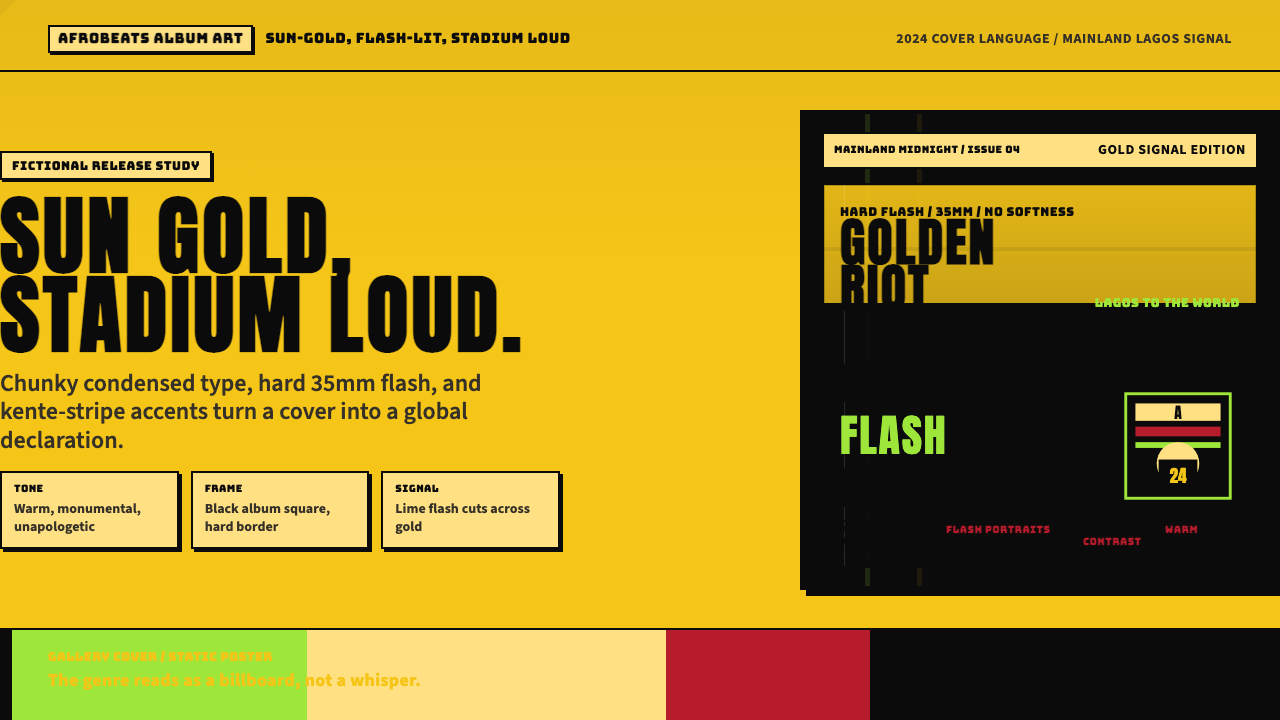
Sun-gold deity portraits, kente-stripe accents, and stadium-scale condensed type — the Afrobeats album cover became the defining Black-pop visual language of the streaming era.
Afrobeats Album Art 2024 in brief
The Afrobeats album-cover aesthetic of 2018–2024 is a visual system built around a single conviction: the artist is a Pan-African deity, and every design choice must support that claim. Hard flash photography on custom-tailored wardrobes, monumental condensed titling that reads like a stadium billboard, sun-gold as the signature tone of triumphant ownership — together these elements form a coherent language that elevated an entire genre from regional phenomenon to global cultural force.
Unlike design movements rooted in formal academies or manifesto culture, this aesthetic emerged organically from the intersection of Lagos street fashion, globalized streaming economics, and the ambitions of a generation of African artists who refused to treat international success as an exception. The look is simultaneously local — anchored in Lekki studio sessions, Surulere markets, and Accra streetwear — and planetary in its confidence.
Visually, the style is instantly recognizable. Portraits dominate, usually shot with a direct hard flash that flattens ambient light and makes the subject glow against a dark or richly colored ground. Type is set in the most condensed, heaviest available styles — letterforms compressed to maximum vertical drama. Color accents — lime-green flash, kente-stripe gold, electric blue — cut across matte or semi-gloss dark frames. The total effect is confrontational in the best sense: it demands attention at thumbnail scale, which is precisely where streaming-era album art must work.

Where does Afrobeats Album Art 2024 come from?
The roots of this visual identity reach back to the mid-2010s, when Afrobeats began its first sustained period of international crossover. Nigerian artists like Burna Boy, Wizkid, and Davido were signing with major global labels and performing in European and American arenas, but their visual presentation lagged behind their sonic ambition. Early cover art borrowed conventions from American hip-hop and British grime — generic dark palettes, stock-photo backdrops, type treated as an afterthought. The turning point came as a new generation of Lagos-based photographers, stylists, and creative directors emerged who understood that the music's decolonial confidence needed a visual language to match.
Burna Boy's *African Giant* album cycle (2019) is widely cited as the aesthetic's crystallizing moment. The campaign leaned into the title without apology: sun-gold saturation, a giant portrait framing Burna as a figure of ancestral weight, and condensed titling that treated his name as an institutional mark rather than a personal brand. The visual team's decision to use hard flash — rather than the soft, flattering light of prestige portrait photography — gave the images an almost documentary rawness that paradoxically amplified the grandeur of the concept. The cover was designed to compete, not to defer.
Wizkid's *Made in Lagos* (2020) offered the movement's counterpoint: where Burna Boy's aesthetic is monumental and confrontational, Wizkid's was cool and restrained. Muted earth tones, considered negative space, and a fashion-forward styling approach indebted to the Afro-luxe movement in Lagos street culture. Together, the two poles — the sun-gold baroque and the earth-toned minimal — defined the spectrum within which the broader Afrobeats visual language would operate over the next four years.
Rema's *Rave & Roses* (2022) and Tems's *Born in the Wild* (2024) extended the aesthetic into new territories. Rema's cover introduced flash-portrait energy at a younger, more playful register — neon accents, an almost editorial fashion sensibility, type that felt borrowed from nightclub poster culture. Tems brought a spiritual, almost otherworldly softness that pushed the sun-gold and hard-flash conventions toward something more vulnerable. By 2024, the aesthetic had absorbed enough variation to constitute a true genre — a visual language with a shared grammar and enough regional dialects to accommodate artists from Lagos to London to Accra without flattening their individual identities. The photographer-stylist collaborations that produced these images, many of them rooted in Lagos's Lekki and Ikeja studio scenes, constituted an informal but cohesive creative infrastructure that international art directors are only beginning to fully recognize.
What defines the Afrobeats Album Art 2024 look?
Sun-Gold and High-Saturation Palette
The signature color of the aesthetic is a warm, deep gold that reads simultaneously as sun, wealth, and ancestral power. It is rarely used as a flat wash; instead it appears as the dominant tone of a lit portrait, as a typographic accent, or as the overall color temperature of a scene shot in golden-hour or tungsten-lit interiors. Alongside the gold, the palette admits rich jewel tones — deep greens and electric blues — as well as hard flash accents in lime or cool white. Dark, near-black grounds are common, allowing the warm and saturated hues to read at maximum intensity.
Hard Flash Portrait Photography
The defining photographic approach is the direct, on-camera or near-camera flash fired at close range. This technique produces characteristic effects: a sharp, unmodeled light that reveals every detail of fabric and skin; a dark, rapidly falling-off background that isolates the subject; and a slight reflective sheen on the subject's face and clothing that reads as radiance rather than overexposure. The harshness that mainstream fashion photography treats as a flaw becomes, in this context, an assertion of presence. The subject does not recede into atmospheric depth; the subject owns the frame.
Monumental Condensed Typography
Type in this aesthetic is set in the most compressed, heaviest available letterforms — faces where the glyph's height dramatically exceeds its width, allowing a few characters to fill the full vertical span of a cover at enormous scale. The effect is borrowed from sports and stadium graphics, where legibility at distance requires maximal vertical economy. Artist names are treated as institutional marks; album titles carry the weight of declarations. Type is rarely set at multiple scales on the same element — instead a single massive headline dominates, and any supporting text is set at a very small size that reads as metadata rather than hierarchy.
Kente and Textile Color Logics
Kente cloth — the woven textile originating from Ghanaian Asante and Ewe traditions, characterized by interlocking strips of vivid geometric patterning in gold, green, red, and black — enters the Afrobeats visual system both as a direct pictorial reference and as a structural color logic. When garments woven in kente or kente-inspired patterns appear in photography, their geometry creates a natural grid of color accent against a monochrome ground. More abstractly, the kente color logic — warm golds in dialogue with deep greens and strong contrasting accents — informs palette decisions even when no textile is literally present in the image.
Smoke, Haze, and Atmospheric Depth
A contrasting element to the hard-flash flatness is the deliberate introduction of smoke machine haze into the photographic environment. This is not the soft diffusion of natural fog but a controlled, directional atmospheric effect that catches the flash beam and creates visible light shafts, contributes a slight color tint, and softens the very far background without softening the subject in the foreground. The technique adds cinematic depth to a photographic approach that would otherwise read as entirely flat. It is the Afrobeats aesthetic's equivalent of the Bauhaus's offset hard shadow — a single controlled element that adds dimensionality without surrendering the governing visual logic.
Lagos Designer Wardrobe and Afro-Luxe Styling
The styling decisions that anchor the aesthetic are inseparable from a generation of Lagos-based fashion designers whose work fuses West African textile traditions with contemporary luxury tailoring. Garments are custom, made-to-measure, and carry cultural specificity — they are not generic luxury signifiers borrowed from European fashion but objects with their own semantic content. The styling often layers multiple textile traditions simultaneously, producing compositions where the garment itself operates as a designed graphic element within the overall image.
Album Title as Declaration
The titling conventions of this aesthetic are unusually blunt. Album names function as statements of geopolitical fact or identity assertion rather than poetic abstractions: *African Giant*, *Made in Lagos*, *Rave & Roses*, *Love, Damini*. The type treatment reinforces this directness — no decorative scripts, no whimsical lettering, no ironic distancing. The condensed block letters sit on the image like a declaration stamped on a document. This literalism is the style's most politically conscious element: it refuses the ambiguity that mainstream pop uses to remain universally palatable.

Who shaped Afrobeats Album Art 2024?
Burna Boy is the artist whose visual campaigns most directly catalyzed the aesthetic's international legibility. Beginning with his self-designation as African Giant, his creative direction consistently insisted on a scale of self-presentation — sun-gold palettes, monumental type, unflinching flash portraiture — that treated his Lagos origins not as exotic context but as the explicit subject matter. His album campaigns from 2019 through 2024 functioned as a series of visual position statements about African artistic authority in the streaming era.
Wizkid's creative contribution to the aesthetic is the demonstration that the genre's visual language could operate in a restrained, fashion-forward register without losing its cultural specificity. His *Made in Lagos* campaign — earth tones, considered negative space, Afro-luxe styling — proved that the aesthetic was not dependent on maximum saturation or confrontational flash, but on a particular quality of cultural confidence expressed through styling, framing, and the precision of craft choices. Wizkid's influence on the aesthetic's more editorial, quiet pole is as significant as Burna Boy's influence on its monumental pole.
Tems represents the aesthetic's expansion into a more spiritually inflected, feminine visual register. Her visual campaigns deploy the sun-gold and flash conventions of the broader genre but layer them with a quality of otherworldly softness — gauze, candlelight, and a compositional openness — that extends the aesthetic's emotional range without abandoning its core visual grammar. Her work demonstrates that the Afrobeats visual system is large enough to contain vulnerability alongside monumentality, and that its visual authority does not require a masculine or confrontational presentation.
Obasi is among the Lagos-based photographer-directors whose studio and editorial work most directly shaped the visual infrastructure behind the Afrobeats aesthetic. His photography synthesizes West African textile traditions, hard flash portraiture, and fashion-editorial precision into a distinctive approach that has influenced a generation of younger creatives working in Lagos, Accra, and in the African diaspora. His work demonstrates that the aesthetic is not simply a product of major-label art department decisions but is rooted in a local creative ecosystem with its own developed visual vocabulary.
Rema's visual presence introduced a youthful, more playful inflection into the Afrobeats aesthetic. His *Rave & Roses* campaign brought neon accents, a nightlife-poster typographic energy, and a fashion sensibility that drew on Gen Z streetwear as much as on Lagos designer culture. Rema's work expanded the aesthetic's age range and demonstrated that its core conventions — flash portrait, condensed type, saturated accent color — could accommodate radically different styling personalities without losing their structural coherence.
How do you use Afrobeats Album Art 2024 today?
The Afrobeats album art aesthetic is among the most transferable contemporary visual languages for designers working outside the music industry, precisely because its principles are rooted in cultural confidence rather than in genre-specific iconography. Applying it correctly means understanding what the system is doing — using saturated warm color to claim space, using monumental type to assert identity, using hard flash to demand presence — rather than simply assembling the visual symbols associated with the genre.
For presentation slides, the aesthetic works powerfully on cover pages where a bold identity statement is required. A cover built in this language might feature a full-bleed portrait or large graphic element shot in sun-gold tones, with the presentation title set in the heaviest available condensed letterforms at maximum scale. The type should fill the vertical space aggressively, leaving only enough margin for the eye to rest. Content slides can adopt the dark-ground, accent-color approach for section headers and key callouts, while keeping body text clean and unadorned. Data slides benefit from treating chart elements as bold graphic objects — bars and segments in the accent palette, set against near-black grounds, with labels in compact condensed type that echoes the cover's typographic register.
For web interfaces, the aesthetic is well-suited to high-impact product pages, artist or creator platforms, and any context where the brand needs to project cultural authority and confidence at first glance. The approach: a dark or deeply saturated ground, a primary warm-gold or jewel-tone accent used for interactive elements and calls to action, and headlines set in the most condensed available weight of a strong sans-serif face. Dashboard and pricing page applications should use the accent color sparingly — it carries maximum weight when it appears rarely and consistently marks the action the user should take. Card components can use a slight warm-tinted dark shadow rather than the neutral gray shadows common in standard design systems.
For editorial and marketing work, the style supports high-impact campaign materials where cultural resonance and visual authority are more important than restraint or universal palatability. A poster or social card in this language leads with a near-full-frame portrait under hard flash, with the subject styled in culturally specific garments that carry their own visual content. Type is set at the scale where it competes with the portrait rather than decorating it — headline and subject are equally weighted visual objects. Marketing decks for creative industries, talent agencies, or culturally positioned brands can use the sun-gold palette and condensed type conventions on cover and transition slides while reverting to a cleaner typographic system for content pages, preserving the energy of the style without overwhelming informational clarity.
A common mistake when applying this aesthetic is treating the hard flash and saturated color as the whole system, while neglecting the specificity of the styling and cultural grounding that give those photographic choices their meaning. Flash photography on generic stock imagery produces a look that reads as harsh rather than powerful. The aesthetic depends on the subject — whether a person, a product, or a graphic element — carrying genuine visual authority within the frame. Similarly, condensed type applied without regard to scale loses the monumental quality that makes the approach distinctive: the letterforms must be large enough that individual strokes have physical weight on the page or screen. Designers should resist the temptation to use multiple accent colors simultaneously; the sun-gold palette is most effective when one dominant warm tone leads and a single cooler accent — lime, electric blue, or cool white — provides the contrast.

Afrobeats Album Art 2024 — FAQ
Is this aesthetic only appropriate for music-industry projects?
Not at all. The visual principles — high-contrast flash portraiture, condensed monumental type, warm saturated palettes, and a posture of cultural confidence — transfer naturally to any context where authority, energy, and cultural specificity are desired values. It works well for fashion and lifestyle brands, creator-economy platforms, talent agencies, cultural institutions, and any product that wants to project genuine boldness rather than borrowed prestige. The key is understanding that the aesthetic's power comes from the conviction behind its choices, not from its association with any particular music genre.
How does this aesthetic relate to earlier Pan-African visual movements?
The Afrobeats visual language of 2018–2024 is deeply indebted to earlier Pan-African visual traditions without being derivative of any single one. The kente color logic draws from Ghanaian Asante weaving traditions that predate colonialism. The monumental portraiture carries echoes of Seydou Keïta's Bamako studio photography of the 1950s and 1960s, which similarly used formal portraiture to assert African dignity against colonial visual hierarchies. The Afro-luxe styling movement has roots in the sapeur tradition of the DRC and Congo-Brazzaville. What the 2018–2024 moment contributed was the globalized distribution infrastructure — streaming platforms, social media, international touring — that gave these accumulated visual traditions a worldwide audience for the first time at scale.
Can the sun-gold palette be used on a light background, or does it require a dark ground?
The canonical application is dark-ground — the warm gold reads at full intensity against near-black or deeply saturated complementary tones, and the hard flash portrait works most powerfully when the background falls quickly to shadow. A light-ground variant is possible but requires significant adjustment: the sun-gold becomes an accent rather than a dominant tone, the hard flash quality is partially lost (since flash differentiation is less dramatic against light backgrounds), and the condensed type typically needs to shift to black or a deep jewel tone to maintain the monumental weight. Light-ground applications work best in editorial contexts where the reference to the aesthetic is knowing and selective, rather than in direct visual communication where maximum impact is the goal.
What makes this aesthetic different from generic high-contrast photography or hip-hop visual conventions?
Three things distinguish it. First, the cultural specificity of the styling: the garments, accessories, and compositional references carry West African textile and fashion heritage that is distinct from American hip-hop's visual vocabulary, which is primarily rooted in Black American street and luxury fashion traditions. Second, the color temperature: the sun-gold warm base is categorically different from the cooler, blue-shifted palettes dominant in much of American hip-hop and trap visual culture. Third, the typography: American hip-hop cover art frequently uses decorative, logo-like custom lettering or mixed-type hierarchies; the Afrobeats aesthetic prefers a single dominant condensed face set at maximum scale, closer to stadium signage than to graphic design pastiche. The underlying ambition — to present the artist as globally significant — is shared; the visual vocabulary through which that ambition is expressed is distinct.
Does the aesthetic work for non-portrait-based compositions?
The aesthetic is strongly portrait-centric — the human subject under hard flash is its compositional center of gravity. However, the palette, typographic, and cultural-reference elements can function independently of portraiture. A non-portrait composition in this aesthetic might use a large graphic element — a kente-inspired geometric pattern, a still life of culturally specific objects, an abstracted architectural element from a Lagos or Accra setting — as the visual anchor, with the sun-gold palette, condensed type, and high-contrast treatment doing the work of establishing the aesthetic register. The challenge is that without the human subject, the composition loses the primary vehicle for expressing the cultural confidence that gives the style its distinctive energy. Non-portrait applications work best when the alternative subject matter carries equivalent cultural weight and specificity.
Related design styles
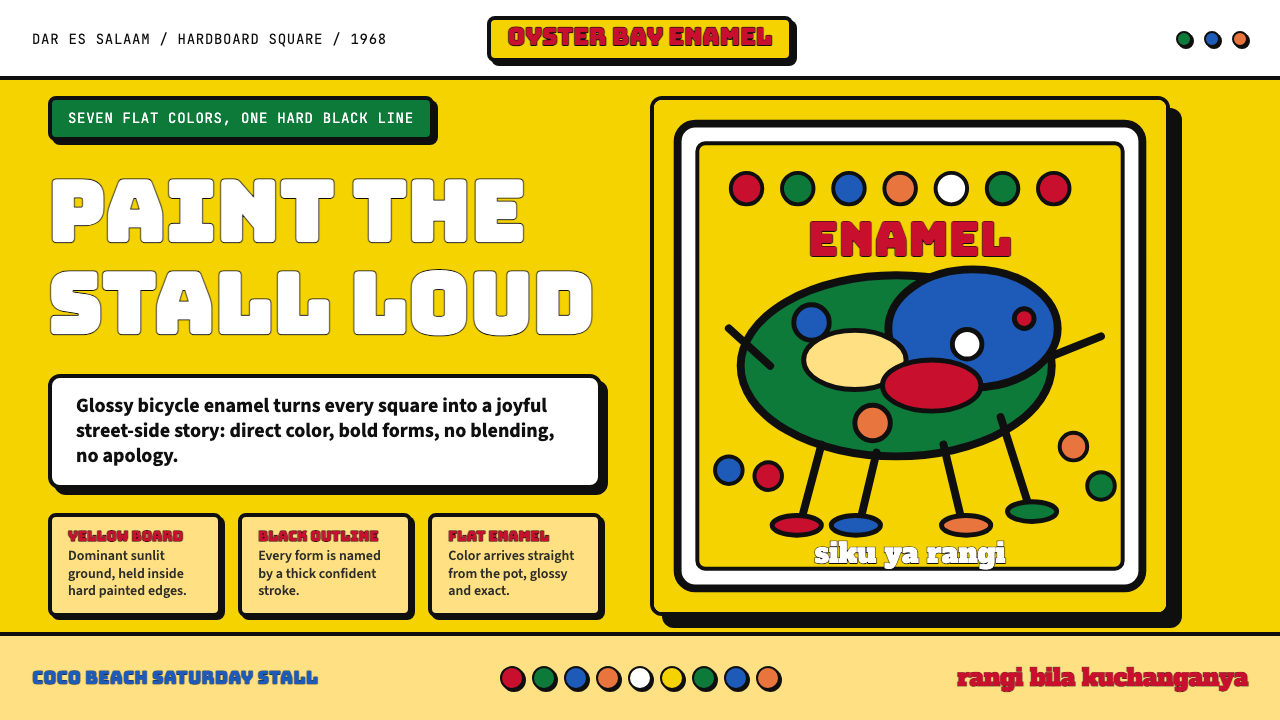 Tingatinga PaintingJoy refuses blending. Enamel yellow, Bungee strokes, and black-outlined flat…
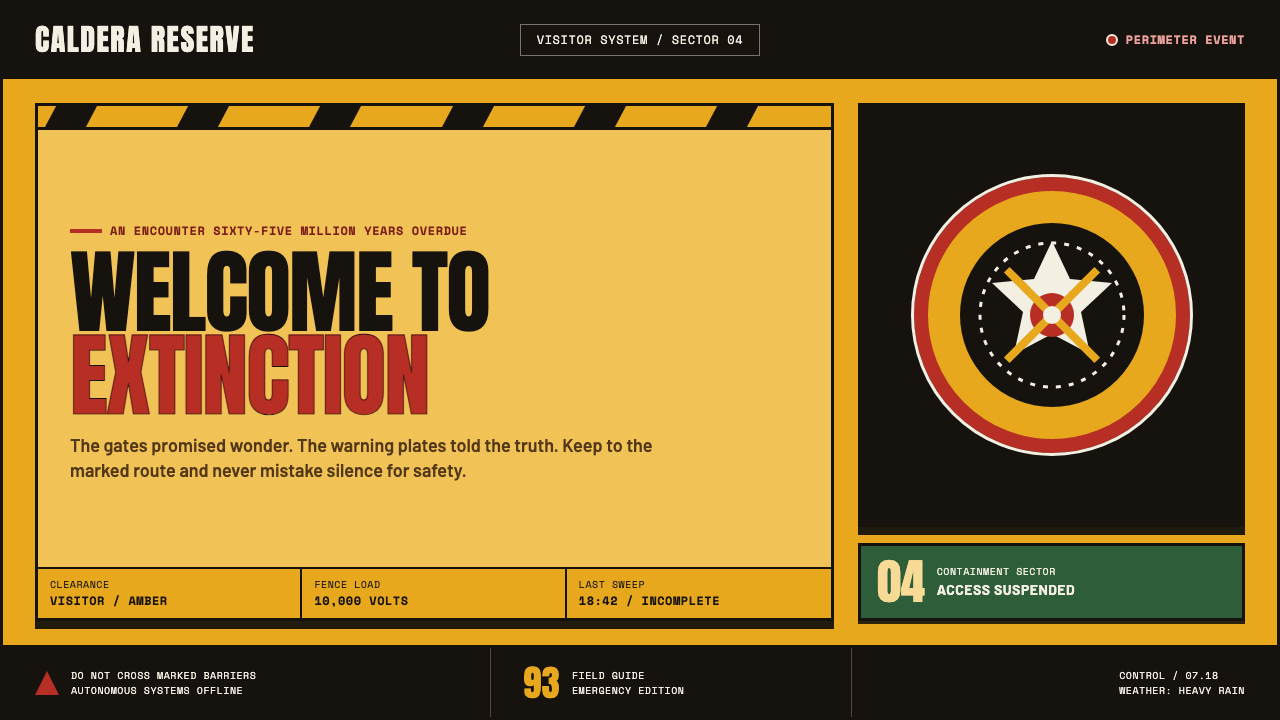 Jurassic Park (1993)Warm welcome, lethal edge. Amber plates, red rings and black chevrons turn aw…
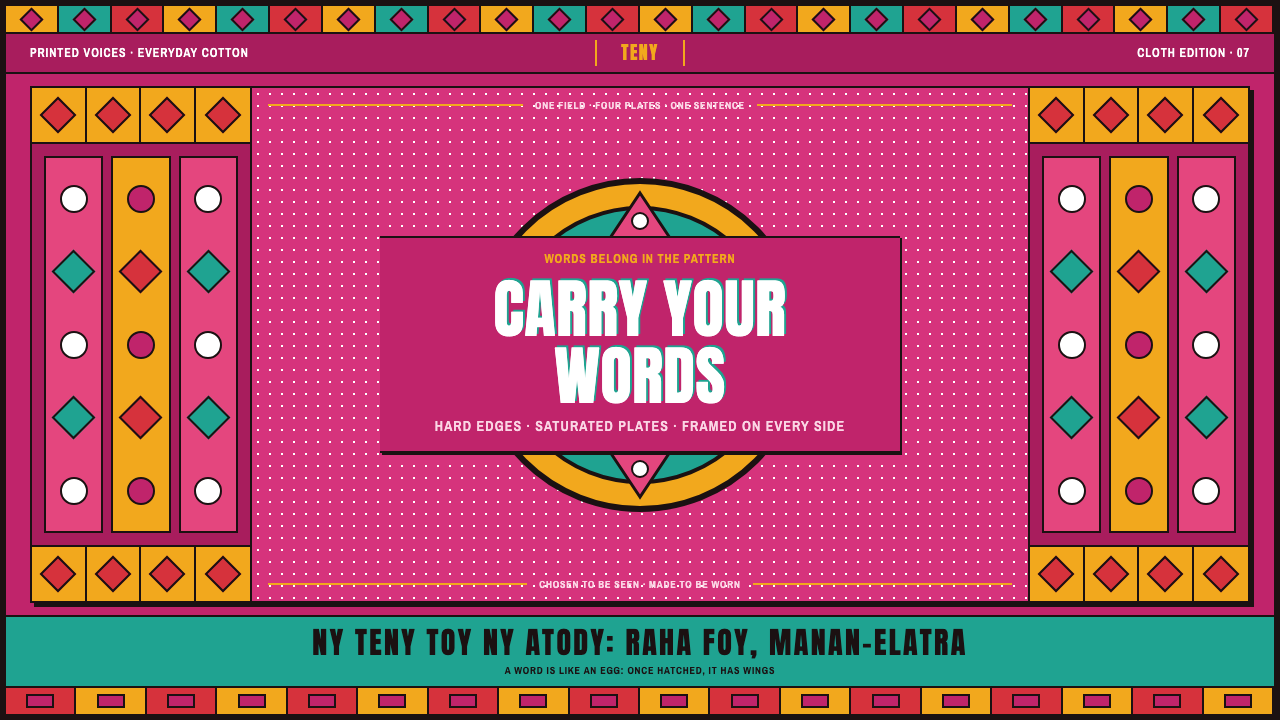 Malagasy Lamba HoanyWords become ornament. Hot fuchsia, saturated print plates and a border that…
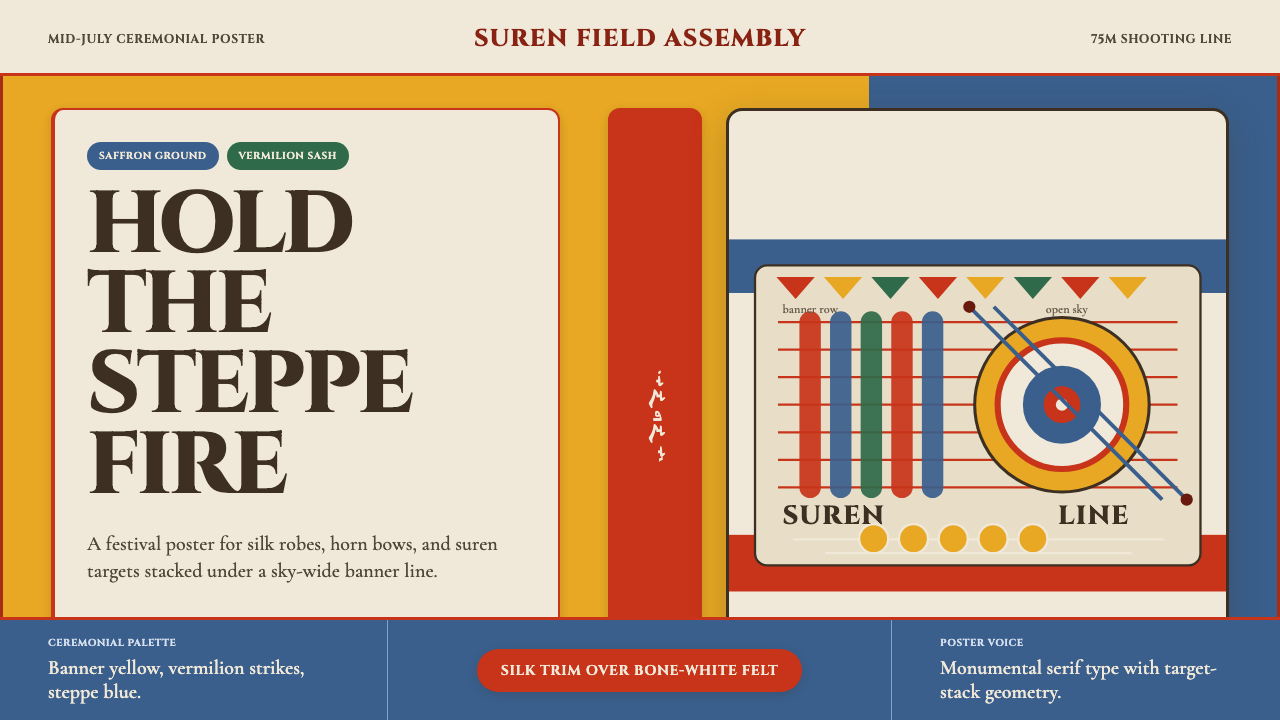 Mongolian Naadam ArcheryFestival heat at full draw. Saffron ground, vermilion trim, suren circles.
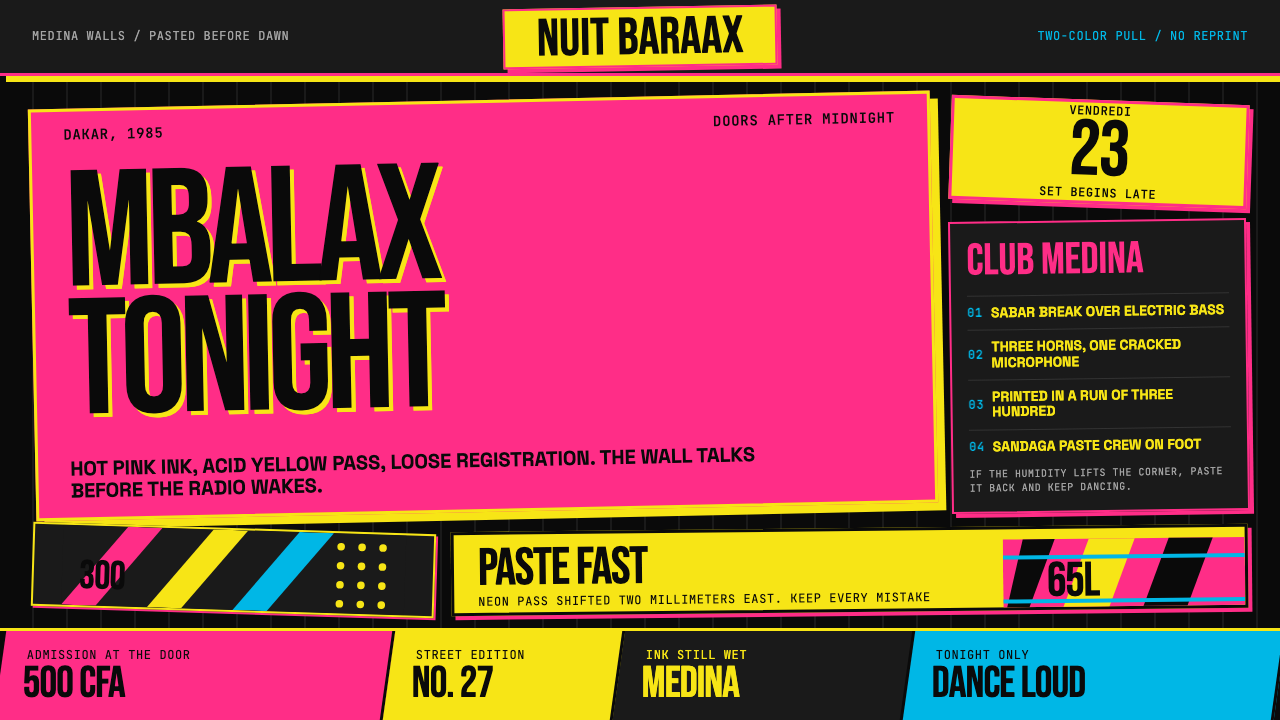 Senegalese Mbalax Poster (Dakar 1985)Street urgency, screen-printed loud. Hot pink and acid yellow drift over blac…
 Toblerone Matterhorn (1908)A mountain compressed into a mark. Foil gold, alpine red and strict triangles…