What is Hawaiian Aloha Shirt?
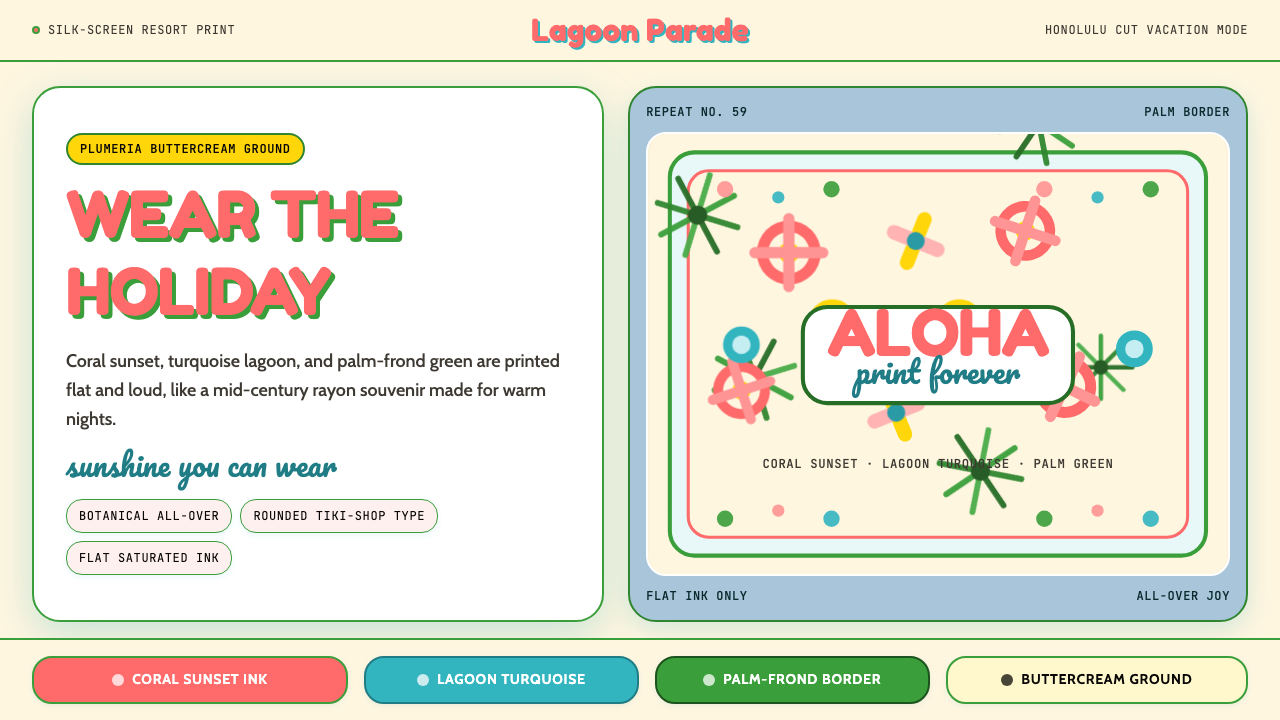
The aloha shirt doesn't decorate leisure — it is leisure, a full-color declaration that botanical abundance, warm water, and unhurried time are the only rules that matter.
Hawaiian Aloha Shirt in brief
The Hawaiian aloha shirt is the most universally recognized tropical-leisure design language in the world. Its visual grammar is built on saturated all-over prints — dense botanical motifs, oceanic scenes, tiki carvings, and stylized wildlife — rendered flat against grounds ranging from warm cream to deep ocean turquoise. The palette is deliberately high-key: coral and sunset orange beside palm-frond green, sunshine yellow against cerulean blue, hibiscus red blooming across natural linen. Nothing recedes; everything competes joyfully for attention.
What distinguishes the aloha shirt aesthetic from generic tropical decoration is its specific fusion of cultural traditions. Polynesian kapa bark-cloth geometry — bold repeating forms derived from hand-stamped barkcloth — sits alongside Japanese yukata-fabric patterning and mid-century American resort illustration. The result is neither purely indigenous nor purely imported: it is a genuinely syncretic visual culture born from the particular geography and immigration history of the Hawaiian Islands.
In contemporary design use, the aloha shirt vocabulary signals warmth, openness, and a deliberate rejection of corporate restraint. Applied to digital or print work, it brings a sense of celebration and approachability that few other historical styles can match. The design system thrives in contexts that want to communicate that the experience on offer is pleasurable, relaxed, and maybe a little bit outside the ordinary rules.

Where does Hawaiian Aloha Shirt come from?
The aloha shirt was born in 1930s Honolulu at the intersection of three distinct textile and cultural worlds. Chinese and Japanese immigrant merchants had long operated dry-goods stores selling kimono silk and yukata cotton; their bolts of vivid floral and geometric fabric were already part of everyday Hawaiian commercial life. When local tailors — many of them Japanese American — began cutting these fabrics into sport-shirt shapes for the tourist and plantation-worker market, they were not inventing a new idea so much as translating existing material abundance into a new form. The garment's defining characteristic, the all-over print with no single dominant focal point, came directly from the logic of Japanese textile design, where the repeat pattern is the statement.
The entrepreneur most often credited with naming and commercializing the aloha shirt is Ellery Chun, a Chinese American merchant who registered the trademark 'Aloha Shirt' in 1936 and stocked his King-Smith Clothiers shop in Honolulu with ready-to-wear shirts cut from kimono fabrics. Chun understood that tourists arriving by ocean liner from the mainland wanted a tangible souvenir of the tropics — something wearable and unmistakably Hawaiian. His shirts provided exactly that. Around the same time, local newspapers began advertising aloha shirts as appropriate business attire for Hawaii's warm climate, a social legitimization that transformed what could have remained a tourist novelty into everyday island dress.
The golden era of the aloha shirt ran roughly from 1947 to 1959, the year Hawaii achieved statehood. Alfred Shaheen, a Los Angeles-born designer who set up manufacturing operations in Honolulu after World War II, was the defining creative force of this period. Shaheen operated his own fabric-printing facilities and developed the lush, narrative all-over prints — featuring outrigger canoes, Diamond Head silhouettes, tropical fish, and dense hibiscus-and-plumeria compositions — that became iconic. He experimented with vertical repeat patterns that read coherently when the shirt was worn unbuttoned, a structural insight that had enormous influence on how the garment was subsequently designed.
The Tiki revival of the 1950s and early 1960s amplified the aloha shirt's cultural reach far beyond Hawaii. Don the Beachcomber and Trader Vic's, the mainland tiki-bar chains that introduced Polynesian-themed cocktail culture to American cities, dressed their staff in aloha shirts and promoted the garment as the emblem of a fantasy Pacific lifestyle. Hollywood reinforced the association: Elvis Presley wore aloha shirts in Blue Hawaii (1961), and the garment appeared on practically every television vacation sequence of the era. By the time mass tourism to Hawaii took off in the jet age, the aloha shirt was already a globally recognized shorthand for tropical leisure — a design language that had traveled well beyond its geographic and cultural origins to become an international visual convention.
What defines the Hawaiian Aloha Shirt look?
Color
The aloha shirt palette is unabashedly saturated and multichromatic. Grounds range from warm white and natural cream through turquoise lagoon, deep cobalt ocean, sunset coral, and jungle green. Motif colors are bold and often unexpected in combination — hibiscus red against cobalt, yellow plumeria on deep black, white outrigger canoes on terracotta. The characteristic effect is of maximum color without muddiness: each hue is clean and print-bright, the way early commercial silk-screen inks read on rayon. Muted or desaturated palettes feel inauthentic to the tradition.
All-Over Print Structure
The definitive structural feature of the aloha shirt aesthetic is the all-over print: motifs repeat across the entire surface with no hierarchy, no focal point, no empty ground. Every square centimeter participates equally. This is the opposite of conventional Western textile logic, where a central motif is set against a neutral background. Applied to layouts, this principle translates to dense, edge-to-edge composition — backgrounds are not negative space but active pattern fields, and the design reads as a total visual environment rather than a figure-ground arrangement.
Motif Vocabulary
Authentic aloha print imagery draws from a specific lexicon: hibiscus, bird of paradise, plumeria, and torch ginger among flowers; outrigger canoes, surfboards, and ocean waves among activity motifs; tropical fish, sea turtles, and flamingos among fauna; pineapples, breadfruit, and banana leaves among vegetation. Tiki carvings and mid-century resort architecture also appear. The illustration style is flat and rounded, favoring thick outlines and bold simplified shapes over detailed naturalistic rendering. Every element is recognizable at a glance.
Typography
Typefaces associated with the aloha shirt tradition are friendly and rounded — letterforms with open apertures, generous curves, and minimal stress contrast. Display type often carries a hand-lettered or brush-script quality that evokes mid-century resort signage and travel-poster typography. Body text sits in clean, warm-toned type that never competes with the surrounding imagery. The typographic tone is always approachable, never austere. Heavy geometric sans-serifs or sharp modern typefaces feel categorically wrong in this context.
Flatness and Print Quality
Despite the richness of color and motif, the aloha shirt visual system is resolutely flat. Shadows are absent or very minimal; forms are not modeled with highlight and shade. The aesthetic owes this quality to its silk-screen printing origins, where each color was a separate ink layer applied without gradation. Applied to contemporary design, this means favoring solid fills over gradients, crisp edges over feathered or blurred ones, and a generally graphic rather than photographic quality of rendering. The flatness is part of what gives the style its cheerful, immediate impact.
Cultural Syncretism
The aloha shirt's visual identity is inseparable from its multicultural origins. Polynesian geometric barkcloth patterns, Japanese yukata repeat structures, Chinese silk-trade color sensibilities, and American mid-century commercial illustration all contribute to the tradition. This layered heritage means the style has a distinctive quality of simultaneous familiarity and exoticism — each element is legible on its own terms, yet the combination produces something that belongs to no single cultural tradition. Designs that draw from only one strand of this inheritance feel thinner and less authentic than those that honor the full complexity.
Mood and Emotional Register
The aloha shirt aesthetic is committed to joy. It refuses restraint, refuses gravitas, refuses the visual language of seriousness and institutional authority. Its emotional register is celebratory, generous, and slightly extravagant — the visual equivalent of ordering the drink with the paper umbrella. This is not a weakness but a specific capability: applied correctly, the style communicates openness and pleasure with an immediacy that no amount of careful neutral design can achieve. The design system works precisely because it takes leisure seriously enough to go all the way.

Who shaped Hawaiian Aloha Shirt?
Chun is the merchant-designer most credited with formalizing the aloha shirt as a commercial product. A Chinese American who trained briefly at Yale before returning to Hawaii to run King-Smith Clothiers, he registered the trademark 'Aloha Shirt' in 1936 and was among the first to manufacture ready-to-wear shirts from kimono and yukata fabrics. His business instinct — recognizing that mainland tourists wanted a transportable piece of Hawaii — gave the garment its market rationale, and his storefront became an early gathering point for the trade. While Chun was not the sole inventor of the form, his commercial framing defined how the aloha shirt was understood, priced, and sold for the next two decades.
Shaheen is the defining creative figure of the aloha shirt's golden era. Born in Los Angeles and trained in textile engineering, he relocated to Honolulu after World War II and built an integrated manufacturing operation — his own fabric-printing mills, design studios, and retail distribution — that was unique in the Hawaii garment industry. Shaheen's prints were narrative and lush: he developed vertical designs that read as compositions when the shirt hung open, featured Hawaiian cultural imagery rendered in sophisticated color combinations, and pioneered the use of new synthetic fabrics that took bold color particularly well. His work dressed celebrities, appeared in films, and set the visual standard that the global aloha shirt market still references. The Shaheen archive remains one of the most complete records of mid-century Hawaiian textile design.
McCullough, co-founder of the Reyn Spooner label, was responsible for one of the aloha shirt's most significant evolutions: the inside-out or 'reverse print' construction. By printing fabric on the reverse side and then sewing the shirt so the more muted, sun-faded version of the pattern faced outward, McCullough created an aloha shirt that could pass as business-appropriate in Hawaii's evolving professional culture — what locals came to call 'Aloha Friday' attire. This innovation made the aloha shirt a year-round garment for working professionals rather than solely tourist or beach wear, and Reyn Spooner's aesthetic — subdued grounds, tonal prints, classic nautical and botanical motifs — became the standard for the island workplace shirt.
Donn Beach (born Ernest Gantt), the founder of the Don the Beachcomber restaurant chain, was not a textile designer but a culture-maker whose influence on the aloha shirt's global spread was decisive. His Hollywood tiki bar, opened in 1934, and the mainland chain it spawned created the fantasy Polynesia that millions of Americans experienced without ever visiting the Pacific. The aloha shirt was central to the Don the Beachcomber aesthetic: staff uniforms, décor, and marketing all featured it. By embedding the garment in the tiki-culture imagination — alongside rum drinks, carved wooden figures, and woven-mat ceilings — Beach transformed the aloha shirt from a Hawaiian local product into the universal costume of tropical escape. The tiki revival he helped launch still shapes how the aloha shirt is read in popular culture.
Presley did not design aloha shirts, but his wearing of them in the 1961 film Blue Hawaii and on the iconic 1973 Aloha from Hawaii satellite concert broadcast — in an eagle-emblazoned aloha suit designed by Bill Belew — gave the garment two of its most culturally visible moments. The Blue Hawaii film in particular, set against the lush backdrop of the islands, presented the aloha shirt to a global movie audience as the natural dress of youth, pleasure, and romantic freedom. The Aloha from Hawaii concert was the first major entertainment event broadcast globally via satellite, and Presley's studded aloha-inspired stage costume was the image the world saw. Both moments established the garment's association with a specifically American fantasy of paradise that continues to resonate in contemporary aloha shirt culture.
How do you use Hawaiian Aloha Shirt today?
The aloha shirt design language is highly directional — it communicates specific things with great effectiveness, and applying it correctly begins with understanding what those things are. At its core, this aesthetic says: warmth, welcome, abundance, and the temporary suspension of ordinary rules. Products and contexts that genuinely benefit from those associations — travel and hospitality, food and beverage, entertainment, summer events, lifestyle brands, and anything that wants to signal that serious work is balanced by genuine enjoyment — are natural fits. Forcing the style onto a context that requires authority, precision, or institutional gravity will produce dissonance no amount of execution skill can overcome.
For presentation slides, the aloha aesthetic works best when the content itself invites celebration or carries a positive emotional charge: launch decks, annual summaries with strong results, team culture presentations, event programs, and hospitality pitches. A cover slide benefits from a full-bleed tropical print used as background — dense botanical motifs at reduced opacity behind a clean, rounded typeface in coral or sunshine yellow. Content slides should use a lighter touch: a bordered card or a panel with a small tropical accent at one corner keeps the energy alive without overwhelming body text. Data slides can adopt the palette without the all-over print; bar charts in the signature coral-turquoise-yellow combination read as cheerful and clear against a warm white or cream ground.
For web interfaces, the aloha shirt vocabulary suits consumer-facing products in travel booking, resort and hotel properties, food delivery, outdoor lifestyle, and beverage brands. Dashboard and pricing page applications follow a tropical color hierarchy: a warm cream or pale sand background, primary interactive elements and calls to action in coral or turquoise, secondary information in a softer botanical green. Card components work well with a subtle leafy or floral border motif rather than a plain rule. Navigation should feel open and unhurried — wide letter-spacing in a rounded typeface, generous padding, and an absence of sharp corners across the entire component library. The aesthetic struggles on productivity tools, B2B SaaS platforms requiring perceived authority, or any interface where users arrive under stress.
For editorial and marketing work, the style delivers a poster-like directness that suits travel features, food writing, summer campaign materials, festival branding, and tourism promotions. A full-bleed tropical print header followed by a clean editorial body is a reliable pattern: the print provides the emotional hook, and the clean typography delivers the content with legibility. Marketing pages benefit from alternating full-color print panels and white-ground sections, allowing the reader to breathe between moments of maximum color. Email headers and social cards in this style have strong stopping power in crowded feeds — the saturated palette and flat illustration quality are immediately recognizable at thumbnail scale.
A common mistake when applying the aloha shirt aesthetic is treating every surface as an opportunity for maximum print density. Authentic aloha design — particularly of the Alfred Shaheen era — used the all-over print on the garment itself but understood negative space in compositional elements like labels, tags, and packaging. Applied to digital and print work, this means reserving the full-bleed, edge-to-edge tropical treatment for hero moments and anchor elements, then using solid grounds in palette colors for body sections and secondary components. Using the dense print everywhere simultaneously produces visual fatigue rather than joyful abundance. Another frequent error is choosing motifs without regard for the tradition's specific vocabulary — generic tropical clipart or flat cactus illustrations read as appropriation-without-understanding. The aloha shirt tradition is specific: its motifs, its color logic, and its flat-print quality have cultural weight that generic 'tropical' does not.

Hawaiian Aloha Shirt — FAQ
Is the aloha shirt aesthetic the same as generic tropical design?
No, and the distinction matters. Generic tropical design borrows surface elements — palm trees, pineapples, bright colors — without the structural logic that makes the aloha shirt tradition coherent. Authentic aloha design is defined by specific principles: the all-over print structure with no focal hierarchy, the flat silk-screen print quality, the multicultural motif vocabulary drawing from Polynesian, Japanese, and American mid-century traditions, and the specific palette logic of printing-bright saturated hues on warm grounds. A design that uses tropical clipart against a white background in a conventional figure-ground arrangement is not aloha design — it is tropical decoration. The difference is not pedantic; it produces meaningfully different visual results and communicates meaningfully different cultural signals.
Can this style work for a dark background or night-mode layout?
Yes, with care. The aloha shirt tradition does include dark-ground variants — prints on deep navy, black, or jungle green grounds were common in the Shaheen era and remain classic today. On a dark ground, the palette logic shifts: warm whites and pale yellows take on the role that coral and turquoise play on light grounds, providing contrast and energy. The key constraint is that flat, print-quality colors remain essential — dark-mode aloha design should use rich, saturated mid-tones rather than desaturated pastels or glowing neon. Avoid gradients on dark grounds even more strictly than on light ones, as they immediately break the flat-print visual contract that the tradition depends on.
How does aloha shirt design differ from other tropical-leisure aesthetics like Tiki or Caribbean?
The three traditions share a tropical palette and leisure orientation but have distinct visual characters. Tiki aesthetic is darker and more artifact-centered: carved wooden figures, bamboo forms, woven textures, and a palette heavy on deep browns, weathered oranges, and jungle greens — it references a fantasy Polynesia seen through American mid-century kitsch. Caribbean design tends toward brighter, more saturated solid colors with geometric or abstract patterning rather than botanical illustration, and draws from reggae-era graphic design, calypso typography, and African diaspora textile traditions. Aloha shirt design is the most illustrative of the three, the most botanically specific, and the most directly connected to a real textile-production tradition rather than a decorative theme. Understanding these distinctions prevents stylistic confusion when selecting the right visual language for a project.
Is this aesthetic appropriate for serious or professional contexts?
It depends on what kind of seriousness. The aloha shirt tradition has its own form of professional legitimacy — in Hawaii, the aloha shirt has been accepted business attire since the 1960s, and 'Aloha Friday' workplace culture spread across the mainland in the 1990s. In design terms, the aesthetic signals that a product or brand takes pleasure and human warmth seriously, which is a form of professional commitment in hospitality, food, travel, and consumer lifestyle sectors. The style is categorically unsuitable for contexts that require projecting institutional authority, analytical rigor, or financial gravity — banking, medical, legal, or enterprise software interfaces will not be served by it. Used knowingly in the right context, however, it is not less professional than any other design system — it is simply optimized for a different set of human values.
How do I avoid the aloha shirt aesthetic looking dated or campy?
The line between celebration and kitsch is mainly a question of intention and control. Dated or campy aloha design tends to result from three specific errors: using low-resolution or poorly drawn motifs, mixing the tropical palette with drop shadows and other contemporary digital-default effects that break the flat-print visual logic, and applying the style uniformly across all touchpoints without relief. Contemporary aloha-influenced design that reads as fresh tends to edit the motif vocabulary to a smaller, crisper selection; maintain strict flatness across all graphic elements; use the all-over print treatment selectively for hero moments and solid palette colors for supporting elements; and anchor the composition with a typographic system that is clean and current rather than nostalgic. The goal is to honor the tradition's vibrancy without replicating its most commodified mid-century expressions.
Related design styles
 Orange Crush Soda (1906)Syrupy nostalgia. Tangerine, cream, and script make it a postcard label.
 DoraemonChildhood joy, inked bold. Cyan fields, white panels, red collars, and rounde…
 Korean Minhwa (Joseon Folk Painting)Cheerful prosperity over restraint. Mineral reds, cobalt, and lampblack on ha…
 Wes Anderson SymmetricalSymmetry turns warm. Salmon-mint panels, Cabin type, walnut rules stage each…
 Atari 2600 (Woodgrain)Woodgrain meets raw pixels. Walnut panels frame Bungee type and CMYK raster b…
 Glow-in-Dark Ceiling StarsTurns lights-out into wonder. Yellow-green stars glow across a dark blue-gray…