What is Korean Minhwa (Joseon Folk Painting)?
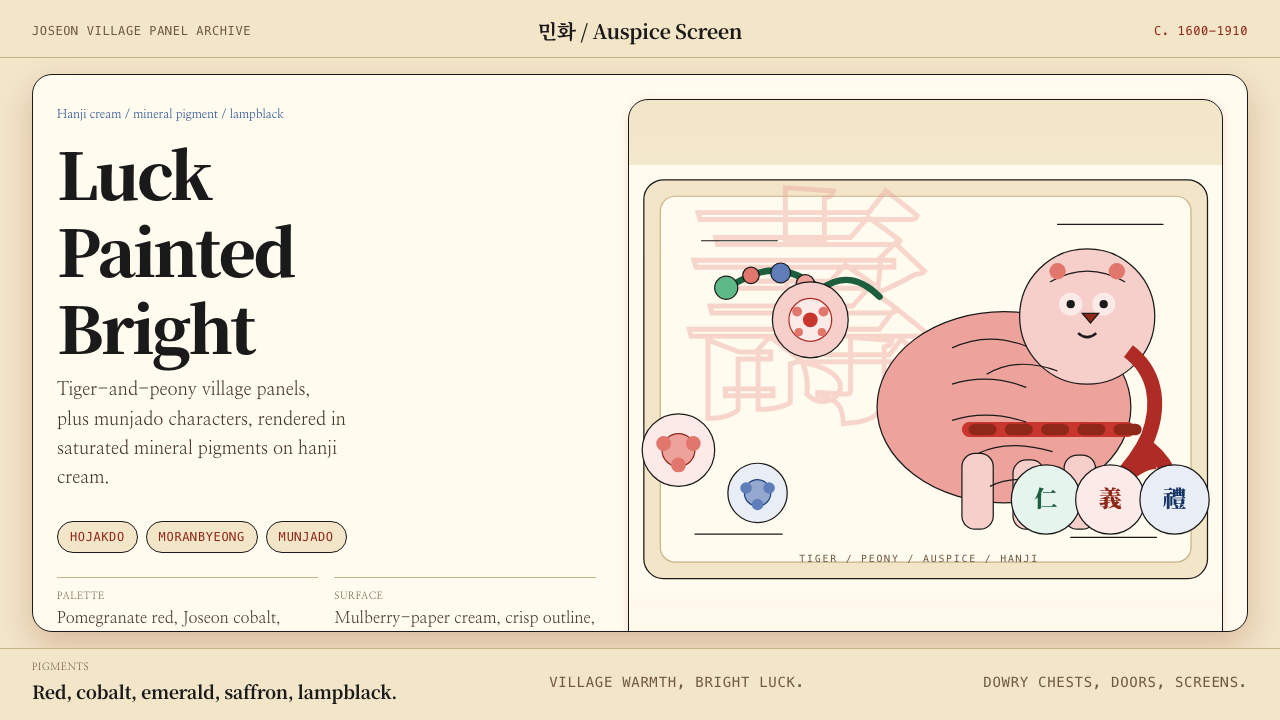
Minhwa turns a tiger into a grinning neighbor, a bookshelf into a paradise of color — Joseon Korea's folk painters made prosperity visible with the boldness of someone who has nothing to prove.
Korean Minhwa (Joseon Folk Painting) in brief
Korean Minhwa — the word means literally 'people's painting' — is the folk-painting tradition that flourished across the Joseon dynasty from roughly 1600 to 1910. Where the ruling literati class practiced restrained ink monochrome to signal their cultured indifference to color, the anonymous village painters of Minhwa did the opposite: they loaded hanji mulberry paper with saturated mineral pigments — pomegranate red, Joseon cobalt, Korean emerald, saffron orange, lampblack — and bounded every passage with a confident, calligraphic outline. The result is an aesthetic of cheerful abundance that reads immediately as warm, symbolic, and distinctly Korean.
The subject matter of Minhwa is almost entirely auspicious. Tigers and magpies face each other from pine branches — the tiger as guardian and wit, the magpie as messenger of good news. Peony screens were painted for wedding rooms to symbolize prosperity and marital happiness. Chaekgeori, or scholar's-bookshelf paintings, filled entire screens with stacked books, brushes, inkstones, bronzeware, and exotic curios — a visual wish-list for learning and worldly attainment. Munjado, or letter paintings, embedded Confucian virtue characters within landscape scenes so that moral teaching could hang on an ordinary wall as decoration. Each subject type was a coded language of aspiration shared between painter and patron.
The visual character of Minhwa is instantly readable: flat color areas bounded by ink outlines, strong contrast between warm and cool pigments, joyful disregard for naturalistic proportion, and a compositional instinct that prizes symbolic completeness over spatial realism. Tigers are round and striped and wide-eyed; flowers are larger than the vases that hold them; books hover in impossible stacks. This is not naivety — it is a deliberate folk grammar that prioritizes meaning and delight over the illusionistic conventions of court painting.

Where does Korean Minhwa (Joseon Folk Painting) come from?
The roots of Minhwa lie in the ritual painting traditions of Joseon Korea (1392–1910), a Confucian state that organized society along strict hierarchical lines. Court painters at the royal Dohwaseo Bureau produced refined works for the aristocracy; Buddhist temples commissioned icon paintings for worship. But ordinary people — merchants, farmers, and artisans — had their own visual culture. Itinerant painters, often working without formal training and known colloquially as hwajang or 'picture artisans', traveled between villages producing affordable panels, screens, and folded albums for domestic use. The precise origins of Minhwa as a distinct tradition are difficult to date, but by the mid-Joseon period — roughly the seventeenth century — the subject types, pigment palette, and stylistic conventions that define the genre were well established.
The auspicious subject matter of Minhwa is inseparable from its social function. Joseon society was saturated with symbolic thinking derived from Confucian ethics, Daoist cosmology, and shamanistic folk belief. Certain images were understood to protect a household, attract wealth, promote longevity, or ensure successful childbirth. A tiger painted on a gate ward kept malevolent spirits at bay. Peonies in the bridal chamber signaled prosperity for the new couple. The ten longevity symbols — pine, crane, tortoise, deer, bamboo, sun, water, cloud, mushroom of immortality, and mountain — appeared singly and in combination across cushion covers, lacquerware, embroidery, and painted screens. Minhwa painters codified these symbols into a visual vocabulary that any household could purchase and any viewer could read.
The aesthetic that distinguishes Minhwa from the literati tradition it implicitly challenges was shaped by the conditions of its production. Village painters worked quickly, from memory and conventional templates, on absorbent hanji paper that rewarded confident single-pass brushwork over labored revision. Mineral pigments — mined and ground rather than ink-suspended — demanded flat, opaque application. The lampblack outline, drawn with a brush loaded generously and moved with calligraphic rhythm, became the defining structural element that held color areas together and gave figures their characteristic expressiveness. These practical constraints produced an aesthetic signature: bold, flat, outlined, and warm.
The twentieth-century rediscovery of Minhwa is largely credited to Yanagi Soetsu (1889–1961), the Japanese philosopher and founder of the Mingei folk-craft movement, who encountered Korean folk art during Japan's colonial administration of Korea and recognized in it a quality of unconscious beauty he called 'beauty without the self.' Yanagi's writings drew international attention to Minhwa at a time when it was in danger of being forgotten. Korean collector and scholar Cho Jayong subsequently devoted decades to gathering and documenting Minhwa works. Since the 1980s, Minhwa has undergone a full cultural revival in South Korea, with its imagery appearing in fashion, packaging, digital media, and contemporary fine art — a folk tradition that became one of the defining visual signatures of Korean cultural identity on the global stage.
What defines the Korean Minhwa (Joseon Folk Painting) look?
Palette
Minhwa works in a palette of five to seven saturated mineral pigments arranged on a warm cream hanji ground. Pomegranate red and Joseon cobalt blue are the defining poles — warm and cool, advancing and receding — with Korean emerald green, saffron orange, and white serving as secondary voices. The pigments are opaque and densely applied, creating flat color areas with a powdery, almost velvety surface quality. Black, used for outlines and calligraphic accents, is the darkest value in the system. The overall chromatic effect is cheerful, legible, and deliberately festive rather than refined or restrained.
Outline
The lampblack ink outline is the structural spine of Minhwa composition. Drawn with a fully loaded brush in a single confident pass, the line varies in thickness as the brush pivots — swelling at corners, tapering at tips — giving figures a calligraphic vitality that flat color alone could not achieve. The outline simultaneously defines form, contains color, and provides the rhythmic energy that makes Minhwa compositions feel animated rather than static. In skilled hands, the line quality alone identifies the work as Minhwa: it is neither the trembling fine line of a court miniature nor the dry dragged stroke of literati ink painting.
Symbolic Subjects
Every Minhwa subject type carries a specific symbolic program understood by any Joseon viewer. Tigers ward off evil; magpies bring good news; cranes and pines signal longevity; peonies indicate wealth and marital bliss; pomegranates with split skins show abundant progeny; bats (their name a homophone for 'good fortune' in Korean) scatter across textiles and painted panels as auspicious scatter-pattern ornament. Chaekgeori bookshelf paintings encode the aspiration for scholarly achievement. Munjado letter paintings make Confucian virtues — loyalty, filial piety, trust, propriety — visually present in the domestic space. The symbolic density of the imagery is what gives Minhwa its distinctive combination of decorative richness and moral seriousness.
Joyful Proportion
Minhwa deliberately departs from naturalistic proportion in ways that are immediately charming. Animals are round-bodied, large-headed, and wide-eyed — the Joseon tiger in particular has been reduced from a fearsome predator to a friendly, slightly bewildered companion who is too fat and happy to menace anyone. Flowers overflow their containers. Cranes tuck improbably large heads under improbably small wings. This is not the result of technical limitation but of a folk-painting logic that prioritizes emotional truth over optical accuracy: things that are important are made large, things that are friendly are made round, things that are auspicious are made bright.
Flat Depth
Minhwa does not use cast shadows, linear perspective, or atmospheric recession to create spatial depth. Figures appear on the picture surface as a series of overlapping flat planes, with spatial relationships indicated by vertical position — higher on the panel reads as farther back — or by a conventional stacking logic derived from the subject type itself (books in chaekgeori, for instance, are arranged in a flat-fronted system that reads as both a view into shelves and a decorative pattern simultaneously). This flat-depth approach is what makes Minhwa imagery so compatible with contemporary digital surfaces: it is already native to two dimensions.
Pattern and Repetition
Many Minhwa formats use systematic repetition as a compositional strategy. Chaekgeori bookshelf panels divide the picture surface into a grid of compartments, each containing a still-life grouping rendered in the same flat descriptive manner. Flower-and-bird compositions repeat the pairing of blossoming branch and avian figure across multiple panels of a folding screen, creating a rhythm that is both decorative and encyclopedic. This taste for organized repetition — a kind of visual listing of abundance — gives Minhwa a pattern-like quality that is distinct from both the gestural spontaneity of literati ink painting and the hierarchical order of court portraiture.
Hanji Ground
The support for most Minhwa work is hanji, a handmade paper produced from the inner bark of the paper mulberry tree. Hanji has a warm cream tone, a slightly textured surface, and exceptional absorbency. The warm ground temperature interacts with the mineral pigments laid over it, pushing the reds warmer and softening the blues, and it shows through wherever the paint application is thin. The result is that even heavily worked Minhwa panels retain a luminous quality — the ground breathes through the pigment — that distinguishes them from the harder appearance of work on silk or Western paper. In contemporary digital Minhwa-inspired work, the equivalent is a warm off-white or cream background rather than a pure white.

Who shaped Korean Minhwa (Joseon Folk Painting)?
The vast majority of Minhwa works were produced by anonymous artisan-painters who traveled between villages, working from memory and conventional templates without formal academic training. Their anonymity is not a gap in the historical record but a structural feature of the tradition: Minhwa painting was understood as craft production rather than individual artistic expression, and painters did not sign their work. The consistent quality and remarkable stylistic coherence of Minhwa across two centuries of village production testifies to the strength of the oral and workshop transmission systems through which technique and iconographic programs were passed from senior to junior painters.
Yanagi Soetsu (1889–1961) was the Japanese philosopher and aesthetician who founded the Mingei folk-craft movement and became the single most important outside advocate for Minhwa's artistic and cultural significance. Encountering Korean folk art during Japan's colonial administration of the peninsula, Yanagi recognized in Minhwa a quality he described as 'beauty born of sadness' and 'the beauty of necessity' — art produced not for self-expression but for use, not by trained elites but by working people. His 1922 essay on Korean folk art and his later collection of Joseon ceramics and textiles drew international attention to a tradition that Korean intellectuals of the era — caught between colonial pressure and the prestige of Western modernism — had not yet fully recognized as their own heritage.
Cho Jayong (1926–2000) was the Korean collector, educator, and folk-art advocate who more than any other individual is responsible for the systematic preservation and scholarly documentation of Minhwa in the twentieth century. Beginning in the 1970s, Cho assembled a major private collection of Minhwa panels and screens at a time when the works were still widely undervalued and sold cheaply at antique markets. He founded the Emille Museum near Seoul — one of the first institutions in Korea dedicated to folk and applied arts — and his publications and exhibitions established the scholarly frameworks within which Minhwa is now understood. The contemporary revival of Minhwa as a living design vocabulary owes much to the archive and the critical language that Cho built.
Lee Dong-jae is a contemporary Korean artist and educator who has been central to the revival of Minhwa as a practiced art form rather than a museum artifact. Working from the late twentieth century onward, Lee trained in traditional Minhwa technique — mineral pigments on hanji, lampblack outline, conventional iconographic programs — and has both practiced and taught the tradition while simultaneously engaging with questions of how folk-painting vocabulary can operate in contemporary contexts. His influence runs through the network of Minhwa studios and cultural education programs that have spread across South Korea since the 1980s, helping to ensure that Minhwa is transmitted as embodied craft knowledge and not merely as archival image.
How do you use Korean Minhwa (Joseon Folk Painting) today?
Minhwa is one of the most distinctive historical design vocabularies available to contemporary practitioners precisely because it is so immediately readable as warm, symbolic, and culturally specific. Applying it well requires understanding what the visual system is actually doing — using saturated flat color to create a sense of festive abundance, using bold outline to give every element a confident presence, using symbolic subject matter to carry meaning beyond pure decoration — rather than simply borrowing its surface appearance.
For presentation slides, Minhwa works best in contexts that call for cultural warmth, celebratory tone, or distinctive brand personality. A cover page benefits from a strong asymmetric arrangement: a symbolic motif — a single bold tiger or a peony cluster — occupies one zone of the slide while the title appears in high-contrast lettering against the warm cream ground. The hanji-cream background is the tonal anchor for the whole system; switching it to pure white loses the warmth that makes the palette cohesive. Content slides should restrain the color to two or three from the mineral palette, using one warm tone (such as the pomegranate red) for emphasis and the cream field for the majority of the surface. Data slides can borrow the chaekgeori compartment logic — organizing charts and figures into bordered zones that echo the shelf-grid format — to make numbers feel curated rather than clinical.
For web interfaces and dashboards, Minhwa's flat-depth logic and strong chromatic contrast translate well to card-based layouts. Use the cream or warm off-white as the page background, with mineral red or cobalt as the primary accent for active states and calls to action. Borders — in the Minhwa tradition, everything is outlined — replace shadow-based depth; cards and panels gain presence through a solid, moderately weighted border rather than a drop shadow. Icon systems benefit from the Minhwa approach: flat, outlined, colored with a single mineral tone, with any figurative elements simplified toward the rounded, friendly proportions of folk iconography. Pricing and tier pages can use the symbolic palette to differentiate tiers — warm red for premium, cobalt for standard, emerald for economy — in a way that feels culturally grounded rather than arbitrary.
For editorial and marketing work, Minhwa's poster-like boldness and rich symbolic vocabulary support storytelling-driven design. A feature article layout can use a large Minhwa-derived motif as a full-bleed opening visual — a patterned background of repeated crane and cloud elements, for instance — with body text set in high-contrast lettering on a cream or white field. Marketing pages benefit from the alternating compartment structure: full-width sections alternate between cream-on-deep-cobalt and black-on-cream, echoing the visual rhythm of a Minhwa folding screen. The symbolic specificity of the imagery rewards considered selection: choosing a peony motif for a luxury goods brand, a magpie-and-pine for a communications platform, or a chaekgeori-inspired bookshelf arrangement for an education or knowledge product aligns visual language with brand meaning at a level that purely decorative pattern cannot achieve.
A common mistake when applying Minhwa is treating it as a flat-illustration style that can be executed with any bold color combination. The warmth and coherence of the authentic Minhwa palette depend on the specific relationships between its mineral tones — particularly the interplay of pomegranate red, Joseon cobalt, and the warm cream ground. Substituting bright digital primaries for the mineral pigments produces a result that reads as generic folk-art pastiche rather than Minhwa. Similarly, the outline is not optional decoration: removing it to create a 'cleaner' version loses the calligraphic energy that gives the style its vitality. A second frequent error is using Minhwa imagery as wallpaper — scattering tiger and peony motifs across a background — without engaging its symbolic logic. Minhwa imagery was always placed with intentional meaning; treating it as pure surface pattern evacuates exactly the quality that makes it culturally resonant.

Korean Minhwa (Joseon Folk Painting) — FAQ
How is Minhwa different from other East Asian folk-painting traditions?
Minhwa shares the broad category of East Asian folk painting with Chinese New Year prints (nianhua), Japanese Otsu-e, and Vietnamese Dong Ho painting, but it is distinctively Korean in its color palette, iconographic program, and compositional sensibility. Chinese nianhua tend toward a denser, more symmetrical composition and a brighter, more festive red-and-gold palette. Japanese Otsu-e is looser and more gestural, with a more limited subject range. Vietnamese Dong Ho woodblock prints use a warm earthy palette quite different from the mineral brightness of Minhwa. What distinguishes Minhwa most clearly is the combination of Joseon-specific symbols (the tiger-magpie pairing, the chaekgeori bookshelf format, munjado letter paintings), the characteristic lampblack outline on hanji ground, and an approach to proportion and form that is simultaneously humorous and dignified — a quality that seems to arise from the tradition's roots in both shamanic folk religion and Confucian moral culture.
Can Minhwa work in a dark-background digital context?
Minhwa is historically a light-ground tradition — the warm hanji cream is not incidental but structural, warming the entire chromatic system. A dark-ground version is possible, but it requires careful adjustment. On a deep background, the mineral palette loses the warmth of the hanji interaction; the pomegranate red will read as more aggressive, and the cobalt will cool considerably. The approach that works best is to invert the hierarchy — use the cream or a light mineral tone as the foreground color for outlines and type, and select one accent from the warm end of the palette (the saffron orange or a muted red-orange) for emphasis, while avoiding the full mineral saturation that works on a light ground. The outline, however, should remain — a dark Minhwa without bold line becomes an entirely different and much less Minhwa-specific aesthetic.
Is it appropriate to use Minhwa imagery outside a Korean cultural context?
Minhwa imagery carries specific symbolic meaning within Korean culture, and using it with awareness of that meaning — rather than as generic 'Asian folk art' surface pattern — is both more respectful and more effective design. The tiger-and-magpie pairing, for instance, is a very specific Korean cultural icon with a particular narrative tradition; using it as pure decoration without acknowledging its cultural origin produces a thinner result than using it with intentional symbolic weight. The technique and aesthetic vocabulary of Minhwa — flat mineral color, bold lampblack outline, warm hanji-inspired ground, the proportional logic of joyful distortion — can be appropriated as a design system without directly reproducing its iconography, and this approach tends to produce more original and less culturally fraught outcomes.
How does Minhwa relate to contemporary K-design and Korean visual culture?
Minhwa has experienced a sustained revival in South Korean visual culture since the 1980s that has accelerated considerably in the context of the global spread of Korean pop culture. Its imagery appears in collaboration collections from major fashion houses, in the packaging of Korean cosmetics and food brands, in the opening sequences of Korean drama and film productions, and in the graphic identities of cultural events from the 2018 PyeongChang Winter Olympics onward. Contemporary Korean designers and illustrators often work with the Minhwa palette and subject vocabulary in ways that are explicitly hybrid — combining the folk visual grammar with modernist composition, digital media, and international typography. The tiger in particular has become a broadly recognized symbol of Korean cultural identity, its rounded Minhwa form circulating globally as both cultural branding and contemporary art reference.
What is the difference between Minhwa and Korean court painting?
Korean court painting and Minhwa existed in the same historical period but operated within entirely different institutional, technical, and aesthetic frameworks. Court painters at the Dohwaseo Bureau were salaried government officials who trained rigorously in both Korean and Chinese painting conventions, and their work — royal portraits, ceremonial scrolls, documentary paintings of court events — was governed by strict iconographic protocols and assessed by criteria of technical refinement. Minhwa painters were itinerant artisans with no institutional affiliation, working from conventional templates, and evaluated primarily by how effectively their work served its domestic and ritual purposes. Technically, court painting uses a much wider tonal range, more nuanced brushwork, and often incorporates ink monochrome alongside mineral color. Aesthetically, court painting prizes refinement, restraint, and fidelity; Minhwa prizes expressiveness, symbolic clarity, and warmth. The two traditions occasionally influenced each other — court painters sometimes worked on folk-format screens; Minhwa painters sometimes borrowed court iconographic programs — but they represent genuinely distinct visual cultures.
Related design styles
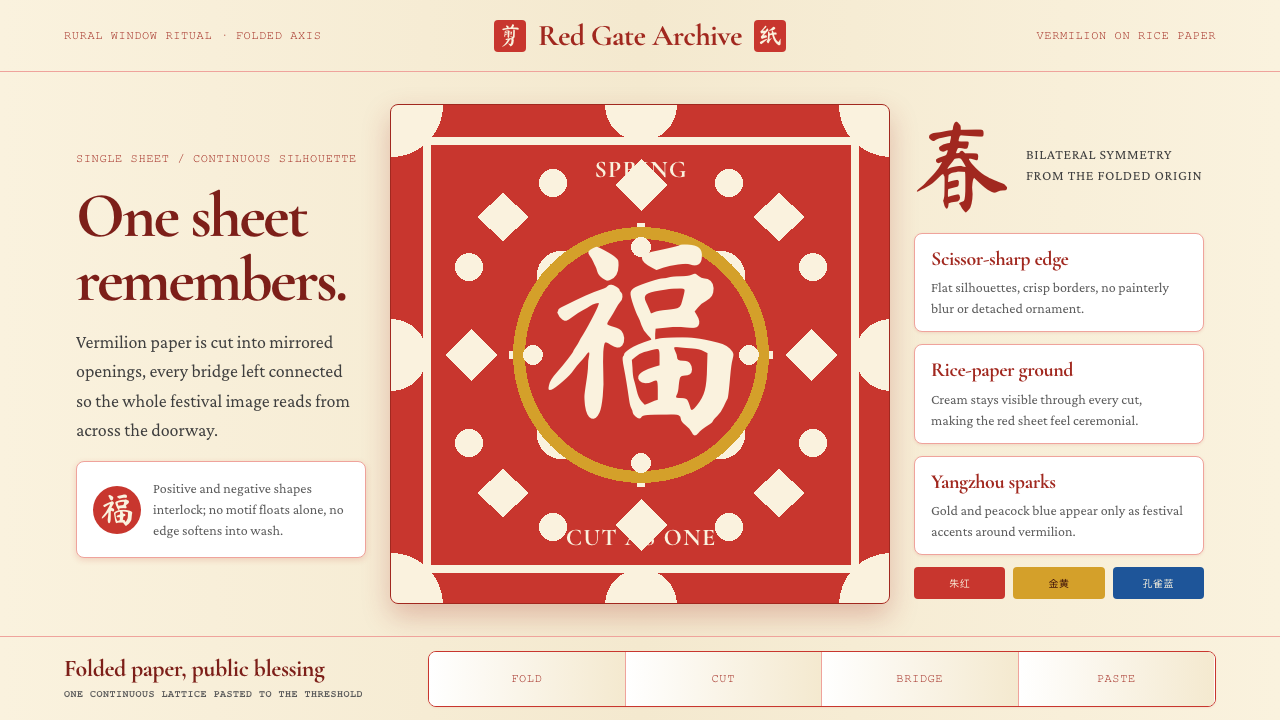 Chinese Jianzhi Paper-CuttingRitual red, cut as one. Vermilion lacework on rice-paper cream locks every sh…
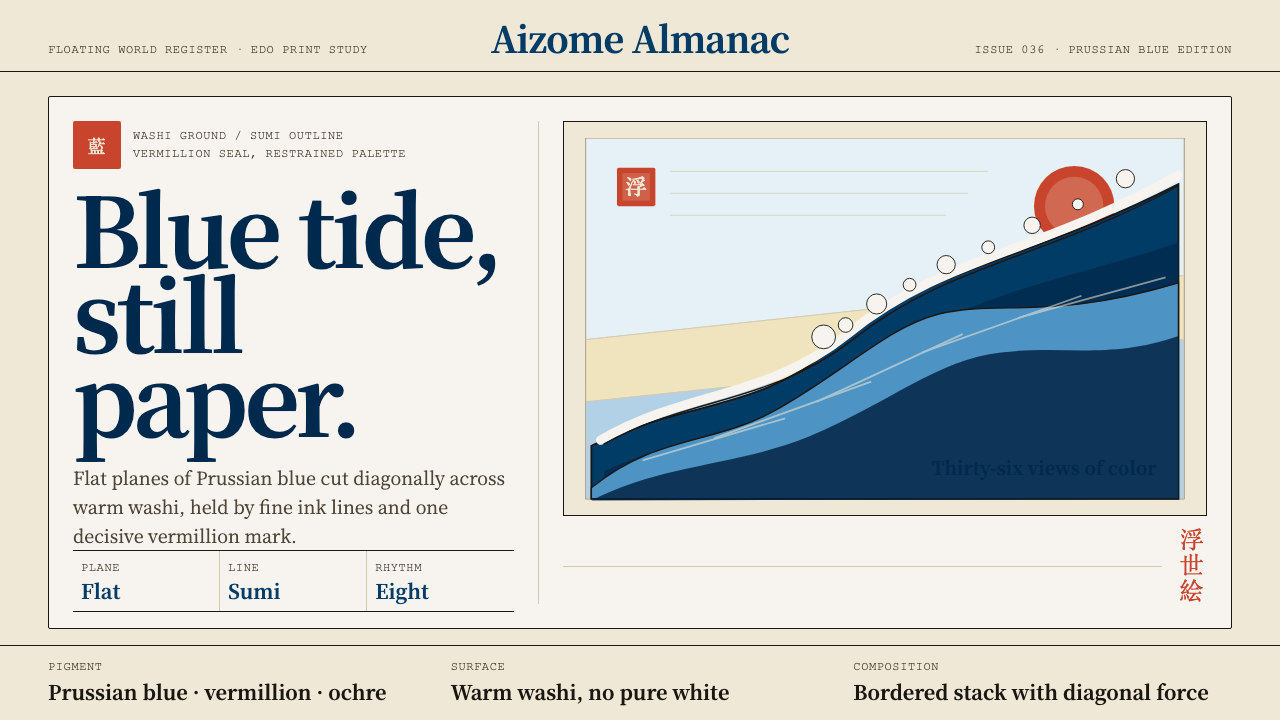 Edo Ukiyo-e (Hokusai)Flat power on paper. Prussian blue diagonals and vermillion seals cut across…
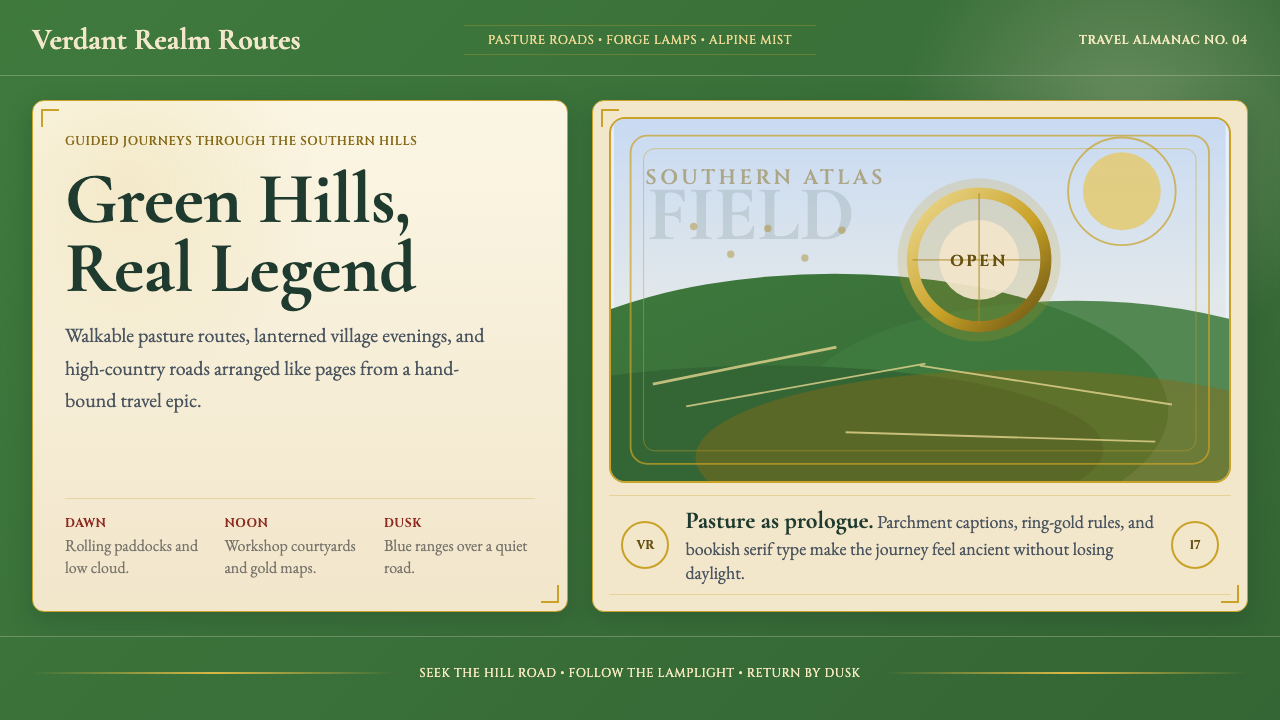 NZ Lord of the Rings TourismEpic feels approachable. Pasture green, ring-gold, and Garamond book frames.
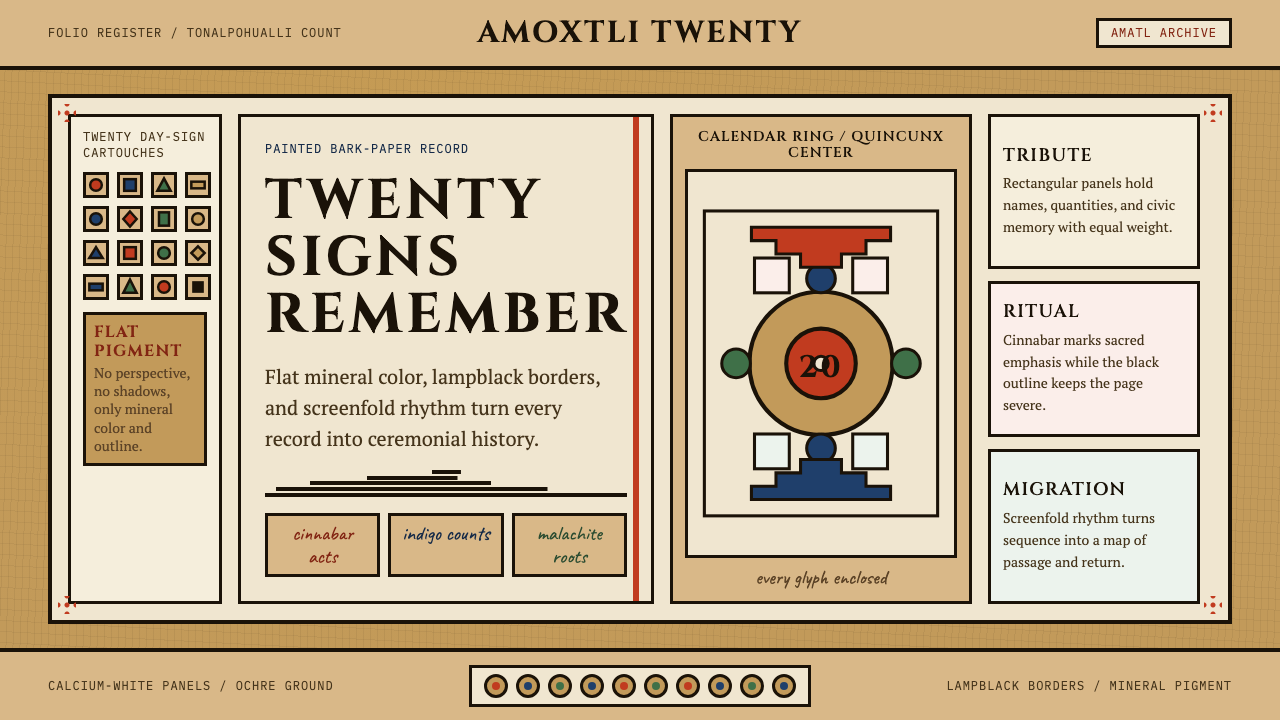 Aztec CodexSacred records stay severe. Ochre amatl ground, Cinzel capitals, black cartou…
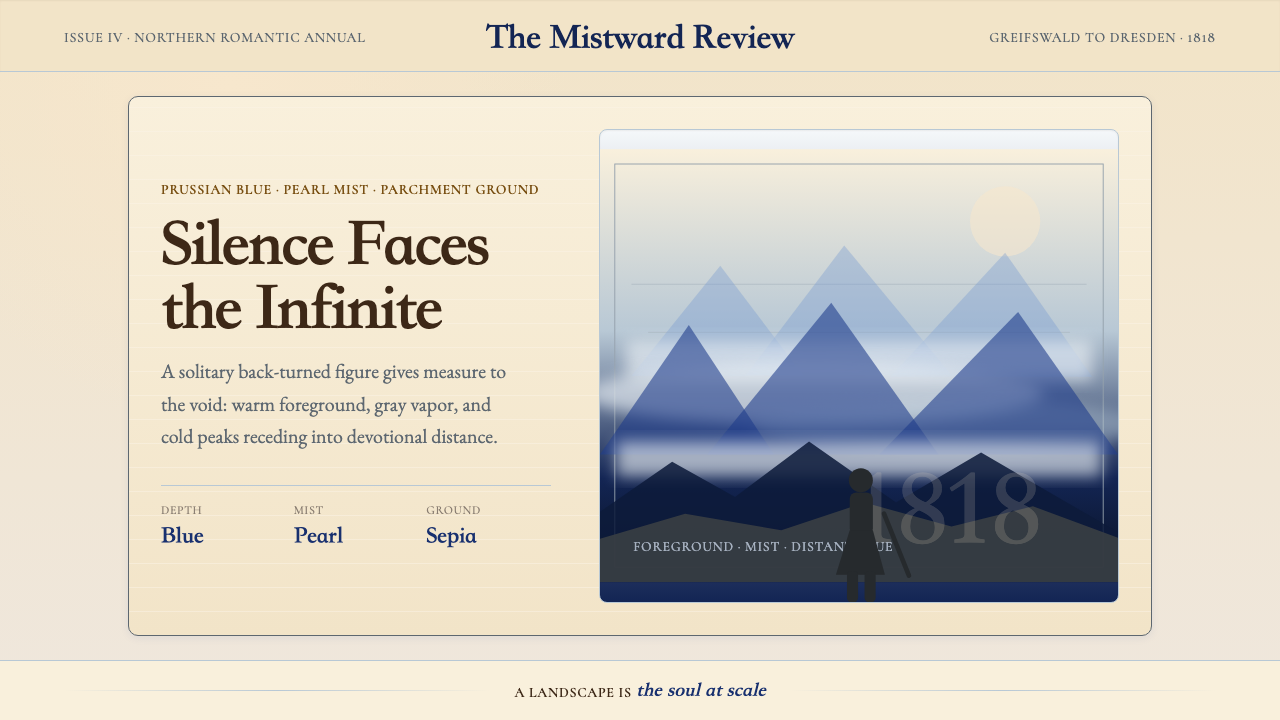 Caspar David FriedrichSilence becomes vast. Prussian blue depth, pearl mist, and parchment framing…
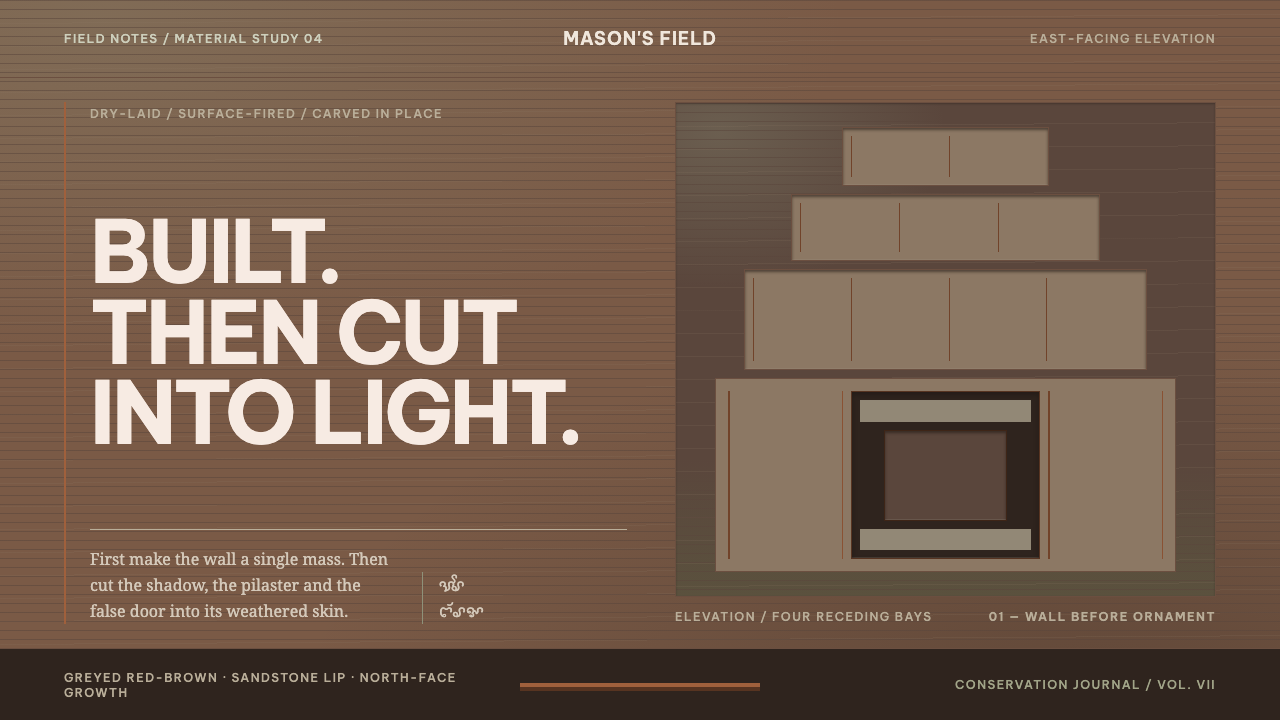 Cham My Son TowersWall before ornament. Greyed brick bays recede around cut shadows and sandsto…