What is NZ Lord of the Rings Tourism?
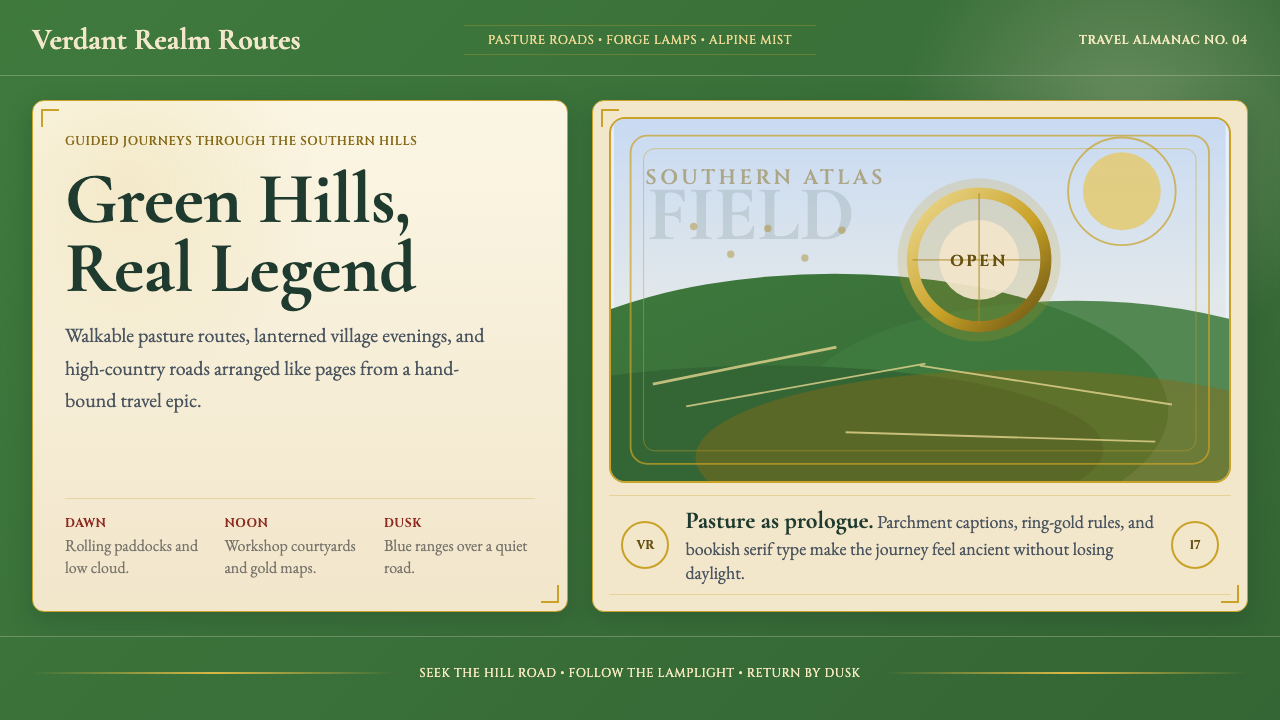
When Peter Jackson chose New Zealand as Middle-earth, he didn't just film a landscape — he fused a national tourism identity with Tolkien's mythology, creating a visual language of sweeping pastoral grandeur, soft fantasy ornamentation, and the unmistakable feeling that the world is wider and more wondrous than it first appeared.
NZ Lord of the Rings Tourism in brief
NZ Lord of the Rings Tourism is a design system born from the collision of two powerful identity machines: the New Zealand government's long-running "100% Pure" destination campaign and the visual art direction developed by Weta Workshop for Peter Jackson's film trilogy. The resulting aesthetic is not simply movie merchandise translated into travel brochures. It is a genuine visual dialect — one that uses sweeping landscape photography, warmly aged typography, and restrained fantasy flourishes to say that a real place and an imagined world are, in some essential way, the same.
The visual register sits comfortably between official destination marketing and illustrated fantasy publishing. Broad, light-filled vistas of volcanic peaks, emerald paddocks, and deep fjords carry the weight of the landscape photography tradition, while soft gold borders, circular badge motifs derived from the One Ring, and serif letterforms drawn from illuminated manuscript heritage introduce the fantasy register. Neither element overwhelms the other — the pastoral keeps the fantasy grounded, and the fantasy lifts the pastoral into myth.
This system is approachable in a way that many fantasy aesthetics are not. Where darker fantasy design tends toward heavy textures, ominous palettes, and aggressive ornamentation, the NZ Lord of the Rings idiom stays warm and sun-touched. The Shire — not Mordor — is its emotional center of gravity. The result is a design language that communicates wonder without menace, grandeur without exclusivity, and depth of world-building without requiring the viewer to have read a single page of source material.
Where does NZ Lord of the Rings Tourism come from?
The story begins not with a design brief but with a location scout. In the late 1990s, Peter Jackson's production team scoured New Zealand for landscapes that could stand in for Tolkien's invented world. What they found — the volcanic plateau of Tongariro, the limestone hills near Matamata, the dramatic Southern Alps above Queenstown, the rugged coastlines of the South Island — was so cinematically convincing that the films would eventually make location tourism one of New Zealand's fastest-growing industries. Tourism New Zealand, the government agency responsible for destination marketing, recognized the opportunity almost immediately and began co-branding efforts that ran parallel to the trilogy's theatrical releases between 2001 and 2003.
Weta Workshop, the Wellington-based practical effects and design company that Jackson had co-founded with Richard Taylor, was responsible for the trilogy's physical design language: the armour, weapons, costumes, creature designs, and prop work that gave each culture of Middle-earth — Shire hobbit, Elvish, Rohirric, Gondorian — its distinctive visual register. Alan Lee and John Howe, the two illustrators whose decades of Tolkien artwork had defined the visual imagination of millions of readers before a single frame was shot, were brought onto the production as concept artists. Their influence — Lee's soft romanticism, Howe's more dramatic medievalism — permeated every designed surface in the trilogy and became the aesthetic foundation from which all downstream NZ Lord of the Rings design would draw.
The permanent reconstruction of the Hobbiton movie set in Matamata in 2012 was the event that transformed the design system from a film-era campaign into an ongoing identity. The original sets had been built to be dismantled; when the films proved world-changing for New Zealand tourism, the landowners negotiated to keep a portion of the set standing. For the production of The Hobbit trilogy (2012–2014), the set was rebuilt in permanent materials and has since operated as a ticketed attraction visited by hundreds of thousands of people each year. The physical experience — walking through round-doored Hobbit holes, past a garden pub, through a landscape that looks simultaneously real and fictional — gave the design system a spatial dimension that most tourism aesthetics never achieve.
Tourism New Zealand's co-marketing relationship with the film properties created a virtuous circle that shaped the visual system over two decades. Official materials used photography that mirrored the films' cinematographic grammar — golden-hour light, wide establishing shots, an emphasis on scale contrast between human figures and landscape. The "100% Pure New Zealand" brand identity, already built on pristine natural imagery, was deepened by the association with Tolkien's explicit love of pastoral nature. Over time, a stable visual vocabulary emerged: deep pastoral greens, warm gold accents, round-arch framing devices, serif letterforms with slight calligraphic variation, and the recurring motif of the lone figure dwarfed by an immense natural backdrop.
What defines the NZ Lord of the Rings Tourism look?
Palette
The color system is anchored by two dominant families: a deep, saturated pastoral green that recalls the rolling paddocks of the Waikato region, and a warm, aged gold that reads simultaneously as late-afternoon sunlight and the glint of Elvish metalwork. These two colors carry the emotional weight of the system — green for belonging, groundedness, and the natural world; gold for myth, value, and the threshold between the everyday and the extraordinary. Supporting tones lean toward warm neutrals: the creamy off-white of parchment, the soft brown of aged leather and turned earth, and a cool blue-grey that appears in shadow areas and distant mountains, preventing the palette from becoming uniformly warm and honeyed.
Typography
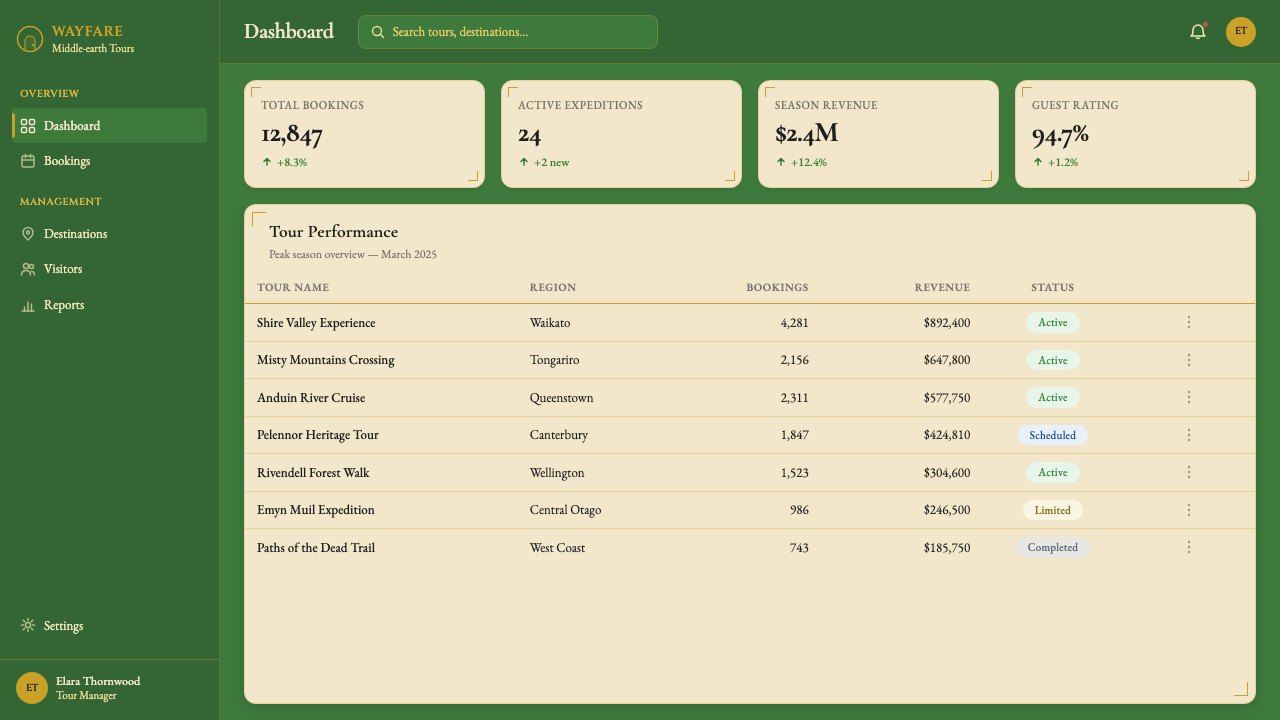
The typographic register draws from the long tradition of humanist book typography — the kind found in quality illustrated editions of classic literature rather than in corporate marketing. Letterforms have organic warmth: serifs carry slight bracketing that recalls calligraphic origins, and at display sizes the characters show a subtle variation in stroke weight that links them to hand-lettered illuminated manuscripts. Capitals are used with restraint and ceremony, often appearing in slightly spaced settings that evoke the title pages of fine press books. There is a deliberate contrast between this warmly historicist display register and cleaner, more functional body text, which keeps the overall reading experience accessible even while the decorative level signals depth and care.
Ornamentation
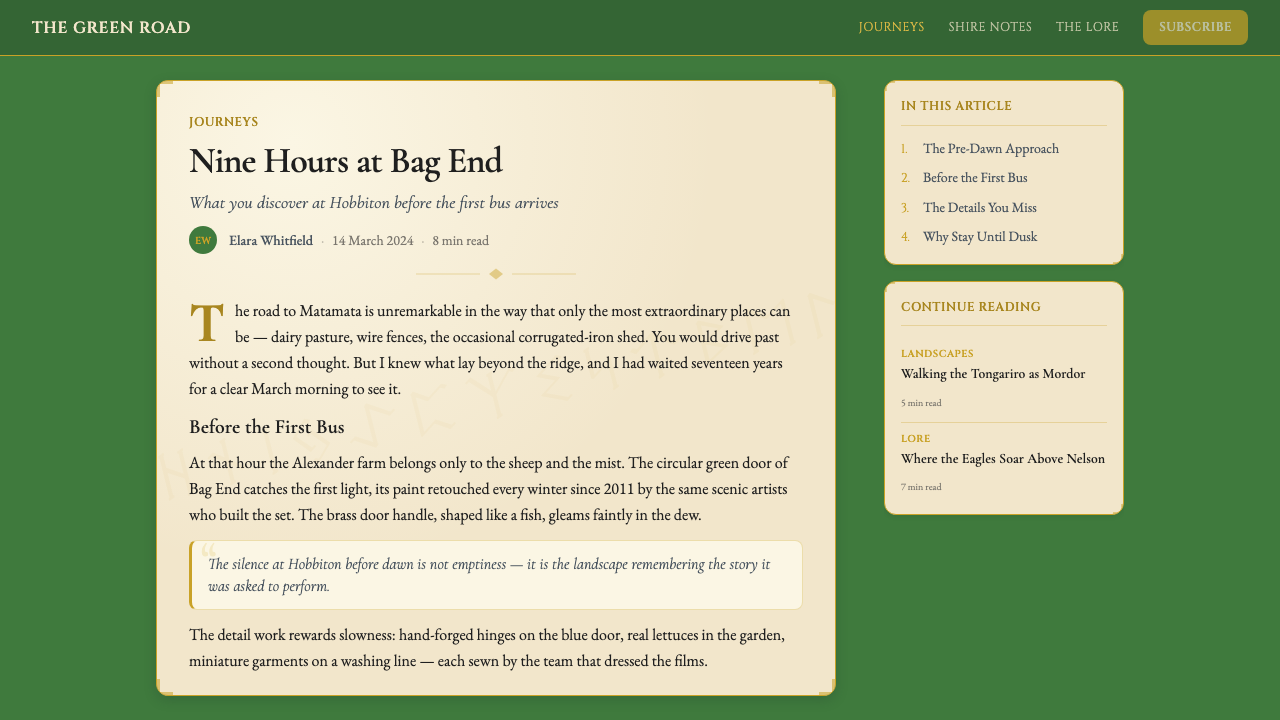
Decoration is present but always subordinated to the landscape and the content it frames. The ornamental vocabulary is drawn primarily from two sources: the circular, interlocked motifs of Tolkien's invented rune systems and Ring engravings, and the foliate border traditions of Victorian and Edwardian illustrated books. Thin gold lines frame content areas, defining edges without creating visual weight. Circular badge forms appear as containing shapes for titles or place names. Leaf and vine motifs occupy corners and margins at small scale, never competing with the primary imagery. The overall effect is of a book that has been carefully and lovingly decorated rather than a poster designed to demand attention.
Landscape Photography Grammar
Photography in this system does specific compositional work that distinguishes it from generic destination marketing. Shots favor a wide establishing frame in which at least one-third of the image is sky, often at golden hour when the quality of light matches the warm gold tones of the overall palette. Human figures appear small in the frame, emphasizing the scale of the landscape around them rather than centering the human experience. Aerial perspectives appear frequently, offering the viewpoint that characters like the Eagles provide in the narrative — a god's-eye compression of vast distance. Seasonal preference leans toward late summer and early autumn, when the pastures are still green but beginning to show the first warmth of turning leaves.
Scale Contrast and the Pastoral Sublime
One of the system's most consistent compositional principles is the deliberate use of scale contrast to evoke a sense of the sublime — not the terrifying sublime of storm and shipwreck, but the gentler pastoral sublime of the Romantic tradition. A lone traveller on a winding road, a single round door set into a hillside, one figure standing at the edge of a vast plain — these compositions communicate that the world extends far beyond what any individual can see or comprehend, and that this is cause for wonder rather than dread. The principle operates across all formats, from full-page photography to small spot illustrations, and is the single device most responsible for the system's consistent emotional register.
Texture and Materiality
Unlike the flat, hard-edged approach of geometric modernism, this visual system embraces surface texture as a carrier of history and meaning. Parchment-like grounds, the grain of weathered wood, the woven quality of linen, and the soft press of letterpress printing all appear as background textures that signal age, craft, and authenticity. These textures are never so prominent that they obscure legibility, but they create a consistent tactile dimension that distinguishes the system from purely photographic or purely digital approaches. The texture register says: this place has a past; what you are looking at has been touched by many hands over a long time.
Bilingual Register: Tourist and Pilgrim
Perhaps the most subtle characteristic of this design system is that it addresses two different audiences simultaneously, without straining to reconcile them. The first audience is the ordinary tourist: someone who enjoyed the films and would like to see the landscape, the sets, the scenery that stood in for Middle-earth. The second is the Tolkien pilgrim: someone for whom the books and their visual interpretation carry deep personal meaning and who approaches the landscape with something approaching reverence. The visual system speaks to both without condescending to the first or over-serving the second — the pastoral photography satisfies the tourist's sense of destination, while the ornamental depth and fantasy framing honour the pilgrim's sense of arrival in a storied world.
Who shaped NZ Lord of the Rings Tourism?
Jackson's decision to film all three Lord of the Rings films simultaneously in New Zealand over eighteen months of principal photography created an unprecedented concentration of design work in a single country and production. His insistence on building and photographing physical environments — Hobbiton, Rivendell's outdoor locations, the volcanic landscapes of Mordor — rather than relying primarily on digital environments gave the visual system its photographic authenticity. His early films were made in Wellington, and his loyalty to New Zealand as a production base transformed the country's film industry infrastructure while simultaneously creating the conditions for what would become one of the most effective destination-cinema marketing campaigns in history.
Lee's illustrated edition of The Lord of the Rings, published in 1991, was the visual reference that defined a generation's mental image of Tolkien's world before the films existed. His style — soft watercolor washes, delicate pen work, a preference for the intimate over the monumental, and a pervading quality of gentle northern European melancholy — was imported wholesale into the film's design language when he joined the production as a concept artist. Lee's contribution explains why the NZ Lord of the Rings aesthetic tends toward soft romanticism rather than hard fantasy: his sensibility was always more Pre-Raphaelite than pulp-fantasy, more William Morris than Frank Frazetta. He won an Academy Award for Best Art Direction for The Return of the King.
Taylor co-founded Weta Workshop with Jackson and served as the head of the physical design department across both the Lord of the Rings and Hobbit trilogies. Under his direction, Weta developed the material vocabulary of Middle-earth: the specific aging and patination of Gondorian armour, the hand-crafted organic quality of Shire pottery and furniture, the elven calligraphy and decorative metalwork that would later become recurring motifs in the tourism design system. Taylor's insistence on fabricating real objects — chainmail knitted ring by ring, swords forged and etched — rather than simulating them digitally gave the physical design an authority that photography translates faithfully. His department won multiple Academy Awards for their work on the productions.
Howe has been the other half of the canonical Tolkien illustration partnership for over three decades. Where Alan Lee tends toward the intimate and the wistful, Howe brings a more dramatic, heraldic sensibility — his Tolkien work favors strong silhouettes, bold compositional choices, and a feel for the monumental that makes his images well-suited to marketing materials and large-format applications. His interpretation of key iconographic elements — the silhouette of the One Ring, the typography of the Ring inscription, the armor of the Nazgul — provided reference points that the tourism design system has absorbed and simplified into its ornamental vocabulary.
The government tourism agency deserves recognition as a design actor in its own right, not merely a client. Tourism New Zealand made a series of strategic decisions — co-branding with the film releases, commissioning matching photography, creating dedicated "Lord of the Rings location" guides — that shaped the visual system's public grammar. Their "100% Pure New Zealand" tagline, launched in 1999, was already in place when the films arrived and proved perfectly compatible with the pastoral-mythic register the films established. The agency's consistency over two decades — maintaining the association across three trilogies worth of content — is what transformed a film-era moment into a durable design identity.
How do you use NZ Lord of the Rings Tourism today?
NZ Lord of the Rings Tourism is a rich and specific visual system, and applying it well requires understanding its emotional contract with the viewer. The system promises a particular feeling: that the world is larger, older, and more beautiful than everyday life suggests, and that a journey — whether to New Zealand or into a book — can put a person in contact with that larger world. Design work that borrows from this system should honor that promise. The mistake is to treat it as a fantasy theme or a movie brand, rather than as a pastoral-romantic aesthetic with particular values about landscape, scale, and the relationship between the human and the non-human world.
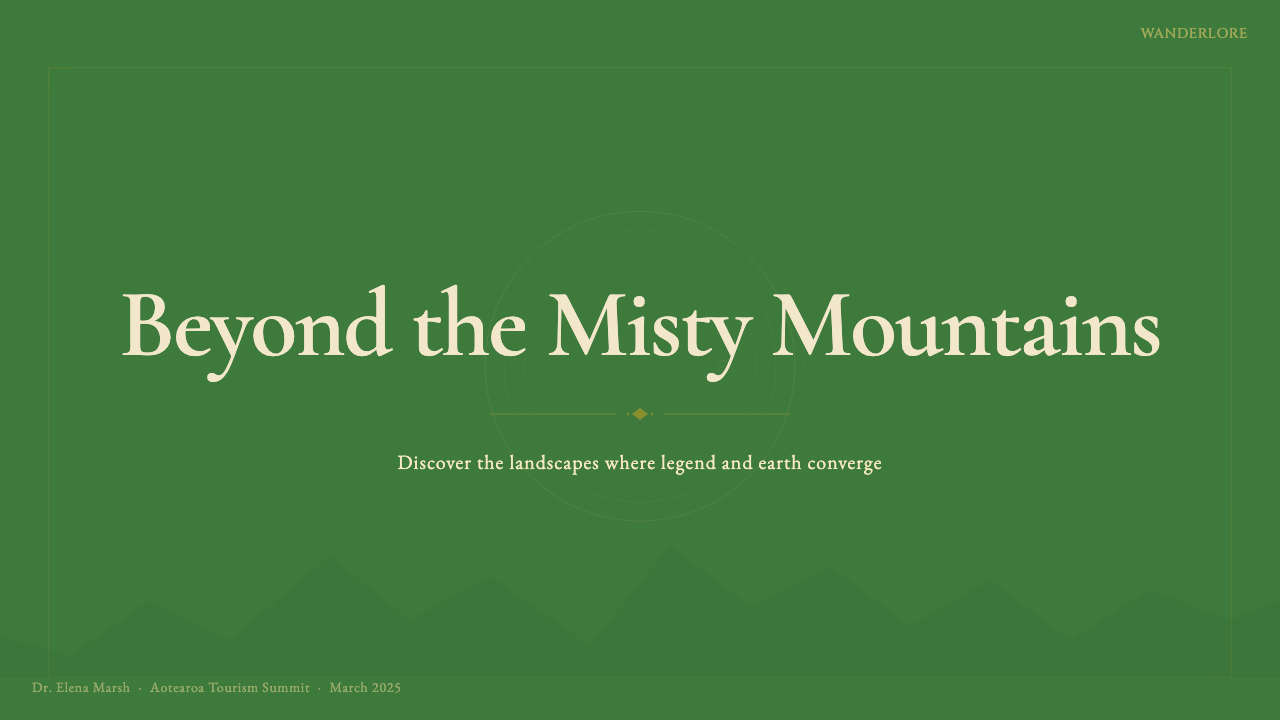
For presentation slides, the system works best when the content itself carries some weight of journey, discovery, or transformation. A travel pitch, a year-in-review that emphasizes growth and change, an educational deck about geography or natural history — these benefit from the aesthetic's combination of grandeur and warmth. Cover slides work well with a full-bleed landscape photograph occupying most of the frame, with the title set in a warm, serif display face against a softened lower third. Content slides should use the parchment-tone neutral backgrounds with gold rule separators; body text reads better in a clean, moderately spaced serif than in the same elaborate display face used for titles. Avoid pairing this system with cold, high-contrast corporate templates — the tonal clash will flatten both.
For web interfaces and digital marketing, the system suits experiences that want to communicate heritage, authenticity, and considered quality — boutique travel operators, literary publishers, artisan product brands, or any service that positions itself as offering something crafted rather than manufactured. Navigation should be typographic and unhurried; dropdown menus and hover states work better in the warm gold accent than in a cold interactive blue. Photography should be curated for the qualities the system values: generous natural light, human figures at the scale of the landscape, no obvious post-processing that flattens the tonal range. Hero sections with a large landscape image, a short decorative rule, and a brief headline in display type establish the register immediately.
For editorial and print work — destination guides, cultural magazines, illustrated books — the system is closest to its native territory. The multi-column editorial grid suits this aesthetic better than single-column blog formats; generous margins create space for the small ornamental details to breathe. Chapter openers and section breaks benefit from a decorative motif at small scale — a leaf, a ring, a fine-line rule — rather than from abstract geometric devices. Pull quotes set in a warm display face against a slightly tinted ground carry the same quality as a richly decorated marginal note in an illuminated manuscript. The overall pacing should be slow and inviting rather than quick and scannable.
A common mistake when applying this system is overloading the decoration. Because the ornamental vocabulary is rich — circular badges, leaf motifs, fine gold lines, textured grounds, calligraphic display type — there is a strong temptation to use all of it at once. This produces visual noise that undermines the system's essential quality: its feeling of spaciousness and natural grandeur. The landscape photography works precisely because it is uncluttered; the ornamentation should occupy the margins and frames, leaving the primary image field open. A second common error is mismatching the photography — using high-saturation travel stock photography rather than images that share the system's specific preferences for golden-hour light, pastoral subject matter, and human figures at small scale in large landscapes.
NZ Lord of the Rings Tourism — FAQ
Is this style specific to Lord of the Rings, or can it work for other fantasy or travel contexts?
The style is specific enough in its origins that using it wholesale for unrelated fantasy properties would read as derivative. However, its underlying aesthetic principles — pastoral photography, warm-gold ornamentation, humanist serif typography, the romance of natural scale — are transferable to other contexts where those values align with the product's story. Literary tourism for other destinations, cultural heritage institutions, high-end eco-travel brands, or illustrated books about natural history can all draw from this register without feeling like Tolkien imitations, as long as the photography and landscape are genuinely the subject rather than a borrowed frame.
How does this style handle dark or serious content — can it work for something with conflict or difficulty?
The system has a tonal range that is wider than it first appears. The Shire register — pastoral warmth, round-arch motifs, golden-hour light — works for accessible and welcoming content. But the trilogy's visual vocabulary also includes a more dramatic, shadow-heavy register associated with Gondor, the paths of the dead, and the volcanic landscapes of the North Island. Photography from the Tongariro area, with its barren volcanic slopes and brooding skies, can carry a sombre grandeur within the same overall palette. The key is maintaining the pastoral-romantic framing device — the sense that even difficulty exists within a world of meaningful beauty — rather than shifting into a dark-fantasy aesthetic that abandons the system's essential warmth.
The system uses a lot of texture and ornamentation. Does it work in purely digital contexts where those elements can feel dated?
Used at the wrong scale or density, textured grounds and fine ornamental lines can appear dated in digital contexts — they may recall the visual excess of early 2000s web design, when parchment textures were often applied indiscriminately. The key is restraint and purpose. Texture should appear at the edges and margins of a composition, not as a full-bleed background behind body text. Gold ornamental lines work at large formats — hero banners, section dividers — but should not appear at small sizes where they become visual noise rather than visual refinement. In mobile contexts especially, simplify aggressively: lead with photography, commit to the warm palette, and let the typography carry the ornamental burden that border work handles in larger formats.
How does this style relate to other heritage or destination-tourism aesthetics — is it easy to confuse with something else?
There are family resemblances to several adjacent aesthetics. It shares warm color palettes and serif typography with general heritage tourism design, but the fantasy ornamentation distinguishes it sharply. It shares landscape photography emphasis and pastoral green palettes with Irish tourism and Scottish highland marketing, but those aesthetics lack the Tolkien-derived circular motifs and the specific quality of the gold accent, which reads as precious metal rather than as harvest warmth. The closest potential confusion is with general illustrated-fantasy book design, which shares the ornamental vocabulary but typically lacks the landscape photography and the destination-marketing context. What makes the NZ Lord of the Rings idiom distinct is precisely the fusion of all three elements: photographic landscape realism, government tourism warmth, and Tolkien-derived fantasy depth.
Can this style work for products or brands that have no connection to New Zealand or to fantasy?
Yes, but the connection to the source material needs to be dissolved before application. The system's underlying visual values — pastoral warmth, the beauty of natural scale, typographic depth, the suggestion of storied history — are not properties of New Zealand or Tolkien specifically. A premium outdoor equipment brand, a craft distillery communicating provenance and character, a slow-travel platform, or a literary magazine can all use the core register (landscape photography + warm gold + humanist serif + light ornamentation) effectively without the Tolkien-specific motifs. The practical rule: retain the photography grammar and the palette; simplify or abstract the ornamentation away from recognizable ring and rune references; let the typography and the landscape do the emotional work that the explicit fantasy iconography would have done.
Related design styles
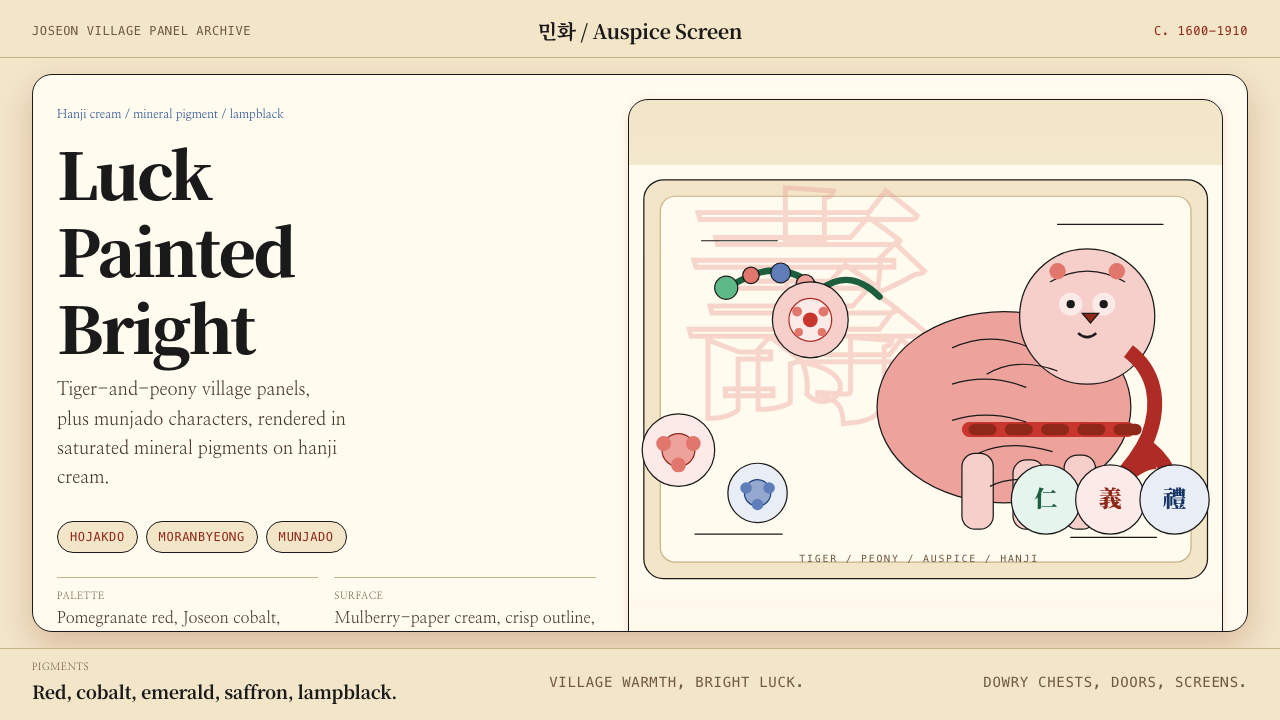 Korean Minhwa (Joseon Folk Painting)Cheerful prosperity over restraint. Mineral reds, cobalt, and lampblack on ha…
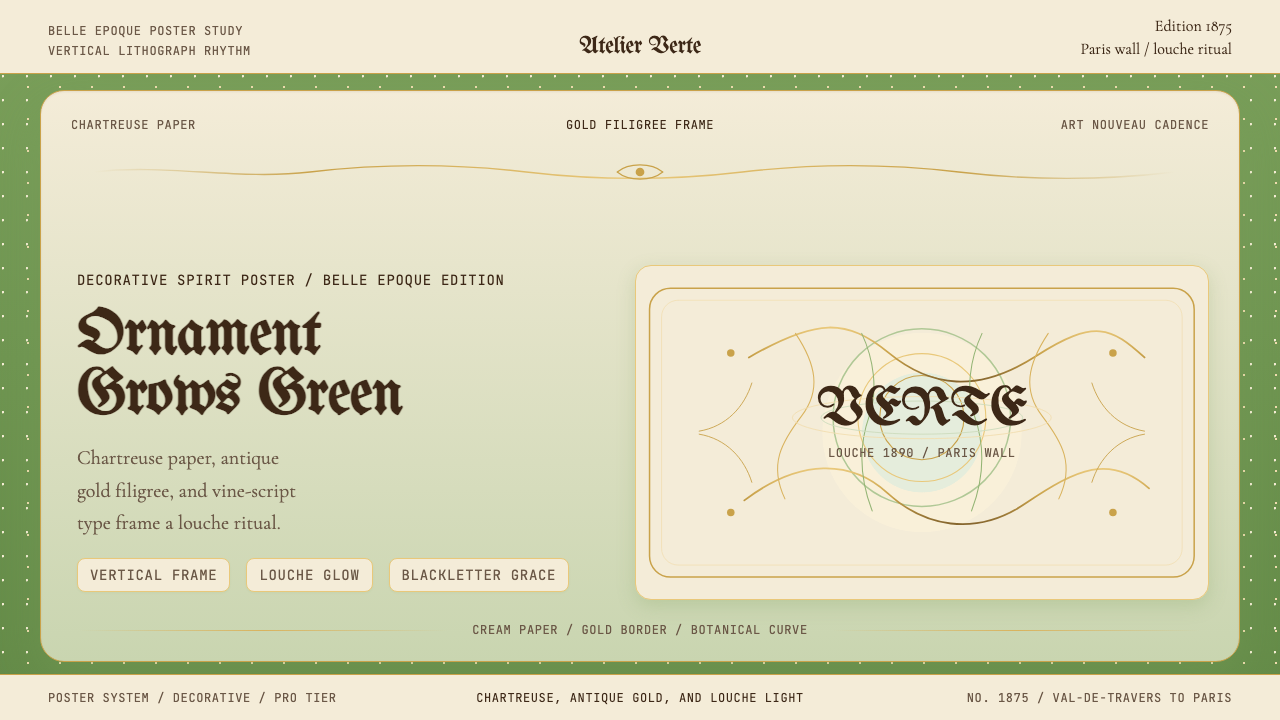 Absinthe Art Nouveau Green (1875)Ornate and verdant. Chartreuse field, gold filigree, vine-script type, and lo…
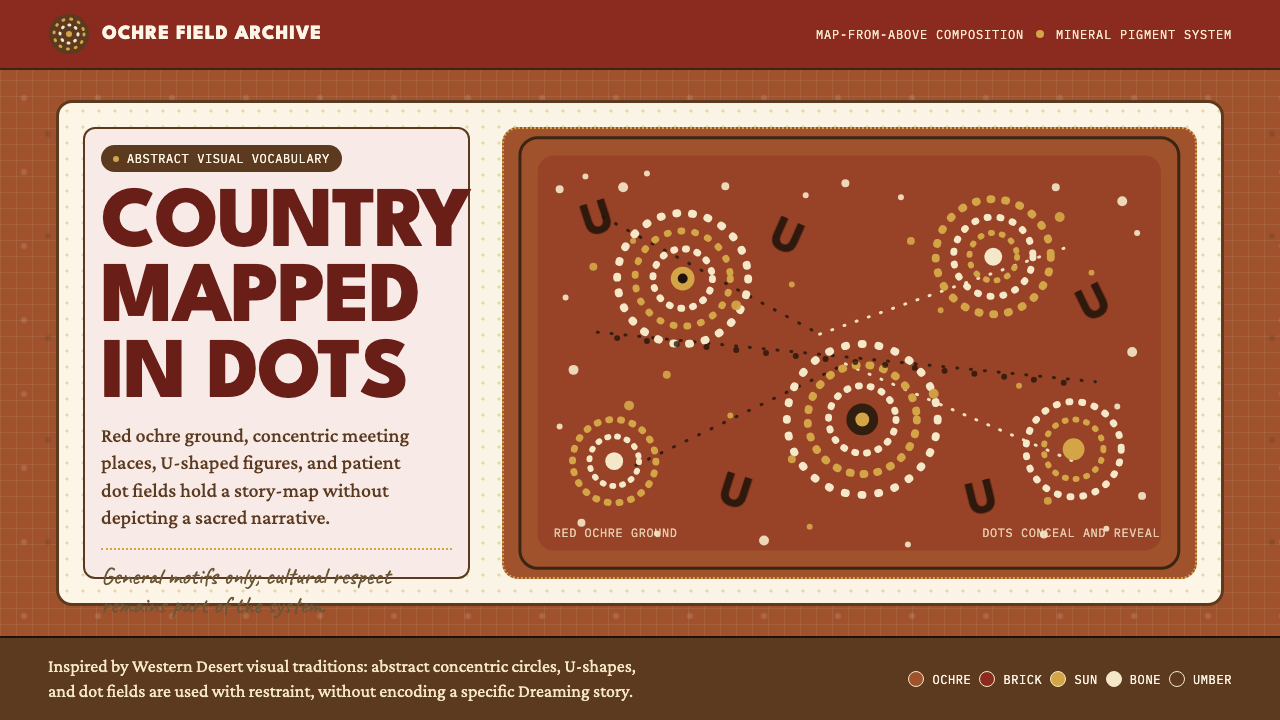 Aboriginal Dot PaintingAncient story-map energy. Red ochre, bone dots, concentric circles, and U-mar…
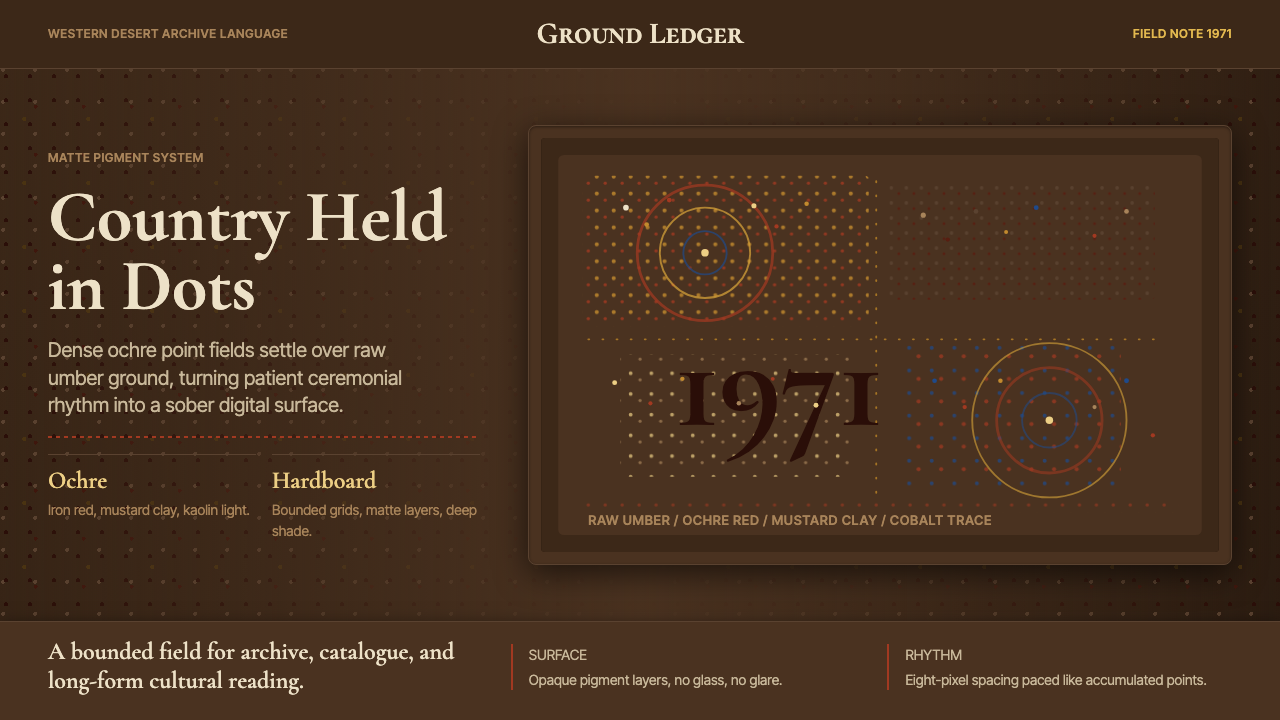 Aboriginal Dot Painting (Papunya 1971)Ochre memory, held steady. Raw umber ground, Cormorant type, disciplined dot-…
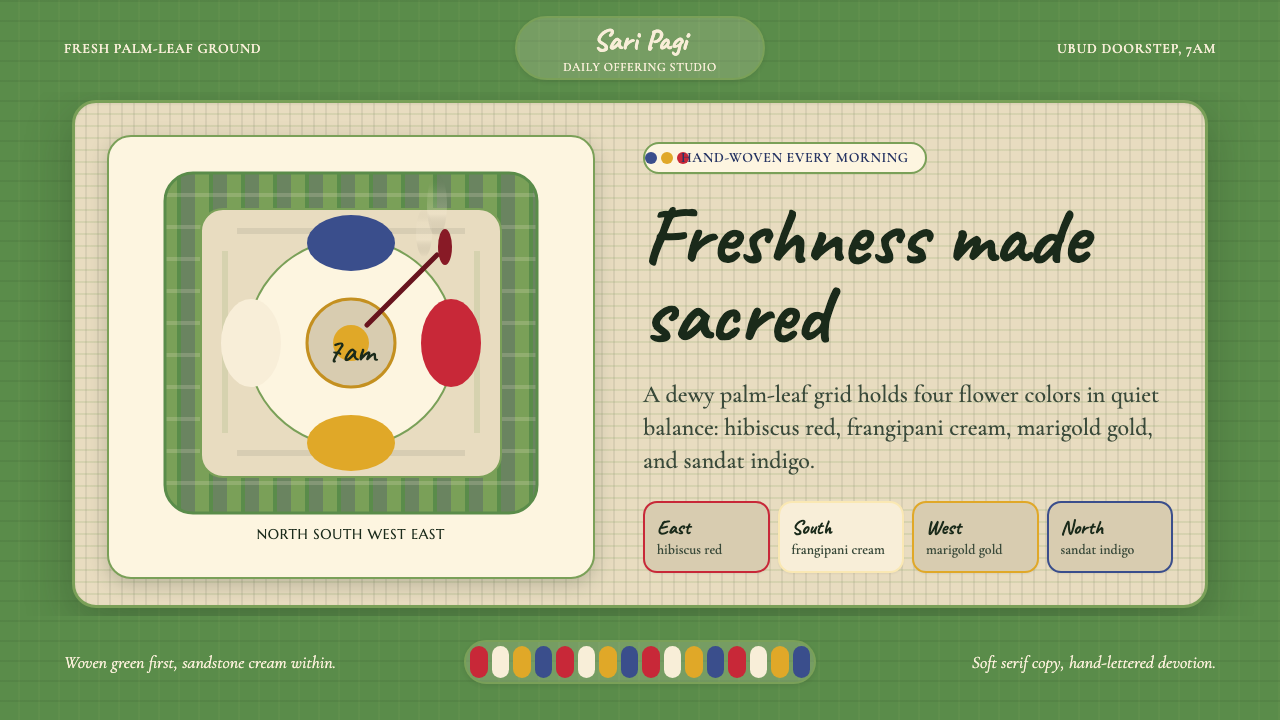 Balinese Canang Sari (Daily Offering)Morning ritual, freshly woven. Palm green grid with four flower colors on tem…
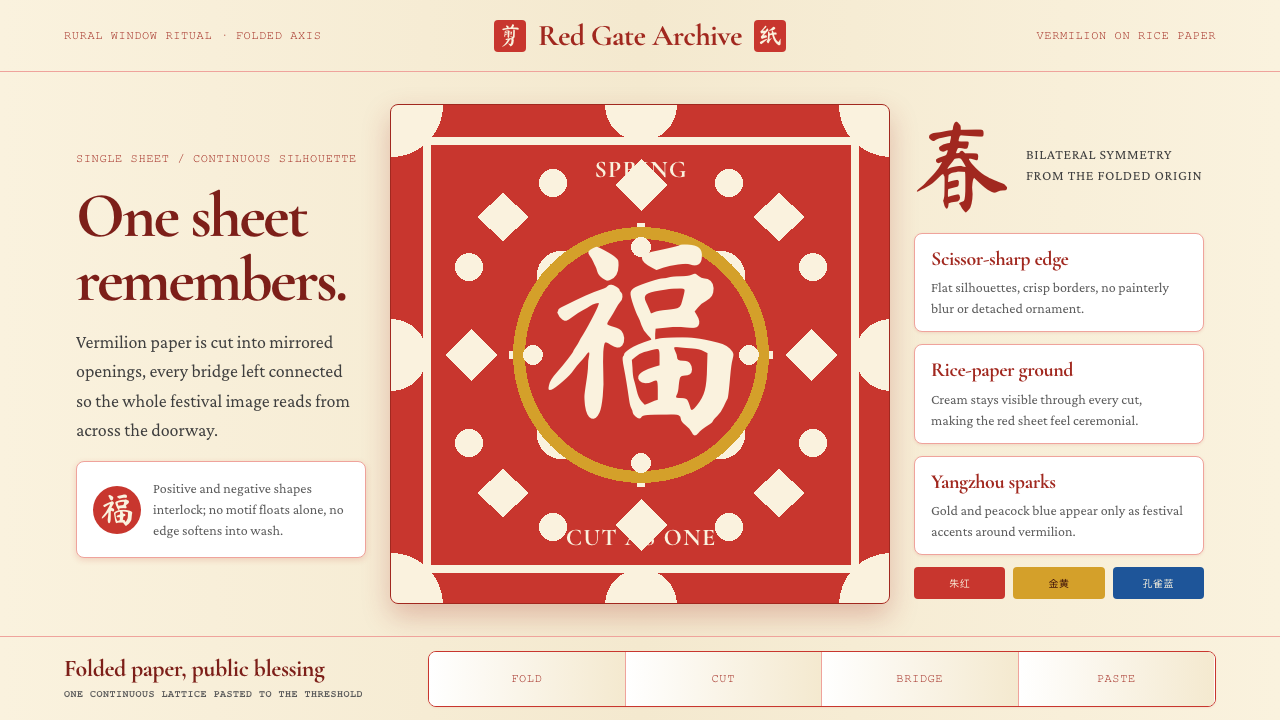 Chinese Jianzhi Paper-CuttingRitual red, cut as one. Vermilion lacework on rice-paper cream locks every sh…