What is Wes Anderson Symmetrical?
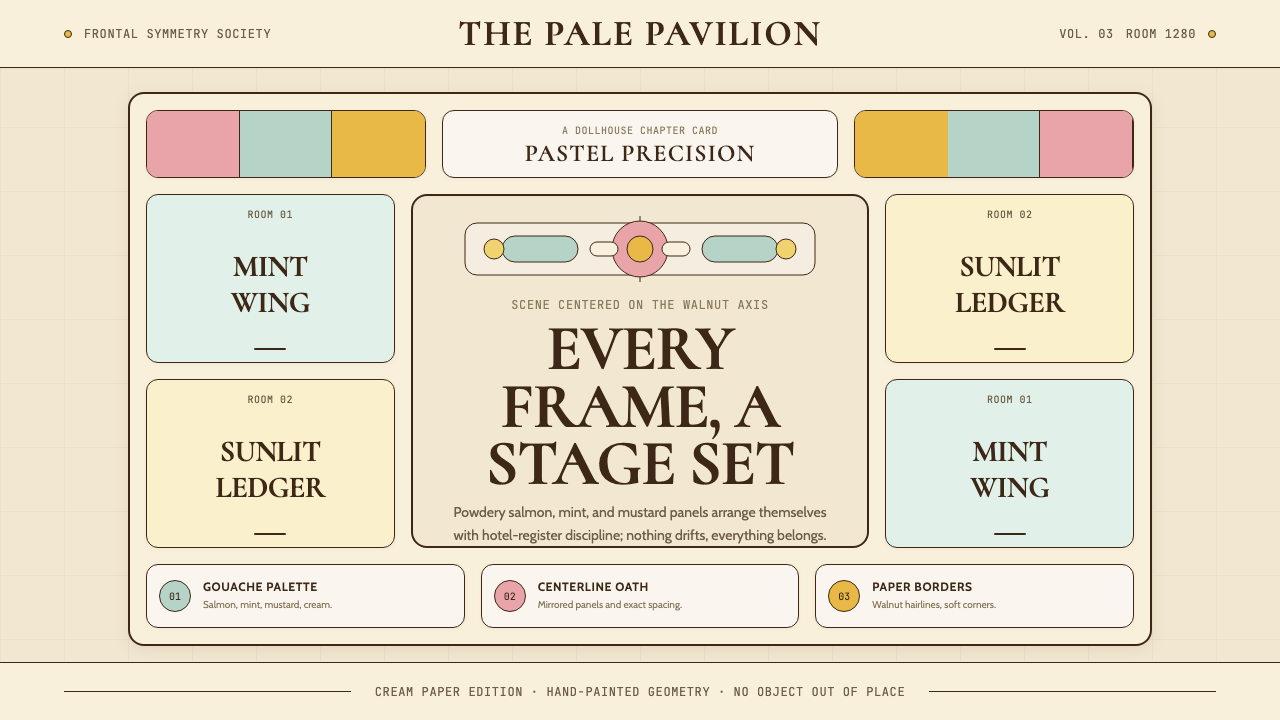
Every frame a stage set: Wes Anderson's obsessive symmetry, candy-pastel palette, and handcrafted lettering turned cinema into the most influential design system of the early twenty-first century.
Wes Anderson Symmetrical in brief
Wes Anderson Symmetrical is a design aesthetic derived from the visual language of filmmaker Wes Anderson — most fully articulated in films such as The Royal Tenenbaums (2001), The Life Aquatic with Steve Zissou (2004), The Grand Budapest Hotel (2014), and Asteroid City (2023). Its defining qualities are frontal bilateral symmetry in every composition, a hand-mixed pastel palette built from salmon pink and mint green punctuated by cream and walnut brown, and a pervasive use of vintage letterpress and serif display type that gives every surface the feeling of a lovingly crafted prop.
The aesthetic belongs to the broader tradition of auteur cinema — filmmaking in which a director's personal vision dominates every visual decision — but it has migrated so completely into graphic design, product packaging, editorial illustration, and digital interfaces that it now functions as a standalone design system. The language is immediately legible without any film reference: symmetry as order, pastels as warmth, hand-painted surfaces as care. It communicates whimsy and precision simultaneously, which is a rare and commercially useful combination.
Unlike historical styles derived from ideological movements, the Wes Anderson aesthetic originates in a single artistic practice. Its coherence comes not from a manifesto but from an extraordinarily consistent body of film work spanning more than twenty-five years. This makes it unusually stable as a design reference: the rules are legible, well-documented across thousands of frames, and more forgiving of interpretation than movement-based styles that carry precise doctrinal requirements.

Where does Wes Anderson Symmetrical come from?
The visual system now called Wes Anderson Symmetrical did not arrive fully formed. Anderson's debut feature Bottle Rocket (1996) showed little of the signature style — it was shot conventionally, with handheld energy and naturalistic color. It was Rushmore (1998) that first displayed the centered compositions, the obsessive set dressing, and the autumnal palette that would define everything that followed. By the time The Royal Tenenbaums (2001) appeared, critics and designers alike were noting that Anderson's films looked unlike anything in contemporary cinema: every shot composed as if for a still photograph, every prop functioning as a character.
Two collaborators were essential to crystallizing the aesthetic. Production designer Adam Stockhausen, who joined Anderson on The Grand Budapest Hotel (2014), brought an architectural precision to the set construction — the film's pastel-painted Mitteleuropean hotel interiors and the iconic Mendl's pastry boxes, with their hand-lettered pink labels, became the most replicated visual references in the style's history. Costume designer Milena Canonero, who had previously worked with Stanley Kubrick on Barry Lyndon and A Clockwork Orange, gave each Anderson cast a color-coded wardrobe system in which characters' palettes relate to their emotional arcs rather than to realistic costume conventions. Prop designer and graphic artist Annie Atkins handled the film's handcrafted paper ephemera — stamps, telegrams, menus, hotel stationery — each item period-accurate and hand-lettered in a way that gave the films an almost archaeological material density.
The aesthetic draws on several art-historical sources that Anderson has cited directly. The mid-century European illustrative tradition — particularly the work of Saul Steinberg and the picture books of Tomi Ungerer — informs the style's flattened, storybook quality. The dollhouse paintings of Joseph Cornell, the stage designs of Jacques Tati (whose Mon Oncle and Playtime Anderson has acknowledged as touchstones), and the graphic symmetry of Soviet-era constructivist posters all feed into a sensibility that treats architecture, props, and type as elements of an integrated stage set rather than as separate design disciplines.
The cultural moment that amplified the style into a global design phenomenon was the intersection of Anderson's peak film output with the rise of Instagram (launched 2010) and the visual culture it generated. The Grand Budapest Hotel's release in 2014 coincided exactly with the platform's emergence as a primary channel for design inspiration. The film's salmon-and-mint palette, its symmetrical compositions photographable in a single square frame, and its abundance of hand-lettered graphic props made it almost algorithmically suited to social-media distribution. Within months of the film's release, the aesthetic had migrated into wedding stationery, café branding, editorial illustration, and independent publishing. By the late 2010s, what had been a cinema auteur's personal vision was operating as a broadly legible commercial design vocabulary.
What defines the Wes Anderson Symmetrical look?
Bilateral Symmetry
The single most defining rule of the aesthetic: every composition is centered on an invisible vertical axis, with left and right halves mirroring each other in weight and structure. This applies not only to overall layouts but to individual graphic elements — title cards, menus, packaging labels, and on-screen typography are all treated as symmetrical objects. The symmetry is strict but not mechanical; small asymmetries in color or content (a character standing slightly off-center, a label with more text on one side) create life within the grid without breaking the overall bilateral logic.
Candy-Pastel Palette
The palette is built from a family of warm, chalky pastels — salmon pink as the dominant warm tone, mint green as its cool counterpart, cream as the foundational neutral, and walnut brown or deep burgundy as structural dark accents. These hues are consistently desaturated and lightened, giving them a gouache or hand-mixed quality rather than the saturated brightness of digital primaries. The palette reads as warm even when cooler tones like mint or lavender appear, because the overall tonal family leans toward cream rather than white.
Vintage Letterpress and Display Type
Typography in this aesthetic is always a designed object, not just a communication vessel. Display type leans toward mid-century European serif styles — the kind found on railway signage, hotel stationery, and pharmacist labels from the early twentieth century. Letterforms have visible weight and personality; compressed serifs, slab serifs with slight ink-trap characteristics, and titling styles with generous letterspacing all appear. Type is almost always set centered rather than left-aligned, reinforcing the overall symmetry of the composition. Hand-lettered elements are prized: labels, stamps, and captions that appear to have been drawn rather than typeset.
Dollhouse Scale and Depth
Compositions are organized in theatrical planes rather than natural perspective. Foreground, middle ground, and background are arranged like stage flats — distinct layers at consistent distances — rather than receding in continuous atmospheric perspective. This creates a characteristic shallow depth of field in the spatial imagination of the style, where everything is visible simultaneously and nothing is hidden in blur or fog. Objects and figures appear at scale with each other as if arranged in a diorama or architectural model, giving the style its distinctive toy-like quality.
Handcraft Material Quality
Every surface in the aesthetic reads as made by hand — paper textures, ink impressions, watercolor washes, and the slight imprecision of letterpress printing all signal a pre-digital material world. This is not roughness or artlessness; it is the appearance of labor and attention. Packaging elements carry the weight and deliberateness of something produced in small quantities with care. The handcraft signal is a counterbalance to the symmetry: the symmetry implies control, but the material quality implies warmth and human presence.
Color-Coded Narrative Structure
Following the influence of Milena Canonero's costume approach, the aesthetic uses color not only decoratively but structurally to encode relationships, hierarchies, and categories. Distinct sections of a layout or system can be assigned distinct palette variants — a warm salmon register for one narrative strand, a cooler mint register for another — and the palette itself becomes an organizational device. This is distinct from mere color-coding in information design; it carries emotional weight, so that the warm palette feels cozier and the cool palette feels more distant or elegiac.
Ruled Lines and Framing Devices
Thin ruled lines — single or double, in dark brown, deep burgundy, or near-black — appear as structural dividers, border ornaments, and framing elements throughout the aesthetic. These lines function like the walnut molding in a Victorian shadow box: they separate elements while drawing the eye to the symmetrical arrangement within the frame. The ruled line is the aesthetic's primary geometric mark; it appears on labels, title cards, menus, certificates, and packaging wherever a boundary needs to be articulated with elegance rather than with a filled shape.

Who shaped Wes Anderson Symmetrical?
Anderson (born 1969 in Houston, Texas) is the director, writer, and primary visual architect of the aesthetic that bears his name. His films from Rushmore (1998) onward established the centered framing, pastel palette, and handcraft material language that became globally recognized. Anderson has described his approach as treating every frame as a painting and every set as a dollhouse — an architecture of control that paradoxically creates an atmosphere of warmth and nostalgic longing. His influence on visual culture extends far beyond cinema: the aesthetic he developed is now taught in design schools, used in commercial branding, and studied as an example of how a single artist's vision can become a transferable design system.
Stockhausen is the production designer who gave the Wes Anderson aesthetic its most architecturally precise form, beginning with Moonrise Kingdom (2012) and continuing through The Grand Budapest Hotel (2014), Isle of Dogs (2018), and The French Dispatch (2021). His work on The Grand Budapest Hotel — designing the pastel-painted hotel interiors, the Mendl's pastry shop, and the elaborate mountain cable car station — produced the single most reproduced visual archive in the style's history. Stockhausen's approach treats every room and prop as a graphic design problem, with color, typography, and proportion resolved simultaneously rather than sequentially.
Atkins is the graphic designer and prop maker who created the handcrafted paper ephemera that gave The Grand Budapest Hotel — and by extension the entire aesthetic — its material density. Her work on the film included the Mendl's pastry boxes, postage stamps, hotel stationery, telegrams, wanted posters, and travel documents — every item hand-lettered and period-researched to the level of an archivist. Atkins has since written extensively about the craft of graphic prop making, and her approach to centered, symmetrical layout with vintage serif typography and ruled border lines is the most direct template for designers working in this style.
Canonero is the four-time Academy Award-winning costume designer whose color-coded wardrobe systems for Anderson's films established the principle of palette-as-narrative-structure within the aesthetic. Her work on The Grand Budapest Hotel assigned each time period a distinct palette family — vivid pastels for the 1930s sequences, desaturated tones for the 1960s, near-monochrome for the present day — demonstrating that color in this style is always meaningful rather than merely decorative. Her earlier work with Kubrick on Barry Lyndon, with its period-accurate color palette derived from eighteenth-century oil painting, is a direct precedent for the historically informed palette construction that characterizes the Anderson aesthetic.
Tati (1907–1982), the French filmmaker and comedian, is the most frequently cited cinematic precedent for the Wes Anderson aesthetic. His films Mon Oncle (1958) and Playtime (1967) share the Anderson style's commitment to architectural framing, lateral camera movement, and the treatment of built environments as characters in their own right. Tati's use of pastel color — particularly the warm cream and faded terracotta tones of traditional French village architecture in Mon Oncle — prefigures the Anderson palette. Anderson has acknowledged Tati as a direct influence, and the comparison illuminates how the symmetrical stage-set framing tradition connects a mid-century European art cinema sensibility to contemporary graphic design.
How do you use Wes Anderson Symmetrical today?
The Wes Anderson Symmetrical aesthetic is among the most immediately legible styles to apply to designed artifacts, because its rules are visual rather than theoretical and its cultural associations — warmth, nostalgia, artisan care, gentle wit — are broadly appealing. Applied correctly, it produces work that feels simultaneously handcrafted and designed, historic and contemporary. Applied carelessly, it collapses into a costume — salmon paint and centered type without the underlying structural logic.
For presentation slides, the style excels at both cover pages and content layouts. A cover built in this aesthetic should commit fully to bilateral symmetry: the title centered on axis, flanked by ruled lines above and below, with a pastel field — salmon or mint — occupying a defined rectangular zone behind the type. Decorative typographic details such as a small ornament or a line of small caps beneath the main title reinforce the label-like quality. Content slides should preserve the symmetry in their information hierarchy: two-column layouts should mirror each other in width, bullet points should be treated as centered lines rather than left-aligned lists, and data visualizations should be arranged as centered objects within the slide field rather than anchored to one edge. Chart and graph elements work well when their color palette is drawn from the pastel family, with each data category assigned a distinct pastel tone.
For web interfaces, the style is most naturally suited to landing pages, pricing tables, and editorial sites where the reading experience is unhurried and the brand personality is warm and characterful. A pricing page in this aesthetic organizes tiers as centered card objects with ruled borders, each tier assigned a pastel background drawn from the palette family, with tier names set in a vintage-inflected display serif. Dashboards can adopt the style selectively: the overall page architecture should maintain the symmetrical grid, while data elements — charts, numbers, status indicators — use the pastel palette and ruled borders to give the dashboard a more considered, less default-SaaS appearance. Navigation should be typographic, centered, with generous letterspacing in a compressed serif.
For editorial and marketing applications, the style produces strong results in print-adjacent contexts: book covers, magazine spreads, event posters, product packaging, and brand identity systems for hospitality, food, and independent retail. A book cover in this aesthetic places the title centered on axis with a symmetrical illustration or decorative type element below, the whole composition framed by a thin ruled border inset from the edge. Marketing emails work well in a simplified version of the style: a centered, narrow-column layout with a pastel background panel, a serif headline, and a single call-to-action button styled as a stamped or embossed label element. The style is particularly effective for brands that want to position themselves as carefully made, independent, and not corporate.
The most common mistake when applying this aesthetic is confusing symmetry with repetition and pastels with mere pinkness. Authentic application requires that the symmetry be compositional — the axis must be felt, not just mathematically present — and that the palette maintain its chalky, desaturated quality rather than drifting toward the high-saturation pastels of candy branding. A second frequent error is treating the handcraft signals as license for visual clutter: genuine restraint is as important here as in any other disciplined aesthetic, and the effective Wes Anderson–derived design is sparse, with each element earning its place on the page as deliberately as a prop placed on a film set.

Wes Anderson Symmetrical — FAQ
Is the Wes Anderson aesthetic the same as general vintage or retro design?
No — and the distinction matters practically. General vintage or retro design borrows the visual surface of a past era: worn textures, distressed type, faded color. The Wes Anderson aesthetic is not interested in wear or degradation; it presents a past that is idealized, pristine, and precisely art-directed rather than authentically aged. Every element looks as if it was produced yesterday by a meticulous craftsperson working in a historical style. The palette is clean and legible, the ruled lines are sharp, and the type is well-spaced — none of the deliberate roughening that characterizes authentic retro work. Understanding this distinction prevents a common error: adding grungy textures or distress effects to an otherwise correct Wes Anderson composition.
How strictly does the bilateral symmetry need to be followed?
The symmetry should be felt as the dominant structural principle, but it does not need to be mathematically perfect in every element. Anderson's own film compositions include many small departures from strict mirroring — a character off-center by a few degrees, a prop that breaks the axis slightly. The key is that the overall impression of each composition reads as symmetrical, which means the major structural elements (the central subject, the dominant text, the framing borders) must align on axis. Small content-level asymmetries — different amounts of text on each side of a label, a figure slightly off-center within a symmetrical door frame — are not violations but are what prevent the style from feeling rigid or robotic.
Can this aesthetic work in dark mode or on a dark background?
Dark mode is genuinely difficult for this aesthetic and should be approached with caution. The entire tonal logic of the style is built on light grounds — cream, pale pastel, near-white — against which warm dark accents (walnut brown, deep burgundy, near-black type) read with clarity and warmth. Inverting this to a dark background fundamentally changes the emotional register: the warmth dissipates, the handcraft pastels become difficult to distinguish, and the composition loses the airy, dollhouse quality that defines the style. If a dark variant is required, the most workable approach is to use a deep, warm navy or charcoal rather than pure black, to retain the pastel palette for type and graphic elements rather than backgrounds, and to accept that the result will be a darker variant of the aesthetic rather than a true dark mode — more like a film shot in dim interior light than a night scene.
What kinds of brands or products is this style poorly suited for?
The Wes Anderson aesthetic communicates warmth, artisan care, gentle nostalgia, and a certain literary or cinephile cultural orientation. It struggles wherever the desired brand values are speed, scale, technological authority, or stripped-down rationalism. Enterprise software, financial services communicating precision and trust through austerity, athletic performance brands, and any product where the user primarily values efficiency over charm will find the style working against the communication. The aesthetic is also poorly suited to genuinely multicultural or globally inclusive brand contexts, as its visual language is deeply rooted in a specific European-American mid-century cultural imaginary — its nostalgias are particular rather than universal.
How is this style different from other pastel-palette aesthetics like Cottagecore or Y2K?
The key differentiator is structure and source. Cottagecore pastels are soft and organic, associated with natural materials, botanical motifs, and informal asymmetry — the opposite of Wes Anderson's architectural precision and bilateral control. Y2K pastels are high-saturation and digitally clean, associated with synthetic materials, ironic maximalism, and early internet kitsch — again, the opposite of the chalky, hand-mixed, pre-digital warmth of the Anderson palette. The Wes Anderson aesthetic is also unusually intellectually grounded for a pastel style: its references are literary, cinematic, and historically specific rather than nostalgic in a vague or generalized sense. Applying it convincingly requires understanding those references, which is why careless applications tend to read as generic pastel rather than as the specific thing.
Related design styles
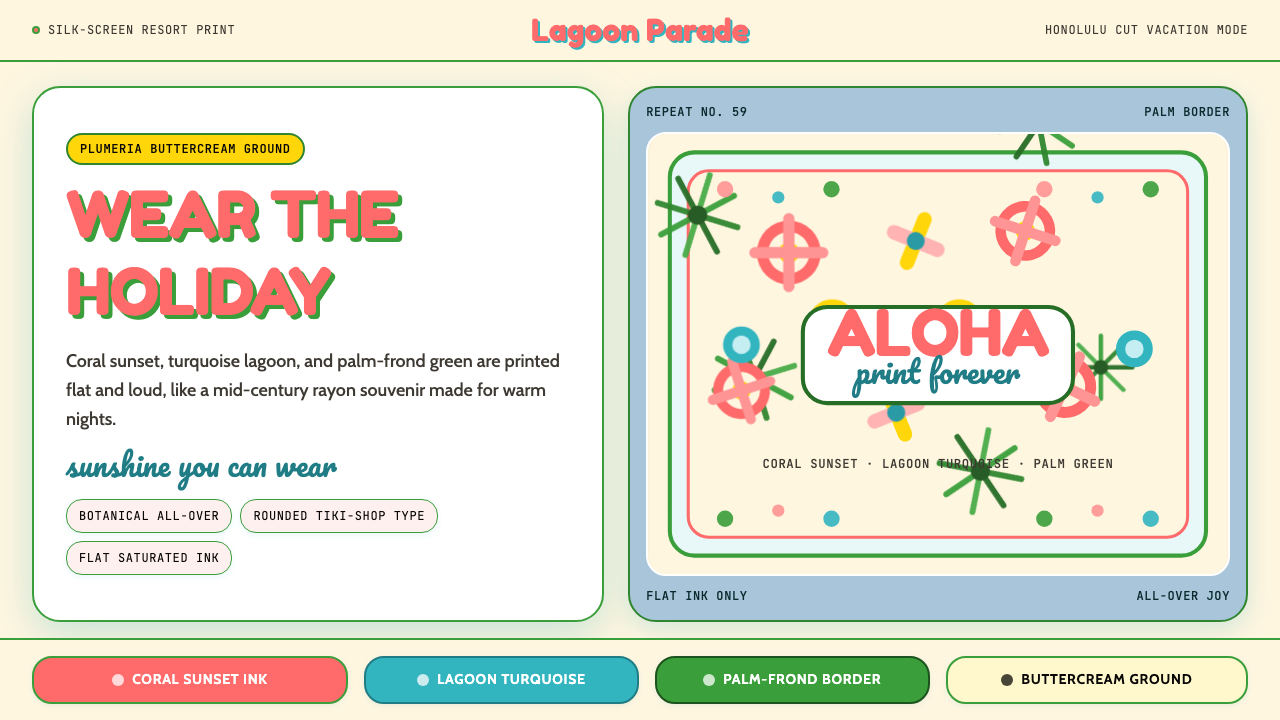 Hawaiian Aloha ShirtThe shirt is the holiday. Buttercream ground, coral Fredoka type, and flat tr…
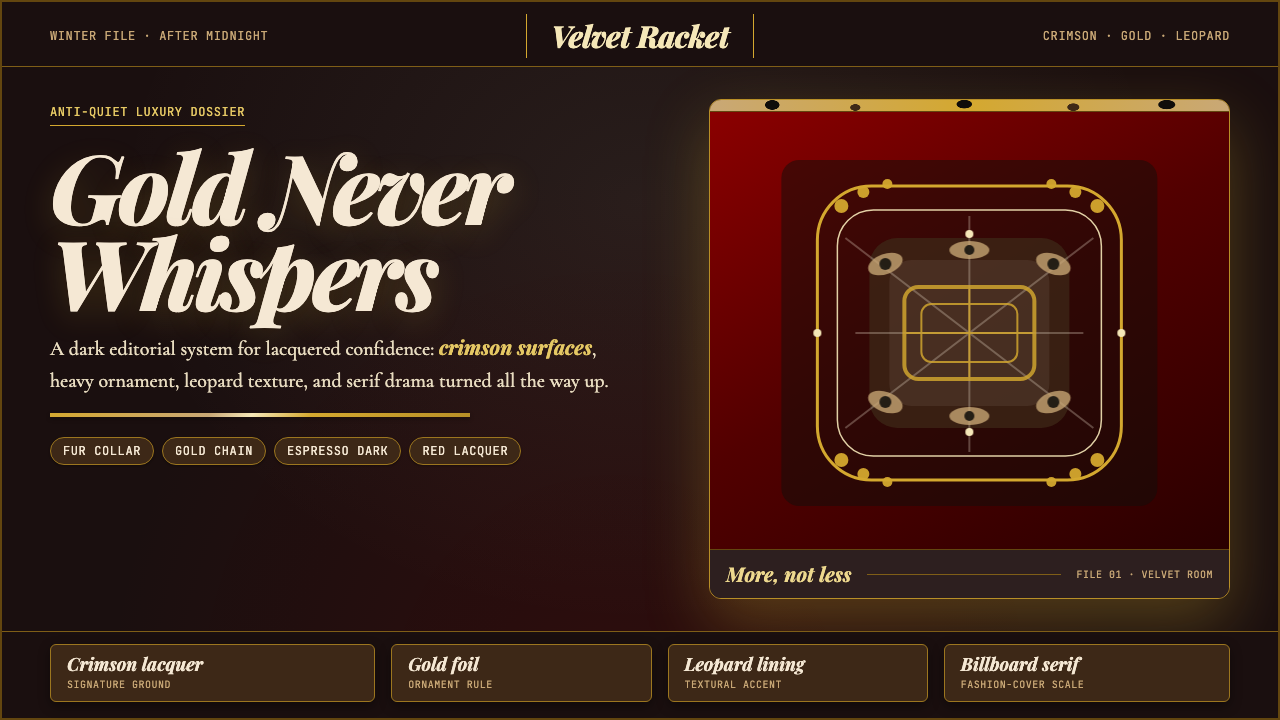 Mob Wife AestheticGlamour refuses restraint. Crimson lacquer, gold foil, leopard texture, billb…
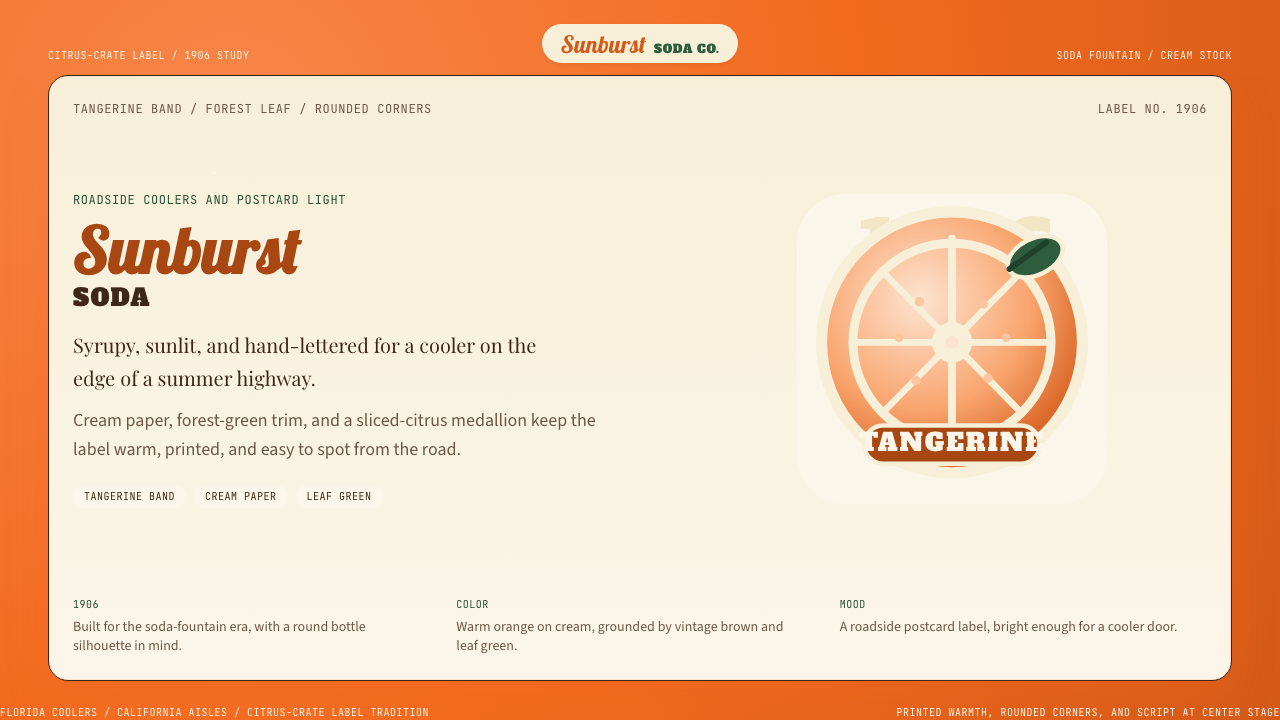 Orange Crush Soda (1906)Syrupy nostalgia. Tangerine, cream, and script make it a postcard label.
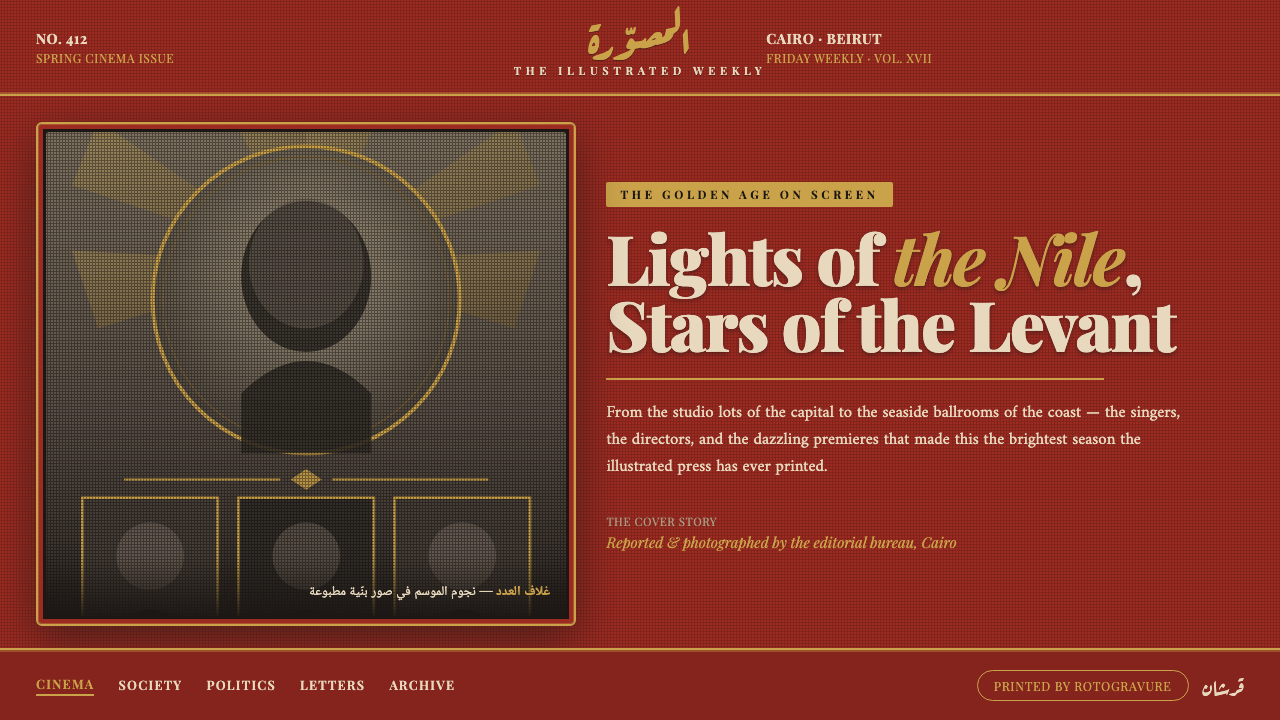 Pan-Arab Illustrated MagazineMid-century Arab press glamour. Brick-red fields, sepia halftone montage, gol…
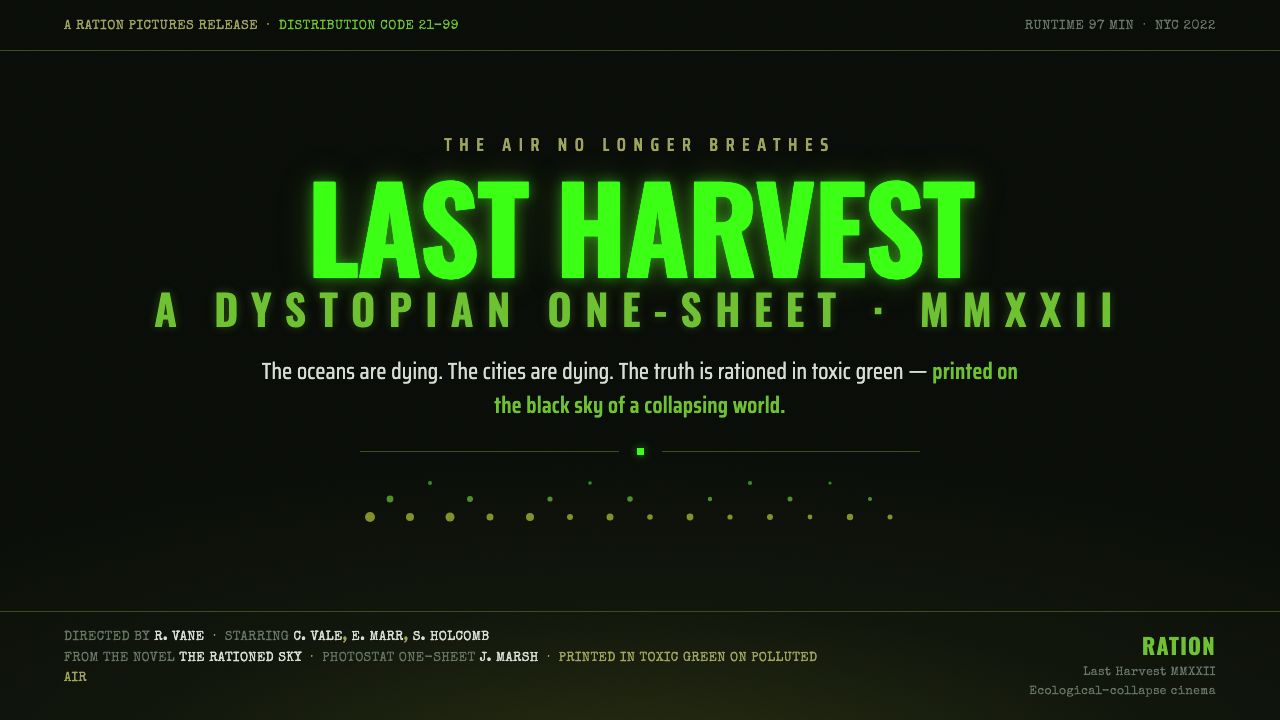 Soylent Green 1973The air no longer breathes. Toxic green titles glow over smoggy near-black, i…
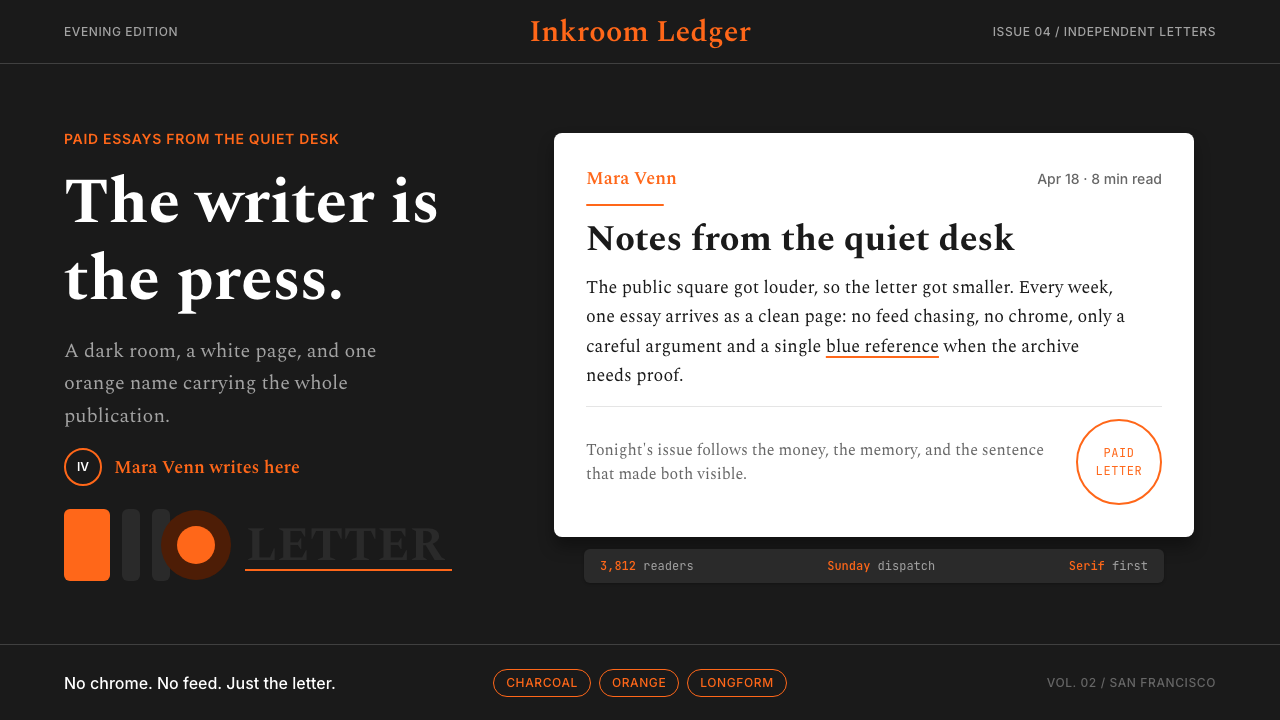 Substack Orange NewsletterLit page, dark room. Orange serif bylines ignite white cards on charcoal.