What is Wong Kar-wai — In the Mood for Love?
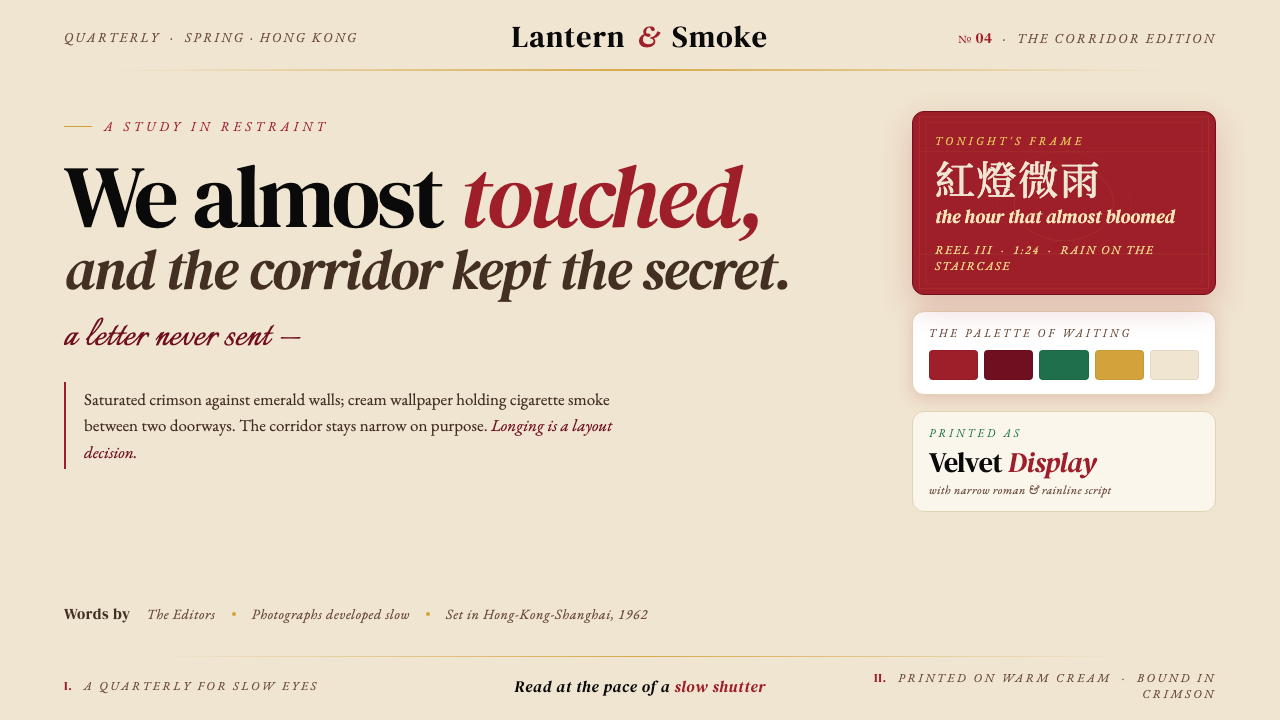
Every frame of In the Mood for Love is an act of longing held perfectly still — saturated crimson, slow shutter, and the architecture of desire.
Wong Kar-wai — In the Mood for Love in brief
Wong Kar-wai's In the Mood for Love (2000) is not merely a film; it is a fully realized visual system built from saturated color, compressed space, and time deliberately slowed. Set in 1960s Hong Kong, the film follows two neighbors — played by Tony Leung Chiu-wai and Maggie Cheung — who suspect their spouses of having an affair and find themselves drawn toward each other through a series of charged, unconsummated encounters. The emotional grammar of restraint, proximity, and longing is inseparable from the film's visual grammar of crimson qipao silhouettes, emerald-jade tenement walls, warm cream wallpaper, and Christopher Doyle's slow-shutter cinematography.
What distinguishes this aesthetic from ordinary period nostalgia is its precision. Every element — the weight of a staircase railing, the quality of light bleeding through a rice-paper screen, the exact red of a dress against a green wall — is a compositional decision. The palette is simultaneously saturated and controlled: deep, jewel-toned hues drawn from the wardrobe and architecture of Hong Kong-Shanghai emigrant culture, offset against warm neutrals that absorb rather than reflect light. The result is a visual world that feels simultaneously intimate and sealed — as if the frame itself were a room with walls closing in.
As a design language translated into digital surfaces, this aesthetic is editorial cinema rendered as interface. Type is set in deep-cut serifs and italic flourishes that carry the weight of handwritten correspondence. Layouts breathe like narrow apartment corridors — framed, intimate, deliberately constrained. Color is unapologetically saturated but rigorously curated: one dominant jewel tone anchors the composition while warm neutrals do the structural work. It is the design system of a film that understood longing as a spatial condition.

Where does Wong Kar-wai — In the Mood for Love come from?
Wong Kar-wai's visual language did not emerge from a single film or a single collaborator. It accumulated across a decade of Hong Kong New Wave filmmaking that began with his debut, As Tears Go By, in 1988. By the time Chungking Express appeared in 1994 and Happy Together in 1997, Kar-wai had established a working method inseparable from his aesthetic: no complete script before shooting, extended shooting periods, improvisation between director and cinematographer, and a willingness to build a film's visual identity through accumulation rather than plan. In the Mood for Love was shot over fifteen months across multiple locations in Hong Kong, Thailand, and Cambodia — an unusually protracted process that allowed the film's visual obsessiveness to deepen with each session.
The film's chromatic foundation draws on the material culture of Hong Kong's 1960s Shanghai emigrant community. Wong Kar-wai's own family had relocated from Shanghai to Hong Kong in 1963, and his childhood memories of that community — its fashions, its apartment interiors, its social codes — saturated the film's visual research. Costume designer William Chang sourced or created more than twenty qipao garments in different colorways for Maggie Cheung's character, each one functioning less as wardrobe than as a mood signal: the shade of red telegraphing emotional temperature, the fit and silhouette encoding social constraint. The emerald-jade and deep teal walls came from Chang's meticulous recreation of period tenement interiors in which color was used structurally — as partition, as atmosphere — rather than decoratively.
Cinematographer Christopher Doyle, who had already collaborated with Kar-wai on Chungking Express and Happy Together, brought a physical and experimental approach to the camera that was essential to the film's look. His use of slow-shutter and step-printing techniques — shooting at higher frame rates and then printing only selected frames — produced the film's signature blurred-motion sequences: figures moving through corridors and stairwells in smeared, painterly trails of color. This was not digital manipulation but analog experimentation, achieved in the camera and in the printing lab. The effect transforms movement into duration, making every walk up a staircase feel like a memory already in the process of fading.
In the Mood for Love sits within the tradition of the Hong Kong New Wave, a movement that emerged in the late 1970s and 1980s among filmmakers who had studied abroad — at London Film School, at New York University, at Paris conservatories — and returned to bring European art-cinema sensibilities into a local commercial industry. Directors like Ann Hui, Tsui Hark, and Patrick Tam established the movement's parameters; Wong Kar-wai extended them into a more subjective, temporally fragmented register that drew comparisons to the French Nouvelle Vague and the work of Michelangelo Antonioni. The film's international reception — it won the Best Director prize at the 2000 Cannes Film Festival — confirmed that its visual language had achieved the rare status of being simultaneously rooted in a specific cultural moment and universally legible as a grammar of longing.
What defines the Wong Kar-wai — In the Mood for Love look?
Jewel-Saturated Color
The palette centers on deep, saturated hues drawn from the wardrobe and interiors of 1960s Hong Kong-Shanghai emigrant culture: crimson and vermilion reds, emerald and teal greens, warm amber yellows, deep indigo. These are not pastels or approximations — they are full-intensity jewel tones. They appear in compression against one another and against warm cream or aged-ivory neutrals that prevent the palette from becoming overwhelming. The logic is not variety but depth: fewer colors, each pushed to its most expressive limit.
Temporal Blur and Slow Shutter
One of the film's most recognizable techniques — achieved through step-printing and slow-shutter cinematography — renders moving figures as smeared trails of color against sharp architectural backgrounds. In a design system, this quality is translated into layered semi-transparent surfaces, soft overlapping elements, and the deliberate use of motion blur or depth-of-field effects to convey that some elements exist in a different temporal register than others. Sharpness is reserved for what matters most; everything peripheral softens into atmosphere.
Compressed and Framed Space
The film's locations — narrow stairwells, corridor kitchens, rooms-within-rooms — impose a vertical, compressed visual logic. Compositions are tightly framed, with doorways and windows acting as frames-within-frames that isolate figures from their environments and charge negative space with emotional weight. In a design context, this translates to narrow column widths, strong vertical rhythm, deliberate use of contained containers and bordered elements, and compositions that use the edges of the frame as active structural elements rather than neutral boundaries.
Serif Typography with Italic Warmth
Where the film's language is literary and intimate — the voiceover, the intertitles, the sense of private correspondence — its design equivalent is found in typefaces with strong serifs, visible ink-trap details, and an affinity for italic cuts. The italic is not used for emphasis in the conventional sense but as a default register: the entire system leans slightly, as if penning a letter that will never be sent. This is the opposite of the rational neutrality of a sans-serif system; every letterform carries some memory of the hand that drew it.
Warm Neutral Grounds
Rather than the cool white or stark black backgrounds common to contemporary digital design, this aesthetic grounds its saturated colors on warm cream, aged ivory, or deep tobacco tones. These backgrounds absorb light rather than reflecting it, giving the overall surface a tactile, almost material quality — closer to aged paper or linen than to a backlit screen. When dark grounds are used, they lean warm, toward deep amber-black or brown-black rather than cool gray-black.
Restraint as Compositional Principle
The film's emotional power comes not from what happens but from what almost happens — the glance not returned, the touch withheld, the words spoken and then unsaid. In design terms, this is the principle of productive omission: whitespace that is not empty but charged, elements placed at the edge of the frame rather than at its center, hierarchy established through absence as much as presence. The system should always feel as if something is being held back — as if the most important thing is just outside the visible area.
Pattern as Texture
The film's interiors are dense with pattern: floral wallpapers, geometric tile floors, embroidered and printed qipao fabrics. Rather than competing with the color palette, these patterns function as texture — adding depth and historical weight to surfaces without disrupting the dominant chromatic logic. In a design system, this translates to the selective use of fine geometric or floral motifs as background texture, always at low contrast relative to the dominant ground color, so that they read as surface quality rather than independent graphic elements.

Who shaped Wong Kar-wai — In the Mood for Love?
Born in Shanghai in 1958 and raised in Hong Kong from age five, Wong Kar-wai brought the remembered atmosphere of Shanghai emigrant culture directly into his filmmaking. His improvisational working method — shooting without a completed script, building narrative in the editing room — produces films that feel like memory itself: fragmented, repetitive, emotionally over-determined. Across a filmography that includes Days of Being Wild (1990), Chungking Express (1994), Happy Together (1997), and 2046 (2004), he developed a visual and tonal vocabulary now widely recognized as the definitive cinematic grammar of longing. In the Mood for Love, which he has described as a film about suppression — about what people do not say — brought that grammar to its most concentrated expression.
Australian-born cinematographer Christopher Doyle (known in Chinese as 杜可風, Du Kefeng) has been the primary visual architect of Wong Kar-wai's aesthetic across multiple collaborations. Doyle's approach to the camera is physical and intuitive — he often operates handheld, positions the lens at angles that compress or distort space, and uses available and practical light rather than formal studio setups. For In the Mood for Love, his most significant technical contribution was the step-printing technique: shooting certain scenes at higher frame rates and selectively printing frames to create the film's signature slow-motion blur. This was an analog solution that gave the film a painterly, temporally suspended quality that digital post-processing cannot convincingly replicate.
Production designer and costume designer William Chang (張叔平) is the third essential creative voice in the Wong Kar-wai visual system, having collaborated with the director on virtually every film from the beginning of his career. For In the Mood for Love, Chang sourced and created more than twenty qipao garments for Maggie Cheung, each one calibrated to the emotional register of the scenes in which it appears. His color choices for the film's interior sets — the deep teal walls, the patterned wallpapers, the warm wood and rattan furniture — constitute a material archive of Hong Kong-Shanghai domestic culture that is simultaneously historically precise and aesthetically idealized. Chang's production design is the bridge between the film's historical subject matter and its dreamlike visual intensity.
Tony Leung Chiu-wai (梁朝偉) plays Chow Mo-wan, a newspaper editor who becomes the film's central consciousness. His performance is constructed almost entirely from physical restraint — a glance held a half-second too long, a hand on a shoulder that stops before it becomes a gesture — and it represents the human embodiment of the film's central design principle. In a visual system built on productive omission, Leung's performance demonstrates that presence is most powerful when it withholds. His collaboration with Wong Kar-wai continued in 2046 (2004), where his character's relationship to suppressed desire and memory forms a direct continuation of the mood established in In the Mood for Love.
Maggie Cheung (張曼玉) plays Su Li-zhen, and her physical presence in the film is so thoroughly mediated through costume, framing, and slow-shutter cinematography that her character functions as much as a visual motif as a narrative agent. The parade of qipao — each one in a different saturated colorway, each one fitted to enclose rather than display — transforms her into the film's primary chromatic element. The color of Su Li-zhen's dress in any given scene communicates her emotional state with more precision than dialogue. Cheung won the Best Actress prize at the Berlin International Film Festival for her performance, recognition that her work required the full integration of physical bearing, emotional intelligence, and visual design into a single coherent presence.
How do you use Wong Kar-wai — In the Mood for Love today?
The Wong Kar-wai aesthetic is most effective when the work itself has something to withhold — when the design problem calls for emotional depth, intimacy, and the sense that a richer world exists just beyond the visible frame. It is a strong choice for cultural, editorial, luxury, and personal brand work: cinema-related projects, literary journals, fashion lookbooks, travel writing, fine dining, boutique hospitality. It struggles in contexts that require transparency, neutrality, or clinical precision — financial dashboards, medical interfaces, government services.
For presentation slides, the system works best when it is used sparingly and with commitment. A cover slide benefits from a single full-bleed image or color field in one of the palette's deep jewel tones — crimson, teal, or deep amber — with a title set in an italic serif at generous scale against a warm neutral. Resist the temptation to layer multiple palette colors on a single slide; the system's power comes from restraint, not variety. Content slides should treat negative space generously: one idea per slide, body text in a narrow column, call-out text in a contrasting weight of the same serif family. Data slides can adopt a period-inspired aesthetic — charts framed within bordered containers, bars in a single jewel tone against the warm ground — to maintain tonal consistency.
For web interfaces, this aesthetic suits editorial, portfolio, and long-form reading experiences more naturally than it suits transactional or utilitarian interfaces. A web page in this register uses a warm off-white or cream background, a single primary jewel tone for interactive elements and section accents, and an italic serif for display text with a more neutral companion for body reading. Navigation can be minimal — typographic only, with generous letter-spacing — and section breaks should be marked by thin rules or soft borders rather than bold dividers. Image treatment matters enormously: photography should be warm-toned, slightly desaturated, and cropped tight to focus on detail and texture rather than full-scene documentation.
For editorial and marketing work — social cards, posters, magazine spreads, campaign visuals — the style lends itself to full-bleed saturated color with typography that is confident and slightly literary. A social card in this aesthetic uses one jewel-tone background color, a single line of italic serif headline in cream or ivory, and perhaps a small flourish or rule as the only graphic element. The feeling should be closer to a film still than to an advertisement. Marketing campaigns benefit from consistency across the palette: choosing two colors from the system — say, crimson and cream — and using only those across a campaign produces stronger work than using the full palette freely.
The most common mistake when applying this aesthetic is mistaking saturation for the system's core principle. Saturated color is one ingredient, but the system's actual logic is compression and restraint: things withheld, space compressed, warmth controlled. Designers who apply the jewel tones to a layout that is otherwise open, airy, and generous in negative space will find that the colors feel decorative rather than structural. The palette needs the narrow frame, the tight crop, and the warm neutral ground to do its work. Similarly, mixing this aesthetic with contemporary flat design or glassmorphism trends undermines the tonal coherence the system depends on — the mood requires commitment.

Wong Kar-wai — In the Mood for Love — FAQ
Is this aesthetic only appropriate for romantic or melancholic subjects?
Not exclusively, though it does carry a strong emotional signature that cannot be entirely separated from its cinematic origins. The system works wherever the desired feeling is depth, intimacy, and a sense of curated experience — which includes wine, travel, fashion, architecture, literary publishing, and cultural institutions. It is less suited to contexts that need to communicate speed, efficiency, transparency, or clinical precision. The key question to ask is whether the subject has something to withhold — something that rewards the viewer for looking closely. If yes, this aesthetic is likely a strong fit.
How does this style handle light and dark modes?
The historic and canonical form of this aesthetic is warm-ground light: cream, aged ivory, or warm white backgrounds with saturated jewel tones and deep type. A dark inversion is possible but requires commitment. In a dark mode, the ground should lean toward deep tobacco brown, warm near-black, or aged charcoal — not cool gray or pure black, which kill the warmth that holds the palette together. On a dark ground, the jewel tones shift in behavior: crimson deepens toward burgundy, teal brightens toward aqua. One dominant color works better than several competing hues. The dark variant reads as nighttime in the same world — appropriate for late-evening editorial or atmospheric landing pages — rather than as a fundamentally different design.
Can this aesthetic work for data-heavy or information-dense interfaces?
With care, yes. The palette's jewel tones work well as categorical colors in chart legends, provided no more than two or three are used simultaneously — the system is not designed for the large color sets that complex data visualization often requires. The warm neutral ground gives charts a period-editorial quality that can be genuinely distinctive in contexts dominated by cool-white dashboard conventions. The key constraint is density: this aesthetic depends on negative space to function, so data-dense grids need to be given more room than a conventional dashboard would allocate. Think of it as a data visualization aesthetic for annual reports and curated data journalism rather than for real-time operational dashboards.
How does this style relate to other Asian-influenced or Hong Kong design aesthetics?
The Wong Kar-wai aesthetic is specific enough that it should not be used as a proxy for Asian design aesthetics generally. It draws on a very particular cultural moment — 1960s Hong Kong-Shanghai emigrant culture — and a very particular artistic sensibility — the Hong Kong New Wave's fusion of European art-cinema technique with local material culture. It shares some chromatic characteristics with certain strands of Japanese wabi-sabi aesthetic (warmth, the beauty of impermanence) but is far more saturated and emotionally insistent. It is distinct from the clean geometric modernism of Taiwanese design or the graphic boldness associated with Japanese commercial culture. Applying it to any Asian cultural context other than the one it references risks a kind of visual conflation that flattens cultural specificity.
What is the relationship between this design aesthetic and nostalgia — and is that a problem?
The aesthetic is deeply inflected by nostalgia — but so is the film, deliberately and self-consciously. Wong Kar-wai does not use period detail to recreate the past; he uses it to examine the emotional texture of memory and longing. The design system works the same way: it should not be applied to projects that need to communicate contemporaneity, forward momentum, or innovation as their primary values, because the visual language carries an irremovable backward lean. Used knowingly, this quality is an asset — it signals depth, curation, and an attention to the past that reads as sophistication. The trap is applying it to contexts where it creates dissonance: a startup promising disruption, a technology platform claiming to reinvent the future. The question is whether the nostalgia serves the work or contradicts it.
Related design styles
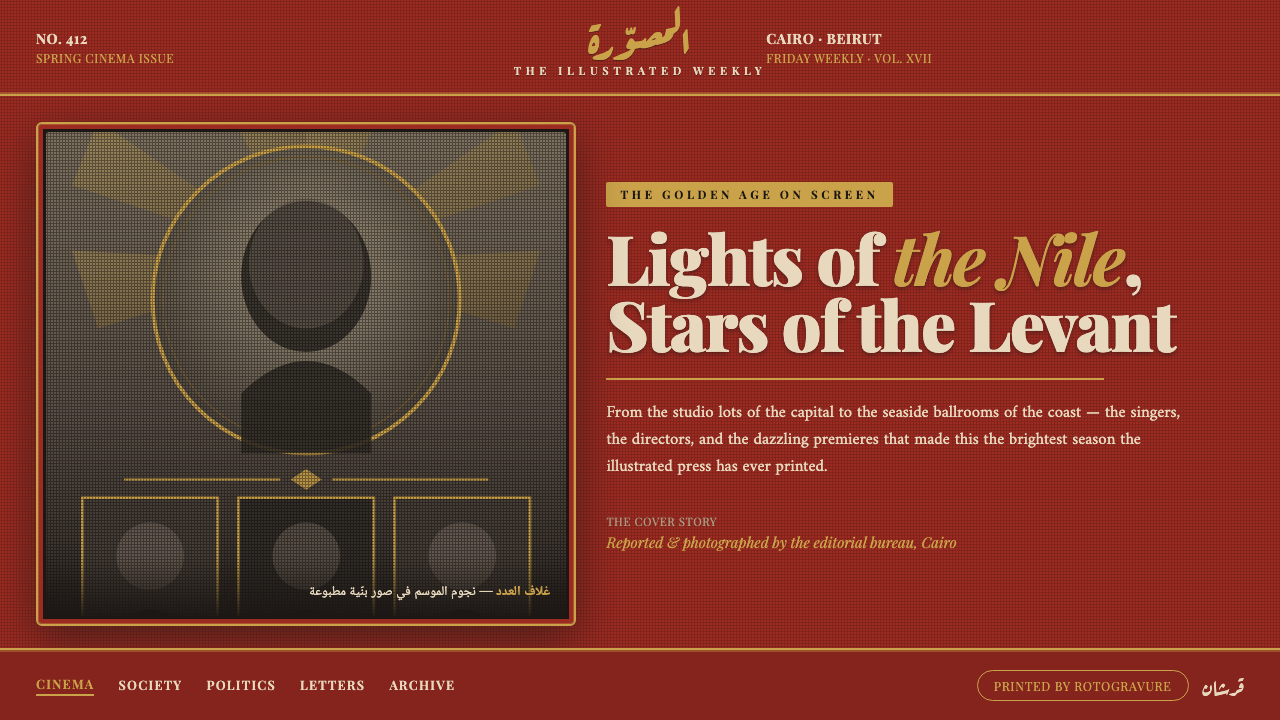 Pan-Arab Illustrated MagazineMid-century Arab press glamour. Brick-red fields, sepia halftone montage, gol…
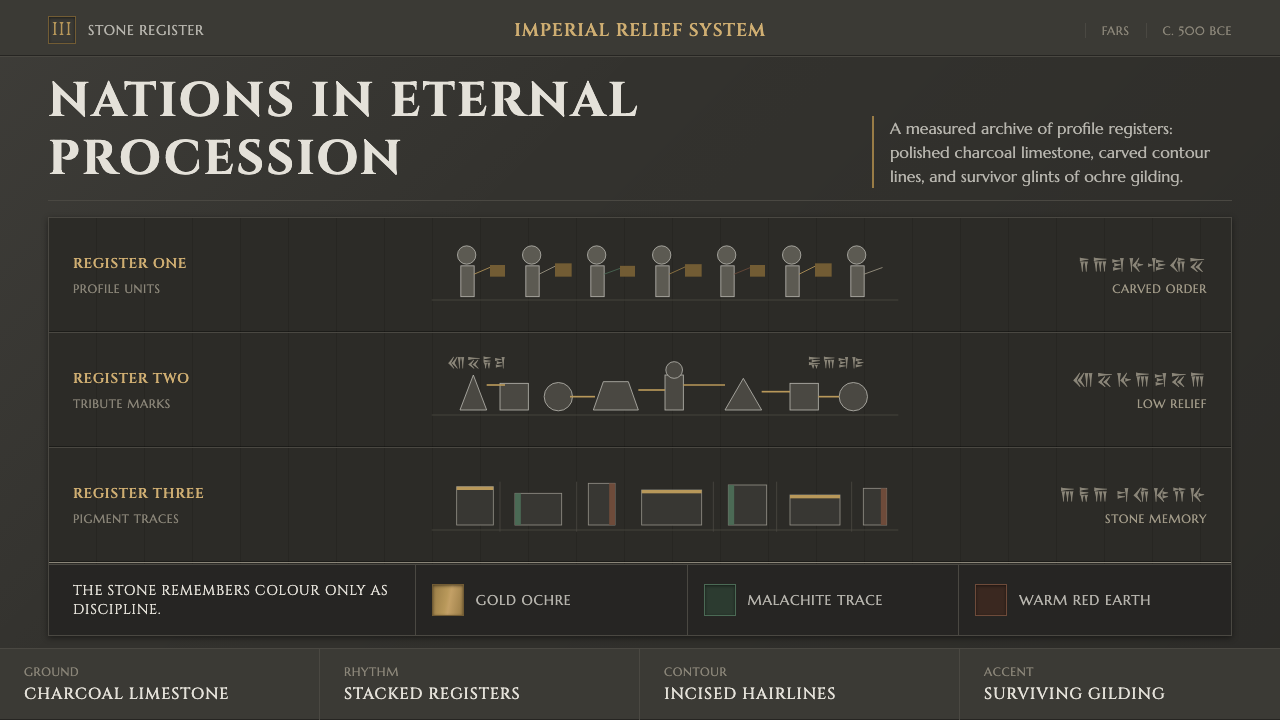 Achaemenid Persepolis ReliefImperial restraint in stone. Charcoal registers carry ochre, green, and red p…
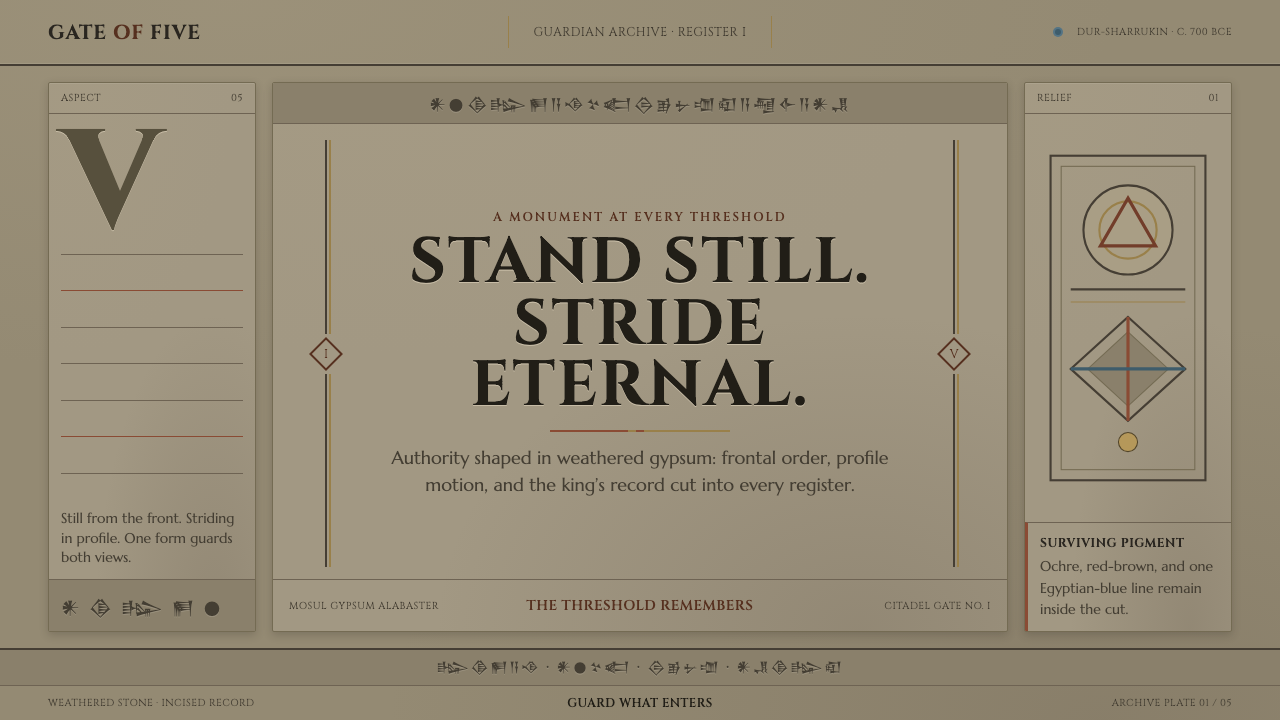 Assyrian Lamassu ReliefAuthority carved into silence. Buff-gray stone, monumental capitals, and cune…
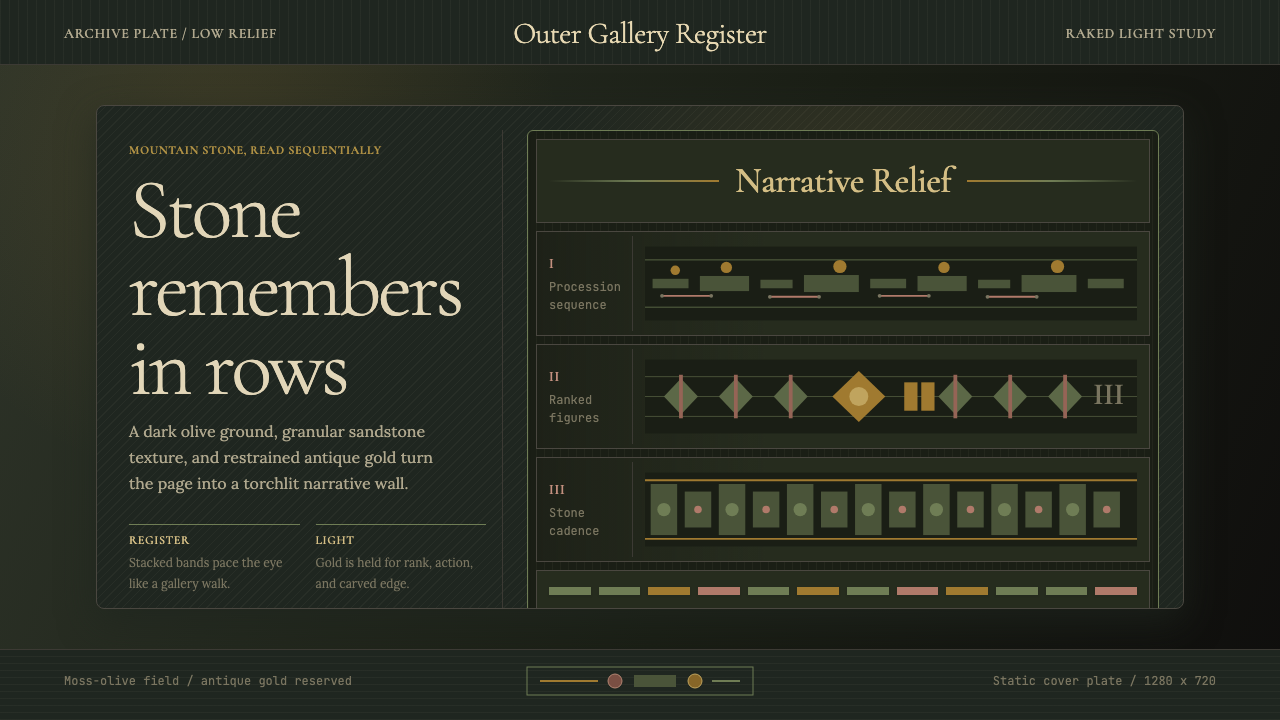 Cambodian Angkor Bas-ReliefStone speaks in shadow. Olive registers and antique gold carve a torchlit arc…
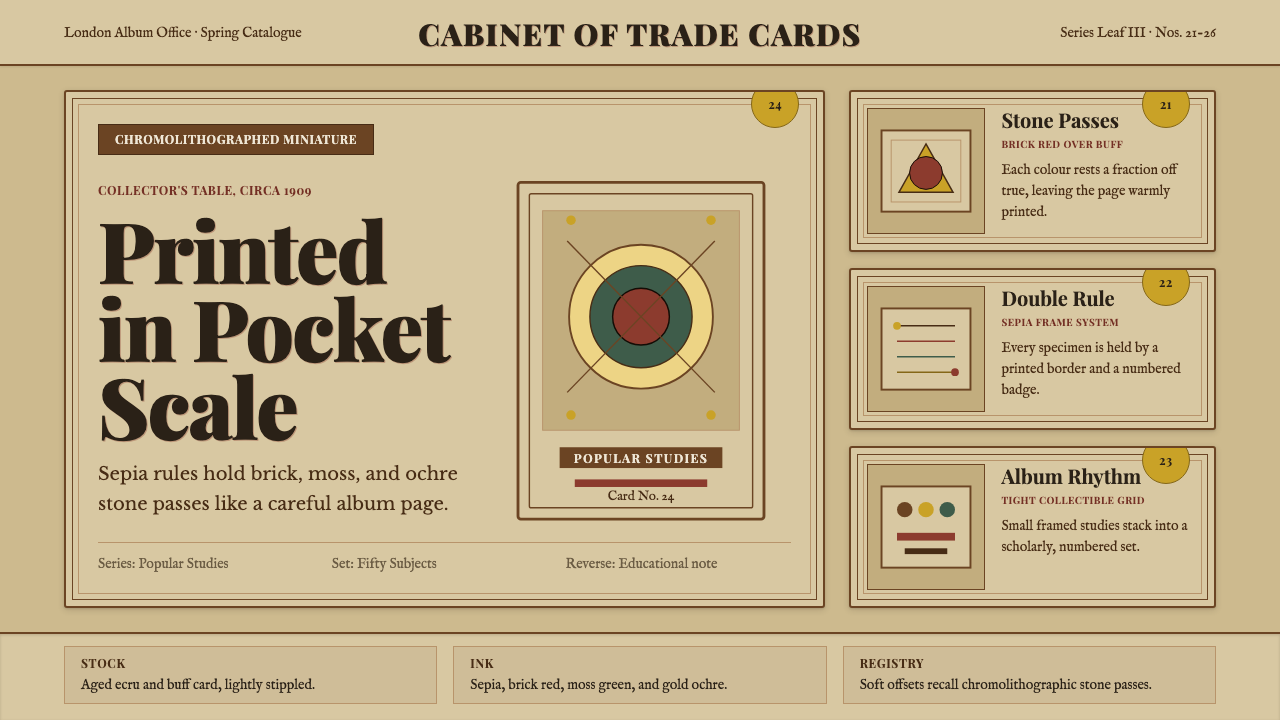 Cigarette Card SetCollectible scholarship. Sepia double-rules, buff stock, and ochre badges fra…
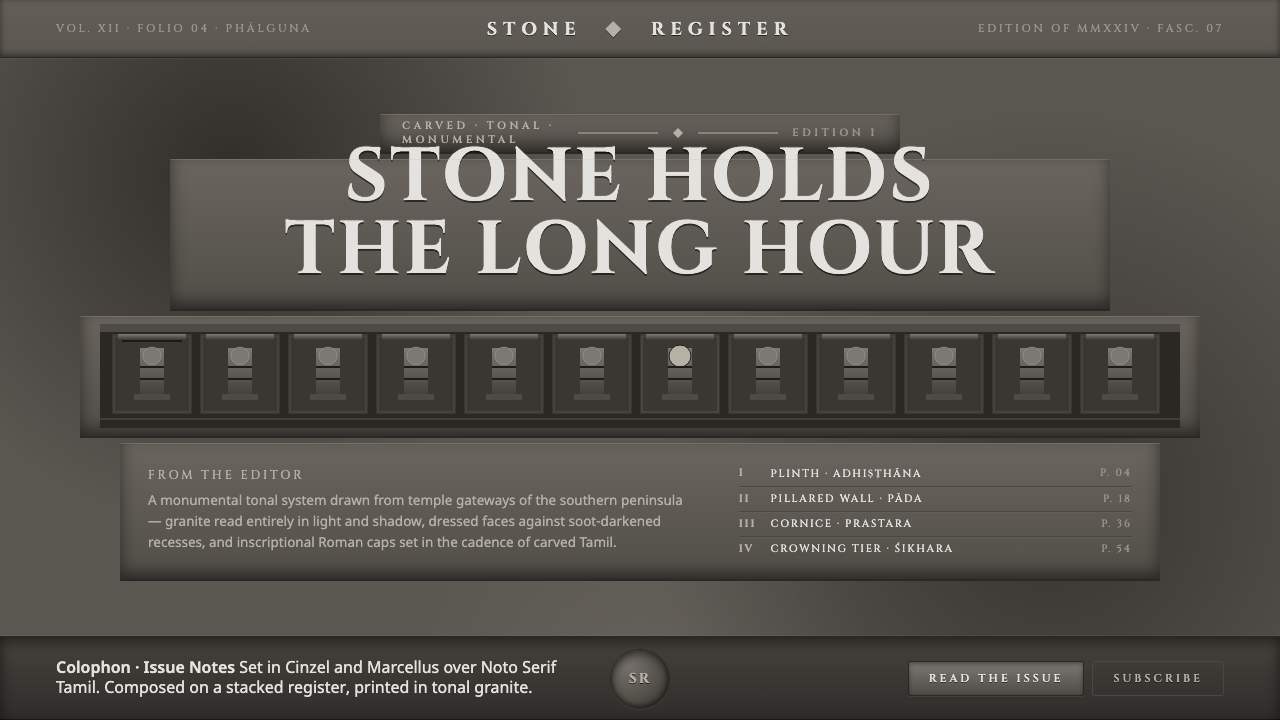 Dravidian Granite GrayscaleRead entirely in grayscale. Soot-dark recesses against dressed granite, Cinze…