What is Substack Orange Newsletter?
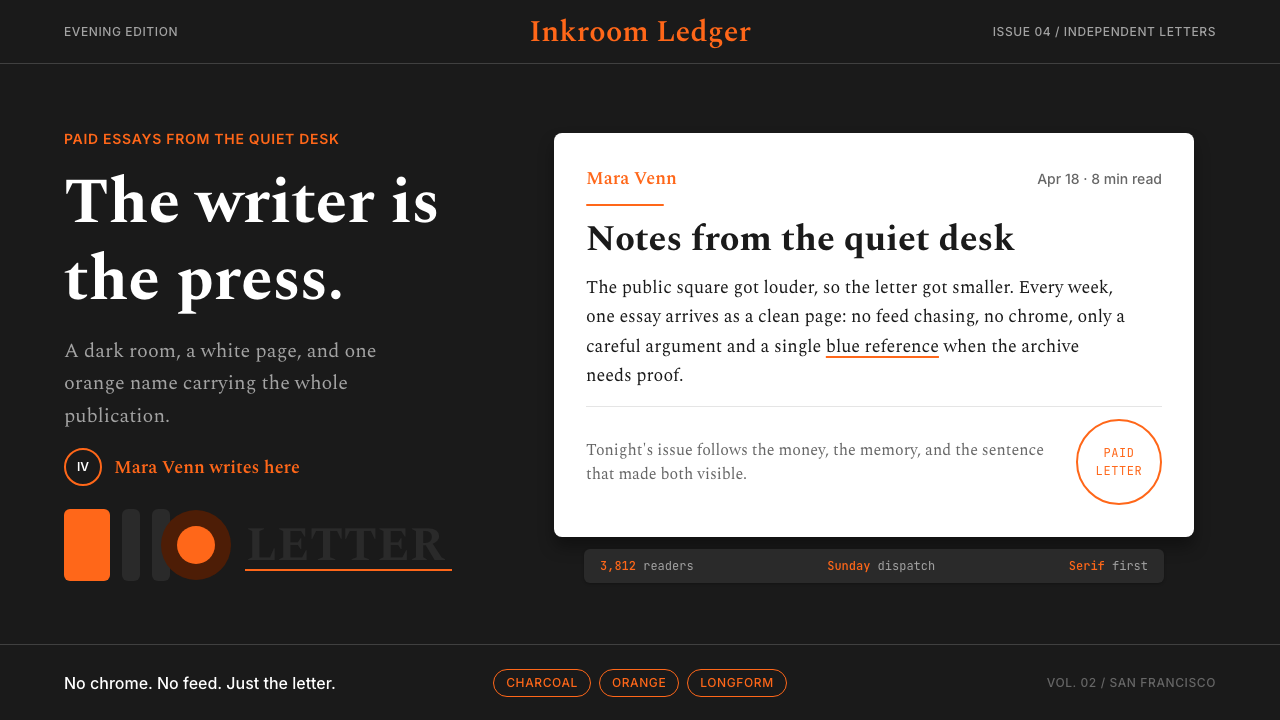
Substack turned writers into publishers — and its visual identity made the byline the only brand that matters.
Substack Orange Newsletter in brief
Substack Orange Newsletter is a dark editorial design system built around a single governing idea: the writing is the product, and everything else must get out of its way. A deep charcoal ground surrounds white article cards, giving the reading surface the quality of a lit page in a dim room. One signature orange — warm, saturated, and unapologetic — marks author names, active states, and editorial accents. Beyond that, the palette holds its breath.
The design system belongs to a lineage of editorial restraint that stretches from magazine mastheads to broadsheet newsrooms. Its visual logic is deliberately anti-app: no gradients, no illustration, no gamified engagement patterns. Navigation is typographic. Cards are clean. The hierarchy moves from author to headline to body, not from thumbnail to engagement metric. In a landscape of notification-red and dopamine-blue, the orange is almost contrarian — warm rather than urgent, editorial rather than commercial.
What makes the dark variant distinctive is the inversion it performs. Classic Substack operates on white or light cream, where orange functions as accent. In the dark version, charcoal becomes the dominant ground, and the orange intensifies: it reads less like an accent color and more like a signal fire. White type on charcoal carries the body text; the orange reserves itself for author names and structural highlights, reinforcing the platform's core proposition that the person behind the words is the brand.
Where does Substack Orange Newsletter come from?
Substack was founded in 2017 by Hamish McKenzie, Chris Best, and Jairaj Sethi in San Francisco. The founding premise was simple and radical: give writers a direct financial relationship with their readers, cutting out the advertising intermediary that had defined online media for two decades. The product launched quietly, but its timing coincided with a moment of acute disillusionment with advertiser-supported journalism, and writers began migrating to the platform in significant numbers from 2019 onward.
The visual identity that would become recognizable as distinctly Substack crystallized roughly between 2020 and 2024, shaped in large part by the work of Esther Park and the internal design team. The design brief was unusual for a technology company: produce an interface that reads like a publication, not a platform. This meant resisting the conventions of social media — infinite scroll, algorithmic feeds, engagement-optimized layouts — in favor of conventions inherited from print editorial: clear bylines, generous white space, readable body type, and minimal chrome.
The choice of orange as the signature accent has roots in the publishing and news tradition. Orange carries historical associations with urgency and broadcast — from newspaper front pages to news ticker graphics — but Substack's orange is warmer and more amber in character, closer to the glow of incandescent reading light than to the alarm of a breaking-news banner. This distinction was likely intentional: the platform needed a color that signaled liveliness without the anxiety of the attention economy.
The creator economy newsletter wave of the early 2020s gave Substack's design system cultural weight beyond its own user base. As major journalists left institutional publishers for independent subscriptions, the Substack aesthetic became visually associated with a certain posture: independent, literate, unbeholden to platform algorithms. Writers brought their audiences with them, and those audiences brought the visual language into their expectation of what serious independent publishing looked like. By the mid-2020s, the dark orange-on-charcoal variant had emerged as a natural extension — suited to late-night reading sessions, OLED screens, and the visual sensibility of an audience that had grown comfortable with dark mode as a default.
What defines the Substack Orange Newsletter look?
Signature Orange
The orange is not a neutral accent — it is the personality of the system. Warm and amber-leaning rather than red-adjacent, it carries editorial authority without the urgency associations of alert colors. In the dark variant, it intensifies against charcoal grounds to become the most visually active element on any surface, reliably marking the author's name and key interactive states. The rest of the palette exists to support and not compete with it.
Charcoal Ground
The dark background in this variant is not pure black but a deep, soft charcoal — a choice that avoids the harshness of maximum contrast while still pushing white article cards into high relief. The charcoal reads as ink-like, referencing the material culture of print without simulating it literally. It gives the interface a nocturnal quality: suited to long reading sessions, low ambient light, and the intimacy of subscription publishing.
White Article Cards
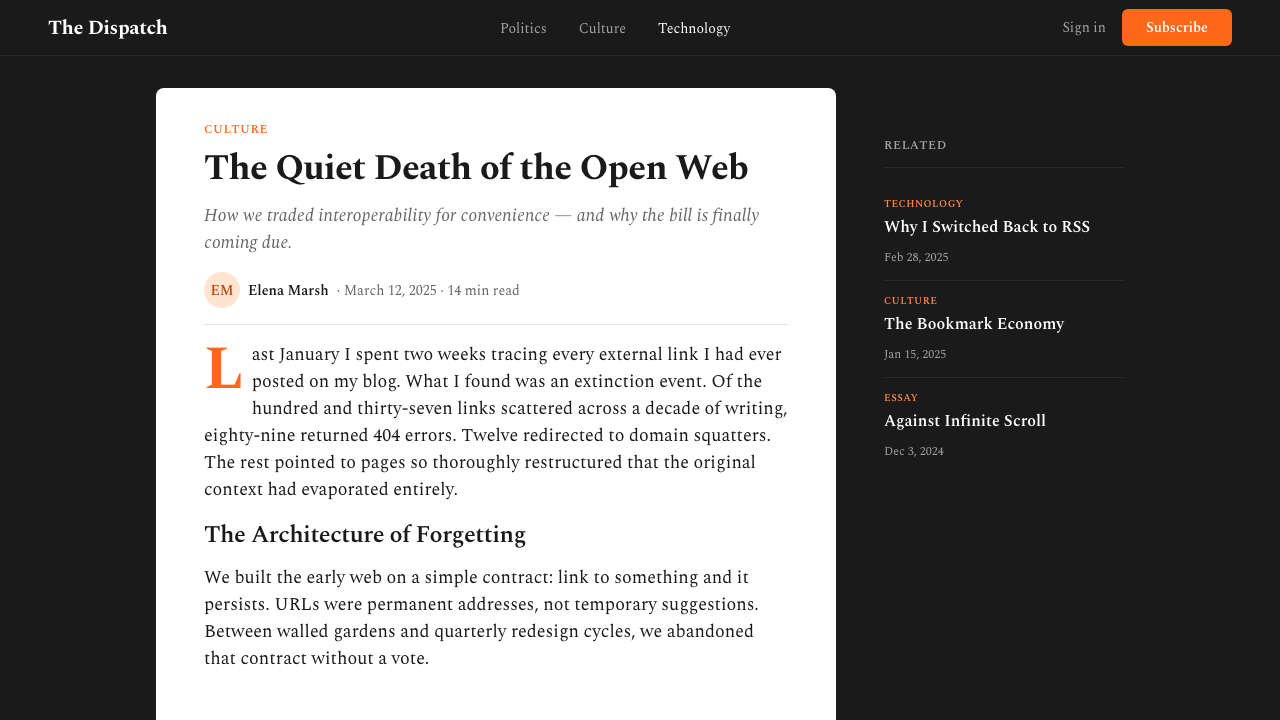
Each article appears within a white card that functions as a contained reading surface — a page within the page. This card structure is the system's primary organizational device, separating individual pieces with clarity while preserving the sense that each is a distinct published object rather than a feed item. The cards carry no decorative border or shadow gradient; they sit cleanly against the charcoal, held by contrast alone.
Serif Editorial Body Type
Where most consumer platforms default to geometric sans-serif for legibility at scale, the Substack aesthetic anchors its body text in a generous, humanist serif — a deliberate reference to the traditions of book and magazine typography. The serif carries cultural meaning: it signals that what you are reading is meant to be read, not skimmed. Heading hierarchies are handled through weight and size contrast rather than a competing sans-serif face, keeping the typographic texture unified.
Authorship as Hierarchy
The visual hierarchy in Substack's system is unusual compared to most platforms: the author's name, rendered in orange, often carries more visual weight than the headline. This inversion — person before content — reflects the platform's founding logic. Readers subscribe to writers, not topics. The design system encodes this by making the author line the first thing the eye encounters and the most chromatically distinct element on the card.
Minimal Interface Chrome
Substack's design system strips navigation, controls, and UI affordances to their functional minimum. There are no sidebars competing with reading content, no persistent notification badges, no recommendation widgets interrupting the editorial flow. Controls appear when needed and recede when not. This restraint is not accidental minimalism but a principled statement: every element that is not the writing competes with the writing.
Dark Mode as Default Posture
The dark orange-on-charcoal variant treats darkness not as an accessibility toggle but as the primary visual statement. This positions the reading experience within a nocturnal, focused register — late night, single-task, unhurried. The inversion also flatters OLED displays, where deep charcoal renders as near-black with minimal power draw, reinforcing the sense that the interface was designed with the reader's comfort rather than platform visibility in mind.
Who shaped Substack Orange Newsletter?
Co-founder of Substack, McKenzie came from a journalism background and was instrumental in shaping the platform's editorial identity. His conviction that the advertising model had corrupted independent journalism informed the product's design philosophy from the start: if writers are the product, the interface should say so visually. McKenzie's public writing and advocacy for the creator economy helped position Substack as a movement as much as a platform.
Co-founder and chief technology officer, Best was responsible for building the infrastructure that allowed Substack to scale from dozens to hundreds of thousands of publications. His technical decisions — including the emphasis on direct email delivery over platform-mediated feeds — reinforced the design philosophy at the infrastructure level. The choice to center the email newsletter as a primary product format has persistent visual consequences: every design decision must work at inbox scale as well as on the web.
Park served as a key member of Substack's design team during the period when the platform's visual identity consolidated into its recognizable form. The choices made under her influence — the editorial restraint, the primacy of the byline, the deliberate rejection of engagement-optimization patterns — represent a coherent design philosophy rather than iterative A/B testing toward higher click rates. Her work stands as an example of design that encodes values rather than merely optimizing metrics.
Third co-founder and technical co-architect of the platform, Sethi contributed to the foundational engineering decisions that gave Substack its characteristic responsiveness and simplicity. The platform's refusal to build complex algorithmic recommendation systems — a decision with deep design implications — was partly enabled by Sethi's approach to building a product where the subscription relationship itself was the discovery mechanism, removing the need for a visually complex feed.
How do you use Substack Orange Newsletter today?
The Substack editorial system is highly transferable to any context where authority through voice, clear author identity, and reading depth are the desired outcomes. Its principles — orange as sole accent, charcoal ground, white reading surfaces, serif body type, minimal chrome — form a coherent package that can be applied to newsletter design, content-heavy web interfaces, independent publication branding, and slide presentations built around dense written argument.
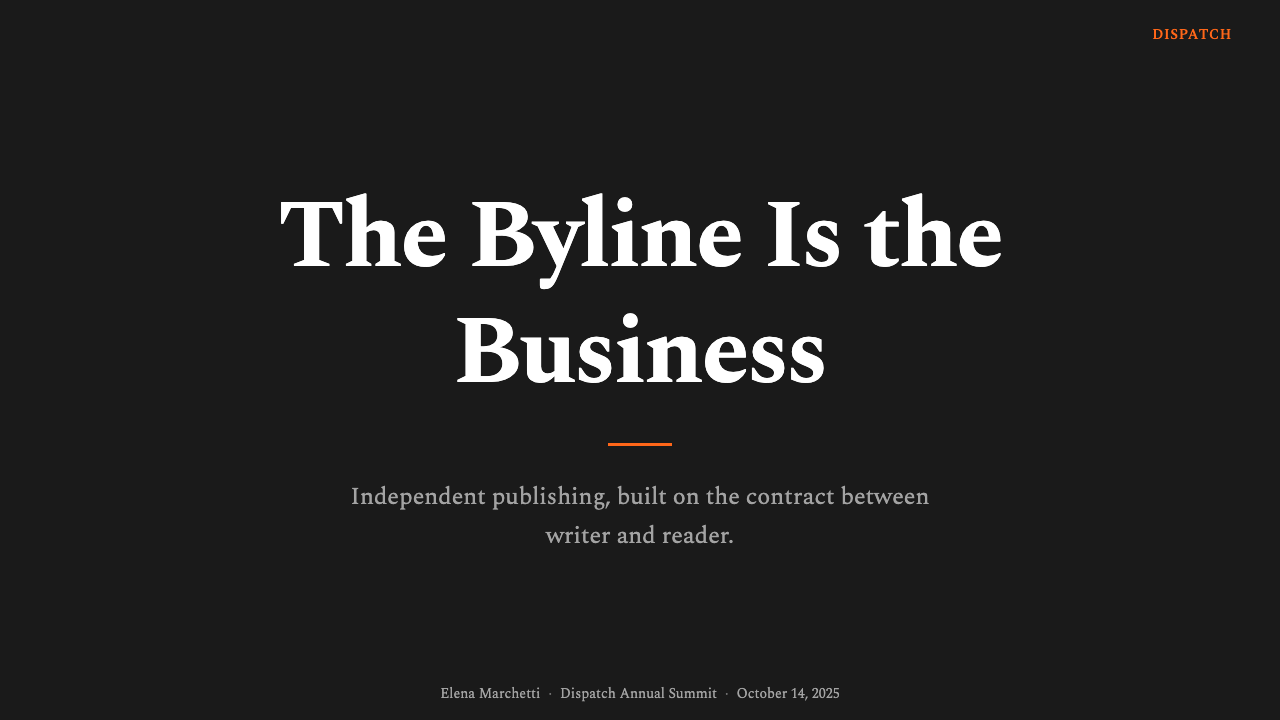
For presentation slides, the system works most powerfully on content-heavy decks where the argument is carried by text rather than data visualization. A cover slide in this register places the author's name or organization in orange against charcoal, with the title beneath in large white serif. Content slides should treat the white card as a text block with generous margins — tight type, clear hierarchy, and nothing decorative. When data appears, it should be presented in a clean table or minimal bar chart against the white card surface, with orange used only to mark the most important figure or series. Avoid the temptation to fill empty space with background graphics; emptiness in this system reads as confidence.
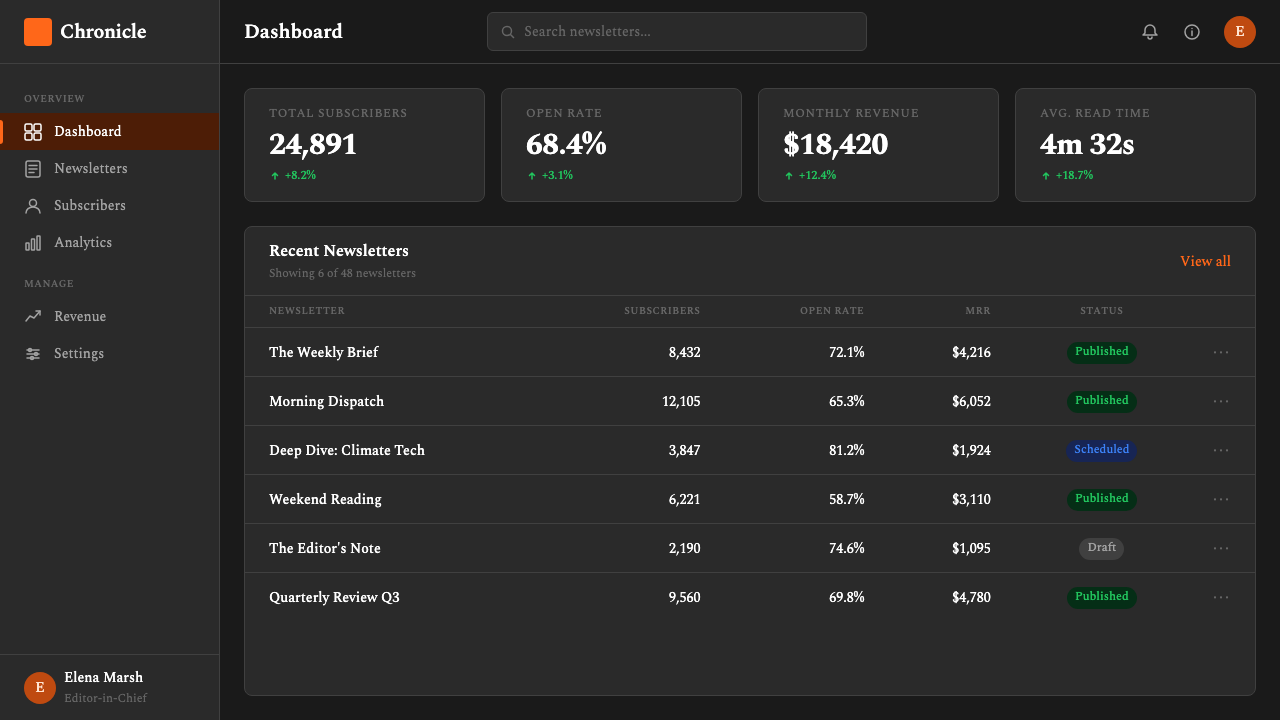
For web interfaces and dashboards, the system suits editorial-first products: independent news platforms, research subscription services, professional newsletters converted to web format, and any product where the reading experience is the core value proposition. The approach requires discipline: maintain the charcoal-white-orange three-value system strictly, resist introducing additional accent colors, and treat all secondary interface elements (timestamps, categories, subscriber counts) in a muted neutral — never in orange, which must remain rare enough to retain its authority. Navigation should be typographic and compact, keeping the reading surface dominant.
For marketing and brand materials, the Substack aesthetic projects independence, intellectual seriousness, and editorial credibility — useful for positioning products that serve creators, writers, researchers, or any audience that values depth over entertainment. A marketing page in this system uses the dark charcoal ground as a dominant surface, introduces white type for headlines at scale, and lands calls to action in orange. Section breaks are clean horizontal rules rather than illustrated dividers. Pull quotes from publications or testimonials can carry the orange author-name treatment, reinforcing the editorial reference.
A common mistake when working with this system is treating orange as a general-purpose highlight color. In the Substack visual language, orange is reserved exclusively for authorship and primary action — it marks the person and the next step. Applying it to secondary labels, decorative accents, or informational callouts dilutes its semantic role and breaks the system's hierarchy. Similarly, mixing a bright or cool-toned orange with the warm amber of the system will create a visual inconsistency that undermines the coherence of the dark editorial palette. One orange, used sparingly, is the rule.
Substack Orange Newsletter — FAQ
How is the Substack aesthetic different from other dark editorial interfaces?
Most dark editorial interfaces use a cool or neutral gray as their ground and a blue or teal accent for interactive elements — a palette inherited from developer tooling and code editors. The Substack dark variant is distinct in two ways: its ground is warmer and softer than typical dark mode grays, referencing incandescent reading light rather than screen backlight, and its sole accent is orange, which carries an editorial and print-heritage warmth that blue and teal do not. The effect is less about technical precision and more about intimate publishing — closer in feeling to a well-designed literary magazine than to a data dashboard.
Can this system work for brands that are not newsletters or publishing platforms?
Yes, but it requires clarity about what the aesthetic communicates. The Substack visual language signals independence, editorial seriousness, and the primacy of written voice. It works well for consulting practices, research organizations, independent agencies, or any brand where intellectual authority and individual expertise are the core value proposition. It tends to struggle for brands that need to project warmth, playfulness, community, or mass-market accessibility. The system is fundamentally author-centric: if there is no authorial voice at the center of the brand, the orange byline treatment has nothing to anchor it.
What makes the orange work in the dark variant without becoming overwhelming?
Restraint in application. The orange is used in at most two or three distinct roles across any given screen: the author name, the primary call to action, and occasionally an active navigation state. It never appears as a background fill for large areas, never spans full blocks, and is never used for decorative purposes. When a color this saturated and warm appears against a deep charcoal ground, it commands immediate attention — which means it can only be placed where you genuinely want attention. The discipline of limiting it makes it powerful; overuse would collapse the entire hierarchy into visual noise.
Is the serif body type essential to the system, or can sans-serif work?
The serif is load-bearing in the editorial register. It is what distinguishes the system from a generic dark-mode interface: the serif carries the cultural signal of reading, of publication, of text that is meant to be encountered at length rather than scanned. A sans-serif substitution would make the system feel more like a developer tool or a dark dashboard than an independent publication. If sans-serif is used for practical reasons — display at small sizes, localization requirements for certain scripts — it should be a humanist rather than geometric variety, and the remaining editorial signals (orange authorship, white cards, minimal chrome) would need to carry more weight to compensate for the loss of the typographic reference.
How should the system handle images and photography?
Images in the Substack editorial system are used sparingly and functionally, not decoratively. The primary image role is the article cover or header — a single photograph or illustration that anchors the piece and appears within the white card at the top of the content. Photographs should be reproduced at full bleed within the card, without additional framing or border treatments. The editorial convention is to let the image speak for itself rather than design around it. In the dark variant, a photograph within a white card creates a natural stage effect — the card lifts the image off the charcoal ground and gives it a contained, gallery-like presence. Multiple images within a single layout should be treated sparingly; if several appear, they are sequenced vertically within the reading flow rather than arranged in decorative grids.
Related design styles
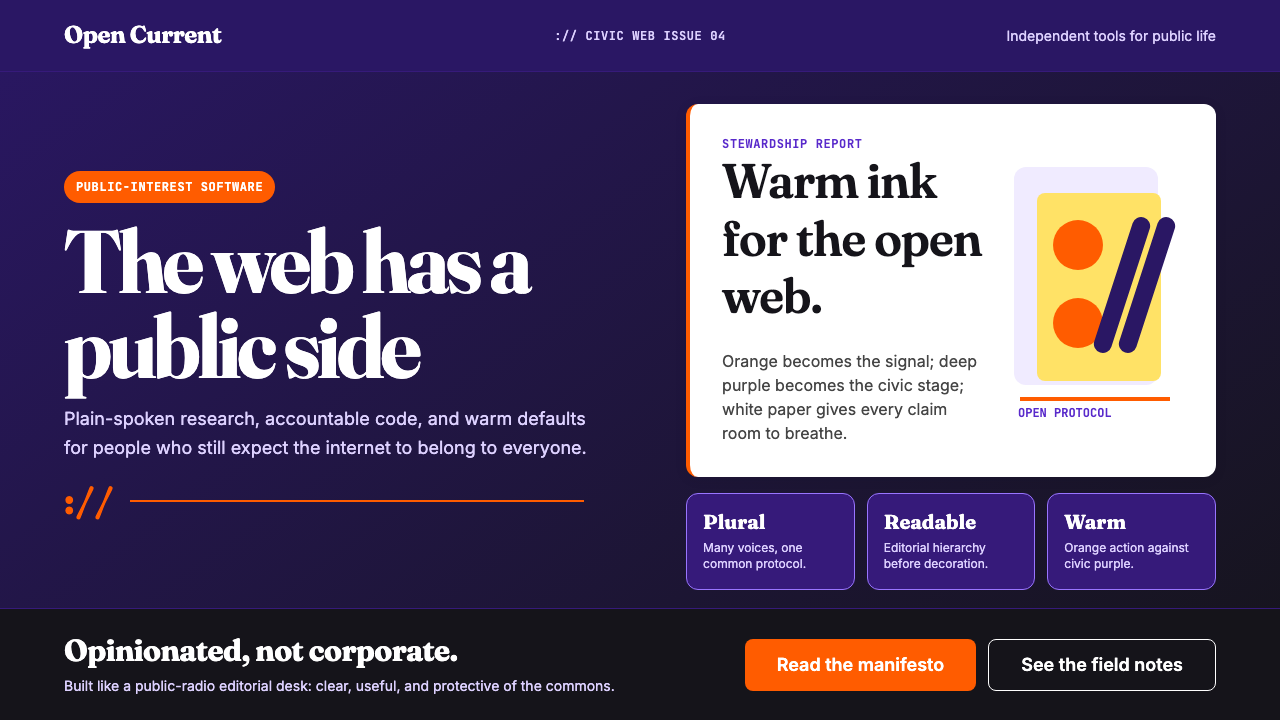 Mozilla Firefox 2024 RefreshPublic-interest warmth. Flame orange cuts through deep purple with Fraunces h…
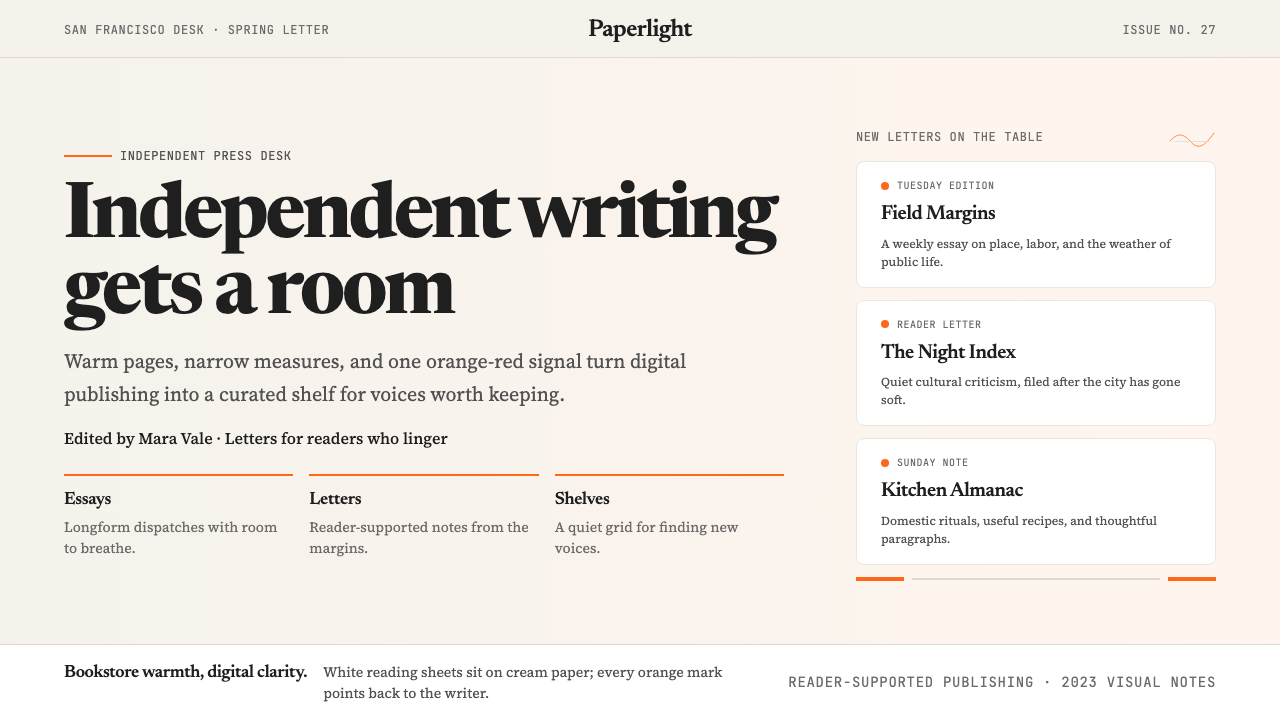 Substack 2023Writing feels shelved, not streamed. Cream paper, Newsreader serif, and one o…
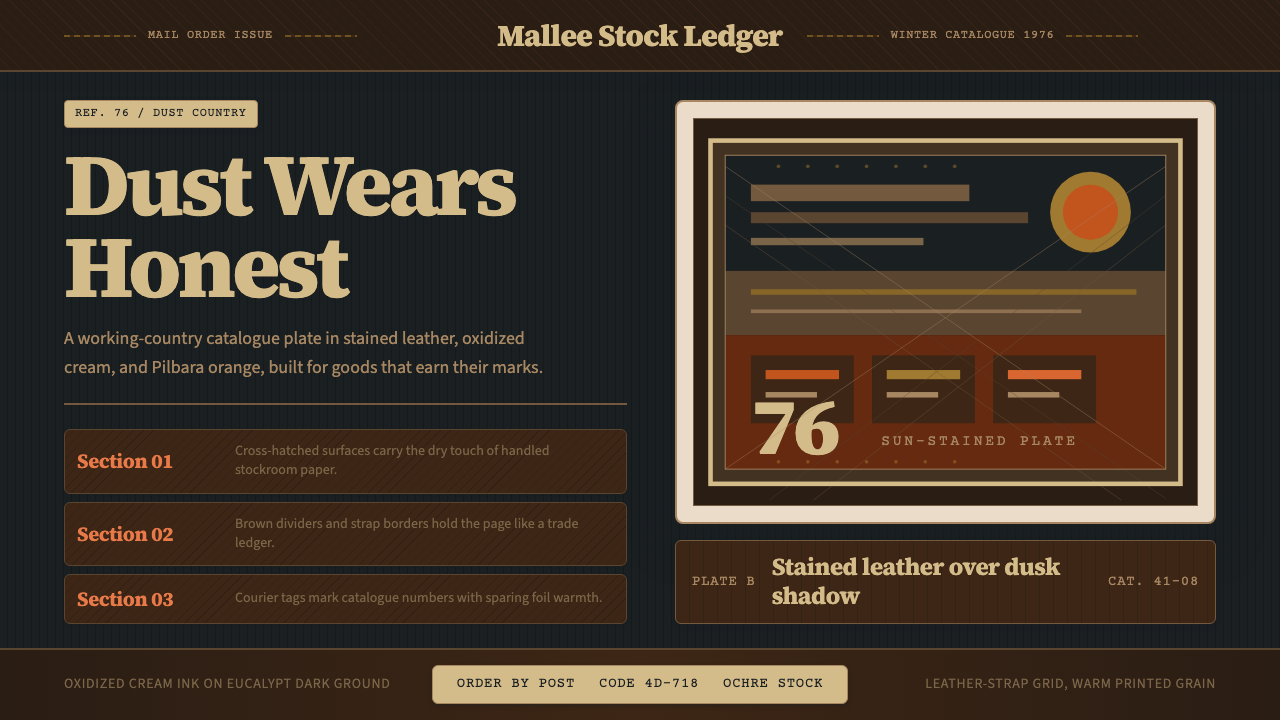 Akubra Outback (1970s Stockman)Worn honesty. Leather brown, Pilbara orange, and cream catalogue frames carry…
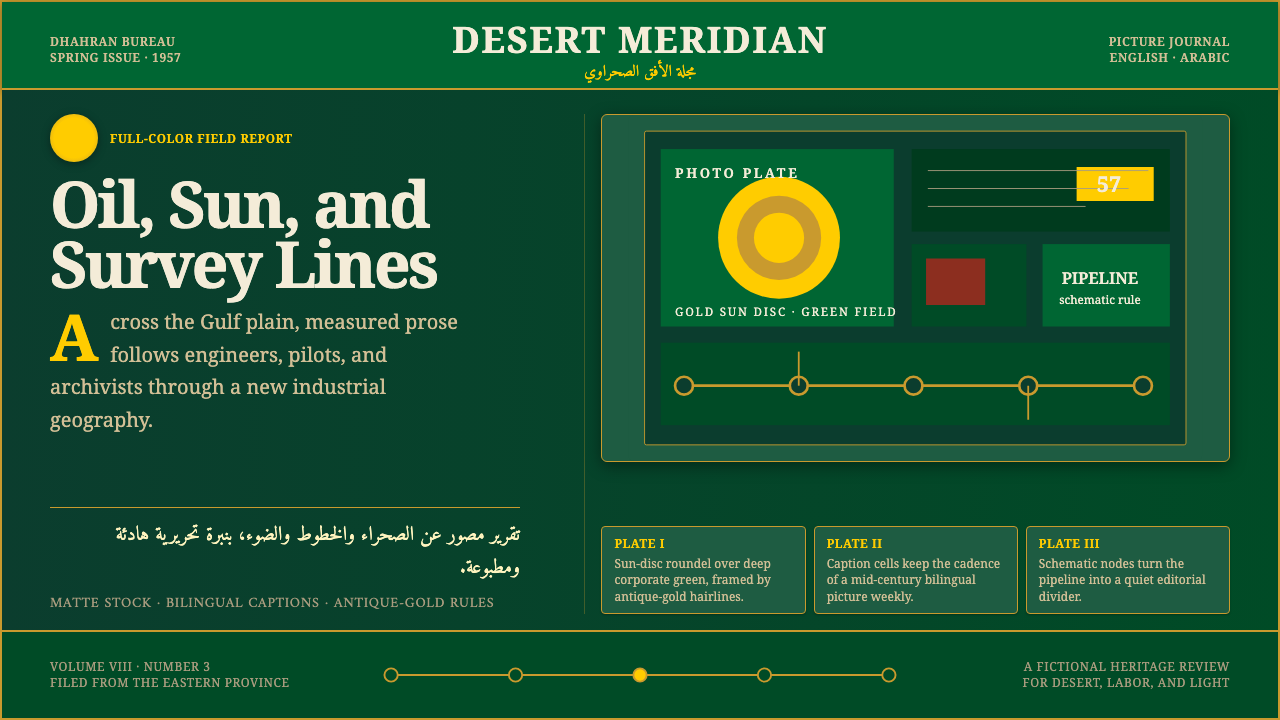 Aramco World MagazineMatte Gulf modernism. Desert green, gold sun-discs, classic serif, and naskh…
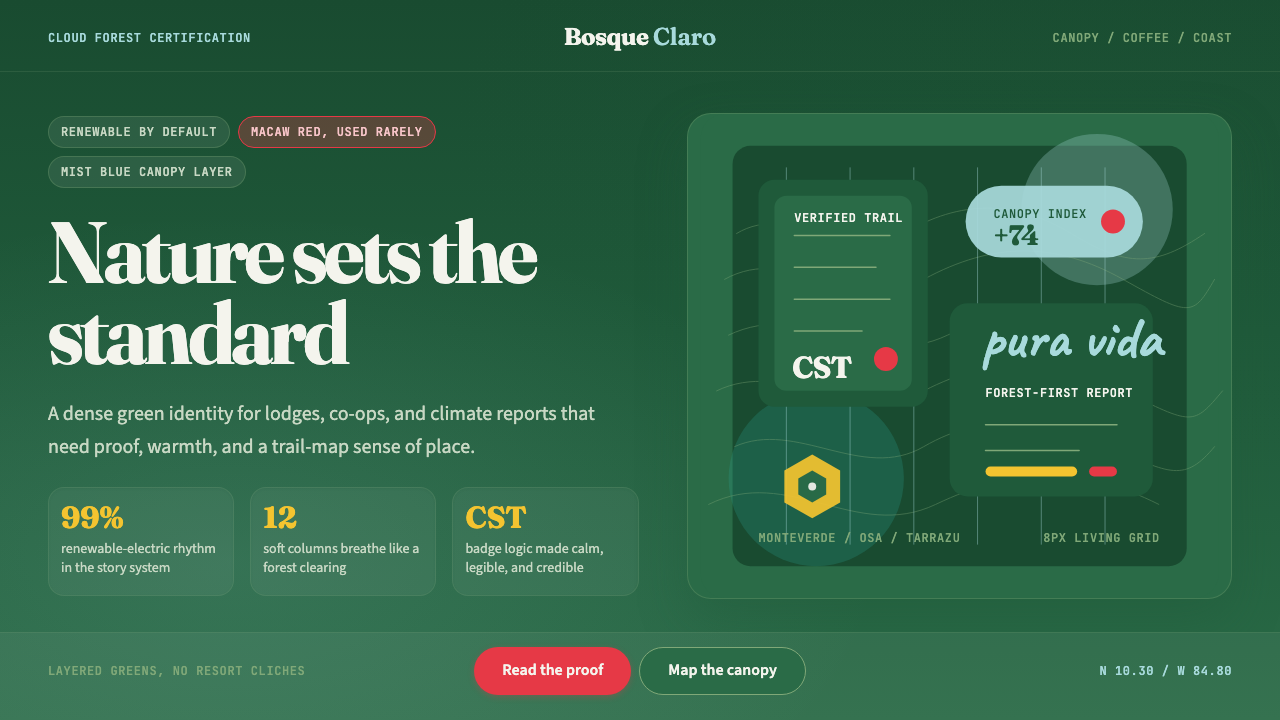 Costa Rica Pura Vida EcoAlive without greenwash. Cloud-forest green, Fraunces serif, and scarlet acce…
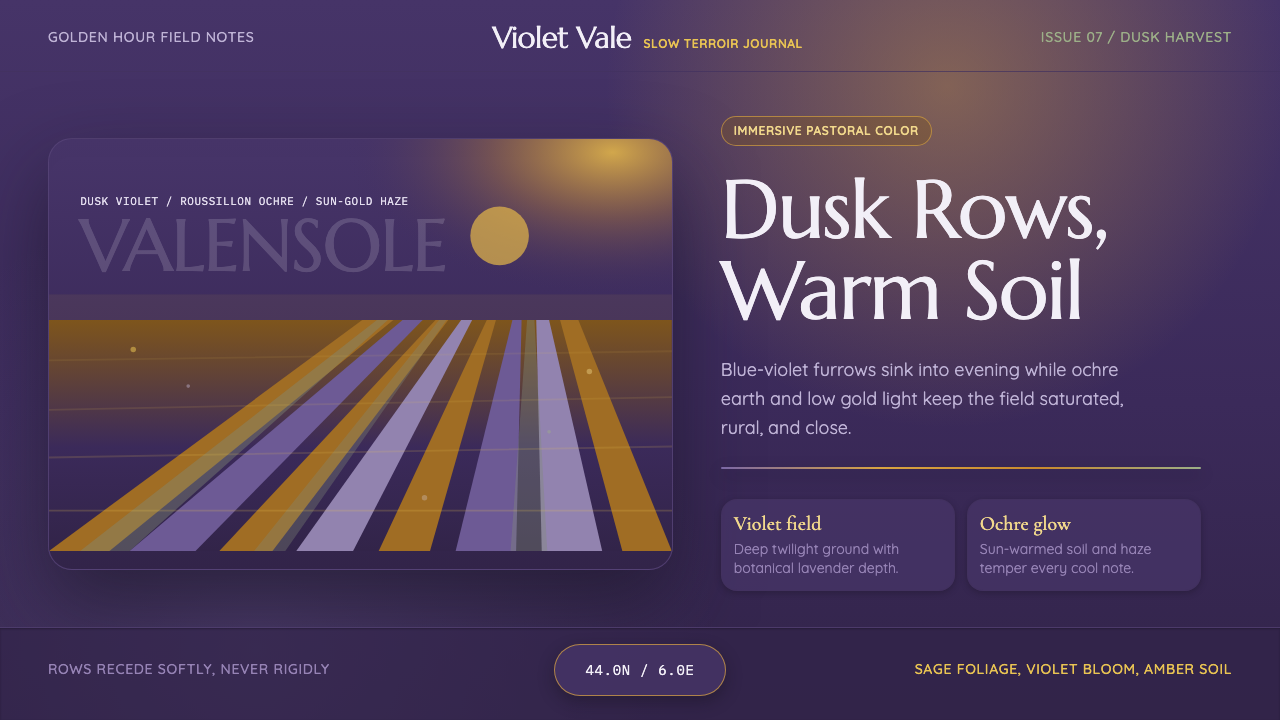 Provence LavenderSaturated pastoral dusk. Violet rows, ochre soil, and sun-gold haze build the…