What is Sri Lanka Ceylon Tea Modern?
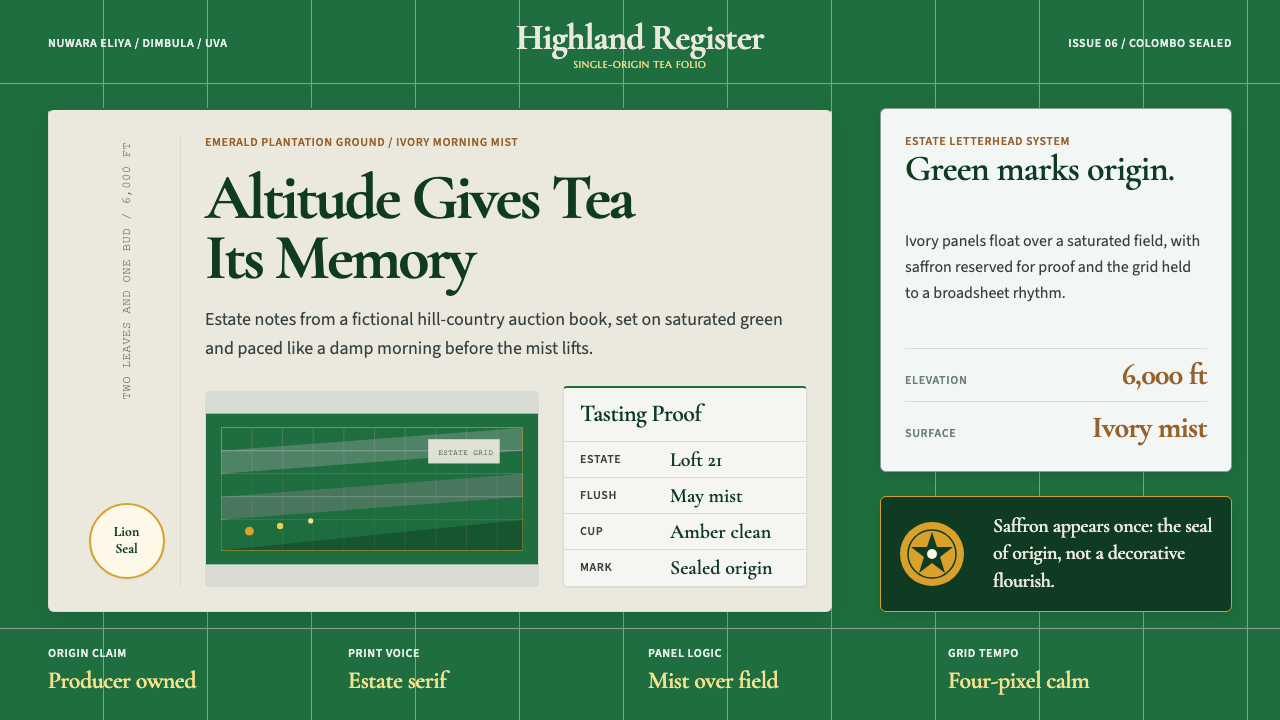
Ceylon tea's modern visual identity transforms a hillside plantation into a design language — emerald provenance, ivory stillness, and a single saffron seal that makes origin feel like authority.
Sri Lanka Ceylon Tea Modern in brief
Sri Lanka Ceylon Tea Modern is a visual identity system rooted in the saturated reality of a high-altitude plantation. Its organizing principle is provenance — origin not merely as a fact but as an aesthetic. Saturated emerald carries the color of a freshly plucked leaf. Ivory panels float like morning mist over the Nuwara Eliya hills. A saffron-gold lion seal, drawn from the national emblem, anchors authenticity without a word of explanation.
The result is editorial and unhurried — the confidence of an estate letterhead that does not need to sell itself because its credentials are already established. Photography shows altitude: terraced rows disappearing into cloud, real hands on real leaves. Copy is sparse, declarative, and lapidary.
This system emerged as Sri Lankan brands moved to reclaim their heritage from colonial-era tea marketing, which had rendered Ceylon tea in sepia nostalgia and generic tropicalia. The new visual language asserted that the island's teas were living, geographically specific products — the design equivalent of the appellation contrôlée tradition in European wine.
Where does Sri Lanka Ceylon Tea Modern come from?
Tea cultivation in Sri Lanka — known as Ceylon until 1972 — began in earnest in 1867, when James Taylor established the first commercial plantation at the Loolecondera estate in Kandy. Taylor had arrived to grow coffee, but a devastating fungal blight destroyed the island's coffee industry in the 1870s, forcing a pivot that redefined the colony's economy. By 1900, Ceylon was among the world's largest tea exporters, with highland estates spanning Nuwara Eliya, Dimbula, Uva, Kandy, and the lower-grown Ruhuna, each producing teas with distinct profiles shaped by altitude, rainfall, and soil.
The visual language of this era was almost entirely colonial: lithographed tins depicting pastoral scenes of plantation workers, romanticized British hill stations, and the colonial lion crest transplanted onto tropical foliage. Ceylon tea was sold abroad as an imperial product — its origin romanticized, its laborers aestheticized — with little connection to how the island's people understood themselves.
The shift began after independence in 1948 and accelerated after the country became the Republic of Sri Lanka in 1972. The government established the Tea Board to promote the nation's teas internationally under their own identity. The decisive moment came in 1988, when Merrill J. Fernando — trained as a tea taster in London — founded Dilmah with the determination to maintain direct quality control from bush to cup. His insistence on single-origin certification and a visual identity centered on the island's own landscape became a template subsequent Sri Lankan brands would follow.
Anselm Perera and other designers for Dilmah and contemporaneous Sri Lankan brands developed the core vocabulary: saturated emerald from the actual color of the highlands, the ivory panel evoking mist, and the saffron-gold lion seal drawn from the national flag. This was a post-colonial act of visual reclamation — asserting that the origin story was not nostalgia but a living geographic fact. The style found fullest expression in the premium segment, where brands like Basilur (founded 2008 in Colombo) extended the vocabulary into gift-packaging that treated the tea tin as a collector's object.
What defines the Sri Lanka Ceylon Tea Modern look?
Provenance Color
The dominant hue is a deep, saturated emerald that references the actual color of the highland plantation — the two-leaves-and-a-bud of hand-plucking at elevation, seen against morning mist. This is not a generic tropical green; it has the density and coolness of altitude. Against this ground, ivory and saffron-gold function as counterweights: ivory provides the neutral breathing space that lets the emerald read as landscape, saffron provides the single warm accent that signals heritage and national identity.
Mist Panels and Negative Space
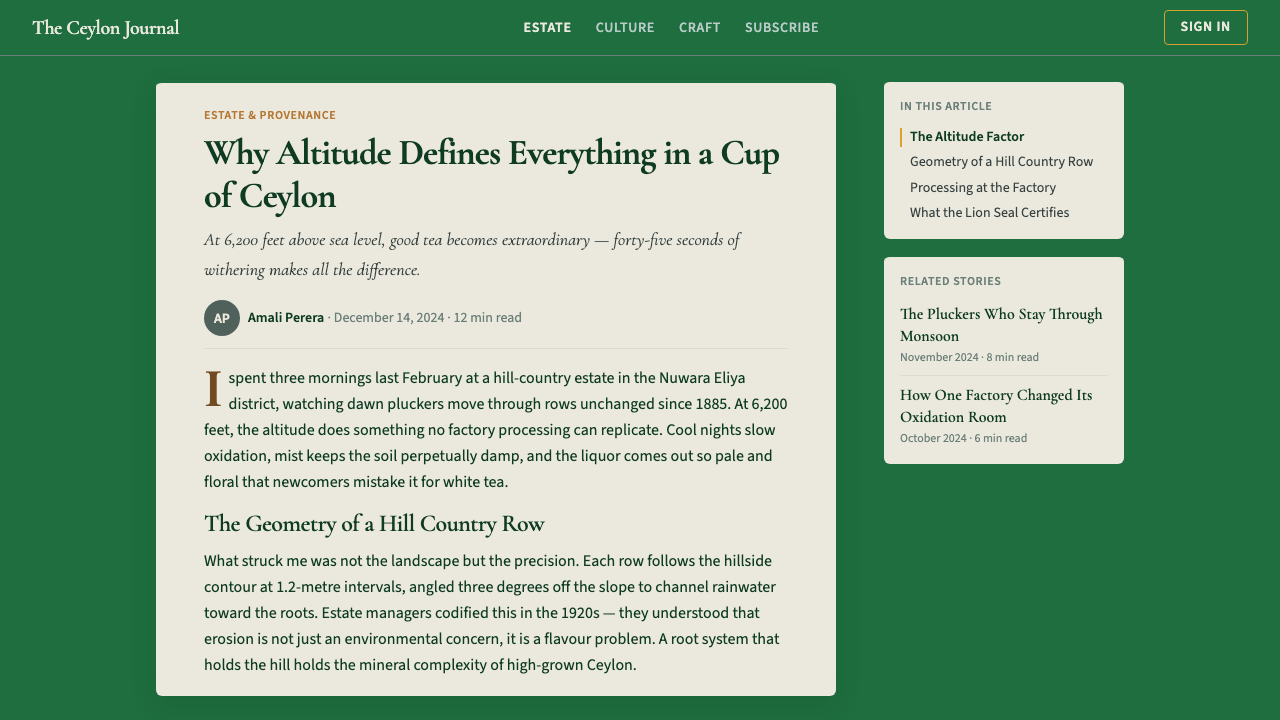
The ivory panel is not merely a background — it is a compositional device that enacts the experience of looking at a hillside through cloud. Layouts use the panel to float content above the saturated emerald ground, creating layered depth without shadows or gradients. The generosity of white and ivory space is deliberate: the style treats negative space as the visual equivalent of the pause before a tasting note, an invitation to attend rather than to consume.
The Authenticating Seal
A single heraldic seal — the Sri Lankan lion derived from the national flag, rendered in saffron-gold — serves as the style's ultimate provenance marker. Its function is closer to a wax seal on a legal document than to a conventional logo: it does not describe the product but validates it. The seal is positioned with deliberate asymmetry, sometimes overlapping the ivory panel edge, to suggest it was applied to an existing document rather than designed as part of a branding system.
Estate Typography
Headlines are set in high-contrast, classically proportioned serif letterforms that evoke English mercantile letterhead and estate documents — formal without feeling archaic. Body text uses generous leading and conservative measure, reinforcing the unhurried quality that distinguishes the style from fast-moving consumer goods packaging. Uppercase spaced-letter settings are used selectively for estate names and geographic designations, lending them the quality of official nomenclature.
Full-Bleed Documentary Photography
Photographic imagery is treated as evidence rather than atmosphere. Images show the specific: the elevation at which leaves are plucked, the worn hands of experienced pickers, the texture of a particular soil. There is no tropical genericism — no anonymous palms or generic waters. Every image makes a geographic claim. Photography is used at full bleed, saturating the field and embodying the emerald palette rather than decorating a frame.
Restrained Gold Detailing
Beyond the authenticating seal, gold appears as a narrow vocabulary of detail: a thin rule framing a panel edge, a foil-stamped grade designation, a cartouche around a geographic name. The restraint is essential — the moment gold becomes abundant, it slides toward generic luxury. One application at high contrast against the emerald reads as official; five read as gilded kitsch. Using gold only where it performs a specific certifying or framing function is one of the harder disciplines of this style.
Geographic Specificity as Hierarchy
The style deploys regional designations — Nuwara Eliya, Dimbula, Uva, Ruhuna, Kandy — as primary organizational elements, treating geography the way a wine label treats appellation: as the quality signal that precedes all other description. This hierarchy communicates that terroir is real and meaningful in tea. The visual weight given to geographic specificity makes the provenance claim structural rather than decorative — part of the layout's architecture, not a footnote.
Who shaped Sri Lanka Ceylon Tea Modern?
Taylor established the first commercial tea plantation on the Loolecondera estate in Kandy in 1867, pivoting from coffee after the blight that wiped out the island's coffee industry. His meticulous record-keeping of soil conditions, altitude variations, and processing methods laid the empirical groundwork for understanding Ceylon's regional terroir — the geographic specificity that became the central subject of the style's visual language.
Fernando founded Dilmah in 1988 after training as a tea taster in London and returning determined to create a family-owned brand with direct control over quality from bush to cup. His insistence on single-origin certification transformed the brand's visual language: Dilmah's packaging was among the first to place Sri Lankan highland landscape — rather than colonial imagery — at the center of its identity, demonstrating that the island's own identity was a commercial asset.
Perera was among the Sri Lankan designers who worked on the visual translation of post-colonial tea brand identity, helping to develop the vocabulary — the emerald palette, the ivory panel, the authenticating seal — that became the shared visual grammar of premium Ceylon tea branding, establishing aesthetic parameters that subsequent brands would inherit.
Established after independence to promote Ceylon tea internationally, the Tea Board created the Lion Logo — a certification mark drawn from the national emblem — that became foundational to the entire Ceylon tea design system. The mark transformed a heraldic element into an international quality guarantee and established the authenticating seal as the style's central device.
Founded in Colombo in 2008, Basilur extended the Ceylon tea design vocabulary into the luxury gift market, treating the tea tin as a collector-object canvas. Its themed collections — drawing on cartography and botanical illustration while retaining the provenance palette — demonstrated how the core visual grammar of emerald, ivory, and saffron-gold could support diverse surface treatments without losing its essential character.
How do you use Sri Lanka Ceylon Tea Modern today?
Ceylon Tea Modern is a deeply specific style, not a universal one. It works when the product or content has a genuine relationship to provenance, craft, or geographic specificity. Applied where that claim cannot be made honestly — a fast-casual brand, a generic SaaS interface — the style's formal weight reads as affectation. Before applying it, ask whether the content can genuinely assert that origin matters and that the details are real.
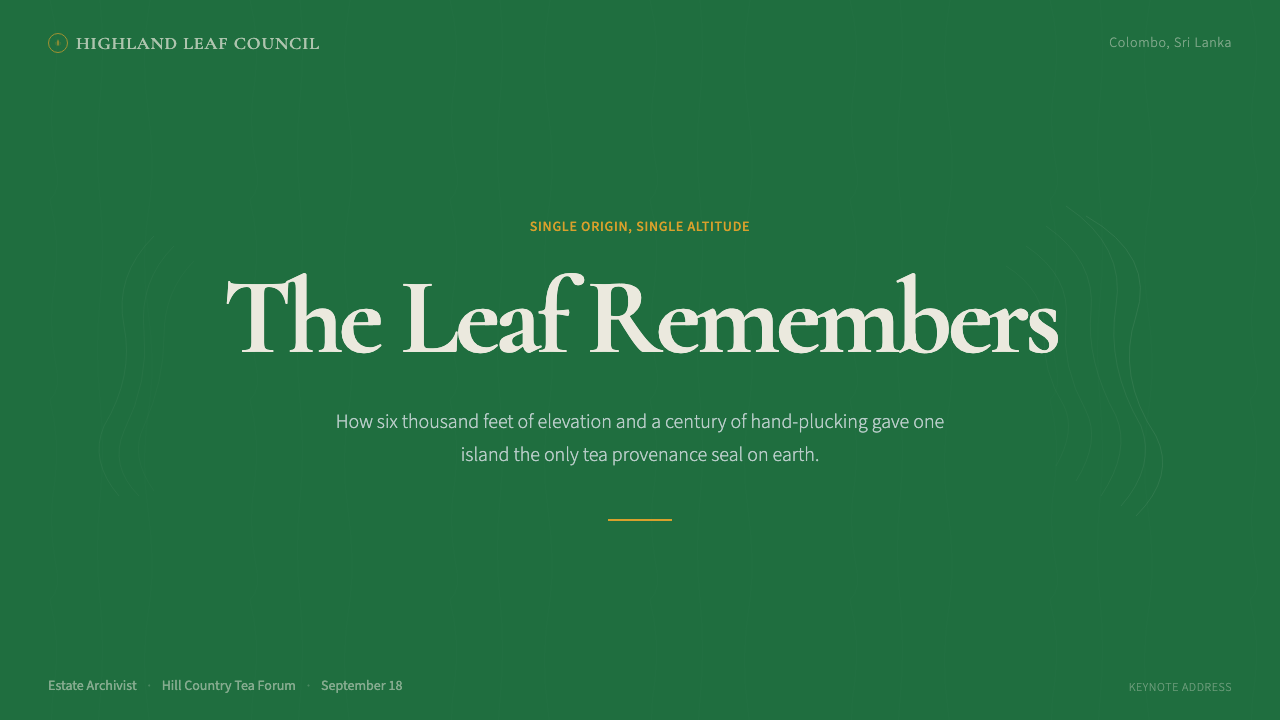
For presentation slides, the style excels on covers and section dividers. A cover might use a full-bleed highland landscape as ground, float an ivory panel with the title over it, and position a certification seal with deliberate asymmetry. Content slides should adopt an estate-ledger quality: wide margins, restrained body text, geographic designations as primary section headers, no ornamental dividers. Data slides can use documentary photography as background rather than a generic fill.
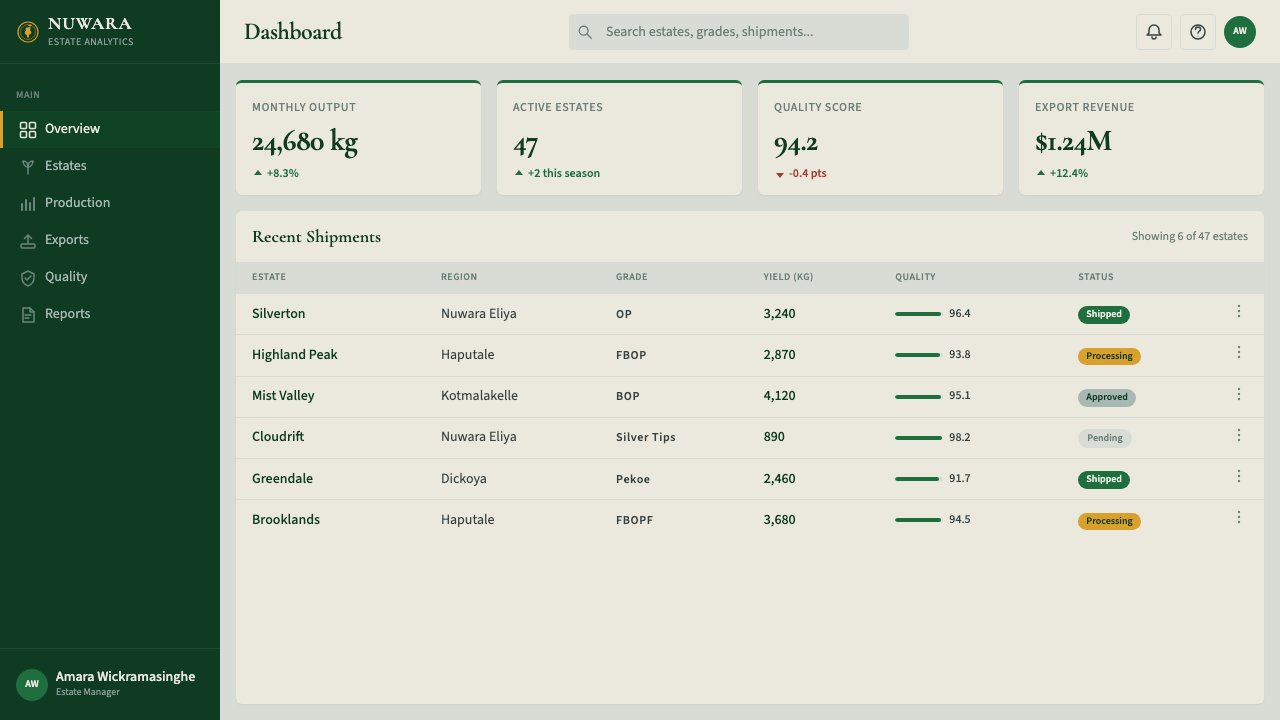
For web interfaces, the style suits contexts that communicate measured authority rather than speed: premium subscription landing pages, origin-certification portals, or brand identity systems for established regional producers. Use a near-white or ivory ground, deploy emerald sparingly as a navigational accent, and reserve a single gold detail for tier markers or certification indicators. Photography should always be purposefully geographic and documentary — never atmospheric stock.
For editorial and marketing contexts, the style supports a confident, specific, unhurried voice. Wide margins create sanctuary for pull-quotes and geographic callouts. A section opening with a regional designation in spaced uppercase type, then developing into measured prose, mirrors what the style does visually: establishes standing before making its case. Marketing pages work with alternating full-width blocks — emerald for provenance statements, ivory for product detail — with gold for calls to action or certification claims.
The common mistake is confusing this palette with generic green-and-gold luxury, producing results that look like high-end packaging for any agricultural product. The distinction is specificity: imagery must be geographically specific, copy must make real claims, and the seal must genuinely certify something. Emerald used as a decorative background without a provenance anchor is just a color. Gold deployed as a general luxury signal rather than as a single authenticating element loses its weight. The style only works when every element earns its place by performing a documentary or certifying function.
Sri Lanka Ceylon Tea Modern — FAQ
Is this style only suitable for tea or beverage brands?
Not at all. The style transfers well to any premium agricultural or artisanal product — single-origin coffee, specialty spices, estate botanicals, regional textiles — where the story of origin is the central differentiator. It also works for institutional contexts that need measured authority: museum exhibition design, heritage communications, archival publications, regional tourism identity. The requirement is that the content can support the style's implicit claim: that origin matters and that the audience is invited to attend carefully.
How does the Ceylon Tea Modern style differ from British colonial tea branding?
The distinction is both visual and ideological. Colonial tea branding depicted the plantation as an imperial idyll — pastoral workers in romanticized landscapes, British heraldry adapted for tropical products. Ceylon Tea Modern reverses this. The landscape is shot at altitude and at eye level with the workers; the seal is Sri Lankan, not British; the geographic designations are Tamil and Sinhala place names. The style makes the island the subject of its own story — and that reversal explains why the vocabulary reads as authority rather than nostalgia.
Can the style work in a dark or night-mode interface?
A dark inversion is possible but requires care. The style's logic depends on ivory floating over an emerald ground. On a very dark ground, emerald reads as a mid-tone and ivory loses contrast. In dark mode, use a very dark forest or near-black green as dominant, reserve saturated emerald as an accent for borders, and use a soft warm off-white for text. The saffron-gold seal carries more visual weight in this configuration. The risk is losing the style's documentary freshness and sliding into generic dark luxury.
How important is photography to the style, and what happens if photography isn't available?
Photography is the primary carrier of the provenance claim. Without it, the style can rely on cartographic elements: illustrated maps of the growing regions, botanical illustration, or typographic layouts that treat regional designations and estate names as visual anchors. The ivory panel and emerald palette still signal provenance, but carry less evidential weight without imagery of the actual landscape. If only generic stock photography is available, use none — a vague tropical background actively undermines the style's authority.
What makes the saffron-gold seal feel authoritative rather than merely decorative?
Its function is specific and earned. The saffron lion derives from Sri Lanka's national flag — a symbol with constitutional standing, not a designed ornament. Applied to a layout, it imports that standing into the product: it certifies genuine origin. That certification weight distinguishes it from a gold flourish applied for richness. The seal only maintains authority when used as a genuine certifying element, appearing alone with compositional deliberateness. Multiplied or used as a pattern element, it becomes decoration and undermines the style's core proposition.
Related design styles
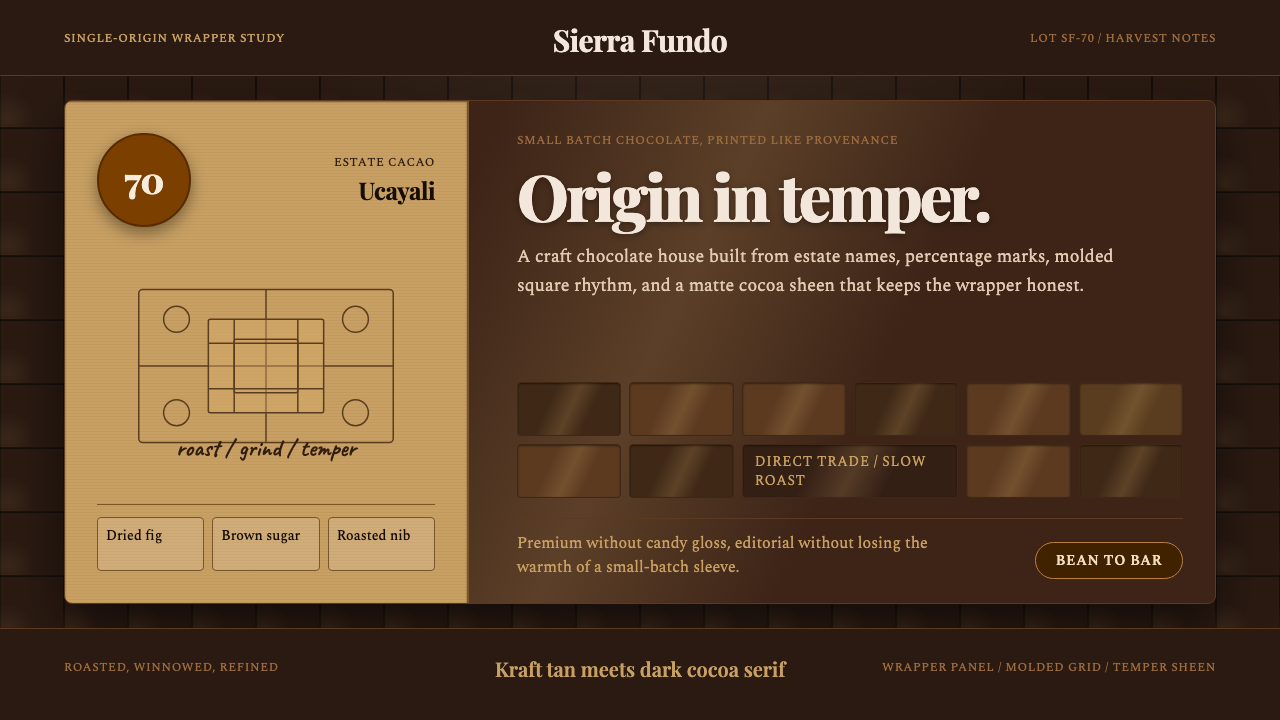 Bean-to-Bar ChocolateOrigin tastes tactile. Cocoa serif, kraft panel, and molded squares carry the…
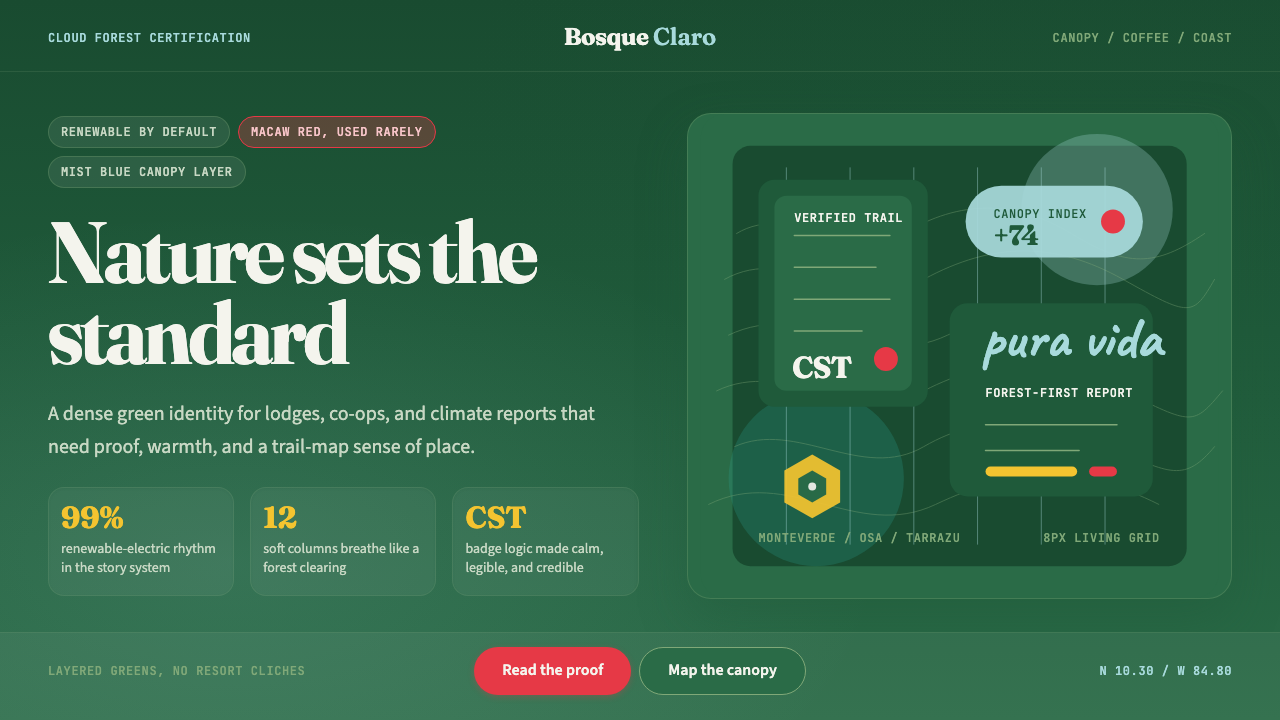 Costa Rica Pura Vida EcoAlive without greenwash. Cloud-forest green, Fraunces serif, and scarlet acce…
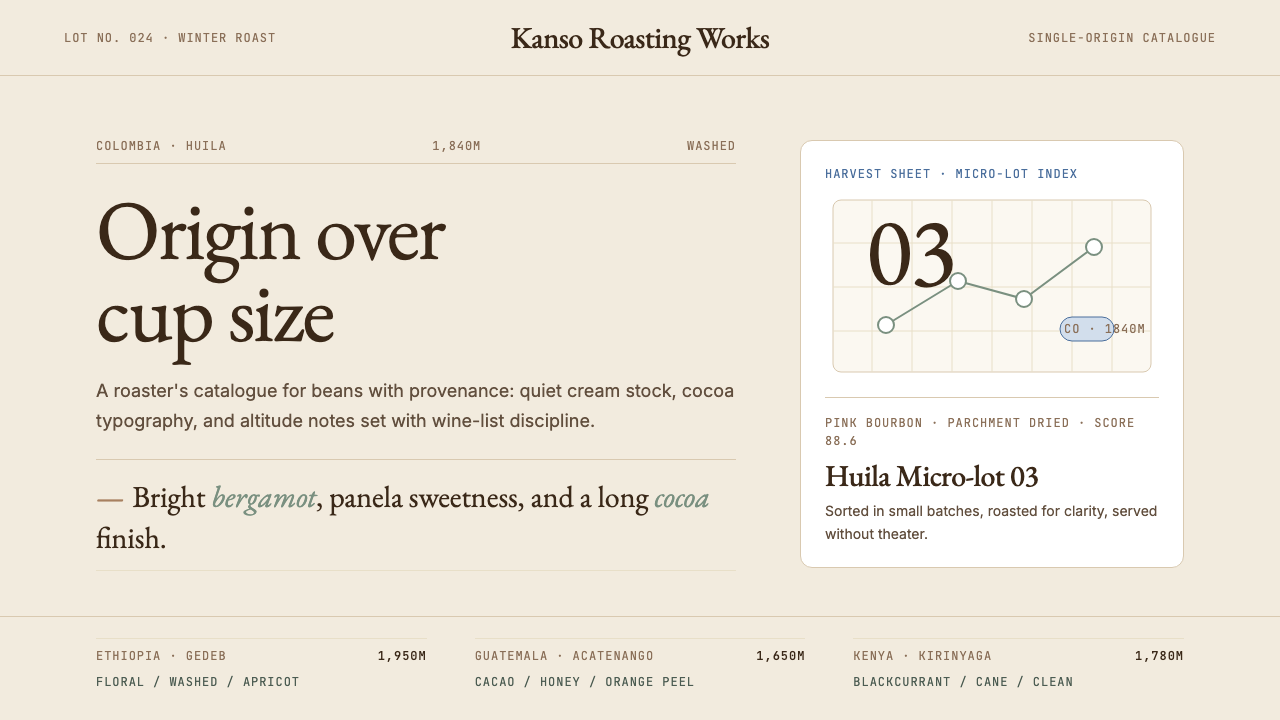 Third Wave CoffeeCoffee as catalogue. Cream paper, cocoa serif, mono origin specs, one sage no…
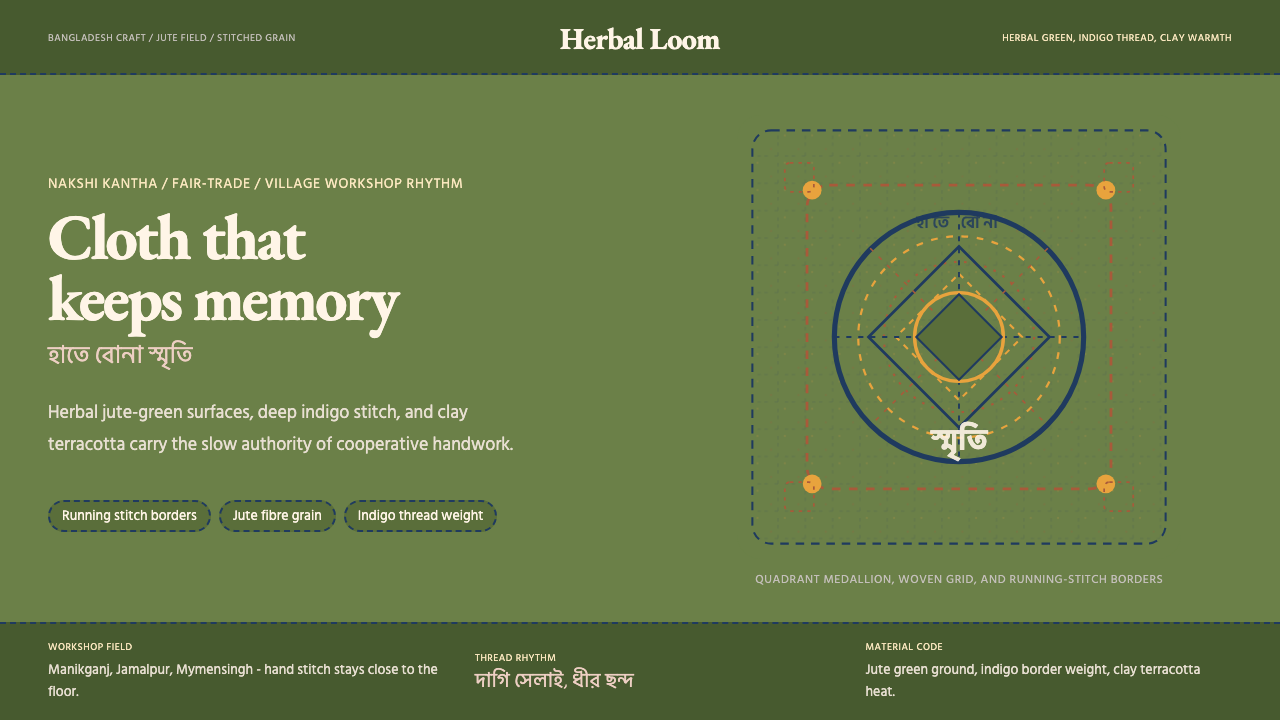 Bangladeshi Jute CraftMemory stays stitched. Jute green, indigo borders, terracotta warmth.
 Pacific Kelp ForestScientific depth. Teal water, amber shafts, and vertical kelp rhythm carry th…
 Provence LavenderSaturated pastoral dusk. Violet rows, ochre soil, and sun-gold haze build the…