What is Third Wave Coffee?
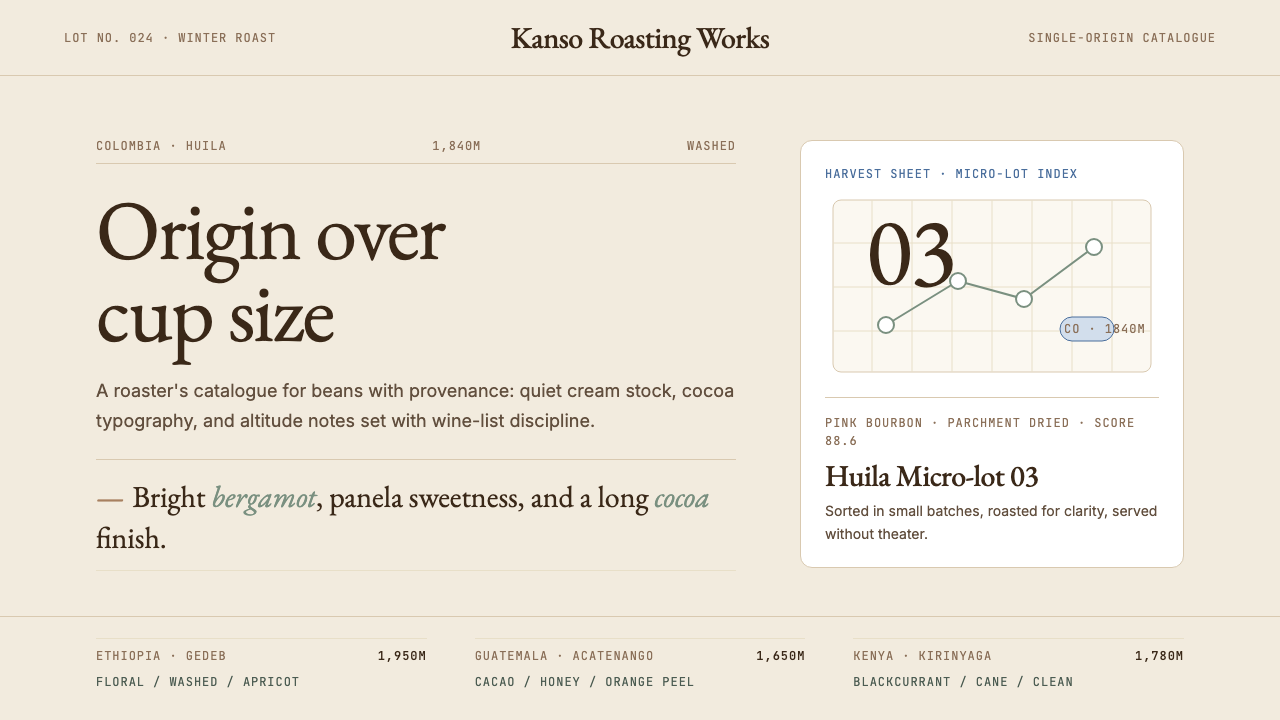
Third Wave Coffee turned the café into a catalogue — single-origin reverence, pour-over ritual, and the quiet confidence of a design language borrowed from fine-art publishing.
Third Wave Coffee in brief
Third Wave Coffee is a specialty-coffee philosophy and its attendant aesthetic — an artisanal counter-reformation to the second-wave model of standardized roasts, drive-through convenience, and branded scale. Where second-wave chains offered familiarity, the third wave offered specificity: the altitude at which a bean was grown, the farmer who picked it, the exact processing method that shaped its flavor. That commitment to origin and craft required a new visual language, one that could communicate connoisseurship without condescension.
Visually, the style reads like a fine-art catalogue rather than a café menu. Oat-milk cream serves as the ground. Deep cocoa brown carries body text and labeling. A muted sage or olive accent — a single, restrained note — marks category or distinction without demanding attention. Monospace type lists varietal, altitude, and processing data with the precision of scientific notation. Generous whitespace creates breathing room that signals there is nothing superfluous here, that everything present was chosen.
The aesthetic owes a deliberate debt to Japanese design culture — the influence of single-object presentation, extreme material care, and the discipline of omission. Blue Bottle's visual identity, developed after its 2002 Oakland founding, became the most widely recognized expression of this grammar: a round logo, cream stock, classical serif headings, and a layout philosophy closer to a museum gift-shop catalogue than to a commercial menu board.

Where does Third Wave Coffee come from?
The phrase 'third wave' was coined by Trish Rothgeb in a 2002 trade journal essay. She mapped coffee's trajectory: the first wave was commodification — canned supermarket coffee, coffee as a utility. The second wave, represented by Starbucks and Peet's, introduced café culture, espresso drinks, and the concept of 'premium' coffee, but ultimately systematized that premium into another form of mass production. The third wave, Rothgeb argued, was a return to the bean itself — its growing region, its varietal genetics, its processing, its roaster relationship. Coffee was to be understood and discussed the way wine had been for decades.
The founding institutions emerged from three American cities in roughly a decade. Intelligentsia opened in Chicago in 1995, Stumptown in Portland in 1999, Counter Culture in Durham in 1995, and Blue Bottle in Oakland in 2002 — launched by James Freeman from a kiosk at a farmers' market, roasting in a small garage space. Each developed direct-trade relationships with farmers rather than buying through commodity brokers, and each built a corresponding visual identity that communicated this seriousness. The geography was deliberate: all three cities had active artisan food cultures, design-literate consumer bases, and proximity to the Pacific Rim, which made Japanese influence natural.
Japan was not merely an influence but a parallel tradition. Tokyo's specialty coffee culture — built around meticulous hand-pour techniques, Hario V60 and Kalita Wave brewers, and a deep respect for single-origin beans — had developed largely independently. When American third-wave practitioners began visiting Japan in the late 1990s and early 2000s, they found a fully realized aesthetic grammar: wooden fixtures, ceramic vessels, unbleached paper filters, chalk-lettered chalkboards, restrained color, and the discipline of extreme slowness. That grammar traveled back and became inseparable from the North American movement's visual identity.
The design aesthetic coalesced around 2008 to 2012, as the movement matured and its leading brands began working with professional designers and architects. Blue Bottle commissioned minimalist café interiors — exposed wood, white walls, natural light — and developed packaging that looked more like art-book endpapers than food labels. Stumptown's printed materials used letterpress printing, uncoated stock, and hand-drawn illustration with a vintage-apothecary register. By 2015, the Third Wave visual language had become recognizable enough to be replicated: cream backgrounds, monospace origin specs, classical serif type, and a single muted accent color had become shorthand for 'specialty coffee' whether the underlying product justified it or not.
The movement's visual maturity coincided with the broader cultural rise of craft-goods aesthetics — small-batch whiskey, artisan bread, natural wine — all of which developed adjacent visual vocabularies around the same period. Third Wave Coffee distinguished itself within this cluster by its particular debt to catalogue and archival design: the sensibility that a product worthy of study deserves a document worthy of study. The result is a design language unusually comfortable with density of information — origin cards, flavor-note ladders, brew-ratio tables — presented in a format that never feels cluttered because whitespace is treated as structure, not remainder.
What defines the Third Wave Coffee look?
Color Palette
The palette is anchored by oat-milk cream as the dominant ground — warmer than white, with just enough yellow-beige undertone to evoke paper stock and natural materials. Deep cocoa brown replaces black for body text and borders, keeping the overall register warm and analogue rather than digital and cool. A single muted accent — typically a desaturated sage, olive, or dusty terracotta — marks interactive elements, category indicators, or origin highlights. High-chroma colors are almost entirely absent; saturation is treated as a scarcity resource, spent only where the hierarchy demands a single point of visual arrival.
Typography System
The typographic hierarchy runs on two contrasting registers. Classical serif type — old-style proportions, optical contrast between thick and thin strokes — carries headlines and brand names, lending the authority of fine publishing. Monospace type handles all specification data: varietal names, altitude ranges, processing methods, brew ratios. This pairing is not decorative; it is semantic. The serif says 'this is a brand with a philosophy'; the monospace says 'these are facts that can be verified.' Body text is set at a generous measure with ample line spacing, treating readability as a form of respect for the reader's attention.
Whitespace as Structure
Third Wave Coffee design treats whitespace not as empty space left over after content is placed, but as an active structural element. Margins are unusually generous — often wider than the content column itself on either side. Elements are isolated rather than grouped; a single product specification card floats in a field of cream rather than sitting in a dense grid. This spatial discipline communicates that each item deserves individual consideration, mirroring the philosophy that each bean, each varietal, each farm has a story worth separate attention. The effect on the viewer is one of deliberate slowness — the layout physically paces the reader.
Photography and Materiality
Photography is warm-toned, shallow-focused, and material in emphasis. The subject is typically the bean, the vessel, the hand, or the landscape — not the experience or the lifestyle. Shots are often taken in natural side-light that reveals surface texture: the bloom of a freshly poured Chemex, the grain of a wooden bar, condensation on a ceramic. Backgrounds are soft and out of focus but identifiably natural — linen, wood, matte ceramic — never a pure digital white sweep. The result is photographic warmth that contrasts productively with the typographic precision of the specification data alongside it.
Origin Labeling as Aesthetic
Specification data — farm name, country, region, varietal, altitude, harvest year, processing method, flavor notes — is not tucked away on a side panel but placed prominently as a design element in its own right. Arranged in a clean vertical stack using monospace type, these details function visually like a catalogue entry or a scientific specimen label. The implicit argument is that provenance is as beautiful as the product itself. This treatment was pioneered in the movement's early printed materials and has since become a standard visual signal for quality positioning across the entire specialty food and beverage sector.
Craft and Restraint
Every material choice communicates deliberateness: uncoated or lightly textured paper stock over glossy; letterpress or offset printing over digital inkjet; ceramic or wooden surfaces over plastic or stainless steel. In digital contexts, this translates to matte finishes, restrained interaction patterns, and the absence of decorative motion. Hover states are subtle — a shift in text weight rather than a color flood, a thin underline rather than a highlight box. The aesthetic refuses to be enthusiastic in ways that feel performative; it trusts the quality of the underlying content to carry the experience.
Japanese Minimalism Influence
The debt to Japanese design — particularly the aesthetics of the kissaten (traditional Japanese coffee house), Japanese packaging culture, and the design philosophy of single-object reverence — is structural rather than superficial. It shows in the commitment to asymmetric, off-center composition; in the use of natural materials presented without treatment or finish; in the discipline of giving each element substantial breathing room; and in the preference for suggestion over declaration. Where Western commercial design often tells the viewer what to feel, Third Wave Coffee aesthetics show the object and trust the viewer to arrive at feeling independently.

Who shaped Third Wave Coffee?
Freeman founded Blue Bottle Coffee in Oakland in 2002, initially roasting beans in a small garage and selling from a kiosk at a Bay Area farmers' market. His obsessive attention to freshness — refusing to sell beans more than forty-eight hours out of the roaster — and his insistence on clean, minimal visual presentation became the template for the Third Wave café model. Blue Bottle's design sensibility, developed under Freeman's direction, is widely credited with bringing fine-publishing visual standards into specialty coffee retail and influencing how dozens of subsequent roasters positioned their brands.
Sorenson founded Stumptown Coffee Roasters in Portland, Oregon in 1999 and pioneered the direct-trade model in which roasters travel to origin countries, develop personal relationships with farmers, and pay substantially above commodity prices for exceptional lots. Stumptown's early visual identity — letterpress-printed packaging, uncoated stock, hand-drawn illustration, and a deliberately rough craft aesthetic — established one branch of the Third Wave visual vocabulary: the artisan-guild register that treated coffee production as skilled hand-craft rather than industrial process.
Rothgeb, a roaster and Q Grader who worked across multiple specialty coffee companies, coined the term 'third wave' in her 2002 essay for the Flamekeeper, the newsletter of the Roasters Guild. Her framing gave the movement an intellectual and historical identity that it had previously lacked, enabling practitioners to articulate the distance between their approach and second-wave commercial coffee. The term spread rapidly through the industry and into mainstream food media, providing the conceptual scaffold on which the movement's visual and philosophical identity could cohere.
Morioka runs Morioka Shoten, a Tokyo bookshop famous for exhibiting only a single title at a time in its spare, white-walled interior. While not directly a coffee figure, Morioka represents the Japanese single-object-reverence aesthetic that Third Wave Coffee absorbed deeply. His model — that one object, given sufficient space and curatorial seriousness, becomes an event rather than a commodity — mirrors precisely the approach Blue Bottle and its peers took to the individual bag of coffee, the single brew recipe, the one farm relationship. His influence on the broader craft-goods aesthetic of the period is foundational.
How do you use Third Wave Coffee today?
Third Wave Coffee is a highly transferable style for contexts where craft, transparency, and considered quality are the values being communicated. Applying it successfully requires internalizing its core logic: information density and visual restraint are not in opposition here — they coexist because whitespace is treated as structure, not surplus. The most common failure is importing the surface elements (cream background, monospace type, muted accents) while abandoning the spacing discipline, producing a layout that reads as trendy rather than authoritative.
For presentation slides, the style works well across both cover and content pages. A cover built in this register should feel like the opening spread of a fine catalogue: a single strong typographic statement set in a classical serif against a cream field, with substantial breathing room on all sides and perhaps one line of monospace specification copy — a date, a location, a version number — placed with precision below or beside the main title. Content slides should resist the urge to fill the frame. One key idea per slide, communicated through a hierarchy of two type sizes, occasional use of the muted accent for emphasis, and nothing decorative that does not carry semantic weight. Data slides can adopt the origin-card format: a clean vertical stack of labeled figures in monospace, arranged as if the numbers themselves are the product being presented.
For web interfaces, the style is particularly well-suited to product detail pages, pricing tiers, and editorial landing pages where credibility and perceived quality are more important than conversion-rate maximization. The approach: a near-cream background, cocoa-brown body text, generous padding around every component, and an information architecture that trusts the visitor to scroll rather than cramming everything above the fold. Navigation should be text-only — no icon-heavy tab bars — and interactive states should be typographic rather than color-flooded. Dashboards built in this register benefit from treating each metric as a specimen: isolated, labeled precisely, given room to be read as an individual fact rather than part of a dense chart cluster.
For editorial and marketing work, the Third Wave register supports long-form credibility. An article or report layout should use a reading-optimized measure for body text — neither too wide nor too narrow — with a generous margin reserved for pull quotes, annotations, or origin-style metadata. Section breaks are marked by a thin horizontal rule, a shift in type weight, or simply by added vertical space — never by decorative elements or colored dividers. Marketing pages can adopt a catalogue-spread logic: alternating full-width blocks of warm cream and deep cocoa, each block presenting a single product, claim, or value with the confidence that one idea at a time is enough. Calls to action are understated — a bordered text link in the accent color rather than a high-saturation button.
A common mistake when applying Third Wave Coffee aesthetics is over-indexing on the cream-and-monospace surface while neglecting the underlying logic of selection and restraint. Adding origin-label typography to a layout that is already dense with competing elements produces something closer to craft-store pastiche than to the style's original authority. The style demands decisions about what not to include at least as much as it demands decisions about what to include. A second common error is using the muted accent color in too many places, diluting its signal value. In an authentic Third Wave layout, the accent appears rarely — it marks a single category, a single interactive state, a single point of arrival — and that rarity is precisely what makes it work.

Third Wave Coffee — FAQ
Is Third Wave Coffee the same as Scandinavian minimalism or Japanese wabi-sabi?
They share family resemblances — restraint, natural materials, generous negative space — but the underlying logic differs. Scandinavian minimalism is rooted in social-democratic functionalism and tends toward the architectural and the abstract. Wabi-sabi finds beauty in imperfection, incompleteness, and transience, actively embracing irregularity. Third Wave Coffee aesthetics are more specifically about the authority of provenance: every visual decision serves the communication of origin information, traceability, and craft seriousness. The style can look Japanese or Scandinavian, but its animating purpose is closer to catalogue design — presenting a product that deserves to be studied.
Can this style work on dark backgrounds?
The canonical Third Wave palette is light-ground — the cream-and-cocoa register is inseparable from its associations with paper, natural light, and analogue warmth. A dark inversion is possible — reversing to a deep espresso brown or slate ground — but it requires careful management. The muted accent colors that work as delicate notes on a cream background tend to read as too faint or muddy on a dark ground; they may need to be lightened toward a sage or dusty gold rather than their darker versions. Monospace specification text loses some of its archival authority when reversed out. Dark variants tend to work better for ambient or evening contexts — a cocktail-bar menu or a café's late-night social content — than for the core product and origin communication the style was designed to carry.
How is Third Wave Coffee different from the broader 'clean and minimal' aesthetic trend?
Generic clean minimalism tends to use cold whites, thin geometric sans-serif type, and symmetric layouts, often with soft gradients or drop shadows that have crept back in. Third Wave Coffee is specifically warm — the cream ground, the cocoa text, the muted earthy accent — and it pairs visual restraint with information density rather than visual emptiness. The monospace type carrying altitude and varietal data is not present in generic minimalism; it is the style's most distinctive and load-bearing element. The difference is between minimalism-as-absence (removing things to feel clean) and minimalism-as-selection (removing things so that what remains carries full weight).
Does this style work for products or brands outside of coffee?
Yes, and it already has migrated extensively into adjacent craft food and beverage categories: natural wine, specialty tea, small-batch spirits, artisan chocolate, and premium olive oil all use versions of this visual vocabulary. It also translates well to non-food contexts where provenance, transparency, and craft seriousness are genuine brand values: independent publishing, high-end skincare, precision tools, and educational platforms. It struggles where warmth and playfulness are required values — children's products, fast casual food, entertainment — and it can feel exclusionary in consumer contexts where affordability and accessibility are part of the brand promise. The style carries a strong implicit class signal; that signal can be an asset or a liability depending on the audience.
What is the single most important element to get right when using this style?
Spacing discipline. The cream ground, the serif-and-monospace pairing, and the muted accent are all recognizable surface features, but they can all fail if the spacing is wrong. Third Wave Coffee layouts have margins and internal padding that feel almost excessive by commercial web and slide standards — and that apparent excess is doing the most critical work. It signals that no element is competing for attention, that each piece of content was placed by someone who cared where it landed, and that the viewer's attention is being treated as a precious thing rather than a resource to be maximized. Get the spacing right, and the other elements follow; compromise the spacing to fit more content, and the style collapses into decoration.
Related design styles
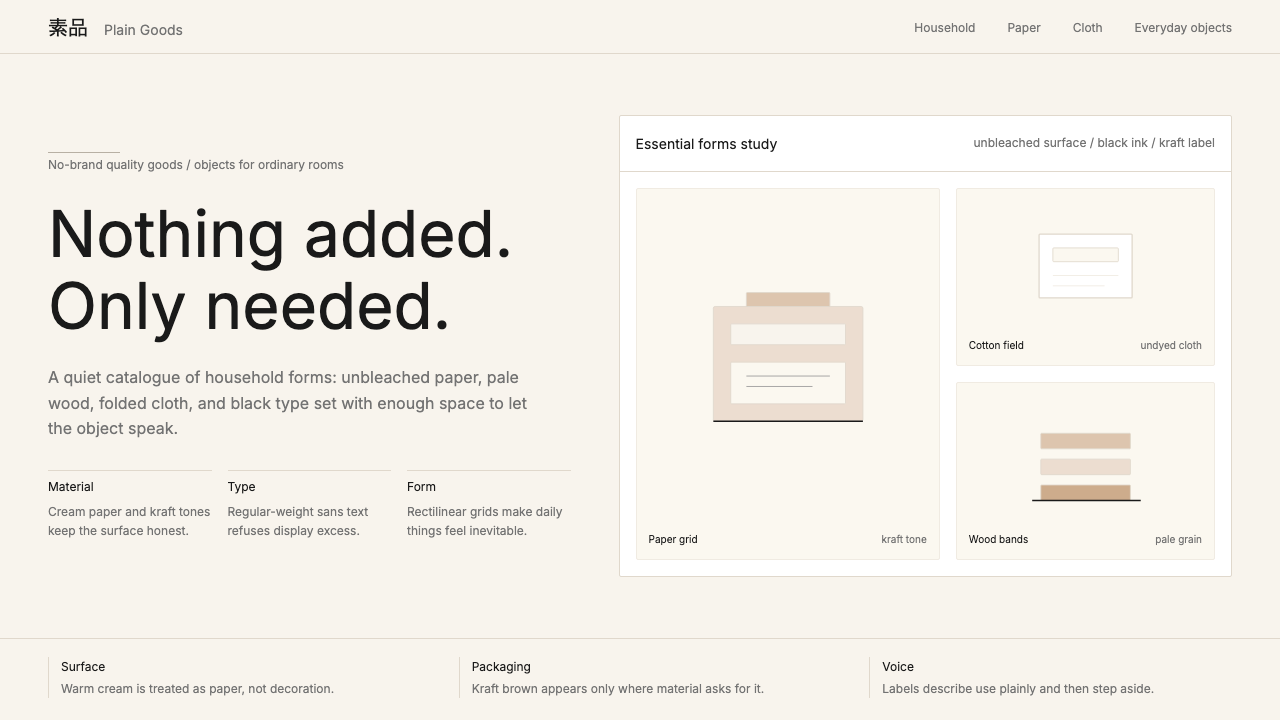 MUJIAnti-brand restraint. Cream paper, kraft brown, and regular Inter leave only…
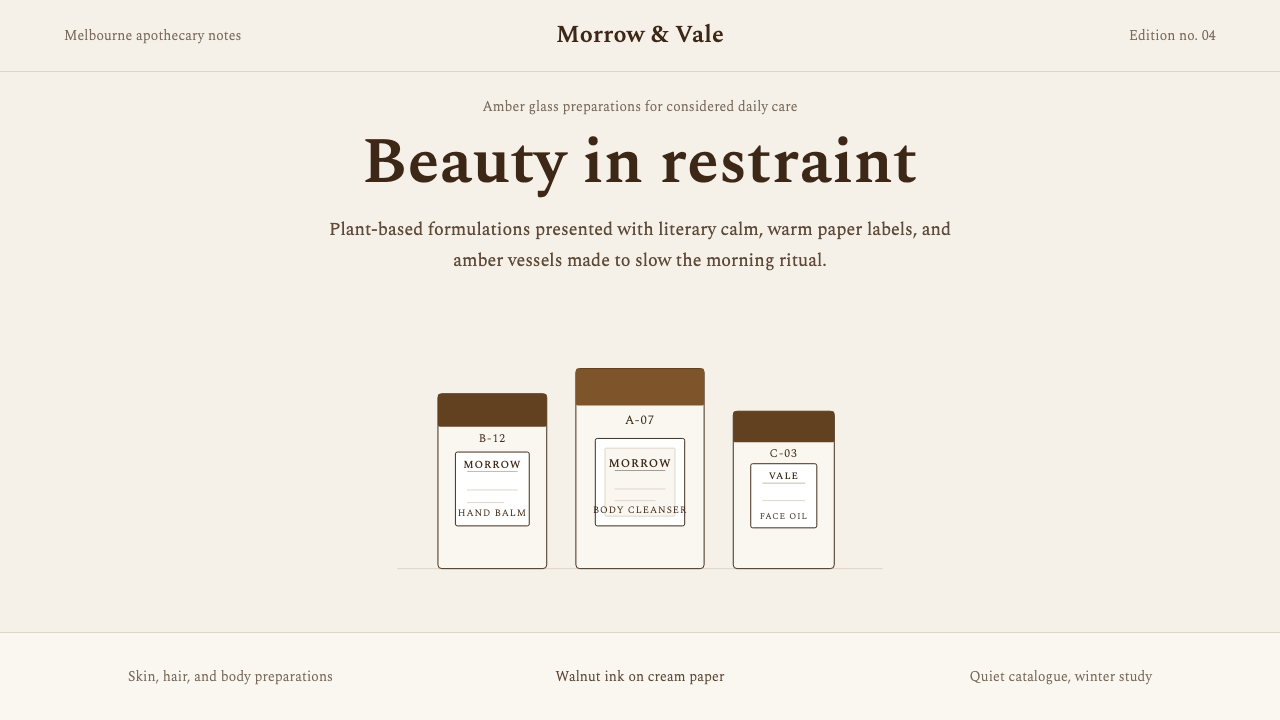 AesopRefuses urgency. Walnut serif on cream paper — every surface paced like a 19t…
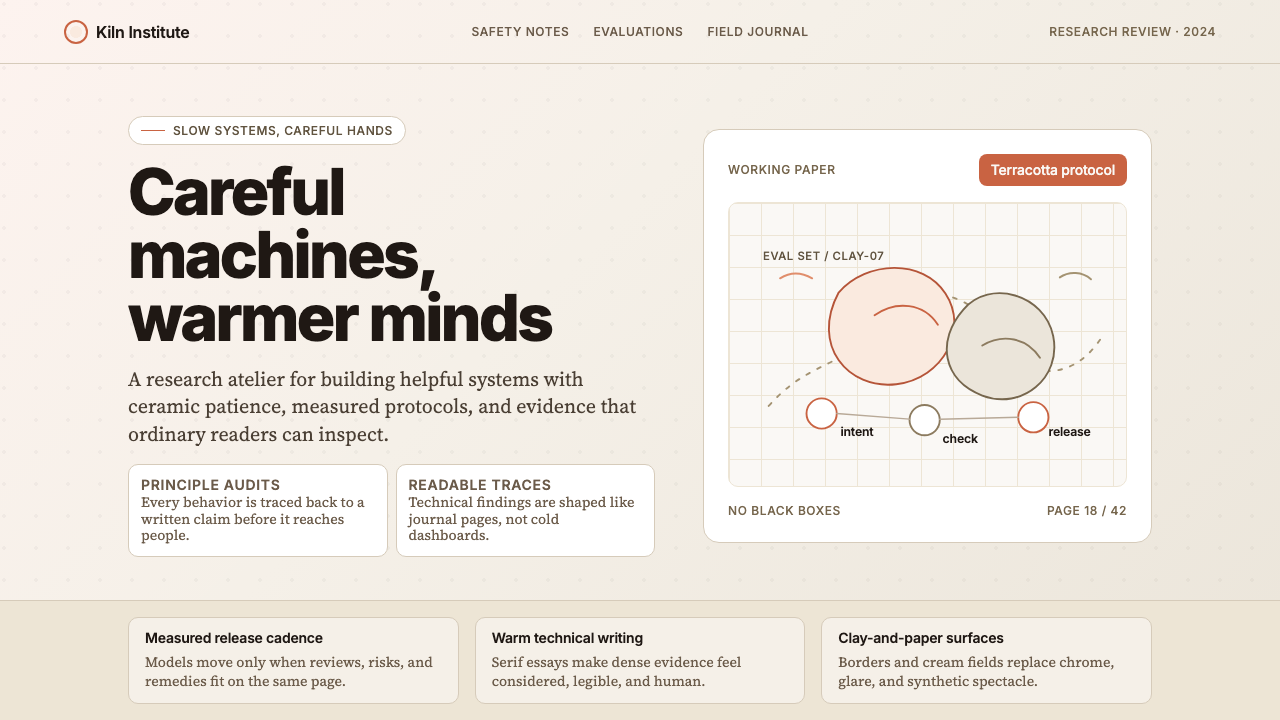 Anthropic ClayAI safety in handmade clay. Sand backgrounds, terracotta accents, serif body…
 Basecamp / 37signalsQuiet craft, strong opinions. Cream paper, tight sans type, yellow and coral…
 Clay 2024CRM as a sketchbook, not a sales pipeline. Cream backgrounds, terracotta, han…
 Photographer Light FolioMakes the browser a gallery wall. Warm cream, hairline serif type, and one im…