What is Photographer Light Folio?
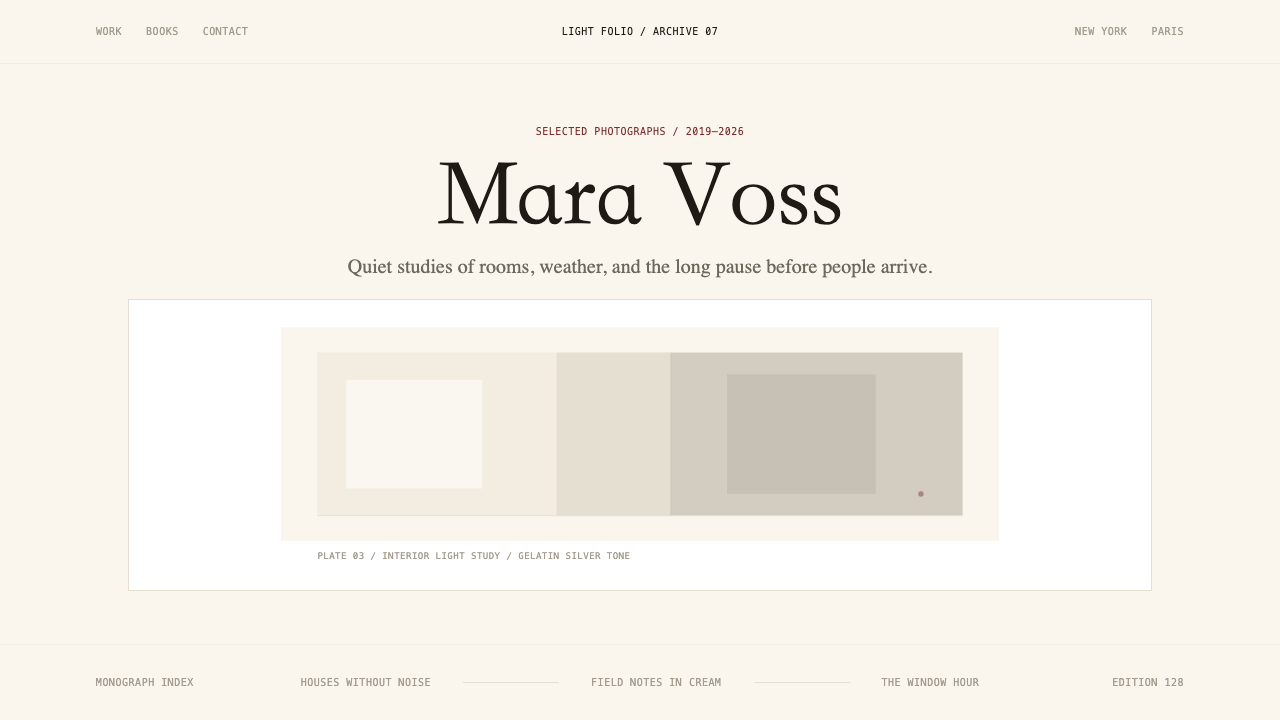
Photographer Light Folio turns the browser into a gallery wall — warm cream substrate, hairline serif type, and nothing allowed to compete with the photograph.
Photographer Light Folio in brief
Photographer Light Folio is a complete design system built around a single premise: the photograph is the entire point. Every typographic and spatial decision in the style exists to eliminate visual noise so that a single image can occupy the viewer's full attention. The substrate is paper-warm rather than clinical white, the type is drawn in hairline weights that whisper rather than speak, and navigation is rendered in small monospace capitals so unobtrusive that it seems to apologize for existing.
The system distills the aesthetic logic of the best photographer portfolio templates — Squarespace's Bedford and Reyes, Format's Lismore and Greystone — into a coherent set of principles that extend beyond templates into any medium: editorial spreads, printed monographs, digital galleries, and personal branding materials. What holds the system together is restraint exercised at every layer simultaneously: color restrained to near-neutrals with one warm accent, type restrained to a single serif family at extreme light weights, layout restrained to generous margins that frame rather than fill.
Unlike modernist styles that use emptiness as a philosophical statement, Photographer Light Folio uses emptiness as a practical service: the white space exists for the image, not for itself. This is a distinction that shows in practice. The style does not read as austere or cold — the warmth of the cream ground and the organic texture implied by hairline serif letterforms give it a quality closer to a fine art book from a respected publisher than to an exercise in reduction.

Where does Photographer Light Folio come from?
The immediate genealogy of Photographer Light Folio runs through the photographer portfolio platforms that consolidated in the late 2010s. Squarespace, Format, and SmugMug each developed template libraries aimed at working photographers who needed a professional web presence without graphic design training. The templates that succeeded commercially were not the most technically sophisticated but the ones that most faithfully translated the visual logic of the printed photography monograph into a browser context. The look that emerged — cream ground, thin serif, single image per viewport, near-invisible navigation — was not designed by any one person; it was the convergence point that the market found when photographers chose among hundreds of options.
The deeper roots lie in print monograph publishing, a tradition that stretches from the mid-twentieth century to the present. Publishers like Steidl (Göttingen), Aperture (New York), and MACK Books (London) developed a set of conventions for presenting photographic work in book form: uncoated or lightly coated paper stock that recalled the material of a photographer's workprint, generous page margins that gave each image room to breathe, typography held to a minimum and set in light-weight classical serifs, and a general conviction that any graphic element competing with the photograph was an editorial failure. Gerhard Steidl, who began his publishing house in 1968, brought standards of print quality and typographic restraint to photography books that had previously been treated as commercial rather than fine-art objects. His collaborations with photographers including Robert Frank, Joel Sternfeld, and Nan Goldin established a visual template that the digital portfolio world would eventually absorb.
Michael Mack of MACK Books represents a slightly younger strain of the same tradition, one that arrived at a moment — the 2000s and 2010s — when art photography was experiencing renewed institutional interest and photographers were increasingly expected to present their practice with the seriousness of a fine-art discipline. MACK's books are typically designed with extreme typographic austerity: the photographer's name appears small and in a light weight, the title is subordinated, and production values — paper choice, binding, the precise registration of ink to stock — communicate that this is an object worthy of sustained attention. The web portfolio platforms that photographers adopted in the same period were attempting, consciously or not, to extend this register of seriousness into a digital context.
The post-Instagram moment also shaped the style in a specific way. By the middle of the 2010s, photographers had lived through a decade of social media platforms that prioritized rapid scrolling, compressed images, and algorithmic visibility over deliberate viewing. The portfolio site became a deliberate counterpoint: the place where work was shown in full resolution, without interruption, on a ground designed to receive it. The cream-and-serif aesthetic is in part a resistance to the compressed, high-saturation, infinitely scrolling feed — it communicates that this work is to be looked at, not browsed. Tim Walker and Annie Leibovitz, both of whom maintained photographer-centered web presences that emphasized image primacy, exemplify the editorial sensibility the style serves.
What defines the Photographer Light Folio look?
Warm Substrate
The ground is never pure white. It holds a warm, paper-like tone that sits between raw linen and a photographic workprint — close enough to white that it reads as neutral in most contexts, but warm enough that photographs placed on it gain the quality of objects presented rather than images displayed. This warmth is the single most important departure from clinical modernist white and from the cold grey fields that dominate tech interfaces. It communicates material rather than digital, permanence rather than refresh.
Hairline Serif Typography
The defining typographic gesture of the style is weight: type is set at the thinnest end of the serif spectrum, where letterforms become almost architectural — a series of fine strokes and bracketed terminals that feel handcrafted rather than mechanical. At display sizes, this hairline quality lends the photographer's name an air of quiet prestige; at small sizes for navigation and captions, it recedes to the point of near-invisibility. The contrast between the delicate type and the full tonal weight of a photograph is the central visual tension of the style.
Image Primacy
A single photograph occupies the dominant position in any layout. Multiple images are rare on a single view; when they appear, they are sequenced rather than gridded — presented as a curated progression rather than an inventory. The image is never cropped to fit a module; instead, the layout accommodates the image's native proportions. Captions, if they appear at all, appear below the image at minimum size and with a visual weight that does not challenge the photograph's authority.
Invisible Navigation
Navigation in Photographer Light Folio is treated as necessary infrastructure rather than a design feature. It appears in small monospace capitals — a typographic choice that reads as technical, precise, and deliberately self-effacing compared to the display serif. The spacing between navigation items is generous, but the size and weight are kept to a minimum. No iconography, no hover animations that draw attention to themselves, no persistent navigation bars that compete with the image for vertical territory. Navigation appears when needed and otherwise steps aside.
Generous Negative Space
Margins are wider than conventional web practice, often extending beyond what a grid-focused designer would consider comfortable. This generosity is not an accident or an aesthetic preference — it is a deliberate service to the photograph. A wide margin gives the image a frame; it communicates that what is inside the margin has been selected and placed, not merely uploaded. The negative space between image and edge functions similarly to the mat board in a physical gallery frame: it creates a zone of transition between the object and the surrounding world.
Restrained Color
The chromatic range of the interface is narrow almost to the point of nonexistence: the warm ground, near-black for type, and at most one muted warm accent for interactive states or subtle highlights. Color is deliberately withheld from the chrome so that the full chromatic range of the photograph is not competed with or contextualized by the surrounding interface. A green navigation item or a blue call-to-action button would immediately pull chromatic energy away from the image; the near-monochromatic interface ensures that the photograph remains the only source of color in the viewer's visual field.
Monograph-Quality Production Sensibility
Every detail in the style communicates that the work shown is being treated with the same seriousness a fine-art publisher would bring to a printed monograph. This means attention to small decisions that most interface design ignores: the precise vertical spacing between a photograph and its caption, the treatment of the photographer's name relative to the portfolio title, the choice of whether to display image dimensions or shooting data and in what typographic voice. These micro-decisions accumulate into a register of care that the viewer senses even without being able to articulate its sources.

Who shaped Photographer Light Folio?
Steidl founded his Göttingen-based publishing house in 1968 and gradually built it into the gold standard for photography book production. His insistence on uncoated or minimally coated paper, his attentiveness to the ink-to-paper relationship, and his collaborative approach to working with photographers on reproduction decisions established the production values that digital portfolio platforms would eventually attempt to evoke. Major collaborations with Robert Frank, Ed Ruscha, and Nan Goldin demonstrated that a photography book could be as carefully authored as the photographs it contained. The Steidl aesthetic — spare typography, warm stock, image as primary object — is the direct print ancestor of Photographer Light Folio.
Mack founded MACK Books in London in 2010 and established it as one of the most typographically rigorous photography publishers of its generation. MACK books are notable for the degree to which their graphic design is subordinated to the photographic content — designer and author roles are separated cleanly, and the designer's task is understood as one of service. This philosophy of typographic self-effacement — small names, light weights, spare covers — translated directly into the web portfolio language that emerged in the same decade and that Photographer Light Folio systematizes.
Walker, the British photographer whose large-format, elaborately staged imagery has appeared in British Vogue and W Magazine across three decades, represents the editorial sensibility that Photographer Light Folio is built to serve. His personal web presence and the editorial contexts in which his work appears rely on the same logic: generous white space, discreet typography, full-bleed imagery that needs no explanatory apparatus. Walker's work requires a presentation framework that does not compete with the work's own visual density and narrative richness — precisely the problem Photographer Light Folio solves.
Leibovitz, whose career spans Rolling Stone, Vanity Fair, and a series of monographs published with book-quality production values, embodies the idea that photographic portraiture at the highest level demands a presentation context equal to its ambition. Her published books — produced with close attention to paper stock, printing quality, and typographic restraint — model the relationship between image and page that the digital folio style attempts to extend into browser context. Leibovitz's practice also underscores the style's implicit audience: not the casual viewer scrolling a feed, but the committed viewer who has chosen to engage with a body of work.
Founded in New York in 1952 by Minor White, Dorothea Lange, Ansel Adams, and others, Aperture established the vocabulary of the serious photography publication decades before digital platforms existed. The Aperture quarterly and the Aperture monograph series defined what photographic seriousness looked like on a printed page: uncoated paper that gave prints a matte, workprint quality; wide margins; minimal sans-serif or light-weight serif type; and a strict editorial line that separated criticism from display. This vocabulary became the template that photographer-platform designers in the 2010s drew on — consciously or through accumulated cultural familiarity — when building the templates that Photographer Light Folio formalizes.
How do you use Photographer Light Folio today?
Photographer Light Folio is a highly specific style, and its specificity is its strength: it communicates one thing very clearly, which is that the images it presents are worth sustained, unhurried attention. Applying it well requires understanding this communicative purpose first and then making every structural decision in service of it. The question to ask at each decision point is not 'does this look good?' but 'does this help or hinder the photograph?'
For presentation slides, the style translates best to portfolio decks, artist statements, and any presentation where the primary content is visual work. A cover slide built in this system should place the presenter's name in hairline serif at modest size, allow significant empty space to breathe around a single strong image, and use the warm ground as the field against which everything else floats. The temptation to fill the cover with a bold headline or a layered composition should be resisted. Content slides carrying multiple images should sequence them as a photographer would — one prominent image supported by smaller contextual images — never as a symmetrical grid. For data slides, the style is less naturally suited, but when used, data visualization should be treated as diagrammatic rather than decorative: clean lines, near-black on cream, no color fills beyond one muted accent for emphasis.
For web interfaces, the style works naturally for portfolio sites, editorial photography sections within larger publications, and gallery or museum digital presences. The homepage pattern is simple: one full-width or near-full-width image, a name in hairline serif positioned to float without competing, and navigation in small monospace capitals tucked at the edge. Dashboard and data-heavy interfaces should approach the style with caution — the generous negative space that serves single images poorly serves dense information. If the style is required for a pricing page or a feature comparison, the solution is to commit to extreme column discipline and treat the page as a sequence of single-image moments rather than a continuous information surface.
For editorial and marketing work, the style is at its most powerful in long-form photographic essays, campaign presentation documents, and brand identity materials for photographers, gallerists, or luxury brands whose positioning depends on implied exclusivity and restraint. A marketing page built in this register should resist the impulse to add calls to action in high-contrast button treatments. Contact forms and booking flows should use bordered, understated inputs; success states and alerts should appear in muted tones rather than standard green or red. The warmth and restraint of the style communicates trustworthiness and selectivity — brand associations that are hard to buy and easy to accidentally disrupt.
The most common mistake when applying Photographer Light Folio is importing the look without importing the logic. The look is cream backgrounds and thin serifs; the logic is image primacy enforced at every decision. Designers who borrow the surface aesthetic but then add a bold color accent for the primary button, a gradient hero overlay for readability, or a sticky navigation bar that follows the user through a full-bleed gallery immediately undermine the style's purpose. A secondary common mistake is applying the style to content that it cannot serve — a SaaS onboarding flow, a social media scheduler, a customer support dashboard — where the generous negative space becomes wasted screen real estate rather than meaningful frame. The style communicates that what it contains is worth looking at for a sustained period; only use it when that is true of your content.

Photographer Light Folio — FAQ
Is Photographer Light Folio only suitable for actual photographers?
Not exclusively, but the style's logic is so tightly oriented around image primacy that it works best when the primary content is visual. Beyond working photographers, the style suits fine artists, illustrators, architects presenting visual portfolios, and luxury brands whose product imagery is sufficiently strong to carry the weight the style places on it. It can also work for editorial brands — magazines, publishers, cultural institutions — where the association with photographic seriousness is a desired brand value. It is poorly suited to text-heavy content, data-dense applications, or any context where the user's primary task is reading or filling in forms rather than looking.
How does the style handle color photography versus black-and-white work?
Both work, but in different ways. With color photography, the near-monochromatic interface is essential — the warm ground and near-black type ensure that the chromatic range of the image is read in full without interference from competing interface colors. With black-and-white photography, there is slightly more flexibility in the interface palette, since the image is not bringing its own colors to compete with. Some practitioners introduce a single, very quiet warm accent in the interface when working primarily with monochrome images, as the contrast between a warm ground and a cool-toned black-and-white photograph creates its own quiet tension. In both cases, the substrate's warmth plays a different role: against color work it is neutral; against black-and-white work it functions almost as a warm filter.
Can the style coexist with a dark mode?
A dark inversion of the style is possible but changes its character significantly. The warm cream ground is the style's primary emotional register — it communicates material, warmth, and the quality of a printed object. A dark inversion, where the ground shifts to a deep warm charcoal or near-black and the type moves to a warm off-white, retains the image-first logic but trades the associations of a fine art book for those of a darkroom or a cinema. This is a valid aesthetic choice — particularly for photographers whose work is naturally dark, cinematic, or high-contrast — but it should be understood as a related but distinct mode rather than a direct dark equivalent. The one strong caution: avoid true pure black grounds, which tend to flatten photographs by removing the subtle luminance separation that the warm ground provides.
How should text-heavy sections like artist statements or bio pages be handled?
Text-heavy sections require the most discipline in this style precisely because the style was not designed with extended reading in mind. The solution is to treat long-form text as a deliberately narrow column — not full-width — set in a weight that is slightly heavier than the display hairline but still lighter than conventional body text. Wide margins on both sides of the text column perform double duty: they give the reader a calm, focused reading field and they maintain the spatial character of the style even when no image is present. Avoid the instinct to break up long text with subheadings rendered in the same hairline weight — they disappear. Use a clear but subtle hierarchy: the section title at a moderate display size, the body text at comfortable reading weight, and any metadata or captions in the monospace small caps that the navigation uses.
What makes this style different from generic minimalism?
Generic minimalism reduces visual complexity as a philosophical or aesthetic end in itself — the goal is the appearance of simplicity. Photographer Light Folio reduces visual complexity as a means to a specific end: making photographs visible. This distinction has practical consequences. A generic minimalist layout might use a cool, neutral grey ground, a geometric sans-serif, and equal attention to all content types — text, image, data — because it is applying a principle of reduction uniformly. Photographer Light Folio uses a warm ground because warmth serves photographs; uses hairline serif rather than geometric sans-serif because the serif implies craft and print tradition rather than digital reduction; and explicitly subordinates text and navigation to image because image primacy is the system's organizing value, not simplicity in the abstract. The warmth, the serif, and the hierarchy are purposeful choices that connect the style to a specific cultural tradition. Minimalism without that tradition is a look; Photographer Light Folio is a language.
Related design styles
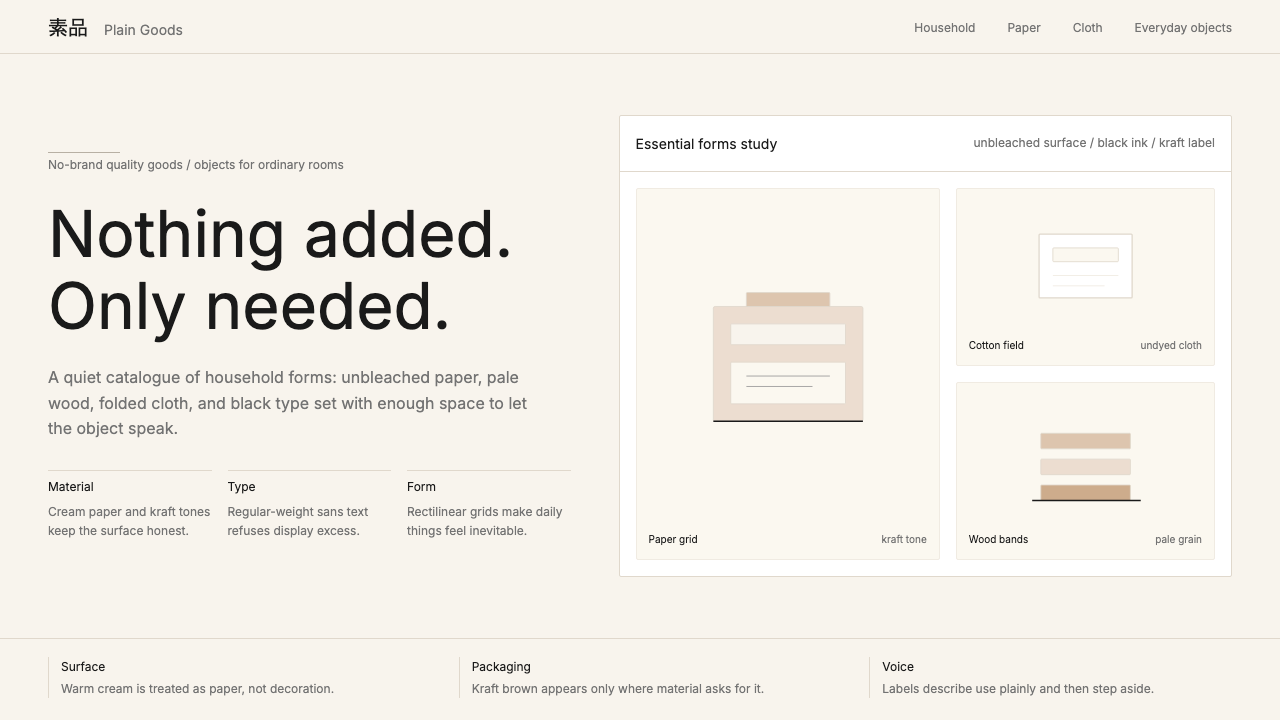 MUJIAnti-brand restraint. Cream paper, kraft brown, and regular Inter leave only…
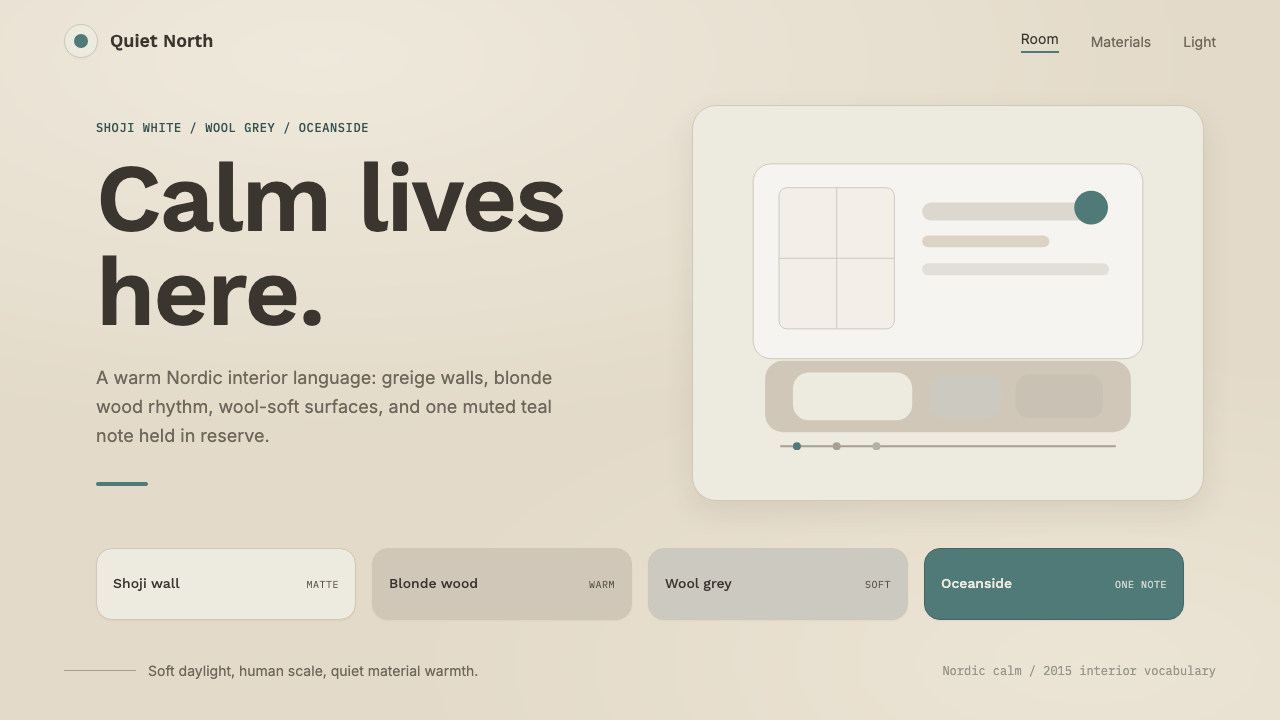 Scandinavian HyggeCalm is the brief. Greige walls, wool-grey cards, and one muted teal line.
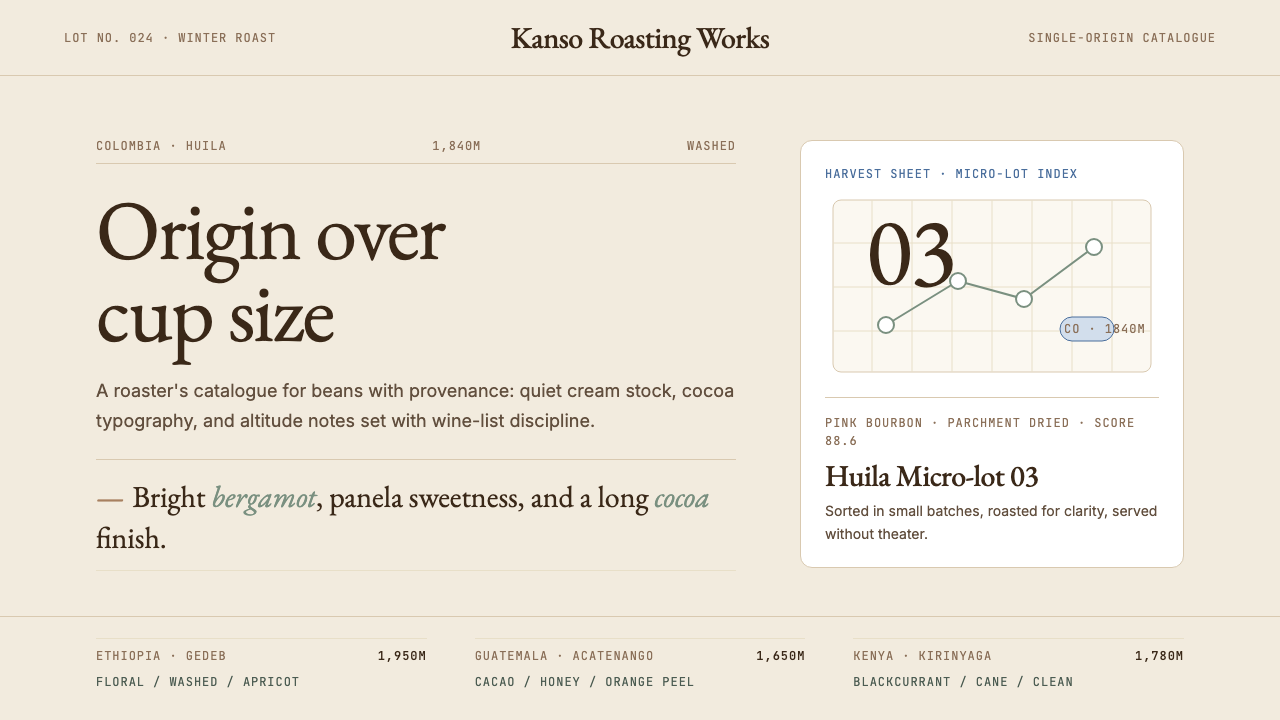 Third Wave CoffeeCoffee as catalogue. Cream paper, cocoa serif, mono origin specs, one sage no…
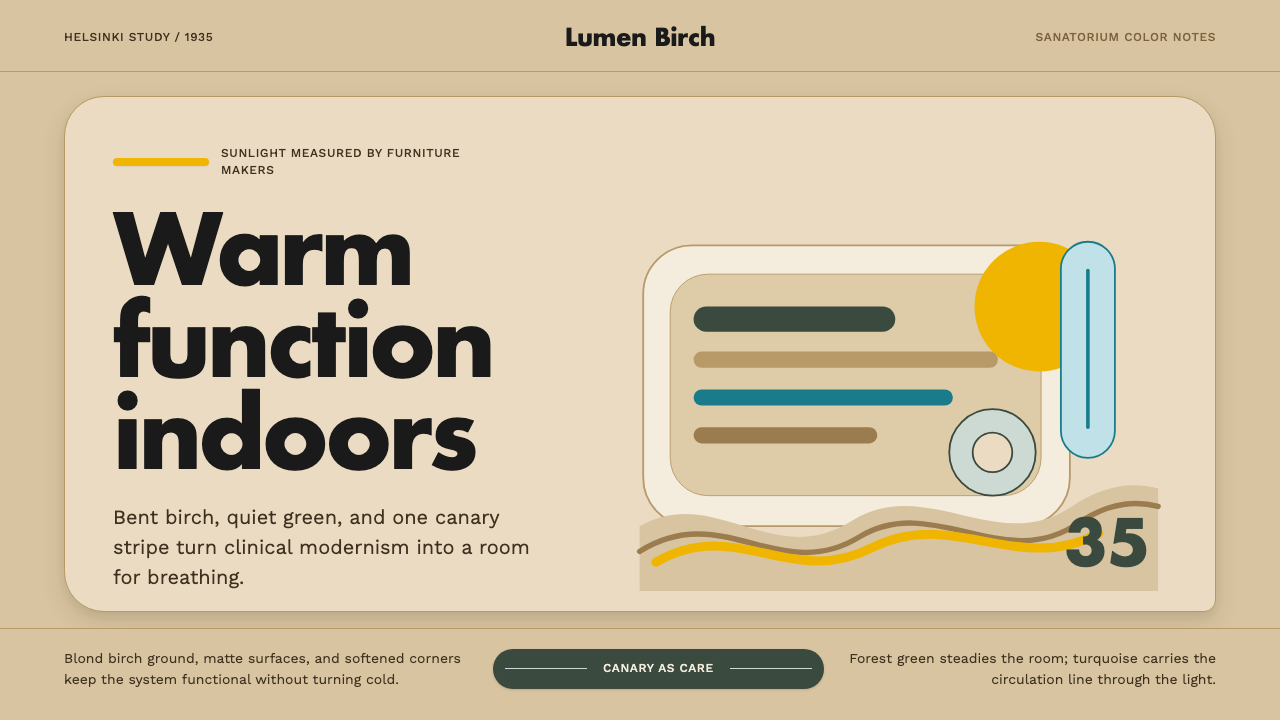 Aalto Finnish ModernModernism made humane. Birch fields, canary yellow, and soft plywood curves b…
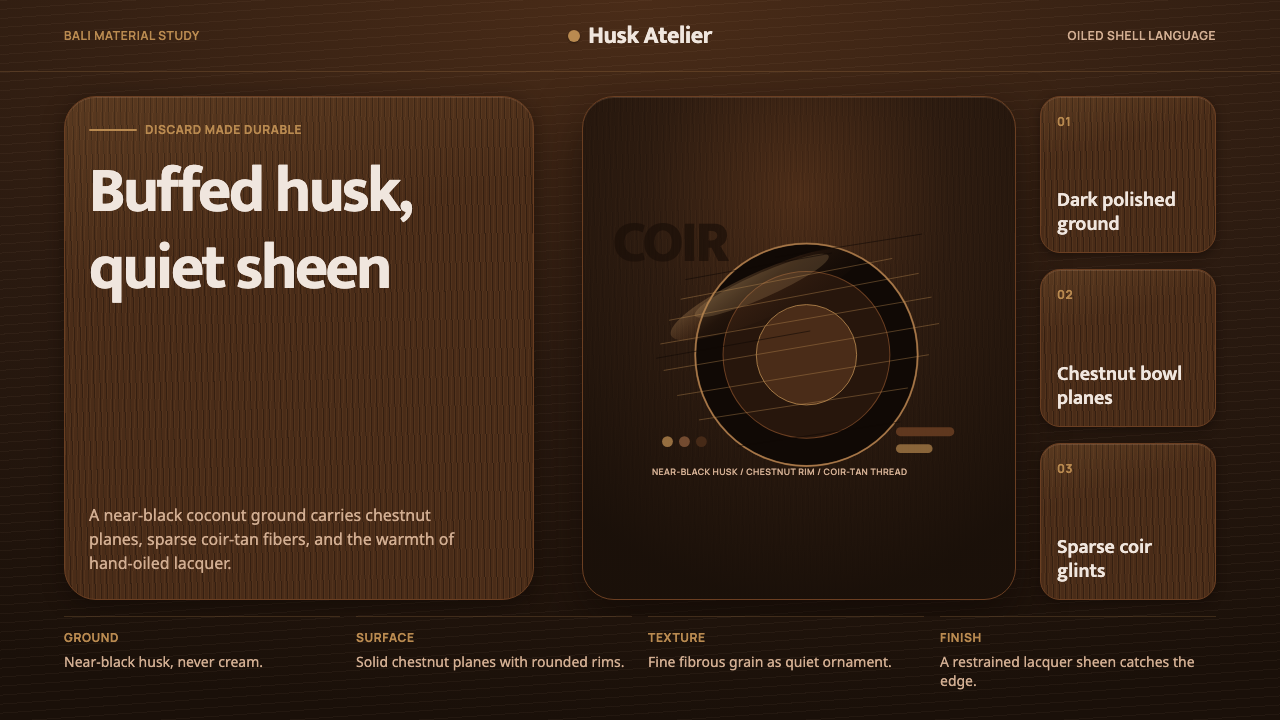 Balinese Coconut ShellQuietly hand-oiled. Near-black husk, chestnut planes, and sparse coir-tan gra…
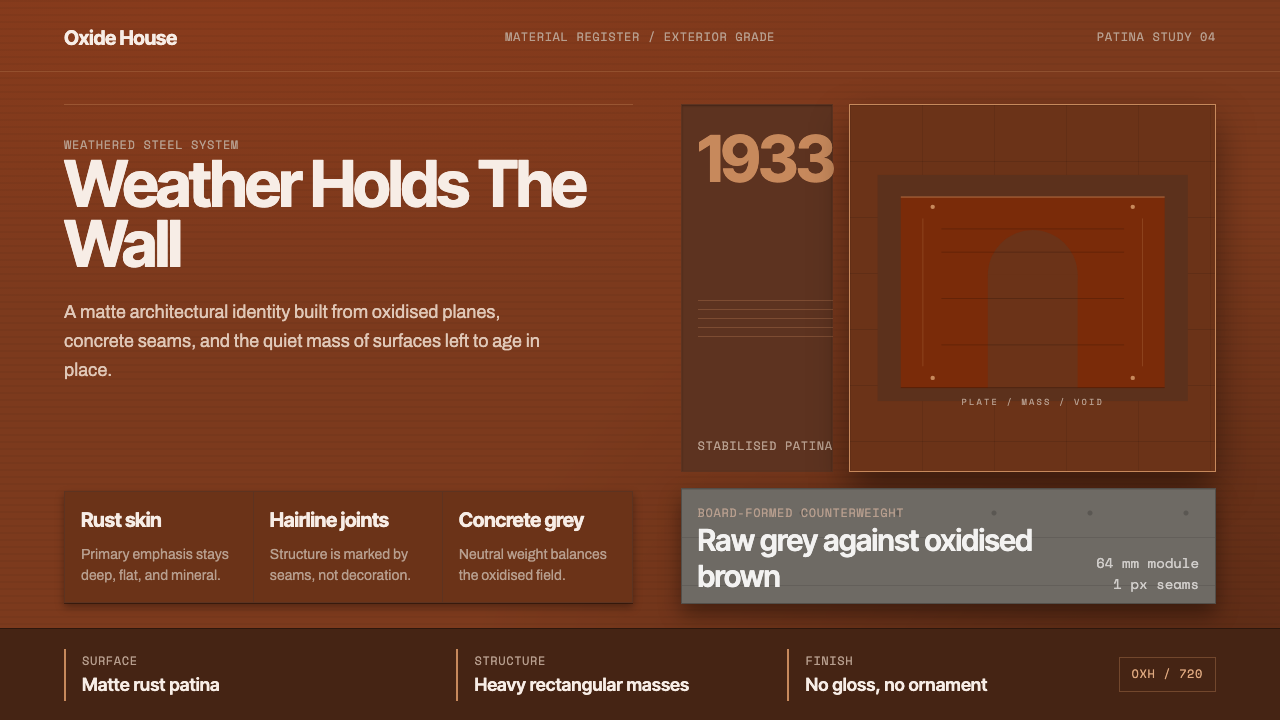 Corten Weathering SteelWeight over ornament. Rust-brown planes and concrete-grey seams make mass vis…