What is MUJI?
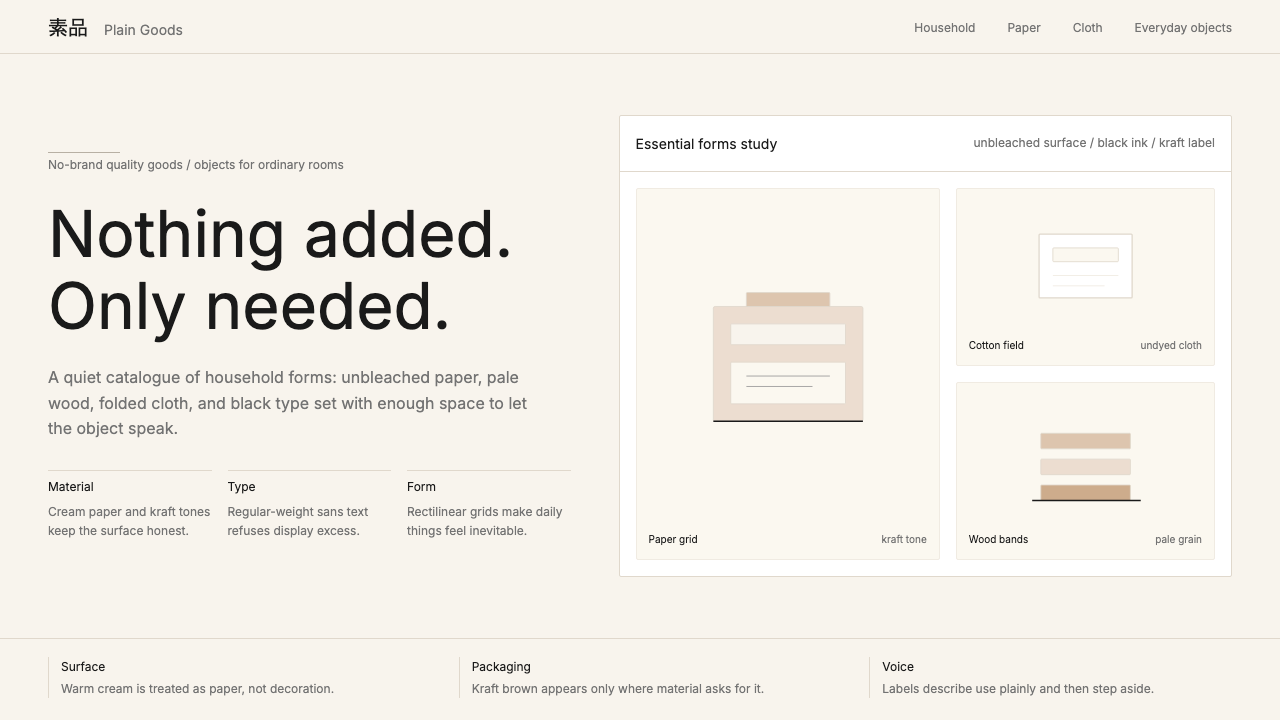
MUJI built a global visual language out of what it refused — no brand marks, no decorative color, no ornament that could not justify its presence.
MUJI in brief
MUJI — Mujirushi Ryōhin, literally 'no-brand quality goods' — is a Japanese retail and design philosophy that treats visual restraint as a form of honesty. Where most consumer brands compete through vivid color, proprietary typefaces, and carefully engineered emotional associations, MUJI deliberately removes all of these signals. Packaging reveals the thing inside rather than advertising an aspiration. Typography is neutral and editorial. Backgrounds are the color of unbleached paper or undyed cotton. The effect is not austerity so much as clarity — a visual environment in which objects are allowed to speak for themselves.
The style's characteristic palette runs from warm cream through kraft brown to the near-black of dense ink on newsprint. These are not chosen for drama but for their relationship to natural, minimally processed materials — the same logic that governs MUJI's products, which favor unbleached cotton, raw wood, unpainted aluminum, and clear glass. Color, when it appears at all, is functional: a pale sage or dusty blue that marks a category boundary, never a branding flourish.
Typographically, MUJI favors letterforms with no extraneous weight — fonts that sit on the page the way a well-made tool sits in the hand, undemonstrative and balanced. Japanese text is set with the density and editorial precision of a quality magazine, while Latin text is handled with equivalent restraint. The result is a system that feels editorially composed rather than marketed — closer in spirit to a museum label or a craft goods catalog than to consumer advertising.

Where does MUJI come from?
MUJI was created in 1980 not as a standalone brand but as an in-house product line for Seiyu, one of Japan's major supermarket chains. The concept was conceived by Seiji Tsutsumi, then chairman of the Saison Group, and developed with the creative direction of advertising executive Kazuko Koike. The founding premise was deliberately anti-commercial: forty products, packaged without logos or decorative graphics, priced as low as possible through simplified manufacturing and the use of previously discarded raw materials. The name itself was a declaration — Mujirushi Ryōhin meant 'no-brand quality goods,' which in a culture where brand marks carried enormous status was a radical inversion of received consumer value.
The early visual language was governed by a kind of negative discipline. Without a brand mark to carry meaning, the packaging itself had to do the work — and it did so through material honesty rather than graphic invention. Craft paper, simple black typography, and the deliberate absence of color differentiated MUJI products from the vivid, highly branded goods around them on the shelf. This original restraint was as much a commercial strategy as a design philosophy: cost savings from eliminating decoration could be passed to the consumer, and the aesthetic plainness became a form of counter-positioning in a market saturated with visual noise.
MUJI became an independent company in 1983 and expanded steadily through the late 1980s and 1990s, opening stores in the United Kingdom in 1991 and establishing itself internationally as a design brand rather than simply a value retailer. The aesthetic became more intentional and more sophisticated as the company grew. The turn that shaped the mature MUJI visual identity came in 2002, when Kenya Hara — one of Japan's most influential graphic designers — became art director for the brand's advertising campaigns. Hara brought a philosophical coherence to the visual language that had previously been implicit: he articulated the concept of 'emptiness' (mu) as MUJI's core aesthetic principle, arguing that the brand's whiteness and blankness were not absence but invitation — a ground onto which any life could be projected.
Kenya Hara's direction crystallized several elements that now define the style internationally: the preference for warm cream over pure white, the use of expansive negative space as an active compositional tool rather than mere background, and a typographic approach that treats letterforms as objects with their own material presence rather than transparent carriers of meaning. His advertising campaigns often featured vast, empty natural landscapes — salt flats, fog-filled valleys, snow plains — in which a single MUJI product appeared at a scale almost too small to see. The message was philosophical: the product exists within the world, does not dominate it, and asks only to be used. This visual philosophy drew directly on Japanese aesthetic traditions — wabi-sabi's appreciation of unadorned materials, ma's embrace of meaningful emptiness, and the mingei folk craft movement's insistence that objects of daily use deserve the same consideration as fine art.
What defines the MUJI look?
Palette
The MUJI palette is built on the colors of natural, minimally processed materials: warm cream, the buff of unbleached paper, the medium brown of kraft and undyed wood, and the near-black of dense ink. These tones are not chosen from a color system but derived from material reality — they describe what things look like before they are dyed, bleached, or coated. Color as emphasis or decoration is almost entirely absent. When a categorical accent is needed — to distinguish a product family or mark an interactive state — it is drawn from the same muted, low-saturation register: a dusty sage, a pale clay, an ashen blue that reads as a slightly warmer gray.
Negative Space
Emptiness in MUJI's visual language is not passive background but an active compositional element. Layouts allocate space generously — often more to the empty field than to the content — because the openness is itself the message. A product placed in a wide cream field feels considered, unhurried, and sufficient. A block of text surrounded by abundant margin has room to be read rather than scanned. This commitment to open space requires discipline: the temptation to fill, to add a secondary message or a supplementary graphic, must be actively resisted. The negative space does not serve the content; together, they constitute the whole.
Typography
MUJI's typographic choices favor letterforms that are quiet and even in weight — neither aggressively geometric nor expressively humanist. The objective is legibility without personality, as if the type aspires to be invisible in the way that a clean window is invisible: you see through it to the content beyond. Japanese and Latin texts are set at densities and spacings derived from quality publishing rather than advertising conventions. Hierarchy is established through scale differences and weight distinctions rather than through color or ornament. Headlines are larger than body text, but not dramatically so; the overall impression is one of measured restraint rather than typographic performance.
Material Honesty
The MUJI aesthetic holds that surfaces should look like what they are. Printed matter should look printed, not simulated as three-dimensional. Products should display their material — wood grain, aluminum brushing, cotton weave — rather than concealing it under paint or laminate. In graphic work, this principle translates to an absence of skeuomorphic effects: no fake paper textures applied as overlays, no artificial aging, no simulated materials that the actual medium cannot provide. Texture, where it appears at all, is the texture of the actual substrate — the slight roughness of uncoated stock, the softness of natural cotton — rather than a decorative illusion imposed on top.
Functional Color
Where Bauhaus deploys color symbolically and the Swiss International Style uses it systematically for wayfinding, MUJI uses color functionally and sparingly — almost as an apology for its own presence. A color accent in MUJI design tends to do one thing: distinguish one category from another, or mark one state as different from a default. It does not decorate, does not express brand energy, and does not exist for sensory pleasure. The low saturation of permitted accent tones ensures that they register as information rather than stimulation — they are quiet signals, not announcements.
Editorial Composition
MUJI layouts read as curated rather than designed — the distinction being that curation implies selection and restraint, while 'design' can imply the addition of style. Each element on the page appears because it was chosen; nothing appears because it fills space or adds visual interest. This editorial approach produces compositions that are often asymmetric but never restless: a single image, placed off-center, balanced by an expanse of cream ground and a single well-set block of text. The visual weight of empty space is treated as equivalent to the visual weight of content — a principle that requires confidence to execute, since every instinct of conventional graphic production pushes toward fullness.
Wabi-Sabi Sensibility
MUJI's visual philosophy is grounded in the Japanese aesthetic concept of wabi-sabi: the beauty of things that are imperfect, incomplete, and impermanent. In practice, this means a preference for materials that show their making — paper with visible fiber, wood with natural grain variation, ceramics with slight irregularity — over materials that have been processed to uniform perfection. In graphic terms, the equivalent is a compositional modesty that accepts incompleteness as a quality rather than a deficiency. A layout does not need to be filled; an image does not need to be explained by a caption; a product does not need to be accompanied by a lifestyle aspiration.

Who shaped MUJI?
Kenya Hara has served as art director for MUJI's advertising since 2002 and is the single figure most responsible for crystallizing the brand's visual philosophy into a coherent global language. A graduate of Musashino Art University, Hara brought to MUJI a theoretical framework rooted in his concept of 'emptiness' — arguing that a blank, open visual field is not absence but a space of infinite possibility. His most celebrated MUJI campaigns feature minimal objects placed in vast natural landscapes, communicating the brand's philosophy without a word of advertising copy. Beyond MUJI, Hara directs the Nippon Design Center in Tokyo and has written extensively on design theory, including the influential book 'Designing Design,' which articulates the philosophy underlying much of his MUJI work.
Naoto Fukasawa is one of Japan's most internationally recognized industrial designers and has been a long-term collaborator with MUJI, serving on its advisory board. His design philosophy — encapsulated in the concept he terms 'without thought' — holds that the best-designed objects integrate so naturally into daily life that their use requires no conscious attention. A wall-mounted CD player he designed for MUJI, in which play is initiated by pulling a cord exactly as one operates a ventilation fan, became a canonical example of how MUJI objects could embody an entire philosophy of use. Fukasawa's collaboration extended the brand's reach from packaging and graphic identity into product form itself, ensuring that the visual and material principles were unified rather than parallel.
Ikko Tanaka was one of Japan's foremost graphic designers of the twentieth century and contributed foundational creative direction to MUJI in its early years. Known for his ability to synthesize traditional Japanese visual culture — woodblock print composition, calligraphic density, the spatial logic of Japanese painting — with the tools and formats of modern graphic design, Tanaka brought a distinctly Japanese compositional intelligence to the brand before Kenya Hara formalized its philosophical framework. His broader influence on Japanese graphic design, particularly his work integrating traditional aesthetics with contemporary commercial communication, established many of the visual conventions that MUJI would later refine into its mature identity.
Seiji Tsutsumi, as chairman of the Saison Group that owned Seiyu supermarkets, was the founding conceptual force behind MUJI in 1980. A poet and novelist as well as a businessman, Tsutsumi approached the creation of MUJI as a cultural project as much as a commercial one — a response to the excess and disposability of Japan's high-growth consumer economy. His decision to build the brand around the explicit rejection of branding was a genuinely unusual strategic choice at a time when Japanese consumer marketing was dominated by imported status brands and aggressively designed domestic products. Without Tsutsumi's willingness to commit to an anti-brand stance at the company ownership level, the aesthetic discipline that defines MUJI today would have had no institutional foundation to rest on.
Kazuko Koike was the advertising executive who worked with Seiji Tsutsumi to develop MUJI's founding concept and early creative direction. Her background in advertising gave the project a practical commercial intelligence that balanced Tsutsumi's more philosophical intentions — she understood that restraint, to be legible as a choice rather than a limitation, had to be communicated actively rather than simply enacted. The early MUJI packaging and in-store communication systems that established the brand's visual vocabulary were developed under her guidance. Koike also co-founded MUJI's product advisory council, the framework through which external designers have contributed to the brand's product line throughout its history.
How do you use MUJI today?
MUJI's visual language is among the more demanding historical styles to apply correctly, because its power depends entirely on what is absent. Most visual systems give the designer things to add — colors, shapes, textures, type treatments — that build toward an effect. MUJI gives the designer things to remove, and the discipline required to keep removing, to resist the pull of visual completeness, is the actual skill the style demands. Applied superficially, it produces work that looks plain and underdesigned. Applied with understanding, it produces work that reads as considered, confident, and honest.
For presentation slides, MUJI is most effective when the deck is conceived as a sequence of editorial pages rather than information containers. A cover slide works best with a single image placed asymmetrically in a wide cream field, the title set in a modest weight at a scale that does not compete with the image, and nothing else. Content slides should use a narrow column for body text with wide margins held open rather than filled with secondary content. Data slides benefit from the MUJI approach of treating charts as objects rather than visualizations: restrained axis labels, bars or segments in the natural palette of cream and brown with a single muted accent for the key metric, and sufficient white space around the chart that it reads as a considered thing rather than a space-filling element.
For web interfaces, MUJI translates well to product pages, editorial sites, and any context where the content itself should dominate over the chrome. The approach is to strip navigation to its functional minimum — wordmarks and text labels, no icon decoration, no gradient backgrounds on navigation bars — and to give product images or editorial photography the room they need to read clearly. Dashboards and data-heavy interfaces can use the MUJI palette's neutral base to reduce visual noise and allow color-coded information to register without competition. Pricing and feature comparison pages benefit from the style's editorial clarity: structured as a well-set table rather than a marketing display, with the differences between tiers made legible through hierarchy and position rather than through saturated color contrast.
For editorial and marketing work, the MUJI style supports long-form content better than short, high-energy formats. An article or editorial layout in this style uses generous page margins as a compositional element in their own right — pull quotes or chapter headings can float in the margin, treating the margin as a secondary reading channel rather than dead space. Marketing pages can use the style's restraint strategically: in a visual environment saturated with high-saturation graphics and motion, a page that holds still and offers space reads as confident and premium. The mistake to avoid is attempting to use MUJI's quiet palette for high-urgency conversion contexts — calls to action embedded in muted cream fields rarely communicate the necessary sense of immediate value.
The most common mistake when applying MUJI is confusing restraint with emptiness. Removing decoration does not mean removing care — every decision that remains after decoration is stripped away must be more considered, not less. Font pairing matters more when there is no color to distract from typographic inconsistency. Spacing decisions are more visible when there is no ornament to mediate between elements. Image selection becomes load-bearing when there is nothing else on the page to carry meaning. Designers new to the style frequently produce work that is sparse without being intentional, empty without being open. The test is whether every element that remains can justify its presence — not by filling space, but by contributing meaning that no other element could provide.

MUJI — FAQ
Is MUJI the same as minimalism?
MUJI and minimalism share a reduction of visual elements, but their motivations and aesthetic results differ significantly. Contemporary minimalism — as practiced in much digital product design — tends to reduce as a formal exercise, pursuing clean lines and open space as aesthetic qualities in their own right. MUJI's reduction is philosophically motivated: it proceeds from the conviction that objects and communications should not claim more than they are, that the unnecessary conceals rather than enhances the essential. The result is that MUJI-derived work is warmer and more material than most minimalism — it accepts the cream tone of unbleached paper rather than defaulting to pure white, and it favors natural material references over clinical neutrality. Minimalism empties. MUJI clarifies.
Can the MUJI style work for digital products and interfaces, or is it mainly suited to print?
MUJI's principles transfer well to digital, but require thoughtful adaptation. The style's warm cream backgrounds work on screen as effectively as on paper, provided the display is calibrated correctly — they read as intentionally warm rather than as an uncorrected white point. The editorial approach to typography, with its emphasis on generous line spacing and wide margins, tends to produce interfaces that are highly legible and notably calm by the standards of most consumer digital products. The difficulty comes in interactive states: MUJI's low-saturation palette makes it harder to communicate hover states, focus rings, and active selections without importing colors from outside the system. The solution is to use value contrast — darker and lighter tones within the same neutral family — rather than hue shift to signal interactivity. Used this way, the style produces digital interfaces that feel considered and trustworthy rather than flat and uninspiring.
How does MUJI differ from Scandinavian design, which also emphasizes simplicity and natural materials?
Both traditions value functional simplicity and material honesty, but they arrive from different cultural contexts and produce distinct aesthetic results. Scandinavian design — rooted in the Nordic design movement of the mid-twentieth century — tends toward cleaner geometry, a brighter palette (including the distinctive Scandinavian use of cool whites and fresh blues), and forms that express a kind of rational optimism about the relationship between good design and democratic society. MUJI's visual philosophy is more inward-facing and philosophically quieter: it draws on Japanese aesthetics of incompleteness and impermanence rather than on the Scandinavian model of design as social uplift. MUJI objects and layouts often contain a deliberate incompleteness — a margin that extends further than seems necessary, a product that makes no gesture toward display — that Scandinavian design, with its focus on considered craftsmanship and social utility, tends not to share.
What is the role of photography in the MUJI visual system?
Photography is central to MUJI's communication, but it is used in ways that deliberately suppress the conventions of commercial product photography. MUJI product images typically show objects in ambient light rather than studio lighting, against neutral grounds rather than styled environments, and without the selective focus, color grading, or retouching that commercial photography uses to make products look more desirable than they are. The goal is to show the thing as it is rather than as it might ideally appear. Campaign photography, under Kenya Hara's direction, has gone further — placing products in vast natural landscapes to communicate scale, transience, and the smallness of designed objects relative to the world they inhabit. In both cases, photography in the MUJI system is asked to be honest rather than persuasive, which is a fundamentally different brief than most product photography receives.
Does the MUJI style work for brands or products that are not Japanese?
The style's underlying principles — restraint, material honesty, functional color, editorial composition — are not culturally restricted and have been adopted successfully by brands across Europe, North America, and East Asia. What is culturally specific is the philosophical grounding: MUJI's aesthetic makes most sense when it is understood as an expression of values — anti-consumption, sufficiency, respect for the user's own projection onto objects — rather than as a set of visual conventions to be mimicked. A brand that adopts MUJI's palette and spacing but continues to use aggressive promotional language, artificial scarcity, or conspicuous brand marks will produce a result that reads as incoherent. The style works for non-Japanese brands when those brands genuinely share the values the style expresses, not merely when they borrow its surface features.
Related design styles
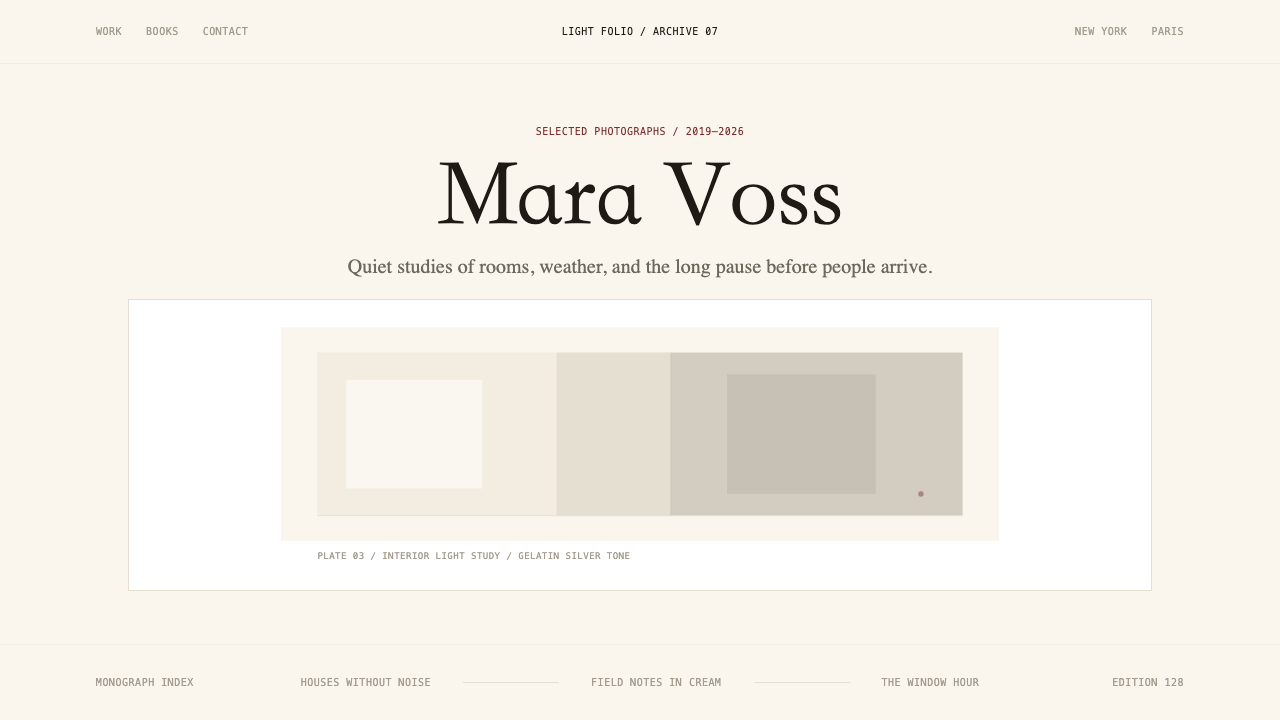 Photographer Light FolioMakes the browser a gallery wall. Warm cream, hairline serif type, and one im…
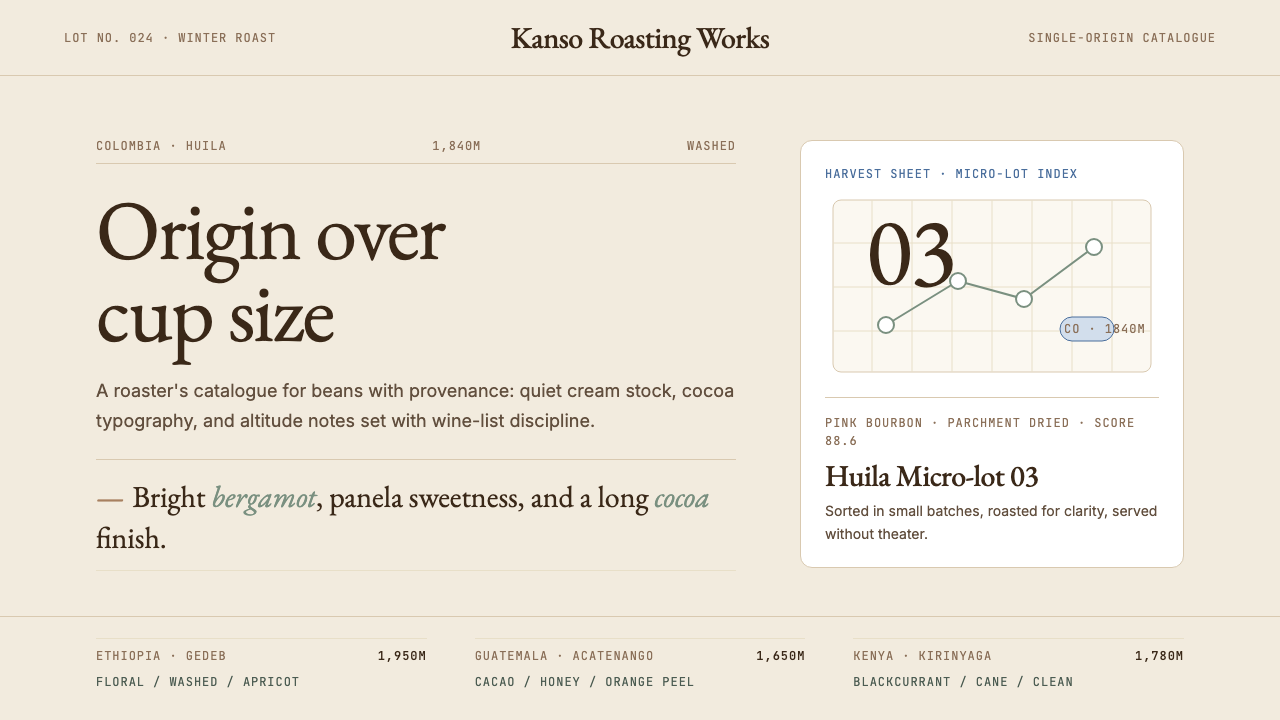 Third Wave CoffeeCoffee as catalogue. Cream paper, cocoa serif, mono origin specs, one sage no…
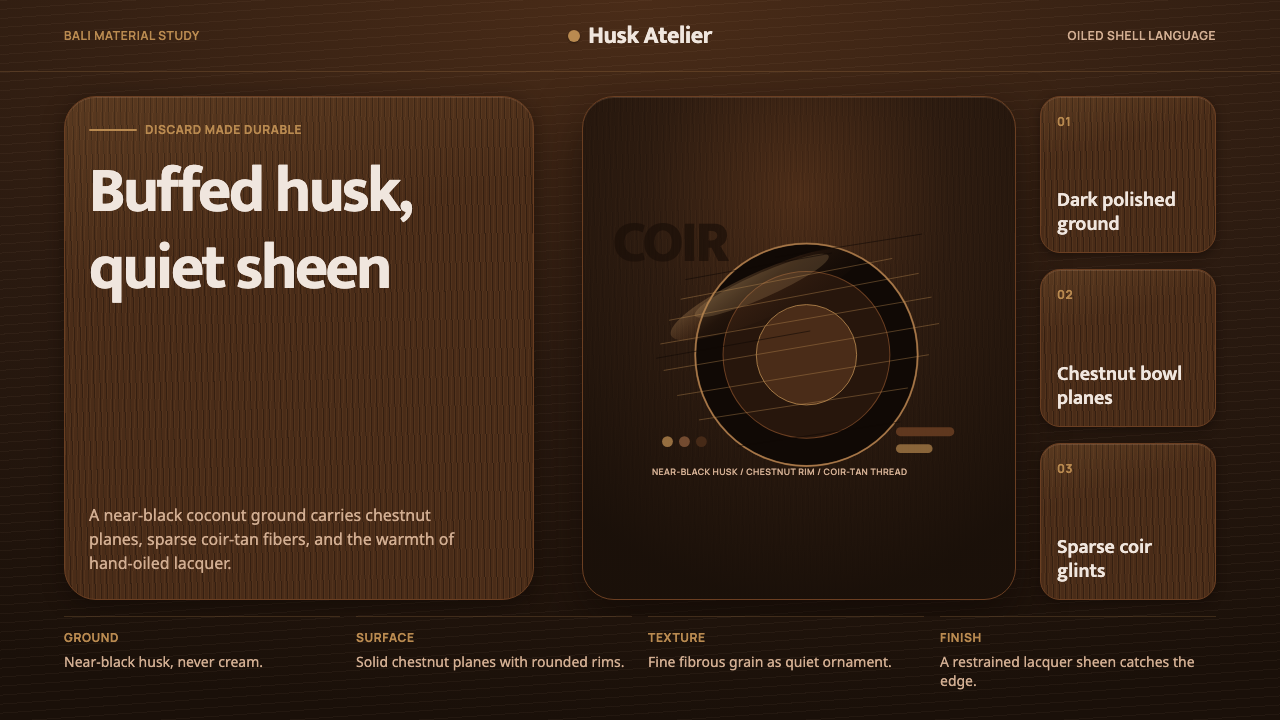 Balinese Coconut ShellQuietly hand-oiled. Near-black husk, chestnut planes, and sparse coir-tan gra…
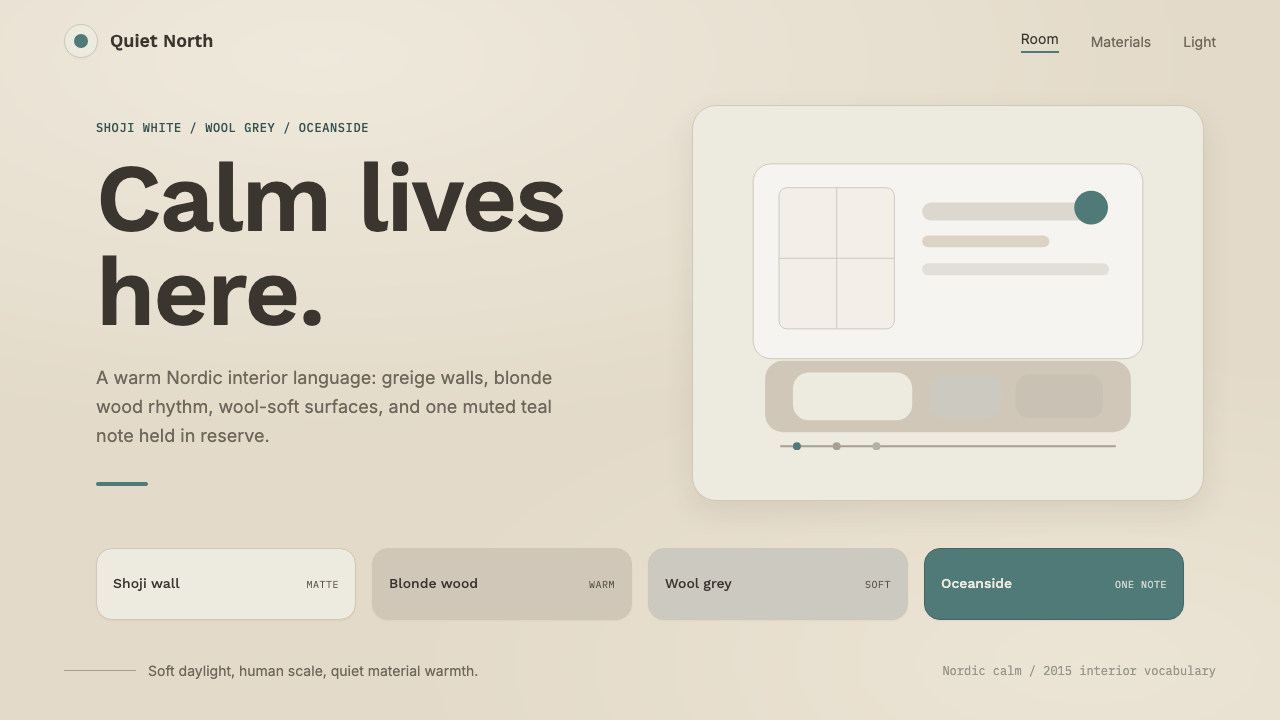 Scandinavian HyggeCalm is the brief. Greige walls, wool-grey cards, and one muted teal line.
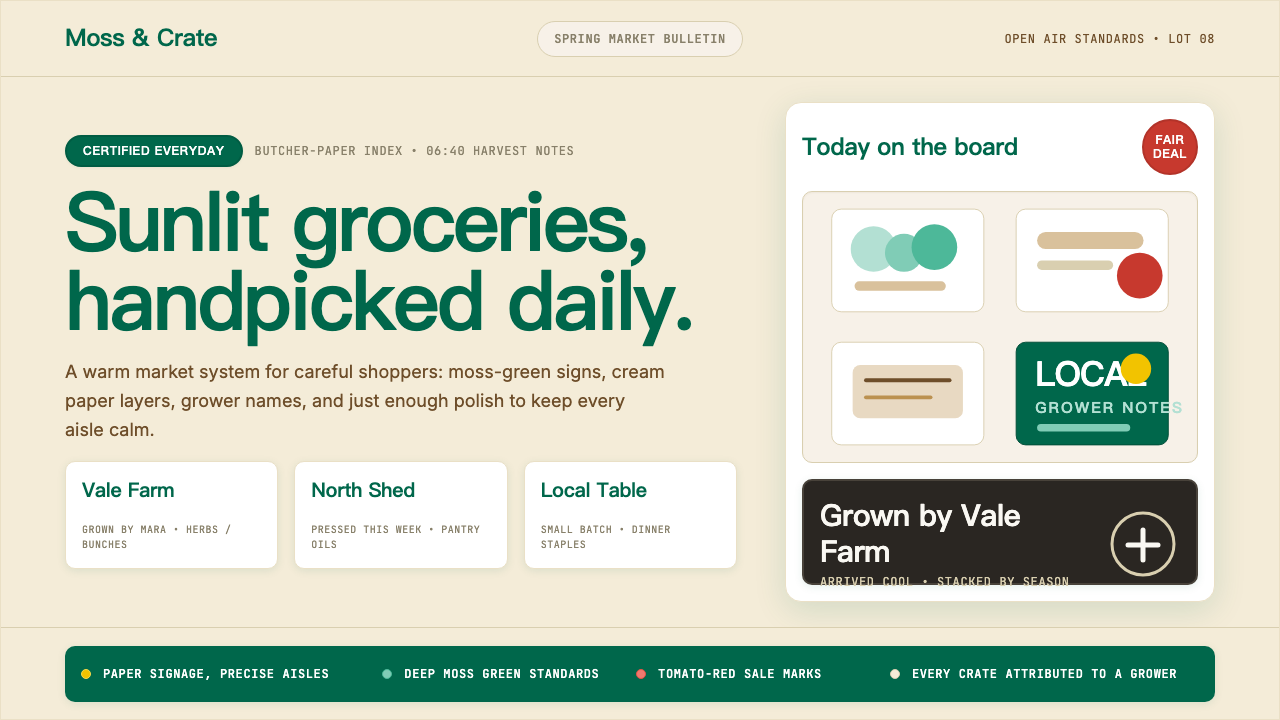 Whole Foods MarketFarmer’s-market polish. Moss green on butcher-paper cream, white cards, growe…
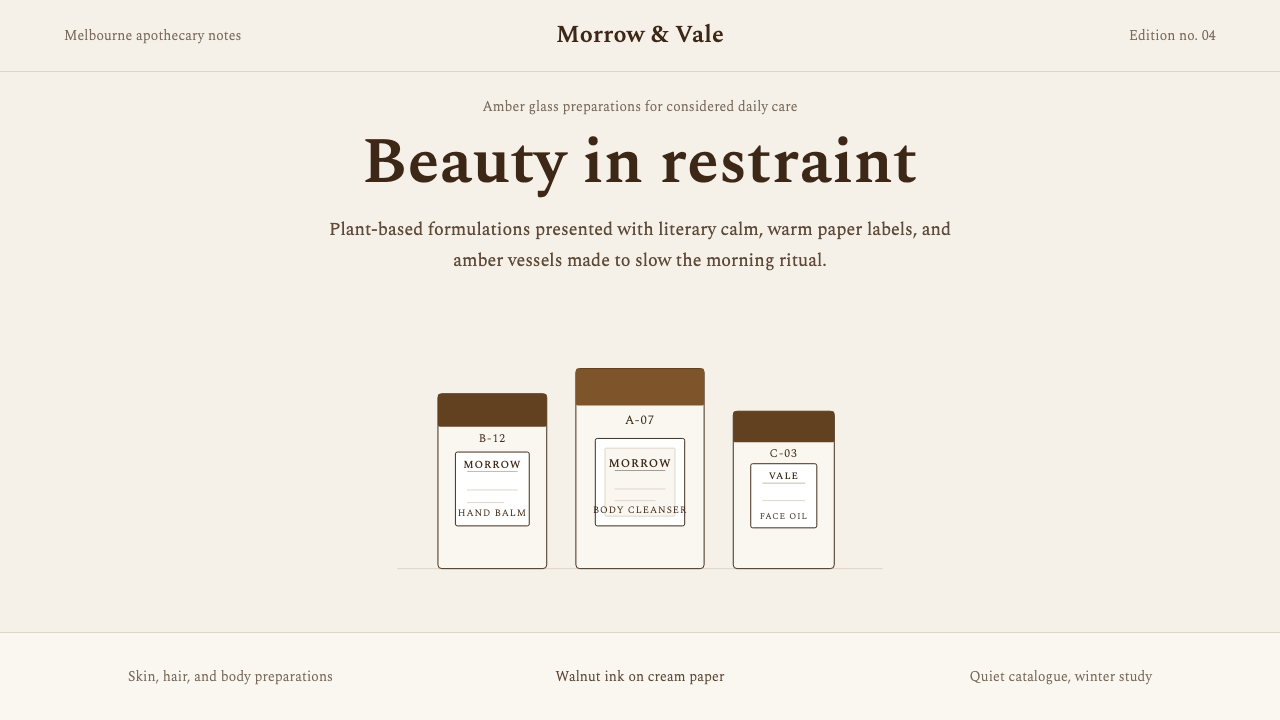 AesopRefuses urgency. Walnut serif on cream paper — every surface paced like a 19t…