What is Aesop?
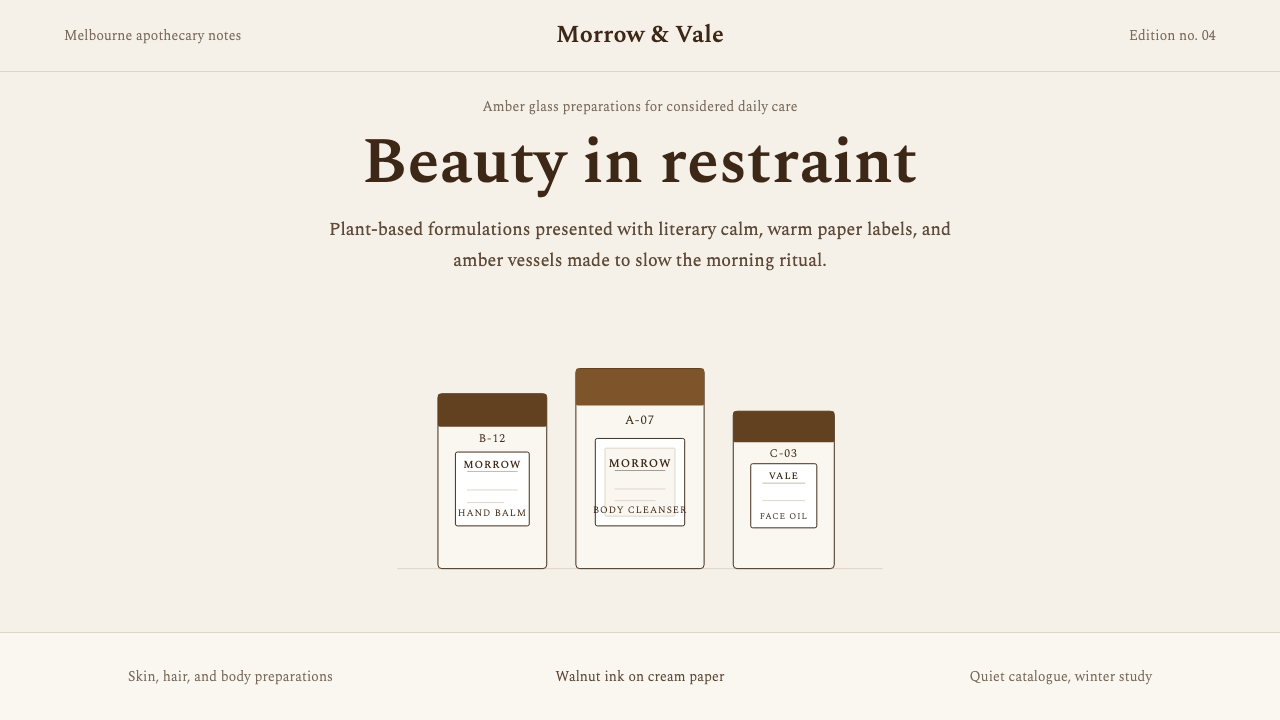
Aesop refuses urgency. Every surface — amber glass, walnut-brown serif, warm cream paper — is calibrated to the unhurried pace of a nineteenth-century apothecary.
Aesop in brief
Aesop is an Australian skincare brand whose visual identity has, since its founding in Melbourne in 1987, functioned as one of the most coherent and consistently maintained design languages in contemporary retail. What makes it distinctive is not innovation in the modernist sense — there are no novel typefaces, no experimental layouts — but rather a principled refusal to adopt any visual convention that implies speed, impulse, or novelty.
The system is built around a warm two-tone palette of deep brown and amber on cream, a classical book serif used at every typographic scale, rectangular apothecary-label geometry, and editorial whitespace calibrated to slow the eye. The result reads less like a brand and more like a carefully preserved institution — something that has been doing exactly this for a very long time and sees no reason to change.
In digital and print applications alike, Aesop's design language signals expertise through restraint. Nothing competes for attention; there are no gradients, no rounded pill shapes, no urgent sans-serif headlines. Every element earns its place through function and precedent, lending the whole system an atmosphere of quiet authority that most consumer brands spend decades trying to approximate.

Where does Aesop come from?
Aesop was founded in 1987 by Dennis Paphitis, a hairdresser who opened a small salon in the Melbourne suburb of Armadale. The early product formulations drew on botanical ingredients, and the original packaging was deliberately utilitarian — dark amber glass bottles with plain rectangular paper labels printed in a single color. This was not a stylistic choice driven by trend research; it was, by Paphitis's own account, a practical and philosophical refusal of the cosmetics industry's prevailing language of glamour, luxury signaling, and aggressive visual differentiation.
The apothecary aesthetic that became Aesop's signature emerged from this refusal. Pharmaceutical packaging — with its classical serif labels, its amber glass designed to protect light-sensitive contents, its terse ingredient listings — implied scientific rigor and functional purpose rather than aspiration. Paphitis and his collaborators took this language and applied it with the care of a bibliophile: the serif type was chosen for its classical authority, the warm brown tones for their earthen honesty, the rectangular label geometry for its echo of the printed book.
As the brand grew through the 1990s and 2000s, the retail store environment became an extension of the same design philosophy. Aesop stores worldwide — designed in collaboration with architects including Rodolfo Dordoni and various local firms — are each site-specific but share a commitment to honest materials, restrained palette, and the kind of deliberate visual calm that the brand's packaging projects. The store-as-art-installation approach, guided in part by Suzanne Santos, who joined early and shaped the brand's cultural positioning, reinforced the packaging language at architectural scale.
The typographic identity consolidated around a classical book serif that carries the weight of nineteenth-century scholarly publishing without the self-consciousness of a period revival. Set in a warm dark brown against cream, it evokes the printed page of a well-made book — an association that Aesop has consistently leaned into through its in-store reading materials, its bibliographic references on product packaging, and its longstanding practice of commissioning literary collaborations. By the 2010s, when the brand was acquired by Natura and later by L'Oréal, the visual language was robust enough to survive ownership changes intact: its logic was too internally consistent to dilute without destroying it entirely.
What defines the Aesop look?
Palette
The palette is anchored by two warm tones: a deep walnut-brown that reads as ink on the page, and a warm amber that functions as both a highlight and a material reference to the brand's glass bottles. These sit against cream or off-white grounds rather than pure white, which softens the contrast and keeps the whole system from reading as clinical. No cool grays, no blues, no greens appear in the core identity — the warmth is absolute and deliberate.
Typography
A classical book serif governs every scale of text, from the dense ingredient listings on product labels to the open, generous headlines of editorial campaigns. The typeface carries associations with nineteenth-century scholarly printing — authoritative without being ostentatious. It is never paired with a contrasting sans-serif family; the system achieves hierarchy purely through size, weight, and spacing. Capital letters are used sparingly, often for proper names and section headings only, reinforcing the tone of a well-edited book rather than an advertisement.
Geometry
Rectangles dominate. The canonical apothecary label — a tall narrow oblong printed with aligned text and a ruled border — is the governing shape. It appears not only on packaging but in the proportions of editorial columns, image crops, and store signage. The rectangle implies order, legibility, and the printed page rather than the digital interface. Rounded corners, circles, and organic curves are almost entirely absent; where a frame appears, its corners are square and its edges are ruled.
Whitespace
Whitespace — or more precisely, cream space — is used with editorial generosity. Text does not crowd the edges of its container; margins are wide enough to suggest a premium printed publication. Images are placed with deliberate isolation, allowed to breathe rather than tiled or overlapped. This spaciousness is not passive emptiness but an active signal: it communicates that each element has been placed with intention, and that there is no urgency to fill every available surface.
Material Honesty
In physical products, the brand insists on materials that read as what they are: amber glass that is actually glass, paper labels that are actually paper, metal caps that show their metal character. No chrome effects, no laminate shine, no embossed logos that imply more than the material can honestly offer. In digital applications, this principle translates to flat surfaces — no simulated textures, no soft depth illusions — and a deliberate avoidance of skeuomorphic conventions that make interfaces look more substantial than they are.
Tone of Voice
The copy register is formal, literary, and unhurried — closer to an essay than to marketing copy. Product descriptions cite botanical sources, historical uses, and sensory qualities with the precision of a well-researched natural history text. There are no superlatives, no urgency phrases, no promotional exclamation. The voice signals that the brand and its reader share a certain cultivated curiosity, and that neither party is in a hurry.
Stillness and Motion
Animation is used sparingly and with deliberate slowness — a gentle opacity fade, a quiet underline reveal on hover. There are no slide-ins, no scale bounces, no particle effects. The brand communicates through stillness; motion appears only as the quietest possible confirmation of interaction, never as spectacle. The pace of any transition mirrors the pace of the typography itself: unhurried, resolved, without urgency.

Who shaped Aesop?
Paphitis founded Aesop in Melbourne in 1987 and remained its creative and philosophical anchor for three decades. His insistence on botanical formulations and utilitarian packaging from the outset established the brand's counter-cultural stance toward the cosmetics industry. A voracious reader with wide-ranging literary interests, Paphitis shaped the brand's distinctive bibliographic identity — the practice of printing literary quotes on packaging, the curation of in-store reading materials, the essayistic register of product copy. His conviction that good design is inseparable from honest intent runs through every design decision the brand has made.
Santos joined Aesop in its earliest years and became a key architect of its retail and cultural identity. She oversaw the development of the store-as-art-installation concept, which turned each Aesop shop into a site-specific spatial composition guided by the same principles as the packaging: honest materials, restrained palette, deliberate calm. Her influence extended to the brand's broader cultural programming — literary partnerships, philanthropic initiatives, the cultivation of a brand persona that reads as curator rather than marketer.
The Milanese architect and designer collaborated with Aesop on several store interiors, bringing a refined Italian modernist sensibility that complemented rather than overrode the brand's established language. His work with Aesop is notable for its material intelligence: warm stone, aged timber, polished concrete, and dark metal are composed with the same economy of means that governs the packaging. Dordoni's stores demonstrate how a two-dimensional design system can be translated into three-dimensional space without losing its essential character.
The Italian marble studio has supplied materials for Aesop store interiors, representing the brand's commitment to sourcing materials with their own histories and material integrity rather than manufactured substitutes. The collaboration exemplifies Aesop's approach to craft partnerships: finding producers whose standards of making align with the brand's values, and allowing the material's inherent qualities to carry meaning without decoration or embellishment.
How do you use Aesop today?
Applying Aesop's design language correctly requires understanding that its restraint is active, not passive — every absence is a decision. The temptation when working with this system is to add: a pop of color, a bolder typeface, a bit of visual energy to prevent the layout from feeling static. Resist this entirely. The system's power comes from its consistency; introducing contrast that the original language does not sanction will collapse the effect immediately.
For presentation slides, the Aesop language works best when treated as a long-form editorial experience rather than a series of discrete slides. Cover pages benefit from generous margins, a single typographic statement in the classical serif at a commanding scale, and the warm cream-on-brown or brown-on-cream palette used without ornamentation. Content slides should adopt a narrow text column with wide margins — the reading experience of a well-typeset book page. Data slides work within this system when charts are kept minimal: bars and lines in the deep brown or amber tones, labels in the same serif, axes undecorated. Avoid color-coded comparisons that introduce new hues outside the core palette.
For web interfaces, the style is well-suited to contexts that benefit from perceived expertise and considered quality: consulting services, editorial platforms, luxury goods, financial tools, and wellness applications positioned as calm and intentional rather than reactive. Dashboards in this language use generous line heights, ruled horizontal dividers rather than card shadows, and amber or warm-brown accent elements for interactive states. Pricing pages read cleanly when the hierarchy is established through the serif at scale rather than through color contrast or card borders.
For editorial and marketing work, the Aesop language supports long-form content with exceptional grace. Article layouts should use a measure that mirrors the proportions of a printed book page — narrow enough to be comfortable to read but wide enough to feel substantial. Pull quotes in the larger serif scale break the text column without requiring graphic decoration. In marketing applications, the language works best when the campaign has a narrative arc — an essay about the origin of an ingredient, a literary collaboration, a seasonal reflection — rather than a product feature list. The warmth of the palette and the literary register of the copy reinforce each other; break either one and the system loses coherence.
The most common mistake is applying the color palette and typeface while preserving digital-native layout conventions: rounded cards, soft box shadows, gradient buttons, icon-heavy navigation. These elements signal a different set of values — approachability, friendliness, digital modernity — that are fundamentally at odds with the apothecary-literary world Aesop constructs. If the layout feels like it could have been built from a contemporary UI component library, the conversion is incomplete. The test is whether the result could plausibly have been printed on paper: if yes, the system is working; if no, something from outside the language has been allowed in.

Aesop — FAQ
Is the Aesop design language the same as minimalism?
They overlap but are not the same. Contemporary minimalism typically removes visual elements in service of clarity and cognitive ease — it is optimization-minded. Aesop's restraint is philosophically different: it removes elements that would compromise a specific world it is constructing — the apothecary-literary world of honest materials, scholarly authority, and unhurried attention. A minimalist design can be made in cool grays on pure white with a geometric sans-serif and be entirely coherent. An Aesop-derived design built on the same foundations would feel wrong immediately: the warmth, the serif, the cream — these are not optional parameters but load-bearing elements of the identity.
Can this style work for a technology product or software interface?
It can, but with significant adaptation costs. Software interfaces operate under functional constraints — interactive states, error messages, density requirements, accessibility standards — that create pressure to introduce conventions the Aesop language does not support: bright accent colors for alerts, icon-based navigation for efficiency, sans-serif type for high-density data. A partial application tends to undermine the system: the warmth and authority the language generates depend on total commitment to its logic. The most successful technology applications of this aesthetic tend to be in contexts where the software is itself positioned as a premium, considered product — creative tools, editorial systems, high-end service platforms — rather than utility software.
Why does Aesop use a serif typeface when most luxury brands have switched to sans-serif?
Because Aesop is not positioning itself within the luxury-goods world; it is positioning itself within the scholarly-literary world. The wave of luxury brand rebranding toward geometric sans-serifs — Burberry, Saint Laurent, Balmain, and others — was driven by a desire to appear contemporary, accessible, and digital-native. Aesop's serif is a deliberate refusal of that repositioning. A classical book serif carries the weight of academic publishing, natural history texts, and nineteenth-century pharmacopoeia — exactly the associations the brand wants. The choice is not nostalgic but strategic: the serif signals that Aesop's authority comes from knowledge and time, not from fashion or market position.
How does the Aesop visual system handle color in data visualization?
Data visualization in the Aesop language must work within the constraint of the warm two-tone palette, which limits categorical differentiation. For data that requires distinguishing three or more categories, the approach is to use variations within the brown-amber range — from a deep walnut anchor through mid-amber to a pale warm tone near the cream — rather than introducing exterior hues. This works well for ordinal data showing degrees of something, but less well for categorical data with no intrinsic order. When categorical differentiation is genuinely necessary, the alternative is to use form rather than color: different line weights, different geometric markers, text labels placed directly on the data rather than in a legend.
What happens when this design language is applied to a younger or more energetic brand?
It tends to create a mismatch between form and content that audiences read as affectation. The Aesop language communicates age, patience, and accumulated expertise — associations that are earned through decades of consistent behavior, not borrowed through aesthetic choice alone. A young brand applying this language without the accompanying substance risks appearing pretentious: the slowness reads as studied rather than genuine, the literary register as performance rather than conviction. This does not mean younger brands cannot use restrained palettes or classical type — they can — but the specific combination of apothecary geometry, warm scholarly color, and unhurried whitespace has a semantic weight that works against energy, immediacy, and novelty.
Related design styles
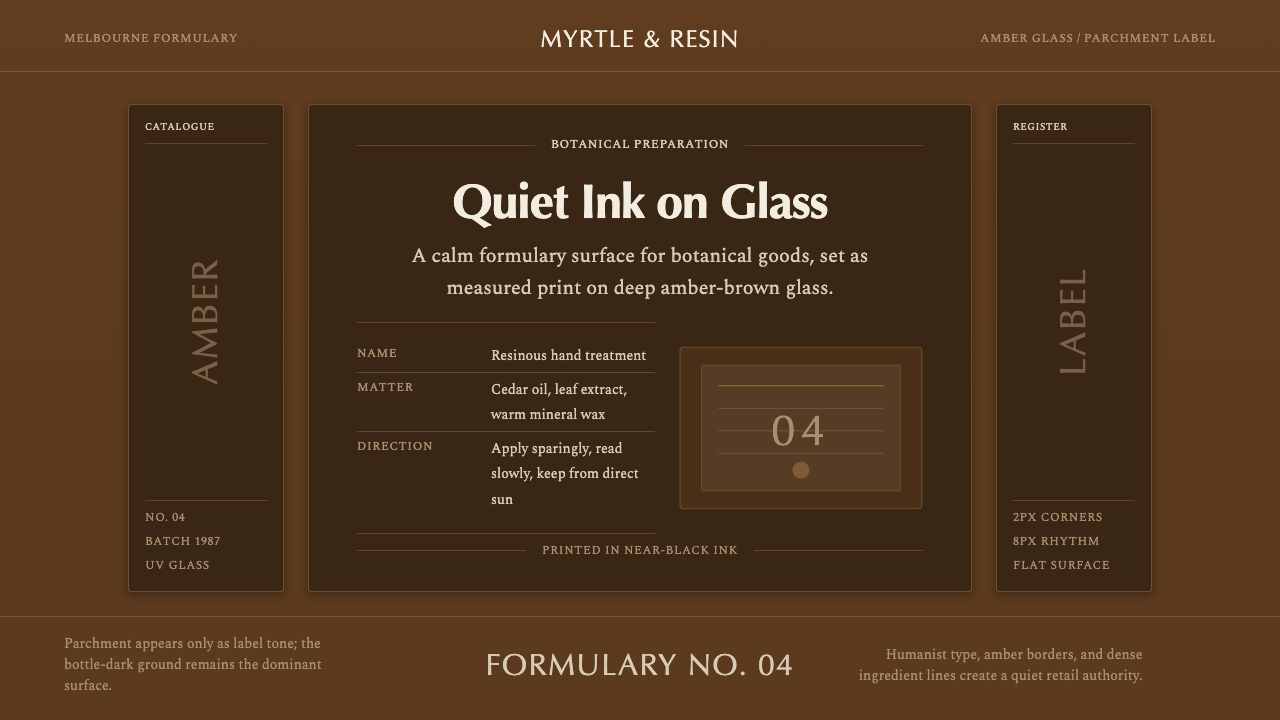 Aesop Apothecary AmberQuiet authority in glass. Amber-brown ground, parchment labels, and humanist…
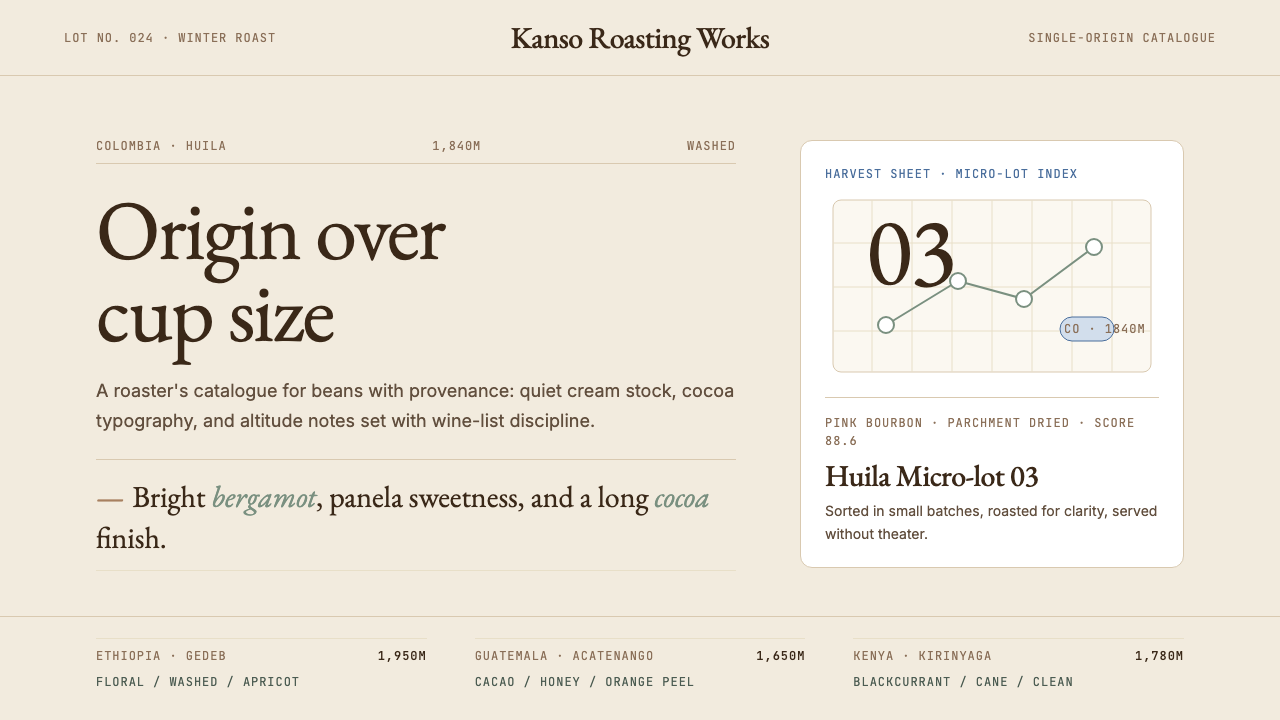 Third Wave CoffeeCoffee as catalogue. Cream paper, cocoa serif, mono origin specs, one sage no…
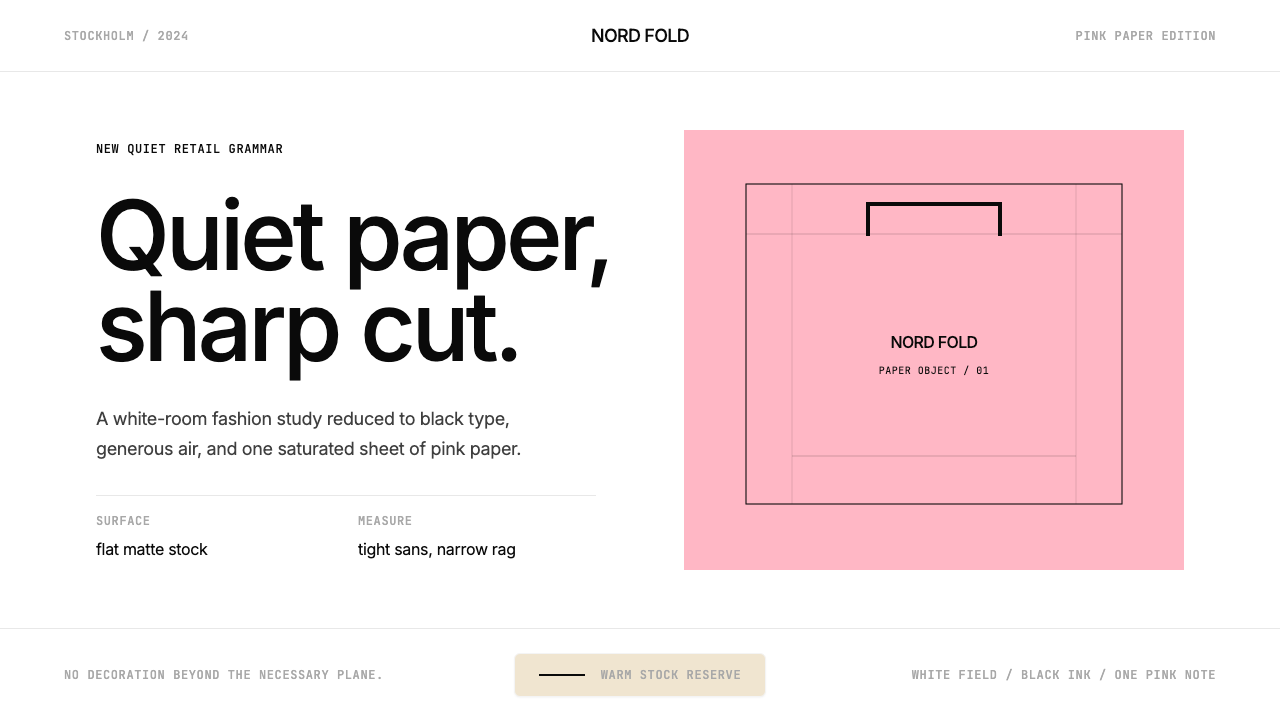 Acne Studios Pink-PaperQuiet luxury in one pink plane. Inter type floats on white with a bag-like re…
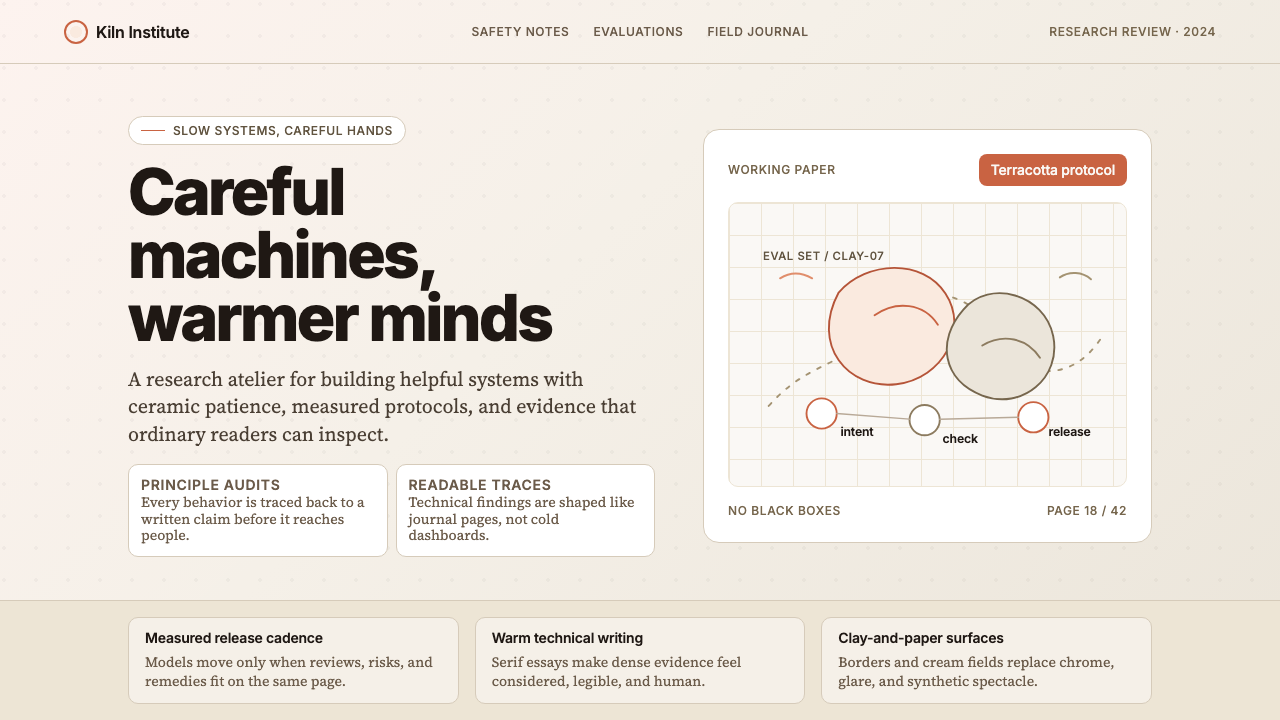 Anthropic ClayAI safety in handmade clay. Sand backgrounds, terracotta accents, serif body…
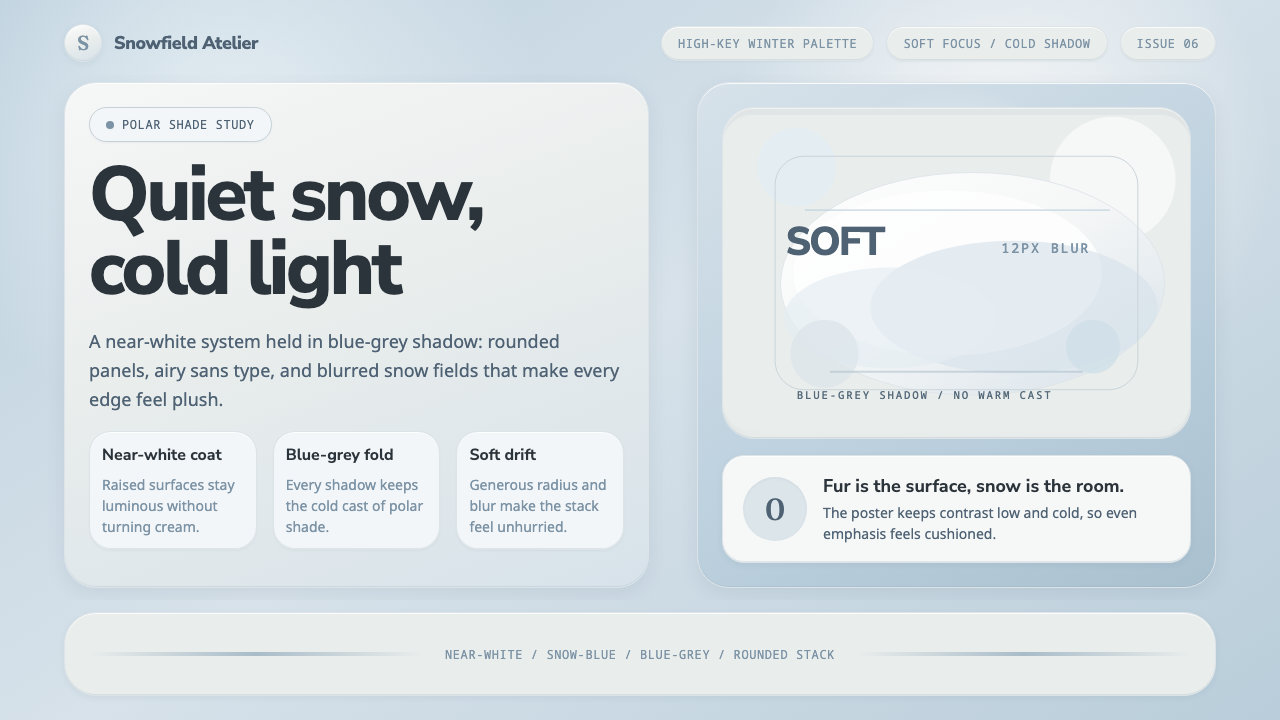 Arctic Fox Winter CoatIcy softness, never cream. Near-white panels float over snow-blue shadow.
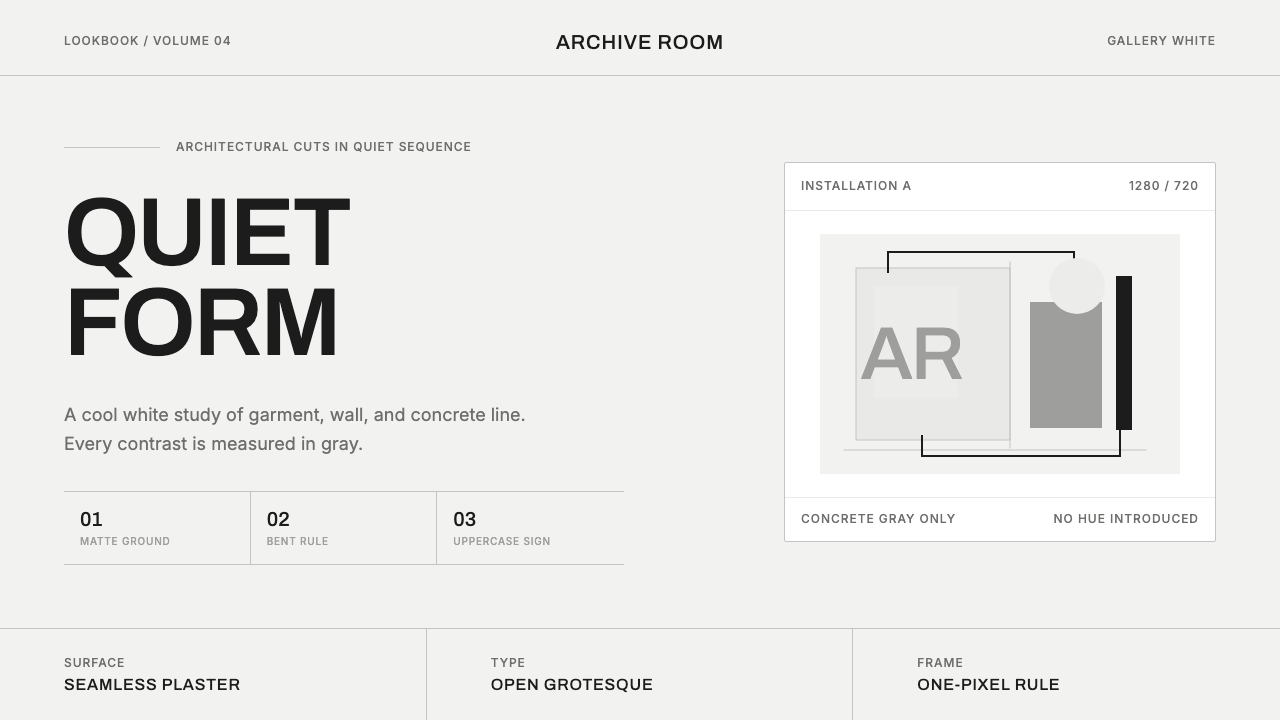 COS Gallery MinimalSilence has structure. Cool gallery white, Archivo uppercase, and concrete-gr…