What is Anthropic Clay?
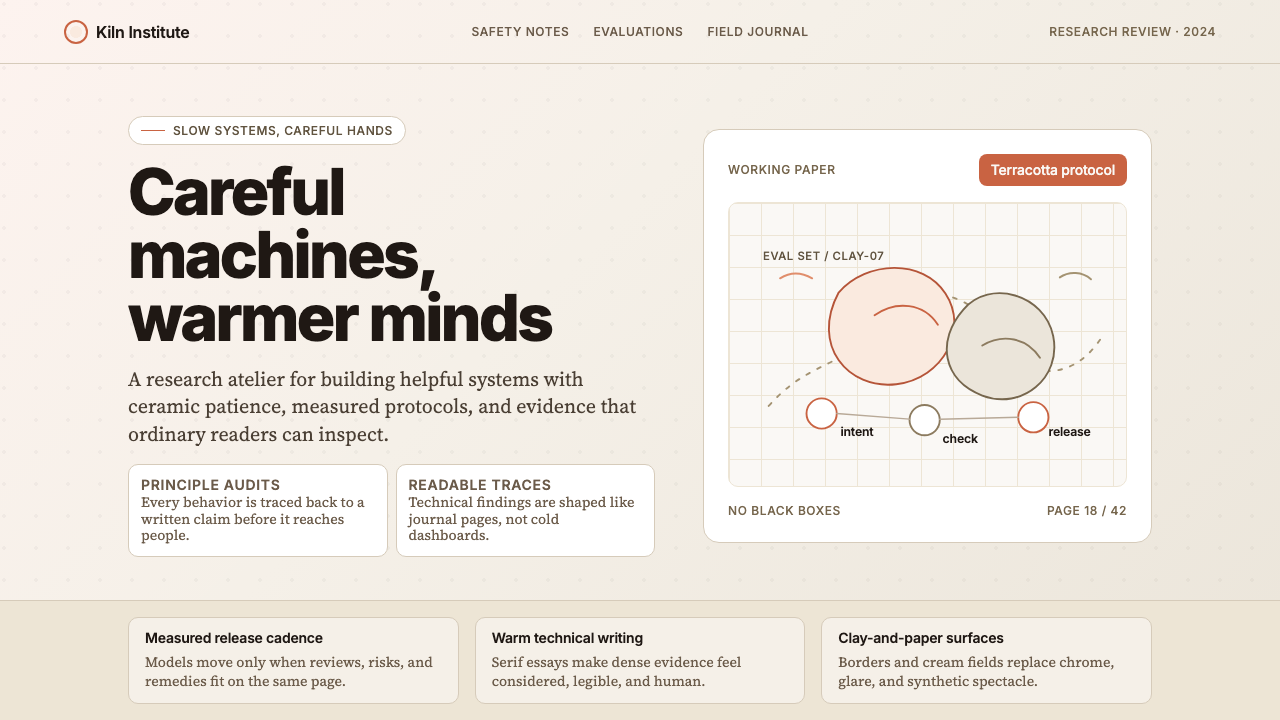
Anthropic Clay dresses AI safety research in warm earth — sand grounds, terracotta accents, and unhurried serif text that says we build slowly, with intention.
Anthropic Clay in brief
Anthropic Clay is the visual identity language developed by Anthropic, the AI safety company, and crystallized between 2023 and 2024. Where most technology brands reach for cold, monochromatic palettes to project competence and speed, Anthropic made the opposite choice: sand-and-cream backgrounds, terracotta-rust accent tones, and generous serif body text that together produce a surface closer in feeling to a craft-pottery studio or an academic press than to a Silicon Valley software company.
The style is defined by an organic warmth that is rare in technology branding. Every color decision whispers paper and earth rather than glass and chrome. The typographic choices signal editorial seriousness — an industry more accustomed to rushing than reflecting. And the deliberately unhurried pace communicated through generous whitespace and restrained ornamentation carries an implicit message: this organization thinks carefully before it acts.
Anthropic Clay is not nostalgia for its own sake. The warmth is strategic, rooted in a genuine philosophical position about how transformative technology should present itself. The aesthetic bridges two worlds — it is technically sophisticated enough to credibly represent frontier AI research, and human enough to communicate that the people doing the research take its implications for real human lives seriously.

Where does Anthropic Clay come from?
Anthropic was founded in San Francisco in 2021 by Dario Amodei and Daniela Amodei, along with several colleagues who had previously worked at OpenAI. The founding premise was a concern: that large-language-model development was moving faster than the field's collective ability to understand and ensure the safety of those models. This concern shaped not only the research agenda — constitutional AI, interpretability, alignment — but eventually the company's entire public identity.
From the beginning, Anthropic positioned itself as a company that regarded speed and safety as genuinely in tension, and that chose to sit on the safety side of that tension. That positioning demanded a visual language that felt different from the ambient aesthetic of AI commercialization: the dark interfaces, neon accents, and kinetic logos that dominated the space around 2022 and 2023. The Clay identity, developed by Anthropic's internal brand team, emerged as a deliberate counterstatement — a rejection of the visual vocabulary of urgency.
The organic, earth-derived palette draws on a longer tradition of brands that use natural materials and warm tones to signal craft, patience, and responsibility. The specific combination of sand grounds, cream midtones, and terracotta accents evokes ceramics, aged paper, and the textures of the physical world — associations that feel antithetical to the abstracted, disembodied quality of most technology aesthetics. This was not accidental. Anthropic's research is fundamentally about keeping AI grounded in human values; the visual identity literalizes that groundedness.
The typographic dimension of the identity — the commitment to serif body text and to layouts with generous reading rhythm — aligns with the company's published communication style. Anthropic publishes substantial technical writing: papers, policy documents, model cards, interpretability research. A visual system anchored in editorial typography signals that this is an organization comfortable with long, careful arguments rather than one optimized for five-second attention spans. The Clay identity thus serves both as a brand differentiator and as a coherent expression of an organizational philosophy about time, attention, and care.
What defines the Anthropic Clay look?
Earth-Warm Palette
The color system is built around sand and cream as primary grounds — warm neutrals that recall unbleached paper, aged linen, and raw clay. Terracotta and rust tones serve as the primary accent register, chosen for their associations with handmade objects and natural materials rather than the electric, screen-optimized hues of conventional tech branding. The overall palette reads as warm without being vivid, muted without being gray — a deliberate middle register that feels considered rather than default.
Editorial Serif Typography
Serif typefaces anchor the body text, establishing a reading rhythm associated with books, long-form journalism, and academic publishing rather than digital interfaces optimized for scanning. Display type introduces contrast through scale and weight rather than switching to geometric sans-serifs. The result is a typographic voice that feels unhurried and authoritative — one that invites sustained reading rather than quick skimming. Line lengths and leading are generous, reinforcing the sense that the content is meant to be thought through.
Tactile Surface Quality
Where other technology brands favor pristine, glossy digital flatness, Anthropic Clay suggests the slight imperfection of physical materials — paper grain, ceramic matte, uncoated stock. This tactility is expressed through tonal choices rather than literal texture overlays: colors that read as pigment-based rather than backlit, warm off-whites rather than pure screen-white, accent tones that recall dyed fabric or fired clay. The effect is an interface that feels like it has weight.
Measured Whitespace
Layouts breathe. Generous margins, open paragraph spacing, and unhurried section pacing give every element room to exist without crowding. This is not minimalism in the reductive sense — the pages are substantive and information-dense — but the arrangement communicates patience. The whitespace carries meaning: it says that the content has been given time to settle, and the reader is expected to bring the same quality of attention.
Restrained Ornamentation
Decorative elements are sparse and purposeful. When illustrative or ornamental graphic elements appear, they tend toward organic, hand-drawn or softly geometric forms — gentle curves, loose botanical shapes — rather than the sharp icons and rigid pictograms common to most software interfaces. Any illustration is subordinate to text; its role is to warm the page, not to compete for attention. Rules, borders, and dividers appear only when they serve a clear structural purpose.
Human-Scale Imagery
Photography and illustration, when used, favor human presence, craft, and tangible physical materials over abstract data visualizations and the disembodied glows of AI-themed stock imagery. The visual world of Anthropic Clay includes hands at work, paper, physical objects, and natural light — imagery that anchors the abstract subject matter of AI research in recognizable human experience. This is a significant departure from the dark, cosmic, and machine-aesthetic imagery that pervades most AI brand communications.
Calm Structural Hierarchy
Information hierarchy is established through type scale, weight, and tonal contrast rather than through competing colors, heavy rules, or aggressive visual containers. The eye is guided gently rather than directed sharply. Primary content sits in the warmest, clearest zone of the page; supporting information recedes without disappearing. The hierarchy feels logical and calm — a structure that rewards careful reading rather than one optimized for first-glance impact.

Who shaped Anthropic Clay?
As CEO and co-founder of Anthropic, Dario Amodei has been the primary articulator of the organization's philosophy that AI development should be slow, careful, and accountable. His public communications — lengthy essays, policy testimony, technical papers — established the intellectual register that the Clay visual identity was built to match. The brand's commitment to editorial depth and unhurried typography directly reflects the communication style of the organization he leads.
As President and co-founder, Daniela Amodei has shaped Anthropic's commercial and public-facing identity. Her background in business operations and her role in building the company's go-to-market strategy meant that the Clay brand needed to function not only as a philosophical statement but as a commercially credible design system capable of representing enterprise products, research publications, and consumer-facing applications coherently. The brand's ability to stretch across these registers without losing its character reflects her influence.
The internal brand team responsible for developing and stewarding the Clay visual system made a series of consequential choices that distinguish this identity from superficially similar warm-palette tech rebrands. The decision to anchor the system in serif typography rather than geometric sans-serifs, to use earth tones derived from ceramic and natural material traditions rather than muted pastels, and to build the layout language around editorial breathing room rather than content density — these choices give Clay its specific character and make it genuinely difficult to replicate without understanding its underlying logic.
Though not a person, Anthropic's constitutional AI research — the methodology by which a model is trained with a set of explicit principles, or a 'constitution', governing its behavior — is the intellectual project that the Clay brand was built around. The idea that an AI system should have internalized values, not just external guardrails, has a visual analog in Clay's design philosophy: an aesthetic that does not impose restrictions on top of a neutral base but rather builds warmth and care into the foundational material itself.
Clay's visual language consciously invokes two historical craft traditions: the ceramics aesthetic, with its organic earth tones, matte surfaces, and preference for the handmade over the industrially perfect; and the tradition of independent academic and artisan publishing, with its editorial typography, generous margins, and slow-reading rhythm. Neither tradition is directly quoted or imitated — instead, they function as tonal references that give Clay its particular quality of warm authority, distinct from both corporate tech branding and from retro-styled artisan brands.
How do you use Anthropic Clay today?
Anthropic Clay translates to designed artifacts most successfully when the underlying content itself calls for the same qualities the aesthetic communicates: care, depth, and a long view. The style works because it is honest — it suits organizations and products that genuinely want their audience to slow down and read carefully. Applying it to content that is actually fast-paced, alert-driven, or transactional will create dissonance rather than distinction.
For presentation slides, Clay performs well on both cover and content pages, but the approach differs by page type. A cover benefits from the palette's warmth used broadly — a sand or cream field occupying most of the slide, the title in a substantial serif at generous scale, and a single terracotta or rust accent providing the only chromatic punctuation. Content slides should be treated as lightly formatted editorial pages: one organizing idea per slide, text at a legible scale with real line spacing, and any data presented in simple bar or line form with warm-neutral fills rather than high-saturation color coding. The overall deck should feel like a well-designed annual report, not a pitch deck.
For web interfaces — particularly the landing pages, pricing pages, and documentation sites that constitute most of Anthropic's public-facing digital presence — Clay's editorial spaciousness is the primary asset. Navigation should be typographic and restrained, with no heavy visual containers or aggressive sticky elements. Feature sections benefit from alternating between warm-ground and slightly warmer-ground blocks rather than dark-and-light contrast, maintaining the palette's tonal consistency throughout. Dashboard interfaces built in the Clay system should use the warm neutral grounds for background and container surfaces, reserve the terracotta accents for status indicators and primary calls to action, and rely on typographic hierarchy rather than colored pills or badges for information organization.
In editorial and marketing contexts — research papers, policy documents, newsletters, long-form blog posts — Clay's typographic decisions are the most important element to preserve. Generous margins create space for thought; serif body text establishes intellectual seriousness; a measured absence of decorative elements signals that the content is doing the work. Marketing materials built in Clay should feel more like a well-produced essay or publication than an advertisement. The goal is to make the reader feel that the organization has something worth saying and the confidence to say it at length.
A common mistake when applying Anthropic Clay is mistaking the warmth for casualness. The palette's earth tones can tempt designers toward a rustic or cozy aesthetic — loose layouts, hand-lettered display type, artisanal texture overlays — that undermines the style's actual combination of warmth and authority. Clay is warm but not folksy, editorial but not precious, restrained but not sparse. The terracotta accent should feel purposeful, not decorative; the serif type should feel serious, not quaint; the generous whitespace should feel considered, not empty. Maintaining this balance — using warmth as a quality of the materials rather than as an invitation to informality — is what separates a successful Clay application from a pleasant but directionless one.

Anthropic Clay — FAQ
Is Anthropic Clay just a warm version of standard tech minimalism?
Not quite. Standard tech minimalism — the kind associated with productivity apps and B2B SaaS — typically uses cool neutral grays, geometric sans-serif typefaces, and layouts that prioritize scannability over reading. Clay shares the restraint but differs in its material references and typographic philosophy. The earth tones are chosen for their associations with handmade, physical things rather than for chromatic neutrality. The serif typography is chosen for its reading rhythm rather than for brand distinctiveness. And the whitespace is generous in a way that invites sustained attention rather than quick navigation. Clay is warm where standard minimalism is cool, editorial where it is functional.
How does Clay handle dark-mode or dark-background layouts?
The canonical Clay identity is a light-ground system — its warmth comes from the relationship between sand-and-cream grounds and earth-tone accents. A dark inversion is possible but requires significant retuning. On a dark background, the terracotta and rust accents can easily become too prominent or read as warm highlights in a way that loses the palette's characteristic measured quality. A more successful dark-Clay variant typically desaturates the accent tones toward warm amber or warm stone rather than maintaining full terracotta saturation, keeps type in a warm off-white rather than pure white, and uses the deep background not as dramatic contrast but as a quiet envelope for the content. The editorial tempo should still read as unhurried.
Can Clay work for a consumer app, or is it only suited to research and enterprise contexts?
Clay can work for consumer applications, but the fit depends heavily on what the product is doing and what kind of relationship it wants with the user. It is well-suited to applications where the user is expected to read, reflect, and engage over time — learning tools, writing aids, reference applications, anything where depth of engagement is the goal. It is less well-suited to applications driven by quick actions, social feedback loops, or high visual stimulation — gaming, social media, anything where the user's primary mode is reactive rather than reflective. In consumer contexts, Clay's measured pace can feel luxurious and calm; or it can feel slow and inaccessible. The key question is whether the product's value proposition rewards patience.
Why does the style use serif type when most AI products use sans-serif?
The near-universal adoption of geometric sans-serif typefaces in AI product interfaces reflects an aesthetic alignment with the technology itself: clean, rational, unornamented, built for the screen. Anthropic's decision to anchor its public identity in serif typography is a deliberate departure from this convention, chosen precisely because it signals something different. Serif letterforms carry associations with print tradition, long-form reading, and editorial judgment — qualities Anthropic wants to project. The choice is also congruent with the company's actual communication style: its published writing is dense, careful, and argumentative in a way that genuinely benefits from a reading-optimized type environment.
What is the most common error when trying to replicate Clay in a new design?
The most common error is over-warming: adding too many earth-tone elements — too many terracotta blocks, too much textured illustration, too many hand-drawn graphic accents — in an attempt to achieve Clay's character by accumulation rather than by restraint. Clay's warmth is a quality of the base materials, not a quantity of warm elements. A single sand background with clean serif text and one terracotta accent line is more authentically Clay than a composition loaded with warm colors, botanical ornaments, and texture overlays. The second most common error is abandoning typographic structure in favor of visual decoration — using illustration and color to create interest where careful typographic hierarchy should be doing the work. Clay earns its warmth through restraint; it does not substitute decoration for structure.
Related design styles
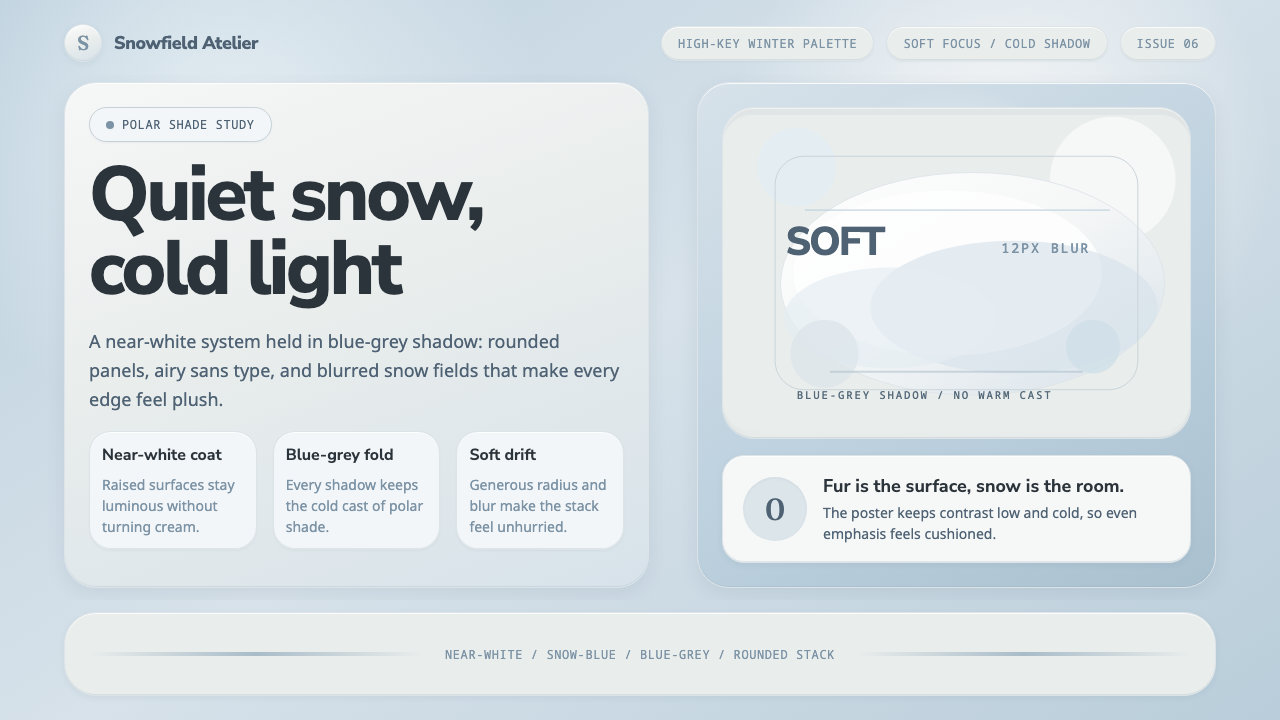 Arctic Fox Winter CoatIcy softness, never cream. Near-white panels float over snow-blue shadow.
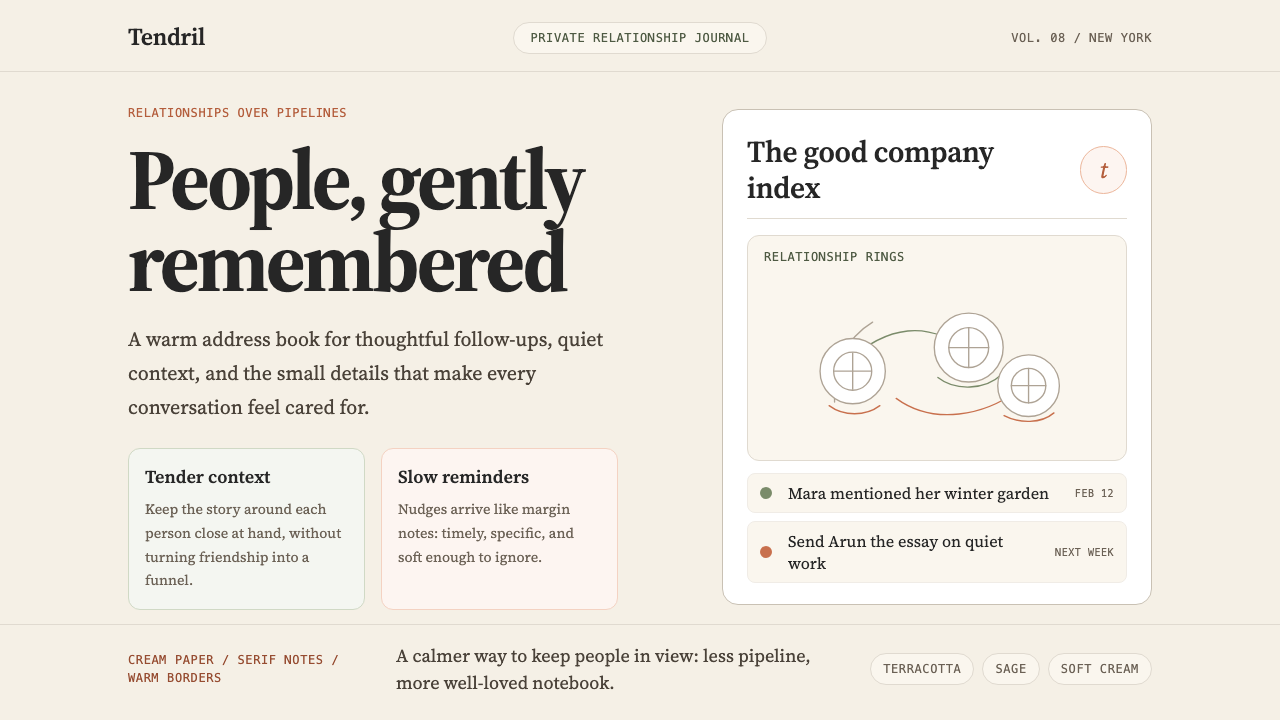 Clay 2024CRM as a sketchbook, not a sales pipeline. Cream backgrounds, terracotta, han…
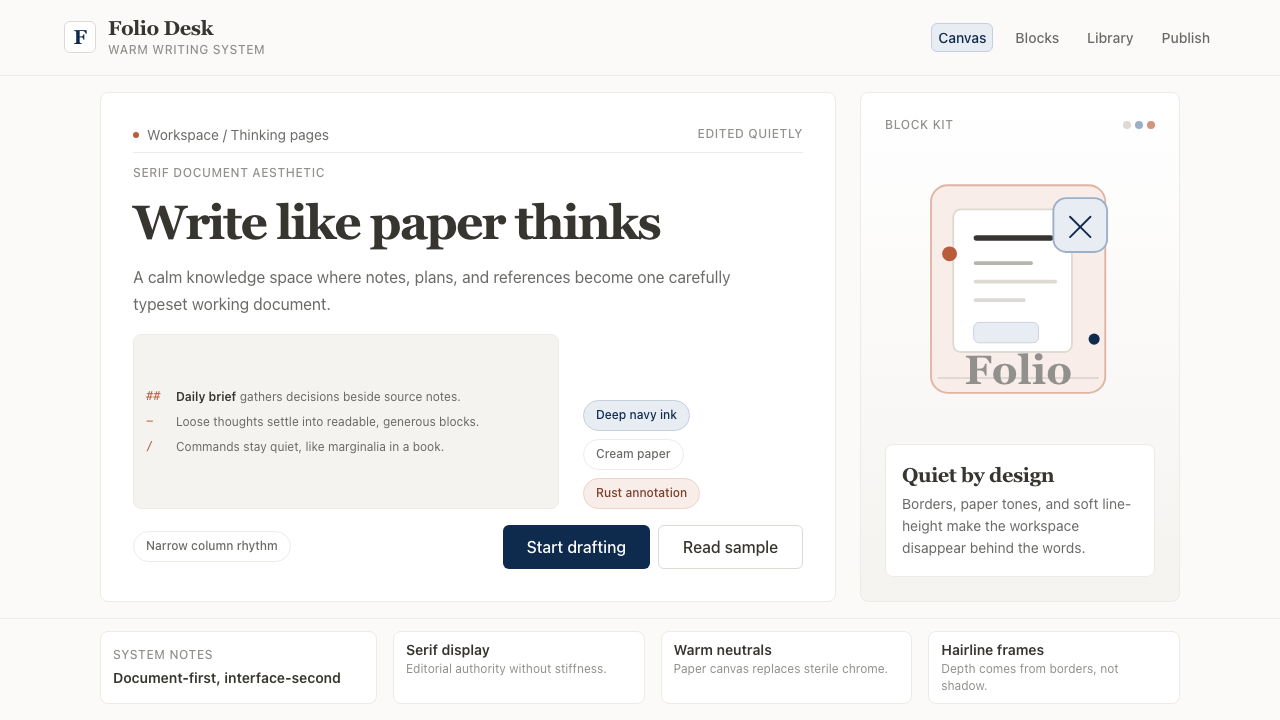 Notion ModernWriting feels papery. Source Serif on warm cream, navy ink, and hairline bord…
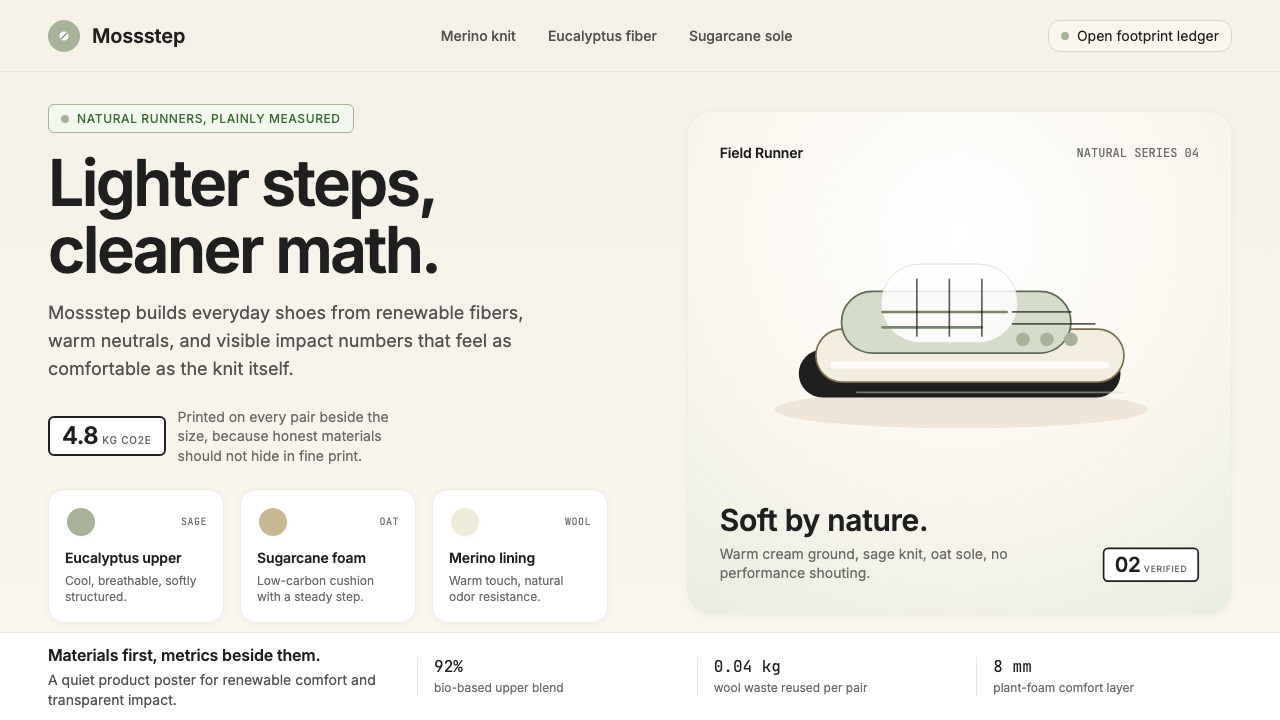 AllbirdsSustainability that breathes. Cream-and-sage tones, carbon labels next to pri…
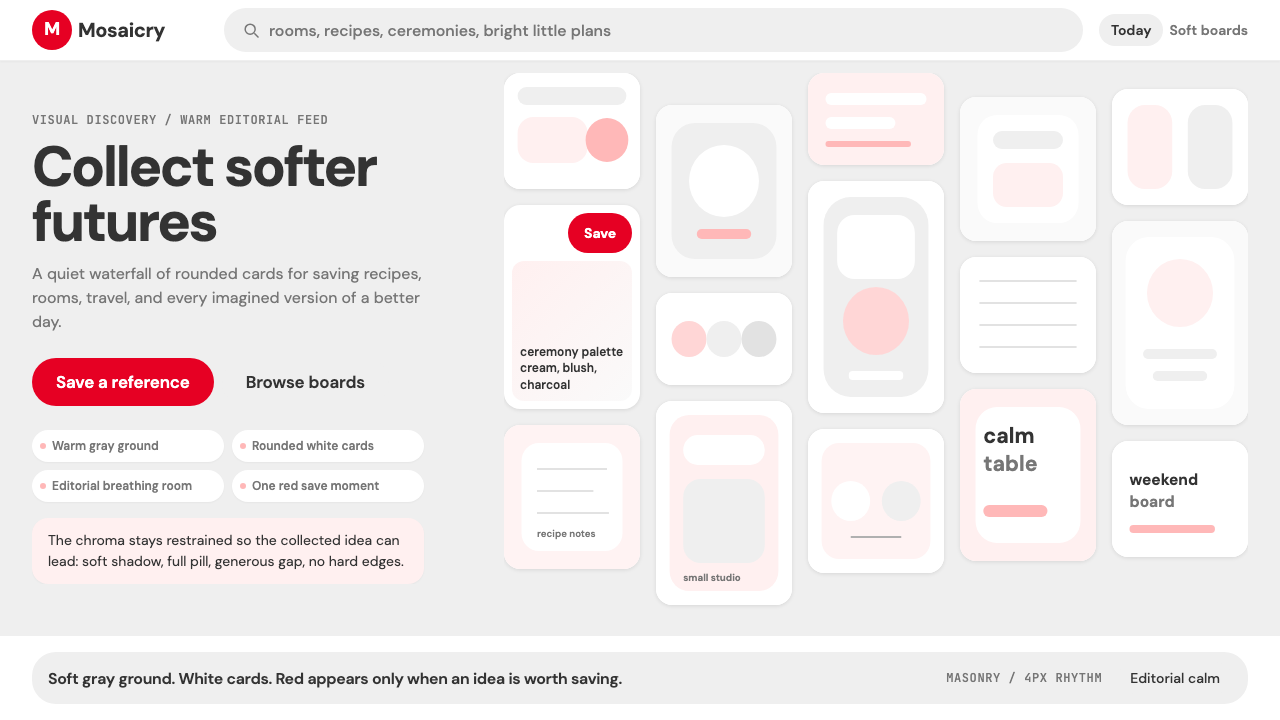 Pinterest 2024Aspirational calm. Warm gray masonry, rounded white pins, one surgical red sa…
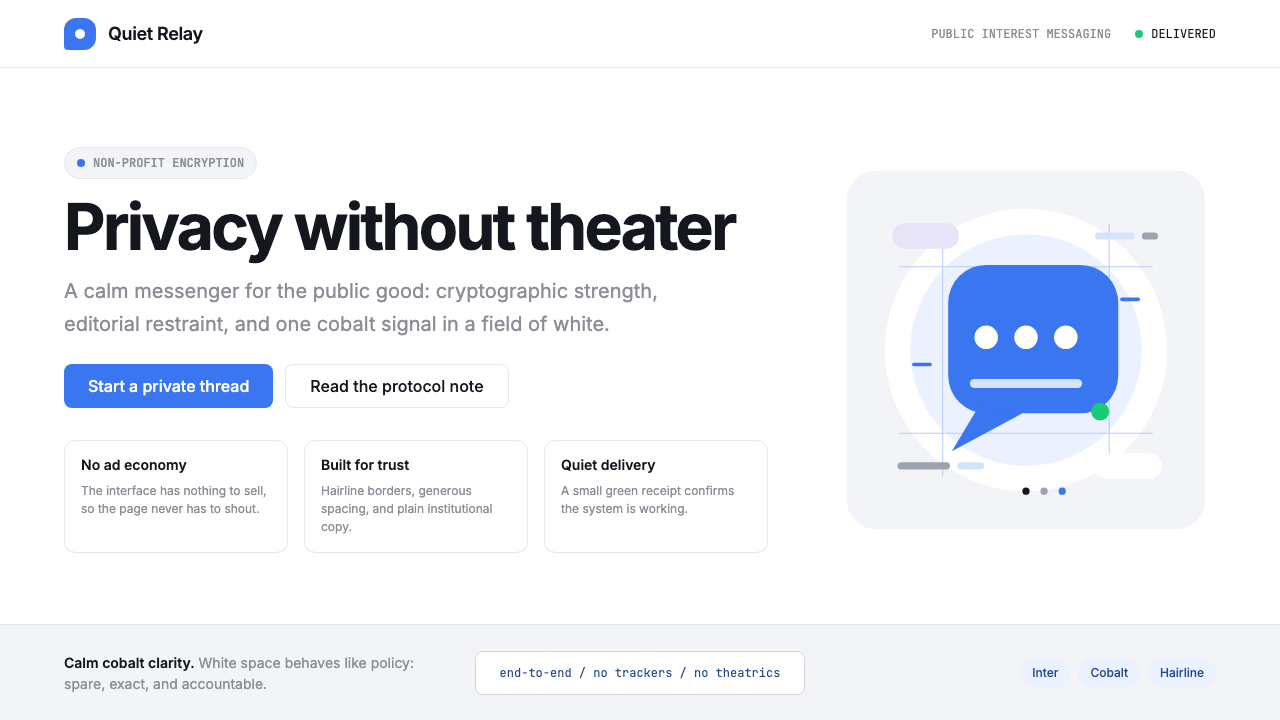 Signal Encrypted MessengerCalm privacy, plainly stated. Cobalt Inter type and white space carry the tru…