What is Pinterest 2024?
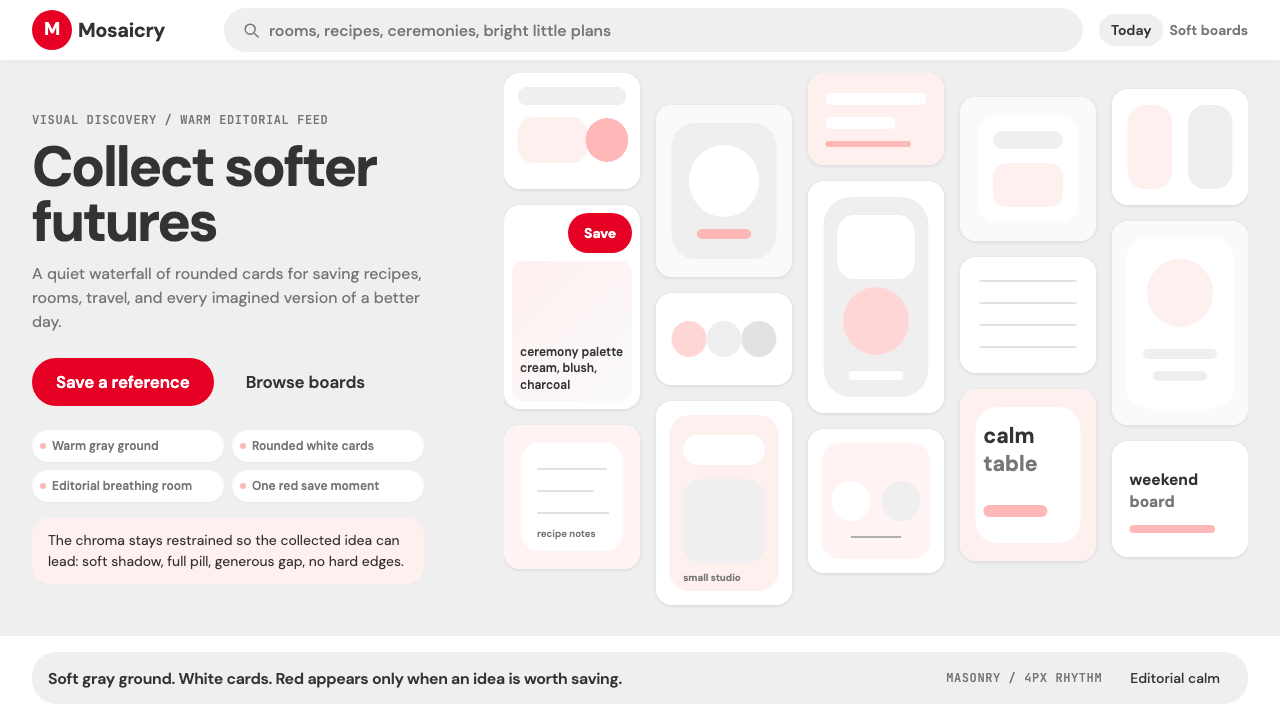
Pinterest's visual language is aspirational calm — a warm masonry waterfall where editorial softness, rounded cards, and one precise red button quietly invite you to imagine your best life.
Pinterest 2024 in brief
Pinterest 2024 is the refined visual identity of one of the internet's most distinctive platforms — a mood-board service built around the idea that images, not text, are the primary language of aspiration. The design language is warm, soft, and deliberately editorial: masonry grids of rounded pin cards float over near-white backgrounds, photography leads every composition, and a single assertive accent color appears only where saving and action are invited.
The palette is intentionally neutral and quiet. Warm off-white grounds and gentle gray tones exist to recede, making user-contributed imagery the true protagonist of every page. Shadows are soft and diffuse rather than hard and graphic, giving cards a gentle lifted quality without asserting themselves over the content they frame. Rounded corners on every card soften the geometry and reinforce the platform's mood of warmth and approachability.
What unifies the system is restraint in the application of brand color. The distinctive Pinterest red — saturated, confident, unmistakably itself — appears almost exclusively on the save action, making it a highly charged signal in an otherwise calm visual field. Everything else yields. This surgical economy of color is what gives the single red element its emotional authority: in a sea of warm neutrals and beautiful photography, the save button is always the loudest thing in the room.

Where does Pinterest 2024 come from?
Pinterest was founded in San Francisco in 2010 by Ben Silbermann, Evan Sharp, and Paul Sciarra. Silbermann, who had worked at Google before, was drawn to the idea of digital collecting — an online analog to the physical pinboards that architects, designers, and hobbyists had long used to gather reference images. The name itself joined 'pin' (the act of fixing an image to a surface) with 'interest,' signaling a platform organized around personal taste rather than social connection.
The early interface was functional but rough, relying on browser-installed bookmarklets and desktop-oriented layouts. The visual design in those first years prioritized density over polish: masonry grids appeared because they packed the most imagery per scroll, not because of any deliberate aesthetic manifesto. The platform grew explosively among audiences — predominantly women in the United States — who used it for wedding planning, interior decoration, recipe collection, and fashion inspiration. This user base shaped the platform's visual evolution as profoundly as any design decision made internally.
The period from roughly 2016 to 2020 saw Pinterest refine its mobile experience significantly, smoothing card proportions, softening shadows, and establishing a more consistent type hierarchy. Evan Sharp, who served as Chief Design Officer before departing in 2022, was a central force in translating the platform's aspirational mood into systematic visual decisions. Under his tenure, Pinterest moved from an informal aggregator toward a more intentional editorial presence — one where the platform's own design language did not compete with the content but instead created a calm, framed environment for it.
The 2020–2024 visual iteration represents the most mature statement of the Pinterest design philosophy. It coincided with broader industry trends — rounded corners, warmer neutral palettes, softer shadow systems — but Pinterest's version is distinguished by its consistency and its disciplined application of the single brand-color accent. Albert Pereta, who joined Pinterest as a design leader during this period, helped shape the systematic approach to product design that brought greater coherence to the platform's many surfaces across web, iOS, and Android. By 2024, the visual language had become one of the most widely imitated in consumer web design — studied for its particular balance of editorial calm and commercial directness.
What defines the Pinterest 2024 look?
Warm Neutral Ground
The background of any Pinterest-style composition is never stark white or cool gray — it carries a subtle warmth, somewhere between cream and light stone, that makes imagery feel cradled rather than clinically presented. This tonal warmth extends to card backgrounds and interface chrome alike, creating a unified atmospheric quality throughout the layout. The neutrality of the ground is what makes the diversity of user content feel harmonious even when pins from wildly different sources sit side by side.
Masonry Grid Rhythm
The masonry grid is both the platform's signature layout and its most deliberate visual choice. Unlike a strict rectangular grid, masonry allows cards of varying heights to pack tightly without uniform rows, creating a sense of abundant, almost infinite imagery. The rhythm is irregular enough to feel alive and editorial — closer to a curated magazine spread than a database table — while the consistent card width and gutter spacing provide enough structure to prevent visual chaos.
Rounded Card Language
Every pin card carries generous rounded corners that soften the geometry of the grid and reinforce a mood of approachability. The rounding is substantial enough to be clearly intentional — not a barely-perceptible refinement but a character-defining choice. Combined with soft diffuse shadows that lift cards slightly off the background plane, the cards read as tactile objects rather than flat frames, inviting the hand gesture of saving or sharing. This physicality is important to Pinterest's promise of a collectable, ownable visual world.
Surgical Red Accent
The Pinterest red is saturated and confident — a color with clear family resemblance to classic brand reds, warm rather than cool in its undertone. What makes it distinctive in practice is not the hue itself but the discipline of its deployment. It appears almost exclusively on the save action — the platform's most important conversion moment — and occasionally on a small number of high-priority interface elements. Everywhere else, the interface withholds it deliberately. The effect of this restraint is that the red commands attention without effort: users learn quickly that wherever red appears, something actionable and important is present.
Photography as Content
Pinterest's design language is unusual in that its primary visual richness comes not from interface design but from user-contributed imagery. The system is designed to disappear, to become a neutral, beautiful vessel for photography of all kinds — fashion editorials, food styling, interior photography, illustration, and DIY project documentation. This means the design must be flexible enough to hold wildly divergent imagery while maintaining visual coherence. The answer is the palette and structural choices: when the frame is consistently warm-neutral and softly rounded, almost any image can sit within it without aesthetic collision.
Generous Whitespace and Scroll Invitation
Pinterest compositions breathe. Gutters between cards are wide enough to give each pin room to exist as a discrete object rather than merging into a continuous texture. Above and below content sections, spacing is ample and unhurried. This generosity of negative space does important work: it slows the visual tempo enough for imagery to register emotionally before the eye moves on, and it creates the sensation of leisurely, pleasurable browsing rather than information retrieval. The scroll becomes an invitation rather than a necessity.
Minimal Typographic Intervention
Text in the Pinterest system is kept deliberately subordinate to imagery. Card titles and metadata appear in clean, unpretentious type — neither bold display typography nor delicate script, but a legible workhorse that registers without competing. Type hierarchy is achieved through modest size differences and weight contrast rather than through dramatic scale jumps. The platform's navigation and interface labels follow the same logic: clear enough to be understood instantly, restrained enough to disappear when imagery is present. This typographic modesty is itself an aesthetic statement — the platform has the confidence to let its content speak.

Who shaped Pinterest 2024?
Silbermann co-founded Pinterest and served as CEO through its formative years and beyond. A former Google product manager, he brought an obsessive attention to the collecting experience — studying physical pinboards, stamp collections, and natural history cabinets to understand what made a collection emotionally satisfying. His insistence on quality over growth in the early years allowed the platform's visual identity to develop organically around its actual use patterns, which is why the design feels genuinely fitted to its purpose rather than imposed. Silbermann stepped down as CEO in 2022, handing leadership to Bill Ready.
Sharp co-founded Pinterest and served as Chief Design Officer, making him the figure most directly responsible for translating the platform's aspirational promise into a coherent visual system. Trained as an architect before moving into digital product design, Sharp brought a spatial sensibility to the platform — thinking about how users would move through images and collections rather than simply how individual screens would look. He championed the warm-neutral palette, the editorial card system, and the disciplined use of brand color that define the mature Pinterest aesthetic. Sharp departed the company in 2022.
Pereta joined Pinterest as a design leader and played a significant role in systematizing the visual language across the platform's many product surfaces during the 2020–2024 refinement period. His contribution was less about inventing new aesthetic directions and more about creating the design infrastructure — component libraries, spacing systems, color application guidelines — that allowed a large design team to maintain visual coherence at scale. This kind of systematic design leadership is often invisible in the finished product but is entirely responsible for why a mature platform feels unified rather than assembled.
Ready joined Pinterest as CEO in 2022, bringing a commercial and technology background from his previous roles at Google and PayPal. While not a designer, his leadership coincided with Pinterest's effort to evolve its shopping and discovery features without compromising the visual calm that users associated with the platform. The tension Ready had to manage — between commerce and aspiration, between conversion pressure and editorial restraint — is essentially a design tension, and the 2024 visual system can be read partly as the resolution his tenure produced.
How do you use Pinterest 2024 today?
Pinterest 2024's visual language transfers well to any context where the primary goal is to make content — particularly imagery — feel aspirational, discoverable, and quietly luxurious. The key principle to internalize before applying the style is that Pinterest's design is a frame, not a statement. Every decision — the warm neutrals, the soft shadows, the rounded cards, the restrained accent — exists to serve the content it contains, not to express the interface designer's personality. This orientation makes it fundamentally different from more assertive visual systems and requires a different kind of discipline to execute correctly.
For presentation slides, the Pinterest style works best when imagery is central to the narrative. Cover slides benefit from a single strong photographic image set against a warm-neutral ground, with the title in clean, legible type that does not compete for attention. Content slides should adopt the card-grid logic: multiple visual references arranged in a loose masonry pattern convey abundance and editorial curation simultaneously. Data slides can borrow the card motif — each metric or statistic presented within a softly rounded container that gives it visual breathing room. The disciplined use of the brand-color accent should be reserved for the single most important call to action on any given slide.
For web interfaces, dashboards, and pricing pages, the Pinterest approach rewards consistency above all. Establish a warm off-white background as the canvas, set all structural chrome in light gray tones, and keep body text in deep charcoal rather than pure black — this preserves the warmth of the system. Card components with soft shadows and rounded corners provide the primary organizational unit. Use the accent color — whatever your brand equivalent of Pinterest red might be — for primary actions only: the subscribe button, the upgrade CTA, the save or bookmark state. Pricing tiers can be differentiated through card elevation and background warmth rather than through competing accent colors.
For editorial and marketing work, the style's editorial calm makes it well-suited to lifestyle, wellness, food, fashion, and home-decor contexts — categories where Pinterest itself is most culturally relevant. Article layouts benefit from wide gutter margins that give imagery room to breathe, with body text set in a comfortable reading measure and pull quotes presented in clean, slightly enlarged type rather than decorative callout boxes. Marketing landing pages can adopt the masonry aesthetic directly: a grid of lifestyle images above the fold, followed by feature sections that alternate a warm-background zone with a slightly richer tonal zone to create rhythm without resorting to high-contrast color blocking.
A common mistake when applying this visual language is to mistake neutrality for emptiness and attempt to add visual interest through additional colors, gradients, or decorative elements. The Pinterest system's apparent simplicity is the product of very deliberate subtractive decisions — every element that might compete with imagery has been removed. Adding it back in, even with good intentions, collapses the careful hierarchy. A second frequent error is rounding every corner uniformly regardless of context: the rounded-card vocabulary works because it is applied to contained, discrete objects. Rounding navigation bars, full-width banners, and typographic elements indiscriminately produces a style that reads as juvenile rather than warm. Apply the rounding selectively, to card and container elements, and allow the supporting structure to remain clean and rectilinear.

Pinterest 2024 — FAQ
Is Pinterest 2024 style the same as general 'warm minimalism'?
They overlap significantly but are not identical. Warm minimalism is a broad design tendency that includes a wide range of typographic, architectural, and product design approaches united by muted palettes and restrained ornamentation. Pinterest 2024 is more specifically defined: it has a masonry grid structure, a card-based organizational logic, a specific application of one saturated accent color against neutral grounds, and a philosophy that the interface should serve photography rather than assert its own presence. You can be warm-minimal without any of those features; Pinterest style requires most of them.
How do you handle dark mode in Pinterest-style design?
Pinterest's canonical expression is light-ground — the warm neutrals are fundamental to the system's emotional quality. A dark-mode inversion is technically possible but requires careful recalibration. The background should shift to a deep warm gray rather than pure black, preserving the warmth that defines the aesthetic. Card surfaces then need to read as distinctly lighter than the background to maintain the card-lift effect, using a mid-tone warm gray rather than white. The accent red requires particular attention in dark contexts: it tends to feel more aggressive against dark grounds and may need to be applied even more sparingly than in the light version. Soft shadows become nearly invisible on dark backgrounds and may need to be replaced by subtle borders or slight background lightness differentials.
Can Pinterest-style design work for B2B or enterprise software?
It depends heavily on the nature of the enterprise product. For tools where the primary interface is gallery-like — asset management systems, creative libraries, e-commerce catalog tools, real estate platforms, media organization software — the masonry card approach translates directly and brings significant usability benefits. For dense analytical dashboards, financial reporting tools, or data-heavy interfaces where the user needs to scan tabular information quickly, the warm-neutral card approach can create a pleasant surface layer but the masonry layout structure is likely to feel inefficient. In those contexts, it is often better to borrow the palette and the soft-shadow card motif selectively while defaulting to a more rectilinear grid structure for data-dense areas.
What makes Pinterest's accent-color discipline worth emulating?
Because it creates a reliable, learned signal hierarchy. When a color appears in only one functional context — the save action, in Pinterest's case — users rapidly internalize its meaning without conscious instruction. The color becomes a navigational tool rather than a decorative choice. This is more effective than distributing an accent color across many interface elements, where it loses its signal value and becomes mere decoration. The practical implication for designers is that the fewer contexts in which a brand color appears, the more authority it carries in each of those contexts. Pinterest's red saves because it never does anything else.
Where does Pinterest 2024 style struggle or feel out of place?
The style underperforms in contexts that require urgency, authority, or high information density. News and media platforms, financial trading interfaces, emergency or safety systems, and any context where the user must process complex structured data quickly will find the warm-neutral, soft-shadow aesthetic creates the wrong emotional register — too relaxed, too browsing-oriented, insufficiently directive. The style also struggles when applied to content that is primarily textual rather than visual: long-form reading, legal documents, technical documentation, and code-heavy developer tools all suffer when the card-and-masonry logic is applied, because these content types benefit from linearity and predictable reading flow rather than the browsing and discovery mode that masonry encourages.
Related design styles
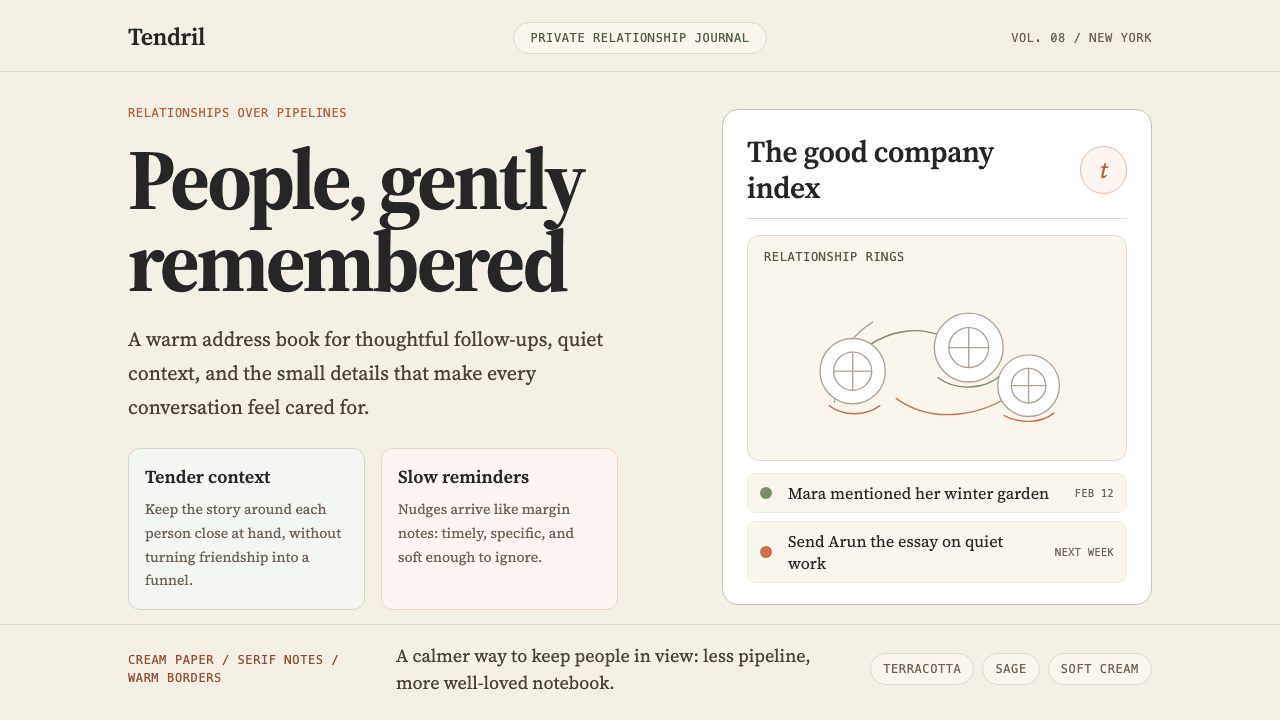 Clay 2024CRM as a sketchbook, not a sales pipeline. Cream backgrounds, terracotta, han…
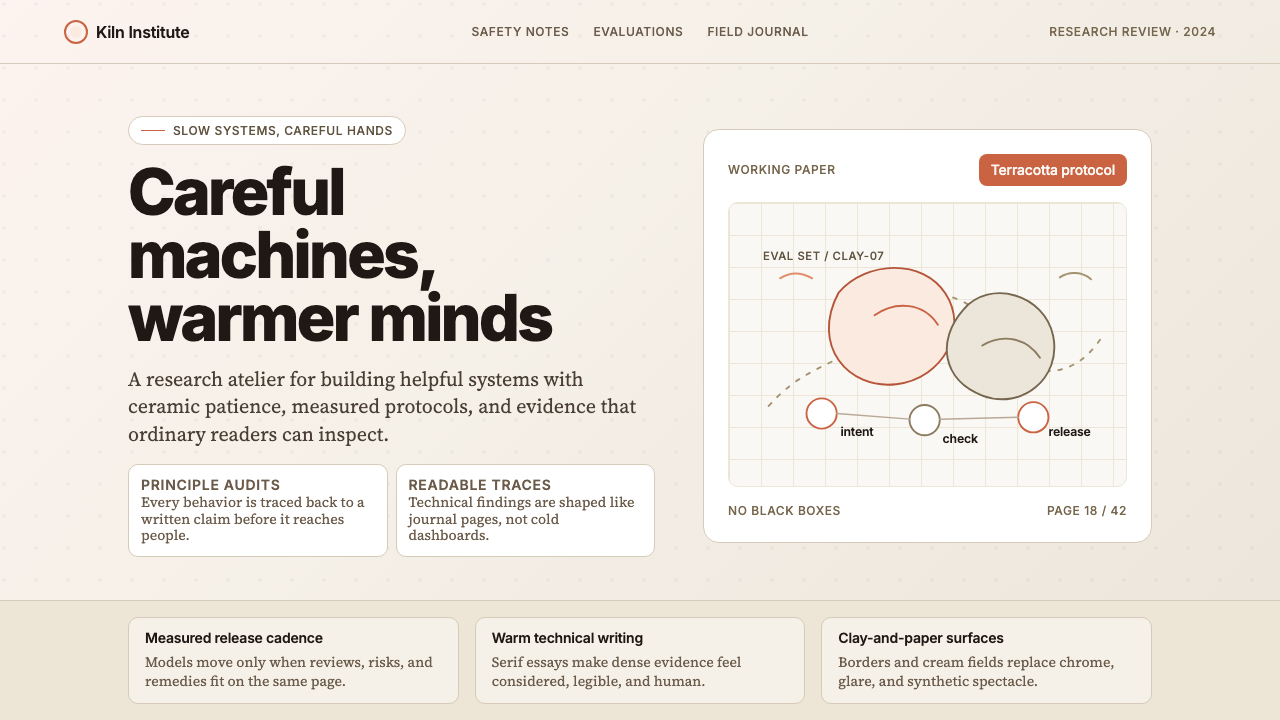 Anthropic ClayAI safety in handmade clay. Sand backgrounds, terracotta accents, serif body…
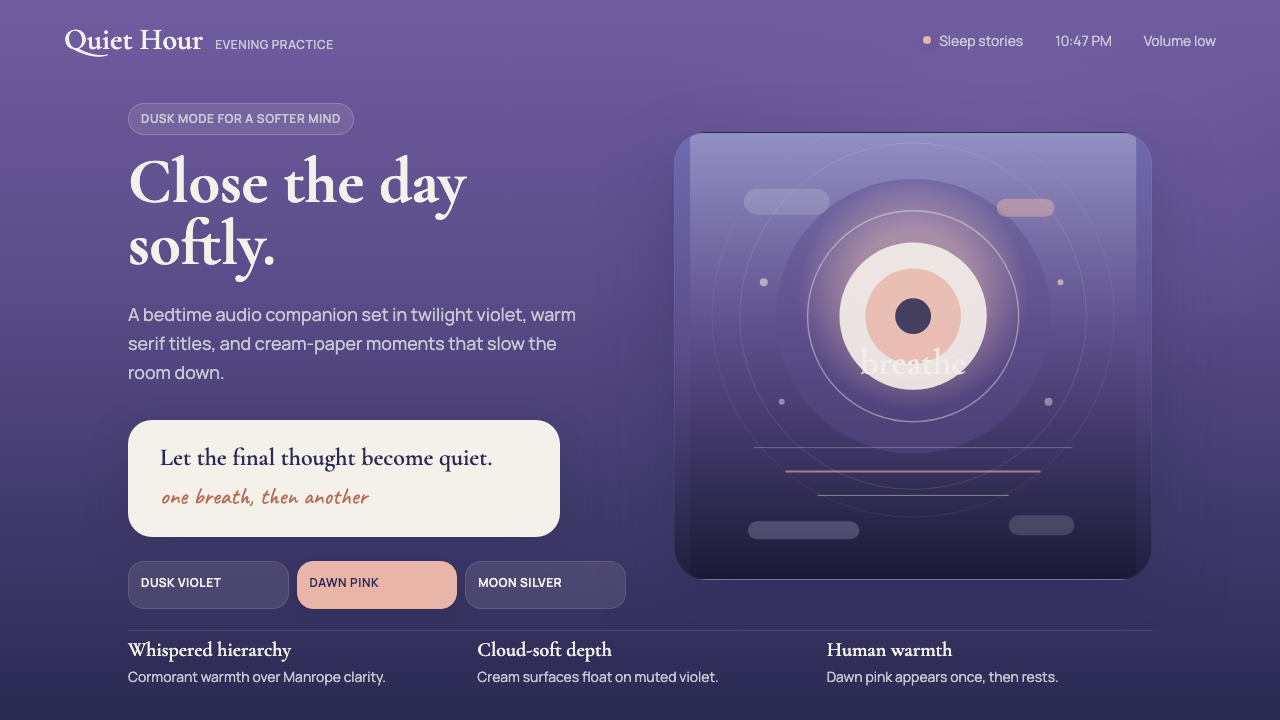 Calm App Purple MeditationWhispers at bedtime. Dusk-purple gradients, cream serif type, and dawn-pink w…
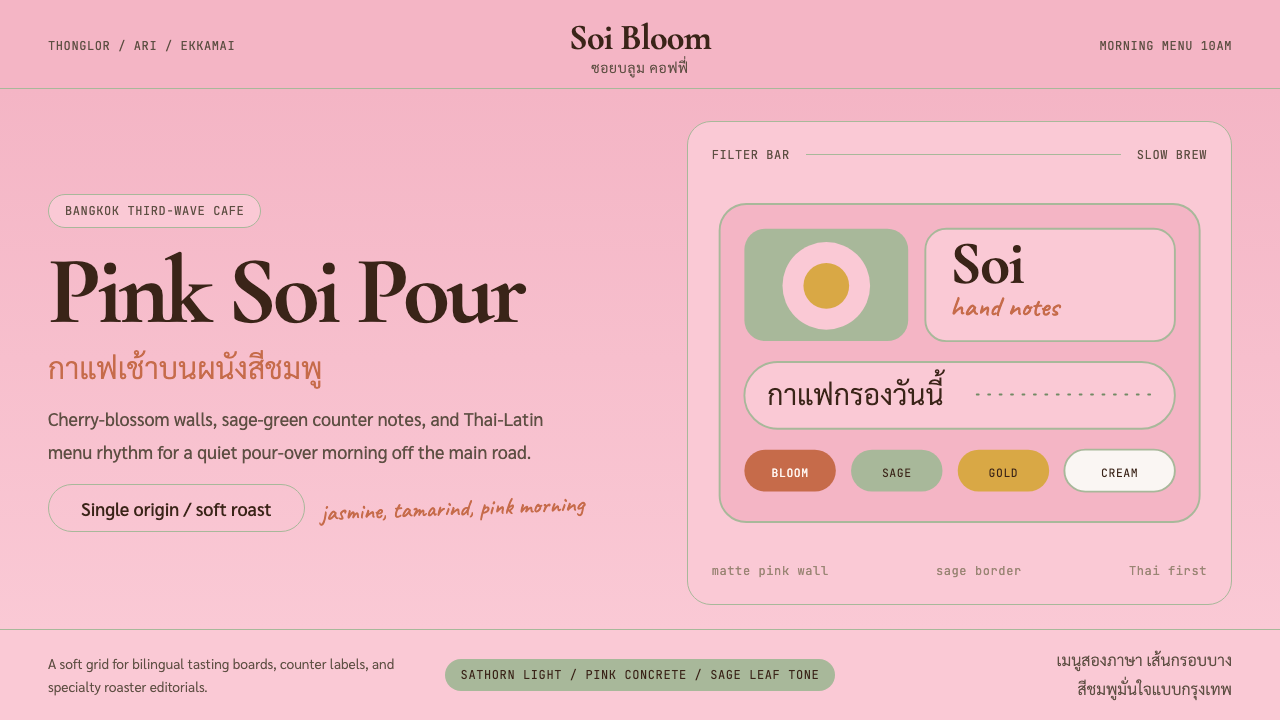 Bangkok Third-Wave CafeBangkok feels soft but sure. Cherry pink, sage borders, and Thai-Latin menu r…
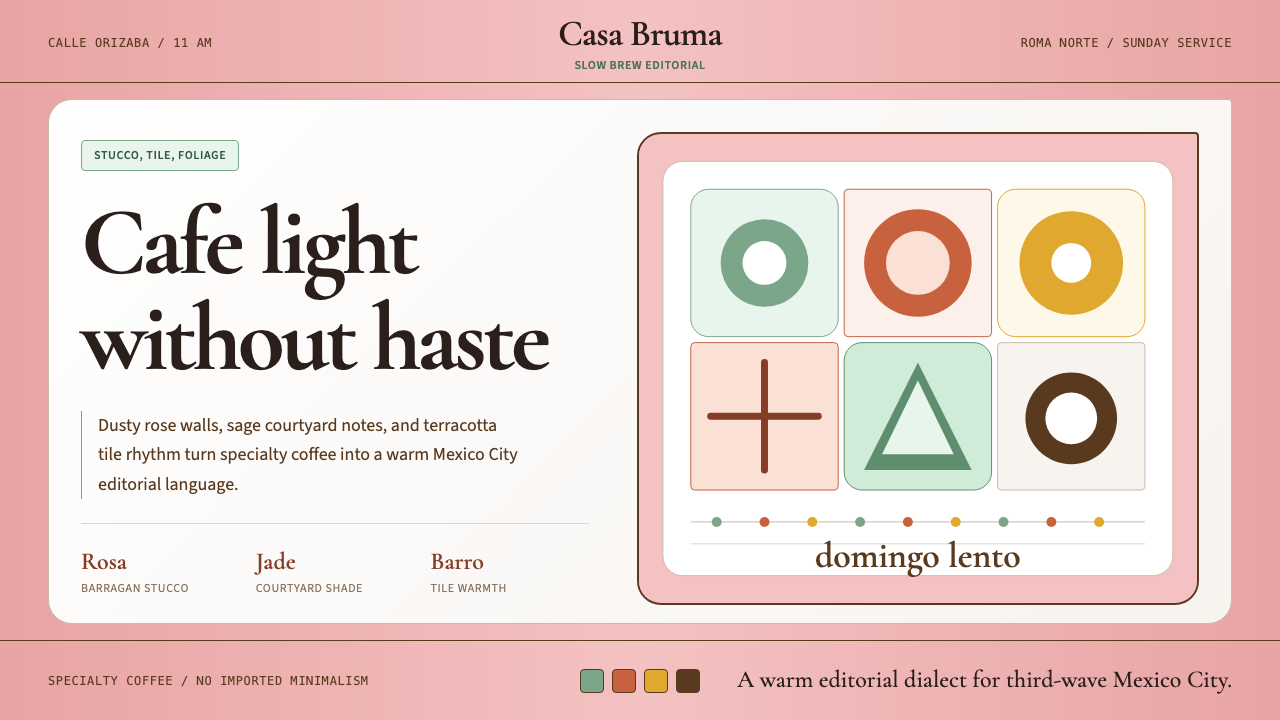 CDMX Roma Norte CafeMexico City coffee, unhurried. Dusty rose, sage jade, and serif rhythm carry…
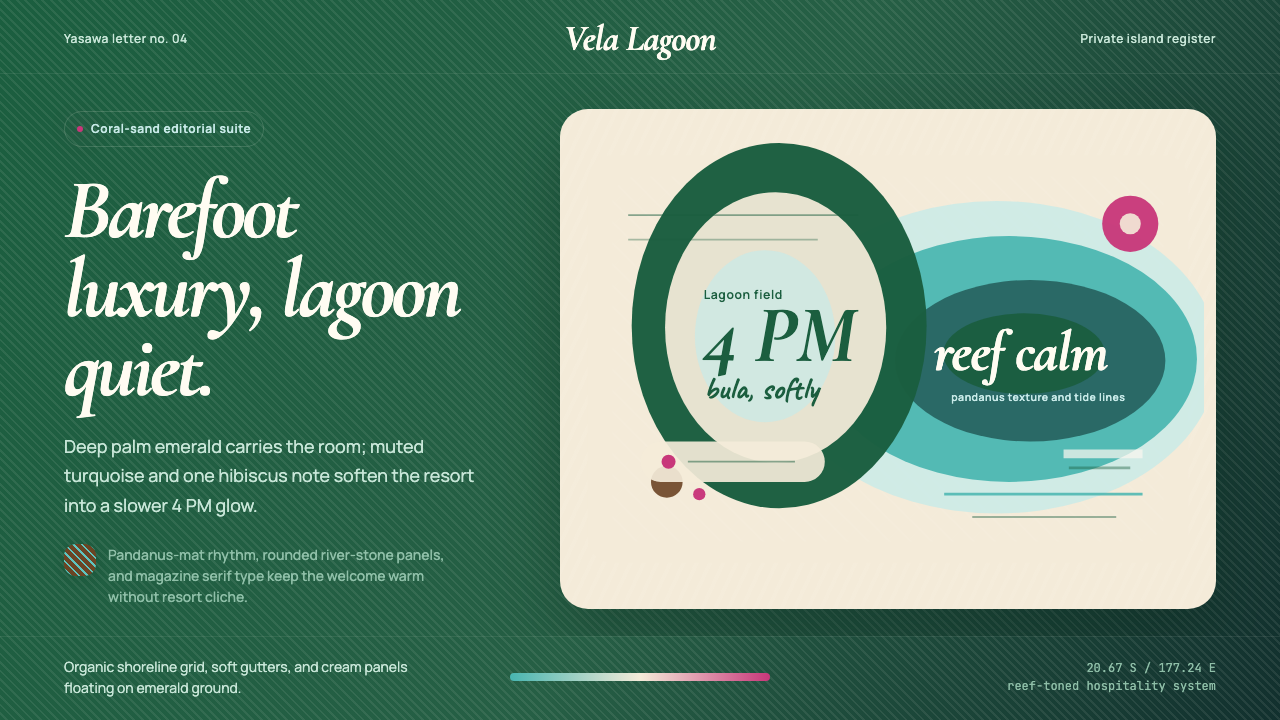 Fiji Tropical Resort Luxe ModernBarefoot luxury breathes slowly. Emerald field, cream panels, and lagoon curv…