What is Bangkok Third-Wave Cafe?
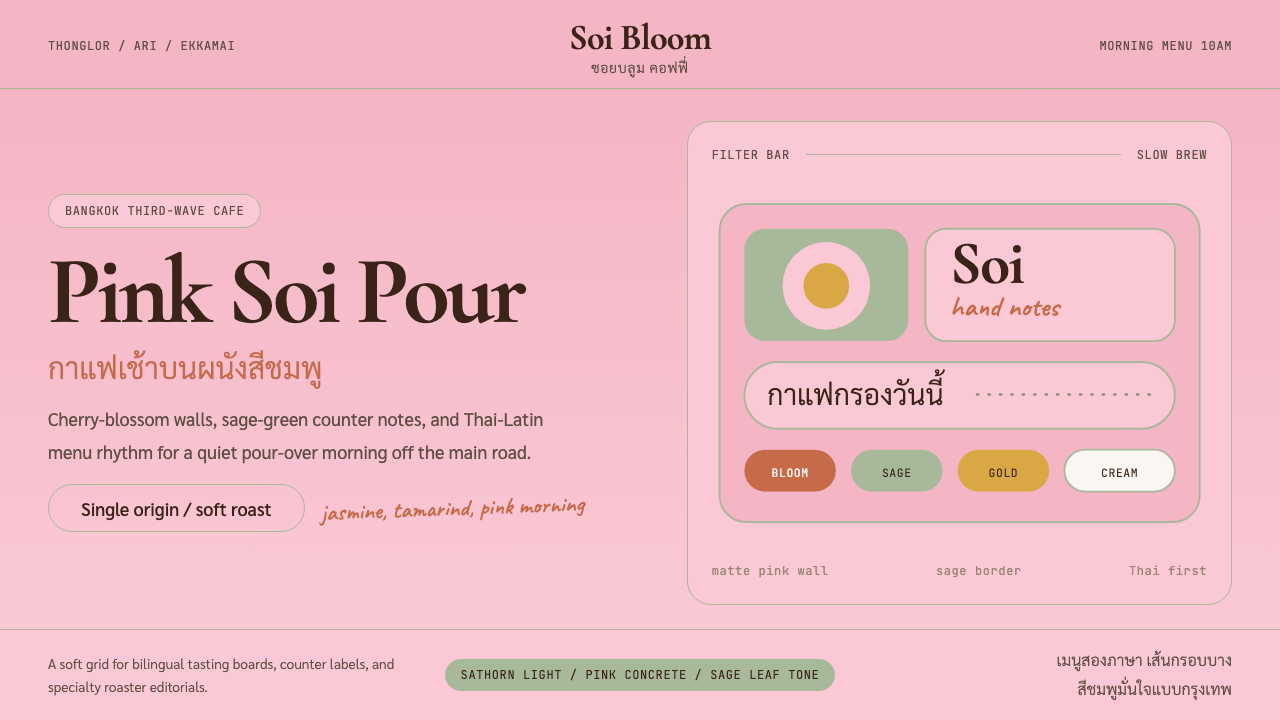
Bangkok Third-Wave Cafe is the aesthetic of a Thonglor side-soi at ten in the morning — cherry-blossom walls, sage monstera, and bilingual menus set with the calm confidence of a city that knows exactly what it is.
Bangkok Third-Wave Cafe in brief
Bangkok Third-Wave Cafe is a visual language born in the specialty-coffee corridors of Bangkok's inner east side between roughly 2018 and 2024. It fuses Japanese pour-over minimalism — the spare surfaces and restrained palette imported from Kyoto's third-wave roasters — with a distinctly Thai warmth expressed through blossom-pink walls, tropical foliage, and the gentle collision of Thai and Latin scripts on a single menu card.
Where Japanese cafe minimalism tends toward severity and wabi-sabi earthiness, the Bangkok variant softens everything. Surfaces are matte but not raw; pinks are cherry-blossom delicate rather than bubblegum loud; greenery appears as considered accent rather than wild abundance. The overall mood is one of confident ease: not striving to be Tokyo, not nostalgic for old Bangkok, but entirely itself.
The style carries a quiet bilingual intelligence at its core. Thai script and Latin letterforms must coexist on signage, menus, and packaging without either apologizing for the other. This constraint — which could produce visual dissonance — instead became a generative tension. Designers learned to exploit the natural roundness and rhythmic density of Thai glyphs as a counterweight to the open ascenders and descenders of Latin type, producing menu layouts that read as unified compositions rather than awkward compromises.
Where does Bangkok Third-Wave Cafe come from?
The roots of Bangkok's third-wave cafe aesthetic lie in two overlapping histories: the global spread of specialty-coffee culture after 2010, and Bangkok's own long-running negotiation between modernist aspiration and tropical tradition. Japanese coffee culture arrived in Thailand first as product export — single-origin beans, manual brewing equipment, precision temperature scales — and then as an aesthetic sensibility that Bangkok's roasters translated rather than copied.
Roots Coffee, founded in Bangkok in 2014 by Varatt Vichit-Vadakan, is widely credited as the incubator of the look. Its Thonglor flagship — matte cream walls, sage-toned plants, warm-toned light fittings, and a menu typeset with the kind of careful leading you more commonly see on a gallery wall than a coffee counter — established that Thai specialty coffee could be visually literate without mimicking Nordic or Japanese templates. Brave Roasters, launched by Sahussawan Khanjornkavin and her partners, pushed the palette warmer and pinker, leaning into cherry blossom as a conscious cultural signal rather than a borrowed aesthetic.
Kenneth Shoji's involvement as a design consultant to several Thonglor and Ari cafes helped crystallize the Japanese-Thai synthesis. His approach treated the matte surface not as a blank canvas in the minimalist tradition but as a material with its own warmth — dusty and chalky rather than clinical. The result was spaces that photographed beautifully in the diffuse natural light that Bangkok's late-morning hours provide, which proved essential: the Thonglor cafe aesthetic was shaped partly by its own Instagram documentation, a feedback loop between the space's design and how it looked in a phone camera's square frame.
By 2020 the aesthetic had consolidated into recognizable conventions: cherry or dusty-rose wall paint in matte finish, sage or eucalyptus greenery as counterpoint, marble or terrazzo surfaces, rounded pill-shaped UI elements migrating from physical menus to cafe apps and Instagram story templates, and handwritten tasting notes in a casual italic. The Ari and Ekkamai neighborhoods added their own inflections — Ekkamai slightly rawer and more industrial, Ari softer and more residential — but all three corridors shared the same foundational palette and typographic sensibility.
Phongtorn Karnchanawanichkun's graphic work for several Bangkok-based roasters helped define the typographic identity of the movement: Thai script given full visual parity with Latin type, both rendered at generous leading, neither subordinated to the other. This bilingual confidence — treating the two scripts as complementary rather than hierarchically ordered — became the movement's most distinctive contribution to Southeast Asian cafe design, influencing roasters and cafe brands as far as Chiang Mai, Ho Chi Minh City, and Kuala Lumpur.
What defines the Bangkok Third-Wave Cafe look?
Palette
The foundational palette pivots around a dusty cherry-blossom pink — muted rather than saturated, closer to dried petals than fresh ones — paired with sage or eucalyptus green as the primary counterpoint. Cream and warm off-white serve as the dominant background tones, giving the palette its particular softness. Marble veining and terrazzo speckle introduce the only naturalistic complexity, held in check by the evenness of the painted surfaces surrounding them. The overall effect is one of warmth without heat: colours that feel considered and slightly faded, as though the cafe has been in the Bangkok sun just long enough to develop its own patina.
Surface Texture
Matte finish is non-negotiable — on walls, on packaging, on ceramic cups. The rejection of gloss is both aesthetic and practical: matte surfaces diffuse the harsh tropical light that pours through Bangkok's east-facing windows, producing the even, flattering glow that became the style's photographic signature. Terrazzo and raw marble introduce texture at counter level, their mineral complexity acting as a visual anchor that prevents the matte softness above from reading as bland. Hand-thrown ceramic cups, with their slight irregularities, extend the soft-tactile register to the object in the guest's hand.
Typographic Bilingualism
Thai and Latin scripts are treated as equally weighted partners in every typographic application. Menu headings, signage, and packaging give each script equal leading, equal weight in the visual hierarchy, and roughly equivalent spatial territory on the page. Rather than subordinating one to the other — as many international cafe brands do when entering Thai-speaking markets — the Bangkok style makes the two-script composition itself a design statement. The natural round density of Thai glyphs and the open vertical rhythm of Latin letterforms create a balanced visual counterpoint when set with generous leading.
Botanical Accent
Monstera leaves, trailing pothos, and small eucalyptus branches appear as considered accent rather than decorative abundance. The greenery is always sage or muted olive in tone — never the vivid emerald that the same plants would show in stronger light — because the cafe environment softens foliage through controlled backlighting and diffuse positioning. Plants are placed to create compositional rhythm: a large monstera beside a pale wall provides the same kind of structural counterpoint that a bold geometric element might provide in a more austere design system. The biological irregularity of the leaf edge is the style's only permitted organic complexity.
Rounded UI Elements
Pill-shaped buttons, rounded-corner price tags, and softly radiused containers appear consistently across both physical menus and digital touchpoints — the cafe's app, its Instagram story templates, and its QR code landing pages. The rounded corner is not a concession to trend but a coherent extension of the palette's softness: hard right-angled corners would introduce a severity at odds with the overall warmth. The pill shape migrates across scales from the smallest tag to the largest call-to-action button without modification, creating formal consistency across the physical-digital boundary.
Handscript Tasting Notes
A casual italic handscript — typically applied to tasting-note cards, blackboard specials, and packaging stickers — introduces warmth and legibility at the human scale that printed type cannot achieve. The handscript is always light in stroke weight, leaning gently rather than dramatically, and uses a consistent baseline rather than the exaggerated bounce of expressive calligraphy. Its function is to signal care and specificity — that someone thought carefully about this particular batch of coffee — without competing with the quieter, more formal typeset text that frames it.
Light Control
The Bangkok Third-Wave Cafe aesthetic is inseparable from how it handles light. Natural light is admitted but controlled — sheer linen curtains diffuse direct sun into an even ambient glow; east-facing windows are favored for the gentle quality of morning light over the harsh intensity of afternoon. Artificial lighting uses warm-toned filament bulbs hung at low intervals, supplementing natural light rather than replacing it. The resulting illumination has a specific quality: objects and surfaces photograph without harsh highlights or deep shadows, which is why the style emerged so strongly on social media — it was designed, in effect, to be photographed in its native light.
Who shaped Bangkok Third-Wave Cafe?
Varatt Vichit-Vadakan is the co-founder of Roots Coffee, widely regarded as the originating space for the Bangkok Third-Wave Cafe aesthetic. His approach — refusing to choose between Japanese precision and Thai warmth — established the hybrid sensibility that defined the movement. Roots' Thonglor flagship, opened in 2014, became the reference point that subsequent roasters, interior designers, and cafe brands throughout Bangkok and Southeast Asia measured themselves against. Varatt's insistence on treating the cafe as a complete designed environment, from the cup to the wall colour to the menu layout, gave the aesthetic its unusual coherence.
Sahussawan Khanjornkavin co-founded Brave Roasters, which pushed the palette of the Bangkok cafe aesthetic toward its most recognizably warm and pink expression. Where Roots had leaned toward cream and sage, Brave committed more fully to cherry blossom as a statement colour — a decision that proved enormously influential on the broader movement. Her approach to branding treated the roastery's packaging and social media presence as extensions of the physical space, establishing a standard of cross-platform visual consistency that became normative for Bangkok specialty coffee brands in the early 2020s.
Kenneth Shoji worked as a design consultant across multiple Thonglor and Ari cafe spaces during the consolidation period of the aesthetic. His contribution was primarily spatial: the understanding that matte surfaces should be understood not as minimalism but as active material, with their own warmth and dusty texture. He helped resolve the central tension in the style between the Japanese-influenced drive toward restraint and the Thai preference for hospitality-warmth, finding a position where each reinforced rather than cancelled the other. His work on lighting design — the specific approach to diffusing natural light through linen and complementing it with warm artificial sources — became a formative influence on the movement's photographic signature.
Phongtorn Karnchanawanichkun's graphic design practice for Bangkok-based specialty roasters established the typographic standard that became one of the movement's most significant contributions: Thai script and Latin type treated as genuine equals, neither decorative, neither dominant, both given the breathing room of generous leading. His menus and packaging demonstrated that the visual challenge of bilingual coexistence, long handled clumsily in Thai commercial design, could produce something genuinely beautiful when approached as a compositional opportunity rather than a constraint. His influence extended beyond typography to the full graphic identity of several roasters, establishing a coherent visual language across packaging, signage, and digital touchpoints.
How do you use Bangkok Third-Wave Cafe today?
Bangkok Third-Wave Cafe translates well to contemporary digital design because its principles are rooted in atmosphere rather than ornament. The style's core move — softening a minimal foundation with warmth, botanical texture, and bilingual typographic confidence — is replicable in screen environments without requiring any of its physical materials. The key is understanding that warmth in this system comes from palette restraint and surface finish, not from decorative addition.
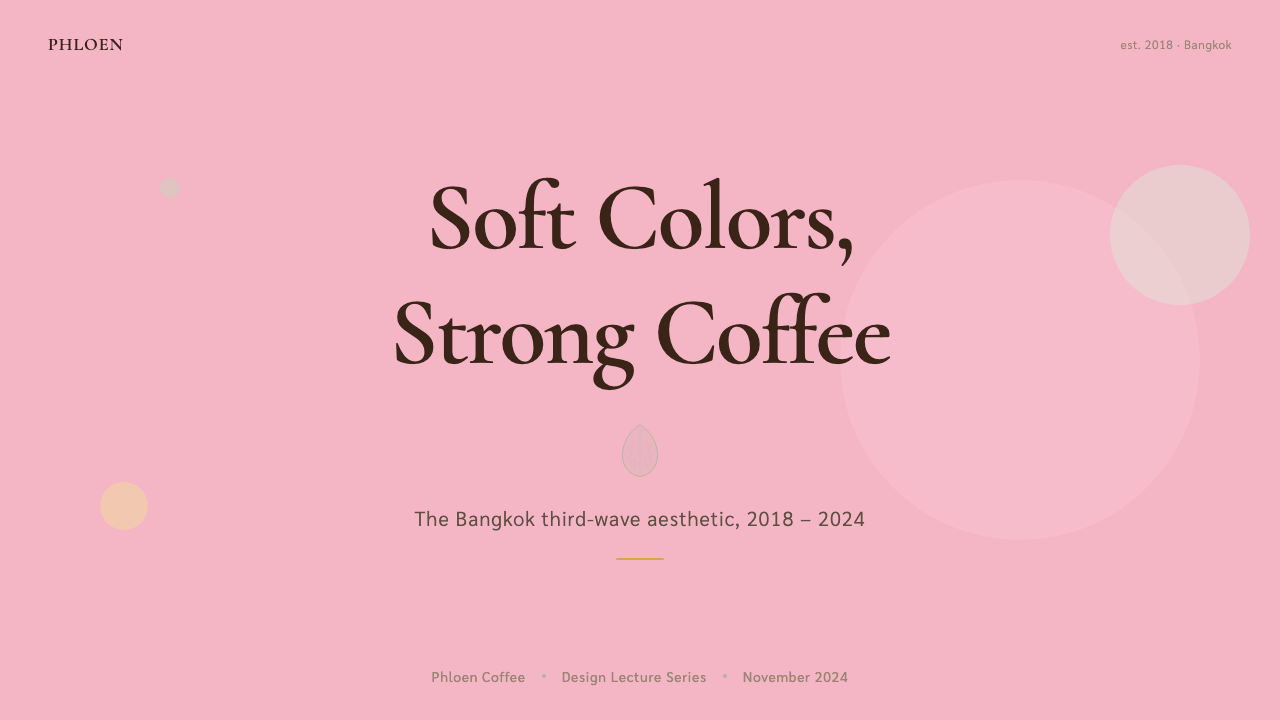
For presentation slides, the style works best as a full environmental commitment rather than a surface treatment. A cover slide should use the dusty-pink or warm-cream ground as its primary field, with foliage imagery cropped to show only leaf silhouette against the plain background — no stock-photo complexity, no busy scene-setting. Title type should be generous in leading, with a secondary line in a harmonious tonal weight rather than a contrasting colour. For content slides, the underlying structure is a clean two-column layout with one column carrying the argument and the other holding visual counterpoint — a botanical crop, a rounded-corner pull quote, or a simple icon. Data slides benefit from the palette's natural softness: rather than high-contrast chart colours, use the sage, rose, and cream as the chart's own colour system, producing visualisations that feel integrated rather than grafted on.
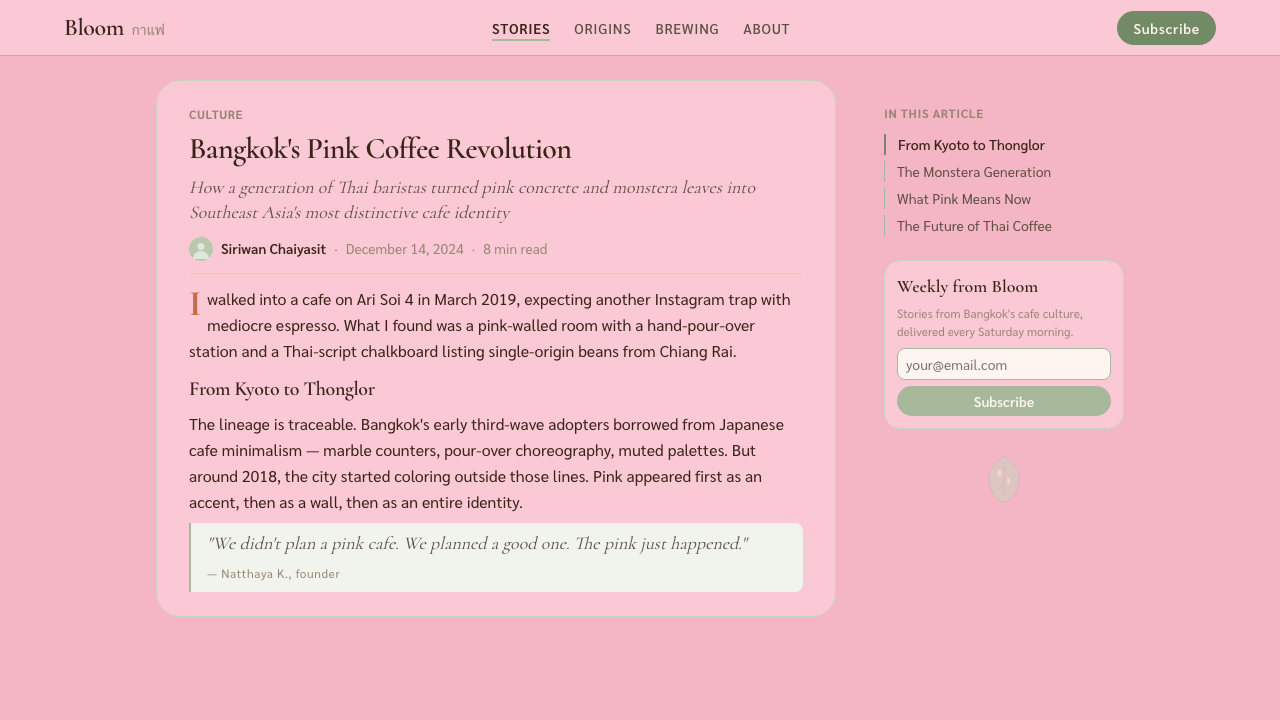
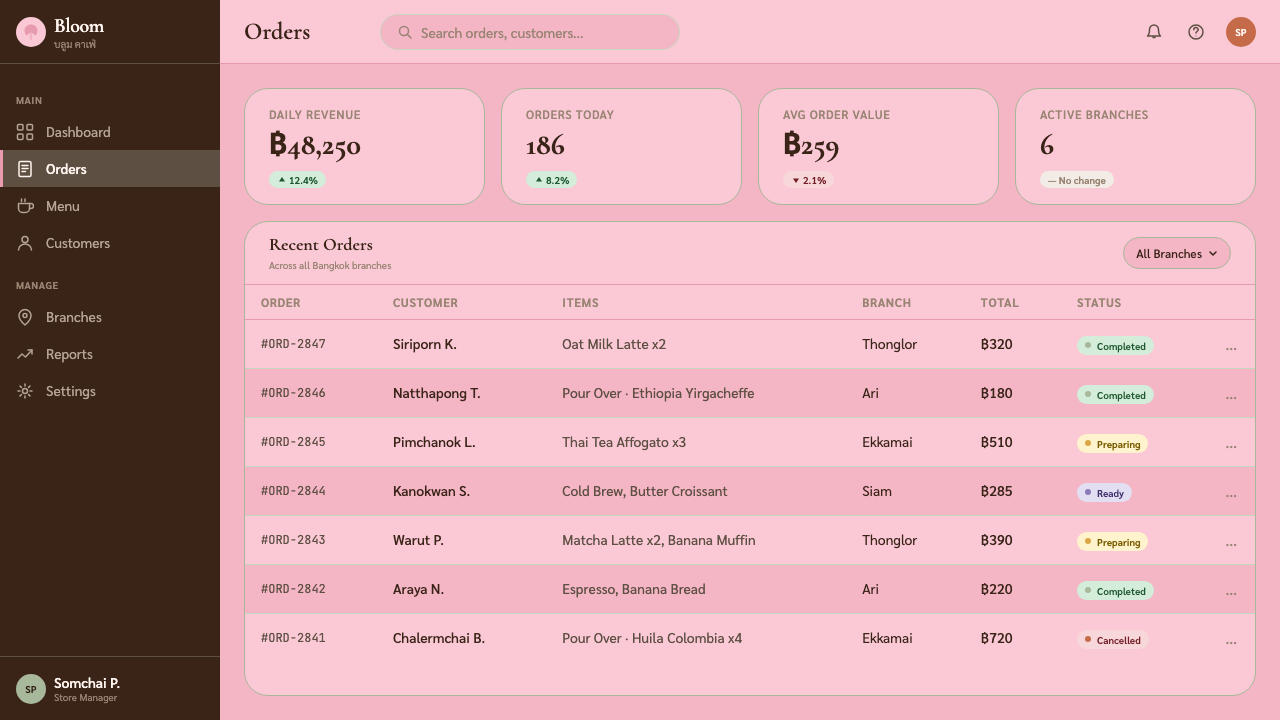
For web and app interfaces, the style suits onboarding flows, landing pages for wellness or lifestyle brands, and any product whose primary value proposition involves taste, curation, or considered quality. The structural approach: a cream or warm-white ground, body type in a deep warm-neutral rather than pure black, pill-shaped buttons as the primary interactive element, and rounded-corner cards with matte-looking backgrounds rather than drop-shadow depth. Navigation should be typographic and understated — wordmarks and text links rather than icon-heavy menus. For dashboards, the style works if the data being presented benefits from a calm, unhurried reading environment — it becomes stressful if the palette's softness fights against the urgency that operational metrics typically demand.
For editorial and marketing applications, Bangkok Third-Wave Cafe supports premium lifestyle positioning most naturally. A long-form article layout benefits from generous leading, a modestly narrow measure, and section breaks marked by botanical illustration rather than geometric rules. For marketing pages, the approach is full-bleed botanical photography — monstera or eucalyptus on the pale ground — alternating with type-only sections where the warmth of the palette carries the full visual weight. Packaging design is where the style arguably reaches its highest expression: the matte surface, bilingual labelling, hand-noted text on a cream field, and the restrained botanical accent translate directly to physical paper and card.
A common mistake when applying this aesthetic is treating it as simply a palette swap — adding pinks and sage greens to an otherwise generic layout — without attending to the surface quality, typographic generosity, and bilingual logic that define the style. Without matte-feeling surfaces, without generous leading, and without the discipline of treating two scripts as equals, the result reads as trend-adjacent rather than specific. Another frequent error is over-botanising: a single well-placed monstera is structural; a screen full of foliage becomes noise. The style is about considered restraint, not abundance.
The style also struggles when forced into high-density information environments. Complex SaaS dashboards, data-heavy analytical tools, and transactional interfaces where speed and precision are the primary user values are not natural homes for this aesthetic. Its warmth and softness, which create the right atmosphere for an unhurried specialty-coffee experience, work against the cognitive clarity that productivity software demands. Knowing this boundary is part of applying the style correctly.
Bangkok Third-Wave Cafe — FAQ
Is this a Thai style or a Japanese style?
It is emphatically a Thai style, though one that has consciously absorbed and transformed Japanese minimalism. The distinction matters: Japanese third-wave cafe minimalism tends toward monochrome restraint, natural wood, and a wabi-sabi acceptance of material imperfection. Bangkok Third-Wave Cafe warms and softens those precedents — adding dusty pink, tropical foliage, and the confident coexistence of two scripts — in ways that reflect Thai hospitality culture and Bangkok's specific tropical light. The Japanese influence is real and acknowledged by the cafes themselves, but the transformation is thoroughgoing enough that the result is distinctly its own thing.
How does the style handle dark mode?
The Bangkok Third-Wave Cafe aesthetic is fundamentally a light-ground system — its warmth and softness depend on pale backgrounds that catch and diffuse light. A dark-mode inversion is possible but requires significant recalibration. On a deep background, the dusty pink reads very differently — it can appear more vivid and less sophisticated — while the sage green loses the muted quality that gives it its elegance. The most successful dark-mode adaptations tend to shift the background toward a very deep warm charcoal rather than pure black, retain the sage as a muted accent, and allow cream-toned type to carry the warmth. The style loses some of its characteristic softness in dark mode but can maintain its bilingual typographic identity and botanical accents.
Can this style work without actual botanical imagery?
Yes — the botanical accent is important but not load-bearing in isolation. The style's warmth comes first from the palette, second from the typographic generosity, and third from the matte surface quality. A well-executed application of Bangkok Third-Wave Cafe using only the colour palette, the rounded UI elements, the bilingual typographic approach, and the generous leading will feel recognizably related to the style even without a single leaf in sight. The absence of botanical imagery does push the style toward a more generic pastel-minimal look, so at least a small botanical element — even a single leaf graphic or a subtle texture — is worth including if it can be justified by the context.
How does Bangkok Third-Wave Cafe differ from general Scandinavian or Nordic minimalism?
Both traditions share a commitment to pale grounds, natural materials, generous whitespace, and restraint in decoration. The differences are in warmth, colour, and cultural specificity. Nordic minimalism tends toward cooler tones — grey-whites, ash tones, blue-adjacent neutrals — reflecting Scandinavian light conditions. Bangkok Third-Wave leans decisively warm: the pinks, creams, and sage greens all tend toward the warm end of their range. Nordic minimalism typically excludes script as a design element; Bangkok Third-Wave makes bilingual script coexistence a positive aesthetic feature. And where Nordic minimalism reaches for timelessness and universality, Bangkok Third-Wave is rooted in a specific city, a specific neighbourhood, and a specific cultural moment — its regionality is a feature, not a liability.
Is this a style suited to luxury positioning, or is it more casual?
Bangkok Third-Wave Cafe occupies a particular middle ground: it communicates considered quality and thoughtful curation without signalling exclusivity or formality. The matte surfaces, generous leading, and careful material choices read as premium compared to generic cafe design, but the handscript tasting notes, the approachable roundness of the UI elements, and the warmth of the palette prevent it from tipping into cool luxury or high-fashion austerity. It suits brands whose offer is premium but whose relationship with the customer is warm and democratic — specialty coffee being the archetype, but the logic extends to boutique wellness, independent bookshops, and considered lifestyle retail. It would struggle to carry ultra-luxury positioning, where more architectural restraint and a colder, more exclusive palette are typically expected.
Related design styles
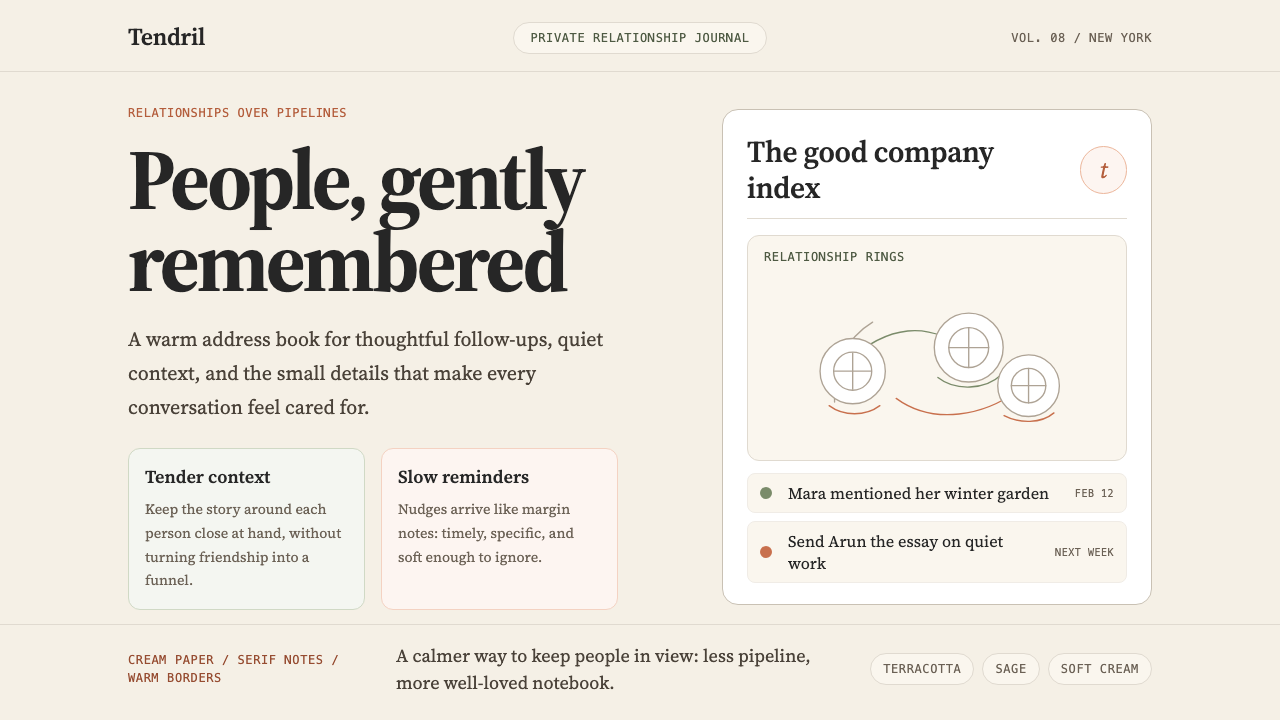 Clay 2024CRM as a sketchbook, not a sales pipeline. Cream backgrounds, terracotta, han…
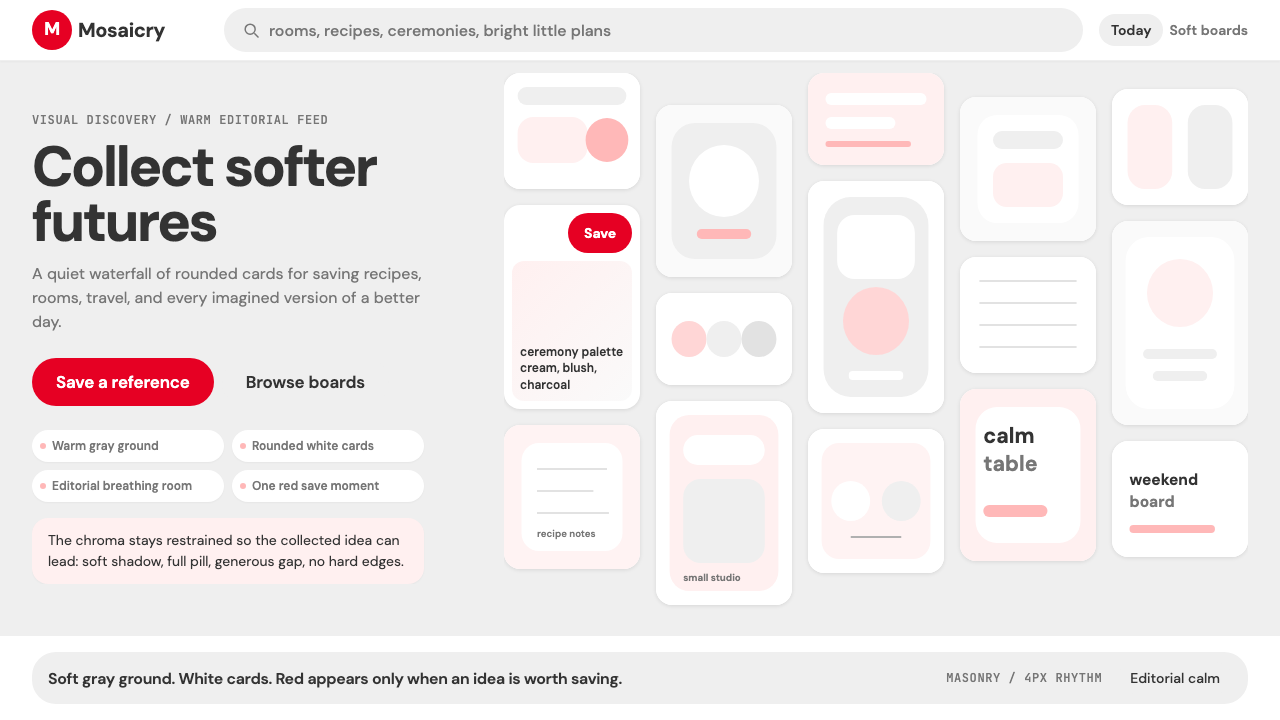 Pinterest 2024Aspirational calm. Warm gray masonry, rounded white pins, one surgical red sa…
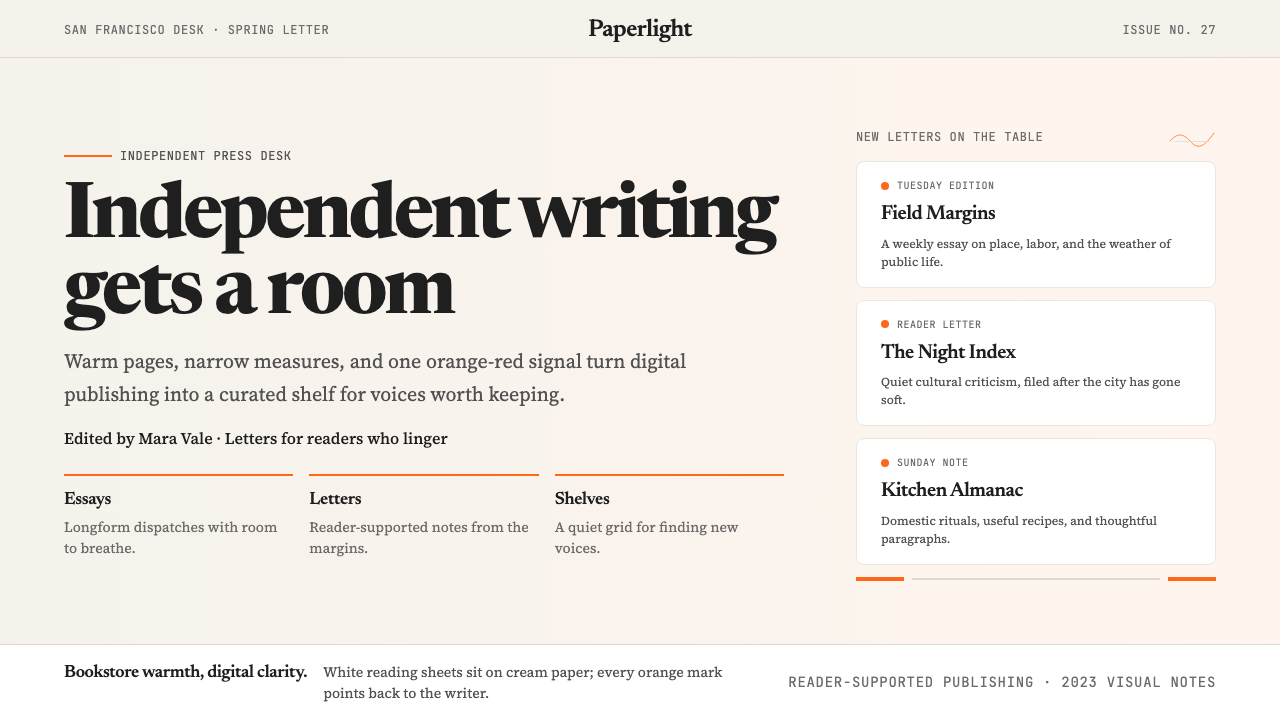 Substack 2023Writing feels shelved, not streamed. Cream paper, Newsreader serif, and one o…
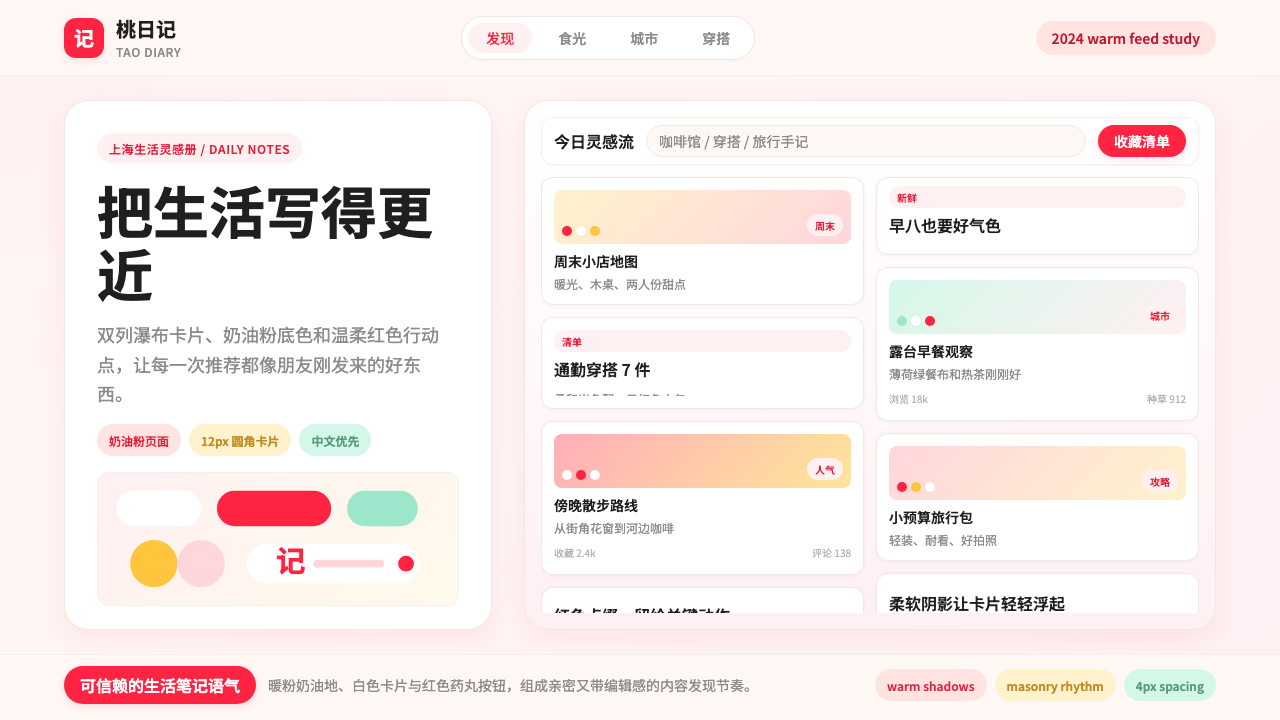 Xiaohongshu (RedNote) 2024Warm notes feel trusted. Cream-pink masonry cards glow with signature red acc…
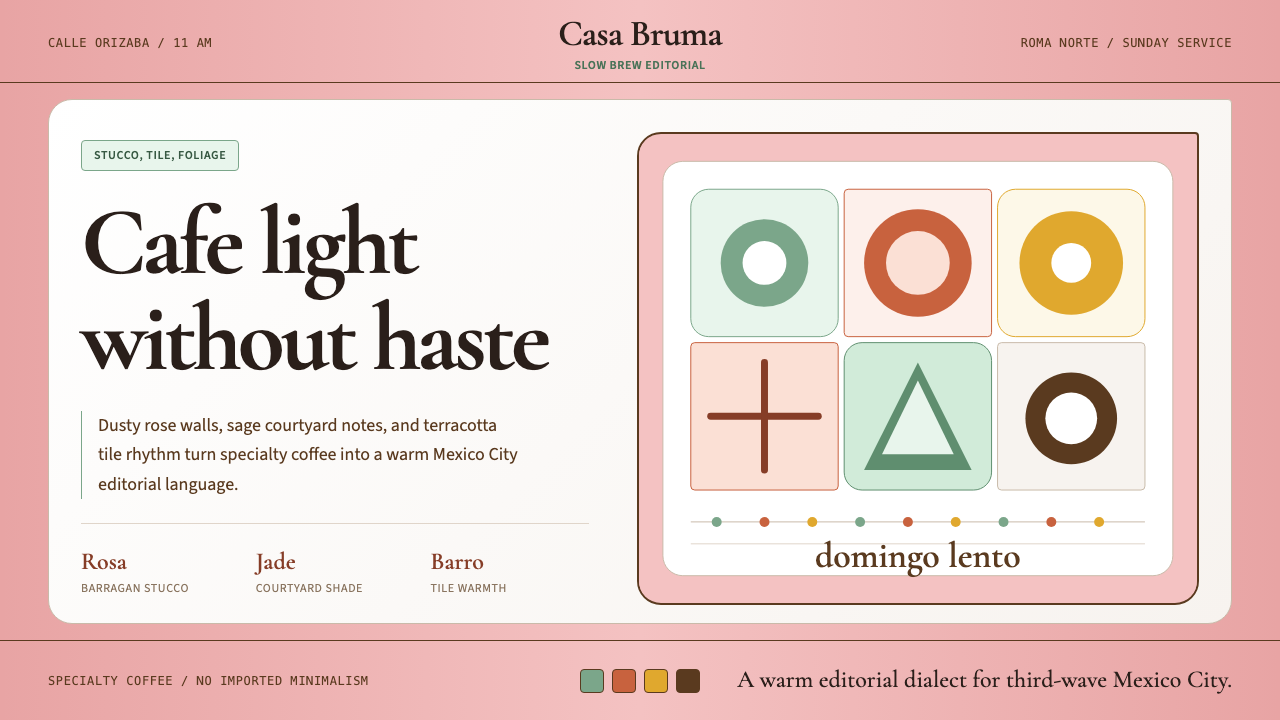 CDMX Roma Norte CafeMexico City coffee, unhurried. Dusty rose, sage jade, and serif rhythm carry…
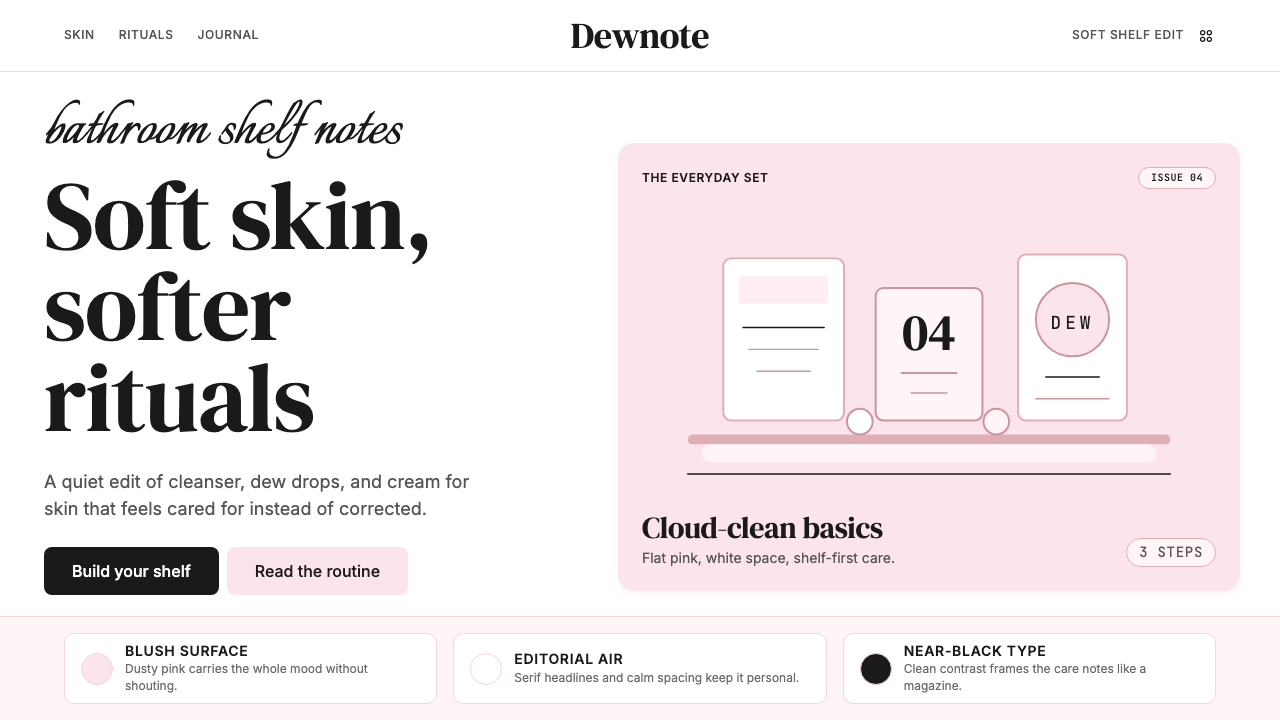 GlossierBeauty as a friend's conversation. Dusty pink (never bubblegum), editorial se…