What is Quiet Luxury / Old Money?
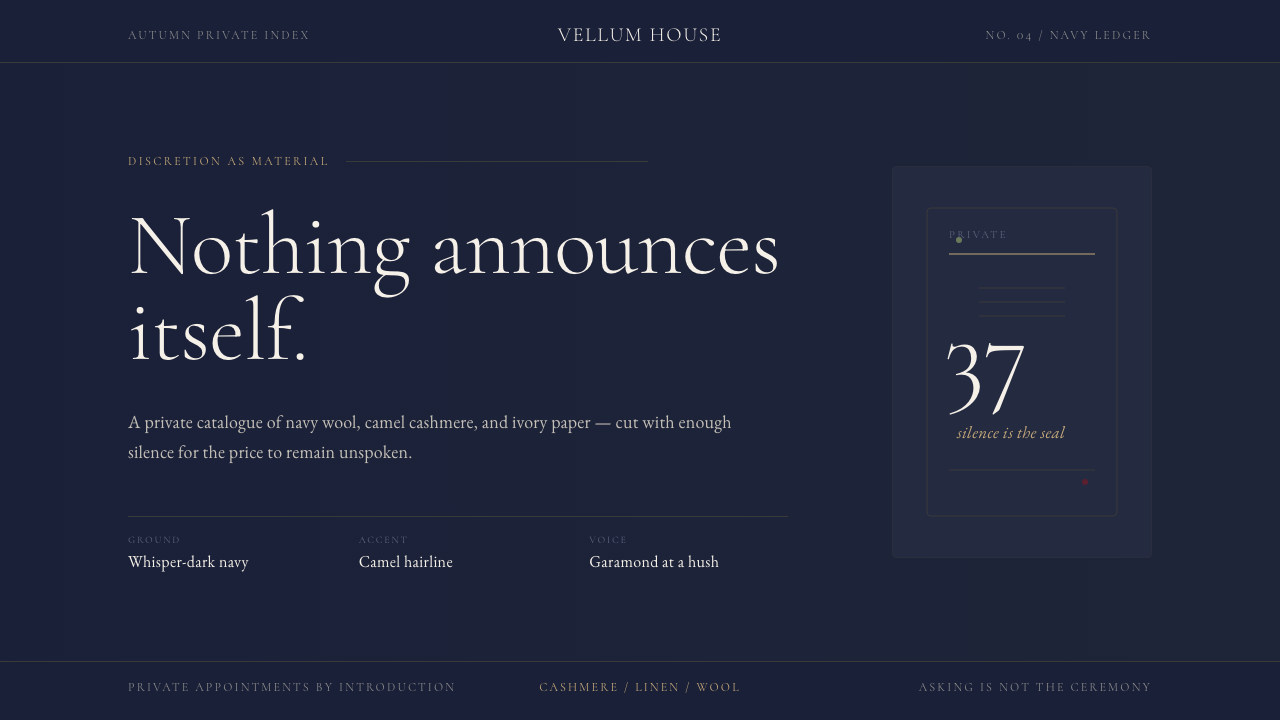
Quiet Luxury is the art of spending without announcing it — a design language built on restraint, heritage, and the conviction that the finest things never need to explain themselves.
Quiet Luxury / Old Money in brief
Quiet Luxury — sometimes called the Old Money aesthetic or stealth wealth — is a visual and cultural sensibility that treats restraint as the ultimate status signal. Where logo-driven luxury announces its price tag, Quiet Luxury removes every marker that could be read as effort. The palette runs from navy and camel to ivory and stone. Typography is thin, set with generous negative space. Hairline rules replace decorative borders. The whole system communicates ease, permanence, and the quiet authority of those who have never needed to impress anyone.
As a design movement, it crystallized publicly around 2022 and 2023, when the television series Succession and the renewed cultural prominence of brands like Loro Piana, The Row, and Brunello Cucinelli made stealth wealth the dominant luxury conversation. But the underlying aesthetic is far older — rooted in the Anglo-American upper-class wardrobe of the mid-twentieth century, European boarding-school dress codes, and the unwritten rules of old-money social circles where conspicuous consumption was considered vulgar.
The visual logic is entirely about what is absent. There are no logos, no loud patterns, no saturated colors. What remains is quality of material, precision of cut, and the self-assurance of understatement. In two-dimensional design, this translates to a system of almost painful refinement: letter-spacing pushed wide on already-light type, compositions that leave more white space than most designers would dare, and a tonal palette so close in value that the eye must slow down to read the contrast.

Where does Quiet Luxury / Old Money come from?
The roots of Quiet Luxury lie in the social codes of the Anglo-American Protestant establishment — what sociologists sometimes call the WASP (White Anglo-Saxon Protestant) style — that dominated elite American culture from roughly the 1880s through the 1970s. In New England prep schools, on the lawns of Newport and Nantucket, and in the Upper East Side townhouses of Manhattan, the display of wealth was governed by a strict inverse logic: the more money a family had, the less it needed to show. A navy blazer, a well-worn leather belt, a cashmere sweater in a muted earth tone — these were not poverty signals but insider codes, legible only to those already within the circle.
European aristocratic tradition reinforced the same logic from the other side of the Atlantic. In British, French, and Italian upper-class dress and interior culture, longevity was the marker of quality — a coat that had been worn for thirty years and looked it, furniture that had passed through three generations, linens monogrammed by a great-grandmother. New things, especially new things that advertised their newness, were suspect. The Italian concept of sprezzatura — the art of making effort look effortless — became the cultural software running underneath the aesthetic. Brunello Cucinelli, speaking of his Umbrian cashmere workshops in the early 2000s, framed this directly: the goal was not to make things that looked expensive, but things that simply were.
The explicit fashion movement labeled 'quiet luxury' or 'stealth wealth' emerged in critical discourse around 2022, accelerated by the visual world of the HBO series Succession (2018–2023), whose costume designer Michelle Matland built the Roy family's wardrobe around precisely these principles — impeccable tailoring, no logos, a palette of grey flannel, navy, camel, and cream that communicated hereditary power without a single branded item. The show's influence on both fashion and design was measurable: Loro Piana reported surging sales, The Row's deliberately logo-free aesthetic attracted a new generation of buyers, and Google searches for 'old money aesthetic' increased by several hundred percent in 2022 and 2023.
Parallel to the fashion moment, the visual language migrated into digital product design and brand identity. Technology companies and financial services platforms — particularly those targeting high-net-worth individuals — began adopting the palette and typographic restraint of the aesthetic as a way to signal trustworthiness and seriousness. The move away from the saturated color palettes and rounded-corner friendliness of consumer tech toward something more austere and tonal was directly legible as a class signal, whether or not the designers using it described it in those terms.
What defines the Quiet Luxury / Old Money look?
Palette
The Quiet Luxury palette is built on a narrow range of near-neutrals: deep navy, warm camel, cold ivory, stone grey, and a warm off-white that reads as aged cream. These tones are valued precisely because they are close in saturation and brightness — the eye has to work slightly to separate them, which creates a sense of refinement rather than immediate pop. Accent colors, when they appear at all, tend to be muted — a dusty burgundy, a faded forest green — and are used sparingly enough that they read as deliberate rather than decorative.
Typography
Typefaces in this system are almost always seriffed and drawn in the classical tradition — letterforms with long, unbracketed serifs, high stroke contrast, and the proportions of Renaissance or Enlightenment-era book printing. Type is set light or regular in weight, never bold in the aggressive sense, and tracked wide enough to feel unhurried. Headlines are often set in small capitals or in a size that is only slightly larger than body text — hierarchy is communicated through tracking and weight rather than scale. The result is a page or screen where the typography seems to recede, leaving the negative space to do the work.
Negative Space
In Quiet Luxury design, negative space is not emptiness — it is the primary material. Generous margins, wide leading, and the deliberate refusal to fill available space all signal the same thing: there is no need to crowd, because nothing is being sold through urgency. This is the visual equivalent of speaking slowly and without filler words. A composition that uses half its available area for content and leaves the other half open is not incomplete — it is exercising restraint as a form of authority.
Surface and Texture
Where other luxury aesthetics rely on shine and gloss to signal richness, Quiet Luxury prefers matte surfaces, subtle paper-like textures, and the occasional suggestion of woven or natural material. In physical design, this is cashmere over silk, linen over polyester, uncoated paper over gloss laminate. In digital design, it translates to slightly warm or off-white backgrounds rather than pure white, subtle noise or grain overlays that add tactility, and the avoidance of any surface treatment that reads as slick or digital-native.
Restraint in Decoration
Quiet Luxury does not simply remove decoration — it employs a highly selective vocabulary of minimal marks that carry maximum meaning. A single hairline rule beneath a headline. A thin border on a card component, set in a tone only slightly darker than the background. A monogram rendered in the same weight as the surrounding body text, easily missed by anyone not looking for it. These micro-details reward close attention and signal that the designer has thought carefully about every element — which is itself the message.
Tonal Contrast
Where bold design traditions use strong contrast to create hierarchy, Quiet Luxury uses tonal proximity. Background and foreground may differ by only a few steps on the value scale. Headlines and body text may be separated by weight rather than size. The result can read as nearly monochromatic, with hierarchy emerging from subtle shifts in tone and weight rather than from dramatic contrast. This approach requires more careful calibration than high-contrast design — there is less room for error — but when executed well, it produces an atmosphere of calm, considered authority.
Heritage Signals
Unlike contemporary minimalism, which tends to feel ahistorical, Quiet Luxury actively references tradition. This might be a serif typeface with visible historical provenance, a layout structure reminiscent of early-twentieth-century quality printing, a paper stock association that suggests the stationery of a private bank, or the use of Roman numerals and classical proportioning systems. The goal is to suggest that something has always been this way — that quality of this order does not respond to trends but simply persists.

Who shaped Quiet Luxury / Old Money?
As creative director of Céline from 2008 to 2018, Phoebe Philo codified the modern visual language of stealth wealth for fashion and, by extension, for design at large. Her collections rejected visible branding, favored an austere palette of cream, camel, black, and tan, and prioritized the quality of cut and material over any surface decoration. When she launched her independent label in 2023, the critical response treated it as a definition of the Quiet Luxury movement rather than a participant in it.
The Olsen twins founded The Row in 2006 as a deliberate counter-signal to the celebrity-branded fashion of the period. The label has no visible logo, maintains an extremely narrow color range, and prices its pieces at a level that ensures they will never appear in a general-market context. The Row's design sensibility — quiet, rigorously proportioned, and entirely without the kind of marketing that announces itself — became one of the most referenced touchstones of the Quiet Luxury movement.
The Italian designer and entrepreneur built his brand around what he describes as 'humanistic capitalism' — the idea that craft, quality, and the human dignity of production should be valued above margin maximization. Cucinelli's cashmere pieces are among the most expensive in the market, yet the brand's visual identity maintains an almost aggressively quiet register: natural tones, no logo on garments, and a retail environment designed to feel like a private home rather than a store. His philosophy provided much of the intellectual framework that the Quiet Luxury cultural moment drew on.
As costume designer for Succession, Michelle Matland built the visual language of the Roy family and their circle from the ground up — a task that required translating abstract ideas about inherited power into specific garment choices. Her decisions (navy blazers without pocket squares, cashmere in institutional grey, no visible branding anywhere) became the most widely discussed example of stealth wealth dressing in popular culture and directly influenced how audiences, designers, and brands thought about the relationship between restraint and status.
Long before the quiet luxury label existed, Ralph Lauren had been systematically constructing an American version of old-money aesthetics since the late 1960s. His Purple Label and Polo lines drew on Ivy League, English country, and Newport summer traditions to create garments that referenced inherited wealth rather than newly earned it. Lauren's contribution to the visual vocabulary — equestrian imagery, navy and camel combinations, understated monograms — became so culturally embedded that it is now the baseline from which other designers measure deviation.
How do you use Quiet Luxury / Old Money today?
Quiet Luxury translates more directly into design work than many heritage aesthetics, because its core principle — that restraint communicates authority — is as applicable to a slide deck or a product interface as it is to a cashmere overcoat. The key is understanding what the aesthetic is actually doing: using a narrow tonal range to force the eye to slow down, using negative space to signal that nothing is being sold urgently, and using classical typographic proportions to invoke tradition and permanence. Applied without this understanding, the style reads simply as bland.
For presentation slides, Quiet Luxury works on both cover and content pages — but demands more confidence in composition than high-contrast styles. A cover slide in this mode might place a single line of widely tracked type in a light serif against a deep navy ground, with nothing else present. The absence of supporting imagery, logo, or tagline is not a lack — it is the statement. Content slides should be treated as pages from a quality annual report: generous margins, type set at a size that does not strain the eye, hierarchies communicated through the relationship between tracking and weight rather than size jumps, and data visualizations rendered in the same tonal palette as the surrounding typography rather than in clashing accent colors.
For web interfaces and digital products, the style is particularly suited to contexts where trust, discretion, and high-ticket positioning are the primary communications goals: private banking platforms, wealth management dashboards, premium subscription services, professional services firms, and luxury brand environments. The approach favors backgrounds in warm near-white or stone tones, body type in a classical serif at comfortable reading size, and navigation that relies on typographic clarity rather than icon decoration. Interactive states should be subtle — a slight darkening on hover, a hairline underline on focus — avoiding anything that reads as animated or attention-seeking.
For editorial and marketing work, Quiet Luxury supports a mode of communication that feels more like a private letter than an advertisement. A long-form editorial layout in this style would use a single column of body text with a very wide margin — the margin used for pull quotes set in a lighter weight of the same typeface, for editorial notes, or simply left empty. Section breaks are marked by a thin rule and a small section numeral rather than a headline in a contrasting color. Marketing materials maintain the same logic: no urgency indicators, no countdown timers, no promotional overlay text. The product or service is presented as self-evidently desirable, not sold.
A common mistake when applying this aesthetic is conflating restraint with minimalism. Minimalism, in the contemporary digital sense, often means reducing a design to its barest functional elements — flat color, system typefaces, maximum whiteness. Quiet Luxury is not the same: it is not about reduction but about selection. The difference is visible in the specificity of the choices. A minimalist background is pure white; a Quiet Luxury background is a warm, slightly tinted off-white that reads as aged paper or fine linen. A minimalist headline is set in a geometric sans at a large size; a Quiet Luxury headline is set in a classical serif with visible stroke contrast, tracked wide, at a size that barely rises above the body text. The restraint is careful and historically aware, not simply spare.

Quiet Luxury / Old Money — FAQ
Is Quiet Luxury the same as minimalism?
They overlap but are philosophically distinct. Minimalism, in its purest form, is about reduction to functional essentials — removing everything that is not necessary. Quiet Luxury is about selection — choosing specific things with great care and then deploying them with restraint. A minimalist design might use a system typeface because any typeface will do; a Quiet Luxury design uses a specific classical serif because that typeface carries a particular historical association. Minimalism tends toward the ahistorical and universal; Quiet Luxury is deliberately particular and tradition-referencing. The practical difference is visible in texture and specificity: Quiet Luxury work has a warmth and material-ness that pure minimalism deliberately avoids.
How do you signal quality without using luxury brand names or logos?
Through the accumulation of small, specific decisions that individually might go unnoticed but collectively produce a distinctive atmosphere. The weight of a typeface chosen for its historical provenance rather than its contemporary familiarity. A background tone that reads as warm paper rather than default white. A margin so wide that it initially seems wasteful. Hairline rules used as section breaks instead of colored blocks. The absence of any element that was placed there to fill space or to signal effort. Quiet Luxury quality reads through what is not there as much as through what is — and through the evident care taken over each choice that remains.
Can Quiet Luxury work in a dark color scheme?
Yes, but it requires rethinking the tonal logic rather than simply inverting it. The canonical Quiet Luxury palette is light-ground — ivory, cream, stone — because those tones evoke aged paper, natural linen, and the rooms of old houses. A dark version works when it substitutes deep navy or a very dark warm charcoal for the light ground, and uses ivory or pale camel as the type and line color. What does not work is a dark background paired with high-contrast white type — that reads as a tech interface rather than old money. The dark version succeeds when the contrast ratio between background and foreground remains moderate rather than dramatic, maintaining the tonal proximity that is central to the aesthetic.
What kinds of products or brands should avoid this aesthetic?
Quiet Luxury is a poor fit wherever the brand's values require visibility, energy, accessibility, or warmth. Consumer food and beverage brands need to signal appetite and sensory pleasure — the tonal restraint of this aesthetic suppresses exactly the cues that drive purchase in a grocery aisle. Youth-oriented brands, sports brands, and entertainment products need energy and movement that the quiet palette and slow typography actively resist. Non-profit organizations communicating urgency or community need visual warmth and approachability that the style's aristocratic cool does not provide. And consumer technology products competing on friendliness and ease of use will find the aesthetic reads as cold and possibly exclusionary to mainstream audiences.
How does Quiet Luxury relate to Scandinavian or Japanese minimalism?
All three value restraint and the removal of the unnecessary, but they arrive at that position from different cultural traditions and produce visually distinct results. Scandinavian minimalism (Hygge aesthetics, Muji's precursors, early IKEA) emphasizes functional warmth — natural wood, soft textiles, and a palette derived from Nordic light and landscape. It is democratic in spirit, designed for comfort rather than status. Japanese minimalism (wabi-sabi, ma, the Kyoto aesthetic) values impermanence, imperfection, and the spiritual quality of carefully considered emptiness. Quiet Luxury, by contrast, is specifically about class and lineage — it is aristocratic rather than democratic, European or Anglo-American in its cultural references, and concerned with signaling a particular kind of inherited position rather than achieving spiritual clarity or domestic warmth.
Related design styles
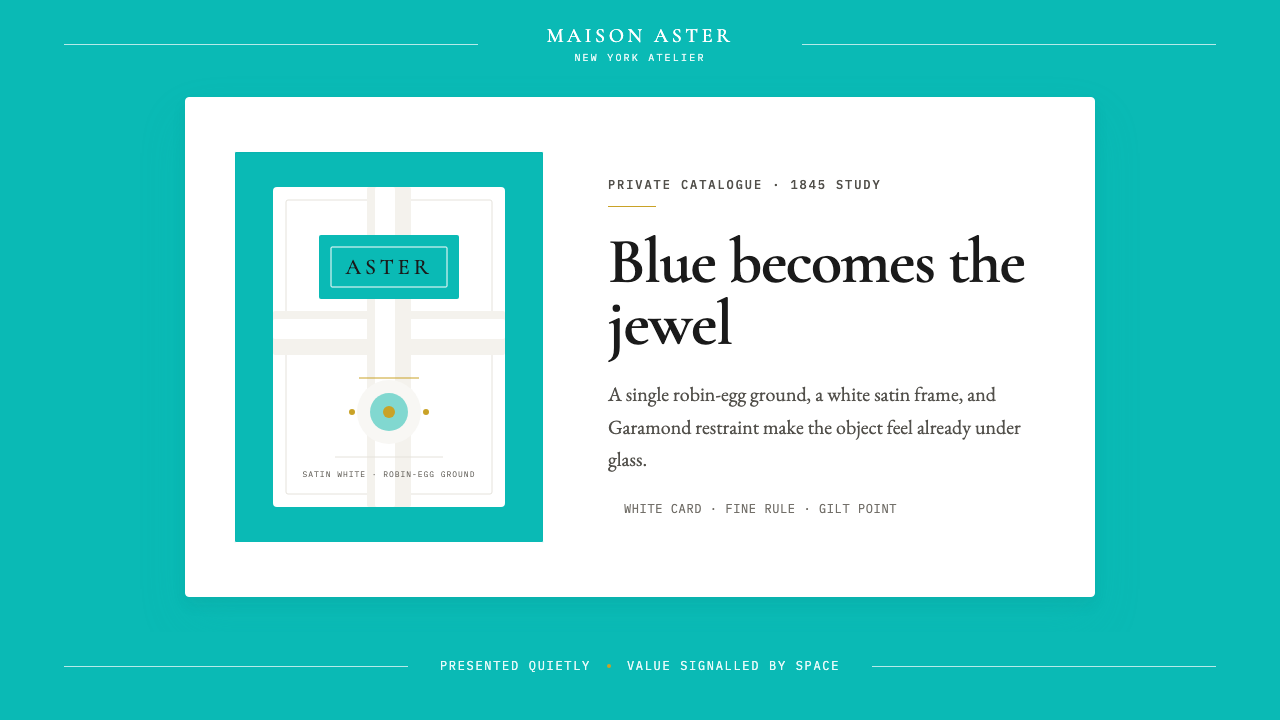 Tiffany Robin-Egg BlueBlue is the luxury signal. Robin-egg ground, white satin rules, Garamond rest…
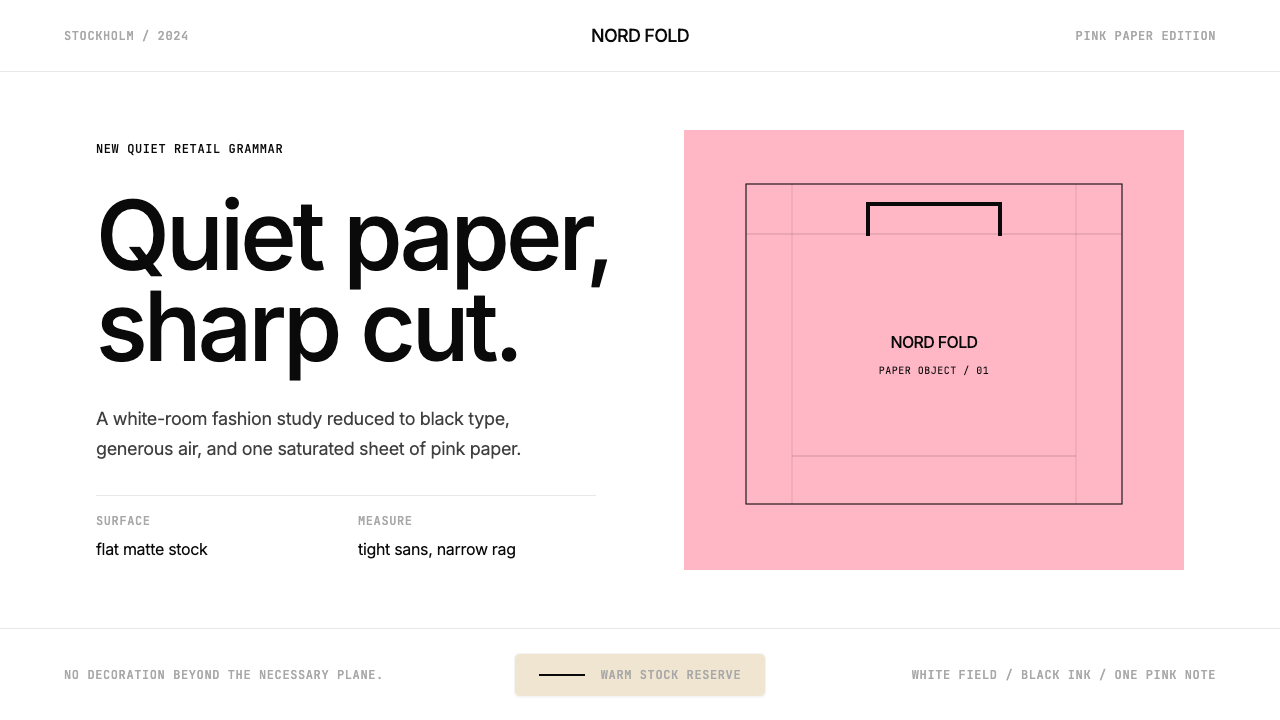 Acne Studios Pink-PaperQuiet luxury in one pink plane. Inter type floats on white with a bag-like re…
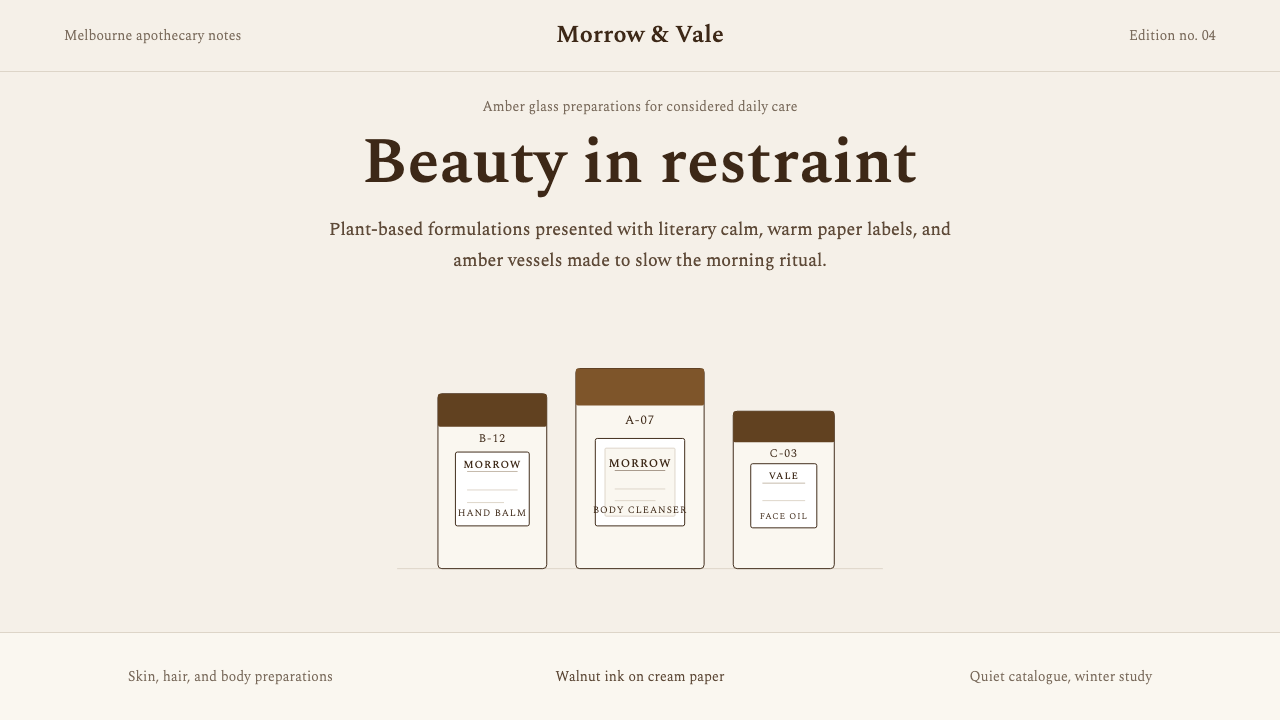 AesopRefuses urgency. Walnut serif on cream paper — every surface paced like a 19t…
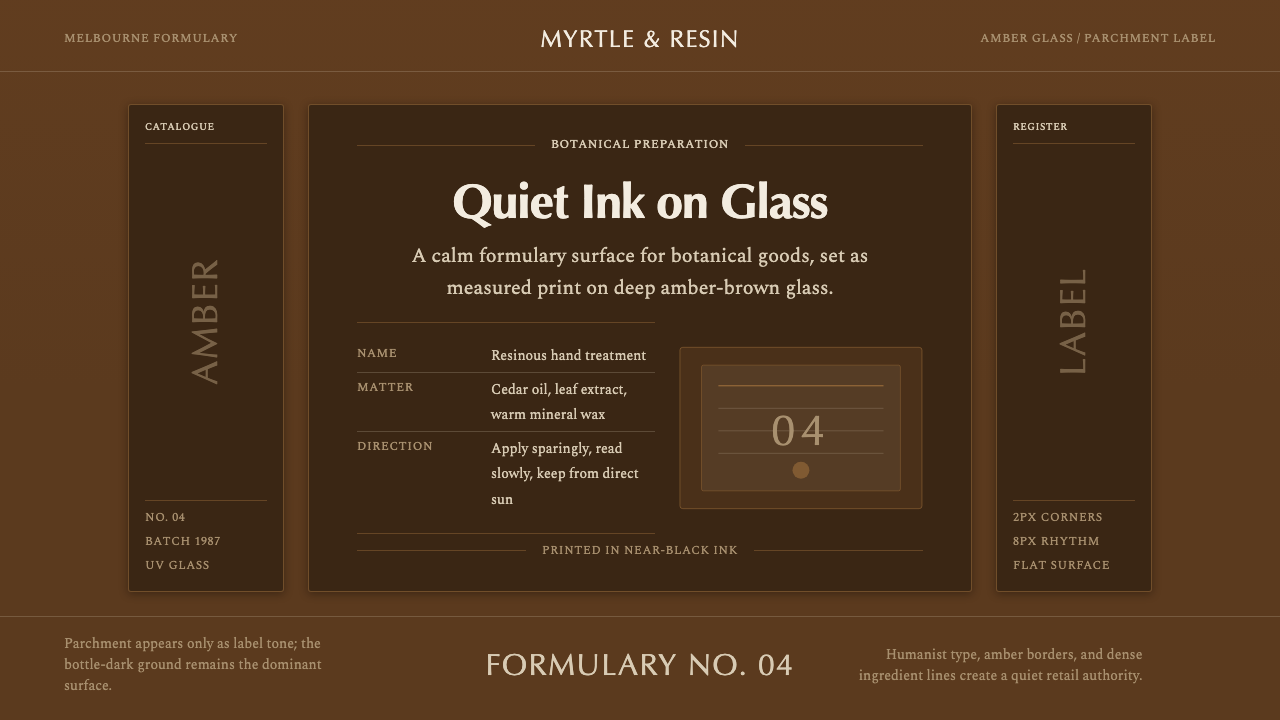 Aesop Apothecary AmberQuiet authority in glass. Amber-brown ground, parchment labels, and humanist…
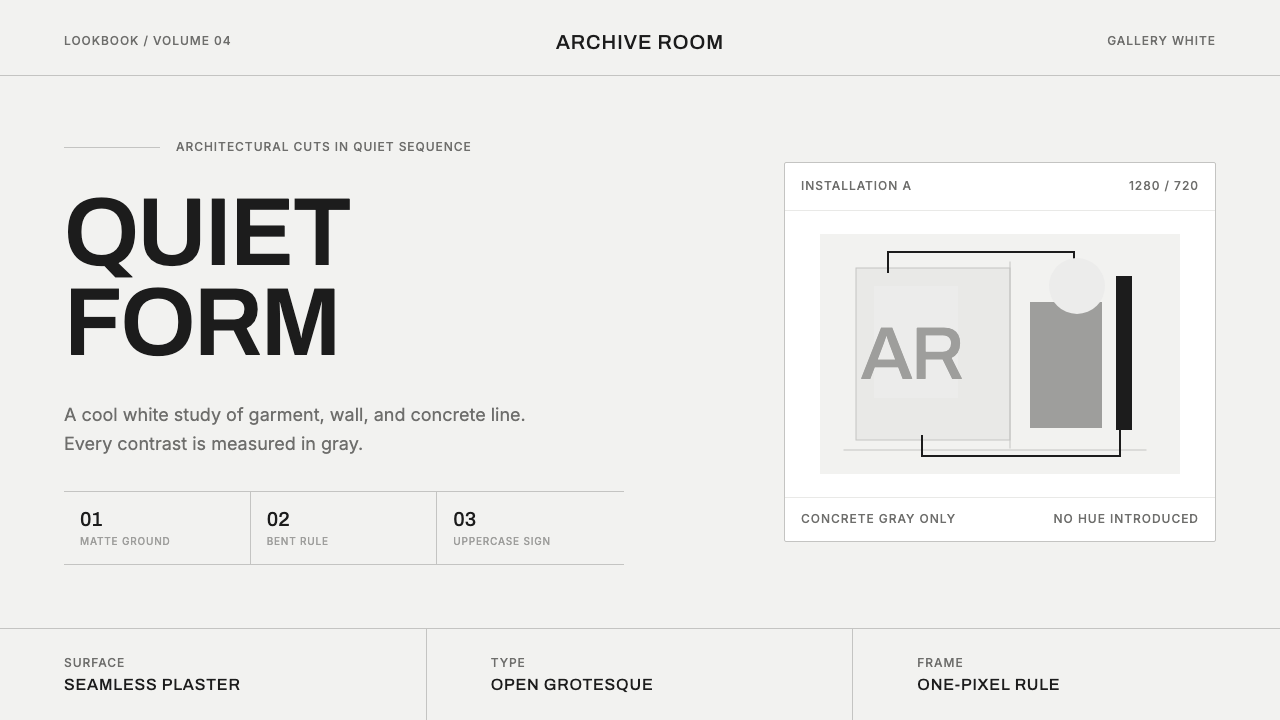 COS Gallery MinimalSilence has structure. Cool gallery white, Archivo uppercase, and concrete-gr…
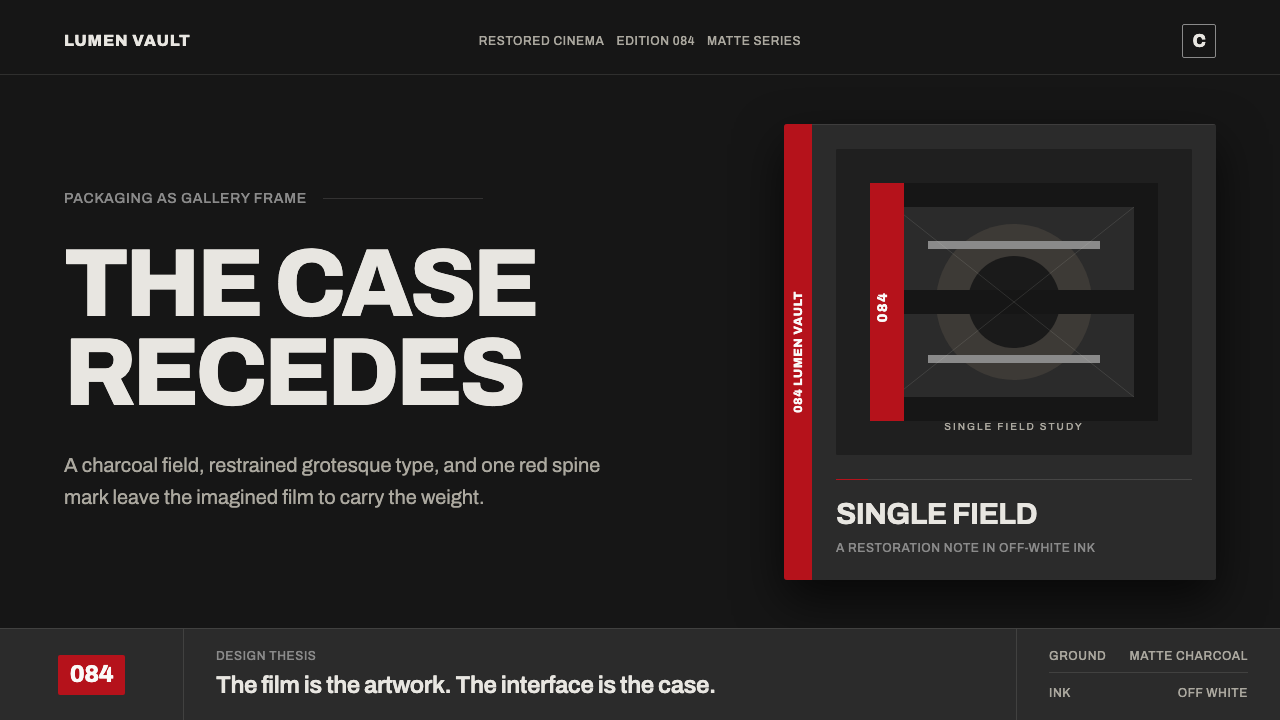 Criterion ArthouseThe case disappears. Charcoal field, off-white Archivo, hairline rules, one r…