What is Melbourne Third-Wave Coffee Modern?
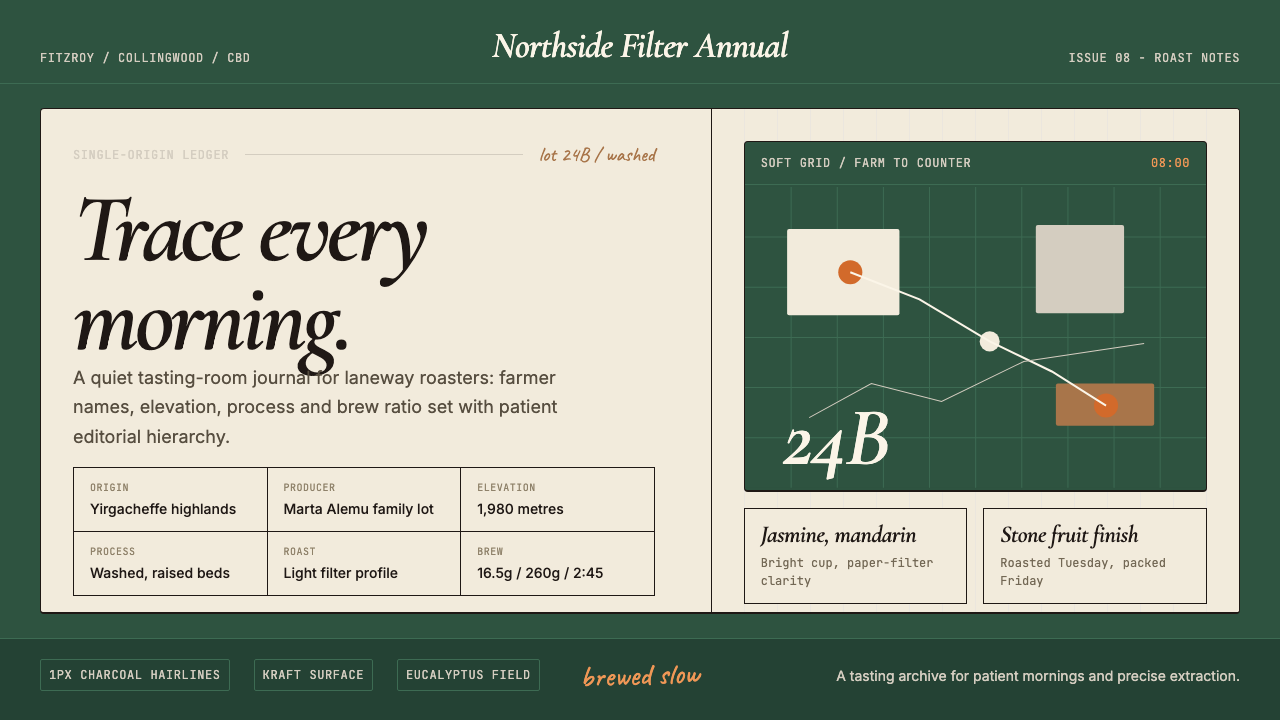
Melbourne's laneway cafés invented a visual language as precise as a tasting note — eucalyptus green, kraft warmth, and provenance-dense type that made sourcing transparent and design inseparable from the coffee itself.
Melbourne Third-Wave Coffee Modern in brief
Melbourne Third-Wave Coffee Modern is the visual language that emerged from the city's specialty-coffee culture between roughly 2008 and 2018, crystallising in the cafés, roasteries, and retail packaging of Fitzroy laneways and Collingwood warehouse conversions. It is a hybrid aesthetic: Japanese restraint in the handling of negative space and quiet color, Scandinavian editorial clarity in grid structure and typographic hierarchy, and a distinctly Australian frankness in material choices — raw concrete, unvarnished timber, kraft board — that refuses to dress up what can honestly be left bare.
At its core the style is about provenance legibility. Third-wave coffee culture insists that a drinker should be able to trace a cup to its farm, harvest season, varietal, and processing method. The visual system was built to carry that information without overwhelming it: the typography is unhurried and detailed, the palette is natural and earth-anchored rather than attention-grabbing, and every layout decision serves readability over decoration. The result is a design register that feels simultaneously humble and expert — the confidence of a roaster who knows exactly where their beans come from.
Though it originated in printed menus, retail bags, and café interiors, the style has migrated convincingly into digital product design, particularly for brands in food, wellness, sustainability, and independent retail where a sense of careful curation and honest material sourcing is a genuine value rather than a marketing posture.
Where does Melbourne Third-Wave Coffee Modern come from?
Melbourne's specialty-coffee scene has roots in the city's post-war Italian immigrant community, which established espresso culture along Brunswick Street and Lygon Street decades before the term 'third wave' existed. But the contemporary aesthetic owes more to a second generation of influence: the Japanese kissaten and sake-bar culture that Melbourne's design community had absorbed through the 1990s travel and publishing boom, and the Scandinavian café tradition arriving via Copenhagen and Stockholm-trained baristas who migrated south in the early 2000s. These two threads — Japanese material minimalism and Scandinavian typographic rigour — were grafted onto an Australian openness to raw, unfinished surfaces.
The era that most directly shaped the visual language runs from roughly 2008, when the post-global-financial-crisis contraction made conspicuous luxury brand language feel dishonest, through to 2018, when the style had become legible enough to be taught, imitated, and exported. Key figures include Mark Dundon, whose Seven Seeds roastery in Carlton helped define the warehouse-as-tasting-room format and its associated print identity; Jason Scheltus of St. Ali in South Melbourne, who brought an editorial intelligence to coffee packaging at a moment when most roasters were using generic commodity design; Bowen Holden, whose work helped establish the standard of botanical illustration as a complement to origin storytelling; and Salvatore Malatesta, whose multiple venues demonstrated that the aesthetic could scale without losing its handmade conviction.
The style's typographic identity was shaped in part by the letterpress and risograph revival that moved through Melbourne's independent publishing scene during the same period. Small-run zines, craft-market print ephemera, and independent bookshop posters fed back into café print culture, establishing a preference for type that showed visible impression and ink variation — the material evidence of process — over the sterile precision of commercial offset printing. This gave the style its characteristic warmth: even when digitally produced, the typography often pays homage to the slight unevenness of a physical printing press.
By the mid-2010s the aesthetic had consolidated around a stable set of conventions — eucalyptus green, warm cream or off-white grounds, kraft board textures for tactile packaging, italic serif details for provenance annotations, and a generous commitment to negative space — that were being applied consistently across Melbourne's highest-profile specialty café groups. The visual system then began to travel: first to Sydney and Brisbane, then to London's specialty-coffee scene (where the Melbourne influence on Antipodean cafés became a recognised phenomenon), and eventually into the branding vocabularies of farm-to-table restaurants, natural wine bars, and artisan food producers globally.
What defines the Melbourne Third-Wave Coffee Modern look?
Palette
The palette is anchored by eucalyptus green — a muted, slightly grey-green that reads as botanical rather than corporate — paired with warm cream or aged-white grounds. Secondary tones borrow from the roasting process itself: the deep brown of a medium roast, the pale gold of a washed natural, the near-black of a dark roast used sparingly as a structural anchor. The palette deliberately avoids high saturation; every hue carries grey, as if it has been left out in the Australian light for a season. Accent color, when it appears, tends toward terracotta, warm ochre, or the dusty rose of a dried banksia rather than the clean primaries of modernist tradition.
Typography
Typography is the most distinctive feature of the style. The primary workhorse is an upright or slightly condensed serif — often with visible bracketed serifs and moderate stroke contrast — used for longer-form provenance text: farm names, altitude, varietal, harvest notes. Running alongside it is an italic cut of the same or closely related face, deployed specifically for handwritten-feeling annotations, tasting descriptors, and origin details. This upright-plus-italic pairing gives the system its characteristic warmth and legibility while maintaining a quiet formality. Display work sometimes introduces a grotesque or geometric sans-serif for weights and prices, creating a deliberate contrast between the warmth of provenance detail and the directness of transactional information.
Negative Space and Layout
Generous negative space is non-negotiable. The style treats emptiness not as unused area but as a material presence — the visual equivalent of the silence a cupper maintains while evaluating a cup. Layouts are loosely gridded rather than rigidly ruled: text blocks appear slightly off-centre or anchored at unconventional margins, botanical illustrations float with deliberate asymmetry, and information hierarchies are created through scale and spatial breathing room rather than ruled lines or boxes. The overall effect is unhurried and attentive — the visual equivalent of a hand-poured filter in an unhurried Tuesday morning.
Material Texture and Surface
In print and packaging work, the style has a strong preference for materials that show their own nature: uncoated or lightly coated stock, kraft board in natural or bleached form, and paper weights heavy enough to convey substance without ostentation. Digital applications translate this material sensitivity into a preference for textured or slightly tonal backgrounds over pure white, and for design elements that carry a sense of hand-production — slight irregularity in illustrated marks, visible grain in photographic assets, type with the feel of letterpress impression even when set digitally. The goal is warmth and tactility rather than digital gloss.
Illustration Style
Botanical and naturalist illustration is central to the visual vocabulary. These illustrations — typically rendered in fine ink line work with selective flat washes of muted color — serve both a decorative and an informational function: they depict the coffee plant, the growing region's flora, or the processing environment. The style draws explicitly on nineteenth-century scientific illustration, particularly the kind found in natural history publications and colonial botanical surveys, which gives the work a sense of careful observation and accumulated knowledge. The illustration palette is always constrained to the overall design system: no illustration color appears that does not echo the broader palette.
Information Density and Provenance Detail
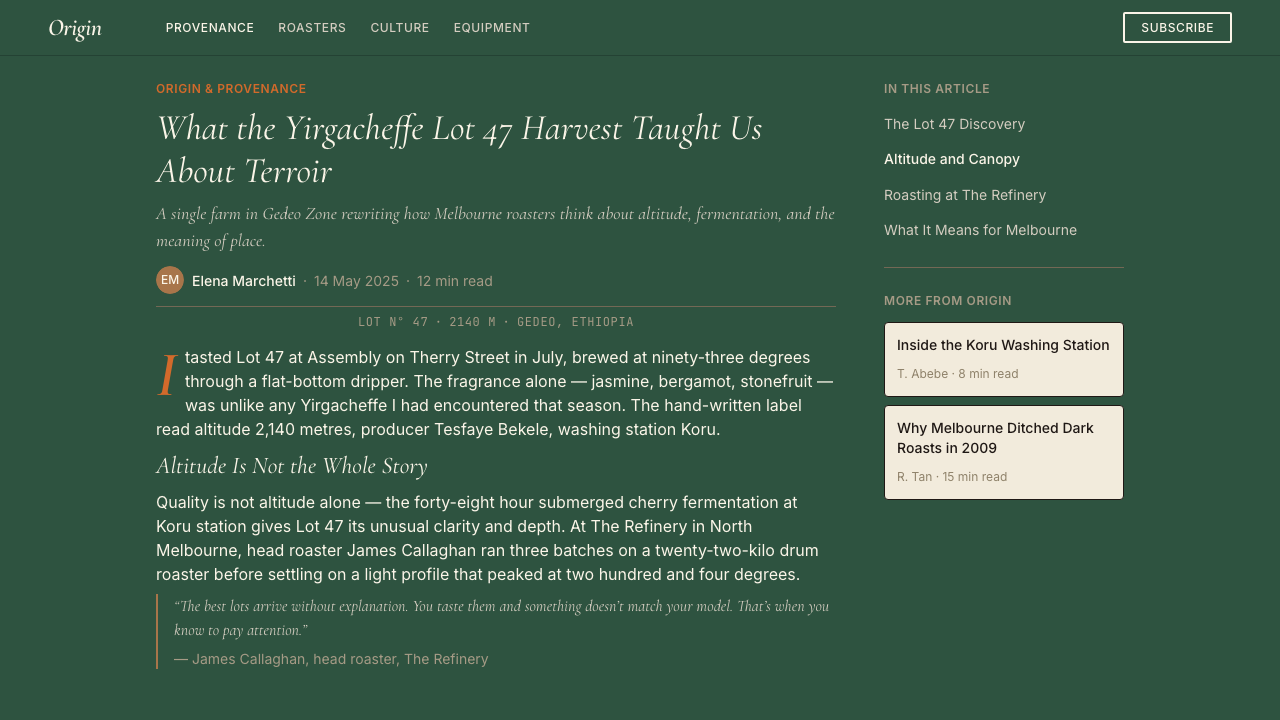
Where most consumer brand design hides complexity behind benefit statements, Melbourne Third-Wave Coffee Modern surfaces it. A retail bag or menu card might carry the farm name, the growing altitude, the varietal, the harvest date, the processing method, the cupping score, and the roaster's tasting notes — all set in carefully differentiated type that makes scanning efficient and reading rewarding. This commitment to specificity is itself an aesthetic statement: it communicates expertise, respect for the producer, and the confidence that the audience is literate enough to care about the difference between a washed Ethiopian and a natural Colombian.
Restraint and Anti-Trend Posture
The style is notably resistant to the visual trends of the mainstream branding industry. At the moment when rounded geometric logos and candy-bright palettes dominated venture-backed startups, Melbourne Third-Wave Coffee Modern remained committed to organic irregularity, muted tones, and serif formality. This anti-trend posture is not conservative — it is a value statement. The style signals that the work is not trying to appeal to the widest possible audience but to the right audience: people who slow down enough to read a tasting note and are put off rather than attracted by visual noise.
Who shaped Melbourne Third-Wave Coffee Modern?
Co-founder of Seven Seeds in Carlton and Market Lane Coffee, Dundon was instrumental in establishing the warehouse-as-tasting-room format that gave Melbourne's third-wave scene its signature spatial and visual grammar. Seven Seeds' print identity — spare, typographically rigorous, and firmly rooted in provenance detail — became a widely referenced template for specialty-coffee branding not only in Melbourne but internationally. His approach treated the café as an educational institution as much as a hospitality venue, and the design system reflected that seriousness.
Creative director behind St. Ali in South Melbourne, Scheltus brought an editorial intelligence to specialty-coffee design at a period when the category was still largely using commodity packaging conventions. His approach to the St. Ali identity — layered, reference-dense, and visually confident — demonstrated that coffee branding could sustain the same visual ambition as independent magazine publishing, and he helped position Melbourne's scene as a place where design was itself part of the product.
A graphic designer who became closely associated with the botanical illustration strand of Melbourne's coffee aesthetic, Holden helped establish the precedent of commissioning original naturalist illustration as an alternative to photography for coffee packaging and in-café signage. His work demonstrated that the high production values associated with fine-art publishing could translate directly into the specialty-food and beverage sector, and it contributed to the normalization of illustration as a premium signal within the category.
Founder of multiple Melbourne venues including Sensory Lab and St. Ali, Malatesta demonstrated that the third-wave aesthetic could be deployed at scale without becoming formulaic. His venues maintained the visual language's sense of craft and restraint while achieving commercial scale, and his influence extended to the staff culture and training materials that became part of Melbourne's broader hospitality design conversation. The consistency of his brand application across multiple sites helped prove the system's robustness as a transferable visual identity.
Rather than a single named designer, Market Lane's visual identity was developed collaboratively, and its consistency over more than a decade made it one of the most studied examples of the style. The Market Lane system — restrained serif type, kraft packaging, botanical line illustration, and a commitment to naming every farm on every bag — functioned as a worked example of how information density and visual restraint could coexist productively, and it influenced the standard of transparency documentation across the Australian specialty-coffee industry.
How do you use Melbourne Third-Wave Coffee Modern today?
Melbourne Third-Wave Coffee Modern transfers well to any context where the brand's credibility rests on demonstrated expertise, careful curation, and honest sourcing — rather than on lifestyle aspiration or status signalling. The style works because it communicates a specific set of values: we know where this comes from, we care about the details, and we trust you to care too. Applied correctly, it creates the feeling of being handed something by someone who really knows what they're doing.
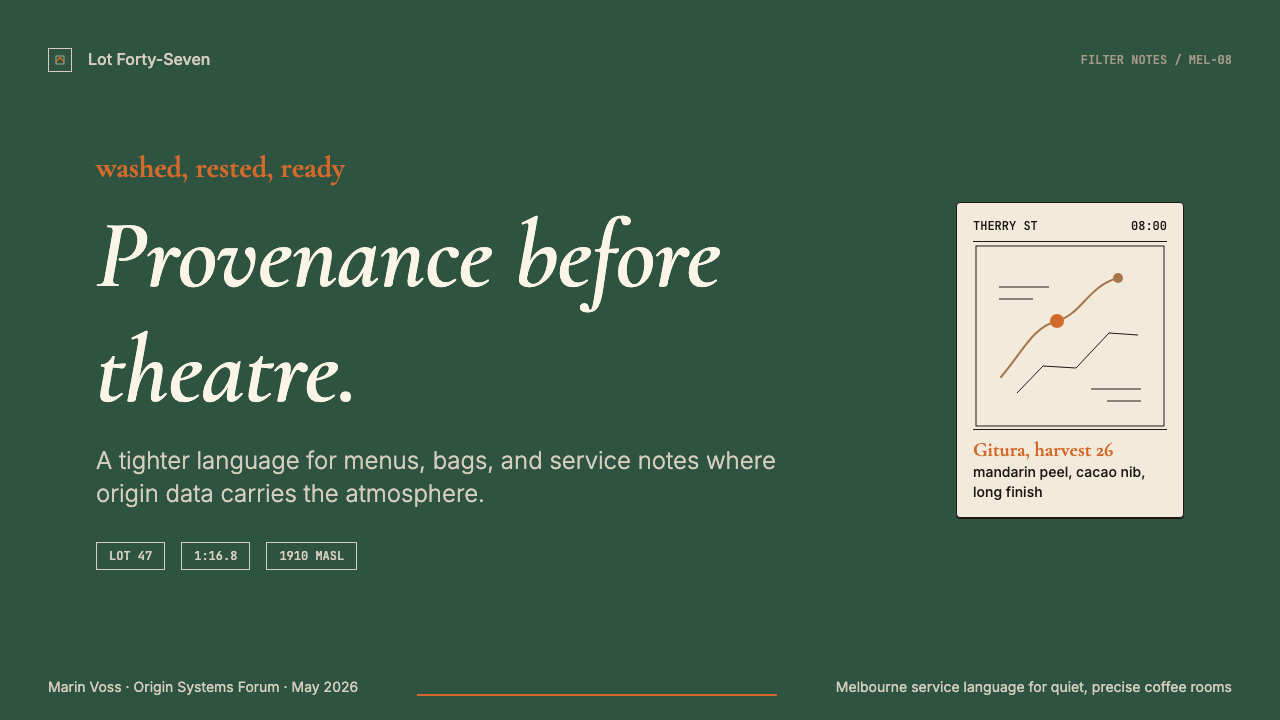
For presentation slides, the style suits cover pages built around a single strong typographic statement: a name, a provenance line, a season or date — set in a serif face against a warm cream or textured ground, with generous empty space carrying at least as much visual weight as the type itself. Content slides should be treated as curated information rather than projected bullet lists: use ample white or cream space, set body text unhurriedly in a readable serif, and reserve italic for annotations and qualitative asides. Data slides can adopt the naturalist illustration palette — replacing generic chart colors with the style's muted greens, warm browns, and pale golds — to maintain visual coherence without sacrificing readability.
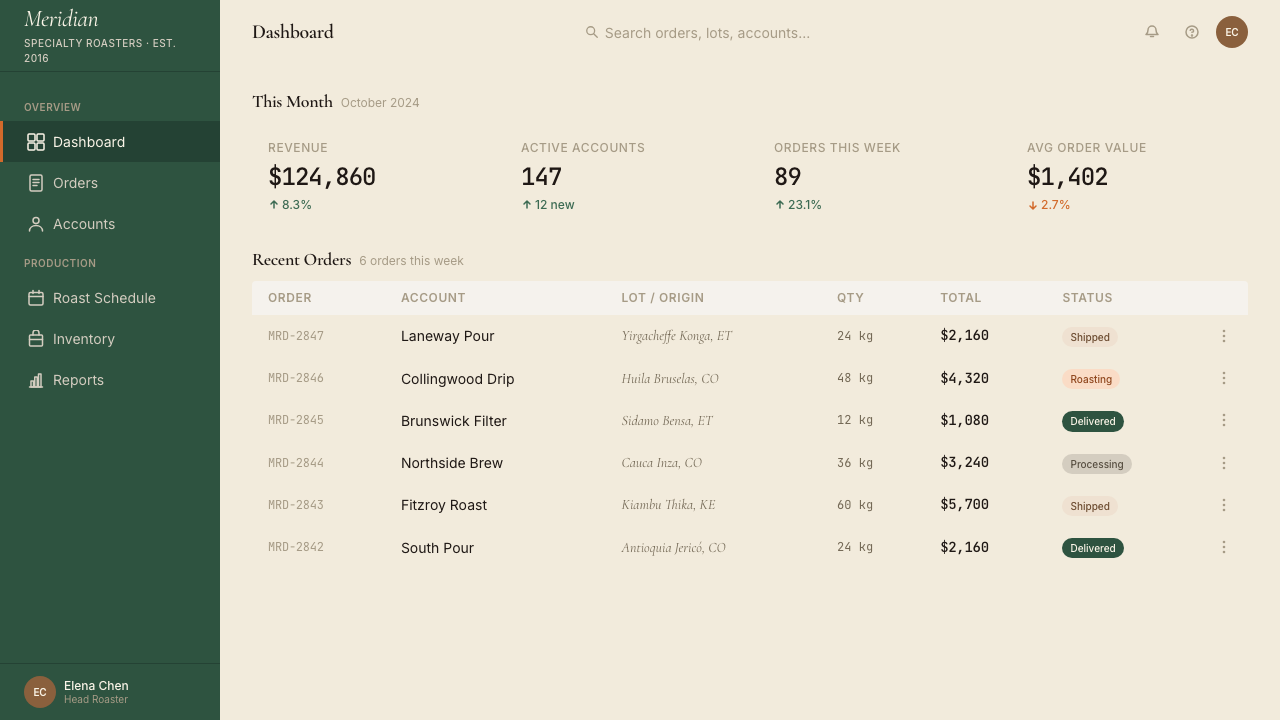
For web and digital product design, the style is particularly suited to dashboards where information density must coexist with calm readability: farm-to-table delivery platforms, natural wine subscription interfaces, wellness tracking tools, and any product category where the user's trust depends on visible evidence of care and specificity. Use a slightly warm or tonal background rather than pure white; keep body type in a legible serif at a comfortable reading size; reserve the eucalyptus green for primary interactive states and confirmations; and use negative space generously — the temptation to fill mobile screens with content should be resisted in favor of a layout that breathes. For pricing pages, lean on the typographic contrast between the serif detail font and a clean sans-serif for numbers and tier names.
For editorial and marketing work — brand books, lookbooks, product stories, social content — the style rewards a slow, considered pace of disclosure. Open with the origin: where, when, by whom. Let the botanical illustration or a detail photograph carry the visual weight on opening spreads. Introduce the product through specificity: not 'ethically sourced' but 'washed, 1,900 metres, Yirgacheffe.' Marketing copy should be written in the same register as the design — precise, unhurried, trusting. The most effective social content in this visual system is the single beautifully set provenance card: a farm name, a region, a harvest note, and nothing else.
A common mistake is applying the palette without the restraint. Eucalyptus green is a quiet color that depends on its partners — the warmth of cream, the weight of deep brown, the openness of negative space — to register properly. Saturating a layout with green, or combining it with competing accent colors, collapses the system's careful calibration. Similarly, the style's affection for serif type does not mean mixing multiple serif families: the warmth comes from depth within a single well-chosen face at multiple weights and cuts, not from variety for its own sake. The other common error is irony: this is a style that means what it says, and any hint of pastiche or knowingly retro application undermines the sincerity that is its entire foundation.
Melbourne Third-Wave Coffee Modern — FAQ
Is this style only appropriate for food and beverage brands?
No, though it originated there. The underlying values — provenance transparency, demonstrated expertise, honest materiality, restrained palette — transfer effectively to any brand whose credibility depends on the audience believing that real care and knowledge went into making the product. Natural cosmetics, independent publishing houses, craft textile producers, small-batch architectural materials, farm-to-table software tools for agriculture — all of these have been successfully expressed in this visual language. What the style cannot carry is a brand that is fundamentally about aspiration, luxury status, or mass-market accessibility. It is a style for specificity, not for everyone.
How does this style relate to Japanese minimalism and Scandinavian design?
Melbourne Third-Wave Coffee Modern is a hybrid that consciously synthesises both traditions without being reducible to either. From Japanese aesthetics it takes the comfort with asymmetry, the preference for materials that age gracefully, and the conviction that restraint is an active rather than a passive quality — something you choose and maintain, not simply the absence of decoration. From Scandinavian design it takes the editorial rigour: the commitment to legible typographic hierarchy, the trust in the grid as an organisational structure, and the sense that good design should be a background condition of daily life rather than a statement. The Melbourne contribution is the frank materiality — an Australian directness that says: this is what it is, no more, no less.
Can the style work in a dark-mode or dark-background application?
With care, yes — but it requires recalibration rather than simple inversion. The canonical form of the style is light-ground: warm cream or off-white is fundamental to its sense of material warmth and the legibility of fine serif type. A dark inversion risks losing both. If a dark variant is necessary, the approach that works best is to treat the background as deep, warm charcoal or near-black rather than true black, preserve the eucalyptus green as an accent rather than a ground, and ensure the serif type is large enough and well-spaced enough to remain legible at low contrast. The botanical illustration strand of the style is particularly vulnerable to dark inversion — fine line work typically needs a light ground to breathe.
What distinguishes an authentic application from a superficial imitation?
The most reliable distinguishing test is specificity. Authentic Melbourne Third-Wave Coffee Modern carries real information at its core: the design exists to make knowledge legible, not to perform the appearance of knowledge. An imitation typically borrows the palette, the serif type, and the kraft texture, but deploys them around generic benefit language — 'artisan', 'crafted', 'small-batch' — rather than around actual provenance data, real producer names, and genuine sourcing specifics. The other tell is restraint: authentic work resists the urge to add one more element, one more accent, one more flourish. The hardest discipline in this style is knowing when to stop.
How does the style handle photography versus illustration?
The style uses both, but they serve different functions. Photography is typically deployed for immediacy and environmental evidence: the texture of a coffee cherry, a portrait of a producer, the morning light on a warehouse floor. It tends toward the restrained and documentary rather than the styled and aspirational — natural light, minimal post-processing, compositions that feel observed rather than constructed. Illustration — particularly the botanical and naturalist strand — is used for information that benefits from the precision and legibility of the drawn line: the anatomy of the coffee plant, a map of the growing region, the range of varietal shapes. The two can coexist in the same system provided each is used for its appropriate purpose, but illustration is the more distinctive and harder-to-imitate element of the style.
Related design styles
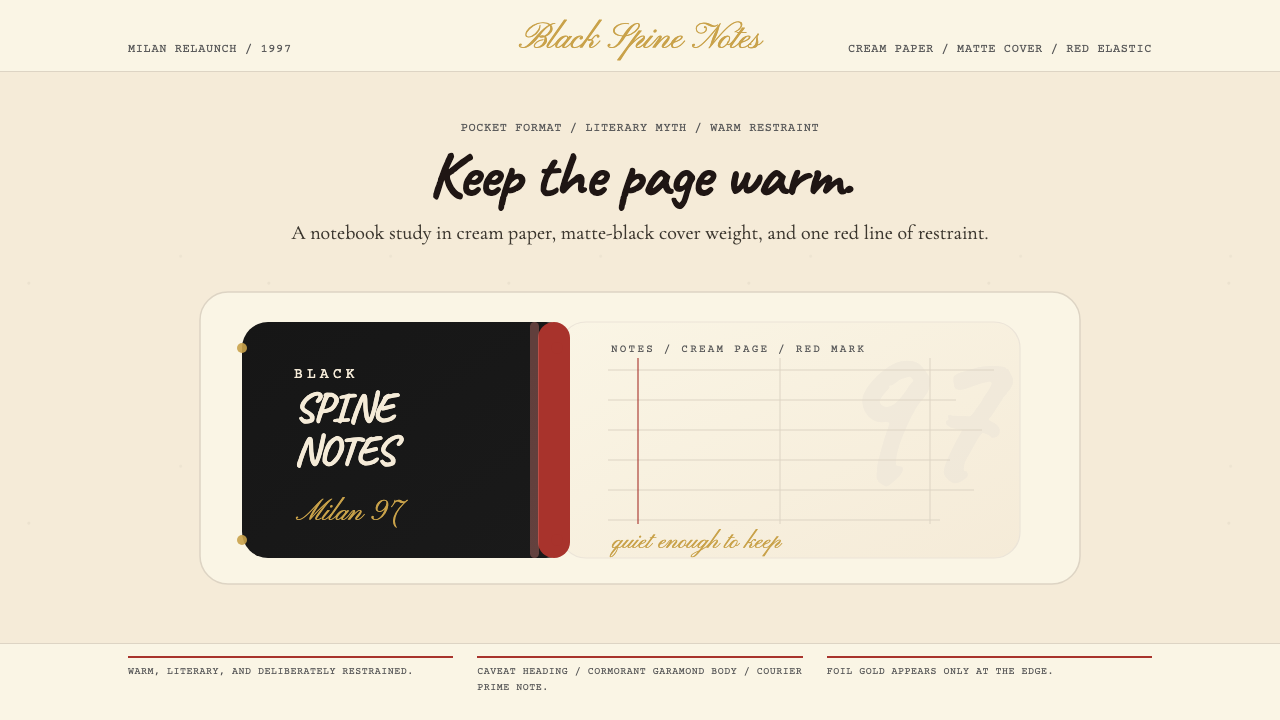 Moleskine Sketchbook (1997)Quietly literary. Cream paper, matte black, and a red elastic stripe do the w…
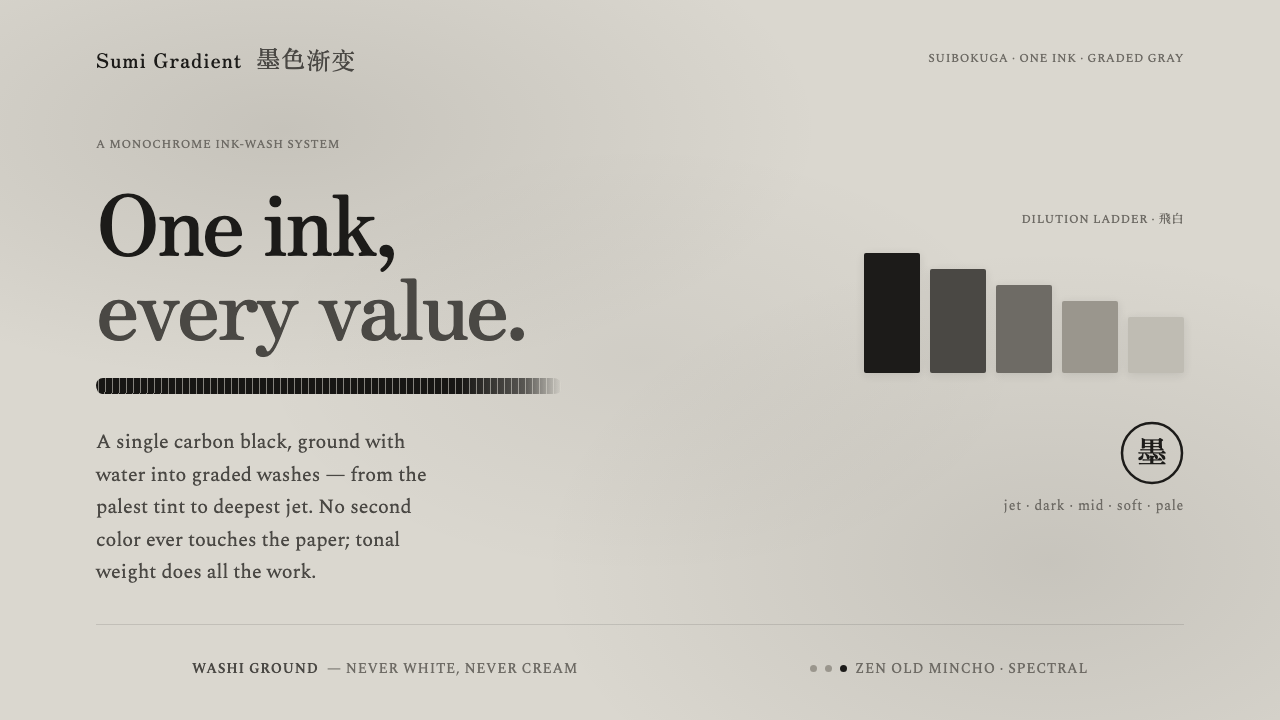 Sumi Grayscale GradientOne ink, every value. A single carbon black diluted into graded grays, marked…
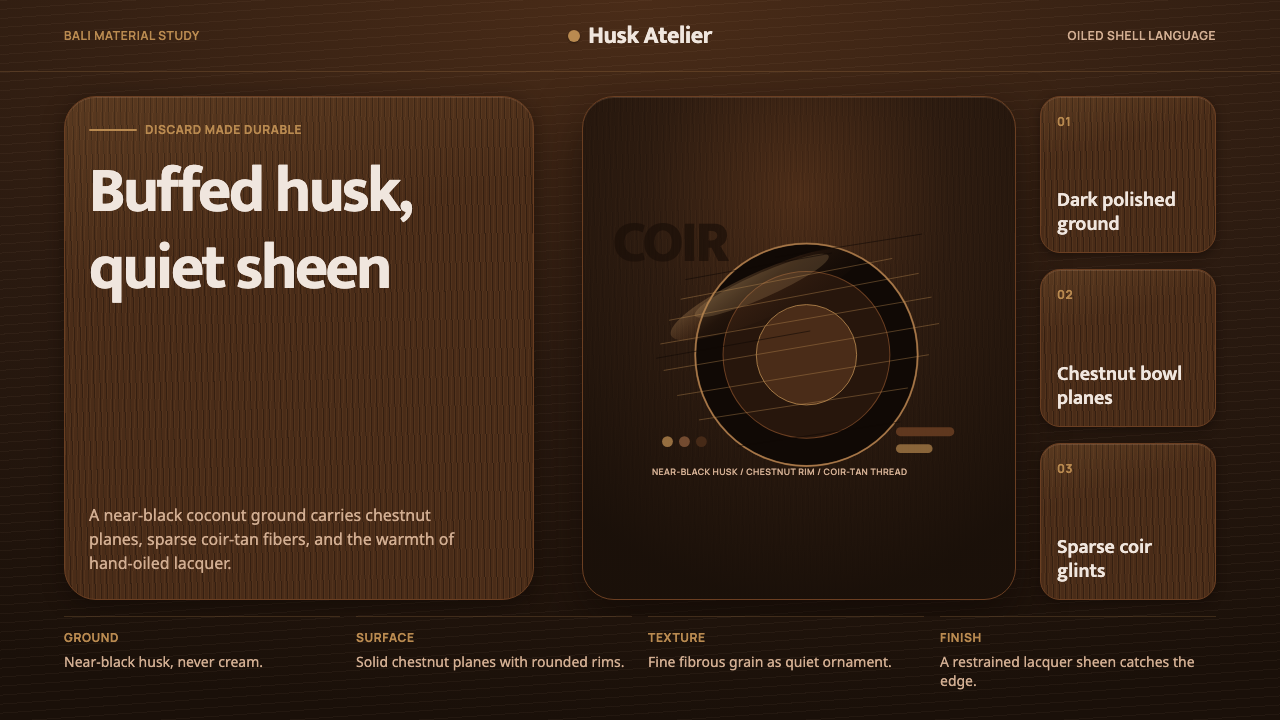 Balinese Coconut ShellQuietly hand-oiled. Near-black husk, chestnut planes, and sparse coir-tan gra…
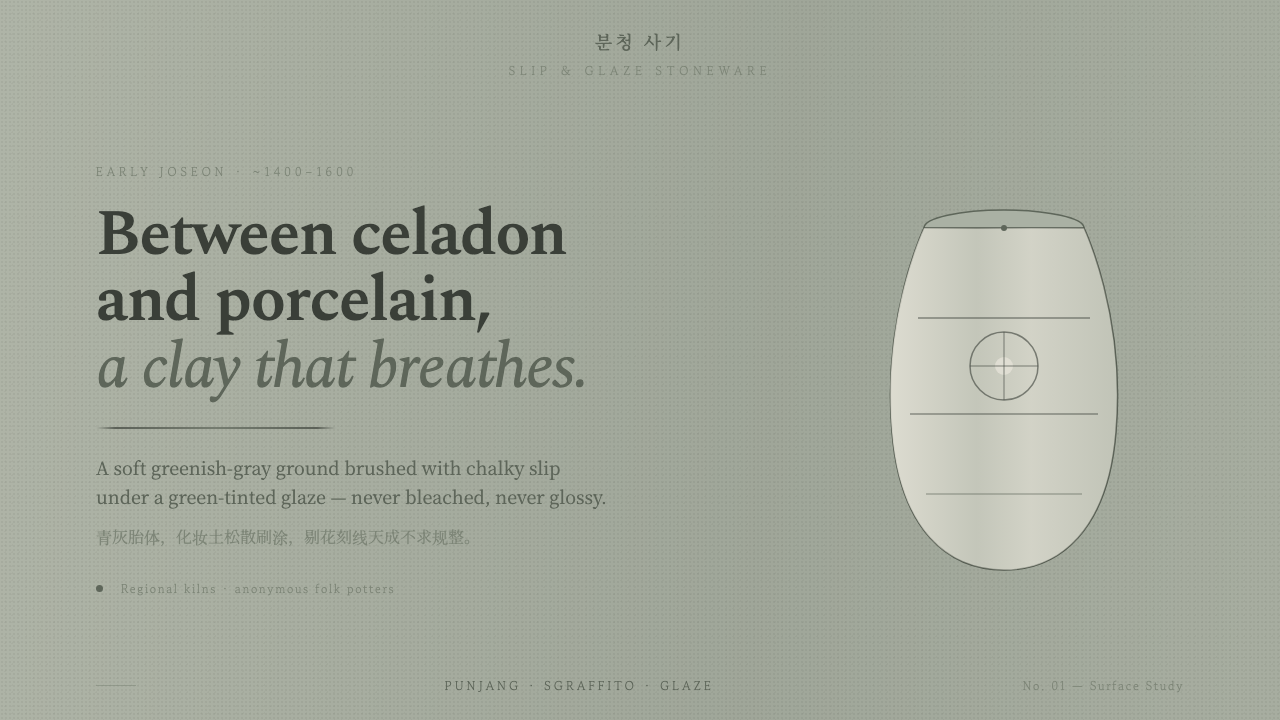 Buncheong Gray Slip WareBetween celadon and porcelain. Greenish-gray clay, chalky slip brushwork, dar…
 Czech Prague Modernist Cafe (2020)Quietly assured. Pine green, cream hairlines, amber Cubist tiles, and literar…
 Estonian Haapsalu Lace ShawlQuiet craft, held in silver light. Cormorant type meets nupp dots and velvet…