What is Czech Prague Modernist Cafe (2020)?
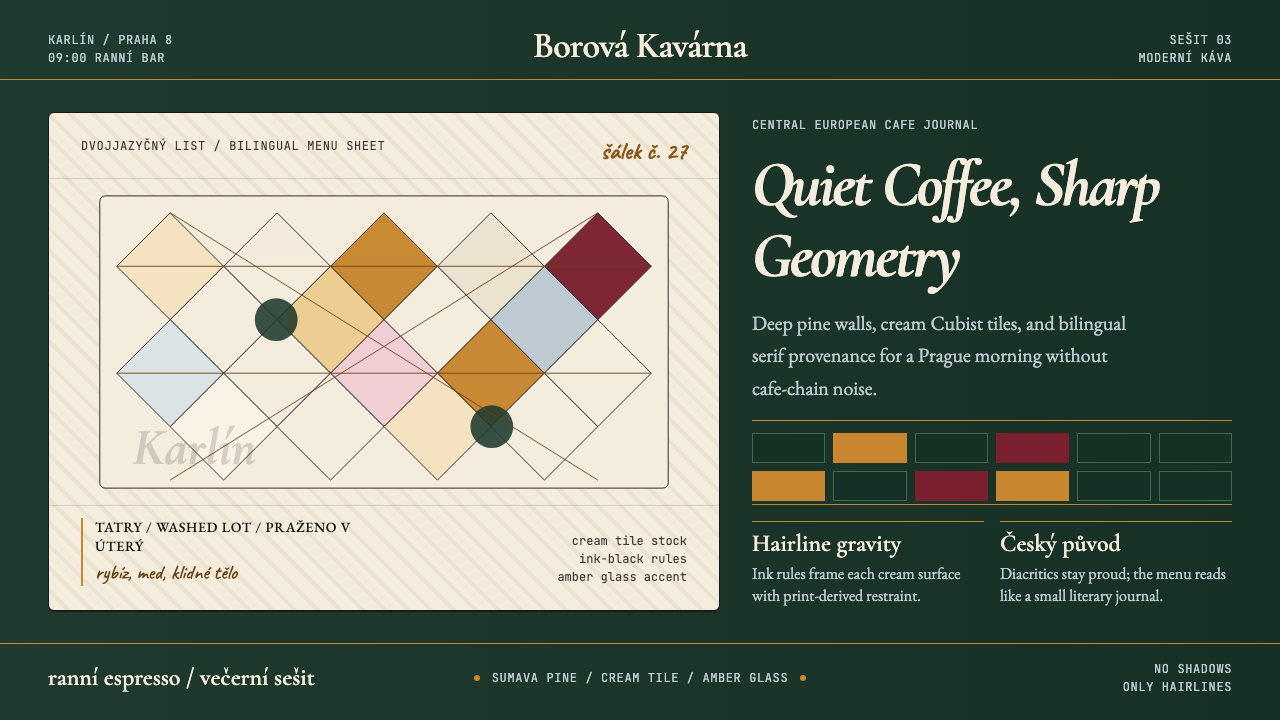
Prague's third-wave cafes distilled a century of Bohemian-Cubist geometry and Central European editorial craft into a quietly commanding visual language with no latte-art clichés in sight.
Czech Prague Modernist Cafe (2020) in brief
Czech Prague Modernist Cafe is a visual design system that emerged from the specialty coffee culture of Prague in the years around 2020, consolidating a distinctive aesthetic that had been taking shape through the Karlín neighborhood cafe boom of the late 2010s. It draws on two deep wells: the Bohemian-Cubist architectural tradition — unique to Czech lands — and the editorial graphic design lineage descended from the Devětsil avant-garde of the 1920s. The result is a design language that feels simultaneously rooted in place and rigorously contemporary.
Visually, the style is organized around a palette of deep Šumava pine-green, warm cream, ink-black, and Czech-glass amber. Surfaces are structured by hairline rules rather than shadows, Cubist-tile geometry replaces organic ornament, and serif typography carries the quiet authority of a literary magazine rather than the friendly cheerfulness of mainstream coffee-chain branding. Everything about the system communicates confidence without loudness — the visual equivalent of a perfectly pulled espresso served without explanation.
The system is not nostalgia. It acknowledges the Cubist and Constructivist heritage of Czech design while translating that heritage into the requirements of a contemporary digital and print context. Bilingual Czech-English copy is treated as a design element in its own right, and the kraft-paper grain that grounds physical menus and packaging brings a tactile intelligence that distinguishes handmade from hand-crafted.

Where does Czech Prague Modernist Cafe (2020) come from?
The story begins with Czech Cubism itself — a movement that existed almost nowhere else in the world. In the years just before and after 1910, architects and designers in Prague developed a distinctive interpretation of Cubist painting principles into three-dimensional form. Architects such as Josef Gočár and Pavel Janák applied prismatic faceting and angular crystalline geometry to building facades, furniture, ceramics, and decorative objects. The result was an architecture and applied arts movement of unusual specificity: the angular volumes, the diamond-shaped tile patterns, and the amber and cream palette are intrinsically Bohemian, with no direct parallel in French or German modernism.
The second root is the Devětsil avant-garde of the 1920s, led by the designer, typographer, and theorist Karel Teige. Teige championed what he called Poetism — a Czech synthesis of Constructivism, Surrealism, and lyric poetic sensibility — and developed a typographic practice of considerable editorial sophistication. His covers for literary journals combined geometric layouts, bilingual captions, and fine serif letterforms in a way that was simultaneously rigorous and warmly literary. This tradition of editorial intelligence flowing through coffee-table culture and literary café society became a defining characteristic of Prague's intellectual self-image across the twentieth century.
The modern Prague specialty coffee scene began emerging seriously around 2010, initially in response to the third-wave movements in Scandinavia and the United Kingdom. But it quickly developed its own local inflection. The Karlín district — historically an industrial and working-class quarter that was being redeveloped after the 2002 floods — became the center of gravity. Cafes opening in Karlín from around 2015 onward found themselves inhabiting spaces with raw brick walls, industrial ceilings, and occasionally surviving Cubist-era tile details. The design response was to engage directly with this material context rather than overlay a generic third-wave aesthetic.
By 2018 to 2024, the visual system had consolidated into something recognizable and specific: deep green walls, hairline typography, amber-accented surfaces, bilingual serif menus that read like exhibition catalogue copy, and a complete absence of the chalk-board cheerfulness that characterized the international third-wave cafe look. Designers including Pavel Holub, Tatiana Tomšů, Adam Neubauer, and Tomáš Pražák worked across multiple Karlín and Prague venues, creating enough consistency across independent projects for a coherent style to emerge. The system is not the product of a single studio or a manifesto; it is a collective visual response to a specific place and cultural moment.
What defines the Czech Prague Modernist Cafe (2020) look?
Color Palette
The palette is anchored by a deep, forested green — the color of Šumava pine-tree shadow rather than moss or sage — deployed as the dominant wall or background tone. Against this, warm cream surfaces carry body text and fine detail. Czech-glass amber appears as an accent, referencing the mineral-rich glass tradition of Bohemia, and tends to catch light rather than fill areas. Ink-black handles wayfinding, borders, and all typographic hierarchy. Together, these four tones create a system that reads as neither warm nor cold but as settled and specific — a palette that could only come from one place.
Typography
Serif type is the editorial backbone of this system — a deliberate inversion of the clean sans-serif uniformity that dominates global third-wave cafe branding. The serifs chosen are literary in character: the kind of letterform associated with Central European publishing rather than with corporate efficiency. Text is typically set with generous leading and a measured line length, giving menus and printed matter the unhurried quality of a journal read over a second espresso. Bilingual Czech-English setting is treated as a design asset rather than a practical compromise, with the two languages often stacked or paired in ways that create their own quiet typographic rhythm.
Hairline Rules and Cubist Geometry
Where other design systems use shadow or color fields to separate areas, this system uses hairline rules — strokes so fine they read as precision rather than structure. These hairlines are used for table borders, sectional dividers on menus, and the organizational grid of printed pieces. The Cubist geometry enters as tile motifs, angular cropping, and faceted surface treatments inspired by the prismatic decorative vocabulary of Czech Cubist ceramics and building facades. Diamond and triangular tessellations appear in background textures and decorative frames, always restrained and never dominant.
Kraft and Material Texture
A distinguishing feature of the physical manifestation of this style is the use of kraft-paper grain and uncoated stock as the ground for print materials. Rather than the glossy lamination common in luxury restaurant branding, menus and packaging sit on surfaces that age visibly and carry a slight roughness to the touch. This material choice is not accidental: it grounds the system in honest craft, signals provenance and quality over spectacle, and creates a tactile counterpoint to the visual precision of the hairline typography. The grain also acts as a gentle texture in digital translations of the style.
Measured Restraint
Perhaps the most difficult characteristic to imitate is the system's complete refusal of demonstrative gestures. There is no illustrative photography of coffee being poured, no brand mascots, no calligraphic script, and no gradient warmth added to soften the palette. Negative space is used generously and purposefully — menus breathe, labels hold their quiet, and nothing competes for attention that has not earned it. This restraint is not coldness: the palette and material choices maintain a sensory warmth. It is, rather, a form of editorial confidence — the assurance of a publication that does not need to shout its own quality.
Wayfinding and Ink-Black Precision
Signage and wayfinding elements within this aesthetic system are treated with the same editorial gravity as the printed menus. Ink-black letterforms on cream or green grounds, set in the same literary serif used for menus, carry café names, directions, and menu categories with a precision that avoids both the clinical neutrality of modernist sans-serif wayfinding and the nostalgic warmth of vintage lettering. The system assumes a visitor who reads carefully rather than scans quickly — an assumption that is itself a statement about the kind of experience being offered.
Literary Bilingualism
Bilingual Czech-English copy is not a concession to tourism but a structural design decision that runs through the entire system. Menu descriptions, origin notes about Tatra-mountain beans, and café naming conventions all exist in both languages, and the typographic system is designed to hold two languages with equal visual dignity. This bilingual character places the system in a specifically Central European intellectual tradition — the literary café as a space where multiple languages and cultures coexist without hierarchy.

Who shaped Czech Prague Modernist Cafe (2020)?
Teige (1900–1951) was the intellectual and typographic engine of the Devětsil movement and the single most important antecedent for the editorial sensibility that characterizes the Prague modernist cafe aesthetic. As a designer, critic, and theorist, he produced layouts for literary journals and avant-garde publications that combined strict geometric composition with fine serif letterforms and bilingual captions — a template that would lie dormant for half a century before being revived in the Karlín cafe scene. His concept of Poetism — a synthesis of Constructivist rigor and lyric warmth — anticipates precisely the quality that distinguishes this style from generic Scandinavian minimalism.
Gočár (1880–1945) was the architect most responsible for giving Czech Cubism its distinctive applied identity. His House of the Black Madonna (1911–1912) in Prague's Old Town remains the most celebrated example of Cubist architecture in the world — a building whose prismatic facade, angular cornices, and diamond-tile staircase created a visual vocabulary that became foundational to Czech design identity. The amber, green, and cream palette of the Prague cafe style, and particularly its Cubist-tile surface treatments, descend directly from the material and geometric language that Gočár and his contemporaries developed in the first two decades of the twentieth century.
Holub is among the contemporary Prague graphic designers most closely associated with the visual identity of the Karlín specialty coffee scene. Working across cafe branding, menu design, and environmental graphics in the 2015–2024 period, his work helped establish the specific combination of literary serif typography, hairline rules, deep-green grounds, and bilingual editorial copy that distinguishes the Prague modernist cafe aesthetic from both generic Scandinavian third-wave design and from nostalgic Czech folk-revival styles. His practice represents the living connection between the historical Devětsil tradition and current cafe culture.
Tomšů brought a strong editorial sensibility to the Prague specialty coffee visual scene, with work that emphasizes the literary and cultural positioning of the cafe as an intellectual space. Her approach to menu design and printed collateral treated the document as a publication in the tradition of Central European literary reviews — typographically precise, editorially considered, and designed to be read at leisure rather than scanned for information. This editorial framing, applied to the context of a contemporary espresso bar, is one of the defining moves that gave the Prague modernist cafe style its particular cultural gravity.
Neubauer's contribution to the Prague cafe visual scene lies in his attention to material consistency — the way a design system must hold together across printed menus, environmental signage, packaging, and digital touchpoints without losing its essential character in any translation. His work across multiple Karlín venues demonstrated that the Prague modernist cafe aesthetic was not a single commissioned identity but a reproducible and transferable system with its own internal logic. This consistency across multiple independent projects is what allowed the style to be recognized as a movement rather than a house style.
How do you use Czech Prague Modernist Cafe (2020) today?
Applying the Prague modernist cafe style correctly requires understanding that it is a system of restraint and editorial hierarchy, not a mood board of green walls and amber accents. The visual language works because every element has been selected for a reason and every absence has been chosen deliberately. Adding decorative warmth, softening the hairline rules into thicker borders, or substituting a friendly rounded sans-serif for the literary serifs will not produce a variation of the style — it will produce a different style that merely borrows a color.
For presentation slides, the style translates most effectively when treated as a typographic system. Cover slides benefit from a single dominant tone — deep green or ink-black — with the title set in a sized-up version of the editorial serif, positioned off-center in a way that creates visual tension without abandoning structure. Content slides should hold the palette to two tones per slide, use hairline rules as organizational dividers, and allow substantial negative space around text blocks. Data slides work well when charts are treated as geometric objects that belong to the same visual family as the Cubist-tile motifs — angular bar charts, tight circle elements, and a color coding that draws from the amber, green, and black palette rather than introducing external data colors.
For web interfaces, the style suits contexts where calm authority is the desired user experience — editorial platforms, cultural institutions, premium product catalogues, and specialty food-and-drink brands. Dashboards built in this language benefit from the hairline-rule grid system: columns separated by fine lines rather than background-color alternation, with amber used only for active states or key metrics. Pricing pages work well when type does the work of differentiation rather than color blocks or illustrated icons — set tiers in the same serif with scale and weight as the only differentiators. Navigation should be spare and typographic, using the full Czech-editorial confidence to resist the temptation of icon decoration.
For editorial design and marketing applications, the style provides a ready-made framework for premium positioning without resorting to generic luxury tropes. Article layouts benefit from generous margins and narrow text measure, with section breaks marked by hairline rules rather than ornamental dividers. Pull quotes can be set in a slightly enlarged version of the body serif, indented to create a typographic pocket rather than boxed in a colored panel. Marketing pages and campaign posters work well when a single tonal ground — green, black, or cream — anchors a full-width field, with the headline in the contrasting tone and amber reserved for a single call-to-action element or key visual accent.
A common mistake is reaching for the amber accent too freely. In the authentic system, amber functions the way Czech glass functions in architecture — as a material that catches and refracts available light rather than a paint color applied to fill areas. In digital terms, this means using amber for illuminated states, hover interactions, and key data points rather than as a background tone or a section-header fill. Similarly, the deep green should function as a ground, not as a pattern or repeating decorative element. Designers who scatter amber and green across a composition without establishing the cream-and-ink-black typographic armature first will produce something colorful but not something that carries the specific gravity of this system.

Czech Prague Modernist Cafe (2020) — FAQ
How does this style differ from generic Scandinavian third-wave cafe design?
The Scandinavian third-wave aesthetic typically uses a light, warm, organic vocabulary — natural wood, muted earth tones, casual hand-lettered scripts, and a general softness that signals approachability. The Prague modernist cafe style inverts almost every one of these choices: deep green rather than warm beige, literary serif rather than casual script, hairline rules rather than rough edges, and a systematic editorial precision rather than studied informality. Where Scandinavian cafe design suggests the domestic and the personal, the Prague style suggests the literary and the considered. Both are forms of restraint, but they are restraining different impulses.
Can this style work for a brand or product that has no connection to Czech culture?
Yes, but the application requires honesty about what you are borrowing. The Prague modernist cafe style is a system built on specific cultural and historical references — Czech Cubism, Devětsil typography, the literary cafe tradition of Central Europe — and applying it to an unrelated context means adopting the visual logic while detaching it from the source. What remains is still a coherent and sophisticated design system: the editorial serif, the hairline rules, the deep-green-and-cream palette, the amber accent. These translate effectively to any context that calls for calm authority, intellectual positioning, and craft-over-spectacle values. What will not transfer is the specific cultural resonance — and that is fine, as long as the designer is clear that they are working with a design vocabulary, not performing a cultural identity.
Is this a dark or light design system?
The canonical Prague modernist cafe aesthetic is light-ground: cream and warm white are the dominant surfaces, with ink-black typography and the deep green used as an accent or wall tone rather than as the primary field. This is consistent with the editorial tradition it descends from — Central European literary journals were printed on cream stock with black ink, not on dark grounds. A dark inversion is possible, using the deep green or ink-black as the primary background, but it requires careful management: the amber accent tends to carry too much visual weight on a dark ground, and the hairline rules need to be adjusted in weight to maintain readability. The light-ground version is more versatile and more historically grounded.
How should photography be handled within this design system?
Photography, when used at all, should be treated with the same editorial restraint as everything else. Images work best when they are tightly cropped to isolate a specific material detail — the surface of a Cubist tile, the pour of espresso into a ceramic cup, the grain of kraft paper — rather than as wide environmental shots of cafe interiors. Color treatment should bring the image into the palette rather than introducing external tones: a slight green cast or a warm amber tone-mapping will integrate photography more effectively than a neutral color balance. Avoid photography that foregrounds people in casual, approachable poses — this style assumes a contemplative rather than a sociable viewer. Architectural photography of Czech Cubist buildings is a natural and appropriate image source.
What is the difference between this style and Art Deco revival aesthetics?
The surface similarities — geometric ornament, jewel-toned accents, serif typography, and a sense of elevated craft — can make the two styles appear related, but their underlying principles are quite different. Art Deco is fundamentally celebratory and decorative: its geometry serves spectacle, its gold and amber tones signal abundance, and its typography tends toward elaborate stylization. The Prague modernist cafe style is editorial and restrained: its geometry is structural rather than ornamental, its amber is an accent rather than a dominant, and its typography favors legibility and literary character over stylistic display. Art Deco turns up the volume; the Prague style holds it at a conversational level. Both are confident, but confidence in Art Deco is expressed through accumulation, while in the Prague style it is expressed through selection.
Related design styles
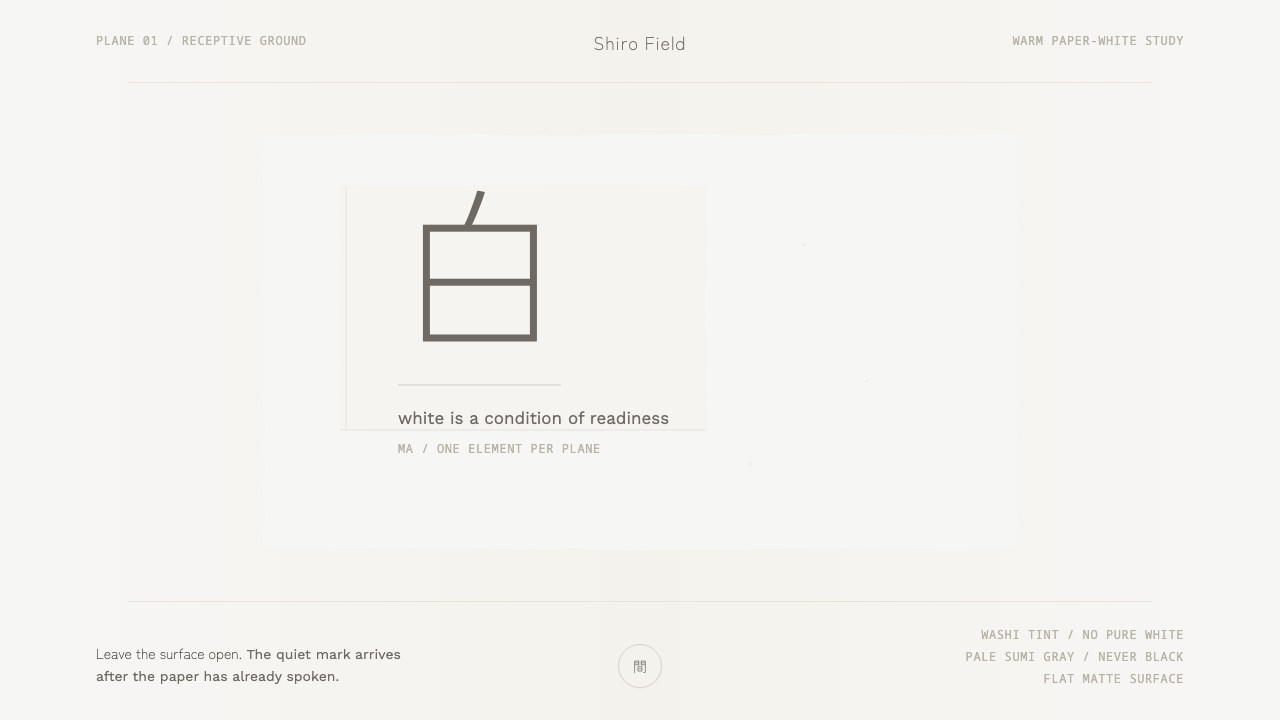 Kenya Hara «White»Emptiness is the subject. Warm washi white holds one pale sumi-gray mark.
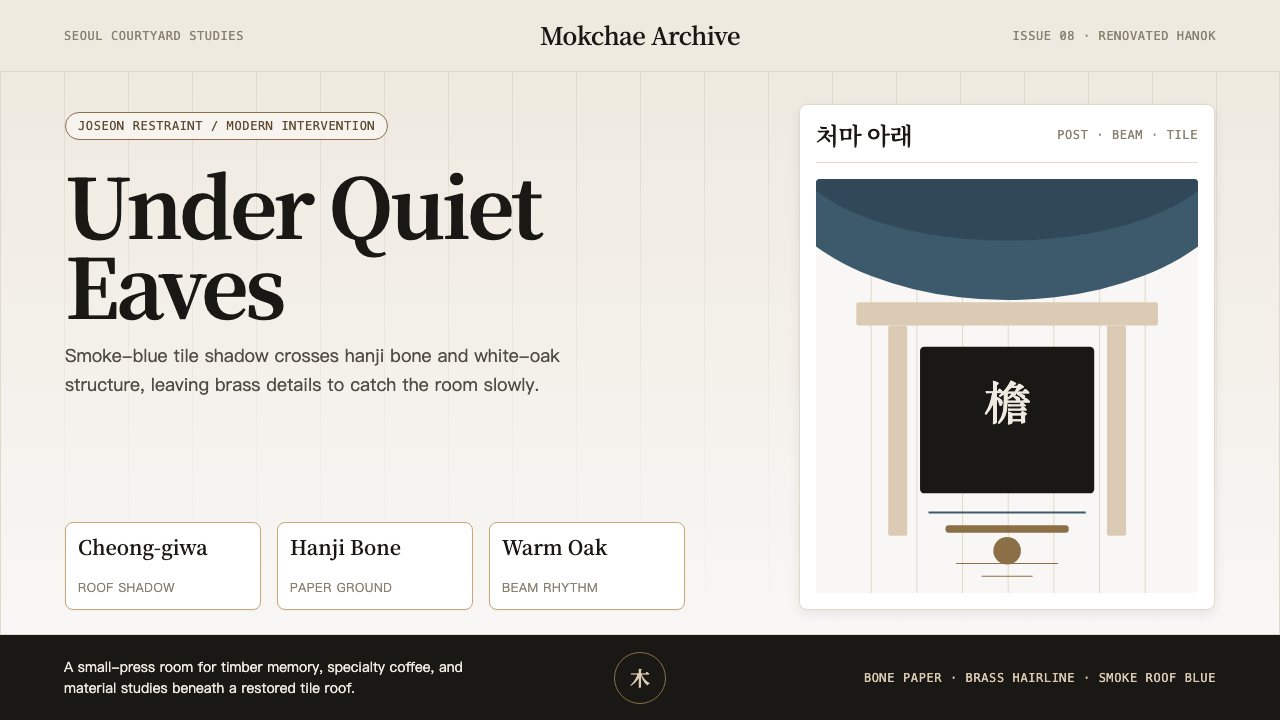 Korean Hanok Eaves RevivalJoseon restraint, not generic minimalism. Smoke-blue eaves cross hanji bone a…
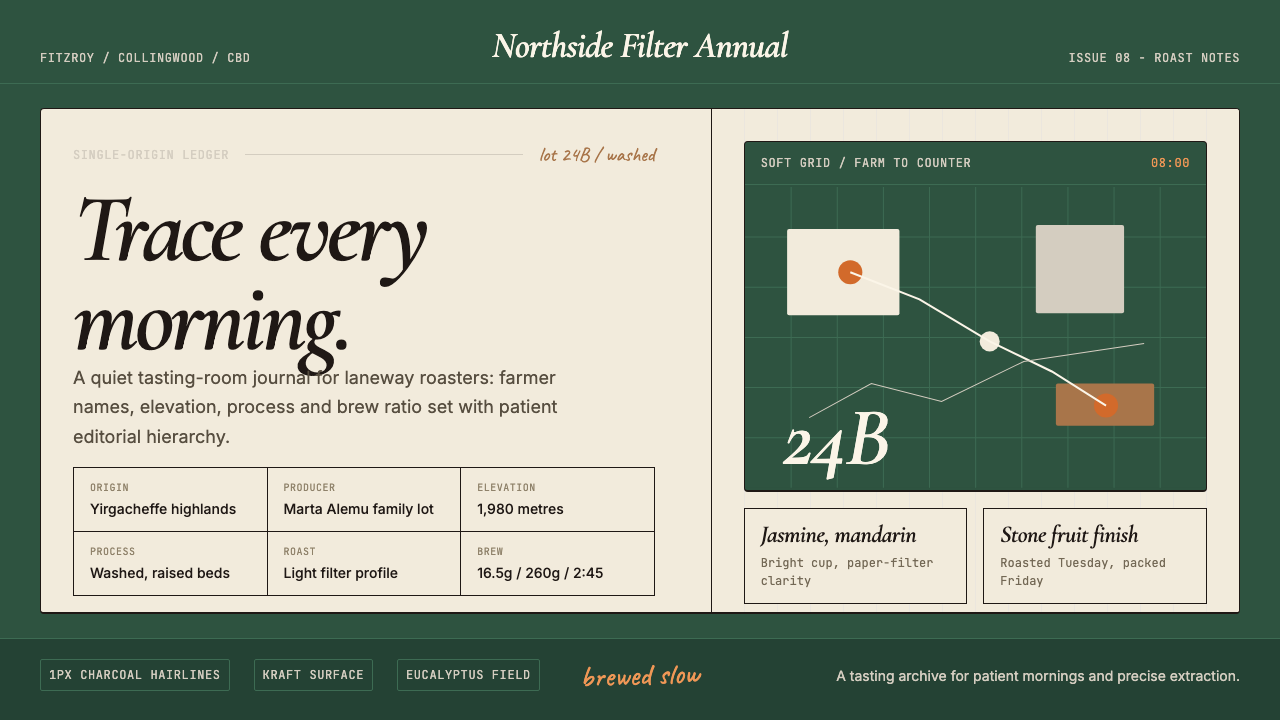 Melbourne Third-Wave Coffee ModernQuiet provenance. Eucalyptus green, cream cards and italic serif tables pace…
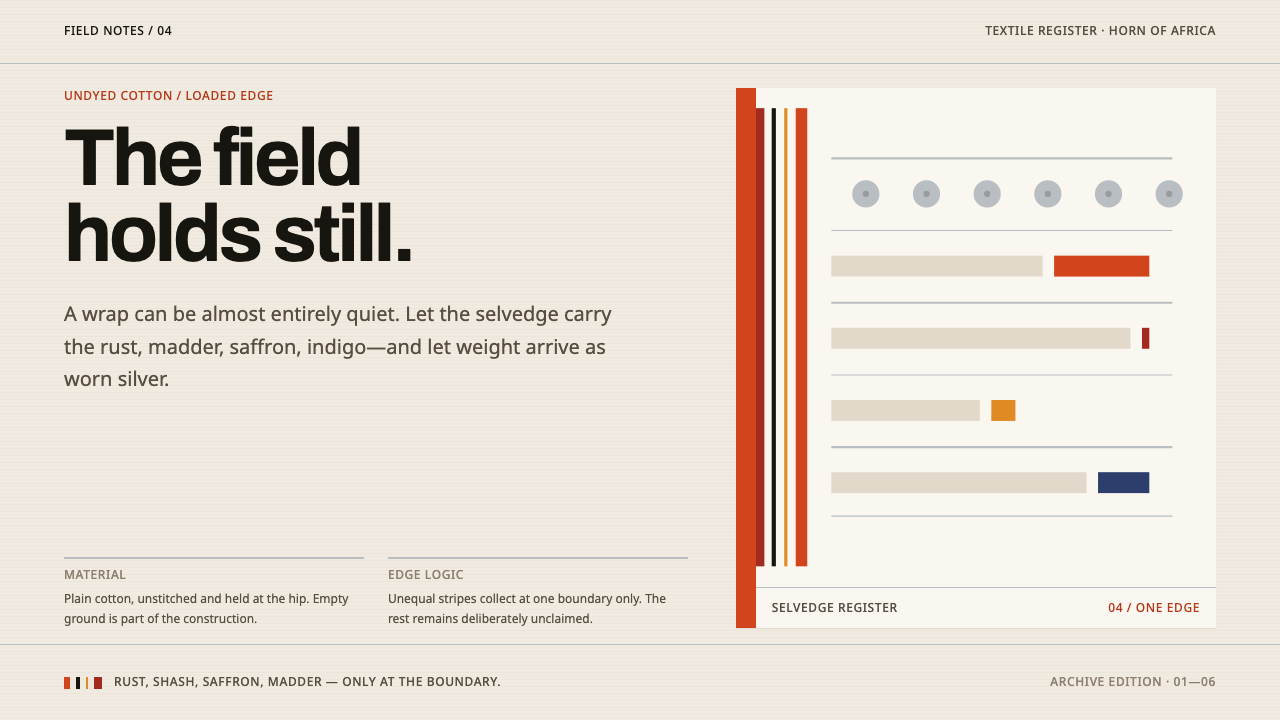 Afar Nomad TextileWeight lives at the edge. Rust and madder selvedges cut across a quiet cotton…
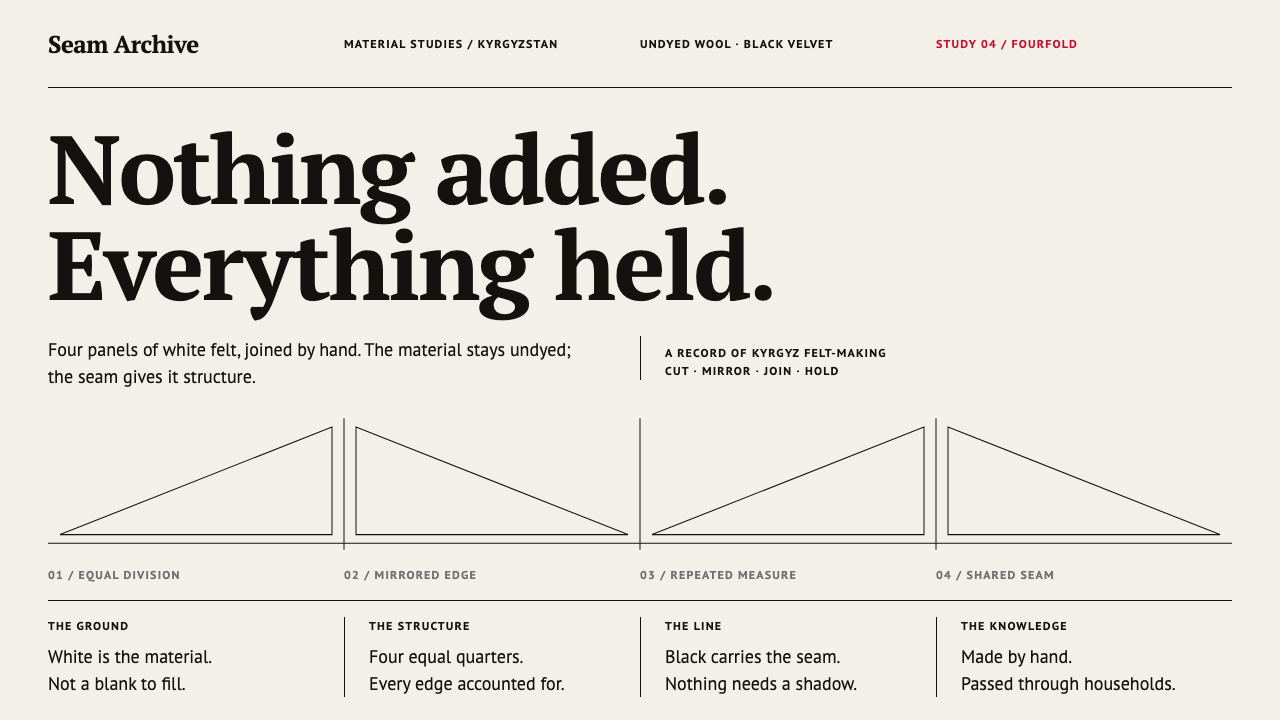 Ak-Kalpak Felt HatWhite does the work. Undyed felt tones, black hairline seams and four mirrore…
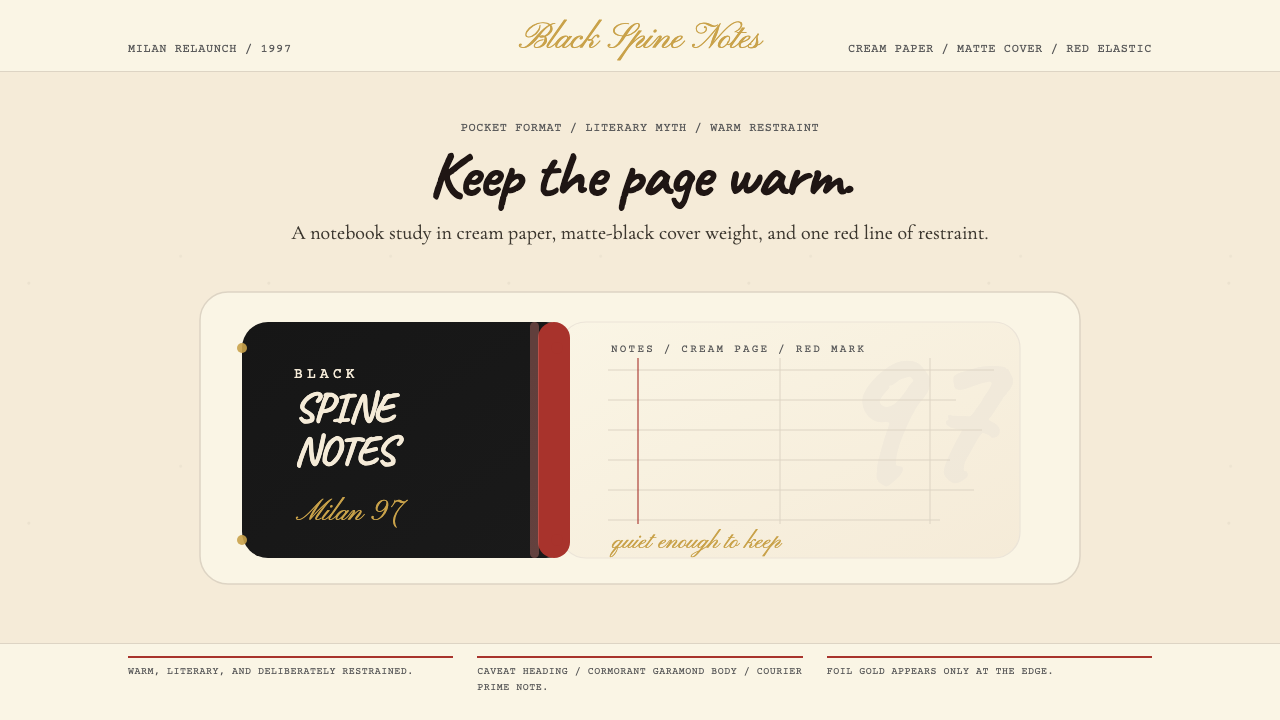 Moleskine Sketchbook (1997)Quietly literary. Cream paper, matte black, and a red elastic stripe do the w…