What is Moleskine Sketchbook (1997)?
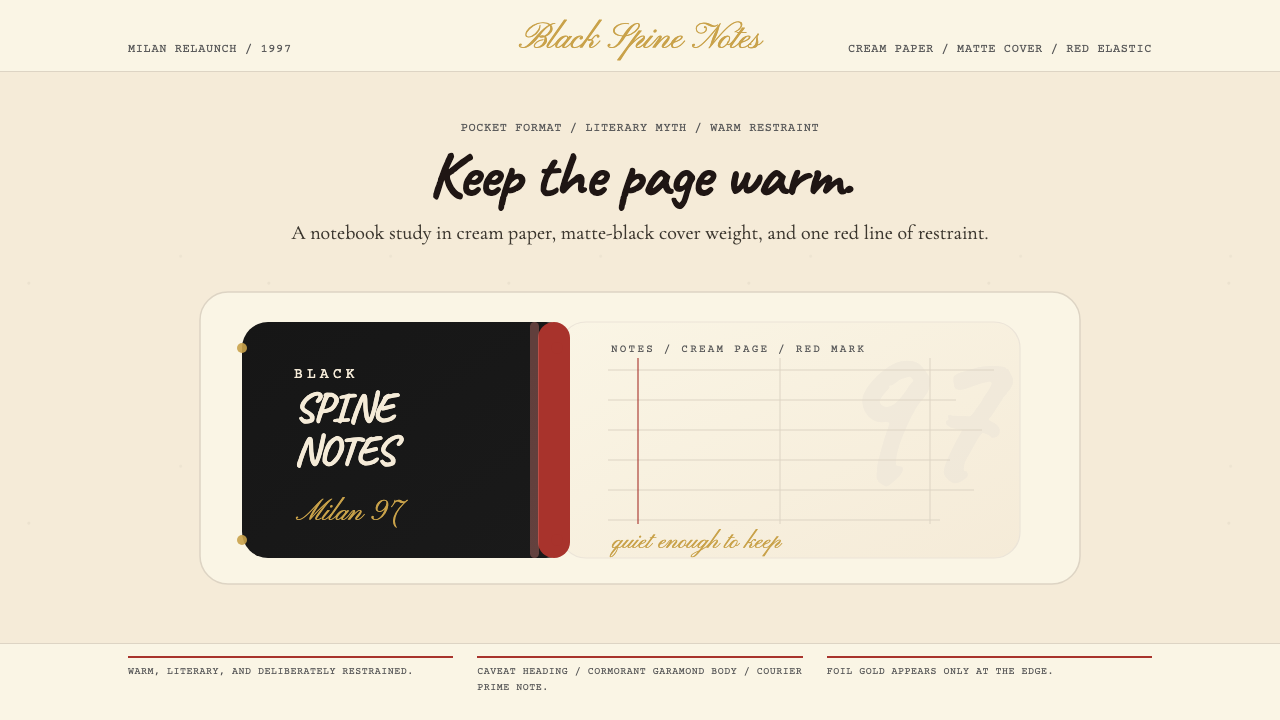
A matte-black hardcover, cream paper, and a red elastic band became the unlikely uniform of a generation of writers and artists who needed to believe their ideas were already worth keeping.
Moleskine Sketchbook (1997) in brief
The Moleskine sketchbook aesthetic is a distillation of the literary notebook as cultural object: warm cream grounds, a matte-black cover that absorbs light rather than reflects it, handwriting-inflected headline type set beside classical serif body text, and a single accent color — the red of an elastic band — that marks the corner of every composition. The result reads as quietly archival, as though each page were already a document of something that mattered.
Unlike typographic modernism, which announces itself loudly through geometry and primary contrast, the Moleskine system operates through restraint and warmth. Paper has texture and fiber-like character. Colors are muted and literary — cream and black as constants, with rust-red and aged-gold as accents rather than shouts. Typography mixes casual brushwork with old-style serif, signaling that intelligence and spontaneity coexist on the same surface.
The visual language carries an implicit promise: that the ideas recorded in this format are already part of a lineage that includes Hemingway, Picasso, and Chatwin. This is branding as mythology, and the design system is built to sustain the myth — every radius on a corner, every matte finish on a surface, every cream-on-black label reinforces the sense that the object has been used before, trusted before, and returned to.

Where does Moleskine Sketchbook (1997) come from?
The Moleskine as a commercial product began not in the nineteenth century but in Milan in 1997, when the Italian publisher Modo&Modo relaunched a style of oilcloth-covered notebook that had circulated among European writers and artists since at least the late nineteenth century. The company credited Bruce Chatwin — the British travel writer — with having popularized the term 'moleskine' (a corruption of 'moleskin') through a passage in his 1987 book The Songlines, in which he described buying up the last supply of a beloved notebook style from a Parisian stationer before it disappeared. Whether Chatwin's notebooks were the direct ancestor of the product relaunched in 1997 is contested, but the story became the product's founding myth and its visual system was built to match it.
The creative direction for the relaunched Moleskine was shaped by Maria Sebregondi and Francesco Franceschi, who developed the brand around the conceit of the legendary notebook used by artists and intellectuals. The visual identity they established drew on the aesthetics of European literary culture: the cream-colored paper stock that evokes aged manuscripts, the matte-black cover that borrows authority from ledgers and legal folders, the red ribbon bookmark and red elastic band that add a single warm accent to what would otherwise be a purely monochrome object. Gold-foil text on the cover whispered the names of Hemingway and Picasso — figures who were claimed as users of the notebook's ancestors — lending the object a biography it may or may not have earned.
The timing of the relaunch proved fortuitous. The late 1990s were a period of acute anxiety about the digital displacement of handwriting and personal documents. The Moleskine arrived into a market hungry for analog objects that felt irreplaceable — objects that positioned their owners as participants in an intellectual lineage extending back before the computer. The sketchbook version found immediate audiences among illustrators, architects, and graphic designers who carried their notebooks visibly, making the object into a professional badge as much as a tool.
Through the early 2000s, the Moleskine brand extended its visual language into stationery, bags, and eventually a digital app ecosystem — always maintaining the same cream-and-black palette, the same red elastic accent, and the same appeal to creative-class identity. The design system demonstrated that a set of highly constrained visual decisions (two neutrals, one accent, one texture register) could sustain a product family across many categories without diluting the core aesthetic. By the 2010s, Moleskine had become a design reference in its own right — cited not just as a notebook brand but as a visual shorthand for a particular kind of thoughtful, analog-inflected creative practice.
What defines the Moleskine Sketchbook (1997) look?
Palette
The system operates on a two-neutral foundation — matte black and warm cream — with a single chromatic accent in a muted rust-red derived from the elastic band. A secondary accent, used sparingly, is aged gold applied through foil or warm metallic ink. The palette avoids saturated or cool-toned hues entirely; every color reads as something that could have been made from natural pigments, aged paper, or bookbinding materials. The overall effect is warm, literary, and slightly nostalgic without being sepia-toned.
Typography
The typographic system pairs handwriting-influenced display type with old-style serif text. Headlines carry an informal, slightly irregular quality — they suggest something written in a notebook margin rather than set by a machine. Body text uses a warm, humanist serif with generous x-height and open letterforms that read well at small sizes on cream paper. The combination communicates both the spontaneity of creative thought and the permanence of the document. Type is never condensed or artificially extended; natural letterform proportions are respected throughout.
Surface and Texture
Texture is a defining characteristic of the Moleskine aesthetic in a way it is not for most typographic modernism. The cream ground reads as paper with grain and fiber, not as a digital white. The black cover surface reads as matte and absorbent, not as glossy or flat-digital. Even in screen applications derived from this style, the goal is to suggest a slightly tactile surface — one that rewards close attention in a way a purely neutral background does not. This texture principle extends to illustrations and supporting graphics, which favor ink-wash, pencil-sketch, or crosshatch rendering over clean vectors.
Corner Radius and Form
Rounded corners are a signature of the Moleskine physical object and its visual language. Containers, cards, image frames, and decorative borders inherit a gentle, consistent arc at every corner — enough to read as intentional softness, not enough to slide into a bubbly or playful register. The rounding suggests wear and use, as though the edges of an often-handled book have been gently compressed over years. Angular or razor-sharp corners feel wrong in this system; they introduce a precision that conflicts with the hand-made warmth the aesthetic depends on.
Rule Lines and Grid
Horizontal ruled lines — the visual echo of the lined notebook page — appear as structural elements in compositions derived from this style. They function as dividers, list containers, and data-table guides, but they retain the visual weight of pencil or light ink lines rather than the hard rule lines of typographic systems. The grid underlying the style is soft and organic: columns have breathing room, rows do not snap rigidly, and margins are generous in a way that recalls the white space around handwritten notes. Overcrowding a layout destroys the aesthetic's essential quality — the sense that space is being saved for something yet to be written.
Gold Accent and Hierarchy
Aged gold is used exclusively for the highest tier of visual hierarchy: cover titles, edition marks, colophons, and certifications of authenticity. It never appears as a background fill or as a decorative pattern. The restraint around this accent is essential — overuse collapses the hierarchy and makes the aesthetic feel cheap. When gold appears, it should feel like a seal or a hallmark: a single instance of formal recognition on an otherwise understated surface. In digital implementations, warm metallic tones or warm yellows stand in for physical foil, but the same principle of strict limitation applies.
Negative Space as Content
Perhaps the most important single discipline in applying the Moleskine aesthetic is the treatment of empty space not as absence but as material. The unwritten page is the subject of the notebook; the white margin around a note is what makes the note feel important. In designed applications, this means resisting the temptation to fill every available area with content, imagery, or decoration. Wide margins, generous line spacing, and deliberate asymmetry create a sense of openness and potential. The aesthetic succeeds when it makes the viewer feel that the layout is ready to receive something — not that it has already said everything it has to say.

Who shaped Moleskine Sketchbook (1997)?
Chatwin's account in The Songlines (1987) of buying up the last supply of a Parisian carnets moleskine gave the product its name and its origin myth. Whether historically accurate or not, Chatwin's passage — describing the notebooks as the type used by van Gogh, Picasso, and Matisse — provided the brand with a lineage stretching back to nineteenth-century European artistic practice. Chatwin himself was a figure whose work blurred the boundary between travel writing, fiction, and anthropology, making him an apt patron saint for a product marketed to people who resist conventional genre categories. His association with the notebook positioned the object as a tool of serious creative life rather than everyday utility.
As the creative and strategic director behind the Moleskine relaunch, Sebregondi was responsible for developing the brand concept that turned a plain notebook into a cultural artifact with a backstory. Her key insight was that the product should not be sold as a functional object but as an identity object — a talisman of creative belonging. The visual system she helped develop, with its literary color palette and handwriting-inflected typography, was designed to make the object feel as though it already belonged to the user's creative history before it was purchased. This approach — building mythology into product design — became influential in how premium lifestyle brands of the 2000s positioned analog objects against digital alternatives.
Franceschi co-founded Modo&Modo and worked alongside Sebregondi to establish the commercial and visual infrastructure of the relaunched brand. His contribution was to understand that the notebook's appeal lay not in novelty but in apparent continuity — the suggestion that this object had always existed and had always been trusted by people worth trusting. The decision to use understated, traditional materials and printing techniques for the visual identity (matte cover, foil lettering, cream paper stock) was consistent with this philosophy: the brand should look like it had been present before the designer arrived. This anti-novelty stance became one of the more counterintuitive product strategies of the late 1990s, at a time when most brands were racing toward maximum modernity.
Van Gogh is one of the historical figures Chatwin cited as a user of the pocket notebook style that Moleskine claims as its ancestor. Whether or not van Gogh used the exact predecessor to the relaunched product, his working practice — constant drawing, constant note-taking, a compulsive need to record visual observations in portable sketchbooks — is precisely the creative behavior the Moleskine brand addresses. His posthumous reputation as an artist whose genius was inseparable from his process of constant mark-making made him an ideal figure in the brand mythology. The connection reinforced the idea that the notebook is not a repository of finished thoughts but an active instrument of seeing.
Picasso's inclusion in the Moleskine brand mythology — alongside Chatwin's invocation of Matisse and van Gogh — served to anchor the product in the tradition of the European modernist sketchbook as a serious instrument of artistic development rather than a luxury commodity. Picasso's known habit of working through ideas in preparatory notebooks and sketchbooks made the connection plausible even if historically unverifiable. More importantly, Picasso represents the idea that art begins in the notebook — that the most significant creative work happens in private, in portable formats, before it reaches a canvas. This is the core promise of the Moleskine visual system: that the object in your hands is where important things begin.
How do you use Moleskine Sketchbook (1997) today?
The Moleskine aesthetic transfers cleanly to presentation work precisely because it carries authority without aggression. A slide deck built in this system communicates that its author is thoughtful and literate — not flashy. Cover slides benefit most: a cream ground with a single matte-black title in humanist serif type, a thin red horizontal rule beneath it, and a modest gold foil-style element for event name or branding creates an opening that feels considered. The absence of photography, gradients, or high-saturation color on the cover is a deliberate signal of restraint.
Content slides should adopt the ruled-notebook logic. Each slide has one clear primary element — a single question, a single data point, a single diagram — surrounded by generous white space. Bullet lists, if they must appear, should be set with wide leading and no decorative bullet markers beyond a simple dash or dot. Section dividers use a full-bleed matte-black slide with the section title set in cream — the inversion of the standard layout, which provides visual rhythm without requiring any new design elements. Data visualization slides treat charts as objects in the notebook: hand-sketched in feeling if not in execution, with axes and grid lines that echo ruled paper rather than digital chart defaults.
For web interfaces, the style is particularly well suited to editorial platforms, portfolio sites, long-form reading environments, and any product positioning itself as a creative or intellectual tool. The key structural decision is to let content breathe: wide outer margins, generous line height in body text, and section spacing that feels more like turning a notebook page than scrolling a feed. Navigation should be minimal and typographic. Cards use the characteristic rounded corners and a warm cream or off-white background rather than pure digital white. Interactive states use the red accent color sparingly — for active links, hover borders, or selected states — and gold for premium or featured indicators.
In marketing and editorial contexts, the Moleskine aesthetic supports long-form content exceptionally well. A blog post or article page styled in this system gives the reader the experience of reading something that was worth writing down — the typography, spacing, and color work together to suggest that the text deserves attention. Pull quotes can be set with a hand-brushed quality, slightly larger than body text, framed by a thin red rule. Author attribution and metadata should feel like a colophon — modest, placed at the end, set in a smaller weight of the serif. Campaign pages can use the full cream-on-black inversion for hero sections, reserving the warm cream ground for editorial content below.
A common mistake when applying this aesthetic is to mistake its warmth for casualness and add in elements — informal illustrations, playful type choices, bright accent colors — that undermine the system's quiet authority. The Moleskine aesthetic is warm but it is not relaxed; it is literary but it is not whimsical. Every element should feel as though it could appear in a well-edited journal or a serious exhibition catalog. A second common error is to overuse the red accent, applying it to multiple elements simultaneously and turning what should be a punctuation mark into a pattern. Red in this system is used the way a date or underline appears in a handwritten notebook: once per spread, for emphasis, not decoration.

Moleskine Sketchbook (1997) — FAQ
Is the Moleskine aesthetic the same as general vintage or retro design?
No. Vintage and retro design typically signals a specific historical period through period-accurate typography, distressed textures, and color palettes drawn from printing or photographic processes of a particular decade. The Moleskine aesthetic is not period-specific — it references the timelessness of the handwritten document rather than any particular era's visual culture. The cream-and-black palette has been in continuous use across centuries of bookmaking; the typefaces referenced are classical rather than period. The distinction matters in practice: vintage design feels like a costume; the Moleskine aesthetic feels like a conviction.
Can this aesthetic work for digital products, or does it only suit print and editorial?
It works well in digital contexts, but with specific adaptations. The texture principle — which is central to the physical aesthetic — requires translation rather than direct application; a cream background on screen should read as warm and soft rather than as a paper scan. The ruled-line grid logic adapts naturally to web layout. The hardest element to translate digitally is the gold foil accent, which depends on light-catching physical properties that screens cannot replicate; warm amber or desaturated gold tones stand in well enough without trying to simulate the original. Where the style struggles digitally is in highly interactive or data-dense applications where the breathing-room logic conflicts with the need to surface information quickly.
How do you prevent the Moleskine aesthetic from looking like generic brown-paper craft design?
The distinction lies in precision and restraint. Craft-aesthetic design tends to use rough textures, imprecise compositions, and a proliferation of warm browns that gives layouts a homespun quality. The Moleskine system is more rigorous: the cream ground is clean and warm but not muddy, the black is true and matte rather than dark brown, the typography is classical and well-structured rather than folksy or hand-stamped, and the single red accent is a precise decision rather than a decorative addition. Keeping the grid firm, limiting texture to one register, using gold sparingly and formally, and insisting on classical typographic proportions will preserve the literary authority that separates this aesthetic from general craft warmth.
Does the Moleskine aesthetic suit dark mode?
A direct dark-mode inversion — cream becomes near-black, black becomes cream — is possible and can work well for late-night reading environments. However, the inversion changes the aesthetic's emotional register significantly: the dark version reads as more dramatic and less intimate than the light-ground original. The key challenge in dark mode is preserving the warmth that the cream paper provides; a pure black background reads as cold and flat in a way that a cream background never does. Using a very dark, slightly warm brown-black as the ground color — rather than a neutral digital black — preserves more of the system's character. The red accent remains effective in dark mode; the gold accent gains presence and may need to be used even more sparingly than on a light ground.
What types of products or brands would benefit most from this aesthetic, and which should avoid it?
The aesthetic benefits products where the perception of thoughtfulness, creative credibility, and intellectual seriousness adds value: independent publishing, design tools, writing applications, professional portfolio platforms, educational content, creative agency branding, high-end stationery and object design, and cultural institutions. It also works well for any brand that wants to position itself as a considered alternative to a dominant digital-native competitor — the aesthetic communicates that some things are worth slowing down for. It is poorly suited to products requiring urgency, excitement, or entertainment: gaming, fast fashion, sports, media platforms optimized for rapid content consumption, or any context where the user should feel stimulated rather than settled. The aesthetic's authority can also read as elitist in contexts that require accessibility and broad populist appeal.
Related design styles
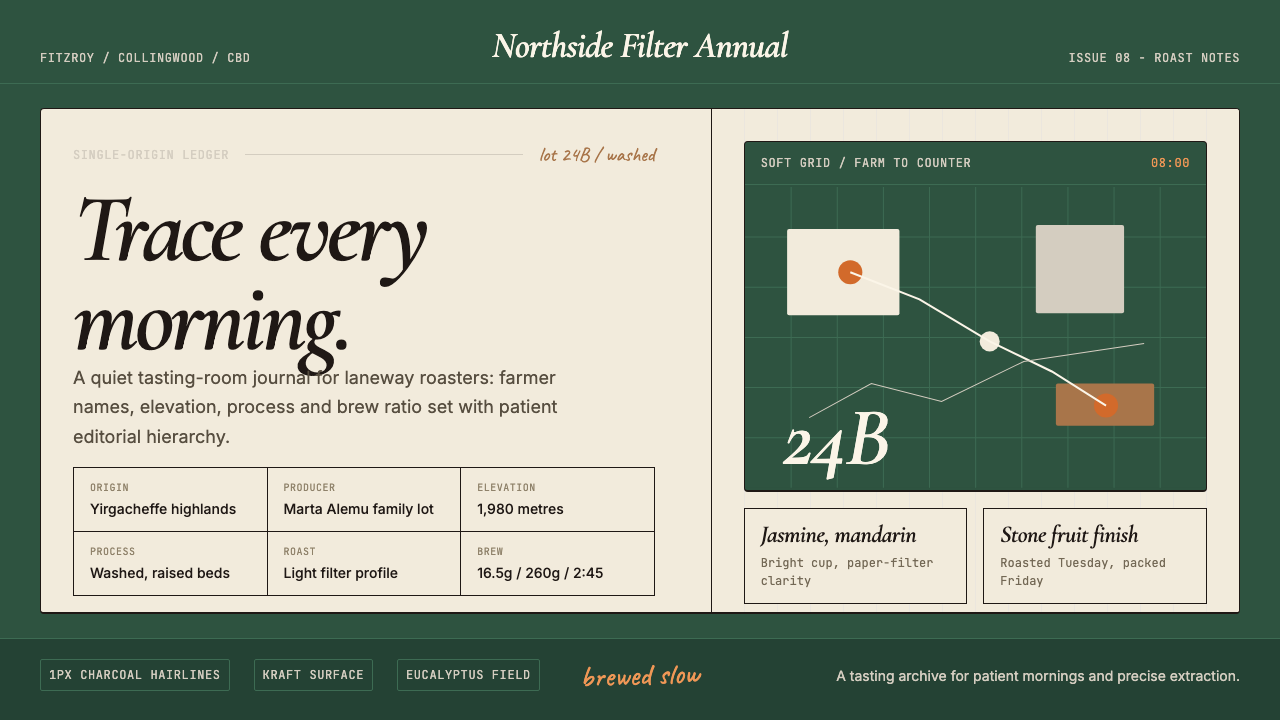 Melbourne Third-Wave Coffee ModernQuiet provenance. Eucalyptus green, cream cards and italic serif tables pace…
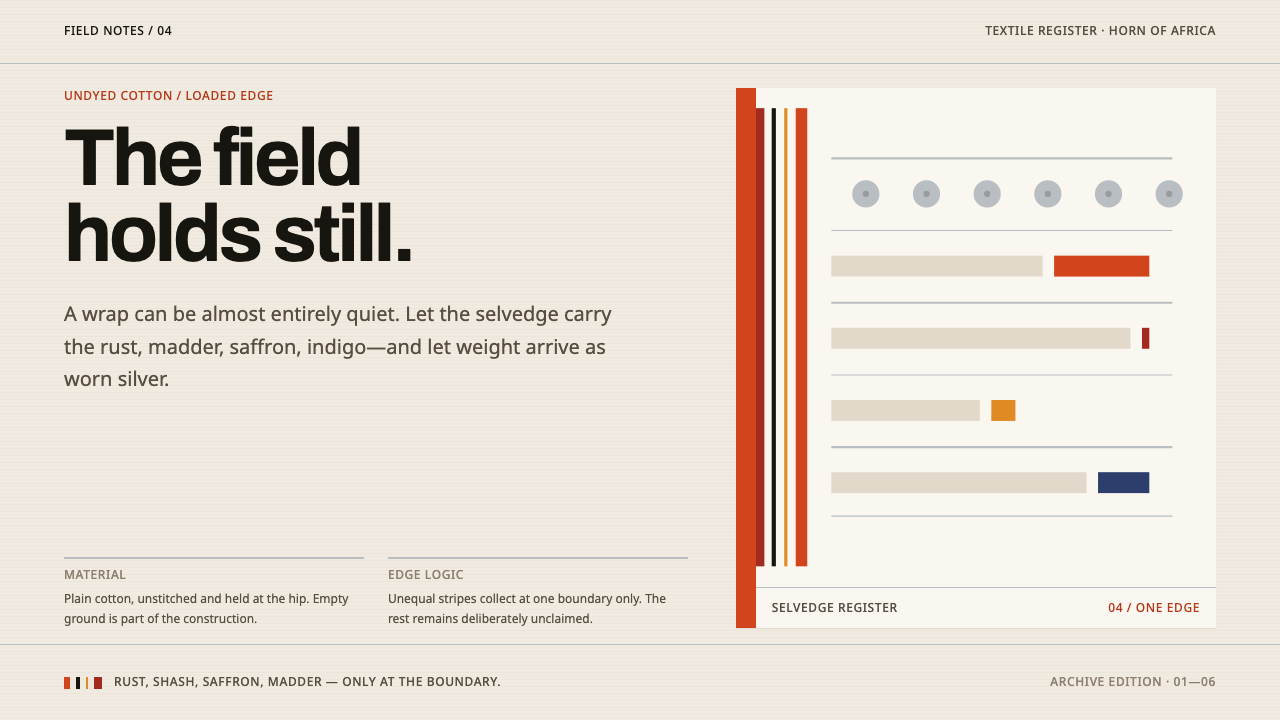 Afar Nomad TextileWeight lives at the edge. Rust and madder selvedges cut across a quiet cotton…
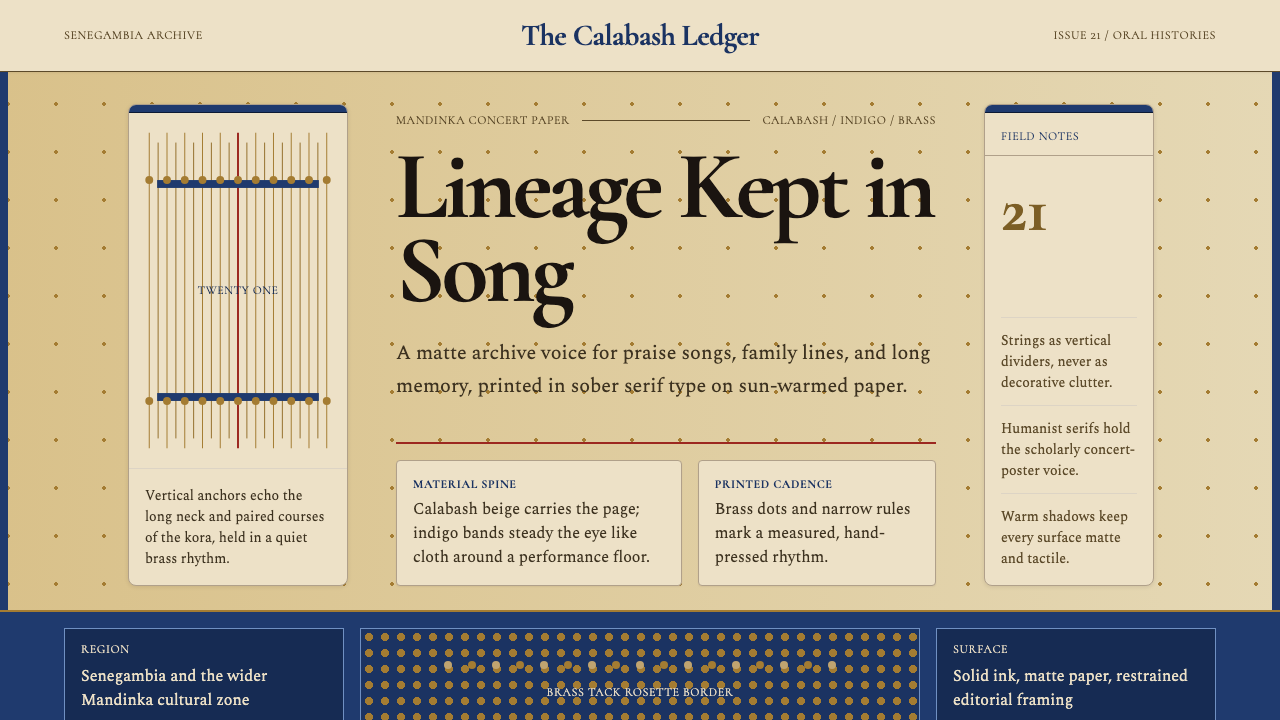 Gambian Griot Kora (21-string)Oral history feels tactile. Calabash beige, indigo bands, and 21 brass string…
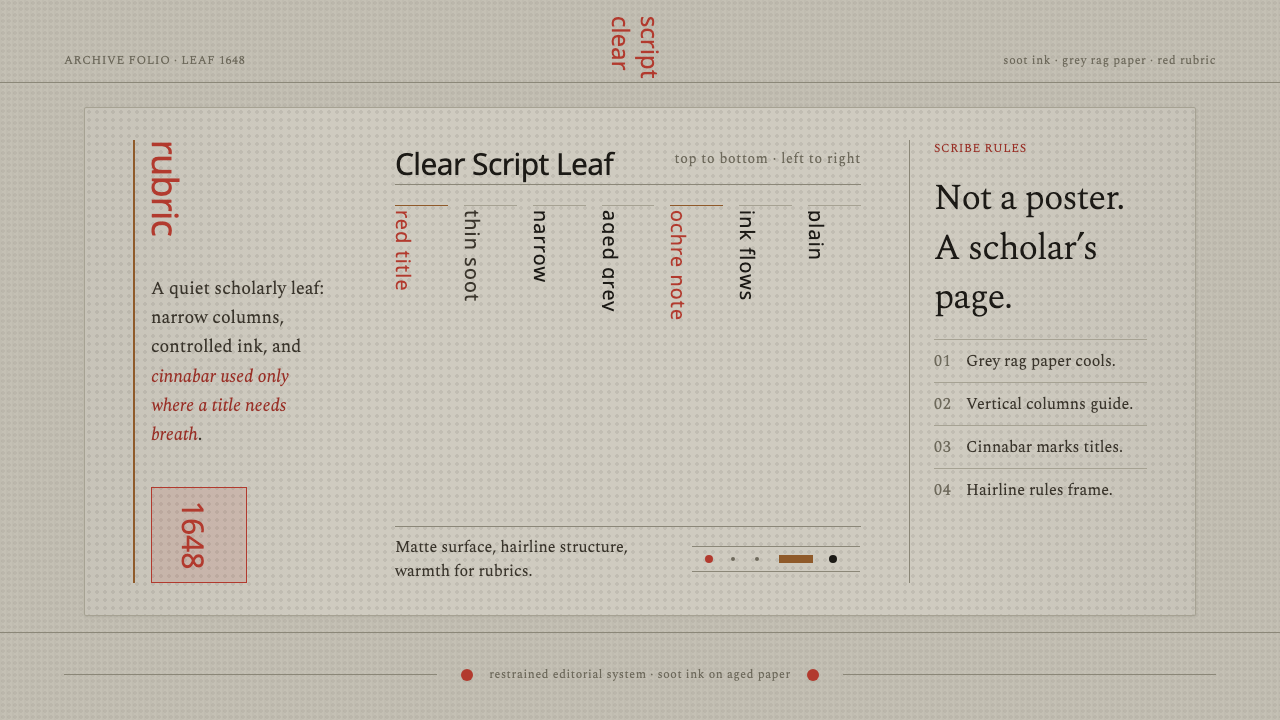 Kalmyk Todo Bichig Clear ScriptRestraint becomes script. Soot columns on grey rag paper, touched by cinnabar…
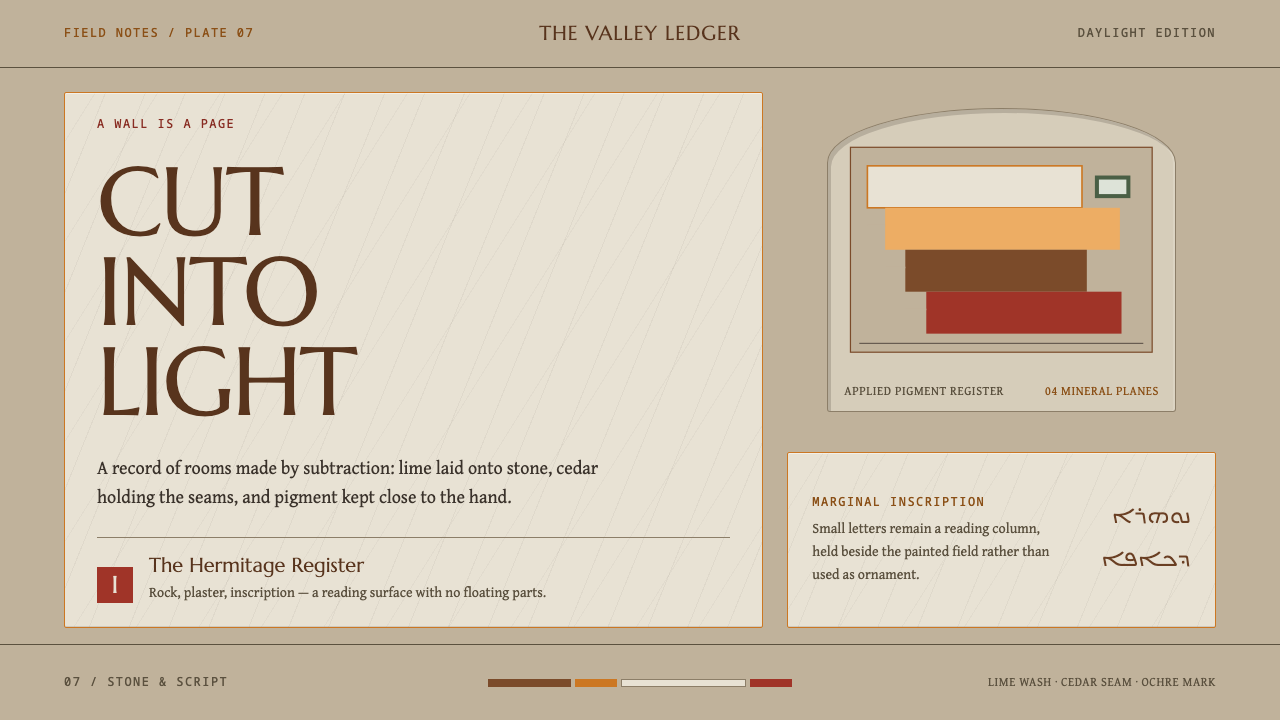 Maronite QadishaNothing floats. Lime-plaster terraces, cedar seams, and small Syriac margins…
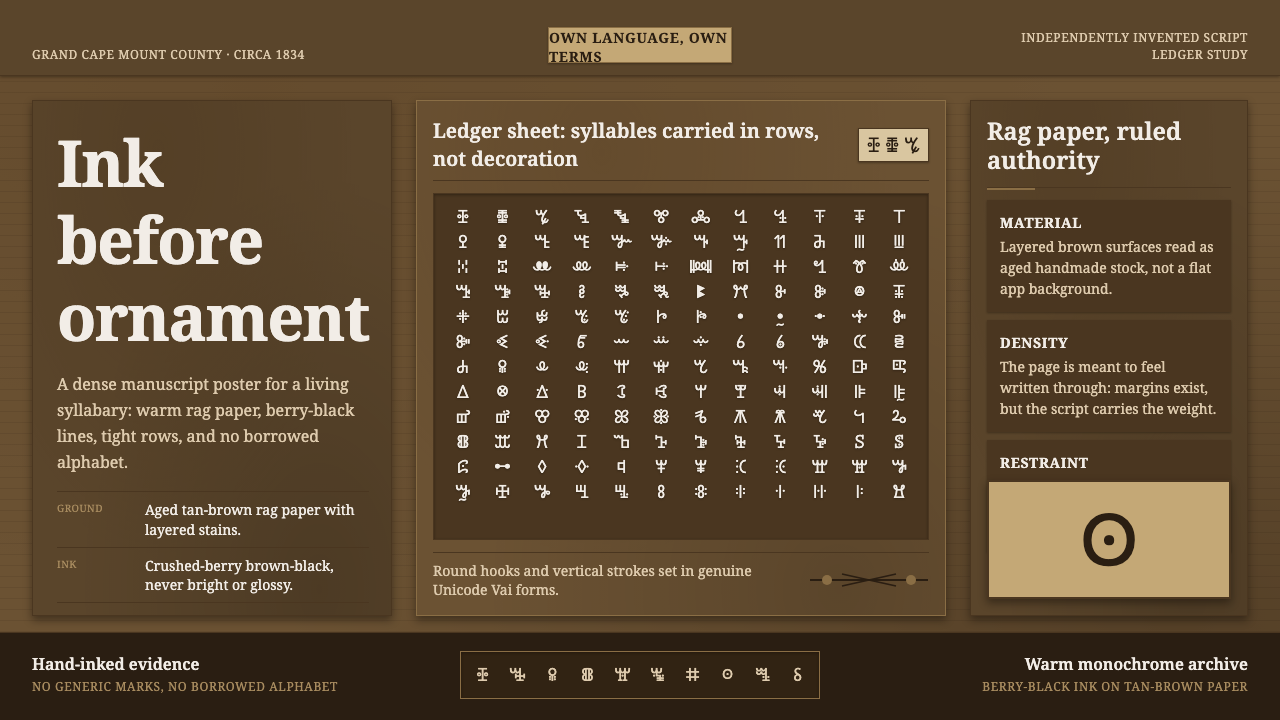 Vai Syllabary LiberiaInk has authority. Dense Vai glyphs pack berry-black rows across warm tan rag…