What is Norwegian Fjord Tourism?
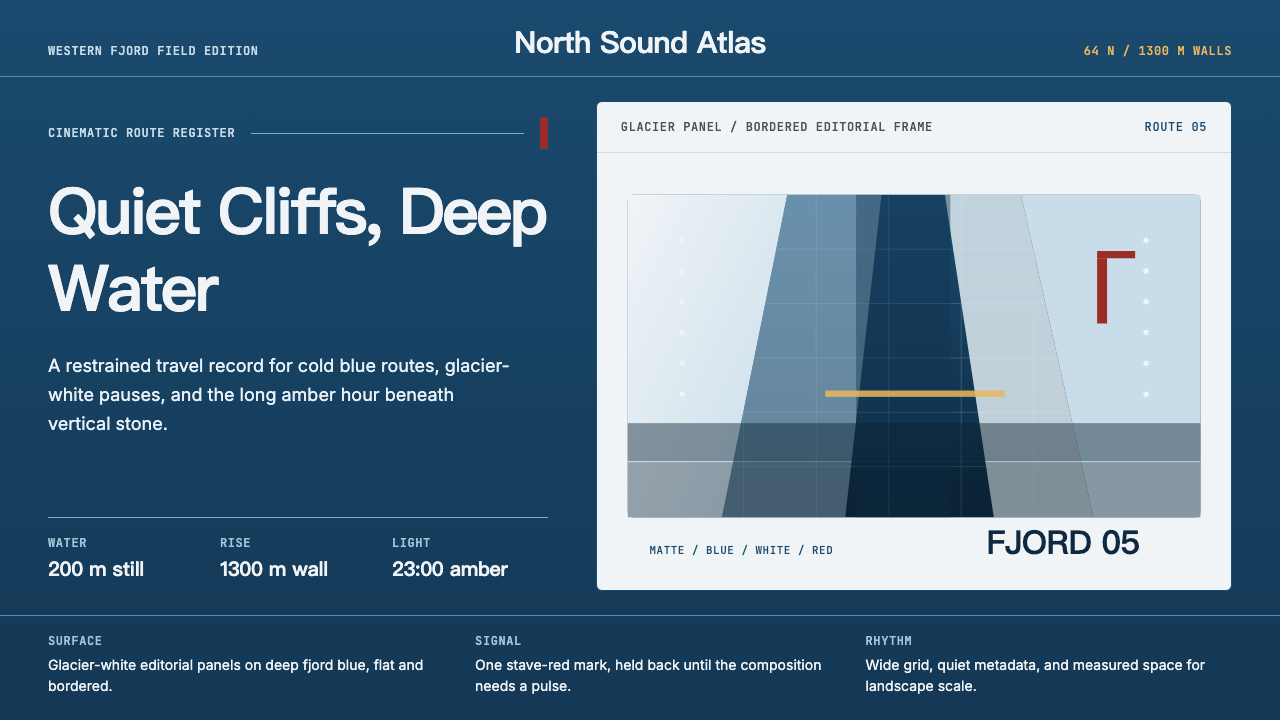
Norwegian fjord tourism's visual language turns raw geological scale into a design system — glacier-white silence, deep cold blue, and a single red accent borrowed from medieval stave churches.
Norwegian Fjord Tourism in brief
Norwegian fjord tourism design is the visual identity language built over two decades by Visit Norway, Hurtigruten, and the National Tourist Routes program. It translates the UNESCO-listed western fjords — Geirangerfjord, Sognefjord, Nærøyfjord — into a repeatable graphic system: a palette pulled directly from the landscape, cinematic photography held to a disciplined framing, and enough negative space that cliff walls and open water carry the composition rather than being decorated over.
The style belongs to a broader tradition of Scandinavian modernism — the same lineage as Nordic product design and Finnish graphic arts — but it is specifically rooted in the tourism infrastructure that Norway built to manage and communicate its extraordinary natural heritage. Where many national tourism aesthetics default to folk ornament or historic architecture, the Norwegian fjord identity chose restraint: let the landscape speak, and give the eye nothing to compete with it.
The result is a design register that reads as monumental without being loud. A travel poster in this style does not shout. It holds open a vast quantity of cold blue space, anchors a horizon line, and places a single stave-red detail — a kayak, a lighthouse, a church spire — at the edge of the frame. The viewer does the rest.
Where does Norwegian Fjord Tourism come from?
Visit Norway was established in 1984 as the state tourism promotion agency, but the visual language that now defines Norwegian fjord tourism took shape much later, during the international tourism boom of the 2000s. Norway's western fjords received UNESCO World Heritage status in 2005, which coincided with a rapid expansion in cruise tourism and a growing global appetite for 'wild' destinations. The challenge for Visit Norway's brand team at Innovation Norway was to create an identity that could compete internationally without reducing the landscape to spectacle.
The National Tourist Routes program, launched in 1994 and significantly expanded after 2004, was the infrastructure project that most directly shaped the aesthetic. The program commissioned leading Scandinavian architects — among them Snøhetta, the firm behind the Oslo Opera House — to design rest stops, observation platforms, and service facilities along eighteen scenic road routes across the country. Snøhetta's interventions in particular established a visual vocabulary: raw Corten steel, unfinished concrete, and dark stained timber set against the landscape rather than competing with it. This architectural language fed back into the graphic identity — the same material restraint, the same sense that human presence should be legible but minimal.
Hurtigruten, the coastal voyage operator with routes dating to 1893, contributed a parallel strand of the identity. Its brand evolution through the 2000s and 2010s moved toward deep navy, glacier-white, and matte finishes — a shipboard translation of the fjord palette that distinguished it sharply from the saturated Caribbean cruise aesthetic. The Hurtigruten identity team treated the coastline not as a backdrop but as the product itself, and their photography and editorial approach — spare, deliberate, unhurried — became a template for how the broader Norwegian tourism sector communicated.
The single stave-red accent that now reads as the style's signature detail comes from Norway's medieval wooden stave churches, of which fewer than thirty survive. The most visited are along the western fjord routes: Borgund, Urnes, Hopperstad. Their dark-tarred timber and soaring spires appear in virtually every canonical Visit Norway image as a point of human scale and cultural depth — a device that anchors the landscape in history without requiring text or caption. The incorporation of Sámi indigenous design elements, led in part by the artist Máret Ánne Sara, brought another dimension of cultural specificity to the northern Norway branch of the aesthetic, particularly in imagery from Tromsø and the Lofoten Islands.
What defines the Norwegian Fjord Tourism look?
The Three-Tone Palette
The palette is built around three sources: the deep cold blue of glacially carved fjord water, the white of snowfields and glacier faces, and the dark, warm red-brown of stave-church timber and traditional Norwegian painted architecture. These three tones — cold blue, pure white, and a concentrated red accent — form a near-exhaustive system. Other colors enter sparingly: the grey-green of coastal lichen, the ochre of autumn birch. The palette reads immediately as Nordic because it is derived from the specific optical conditions of western Norway — low-angle northern light, high-reflectance snow, and the saturation of cold deep water.
Cinematic Restraint in Photography
Fjord tourism photography favors wide-angle and ultra-wide framing that allows landscape to dominate the image. Drone perspectives — looking straight down a fjord corridor, or catching the reflection of cliff walls on still water — are used not for spectacle alone but to reveal the scale relationship between human-made elements and geological form. A critical rule is horizon placement: the horizon sits low, giving the sky its full weight, or high, collapsing the fjord into a graphic band of color. Mid-horizon compositions that divide the frame in half are avoided. Human figures, when they appear, are always small relative to the surrounding landscape.
Matte Surfaces and Textural Honesty
Informed by the National Tourist Routes architectural vocabulary, the design system has an implicit preference for matte rather than glossy surfaces — in print, in digital interfaces, and in physical wayfinding. This preference mirrors the material choices made by Snøhetta and related architects: unfinished concrete, weathered steel, darkened timber. Glossy or highly reflective finishes are associated with international luxury tourism; the Norwegian fjord aesthetic deliberately moves away from that register toward a rawer, more Northern European material sensibility.
Generous Negative Space
Perhaps the most transferable characteristic of the style is its use of negative space — not as emptiness to be filled, but as the primary compositional element. A fjord vista is largely water, sky, and cliff face with a narrow inhabited margin. The design system reflects this ratio: wide margins, light text loading, and a deep reluctance to cover the ground color with additional graphic elements. This generous negative space is what gives the style its sense of monumentality and stillness.
The Stave-Red Accent as Focal Point
The single concentrated red accent — drawn from the red ochre pigment historically used on Norwegian stave churches and traditional wooden buildings — functions as the visual system's only high-saturation color. Its role is not decoration but orientation: in a composition dominated by cool neutrals, a small area of stave red draws the eye and establishes the focal point. The accent is used sparingly; its power depends on being surrounded by the full weight of the blue-white palette.
Understated Typography Rooted in Scandinavian Modernism
Type in the Norwegian fjord tourism system is deliberately quiet relative to the imagery. Clean, geometrically grounded sans-serif faces — the same broad family as other Nordic design systems — are preferred, with weight used to distinguish headline from body rather than decorative variation. Text is often set in white against dark photography or in near-black against white, maintaining maximum legibility without competing with the landscape for visual dominance. Ornamental scripts, serif revival faces, and compressed display types are all avoided.
Sámi and Indigenous Visual Integration
In northern Norway — particularly in imagery associated with Tromsø, the Lofoten Islands, and Finnmark — the aesthetic incorporates Sámi indigenous design elements: geometric patterns derived from traditional duodji craft, references to reindeer herding culture, and the distinctive color register of Sámi formal dress. This integration, championed by artists including Máret Ánne Sara, adds cultural depth and prevents the aesthetic from being purely a landscape-photography exercise. It also signals that Norwegian tourism identity is multiple rather than singular, and that indigenous northern culture is part of the country's contemporary self-presentation.

Who shaped Norwegian Fjord Tourism?
Innovation Norway is the government agency that owns the Visit Norway brand and has been responsible for its international direction since the 1990s. The brand team's core contribution was the decision to resist spectacle: rather than leading with superlatives or crowd statistics, the Visit Norway visual identity was built around patience and proportion. Their editorial guidelines established the principle that imagery should always give the landscape more space than it gives human subjects — a rule that sounds simple but requires sustained discipline across hundreds of partner vendors and content creators.
Snøhetta is the Oslo and New York-based architecture and design practice that has had the most direct influence on the visual vocabulary of Norwegian fjord tourism. Their work on the National Tourist Routes — observation platforms, visitor centers, and rest stops designed between the mid-1990s and the 2010s — established the material grammar that the graphic identity then translated: raw concrete, weathering steel, dark timber, and the consistent principle that built structures should serve as frames for landscape rather than as attractions in themselves. Their Trollstigen National Tourist Route facility and the Aurland lookout platform Stegastein are among the most reproduced images in Norwegian tourism media.
Hurtigruten — the coastal voyage operator founded in 1893 whose name means 'the fast route' — underwent a significant brand evolution in the 2000s and 2010s that aligned its visual identity closely with the fjord tourism aesthetic. The identity team's decision to anchor the brand around deep navy, glacier-white, and matte materials was a deliberate departure from the saturated, resort-inflected look of Caribbean cruise operators. Their approach treated the Norwegian coastline as a product to be presented with the same seriousness as a museum collection rather than as exotic scenery to be hyped. This editorial restraint influenced how the broader Norwegian tourism industry communicated across print, digital, and environmental media.
Máret Ánne Sara is a Sámi artist and activist from Finnmark whose work has been instrumental in bringing indigenous visual culture into the mainstream representation of northern Norway. Her textile and installation work draws on the geometric patterning of duodji — traditional Sámi craft — and on the political and ecological realities of Sámi reindeer herding communities. Her presence in Norwegian cultural and tourism contexts has helped ensure that the aesthetic of 'northern Norway' is not simply a projection of fjord landscape photography onto an empty stage, but a representation that acknowledges the living culture of the region's indigenous people.
How do you use Norwegian Fjord Tourism today?
Norwegian fjord tourism design translates well beyond its original context precisely because its principles are proportional rather than decorative. Applying it correctly means understanding what the style is actually doing: subordinating all graphic elements to a single dominant impression (the landscape, or its analogue in your context), using color as a sparse, meaningful system rather than a rich palette, and letting negative space do structural work. The most common failure mode is treating the style as a color reference while ignoring its compositional logic — using the cold blue and stave-red on a dense, graphic-heavy layout produces neither fjord tourism nor anything coherent.
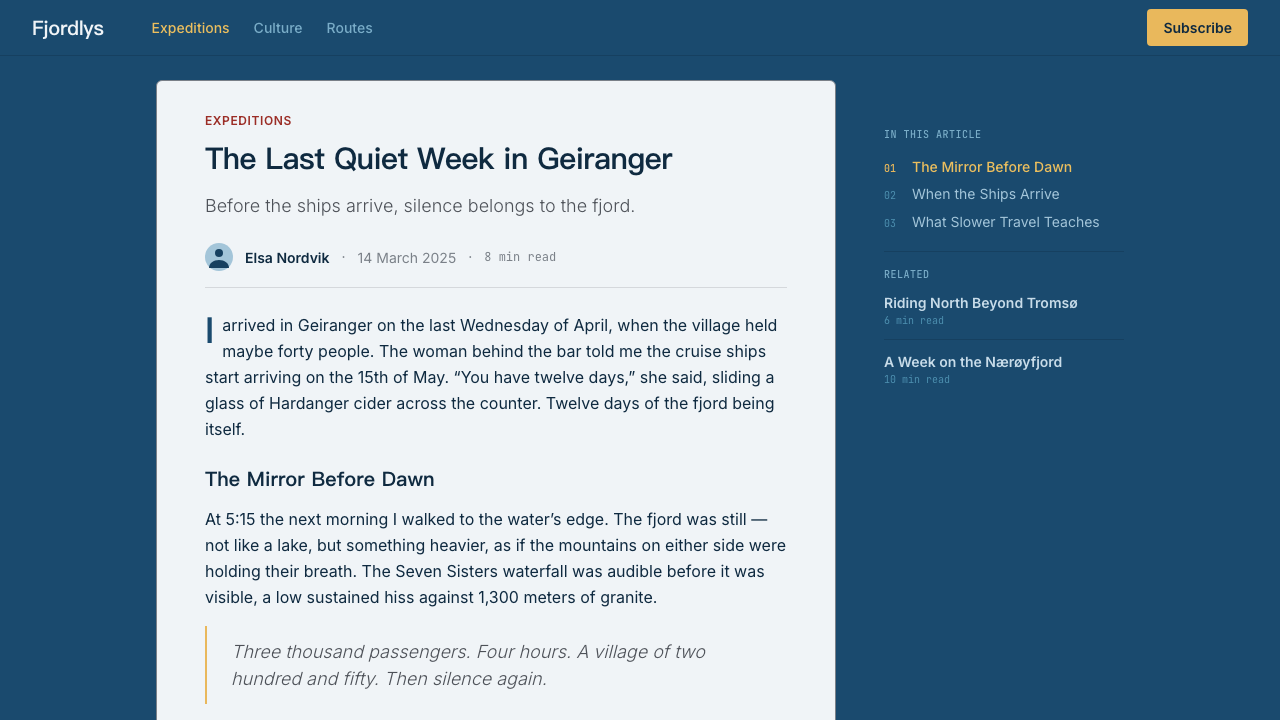
For presentation slides, the style works particularly well on full-bleed photography covers. A wide-angle landscape image set with the horizon low or high — not centered — gives the cover its essential character. The title should sit in one quiet corner, set in a clean geometric sans-serif in white or near-white, small enough that the image still dominates. Content slides should be treated as open fields: a single large image or a generous white ground, hierarchical type in two sizes, and no decorative dividers. Data slides benefit from the style's visual patience — bar charts and diagrams in the palette's cold blue, with the stave-red reserved for the single most important data point. Gradient fills in charts are inconsistent with the aesthetic.
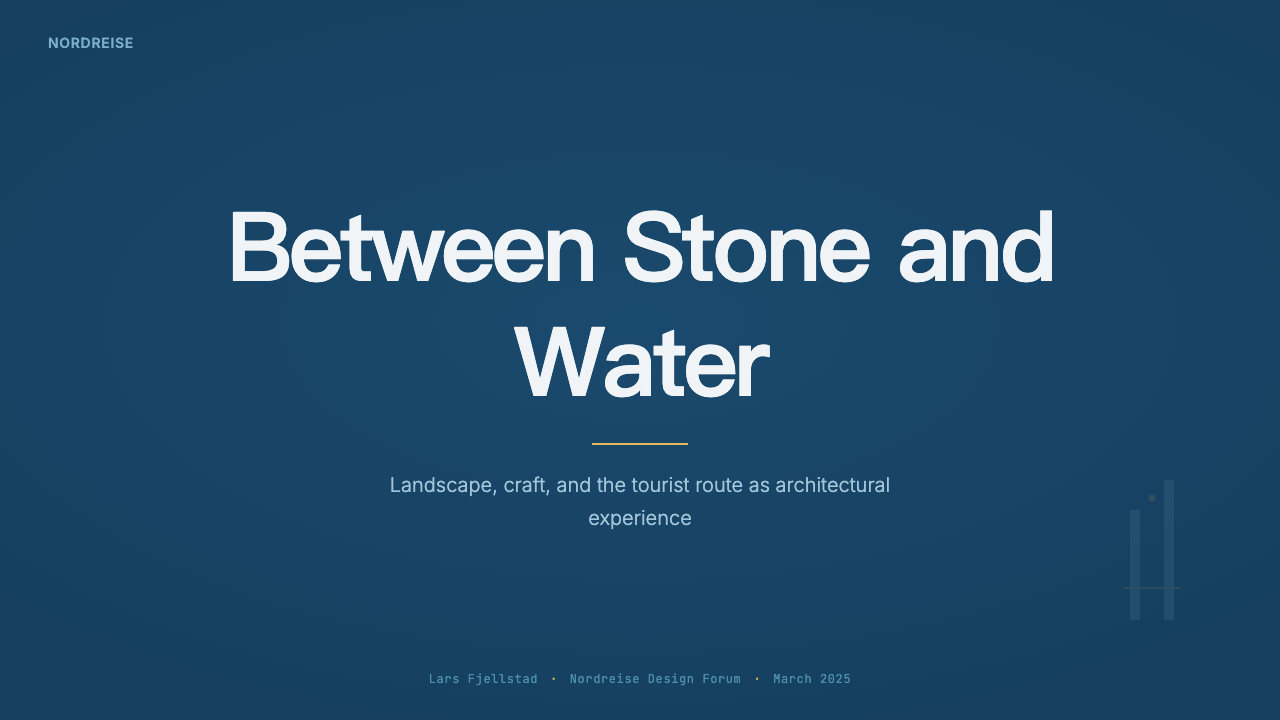
For web interfaces, the Norwegian fjord approach is well matched to premium travel brands, outdoor equipment companies, environmental organizations, and any product positioned around natural materials or considered craft. The practical translation: a near-white or light grey ground, deep navy or cold grey for type, photography given generous allocation in the layout with minimal text overlay, and the red accent used only for primary calls to action or critical alerts — never as a decoration. The matte preference translates to flat card components, flat button styling, and an avoidance of both drop shadows and inner glows.
For editorial and marketing work, the style supports storytelling at scale. A long-form editorial layout in this register uses a wide measure for full-bleed images, a narrower measure for body text, and lets sections breathe with generous spacing between them. Pull quotes should appear in the cold blue rather than in colored highlight boxes. Marketing pieces — event invitations, capability statements, campaign headers — benefit from extreme restraint: one strong image, the minimum necessary text, and the stave-red accent in at most one location per page. The style does not support busy collage layouts or multi-column grids with competing visual weights.
The most common mistake when applying this style is overcrowding the stave-red accent. Its power depends entirely on being used once, or at most twice, in a composition surrounded by the cold blue and white palette. When red appears in multiple locations — navigation links, icon fills, decorative borders, and a button — it stops functioning as a focal device and collapses into background noise. The second most common mistake is substituting a warm or vibrant blue for the specific cold blue of glacial water. A warm mid-blue gives the composition a Mediterranean character entirely at odds with the Northern European register the style depends on.
Norwegian Fjord Tourism — FAQ
Is Norwegian fjord tourism design the same as generic Scandinavian minimalism?
Related but distinct. Generic Scandinavian minimalism — the design language associated with Swedish furniture brands, Finnish kitchenware, or Danish graphic design — shares the preference for restraint, negative space, and clean typography, but its palette is typically warm-neutral: off-white, birch, warm grey, dusty rose. Norwegian fjord tourism design is specifically cold: the blues are glacial rather than sky-blue, the whites are polar rather than creamy. The stave-red accent and the explicit connection to landscape photography also distinguish it from the interior-design-adjacent version of Scandinavian minimalism.
Can this style work for urban or non-landscape brands?
Yes, with appropriate adaptation. The style's structural principles — cold palette, generous negative space, single warm accent, matte surfaces, photography-led composition — are transferable to any brand that wants to communicate spaciousness, considered restraint, and a certain Northern European seriousness. Architecture firms, premium outdoor apparel, high-end hospitality, and environmental-data products have all used adjacent aesthetics effectively. The adaptation requires finding the brand's equivalent of the fjord: the single visual element that the composition will be built around. Without that organizing focal point, the style loses its essential logic and becomes merely cold and sparse.
How is this style different from other national tourism identities?
Many national tourism identities lean heavily on folk ornament, historical architecture, or vivid local color as their primary visual signature. Norwegian fjord tourism is unusual in that it largely removes cultural decoration from the frame and lets geological and natural scale do the primary work. The New Zealand tourism identity, for comparison, uses similar wide-landscape photography but with warmer greens and the cultural presence of Māori design. Japanese tourism identity uses a very different register — precision, cultural layering, seasonal color symbolism. The Norwegian approach is among the most stripped-back: culture enters mostly through the stave-church accent and the Sámi design thread in northern imagery, rather than through surface ornament.
What time period does this style reflect, and does it feel dated?
The current form of the style was consolidated roughly between 2005 and 2015, during the peak of international attention to Nordic design and the UNESCO-driven growth in fjord tourism. Because the style's foundation is a landscape palette rather than a trend palette — cold blue and glacier white are not subject to fashion cycles the way millennial pink or early-2010s teal were — it has aged more gracefully than many tourism identities from the same era. The drone photography conventions that the style helped popularize have become generic, which means imagery that relies too heavily on the straight-down fjord aerial without additional compositional thought can now read as stock. The solution is the same discipline the style always required: fewer elements, more space, the single accent placed deliberately.
How should the stave-red accent be introduced in a design that has no obvious Norwegian reference?
The accent does not need to carry a Norwegian reference to function; it needs to function as a warm focal point in a cold composition. The practical question is: what is the single most important element the viewer's eye should reach first? That element receives the accent. In a slide deck, it might be the one statistic that changes everything. In a website, it might be the primary call-to-action button. In an editorial layout, it might be the opening pull quote. What the accent cannot do is appear in multiple roles simultaneously — it loses its power the moment it becomes a system color rather than a decisive, singular mark.
Related design styles
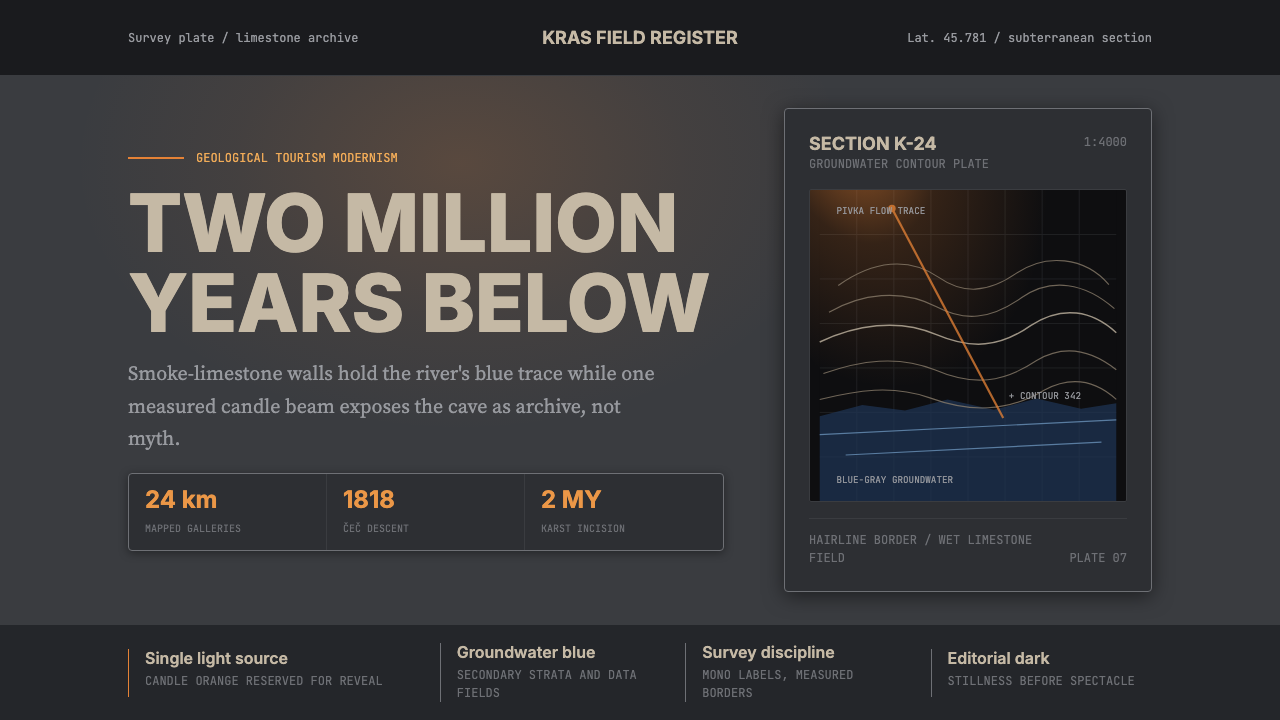 Slovenian Postojna Cave (Karst)Serious geology. Limestone gray, groundwater blue, and Inter type cut by one…
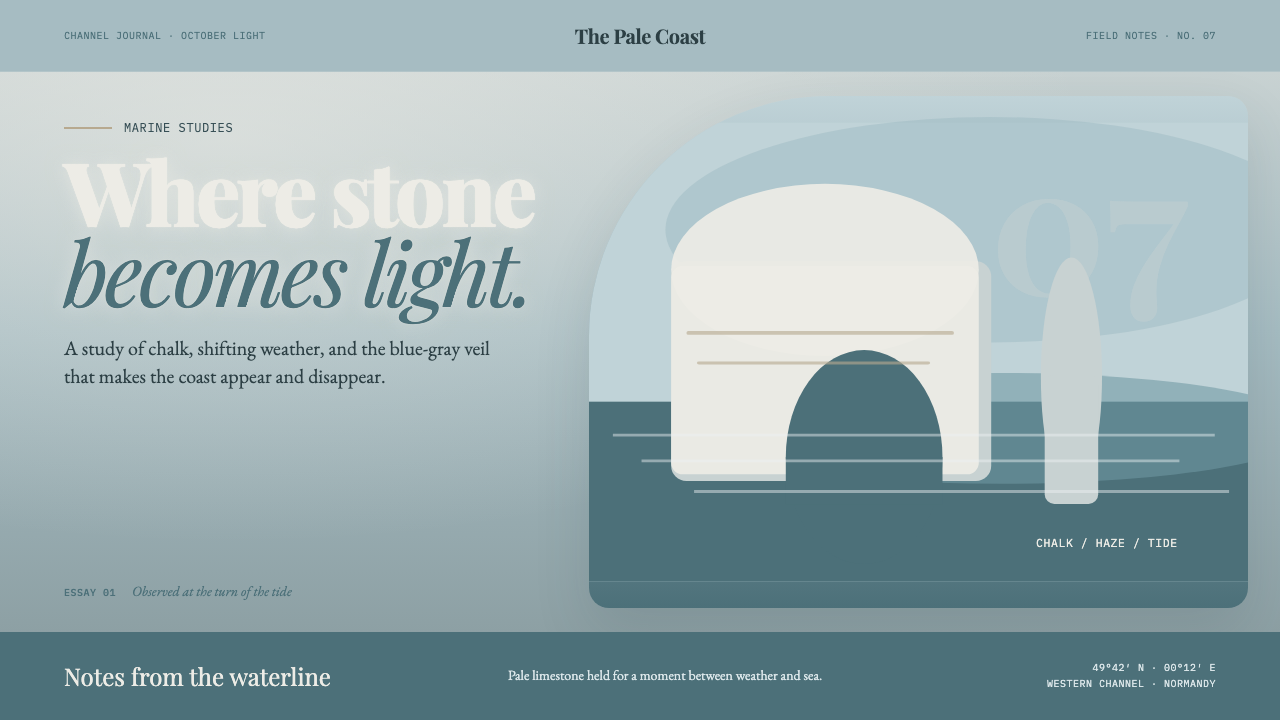 Étretat Chalk CliffsStone becomes light. Chalk-white forms dissolve through blue-gray mist and li…
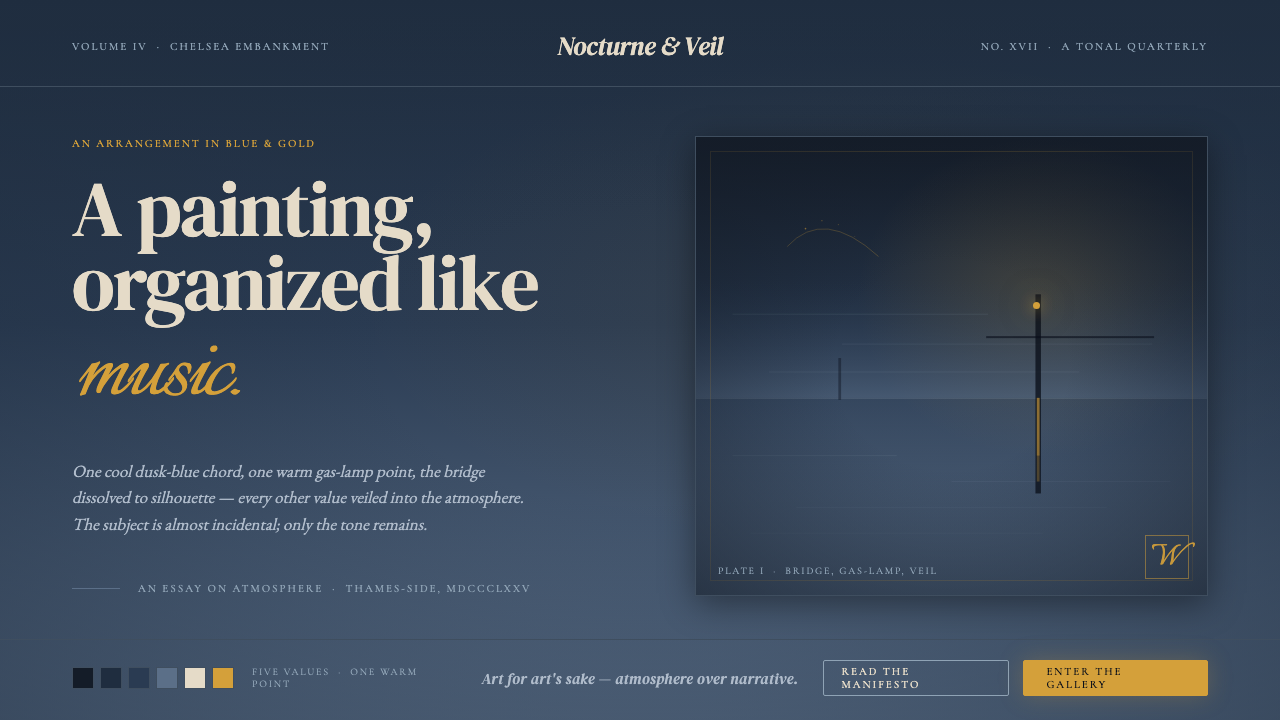 Whistler Nocturne TonalismA painting organized like music. One dusk-blue chord, one warm gas-lamp point…
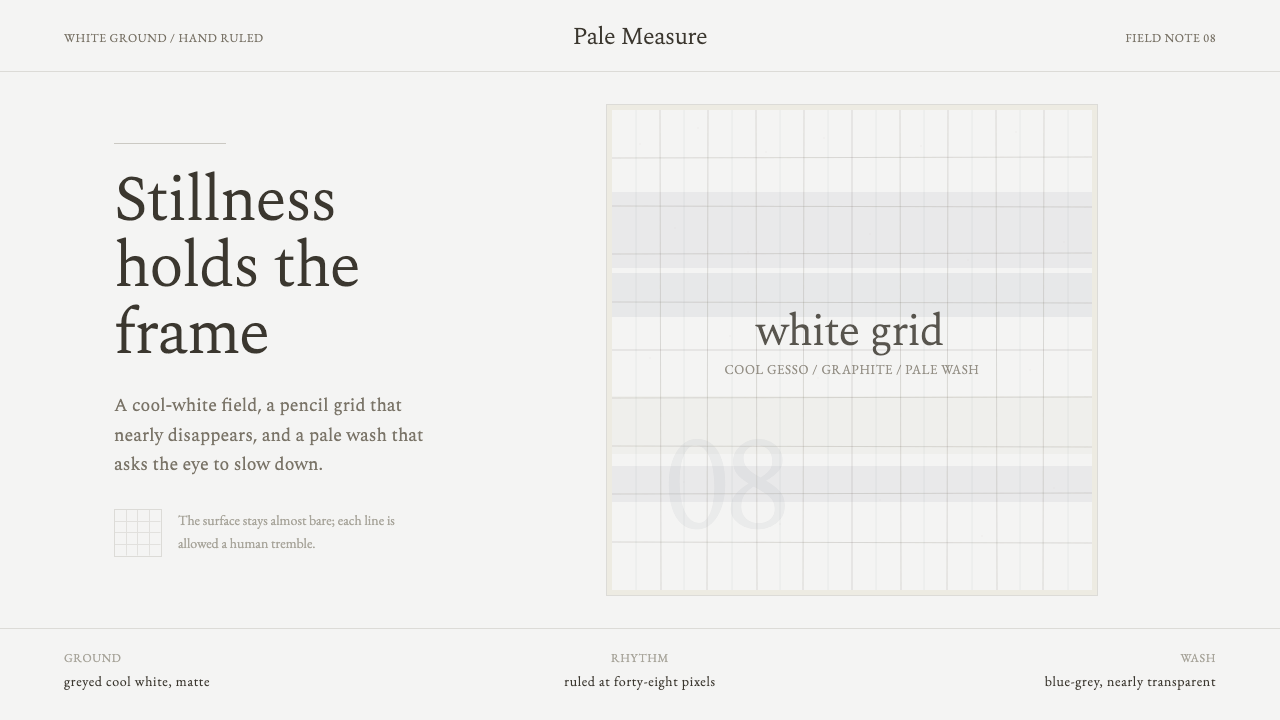 Agnes Martin White GridStillness made visible. Cool-white ground, graphite grid, and pale blue-grey…
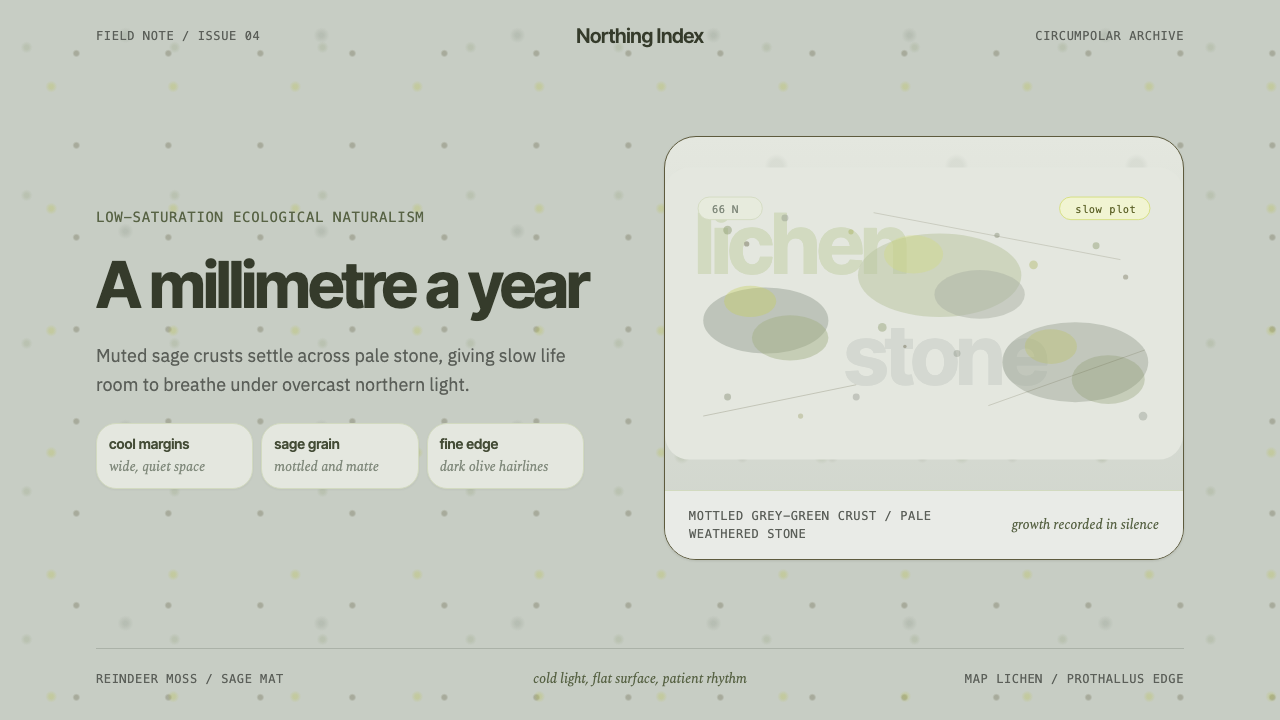 Arctic Tundra LichenPatience made visible. Sage speckles drift over cold stone with narrow, quiet…
 Bengali Art-House CinemaLight becomes restraint. Near-black ground, silver serif, and Bengali script…