What is Whistler Nocturne Tonalism?
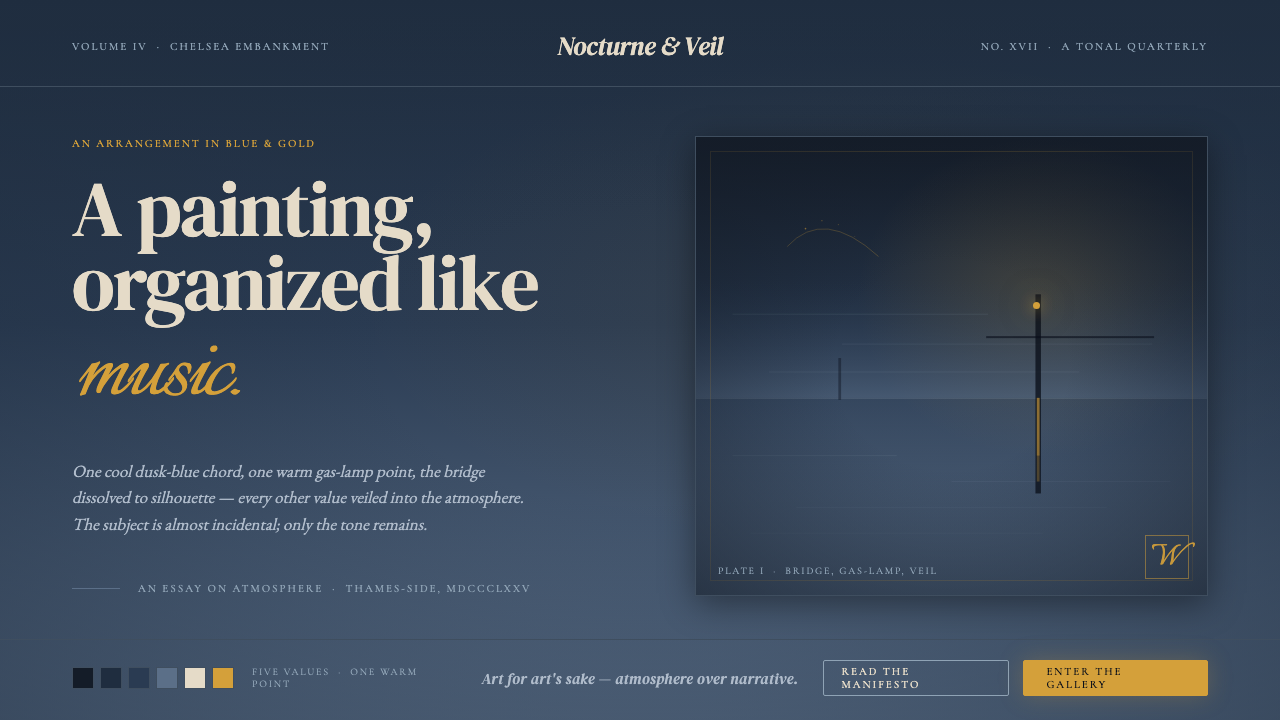
Whistler proved that a painting — and by extension any designed surface — could be organized like a musical chord: one cool tonal field, one warm point of light, and silence everywhere else.
Whistler Nocturne Tonalism in brief
Whistler Nocturne Tonalism is a visual discipline derived from the Nocturne series painted by James McNeill Whistler between roughly 1872 and 1878. Its governing principle is tonal unity: an entire composition is built from a single closely related family of values — almost always a cool dusk-blue or blue-grey — with no more than four or five distinct tones across the whole surface. Into this near-monochrome field, a single warm accent intrudes: the halo of a gas lamp, the ember-glow of a distant firework, a candle behind a curtain.
The discipline demands that subject matter be subordinate to atmosphere. Whistler famously titled his canvases after musical forms — Nocturne in Blue and Gold, Nocturne in Black and Gold — not after the bridges, barges, and fogbanks they nominally depicted. The subject is almost incidental; what the work is actually organizing is the emotional register of a particular quality of light. Negative space is not empty: it is the primary material, typically occupying sixty to eighty percent of each composition.
Applied to contemporary design, Whistler Nocturne Tonalism becomes a system for achieving depth and atmosphere through restraint rather than complexity. Where most visual systems build richness by adding — more colors, more textures, more elements — this one builds it by subtracting until only the essential tonal relationships remain. The result reads as quiet authority: sophisticated, nocturnal, and deliberately unhurried.

Where does Whistler Nocturne Tonalism come from?
James McNeill Whistler was an American-born painter who spent most of his working life in London and Paris. By the late 1860s he had absorbed the influence of Japanese woodblock prints — their flat color fields, radical cropping, and compositional emptiness — and was applying these principles to the Thames at dusk. The Nocturne series emerged from nightly observations of Battersea Bridge, Chelsea Embankment, and the working river, made at the hour when industrial London dissolved into atmosphere and the gas lamps began to compete with the failing light.
The word 'nocturne' was suggested to Whistler by his patron Frederick Leyland, a Liverpool shipping magnate with musical interests. Whistler adopted it immediately and gratefully: it made explicit what he had been attempting all along, which was to treat painting as an art of pure sensation rather than representation or narrative. In a letter of 1878 he wrote that he sought 'an arrangement of line, form and colour first — the subject being of secondary importance.' This was a radical statement in an era when Victorian painting was still largely governed by anecdote, moral instruction, and literal description.
The movement existed within the broader Aestheticism that flourished in London through the 1870s and 1880s — the circle around Oscar Wilde, Algernon Swinburne, and Dante Gabriel Rossetti that held 'art for art's sake' as its creed. Whistler was its most technically rigorous practitioner. He was also deeply influenced by Japonisme, the European fascination with Japanese visual culture that had intensified after Japan's forced opening to Western trade in the 1850s. Japanese woodblocks taught him that vast areas of un-worked surface could carry more visual weight than a densely painted one, and that a single acute diagonal could organize an entire composition.
The movement's defining crisis was the libel trial of 1878. The critic John Ruskin, reviewing Nocturne in Black and Gold: The Falling Rocket at the Grosvenor Gallery, accused Whistler of 'flinging a pot of paint in the public's face' and implied that two hundred guineas was an outrageous price for what amounted to an unfinished sketch. Whistler sued for libel and won — but was awarded only a farthing in damages and was ruined by the legal costs. He was forced into bankruptcy and sold his Chelsea house. The trial, however, made the Nocturnes internationally famous and crystallized the argument about what a painting was for: sensation and arrangement, or description and moral instruction. Whistler won the argument even as he lost the financial war. The tonal discipline he established went on to influence the American Tonalist movement of the 1890s and 1900s, and its visual logic — one chord, one accent, vast silence — has proven durably applicable in every subsequent medium from poster design to digital interface.
What defines the Whistler Nocturne Tonalism look?
The Single Tonal Chord
The entire ground of a Whistler Nocturne composition belongs to one family of closely related tones — typically a cool blue-grey or deep dusk-blue that ranges from near-black at its darkest to a pale, misted mid-value at its lightest. These tones share the same underlying hue and differ only in value and the degree of atmospheric softening. The discipline is to hold this chord absolutely: no competing hue enters the background, no warm neutral compromises the cool unity.
The Single Warm Accent
Against the cool ground, exactly one warm note is permitted: the amber halo of a gas lamp, the golden reflection dragged across still water, the orange-white burst of a distant firework. This accent is small — it may occupy only a fraction of the total surface — but because it is the only warm element in a field of cool, it carries disproportionate visual weight. In design application, this translates to one golden, amber, or warm cream element used as the focal point within an otherwise cool-toned composition.
Atmospheric Dissolution
Edges in a Whistler Nocturne are not edges in the conventional sense. Forms — a bridge, a barge, a treeline — emerge from the tonal ground and dissolve back into it. Transitions are soft and graded rather than hard and decisive. This atmospheric quality is achieved by keeping the value difference between figure and ground small enough that the eye reads them as belonging to the same world rather than as a figure placed against a background. In design, this technique manifests as intentionally softened transitions between sections, elements that share the ground value rather than contrasting sharply with it, and a general avoidance of hard outlines.
Dominant Negative Space
The most structurally important feature of the Nocturne system is what it chooses not to fill. Negative space — the misted mid-tone field of sky, water, and fog — typically occupies more than half and often two-thirds or more of the total composition. This is not emptiness but active material: it creates the silence that makes the warm accent audible, and it establishes the mood of contemplative stillness that defines the style. Overcrowding — adding elements to reduce the sense of emptiness — is the most common failure mode when applying this approach.
Value Compression
The entire tonal range of a Nocturne composition is compressed into the middle and lower values — darks and mid-tones, with almost no pure white or near-white anywhere in the composition except in the immediate halo of the warm accent. This compression is what gives the style its characteristic nocturnal weight and depth. Expanding the range toward bright whites or introducing high-key areas immediately breaks the mood, because it implies daylight or artificial floodlighting rather than the specific quality of dusk transitioning into night.
The Butterfly Signature and Compositional Asymmetry
Whistler replaced his conventional artist's signature with a butterfly monogram — a design that evolved over the years and was placed with deliberate compositional intent, typically in a lower corner, acting as a final visual anchor rather than merely an attribution. This detail reflects the broader compositional logic of the style: asymmetric placement, considered negative space, and the treatment of functional elements as integral parts of the visual composition rather than afterthoughts. In design application, this means that credits, labels, and navigational elements are positioned with the same tonal and spatial care as primary content.
Musicality and Mood as Primary Goal
More than any other historical style, Whistler Nocturne Tonalism subordinates all visual decisions to a single overriding aim: the creation of a sustained emotional mood. Color, tone, composition, and detail are chosen not for their individual merits but for their contribution to the overall sensory register — the feeling of standing at the waterfront after dark, of ambient sound muffled by fog, of time suspended. This makes it unusual as a design system: the question is not 'does this element communicate clearly?' but 'does this element contribute to or disturb the chord?'

Who shaped Whistler Nocturne Tonalism?
Whistler (1834–1903) trained in Paris before settling in London, where he became simultaneously one of the most celebrated and most controversial painters of the Victorian era. His rejection of literary and moral content in painting — articulated most forcefully in his Ten O'Clock Lecture of 1885 — placed him in direct conflict with the dominant critical establishment, personified by Ruskin. Despite the bankruptcy that followed the 1878 trial, Whistler's reputation steadily grew; his Venice etchings and pastels, made during a financially motivated stay of 1879–1880, extended the Nocturne aesthetic into printmaking and became some of the most influential works of the late nineteenth century.
Ruskin (1819–1900) was the most influential art critic in Victorian Britain, whose multi-volume Modern Painters established the interpretive framework through which most educated Victorians understood landscape and painting. His attack on Whistler's Falling Rocket was not merely a personal dispute but a clash of two incompatible theories of art: Ruskin's conviction that painting must engage with the moral and natural world, and Whistler's that it need answer only to sensation and formal arrangement. The trial's outcome — a pyrrhic legal victory for Whistler — effectively ended Ruskin's critical authority and marked a turning point in the acceptance of purely aesthetic values in Western art.
Leyland (1831–1892) was a Liverpool shipping magnate and the most important patron of Whistler's middle career. He commissioned several major works and provided the financial support that allowed Whistler to develop the Nocturne series without immediate commercial pressure. The relationship ended catastrophically when Whistler, given permission to make minor adjustments to Leyland's dining room while displaying his Peacock Room decorations, transformed the entire interior into an elaborate blue-and-gold mural without Leyland's consent — a project Whistler titled Harmony in Blue and Gold: The Peacock Room. The falling-out destroyed the patronage relationship but produced one of the nineteenth century's most remarkable decorative interiors, now preserved at the Freer Gallery in Washington.
Wilde (1854–1900) was the most prominent literary advocate for Aestheticism and a close associate of Whistler in London's art circles through the late 1870s and 1880s. His critical writings articulated in prose what Whistler was demonstrating in paint: that art's purpose is to intensify sensation and that beauty requires no moral justification. The two men's relationship was famously competitive — Whistler was known to resent Wilde's facility for popularizing ideas that Whistler considered his own — but together they defined the cultural moment in which the Nocturne's values became legible to a wider public. Wilde's aphorism 'The only excuse for making a useless thing is that one admires it intensely' is perhaps the best one-sentence gloss on what the Nocturne series was actually arguing.
Tryon (1849–1925) was among the most accomplished practitioners of American Tonalism, the movement that carried Whistler's principles into United States landscape painting from the 1890s onward. Working primarily in Connecticut and Cape Cod, Tryon developed a variant of the Nocturne discipline applied to dawn and twilight pastoral scenes: the same tonal compression, the same dominant negative space, the same suppression of detail in favor of atmosphere, but transposed from the industrial Thames to the American countryside. His work demonstrates how the Nocturne visual logic generalizes across subjects and geographies while remaining formally coherent.
How do you use Whistler Nocturne Tonalism today?
Whistler Nocturne Tonalism is one of the few historical styles that translates directly to dark-mode digital design without forcing or pastiche. Its native ground is already deep and nocturnal; its logic of one cool tonal field plus one warm accent maps cleanly onto the design problem of creating depth and hierarchy on a dark-background interface. The key discipline when applying it is understanding that the 'single warm accent' rule is absolute: one focal warm element per composition, not a warm accent per component or per section. When every card or every feature block has its own warm highlight, the system ceases to function as a nocturne and becomes merely a dark theme with gold trim.
For presentation slides, the Nocturne approach works powerfully on both cover and content pages, with meaningfully different applications for each. A cover slide should commit entirely to the tonal chord: a deep, cool, atmospheric ground — blue-grey, slate, or near-black with blue undertone — with the title appearing in a value only slightly lighter than the background, and a single warm element (a monogram, a small device, a horizontal rule in warm gold) serving as the sole focal point. This restraint reads as confident authority rather than underdesign. Content slides use the same tonal ground but introduce a very limited light value for body text, keeping the warm accent for the single most important data point, call-out, or section label on the page.
For data visualization and dashboards, the Nocturne palette has specific strengths and constraints. Its strength is depth and legibility at a glance: a cool-toned ground makes a single warm data series or alert state immediately visible without requiring high contrast across the whole chart. The constraint is that it is inherently a low-saturation system — pure, vivid secondary colors read as violations of the tonal unity. Data series should be differentiated through value shifts within the cool family (dark slate, mid-blue-grey, lighter blue-mist) with only the primary series or the alert state rendered in the warm accent. Grid lines, axis labels, and supporting text should remain within the cool-toned family and at low contrast against the ground.
For editorial and marketing work, the Nocturne aesthetic suits contexts that need to communicate depth, sophistication, and a certain unhurried confidence — luxury goods, cultural institutions, premium financial services, and any brand positioning itself as thoughtful rather than urgent. Full-width sections that hold a single statement headline with generous surrounding silence are more effective than dense feature grids. A marketing page built on this system alternates between near-black cool grounds with warm-accented headlines, and deep cool-grey grounds with lighter cool-toned body text — never breaking into high-key whites or pure-black sections that would pierce the atmospheric coherence. Photography, when used, should be treated as another tonal element: desaturated or blue-filtered, cropped to emphasize sky and mist over detail, and never placed at full contrast against the ground.
The most common mistake when applying Whistler Nocturne Tonalism is confusing it with generic dark-mode design or with gothic/dark luxury aesthetics. Generic dark mode typically uses high-contrast white text on near-black grounds, which is the opposite of the value compression this style requires. Gothic dark luxury tends toward gold-on-black at high saturation, which violates the single-accent rule and reads as ornamental rather than atmospheric. The genuine Nocturne application is quieter than both: mid-value cool text on a slightly darker cool ground, with the warm accent used only once and used small. If a layout feels moody but not restrained, or rich but not quiet, the tonal discipline has been lost. The test is simple: cover the warm accent element — if the remaining composition still holds together as a complete, coherent whole, the tonal chord is working correctly.

Whistler Nocturne Tonalism — FAQ
Is Whistler Nocturne Tonalism the same as generic dark mode?
No, and the difference is fundamental. Generic dark mode is primarily a contrast convention: white or very light text on a near-black background, usually to reduce eye strain in low-light conditions. Whistler Nocturne Tonalism is a tonal system: the ground, the text, and all supporting elements occupy a compressed range of closely related cool values, with only minimal contrast between layers. The effect is atmospheric and immersive rather than high-contrast and legible. Generic dark mode prioritizes readability; the Nocturne system prioritizes mood. In practice, a genuine Nocturne application will use text at a noticeably lower value contrast against the background than dark mode guidelines recommend — a deliberate choice, not an accessibility oversight.
Can this style work in a light-background or daytime context?
The style can be transposed to a pale ground — a pale grey-blue, a misted lavender-grey, a cool near-white — but it requires careful handling. The defining element is not darkness per se but tonal compression and cool unity. A light Nocturne variant should hold the same low-contrast, close-value relationships between ground and elements, and should still admit only one warm accent. What it cannot do is introduce the warm brightness, high contrast, and full tonal range that characterize daylight. If the result begins to read as airy or crisp, the tonal chord has dissolved. Light-ground Tonalism tends to look more like quiet Scandinavian minimalism than like Whistler specifically — related in spirit but distinct in character.
How is Whistler Nocturne Tonalism different from other dark aesthetic styles like noir, gothic, or moody luxury?
The distinguishing feature is restraint and atmospheric dissolution rather than drama or ornament. Noir typically relies on hard light sources, sharp shadows, and high contrast between dark and light areas — the opposite of the Nocturne's value compression. Gothic aesthetics use black as a saturated, expressive absolute and typically incorporate ornamental elements — texture, pattern, decorative typography — that the Nocturne system excludes. Moody luxury often pairs deep grounds with gold at high saturation, which reads as opulent but violates the single-accent rule and the tonal unity. The Nocturne is quieter, more atmospheric, and more abstract than any of these; its closest relatives are Japanese ink wash painting and the hushed interiors of certain Scandinavian design traditions — stillness rather than drama.
What kinds of products or brands should not use this style?
Whistler Nocturne Tonalism is unsuited to products whose value proposition depends on energy, clarity, accessibility, or warmth. Consumer apps that need to feel approachable and immediate — social platforms, food delivery, children's education, fitness tracking — will read as cold or mysterious under this system rather than inviting. Products requiring high accessibility compliance will find the low-contrast, value-compressed approach structurally incompatible with legibility standards. Brands that need to signal openness, transparency, or corporate friendliness should use systems with more tonal range and warmer grounds. The style is best reserved for contexts where the user's relationship to the product is contemplative and unhurried: premium cultural content, archival or research tools, high-end portfolio presentations, and experiential luxury.
How literally should the 'one warm accent' rule be interpreted in a complex multi-page design system?
The rule applies at the composition level, not at the system level. In a multi-page design system, the warm accent can recur across pages — it may appear consistently as the primary call-to-action color, the active state indicator, or the brand accent — but within each individual view or composition, it should appear in only one location or serve only one function. The mistake is not having a warm accent color in the system; the mistake is deploying it simultaneously in multiple competing locations within a single composition. A dashboard that uses warm amber for the primary metric, for alert states, for active navigation items, and for data highlights has dissolved the tonal unity even if each individual use seems justified. Pick one role for the warm accent per composition and let everything else remain within the cool family.
Related design styles
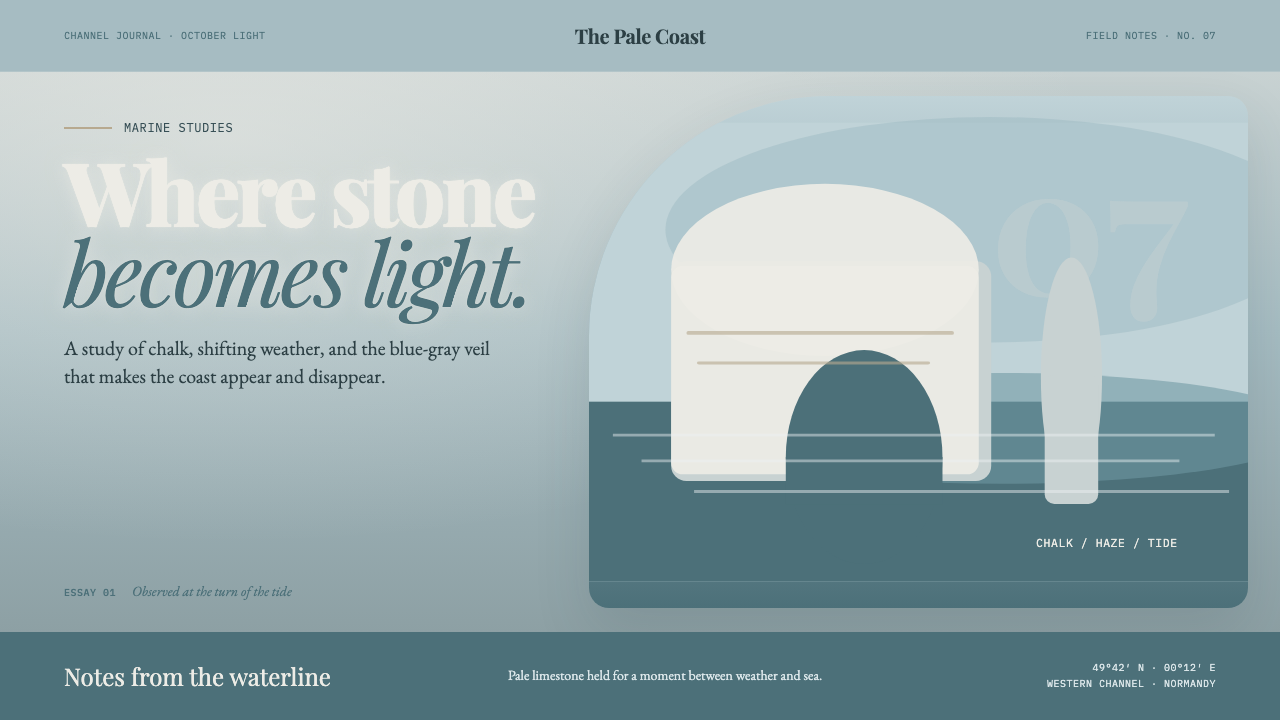 Étretat Chalk CliffsStone becomes light. Chalk-white forms dissolve through blue-gray mist and li…
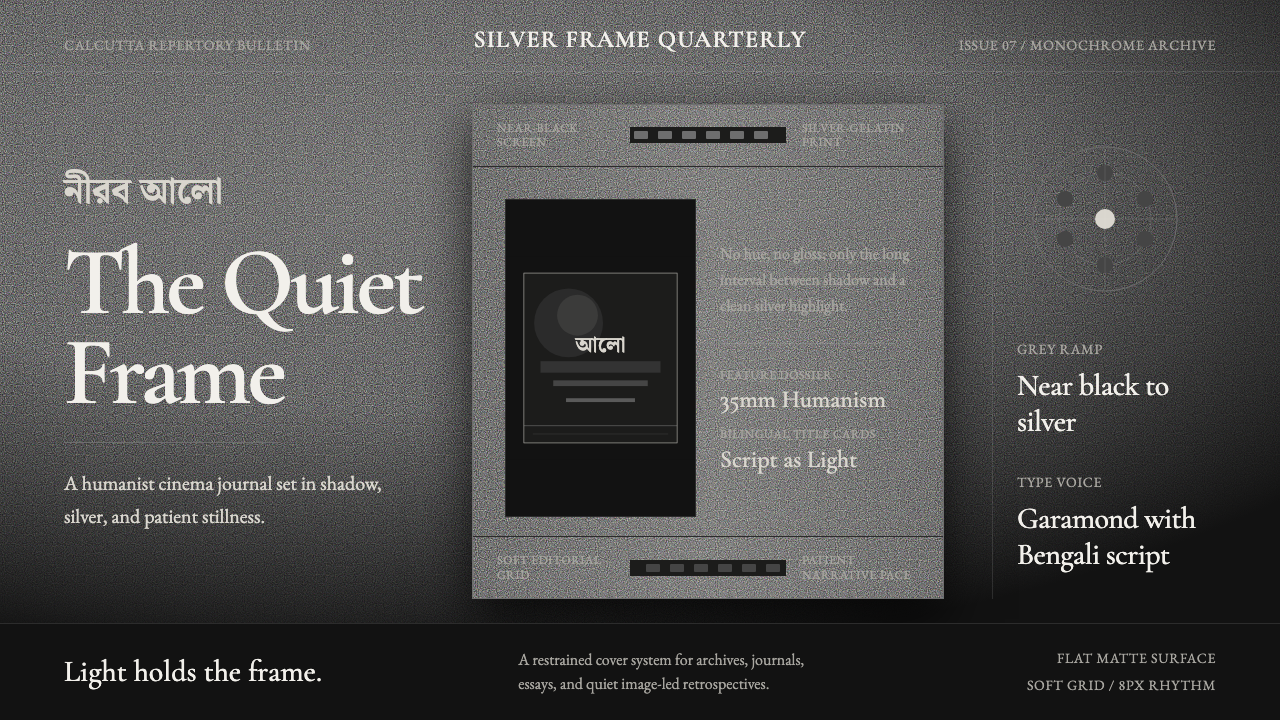 Bengali Art-House CinemaLight becomes restraint. Near-black ground, silver serif, and Bengali script…
 Eiffel Tower (1889)Structure speaks plainly. Graphite lattice, bronze rivets and measured type m…
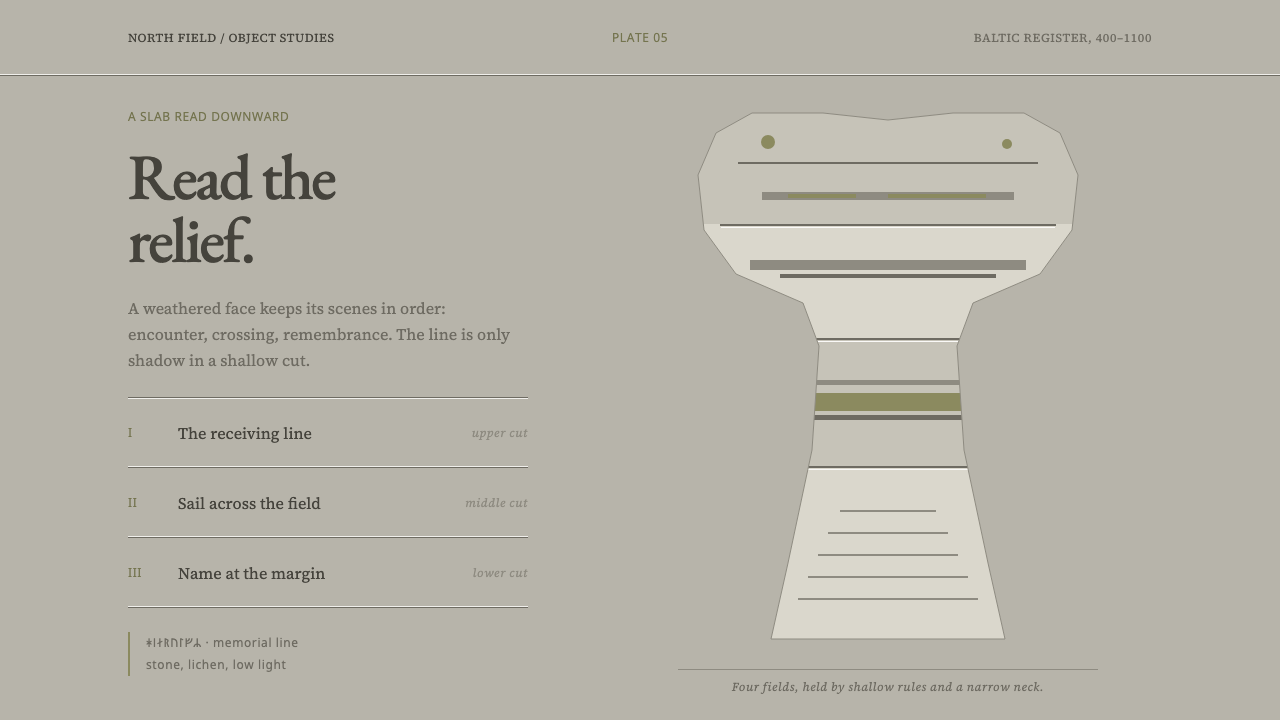 Gotland Picture StoneMeaning emerges slowly. Weathered limestone greys divide a story into shallow…
 Mongolian SoyomboReverent geometry. Gold Soyombo on Tengri blue, with vertical black-script rh…
 Ak-Kalpak Felt HatWhite does the work. Undyed felt tones, black hairline seams and four mirrore…