What is Shaker Broadside Print?
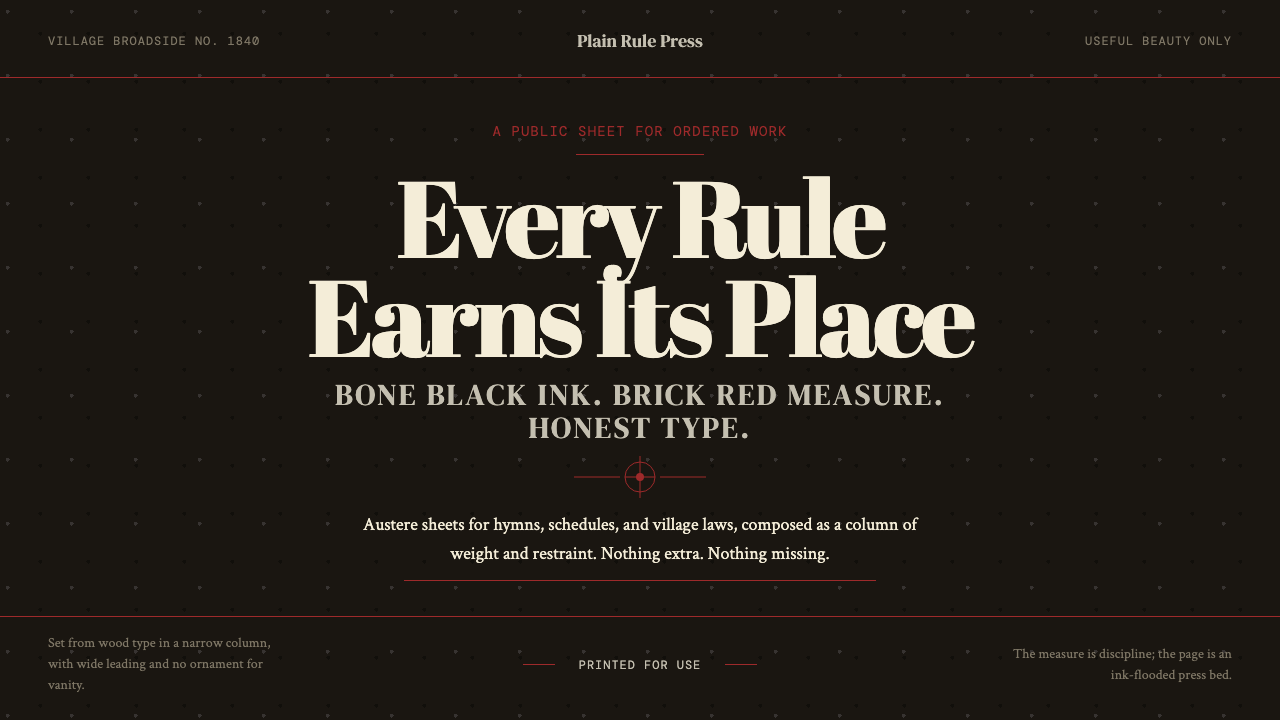
The Shakers printed the way they prayed — with absolute conviction that nothing unnecessary should exist.
Shaker Broadside Print in brief
Shaker Broadside Print is the typographic and compositional tradition that emerged from Shaker communal villages in the northeastern and central United States between roughly 1810 and 1870. Working with wood type, hand-set lead, and letterpress equipment, Shaker printers produced hymn sheets, seed catalogs, rules broadsides, and community announcements that share a distinctive visual grammar: deep, near-black grounds, brick-red accent rules, massive display letterforms organized in strict architectural hierarchies, and an almost total absence of decorative ornament.
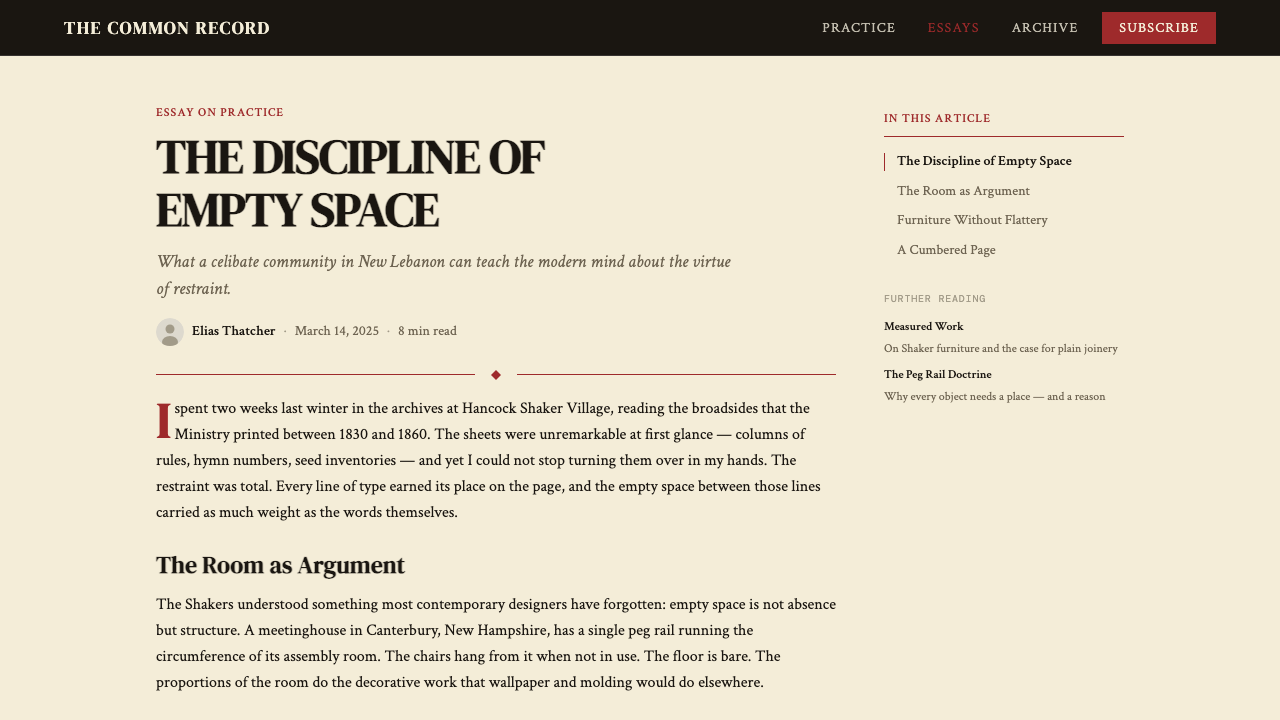
What makes this tradition remarkable is that it predates the European modernist rejection of ornament by more than half a century. While Victorian commercial printing was piling on flourishes, ornamental borders, and competing typefaces, the Shakers were producing work of spare, disciplined clarity rooted not in aesthetic theory but in religious conviction. For them, beauty was a byproduct of usefulness; anything added purely for visual effect was a form of pride, and pride was a sin. The result was a print language that looks, to contemporary eyes, startlingly ahead of its time.
The system draws its visual authority from constraint: a narrow palette of bone-black and brick red, wood-type letterforms with their inherent irregularity and tactile weight, and compositions that use scale contrast and vertical stacking rather than decoration to create hierarchy. Ink pressed into rag paper left visible impression and texture — material honesty that was a consequence of the process, not a stylistic choice, and that gives surviving Shaker broadsides their distinctive warmth within austerity.
Where does Shaker Broadside Print come from?
The United Society of Believers in Christ's Second Appearing — known universally as the Shakers — was founded in England by Ann Lee, who led a small group of followers to America in 1774. By the early nineteenth century, the movement had established a network of self-contained communal villages stretching from Maine to Kentucky, each organized around collective labor, celibacy, and the principle that work performed with skill and care was itself a form of worship. This theological foundation shaped every material object the Shakers made, from oval storage boxes and ladder-back chairs to the broadsides that governed community life.
Shaker printing developed out of practical necessity. Communities needed to communicate rules, share hymns, advertise surplus seeds and goods to the outside world, and distribute devotional texts. The first Shaker printing operations were modest — small hand presses, limited type inventories — but by the 1830s and 1840s, villages at Mount Lebanon, New York; Hancock, Massachusetts; Pleasant Hill, Kentucky; Sabbathday Lake, Maine; and Canterbury, New Hampshire had established functioning print shops with substantial wood-type collections. The peak years of Shaker broadside production, roughly 1830 to 1860, coincided with the movement's population zenith of around six thousand members.
The visual character of Shaker printing owed as much to material constraint as to ideology. Wood type was large, heavy, and limited in variety — it naturally imposed a kind of typographic discipline, because the printer could not set small, intricate compositions without purpose-cut sorts that most shops did not own. Bone-black ink, made from charred animal bones, produced a deep, slightly warm black that differed from the bluer-black of lamp-black inks standard in commercial printing. Brick-red accent color — used for horizontal rules that separated sections, underscored headings, or marked the top and bottom of a broadside — was available cheaply through iron-oxide pigments and became a signature of the Shaker print vocabulary.
The Shaker printing tradition began to decline in the latter half of the nineteenth century as membership fell and steam-powered commercial printing made outside production cheap and fast. By 1900, most Shaker villages had closed their print shops. What survived was a body of work preserved in Shaker museum collections and archives — most notably at the Shaker Heritage Society in Albany, the Shaker Museum in Old Chatham, and Sabbathday Lake, which remains the only active Shaker community. The broadsides themselves were rediscovered by typographers and design historians in the mid-twentieth century, who recognized in them a formal discipline that looked forward rather than back.
What defines the Shaker Broadside Print look?
Ground Color
The Shaker broadside palette is built on bone-black — a deep, slightly warm near-black derived from charred animal bone that differs subtly from the cooler, bluer blacks of standard commercial printing ink. This warmth gives the dark ground an organic quality, softening the visual severity without sacrificing depth. The ground reads as authoritative but not cold, a distinction that separates the Shaker palette from later industrial or digital interpretations of black-ground composition.
Brick-Red Accent Rule
Horizontal rules in brick red — an iron-oxide color available cheaply to early nineteenth-century print shops — are the single accent element that Shaker broadsides deploy consistently. These rules serve structural roles: separating sections, underlining headings, banding the top and bottom edges of a composition. They are never decorative in intent; each one marks a boundary or a transition. The earthen warmth of brick red against bone-black creates a visual temperature that is rich without being ornate, and the restraint of using only this one accent color amplifies its authority when it appears.
Wood-Type Hierarchy
Display type in Shaker broadsides is set in massive wood letterforms, often cut from maple or boxwood, that create a bold visual architecture when stacked vertically. The organizing logic is pure scale contrast: the most important information — a community rule, a hymn title, a product category — occupies the largest type, and subsidiary information cascades downward in progressively smaller sizes. There are no decorative dividers between levels; scale alone creates the hierarchy. The inherent imperfection of hand-cut wood type — slight variations in letter-spacing, occasional ink irregularities — gives the composition a tactile quality absent from mechanically perfect type.
Vertical Stacking
Shaker broadside compositions are organized along a single vertical axis rather than across a horizontal spread. Text blocks are centered or flush within a narrow measure and stacked top-to-bottom with deliberate breathing room between them. This architectural stacking mirrors the communal symmetry of Shaker meeting houses and furniture arrangements — everything aligned to a central spine, nothing veering left or right without reason. The result is a formal authority that feels almost monumental despite the humble scale of the printed sheet.
Ink-into-Paper Texture
Letterpress printing leaves a physical impression in the paper — ink is not merely deposited on the surface but pressed into it, creating a tactile relief that catches light and registers as texture to the touch. Shaker broadsides were printed on rag paper, which has a more irregular, absorbent surface than wood-pulp stock, making this impression more visible and more variable. The texture reads as material honesty: the process is not concealed but evident. This quality distinguishes the style from any purely visual imitation and explains why digital recreations of the aesthetic require deliberate attention to simulating surface variation.
Zero Ornament
Shaker printing contains no decorative borders, no typographic flourishes, no ornamental woodcuts, no decorative initial capitals, and no illustrative imagery beyond the occasional simple hand. This is not aesthetic minimalism in the contemporary sense; it is theological restraint made visible. The printed page, like the furniture and architecture of a Shaker village, was governed by the principle that pride — expressed through unnecessary adornment — was incompatible with the spiritual life. Every absent ornament is a kept promise.
Centered Symmetry
Unlike the dynamic asymmetry of modernist print traditions, Shaker broadsides are almost universally centered along a vertical axis. This symmetry is not the classical balance of academic tradition but a communal and spiritual one: no element claims more spatial territory than it deserves, and no side of the composition is favored over the other. The centering creates calm authority rather than visual excitement, a quality appropriate to text whose purpose is governance, devotion, or practical instruction rather than persuasion or spectacle.

Who shaped Shaker Broadside Print?
Hannah Cohoon (1788–1864) was a member of the Hancock, Massachusetts Shaker community and one of the movement's most important visual artists. Best known for her spirit drawings — intricate images of trees, fruits, and flowers received in spiritual visions — Cohoon worked in a tradition of inspired Shaker visual culture that ran alongside the printed broadside tradition. Her work demonstrates the capacity of Shaker aesthetics to contain richness within radical constraint: even her most elaborate spirit drawings maintain a flat, diagrammatic quality that refuses illusionistic depth. Cohoon's drawings were not printed broadsides, but they share the same underlying visual theology: every mark present for a reason, nothing extra.
Henry Clay Blinn (1824–1905) was the central printer, editor, and chronicler of the Canterbury, New Hampshire Shaker village and one of the most prolific figures in Shaker print culture. He managed Canterbury's print shop for decades, produced the community's publications, and kept meticulous records of Shaker life and history. Blinn's practical approach to typography — treating the printed page as a vessel for clear communication rather than an opportunity for display — exemplifies the Shaker print ethic at its most conscious and articulate. His publications demonstrate how the visual restraint of the broadside tradition was maintained even as outside commercial printing grew increasingly ornate.
Brockmeyer was associated with Shaker print operations in the western communities, particularly in the Kentucky villages. His work illustrates how the Shaker print vocabulary traveled across geography while maintaining remarkable consistency — the same bone-black grounds, the same brick-red rules, the same wood-type hierarchies appeared in broadsides produced hundreds of miles apart, because the underlying theology was the same across all communities. This geographic consistency is itself significant: the visual language was not a regional style but a communal discipline, enforced by shared belief rather than shared instruction.
Ann Lee (1736–1784) was the founder of the Shakers and the source of the theological convictions that shaped every aspect of Shaker material culture, including its print tradition. Lee taught that hands must be kept busy in honest labor and that all work should be performed as though for God. She did not herself engage in printing — the Shaker print tradition developed after her death — but the principle she articulated, that beautiful things arise naturally from honest work and the elimination of pride, is the direct theological ancestor of the visual discipline that distinguishes Shaker broadsides from all contemporary commercial printing.
Frederick William Evans (1808–1893) was the most public-facing Shaker leader of the nineteenth century, a prolific writer and the primary voice through which Shaker philosophy reached the outside world. As a writer and editor, Evans engaged directly with the print tradition as a medium of communication and outreach — his pamphlets and tracts were among the most widely distributed Shaker publications and helped establish the community's reputation for plain, clear, morally serious communication. His work illustrates the functional role of the broadside tradition: it was never art for its own sake but a vehicle for ideas, which is precisely why it looks the way it does.
How do you use Shaker Broadside Print today?
Shaker Broadside Print is a high-discipline style that rewards understanding its underlying logic before application. The visual system works because every choice — deep ground, limited accent color, massive wood-type scale, vertical stacking, absence of ornament — serves the same end: giving content an authority that comes from structure rather than decoration. Applied superficially, the aesthetic risks reading as merely gloomy or severe. Applied with attention to the underlying principle, it produces work with a rare quality of conviction.
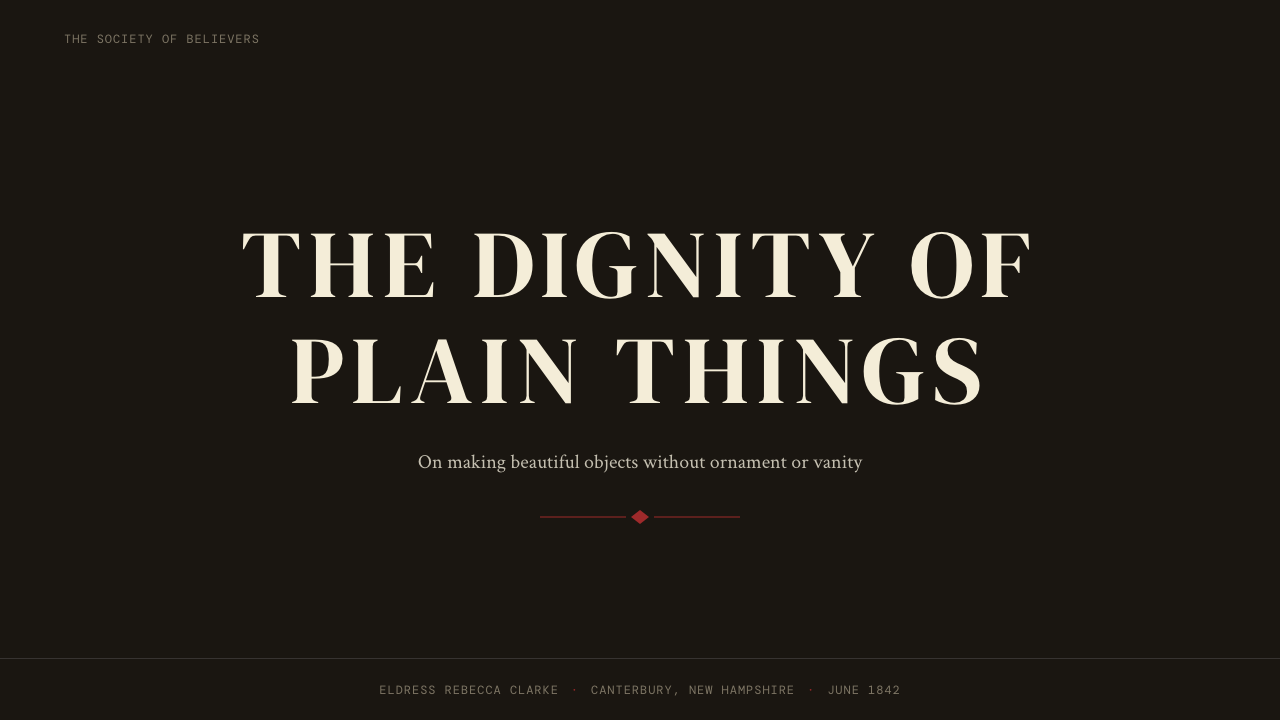
For presentation slides, the style is best suited to covers and section dividers where bold typographic hierarchy can do the structural work. A cover in this mode sets large display text — a company name, event title, or theme — in stacked lines against a near-black ground, with a single horizontal rule in warm red separating a subhead or date. Content slides should be spare: a clean off-white or pale ground, body text in a single weight, and section markers using a thin rule rather than a colored heading block. Data slides benefit from treating charts as geometric objects — axes and labels set with the same typographic economy as a Shaker hymn sheet, no legend boxes, minimal annotation.
For web interfaces and dashboards, the style's grid discipline and dark-ground variant translate well to environments where data density is high and distraction should be low. The near-black ground reads as a focused environment, and the warm brick-red accent used for interactive states, alerts, or active navigation items creates a clear visual hierarchy without the visual noise of multiple competing accent colors. Pricing pages in this mode are compelling: large, stacked type hierarchies for plan names and prices, ruled separators between tiers, and a single warm-toned call-to-action. The approach works best when the typography is doing all the work and graphic elements are nearly absent.
For editorial and marketing applications, the Shaker broadside register works well as a frameworkfor headline-led layouts, event posters, and any context where authority and seriousness are brand values. An event poster in this style stacks the event name in large display type at the top, followed by date and location in progressively smaller sizes, bound above and below by horizontal rules, all centered on a deep ground. For marketing landing pages, the approach benefits from generous vertical spacing — each content block allowed to breathe rather than packed together — with the brick-red rule marking section transitions and the typographic hierarchy carrying all information structure.
A common mistake when working with this style is reaching for multiple accent colors to relieve the severity of the palette. The system depends on the brick-red rule being the only warm element against the deep ground; adding a second accent — say, an off-white for subheads or a muted gold for icons — diffuses the authority of the primary accent and produces something that reads as eclectic rather than disciplined. Similarly, mixing typefaces from different historical periods undermines the wood-type unity of the original. If a single typeface family cannot supply the weight and scale variation needed, the solution is to use fewer text levels, not to introduce a second family.
Shaker Broadside Print — FAQ
Is Shaker Broadside Print the same as general Victorian letterpress design?
No — in fact, the two are almost opposites. Victorian commercial letterpress printing of the mid-to-late nineteenth century was characterized by extreme typographic variety, dense ornamental borders, competing display typefaces in multiple sizes, and the layering of decorative woodcuts and rules into compositions of considerable visual complexity. Shaker broadsides were produced during the same period but actively refused all of those conventions. Where Victorian printing sought to attract attention through visual abundance, Shaker printing commanded attention through visual restraint. The comparison is useful precisely because the contrast is so sharp: the same technology, the same material, opposite philosophies.
Why does the style use a dark ground rather than a white or cream field?
Not all Shaker broadsides used dark grounds — seed catalogs and rules sheets often used cream or off-white grounds with black ink, because those were the most economical production choices. The bone-black ground appears most prominently in devotional broadsides, community pronouncements, and hymn sheets where a more solemn, authoritative register was appropriate. In the design system, the dark ground is the signature choice because it best captures the visual temperature — deep, warm, weighty — that distinguishes Shaker print culture from both the lightness of contemporary minimalism and the chaos of Victorian commercial printing.
How does the Shaker style relate to later modernist design movements?
The relationship is one of parallel evolution rather than direct influence. Shaker design was largely unknown to European modernists; Gropius did not cite Shaker furniture when he founded the Bauhaus, and Tschichold did not reference Shaker typography in the New Typography. Both traditions arrived at similar conclusions — restraint, honest materials, structure over decoration — by different routes: the Shakers through theology, the European modernists through rationalist philosophy and industrial production logic. The convergence is intellectually interesting but historically coincidental. Appreciation for Shaker design by the design community came primarily through mid-twentieth century museum exhibitions and the Arts and Crafts revival, well after modernism had already reached its own conclusions.
Can this style work for digital interfaces, given its roots in physical print?
Yes, with intentional translation rather than literal imitation. The tactile qualities of letterpress — ink impression, paper texture, ink spread variation — cannot be reproduced on screen, and attempting to simulate them with digital effects tends to read as either nostalgic pastiche or low-fidelity artifact. What translates directly are the compositional principles: the near-black ground, the single warm accent, the vertical typographic hierarchy, the absence of decorative elements, and the use of a ruled line as the primary structural divider. These translate cleanly to screen environments and produce interfaces of considerable authority and focus. The key is to treat the digital application as an interpretation of the principles rather than a reproduction of the physical object.
What distinguishes an authentic application of this style from a superficial one?
The most reliable indicator is whether the visual restraint extends all the way through the design or only applies at the surface level. A superficial application takes the dark background and the red accent rule but then populates the layout with decorative icons, multiple typeface families, soft-shadow cards, and gradient buttons — elements that contradict the underlying logic at every level. An authentic application asks of each element: does this earn its place? Can I remove it without losing information or structure? The answer should be yes for anything ornamental. The second indicator is color discipline: one primary accent used consistently and sparingly, not as an opportunity for visual variety but as a structural tool. If a design needs more than one accent to function, it is compensating for compositional weakness rather than embodying the Shaker principle.
Related design styles
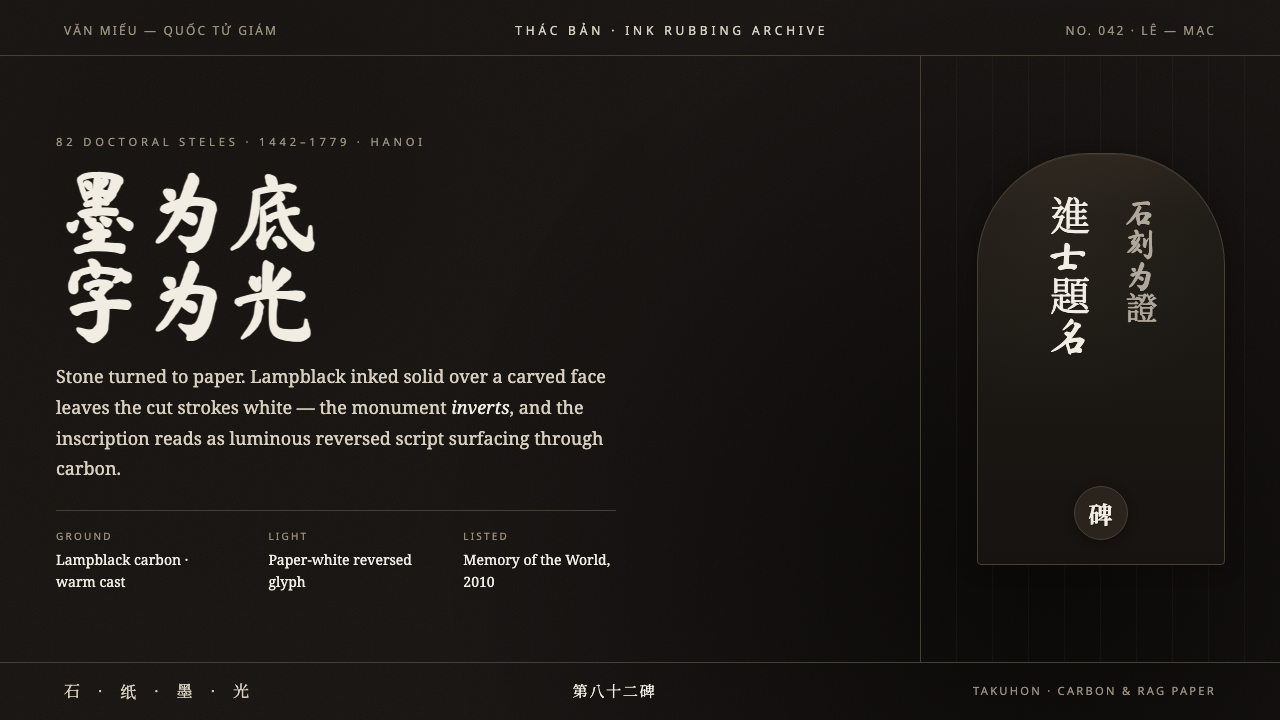 Vietnamese Stele RubbingStone turned to paper. Lampblack ground, ghost-white carved Han glyphs surfac…
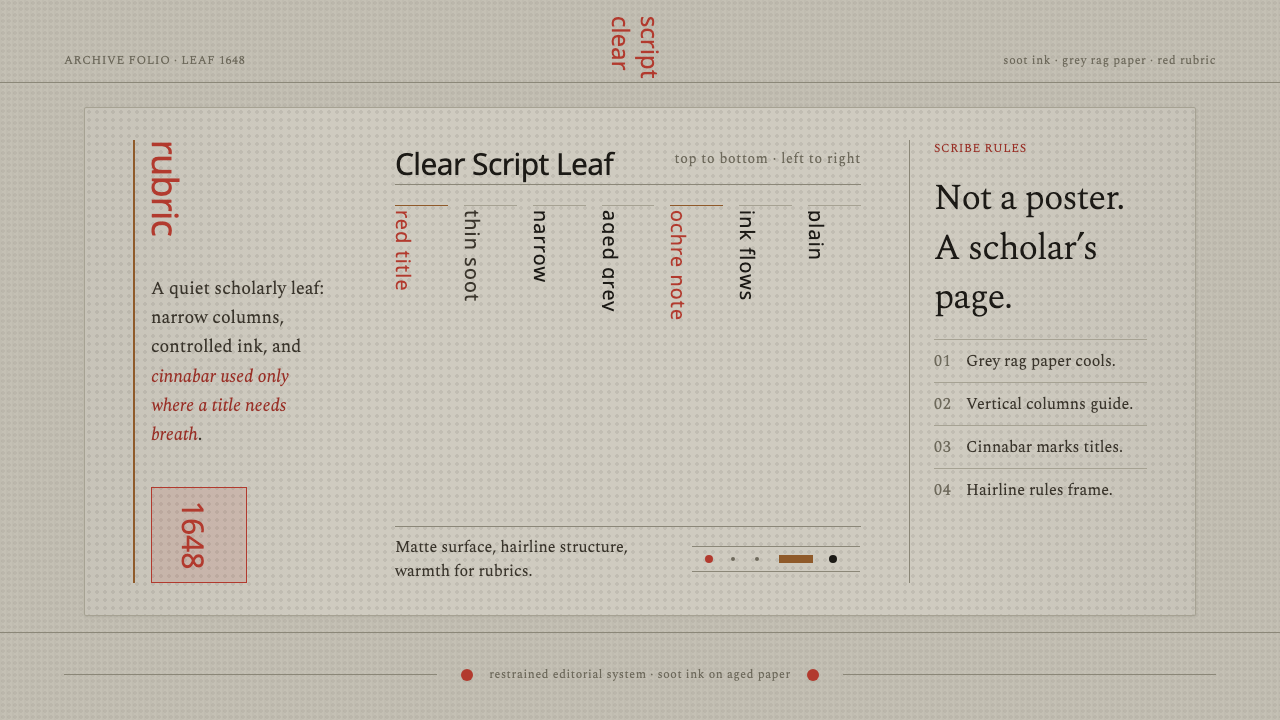 Kalmyk Todo Bichig Clear ScriptRestraint becomes script. Soot columns on grey rag paper, touched by cinnabar…
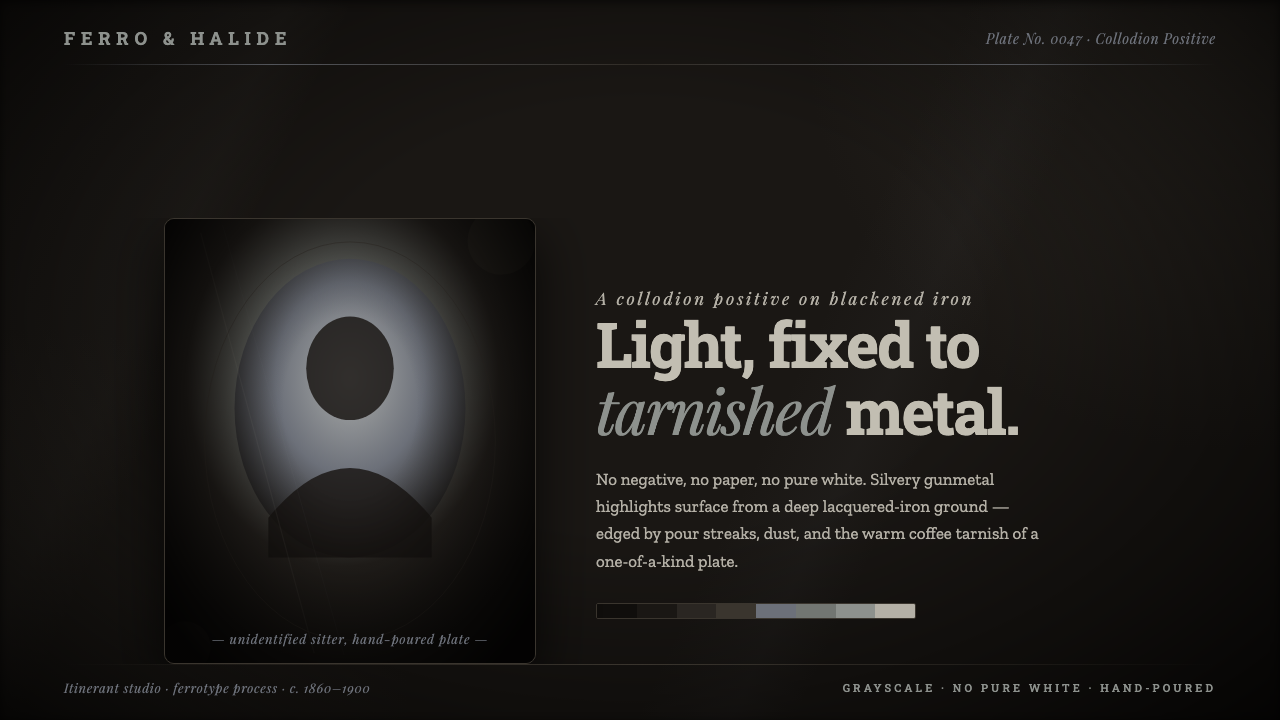 Tintype Wet PlateLight fixed to tarnished metal. Gunmetal grays rise from blackened iron, capp…
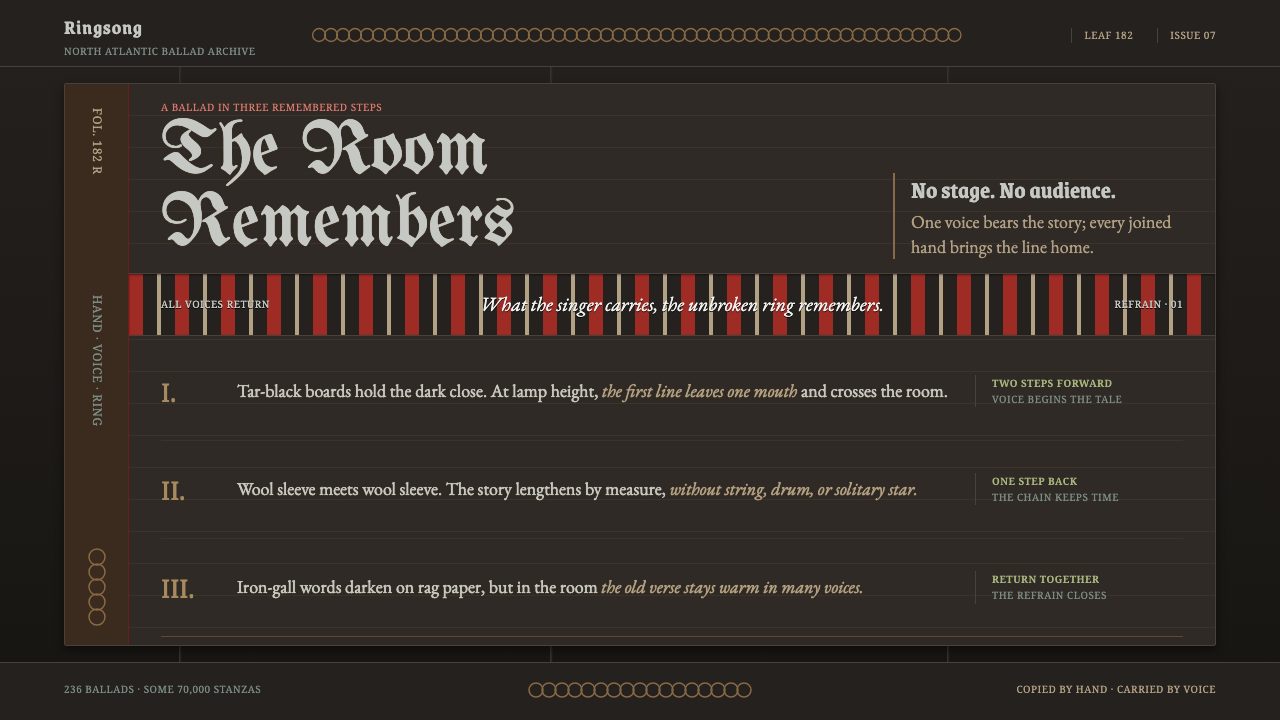 Faroese KvæðiThe room sings as one. Silver type and red refrain bands rule a tar-black man…
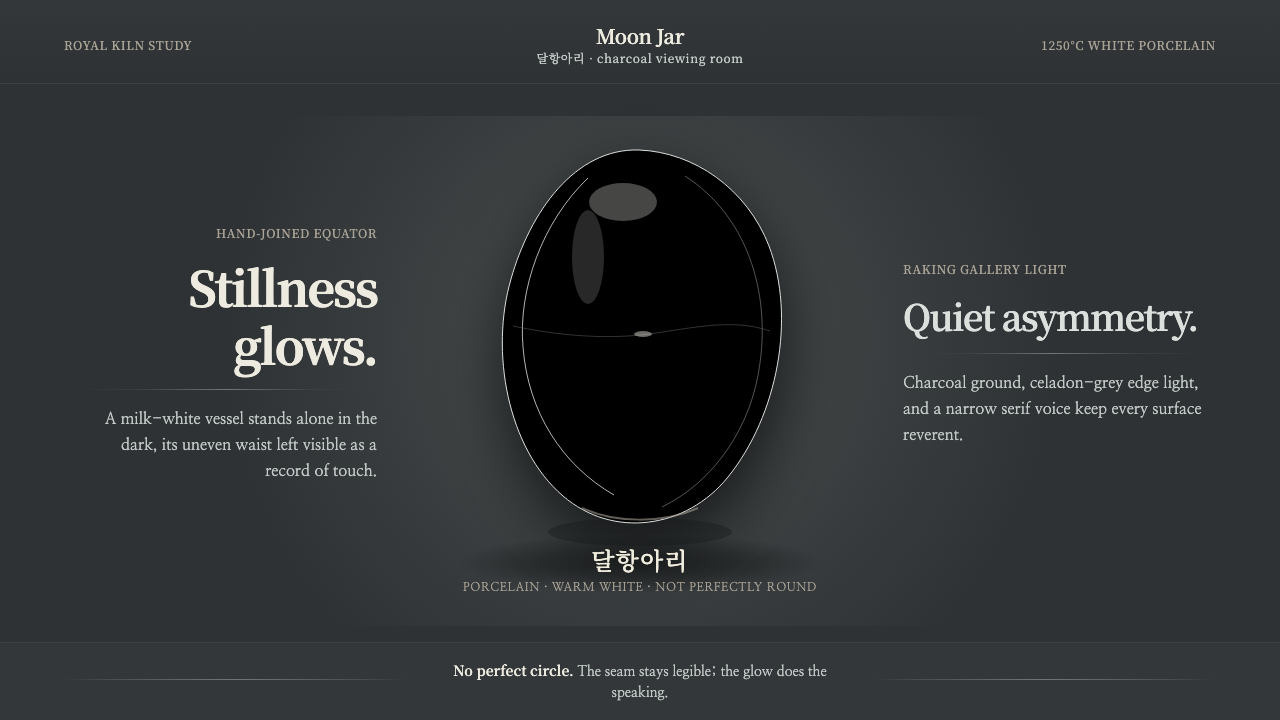 Joseon Moon JarQuiet imperfection glows. Milk-white porcelain floats on charcoal with a visi…
 Lepidoptera DrawerDark, ordered hush. Walnut ground, IM Fell type, cork slips, and gridded moth…