What is Mongolian Ovoo (Cairn Prayer Site)?
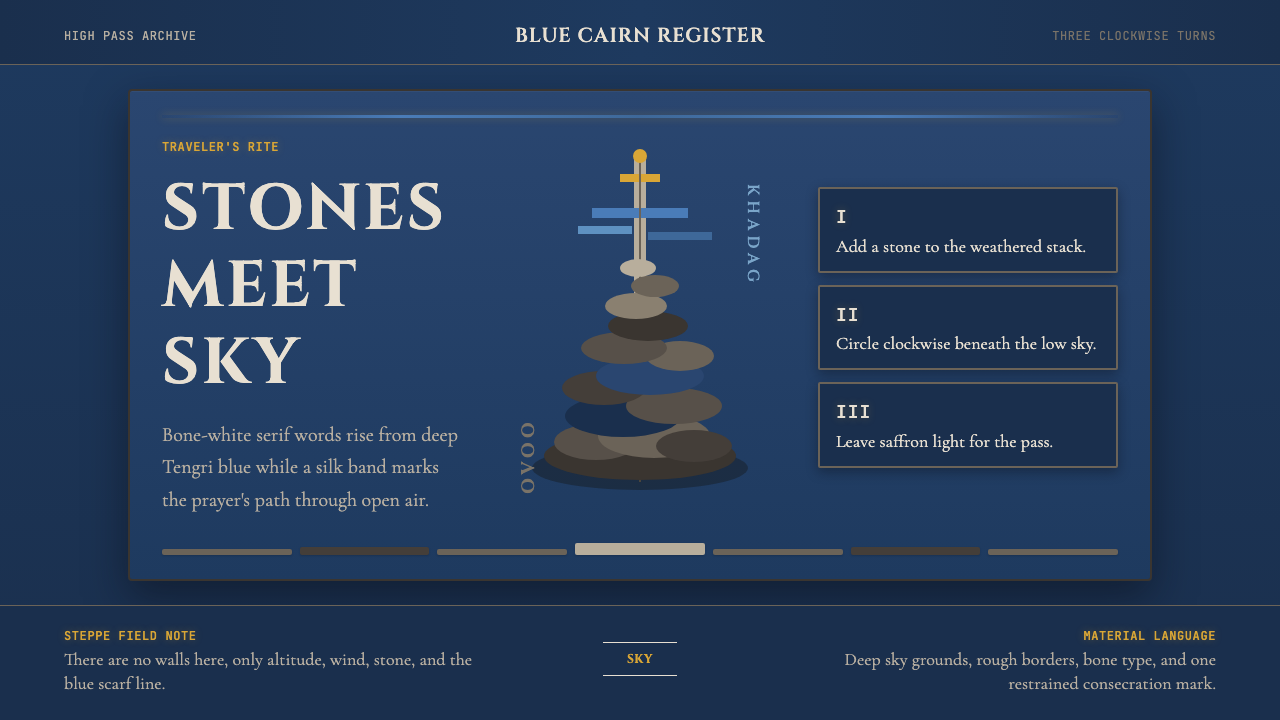
The Mongolian ovoo — a sacred cairn of stones, bleached wood, and sky-blue prayer scarves raised at mountain passes — becomes a design language of austere verticality, deep steppe-sky grounds, and bone-white type that weathers like stone.
Mongolian Ovoo (Cairn Prayer Site) in brief
Mongolian Ovoo (Cairn Prayer Site) is a design aesthetic drawn from the sacred cairns — called ovoo — that mark high passes, hilltops, and liminal zones across the Inner Asian steppe. An ovoo is not a monument built to last in the architectural sense; it is an accumulation: each traveler adds a stone, a branch, a strip of silk, until the pile becomes a breathing collaboration between landscape and human passage. The visual language of the style translates this quality into interface and graphic work — layered rather than monolithic, devotional in its attention to surface and absence.
At its core, the Mongolian Ovoo aesthetic is built on deep steppe-sky blue grounds, bone-white type that reads like carving in pale stone, and a single thread of silk blue — the color of the ceremonial khadag scarf — that runs through compositions as an accent line or highlight. Texture is implied rather than rendered: the roughness of granite, the grain of bleached larch, the flutter of dyed silk in high-altitude wind. The result is simultaneously grounded and vertiginous, heavy and airy, sacred and spare.
Unlike purely decorative ethnographic references, the Ovoo style is grounded in a consistent visual logic: deep grounds absorb the eye as an enormous sky absorbs a traveler; type sits carved and still; the accent scarf-color provides the only warmth or movement. This is a dark-mode aesthetic in temperament even when specific implementations vary — its emotional register is reverence and exposed space, not ornament or abundance.
Where does Mongolian Ovoo (Cairn Prayer Site) come from?
The ovoo tradition predates recorded history across the Inner Asian steppe, rooted in Tengrist shamanism — the animist belief system of the Turkic and Mongolian peoples centered on the sky deity Tengri and the earth deity Etugen. In Tengrist practice, high places are where the two realms touch: the sky presses down, the earth rises up, and the cairn marks the seam. Travelers who pass an ovoo add a stone to acknowledge the spirits of the place and invoke safe passage. The practice is neither prescribed nor centralized; it accumulates organically, one gesture at a time, across generations.
By the seventeenth century, the arrival of Vajrayana Buddhism in Mongolia — partly through the influential reformer and sculptor Zanabazar, the first Jebtsundamba Khutughtu — had layered Buddhist iconography and ritual structure over the Tengrist foundation without displacing it. Prayer flags, incense offerings, and mantras joined the stone and wood. The blue khadag silk scarf, whose color represents the sky and Tengri himself, became the ovoo's most recognizable textile element. This syncretism is itself a design principle: accumulation without erasure, each layer legible through the others.
Russian scholars in the nineteenth century began systematic documentation of ovoo practice across Buryatia and what would become the Mongolian People's Republic. Among them was Sergei Dordzhi Banzarov, whose 1846 work on the Black Faith — the term he coined for the pre-Buddhist shamanic tradition — remains a foundational text. The anthropologist Caroline Humphrey and the geographer Owen Lattimore both wrote extensively about ovoo as cultural infrastructure: not mere superstition but a technology for marking territory, coordinating passage, and sustaining community across the vast distances of nomadic life.
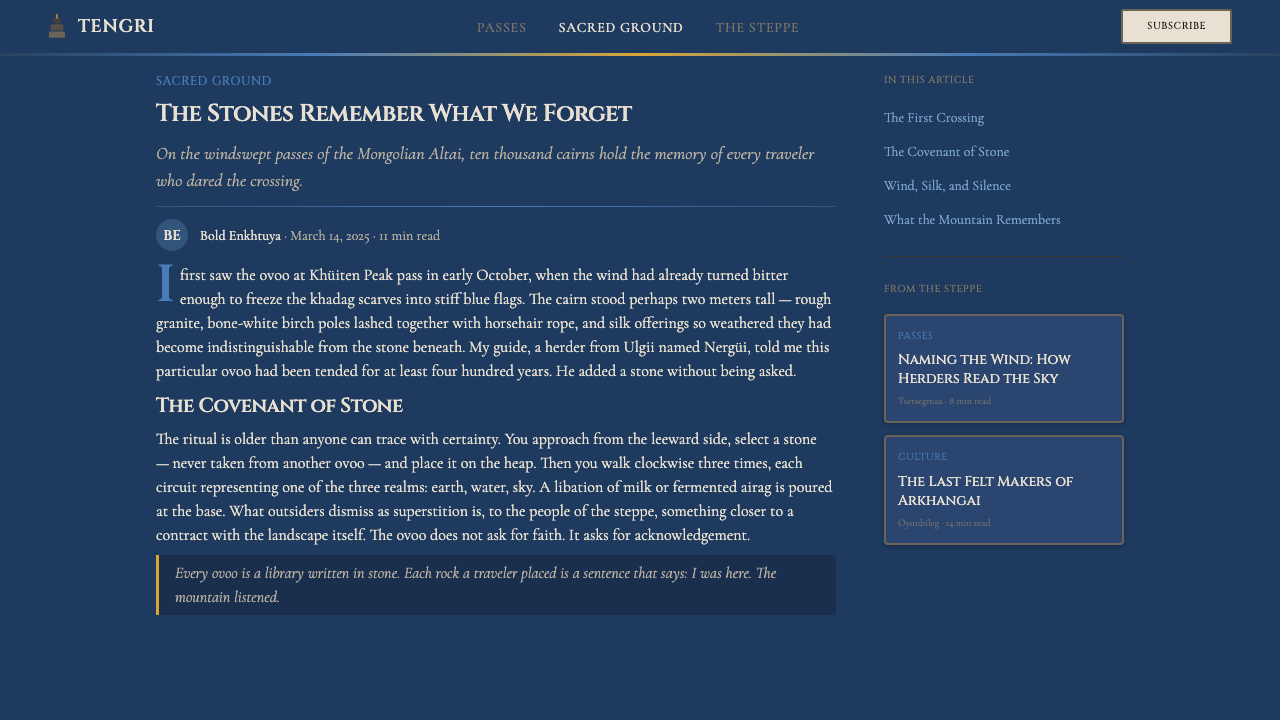
The spatial logic of the ovoo — high ground, expansive horizon, one vertical marker against an enormous sky — shaped the aesthetic vocabulary that eventually became this design style. The deep blue is the steppe sky at dusk, neither night nor day, neither protective nor hostile. The bone-white is weathered stone and bleached wood after years of wind and ultraviolet exposure. The silk-blue accent is the khadag itself: a flash of human intention in an inhuman landscape. These are not arbitrary color choices; they carry the weight of a specific relationship between a culture and its physical environment.
What defines the Mongolian Ovoo (Cairn Prayer Site) look?
Palette: Deep Sky and Bone
The dominant ground color is a saturated, mid-to-deep steppe-sky blue — the color of the Mongolian sky viewed from altitude at the blue hour between dusk and night. Against this ground, primary text and structural elements appear in a warm bone-white, neither pure white nor cream, suggesting weathered limestone or sun-bleached wood. A single silk blue — warmer and lighter than the ground, the precise color of a ceremonial khadag — appears as the system's accent, used sparingly for a single line, a highlight state, or a key label. Secondary tones are rarely needed; the power of the palette comes from its restraint to three closely related values rather than contrast through hue opposition.
Typography: Carved and Patient
Type in the Ovoo style carries the quality of stone inscription: serifs are appropriate and preferred, giving letterforms the sense of having been cut into a surface rather than painted onto it. Body text is set at a generous measure with deliberate spacing between lines, evoking the patience of reading weather-carved inscriptions. Headlines are large and unhurried, using scale rather than decoration to establish hierarchy. Weight contrast between headline and body is significant — the headline is a presence, not merely a label. All-caps usage in display contexts is acceptable and reinforces the monumental register; lowercase body text provides the necessary counterpoint of approachability.
Texture by Implication
The style does not render texture directly — no photographic grain overlays, no simulated stone patterns, no skeuomorphic surfaces. Instead, texture is present in the choice of ground color (a blue that carries the memory of open sky), in the weight of the type (letterforms that feel carved rather than screened), and in the placement of the accent line (the flutter of silk registered as a straight edge). This is texture as cultural memory rather than literal surface. Backgrounds remain flat; the depth comes from association rather than simulation.
Vertical Emphasis and Open Sky
Compositions in this style favor generous vertical space — the sense of a tall cairn silhouetted against an enormous horizon. Layouts breathe: generous margins, ample space between typographic elements, and a reluctance to crowd the visual field with competing content. When a single vertical element — a title, a rule, a single accent element — is placed against a large open ground, the effect echoes the experience of standing beside an ovoo in the steppe: the world is mostly sky, and the cairn is a point of orientation within it. This compositional restraint is not emptiness but presence through absence.
Accumulation and Layering
Where most minimal styles eliminate layering, the Ovoo aesthetic permits — even encourages — a quality of strata: elements that appear to have been placed one upon another over time, each legible through the others. This might manifest as typographic overlays where a large ghosted letterform sits behind smaller active text, or as subtle opacity differences between levels of a UI hierarchy. The principle is that depth should feel accreted, not engineered. Each layer should look as if it arrived with intention and then was added to by the next.
Sacred Restraint in Ornamentation
The Ovoo style is not anti-ornament in the ideological sense that Bauhaus was; rather, it treats ornamental elements as offerings — each one placed with intention and in small number. A single thin rule, a carefully positioned decorative glyph from an Inner Asian script tradition, or a deliberate asymmetric margin can function as the equivalent of a stone added to the pile: a small human mark within a larger natural order. Ornament is not absent but rare, and rarity is what gives each instance weight.
Dark Ground as First Principle
The style's deep blue ground is not a dark mode alternative to a light base — it is the aesthetic's natural state. The steppe sky is the environment, not a feature. This means that when adapting content for light-ground contexts (such as printed materials or light-mode UIs), the system requires deliberate reconstruction rather than simple color inversion: the ground becomes a sky-blue tinted near-white, the type shifts to near-black, and the khadag accent deepens to a richer, more saturated blue. The emotional register changes with the ground; light versions feel more documentary, less devotional.

Who shaped Mongolian Ovoo (Cairn Prayer Site)?
Zanabazar (1635–1723) was the first Jebtsundamba Khutughtu — the highest reincarnate lama of Mongolian Buddhism — and one of the most significant sculptor-artists of Inner Asia. His bronze figures, which synthesized Tibetan Buddhist iconography with distinctly Mongolian aesthetic sensibilities, established a visual language for the fusion of shamanic and Buddhist traditions that the ovoo itself embodies. His influence on sacred art across Mongolia, Inner Mongolia, and Buryatia meant that the visual vocabulary of Mongolian sacred spaces — including the color, textile, and spatial conventions associated with ovoo — developed in dialogue with his work.
Banzarov (1822–1855) was the first Buryat Mongolian scholar to receive a European university education, completing his studies at Kazan University. His 1846 dissertation The Black Faith, or Shamanism Among the Mongols was the first systematic academic study of Tengrist shamanism and remains foundational. By documenting the ritual function of ovoo within the broader cosmological framework of the steppe peoples, Banzarov preserved an intellectual record that allows the spatial and symbolic logic of the cairn tradition to be understood rather than merely observed.
Caroline Humphrey is a British social anthropologist at Cambridge whose fieldwork in Mongolia and Buryatia across several decades produced some of the most detailed accounts of ovoo ritual practice available in English. Her writings examine the ovoo not as a static monument but as an ongoing social process — a site of negotiation between human communities, natural forces, and cosmological powers. This understanding of the ovoo as accumulative, relational, and living rather than fixed and symbolic is precisely the principle that the design style translates into its approach to layering, restraint, and the treatment of accent elements.
Owen Lattimore (1900–1989) was an American scholar and journalist who spent decades traveling and living across Inner Asia and wrote extensively about the geographical and cultural logic of the steppe. His analyses of how nomadic peoples organize space, mark territory, and build community through infrastructure like the ovoo provided a framework for understanding the cairn not as a religious anomaly but as a rational technology for inhabiting vast, undifferentiated landscape. His geographic sensibility informs how this design style thinks about white space: not as emptiness to be filled but as steppe to be navigated.
How do you use Mongolian Ovoo (Cairn Prayer Site) today?
The Mongolian Ovoo aesthetic is among the more distinctive and context-sensitive historical styles available for contemporary design work. Because its emotional register is reverence, exposure, and austere verticality — rather than energy, playfulness, or warmth — it suits products and communications that benefit from that same quality: solemnity without stiffness, grandeur without excess. Applying it well requires understanding what the visual system is doing structurally, not simply borrowing its color palette.
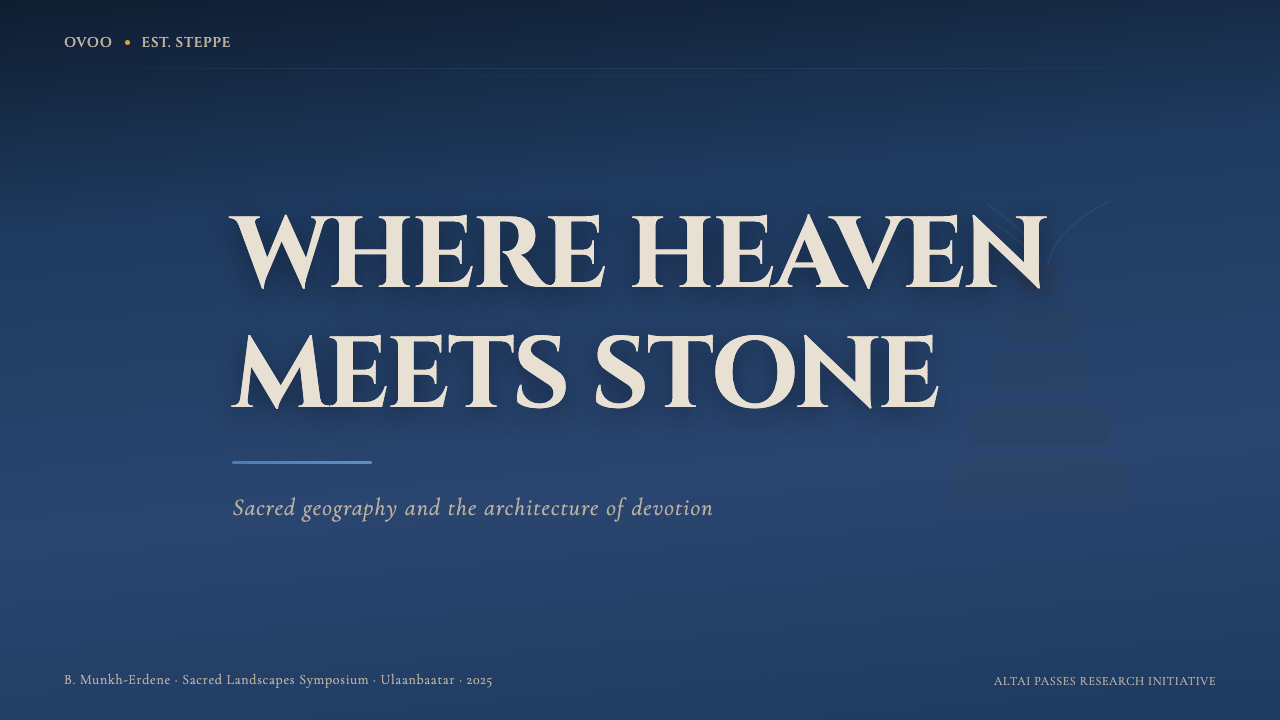
For presentation slides, the Ovoo style works powerfully on cover pages and section dividers where a single strong statement needs to land. A cover built on a deep blue ground, a large bone-white serif headline, and a single silk-blue rule below the title reads as intentional and distinctive without requiring any graphic decoration. Content slides benefit from treating the ground as a sky: wide margins, spare bullet structure, generous space between items. Data visualizations in this style should use the accent blue for the primary data series and bone-white for secondary reference lines — the visual hierarchy mirrors the hierarchy of sky above and ground below.
For web interfaces, the Ovoo style suits applications where depth, trust, and considered experience are primary values: research platforms, cultural institutions, premium editorial products, and tools aimed at sustained engagement rather than rapid conversion. The approach: commit fully to the deep blue ground and resist the impulse to lighten it for accessibility reasons by using only bone-white text at large, well-spaced sizes. Navigation is typographic and vertical-friendly. Cards and content blocks appear as accumulated layers rather than bordered containers — slightly different opacity levels or subtle shadows distinguish depth without hard borders. Interactive states use the silk-blue accent to mark focus and selection.
For editorial and marketing work, the style excels in long-form contexts: journal covers, book interiors, cultural institution communications, and annual reports. The compositional principle of one vertical marker against an open ground — derived from the cairn itself — makes for powerful full-bleed layouts where a single large typographic element anchors a deep blue field. Marketing pages can alternate between full-ground-blue hero sections and bone-white body sections, using the accent blue consistently for calls to action or highlighted data points. The style is less suited to fast-moving consumer product marketing, where its deliberateness reads as slow rather than thoughtful.
A common mistake when applying the Ovoo style is treating the deep blue as merely a dark background and then populating it with the same density of content and contrast that would work on a light ground. The deep blue is environmental — it needs room to function as sky. Crowding it with multiple competing type scales, icon sets, and brightly colored UI components destroys the spatial logic the style depends on. Equally, introducing warm neutrals, amber tones, or any color outside the three-value palette (deep blue, bone-white, silk-blue) breaks the system's coherence. The strength of this style is precisely its commitment to a narrow, culturally specific palette; diluting that commitment produces a generic dark-mode aesthetic rather than something with the particular resonance of the steppe.
Mongolian Ovoo (Cairn Prayer Site) — FAQ
Is this style appropriate for products outside of cultural or heritage contexts?
Yes, but the application needs to be grounded in what the style actually communicates rather than its surface appearance. The Ovoo aesthetic's core qualities — depth, patience, reverence for space, and the sense of something accreted rather than engineered — translate effectively to any product that wants those values: a long-form research tool, a meditation application, a premium publication platform, or a cultural organization's digital presence. The mistake is applying the palette and type conventions while ignoring the spatial logic, producing something that looks like a borrowed aesthetic rather than a coherent design decision.
How does the Ovoo style differ from generic dark-mode design?
Generic dark-mode design inverts a light-ground system — it starts from utility and adjusts for low-light contexts. The Ovoo style's deep blue ground is its natural state and primary expressive medium. The differences show up in several ways: generic dark mode tends toward near-black or very dark grey grounds; Ovoo uses a saturated, directional blue that reads as sky rather than shadow. Generic dark mode accommodates a broad range of accent colors; Ovoo commits to a single silk blue. Most importantly, generic dark mode is density-neutral — it will accept as much content as the light version. Ovoo demands spatial generosity; density breaks its logic. The spiritual register of the steppe is present in well-executed Ovoo work and entirely absent from generic dark UIs.
Can the Ovoo style work in a light-ground version?
It can, but with significant loss of the style's characteristic quality. The deep blue ground is not an optional variant — it is where the steppe-sky metaphor lives. A light version requires reconstruction: the ground becomes a sky-blue tinted near-white, the type moves to near-black, and the silk-blue accent becomes a deeper, richer blue to maintain its distinctiveness against the lighter field. The result is usable and retains some of the style's typographic and spatial logic, but it loses the particular sense of enormous atmospheric depth that the dark ground provides. Light versions are appropriate for printed materials or contexts with strong accessibility constraints; they should not be treated as equivalent to the base style.
What kinds of imagery work within the Ovoo aesthetic?
Photography and illustration within the Ovoo style should carry the same spatial logic as the rest of the system: expansive, unhurried, and dominated by sky or open ground. Documentary landscape photography of the Mongolian steppe — shot at dusk or under overcast skies with long horizons — integrates naturally. More generally, images with a strong vertical subject against an open ground work well: a single figure on a hillside, a tower against sky, a lone tree. Heavily cropped, detail-focused, or visually busy imagery conflicts with the style's core spatial principle. Illustration should tend toward simplified, near-silhouette forms rather than detailed rendering — think of the visual weight of a cairn seen from a distance rather than the textural detail of its individual stones.
Does the Ovoo style incorporate script or calligraphic elements from Mongolian writing traditions?
The vertical orientation of traditional Mongolian script — written in columns from top to bottom, left to right — aligns naturally with the style's compositional emphasis on vertical elements, and incorporating a few glyphs or script fragments as decorative elements is historically grounded and visually coherent when done with restraint. However, this should be treated as an accent in the same way as the silk-blue line: rare, intentional, and never as a substitute for the system's primary typographic structure. Using Mongolian script elements without understanding their meaning, or using them at a scale and density that reduces them to texture, crosses into superficial exoticism. When in doubt, the spatial and color logic of the system is sufficient without any direct textual reference to the tradition.
Related design styles
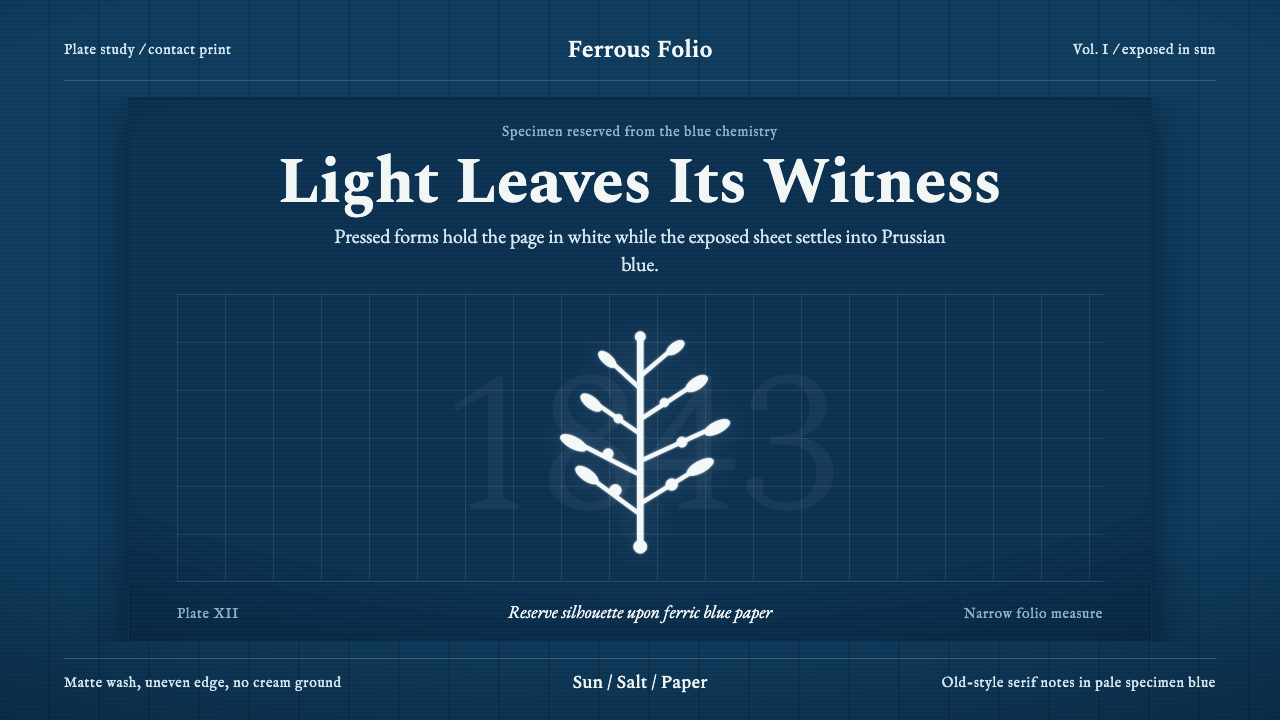 Anna Atkins CyanotypeScience turns spectral. Prussian blue ground, white reserves, Victorian serif…
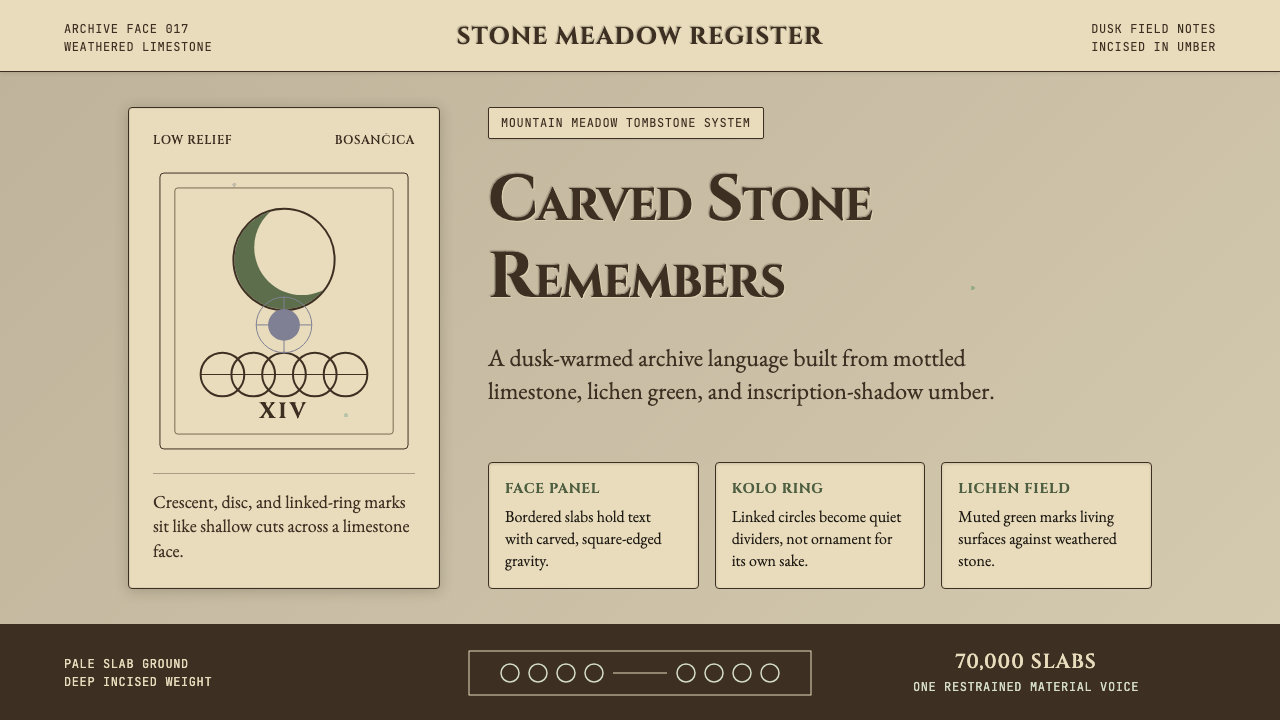 Bosnian Stećak Medieval TombstoneStone remembers quietly. Lichen green and Cinzel cuts sit on weathered limest…
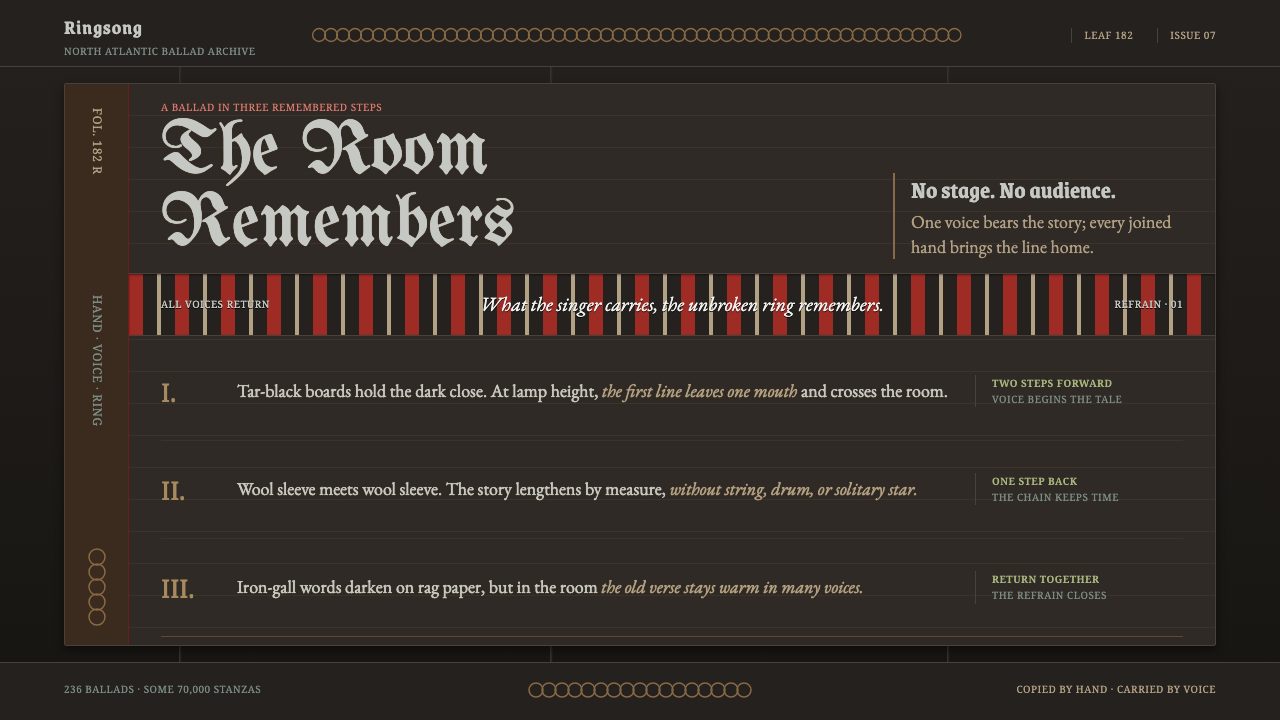 Faroese KvæðiThe room sings as one. Silver type and red refrain bands rule a tar-black man…
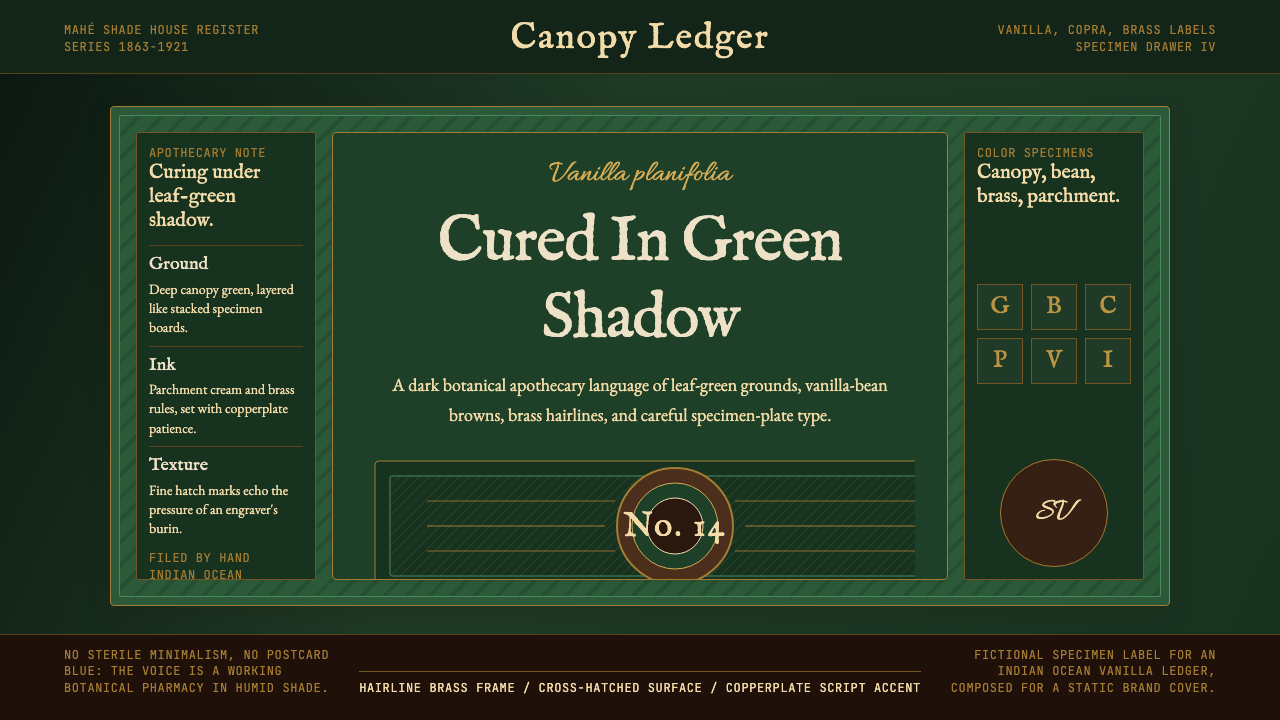 Seychellois Vanilla TakamakaBotanical apothecary in shadow. Deep green, brass hairlines, and copperplate…
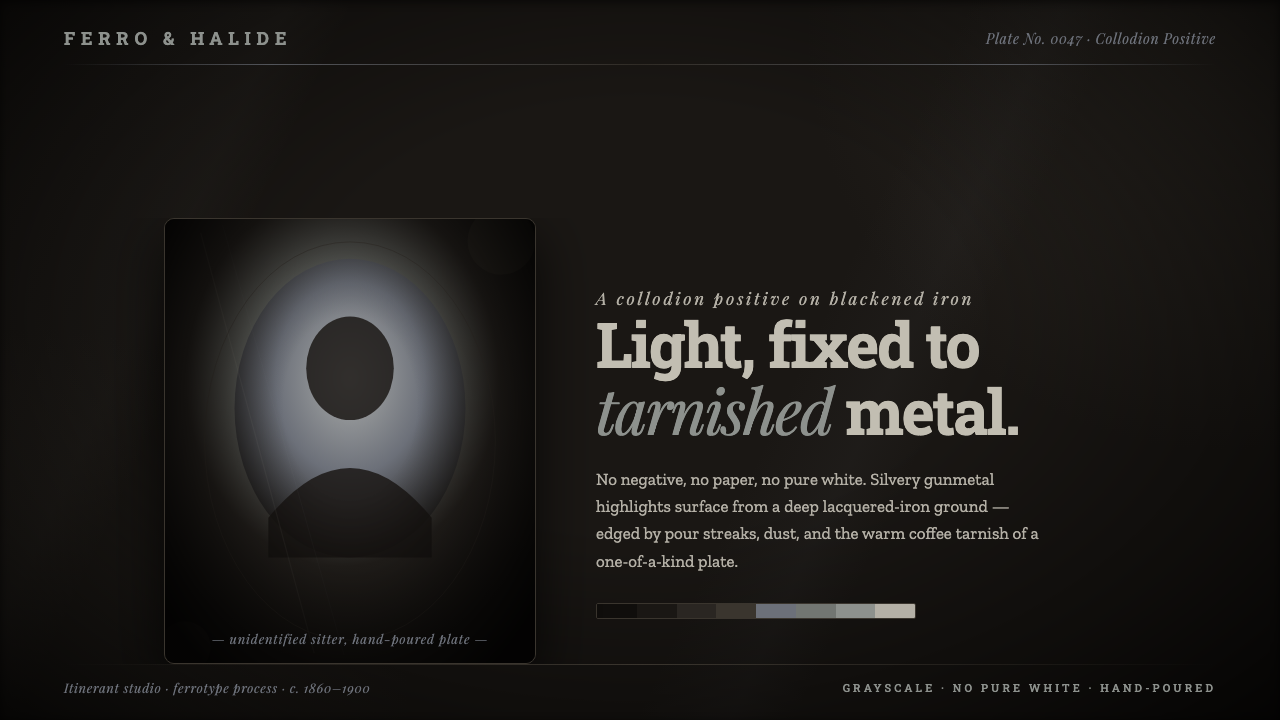 Tintype Wet PlateLight fixed to tarnished metal. Gunmetal grays rise from blackened iron, capp…
 Hiroshige — Tokaido RoadA road print in motion. Prussian blue blocks, vermilion cartouches, diagonal…