What is Seychellois Vanilla Takamaka?
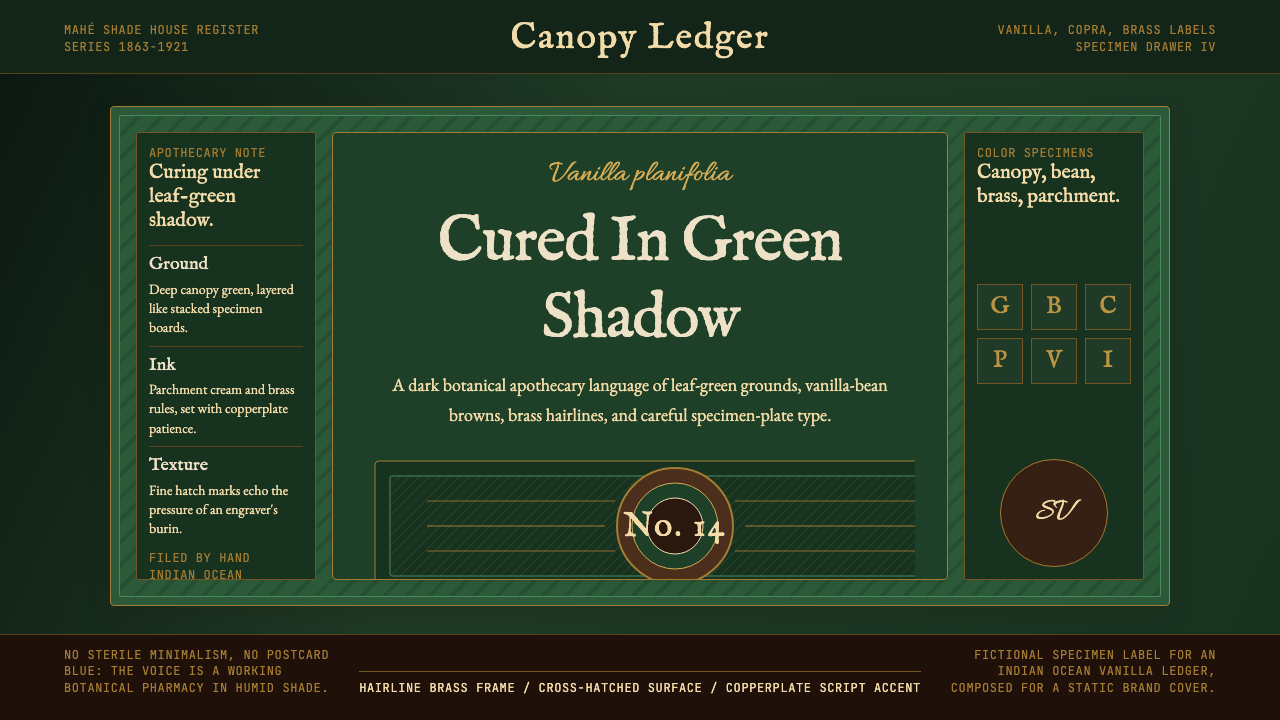
Deep in the shade of takamaka canopies, where vanilla vines spiral upward and brass-fitted bottles of rum age in silence, a design language rooted in the Indian Ocean's colonial botanical trade quietly insists that luxury is a matter of precision, not abundance.
Seychellois Vanilla Takamaka in brief
Seychellois Vanilla Takamaka is a design aesthetic rooted in the botanical apothecary culture of nineteenth-century Seychelles. It draws on the visual world of colonial-era copperplate engravings, hand-labeled specimen bottles, and the slow craft of vanilla curing — translating those references into a digital design language built on deep leaf greens, warm brass accents, and vanilla-cream typographic surfaces.
The defining quality is controlled darkness. Where many nature-inspired systems reach for bright tropical palettes, this one insists on shadow — the understorey of the forest floor rather than the sun-lit canopy, the interior of a curing shed rather than the open beach. Against that deep ground, fine hairline rules and cream-toned letterforms carry the precision of a Kew Gardens specimen plate: everything is labeled, measured, and placed with the gravity of scientific documentation.
The system sits at the intersection of botanical illustration and colonial pharmacopoeia. It is simultaneously lush and austere — dense with tactile reference (bark texture, parchment weight, oxidized brass) yet visually restrained in the sense that every element earns its place by contributing to a cumulative sense of provenance and expertise. The result is a dark-ground aesthetic that reads as knowledgeable and deliberate rather than merely dramatic.
Where does Seychellois Vanilla Takamaka come from?
The Seychelles archipelago — Mahé, Praslin, La Digue, and their surrounding islands scattered across the western Indian Ocean — came under sustained French colonial administration from the 1770s and passed to British control after the Napoleonic Wars. The islands' economy in the nineteenth century was organized around two botanical commodities: vanilla and copra. Vanilla, originally native to Mexico, had been introduced to the Indian Ocean islands in the 1840s through the efforts of French naturalist and colonial administrator Pierre Poivre and his successors. The hand-pollination technique developed on the island of Réunion made large-scale cultivation viable, and the Seychelles became one of the world's significant producers.
The material culture of this economy was rich with the visual references that now define the aesthetic. Vanilla beans were dried and cured on wooden trays in open-sided sheds, their progress tracked in ledgers with copperplate handwriting. Export shipments were packed in crates labeled with engraved paper seals. Rum distilled from molasses — today carried forward by Takamaka Rum, one of the islands' best-known contemporary products — was bottled in brass-fitted glass, its labels modeled on the apothecary traditions of the colonial pharmacopoeia. The entire trade operated through a visual register of documentation, provenance, and expertise rendered in ink, brass, and dark-stained wood.
The botanical illustration tradition that provides the system's most direct visual ancestor was formalized not in Seychelles but in Britain. The painter Marianne North made a celebrated journey through the Indian Ocean in the early 1880s, producing detailed oil paintings of the islands' flora — takamaka trees, coco de mer palms, endemic orchids — that now hang in the Marianne North Gallery at Kew Gardens. Her work exemplifies the cross-hatched, densely detailed approach to botanical documentation that the Seychellois Vanilla Takamaka system abstracts and systemizes: a combination of rigorous observation and an aesthetic pleasure in the complexity of plant form.
The contemporary revival of artisan craft production in the Seychelles, gathering momentum since the early 2000s, has reinvigorated these visual references. Small-batch vanilla producers, artisan distilleries, and eco-lodge hospitality brands on the islands have returned to the design language of the plantation era as a marker of authenticity and craft quality — hand-stamped labels, wax-sealed packaging, typography in the copperplate tradition. The Seychellois Vanilla Takamaka system takes this contemporary artisan revival as its immediate design context and extends it into a coherent digital vocabulary.
What defines the Seychellois Vanilla Takamaka look?
Palette
The palette is anchored in deep forest greens — the understorey of the takamaka canopy — offset by vanilla-bean browns, parchment creams, and the warm oxidized tone of aged brass. Against these ground colors, fine lines and typographic elements appear in cream or pale gold. The system is built for dark backgrounds: the greens are near-black in density, and the overall impression is of depth and shadow rather than brightness. Accent colors are restrained and warm; nothing reads as cool, synthetic, or saturated.
Line Work
Hairline rules — the thinnest legible line weight — are among the system's most distinctive formal elements. They appear as border frames, section dividers, and decorative infill in the manner of copperplate engraving margins. Cross-hatching and fine parallel lines evoke the shading conventions of botanical illustration. These line elements are not ornamental in the sense of being arbitrary; they carry the visual logic of a medium (copperplate engraving) that communicated precision and expert knowledge.
Typography
Type references the copperplate script and engraving letterforms of nineteenth-century botanical publishing. Headlines carry formal weight and slight cursive character; the overall typographic register is that of an expert scientific document or a hand-lettered apothecary label — authoritative and meticulous. Body text is set with generous leading to evoke the legibility standards of printed specimen plates. Hierarchy is established through the contrast between formal display letterforms and more restrained text-weight companions, never through color saturation.
Texture and Material Reference
The system carries persistent material references even in digital contexts: parchment grain in background fields, the subtle oxidation pattern of aged brass in accent elements, the tactile quality of dried botanical material in texture overlays. These references are handled with restraint — evoked rather than simulated, present enough to ground the aesthetic in material culture without competing with content legibility. The effect is that of a surface with evident provenance rather than a flat digital screen.
Composition and Hierarchy
Layouts favor the asymmetric compositions of specimen plates and apothecary label design: a dominant textual block (the botanical name, the product designation) sits within a carefully measured frame, surrounded by ruled borders, smaller classification text, and fine decorative line work. The center of the composition is often the densest point; margins are generous and used for secondary information. This approach produces a sense of deliberate curation — nothing is left to accident.
Contrast Logic
The system relies on a specific contrast relationship: the cream and pale gold of text and line work against the near-black depth of the ground color. This is not a high-legibility contrast in the conventional sense — it is a warm, antiquated contrast that trades the crispness of pure black-on-white for the richness of candlelight on parchment. Accessibility considerations require attention here; the warm contrast ratio must be tested against minimum legibility thresholds in digital implementations.
Ornament Discipline
Unlike systems that claim botanical reference while deploying ornament indiscriminately, Seychellois Vanilla Takamaka restricts decorative elements to those with a clear precedent in the source tradition: engraving borders, cross-hatched shadows, specimen labels, and the occasional small botanical motif. Every ornamental element should be traceable to the copperplate and apothecary repertoire. Decorative elements that belong to unrelated craft traditions — filigree, floral swashes, watercolor splashes — are disqualifying intrusions.
Who shaped Seychellois Vanilla Takamaka?
Poivre was an eighteenth-century French naturalist, administrator, and prolific botanical smuggler whose efforts to break the Dutch spice monopoly brought cloves, nutmeg, and the conditions for subsequent vanilla cultivation to the Indian Ocean islands. As intendant of Île de France (Mauritius) from 1767, he established the Pamplemousses botanical garden and oversaw the transfer of spice plants throughout the region. His legacy is foundational to the economic and botanical history that the Seychellois Vanilla Takamaka system draws upon.
North was a Victorian-era botanical painter who traveled the Indian Ocean in the early 1880s and produced a substantial body of oil paintings documenting the flora of Seychelles, including takamaka trees, coco de mer palms, and endemic species. Her work — now housed in the gallery purpose-built for her collection at Kew Gardens — represents the nineteenth-century botanical illustration tradition at its richest: densely observed, formally composed, and suffused with the specific quality of Indian Ocean light. The cross-hatching and detailed linework of copperplate botanical engraving, which the Takamaka system directly references, was the print medium equivalent of North's painted approach.
Takamaka is a contemporary Seychellois rum brand founded by the d'Offay family on Praslin island that has become one of the most visible international representatives of Seychellois craft production. Its bottle design, label typography, and brand visual language — dark grounds, brass detailing, handcraft references — directly instantiate the aesthetic vocabulary that the design system codifies. Takamaka demonstrates that the botanical apothecary reference is not merely historical nostalgia but an active contemporary design register for premium Seychellois goods.
The Royal Botanic Gardens at Kew, established in its current form in 1840, became the institutional home of the finest botanical illustration tradition in the English-speaking world. The Kew model — rigorous scientific documentation rendered with aesthetic care in engraving and watercolor — defined the visual register of authoritative botanical knowledge for over a century. The Seychellois Vanilla Takamaka system draws explicitly on the visual grammar of Kew-style specimen plates: the fine line work, the labeling conventions, the compositional gravitas of a document that is simultaneously a scientific record and an aesthetic object.
How do you use Seychellois Vanilla Takamaka today?
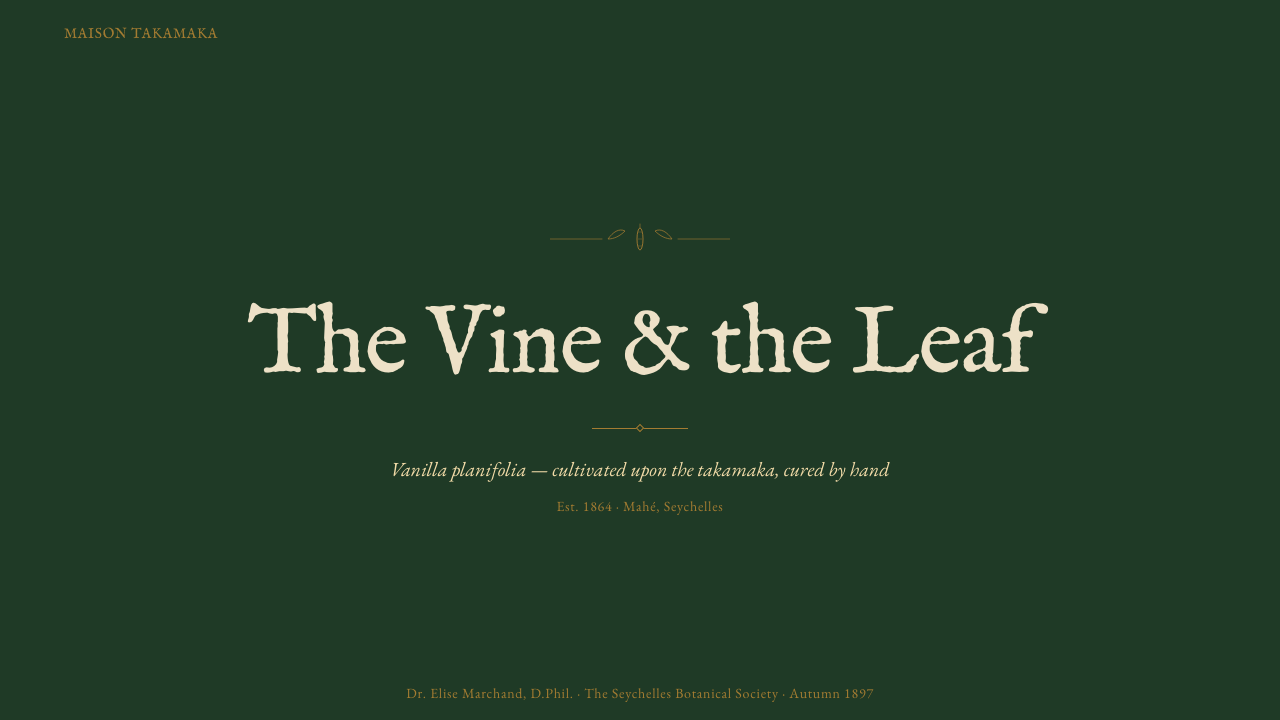
Seychellois Vanilla Takamaka is most powerful when applied to contexts where provenance, craft quality, and expert knowledge are core to the communication. Presentation cover slides designed in this system benefit from treating the entire slide as a framed specimen: a single subject centered or asymmetrically anchored within hairline borders, formal type giving the subject its full botanical or product name, and the deep green ground establishing the register of serious documentation. This is a system for contexts where authority matters — it should not be used for content that wants to feel approachable or casual.
For content slides in presentations, the system works best with a disciplined single-column layout inside a ruled frame. Data should be presented as if it were specimen measurements: precise, labeled, hierarchically organized, with no decorative chart elements beyond what the data itself requires. Infographics and process diagrams take on the character of hand-drawn botanical cross-sections — line-based, with fine labeling rather than color-coded call-outs. The palette's warmth means that color-coded categorical differentiation needs care; the system handles sequential data well but struggles with multi-hue categorical color schemes.
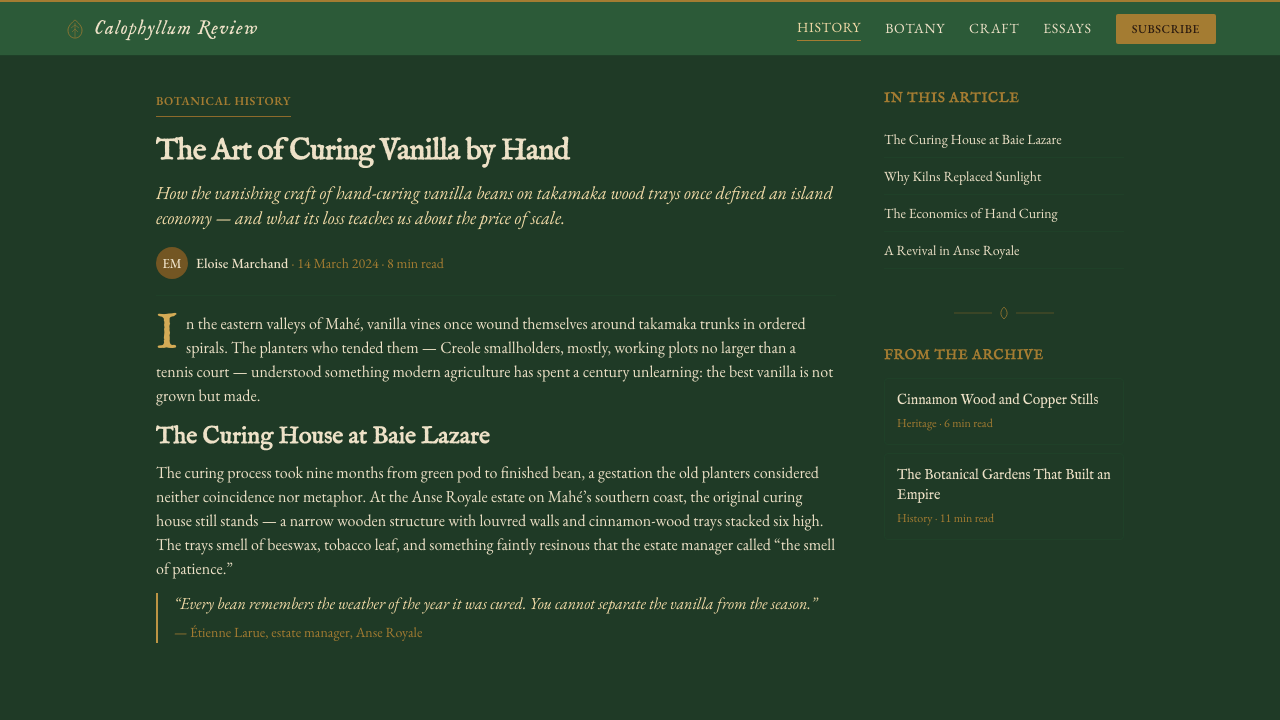
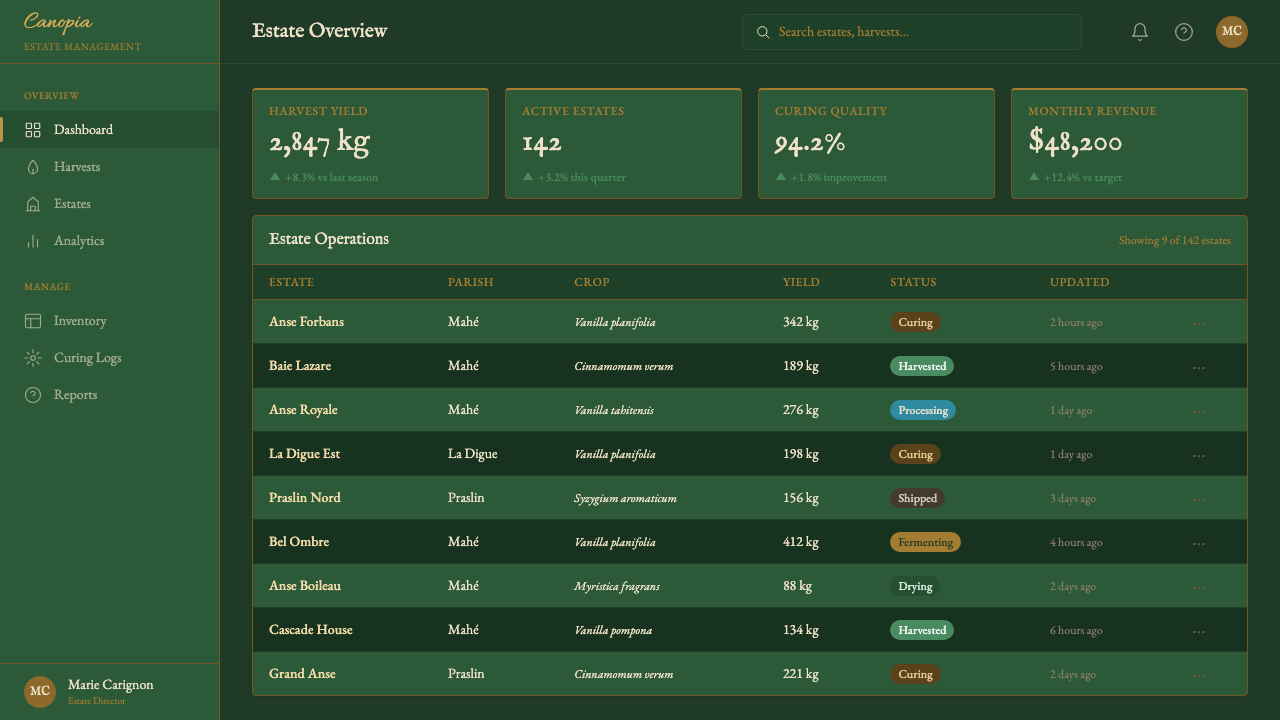
For web interfaces, Seychellois Vanilla Takamaka is best suited to premium product pages, editorial landing pages, and any context where a dark, rich, materially-grounded aesthetic will reinforce the brand proposition. Dashboard applications can adopt the system's structural vocabulary — ruled section dividers, fine type hierarchy, warm brass-toned interactive states — without fully committing to the dark ground, using a deep green or parchment-cream surface selectively for feature areas. Pricing and conversion pages can use the system's authority to establish confidence, with cream-on-dark call-to-action blocks carrying the visual weight of a signed document.
In editorial and marketing contexts, the system excels at luxury product marketing, heritage brand storytelling, and any content positioned around craft, authenticity, or the knowledge economy. An editorial layout in this register uses wide outer margins for specimen-style caption and metadata, with body text in a warm near-white against the deep ground. Marketing pages for artisan, hospitality, or botanical brands gain immediate visual credibility from the system's precision and material richness. The system also works well for academic or reference content that benefits from a visual register of documented authority.
A common mistake when applying this system is over-decorating. The copperplate reference invites embellishment — additional hairline frames within frames, clusters of botanical motifs, excessive cross-hatching texture overlays — but the source tradition was disciplined and purposeful, not decorative for its own sake. Each specimen plate contained exactly what the specimen required and no more. In digital application, the same discipline applies: a single ruled border frame, one or two small line-work ornaments in alignment with the copperplate vocabulary, and the restraint to stop there. A related error is using this system's darkness as license for low contrast; the cream-on-deep-green relationship should be tested for readability in every implementation, and the warmth of the palette should not compromise functional legibility.
Seychellois Vanilla Takamaka — FAQ
Is this system only appropriate for Seychellois or Indian Ocean brands?
No. The system's visual logic — dark botanical grounds, hairline precision, copperplate typography, warm brass accents — is a design register that communicates craft expertise and documented authority, regardless of geographic specificity. It is well suited to any premium brand, heritage product, artisan producer, or knowledge-economy context that needs to establish credibility and depth. The Seychellois and Indian Ocean references are the historical origin of the aesthetic, not a usage requirement. A Scottish whisky brand, a Japanese botanical apothecary, or a Swiss scientific publisher could all apply the system credibly.
How does this system differ from general dark botanical or apothecary aesthetics?
Many brands reference the apothecary or botanical illustration tradition, but most do so loosely — borrowing the dark backgrounds and serif typography without the formal discipline that makes the source tradition coherent. Seychellois Vanilla Takamaka is specifically grounded in the copperplate engraving medium, which means the line work has a particular character: hairline weight, cross-hatching conventions, and the compositional logic of a document designed to communicate scientific authority. The Seychellois geography adds a specific palette (deep tropical greens rather than the grey-greens of European botanical illustration) and the warm brass accents of Indian Ocean colonial trade culture.
Can this system work in a light-background version?
The system was designed from the ground up as a dark-background aesthetic; inverting it to a light ground changes the fundamental register. A parchment-cream background with deep green type and brass accents is possible and can work for secondary surfaces — interior page sections, table backgrounds, data panels — but it will read as the quieter, more administrative cousin of the full dark-ground system rather than as its equal. If a consistently light-background application is required, a different design system that was built around light grounds will generally produce more coherent results.
How should imagery be handled in this system?
Photographic imagery should be treated with a degree of formality consistent with the system's documentary character. High-contrast, close-cropped botanical photography works well — vanilla beans, bark textures, brass details — because it echoes the observational precision of botanical illustration. Lifestyle photography with soft gradients or naturalistic color renders poorly against the dark ground and warm palette; it should be treated with a warm duotone or heavy contrast grade to bring it into register with the system. The system does not welcome casual or candid photography — the compositional logic favors the deliberate and the documented over the spontaneous.
Does the system suit digital products aimed at younger or more casual audiences?
Rarely, and with considerable adaptation. The system's formality, darkness, and reference to nineteenth-century document culture communicate expertise and heritage — qualities valued by audiences who associate quality with history and craft. Younger audiences oriented toward digital-native aesthetics may read the same formal register as inaccessible or dated. Where the system is used for a mixed audience, the structural vocabulary (grid discipline, fine type hierarchy, ruled dividers) can be retained while softening the material texture references and warming the palette slightly toward the vanilla and cream end. The copperplate script accents are typically the first element to adjust — replacing them with a contemporary serif or humanist letterform preserves the authority register while reducing the period specificity.
Related design styles
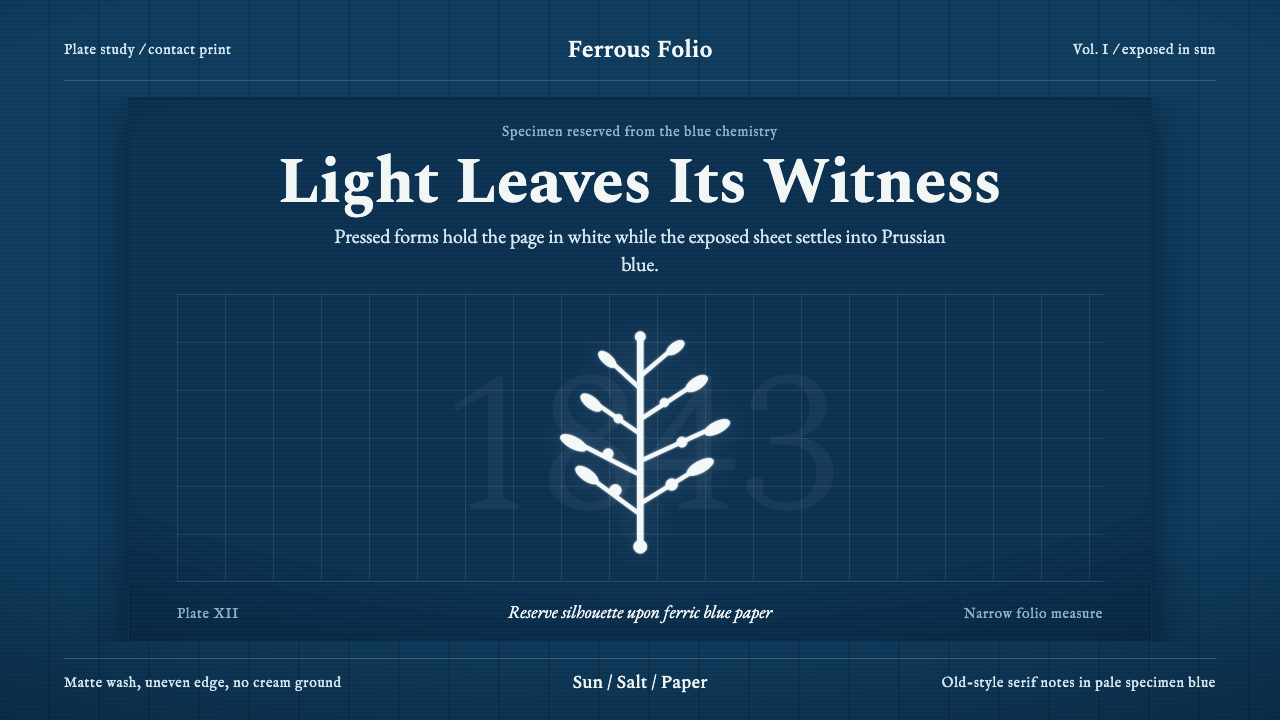 Anna Atkins CyanotypeScience turns spectral. Prussian blue ground, white reserves, Victorian serif…
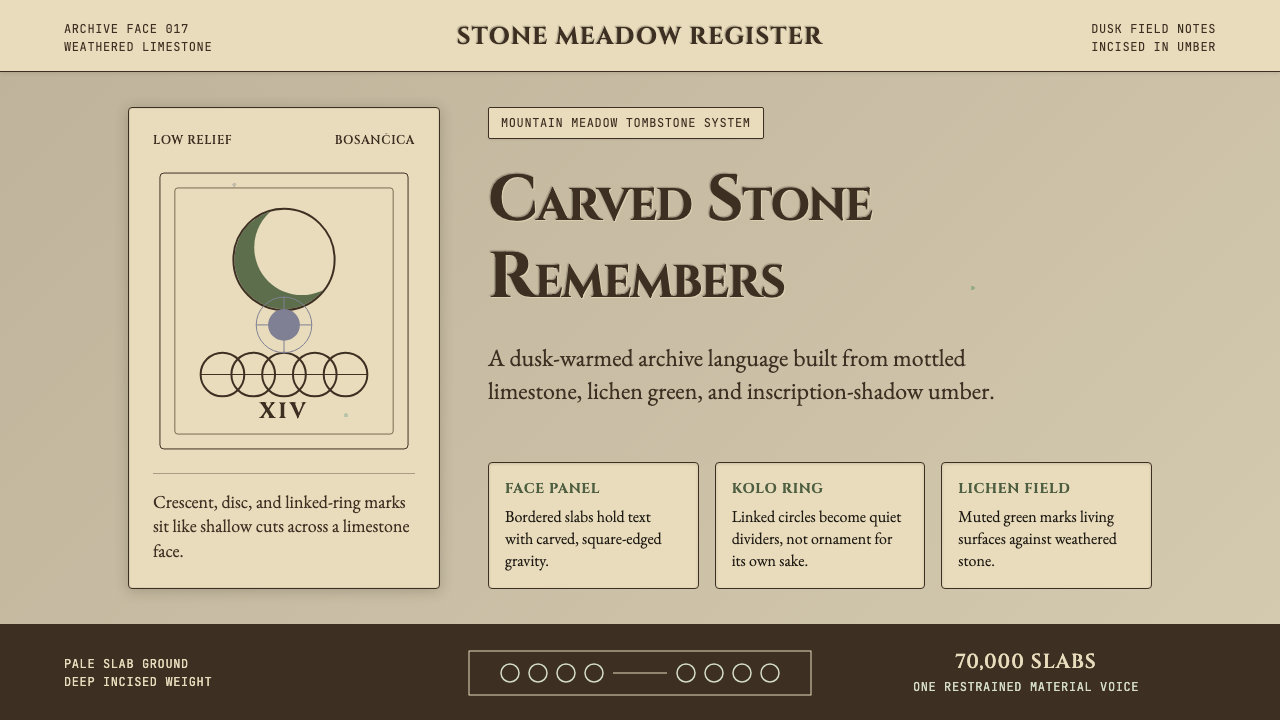 Bosnian Stećak Medieval TombstoneStone remembers quietly. Lichen green and Cinzel cuts sit on weathered limest…
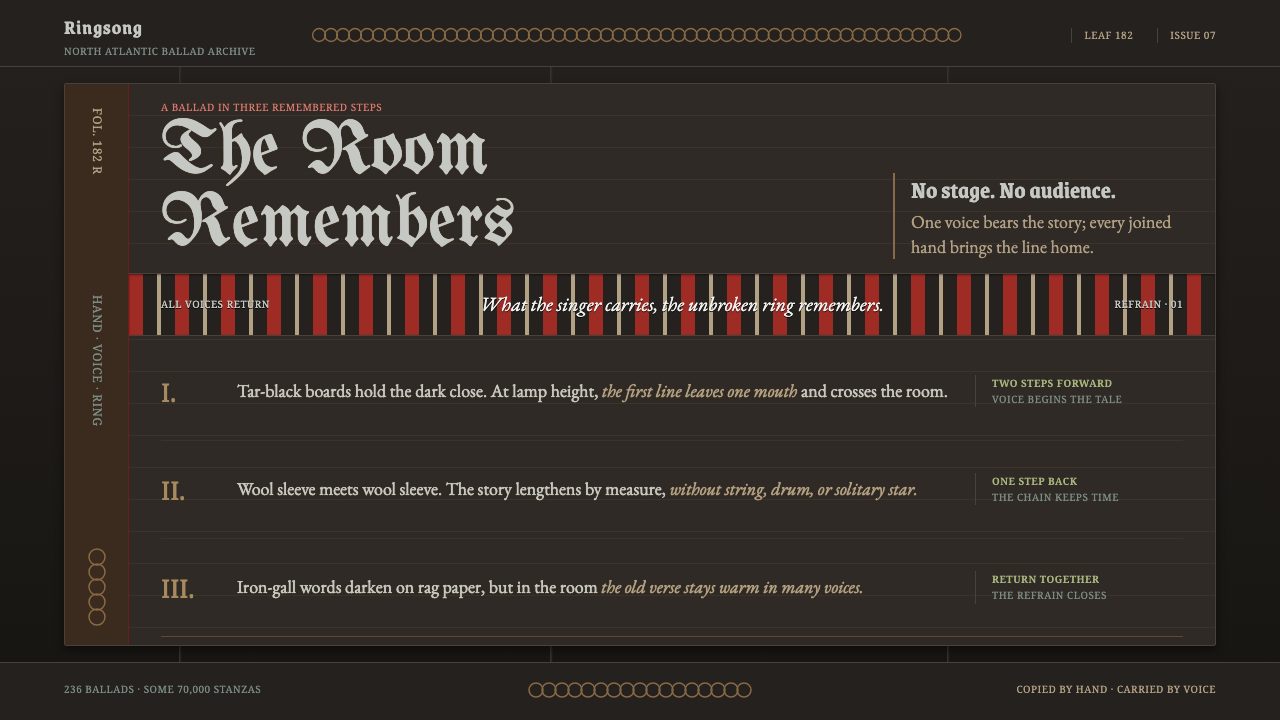 Faroese KvæðiThe room sings as one. Silver type and red refrain bands rule a tar-black man…
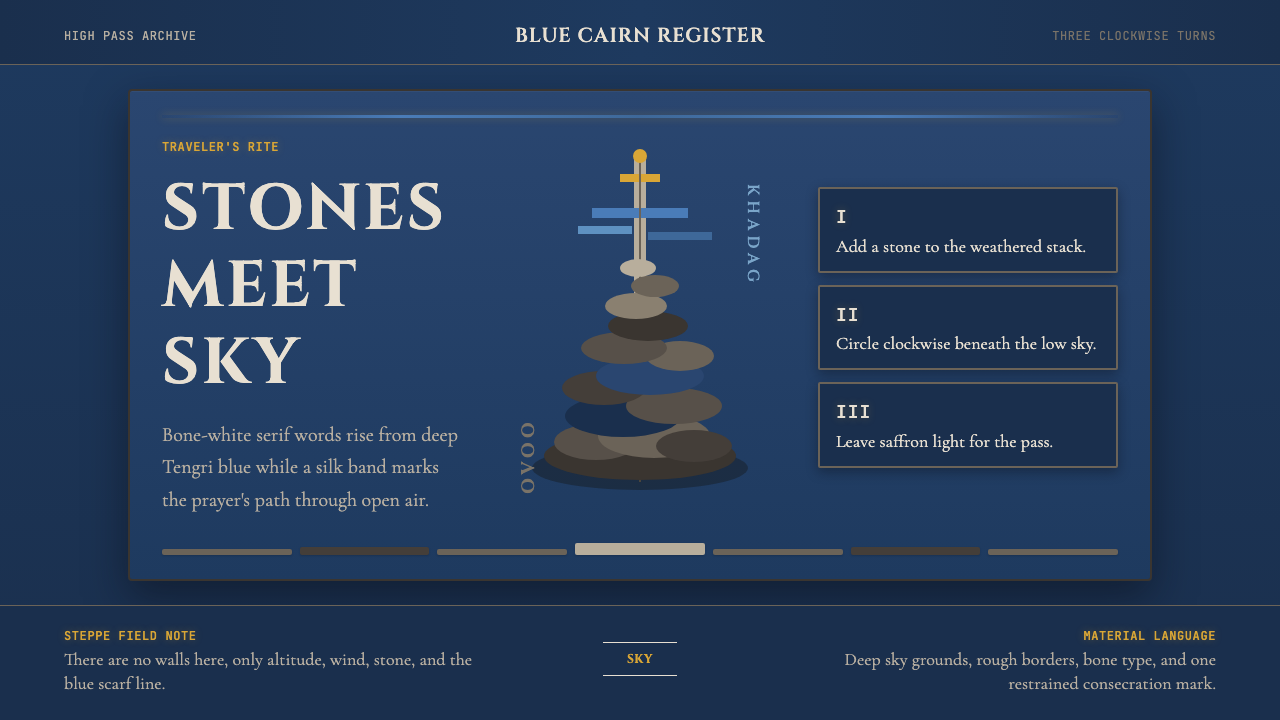 Mongolian Ovoo (Cairn Prayer Site)Sacred austerity. Steppe-blue ground, bone serif type, and one silk-blue pray…
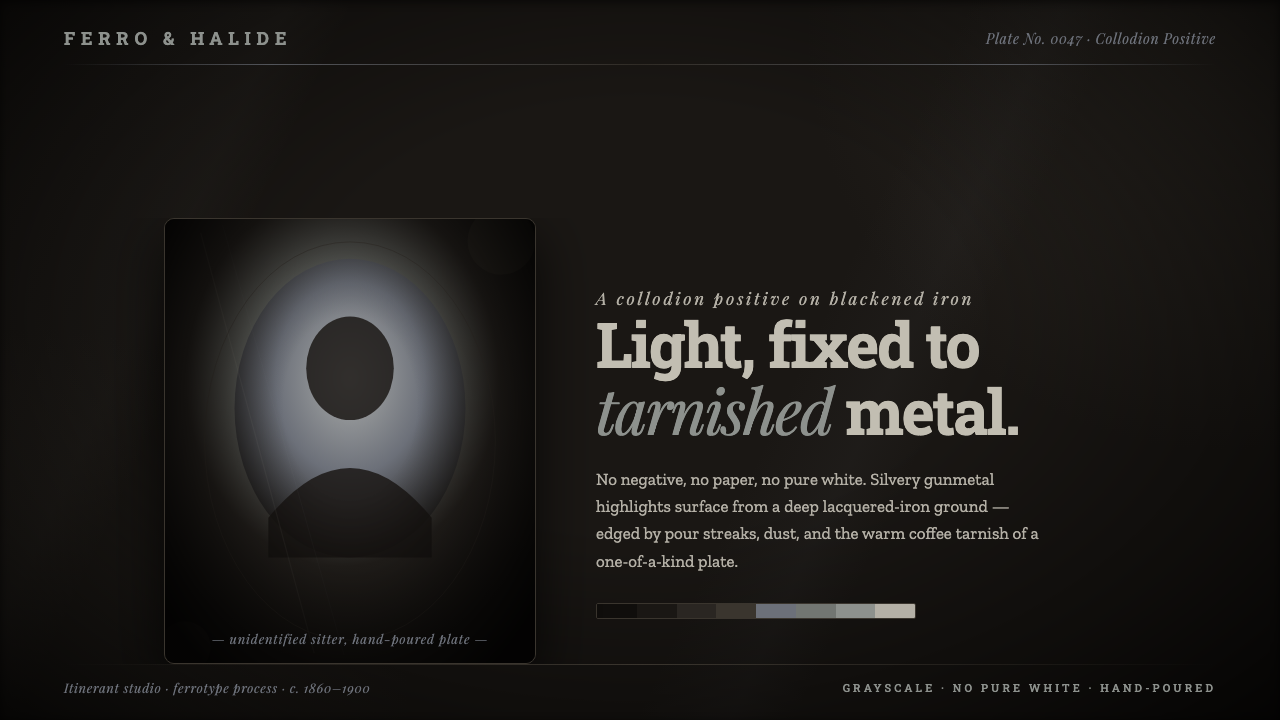 Tintype Wet PlateLight fixed to tarnished metal. Gunmetal grays rise from blackened iron, capp…
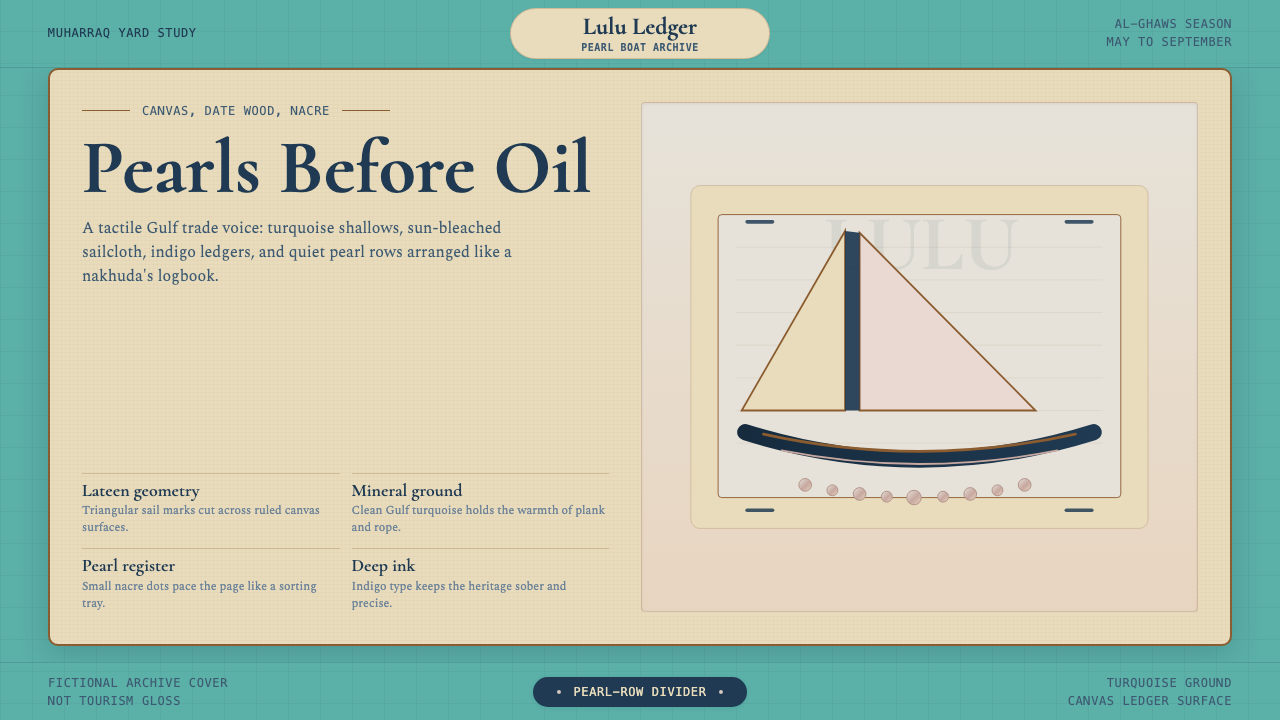 Bahraini Dhow Pearl-Diving BoatMineral and sun-bleached. Gulf turquoise, canvas cream, and pearl rows frame…