What is Bahraini Dhow Pearl-Diving Boat?
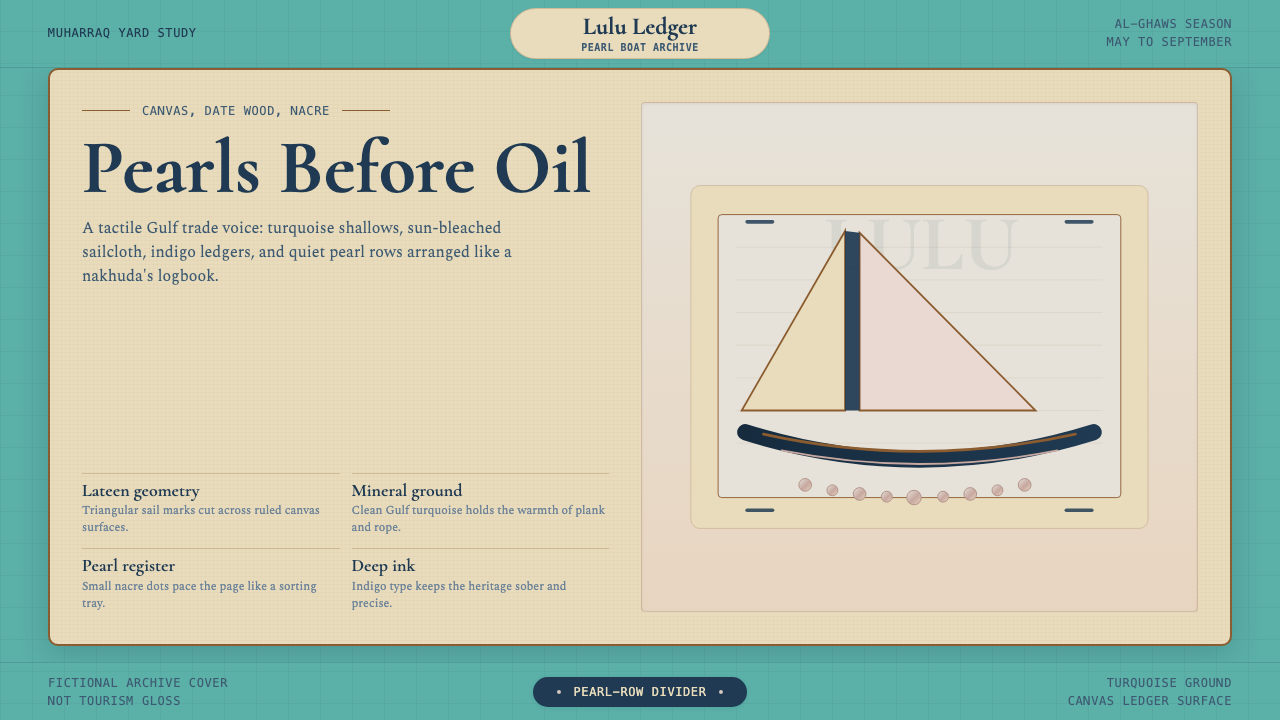
Before oil rewrote the Gulf, Bahrain ran on pearls — and the dhow yards of Muharraq encoded four thousand years of maritime craft into a visual language of mineral turquoise, sun-bleached canvas, and iridescent shell.
Bahraini Dhow Pearl-Diving Boat in brief
The Bahraini Dhow Pearl-Diving Boat design style takes its visual logic from the material world of the Gulf pearl trade at its peak — roughly the nineteenth and early twentieth centuries — before synthetic Japanese cultured pearls collapsed the industry in the 1930s. Every element of the palette, the texture vocabulary, and the ornamental grammar traces back to a real artifact or environment: the dhow hull's sun-bleached date-wood planking, the mineral shallows south of Sitra island, the iridescent interior of the lulu oyster, the canvas of a lateen sail gone cream under sustained sun, the deep indigo of open-water navigation charts.
What makes the style distinctive is its combination of warmth and restraint. This is not the aggressive saturated heat of many Gulf-inspired color systems. The turquoise is mineral and slightly muted — the color of shallow seawater over white sand rather than the electric teal of modern branding. The cream tones carry texture and age. The indigo is reserved for depth and emphasis rather than decoration. Together they create a palette that reads as both historically grounded and quietly luxurious, evoking the world in which a single exceptional pearl could fund a merchant family for a generation.
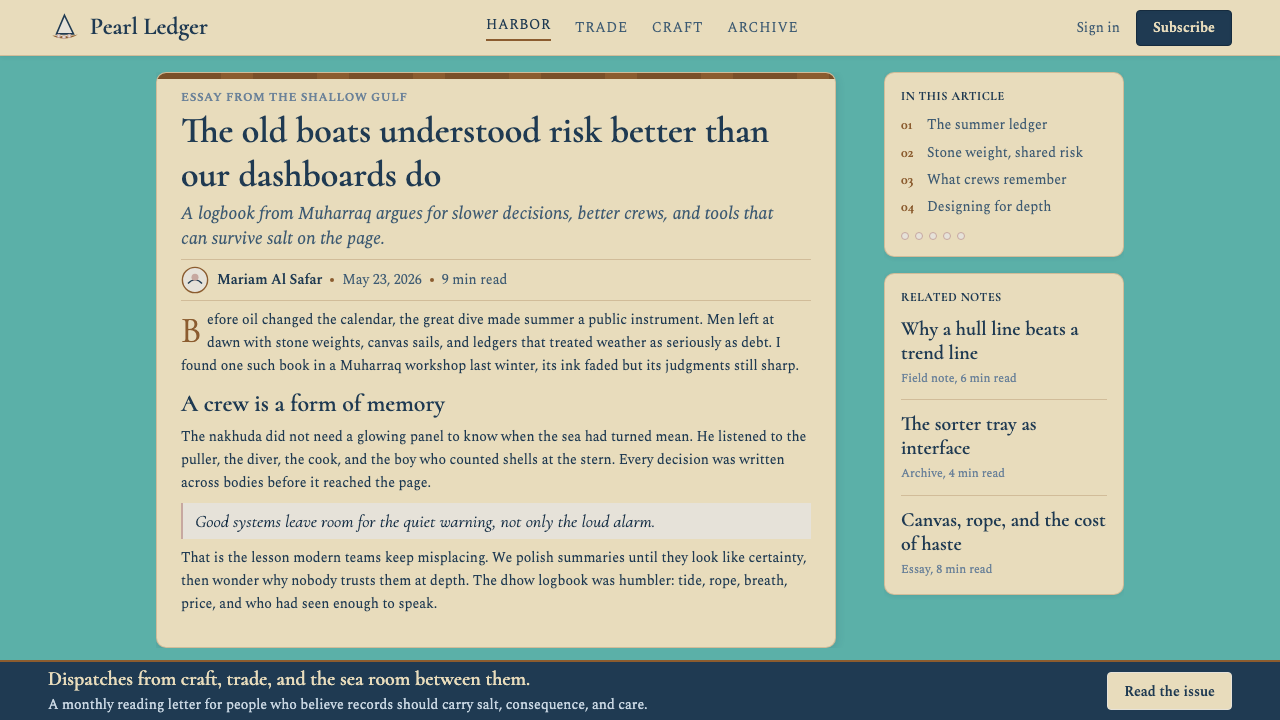
Ornament in this style is earned and specific. The lateen-sail triangle, the repeating pearl-row dot, the curved hull-line divider — these motifs appear because they are readable shorthand for the trade itself, not because they fill empty space. Used with restraint, they function the way a maker's mark functions on fine objects: as a quiet signal of authenticity rather than a shout for attention.
Where does Bahraini Dhow Pearl-Diving Boat come from?
Bahrain's relationship with pearling stretches back to the Dilmun civilization of the second millennium BCE, when the archipelago served as a major entrepôt between Mesopotamia and the Indus Valley. Ancient Sumerian texts describe Dilmun as a source of fish-eyes — their term for pearls — and archaeological sites at Qal'at al-Bahrain have yielded evidence of organized pearl-working as far back as 2000 BCE. But it was the convergence of Islamic luxury demand, Mughal court taste, and European colonial appetite for precious gems that transformed the Gulf pearl trade into a global industry between roughly the seventeenth and early twentieth centuries.
At its height in the 1880s through the 1920s, the Bahraini fleet comprised several thousand dhows — primarily the sambuk, a double-ended wooden vessel built from imported teak or local date wood, rigged with a triangular lateen sail — and employed tens of thousands of divers and crew. The annual diving season, al-ghaws, ran from late spring through early autumn. Divers worked without equipment: a nose clip of carved tortoiseshell, a leather finger-stall, a stone weight tied to the ankle, and a rope. A skilled diver could make sixty or more descents per day, staying under for ninety seconds at a time. The pearls were sorted on deck by the vessel's musakkim using graduated sieves, then sold through specialist merchants in Muharraq and Manama to international buyers from India, Paris, and London.
The social world of the pearl trade was elaborately structured. The nakhuda — the boat captain and commercial owner — occupied the highest position; below him, the divers (ghawwas) and the haulers (siyb) who pulled them to the surface were bound to their captain by a credit system that often functioned as debt bondage. Poetry and music were integral to the work rhythm: the fidjeri songs sung by the crew during the return voyage are now recognized by UNESCO as an Intangible Cultural Heritage of Humanity. The trade also generated a sophisticated merchant class in Muharraq whose coral-plastered courtyard houses, with their wind-catchers (barjeels) and ornamental carved plasterwork, survive as a UNESCO World Heritage Site.
The collapse came swiftly. Mikimoto Kokichi's Japanese cultured-pearl technology, perfected during the 1920s, made gem-quality pearls available at a fraction of the cost of natural Gulf pearls. By 1932, the price of Gulf pearls had fallen so catastrophically that most of the fleet was laid up permanently. The discovery of oil in 1932 — the same year — provided an economic replacement, but the material culture of the pearl trade survived in the built environment of Muharraq, in the fidjeri musical tradition, and in the visual archive of dhow-building and pearl-sorting that Bahrain has consciously preserved as a marker of pre-oil identity.
What defines the Bahraini Dhow Pearl-Diving Boat look?
Palette
The color system is built on three anchors drawn directly from the physical environment of the dive: a mineral Gulf turquoise that reads as the shallow sea over white sand, a canvas cream that carries the warm age of sun-bleached sailcloth, and a deep-sea indigo reserved for text, depth, and navigational emphasis. A fourth tone — the soft iridescent shimmer of mother-of-pearl — appears as a surface quality rather than a flat color, used to give highlights and accent elements a living, light-catching quality. The palette is warm overall but never garish; saturation is kept at the level of natural pigment rather than modern synthetic dye.
Ornamental Grammar
Decorative elements in this style are not generic geometric patterns but specific visual shorthand derived from the objects of the trade. The lateen-sail triangle — a slender, acute isosceles form — functions as a directional and compositional accent. Pearl-row dots, arranged in graduated sequences that echo the sorting sieves, serve as dividers and progress markers. Hull curves, drawn from the sambuk's distinctive double-ended profile, act as section separators with more warmth than a ruled line. Each motif earns its presence by referencing something real; promiscuous use of all three simultaneously tips the design into costume rather than character.
Texture and Surface
Unlike purely flat digital styles, this aesthetic acknowledges the weathered materiality of its source world. Canvas surfaces carry a slight grain that reads as age rather than noise. Wood-plank textures appear in full-bleed backgrounds and dividers, rendered with enough restraint that they register as atmosphere rather than wallpaper. The mother-of-pearl iridescence — a gentle interference shimmer that shifts across a narrow range of cream, pale gold, and blue-white — is the style's most distinctive surface quality and should be used sparingly: a highlight stripe, an activated state, a premium tier indicator.
Typography
The typographic pairing mirrors the social hierarchy of the trade itself. Display type calls for serif letterforms with the authority and formal confidence of an auction-house catalogue or a merchant ledger — tall, slightly condensed, with bracketed serifs that suggest both tradition and precision. Body text shifts to a quieter editorial face with generous line spacing, evoking the patient logbook entries of a nakhuda recording the season's harvest. The contrast between the two creates natural hierarchy without requiring color or heavy weight shifts. Arabic calligraphy, where appropriate, draws from the Naskh tradition rather than ornate Thuluth, keeping the register legible and archival rather than ceremonial.
Composition and Whitespace
Layout in this style favors the logbook and ledger tradition: wide margins that read as breathing room, content organized in clear vertical columns, and a consistent sense that each element has been placed with deliberate economy. Crowding is the visual antithesis of the style — the pearl's value came from its isolation and presentation, not from being piled. Headers and section anchors are given generous space above them; the canvas-cream ground is meant to show, not be covered. On grid-based layouts, the style works best with a clearly defined central measure and broad, unhurried gutters.
Light and Iridescence
The style's most unusual quality is its treatment of light as a surface property rather than a source. Mother-of-pearl does not reflect light from a single direction — it diffracts it, producing a color that shifts with viewing angle. This translates, in flat digital contexts, to subtle gradient overlays that move within a very narrow tonal range (cream to pale gold, or turquoise to blue-white) rather than strong directional shadows. The effect should feel like looking at a pearl in indirect light: quietly alive, never flashy. Hard shadows and sharp highlights work against the aesthetic; the style prefers soft, ambient, almost watercolor-like depth.
Restraint and Authenticity
The hardest discipline the style demands is knowing when to stop. The visual vocabulary — turquoise, cream, indigo, pearl iridescence, three specific motifs — is rich enough to be evocative and specific enough to be coherent, but it can tip into pastiche if every element is deployed at once. Authentic application looks like a merchant's ledger page or a navigator's chart: functionally complete, ornamented only where ornament serves a communicative purpose, with the elegance coming from selection rather than accumulation. When in doubt, remove one element rather than add another.
Who shaped Bahraini Dhow Pearl-Diving Boat?
Al-Shamlan was a Bahraini historian and the foremost chronicler of the pearl-diving era. His research and writing — produced across several decades of the twentieth century — preserved the social, economic, and technical vocabulary of the trade at a moment when living memory of it was fading. His accounts of the fidjeri music tradition, the social hierarchy of the diving fleet, and the mechanics of the sorting and sale process gave subsequent scholars and designers a primary-source understanding of what the material world of the dhow yards actually looked like, sounded like, and felt like.
Al-Zayani was among the most respected nakhuda — boat captains and commercial owners — of the late pearl-diving era, operating out of Muharraq during the final decades of the trade's viability. His role embodied the dual function that gave the style its visual tension: he was simultaneously a skilled maritime navigator and a sophisticated commercial agent, keeping meticulous ledgers that recorded the season's dives, the pearl grades sorted, the advances made to crew, and the prices received from Indian and European buyers. The visual language of the style — chart-like clarity combined with the warmth of handwritten record — derives in part from the documentary culture he represents.
Al-Madhoob was a celebrated fidjeri musician — a lead singer in the choral tradition performed by pearl-diving crews during the return voyage home. The fidjeri songs, which UNESCO recognized in 2016 as an Intangible Cultural Heritage of Humanity, were functional music: they synchronized the haulers' rope-pulling rhythm, maintained morale during the exhausting final days of a season, and encoded navigational and meteorological knowledge in poetic form. Al-Madhoob's mastery of the tradition represents the style's sonic equivalent — an art form that is simultaneously working knowledge and aesthetic expression, practical and beautiful without contradiction.
A prominent merchant family representative from the height of the trade era, Al Bin Ali typifies the class of Muharraq merchants whose courtyard houses — the surviving UNESCO World Heritage buildings — defined the architectural language of Gulf pearl wealth. Their buildings translated the material values of the trade into architecture: the barjeel wind-catcher cooling the courtyard as the shallows cooled the divers, carved plasterwork as intricate as a sorted pearl display, and the logbook-like precision of the courtyard's spatial organization. The visual identity of the style draws as much from these mercantile interiors as from the dhow deck itself.
Mikimoto is not a Bahraini figure, but his influence on the style's historical context is decisive. The Japanese entrepreneur perfected cultured-pearl technology in the 1920s and brought it to commercial scale by the early 1930s, making gem-quality pearls available at prices that the natural Gulf trade could not match. The industry's collapse in 1932 — simultaneous with the discovery of oil — froze the pearl trade's material culture at the moment of its disappearance, creating the preserved and coherent visual archive from which the style draws. Without Mikimoto's disruption, the dhow culture would have evolved and blended; the abrupt end preserved it whole.
How do you use Bahraini Dhow Pearl-Diving Boat today?
The Bahraini Dhow Pearl-Diving Boat style is well-suited to work where heritage, quiet luxury, and cultural specificity are genuine values rather than decorative claims. It carries the authority of a real and documented history, which means it rewards applications where that authority is earned — premium products with genuine craft lineage, cultural institutions, travel and hospitality brands operating in the Gulf region, or any context where the user should feel they are receiving something rare and carefully sourced rather than mass-produced.
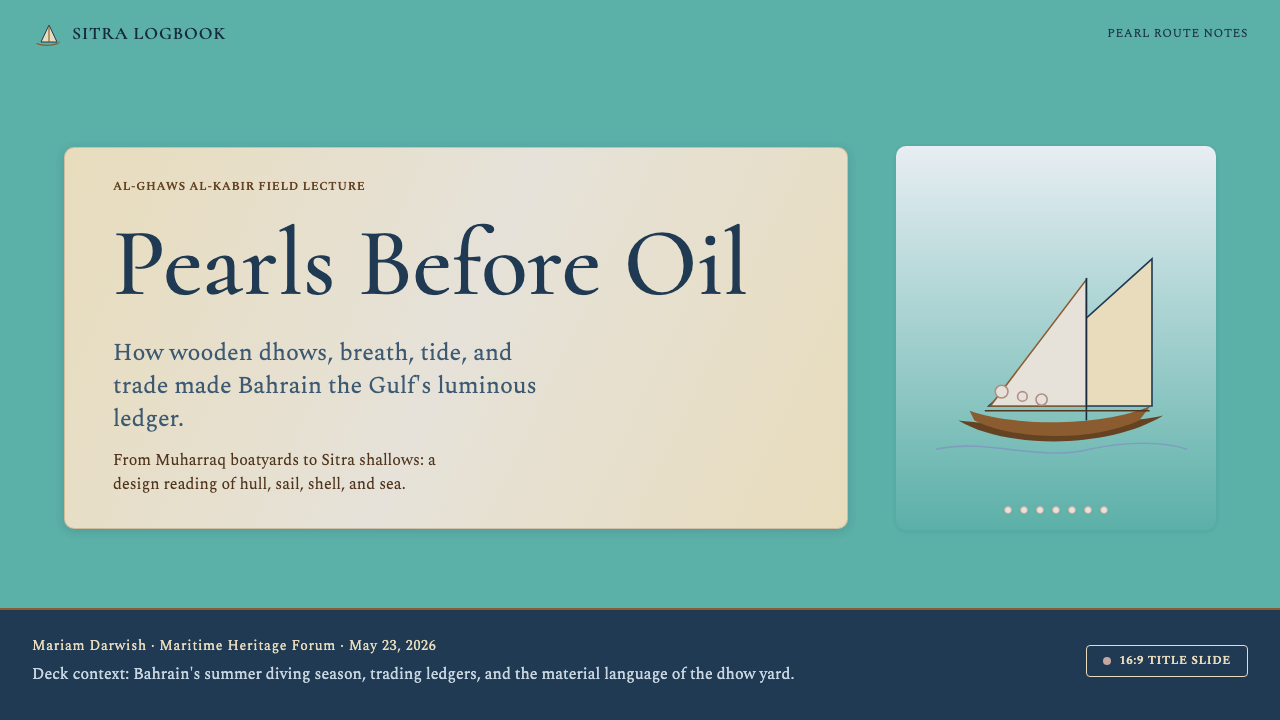
For presentation slides, the style performs well on cover pages that need to communicate premium positioning without aggression. A cover built in this vocabulary uses the mineral turquoise as a full-bleed ground, places the title in a tall authoritative serif at generous scale, and introduces the pearl-row motif as a quiet horizontal accent rather than a centrepiece. Content slides work best as clean two-column layouts with the canvas-cream ground, body text in an editorial weight, and section headers in the taller display face — the shift in register carries hierarchy without the need for color blocks or decorative dividers. Data slides should be treated with the same restraint: chart elements draw from the three-color anchor palette, with annotations in a quiet warm tone rather than arbitrary accent colors.
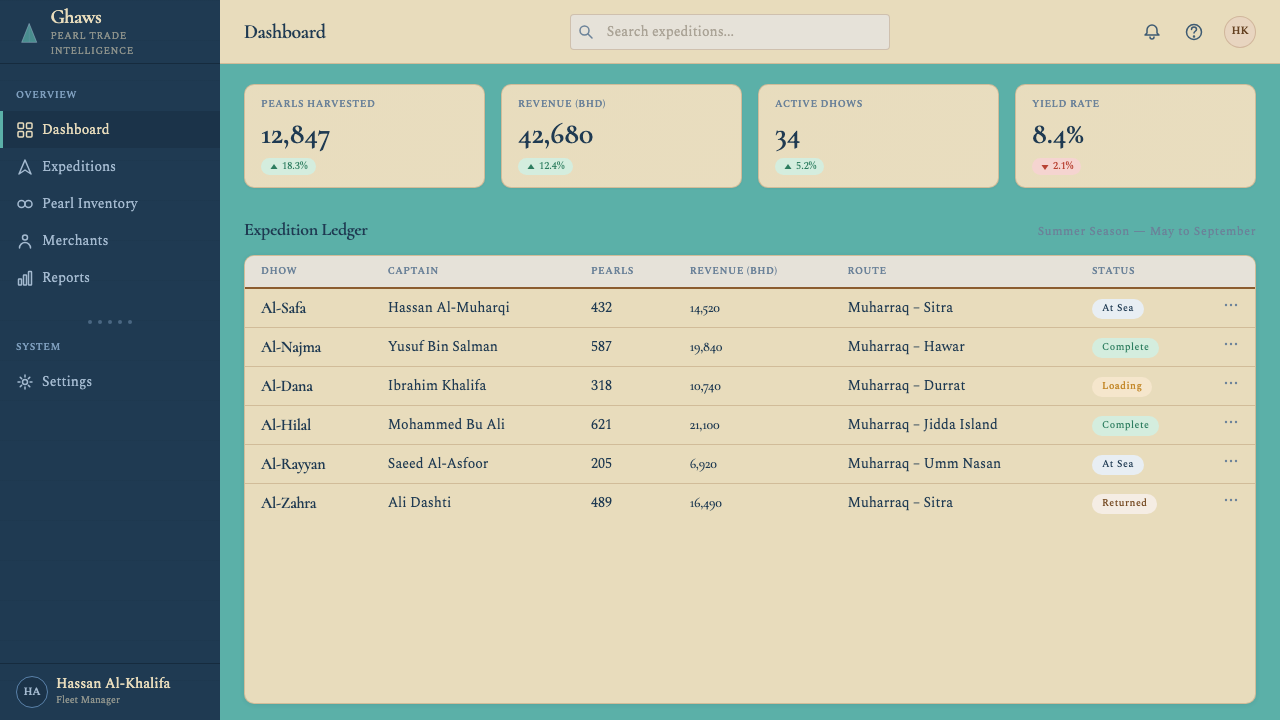
For web interfaces, the style adapts best to contexts where considered pacing is part of the experience — portfolio sites, long-form editorial, hospitality landing pages, and premium e-commerce. The approach is to build on the canvas-cream ground as the default surface, reserve the turquoise for primary interactive elements and key calls to action, and use the indigo only for body text and depth. Card components should carry the soft iridescent surface quality rather than hard drop shadows — a gentle, light-catching finish that distinguishes a selected or hovered state from a resting one. Navigation should be typographic and unhurried: wide spacing between items, a clear current-state indicator in turquoise, and no decorative icon clutter.
For editorial and marketing work, the style's logbook-and-ledger aesthetic supports confident long-form layout. An editorial article benefits from a wide single-column measure on the canvas-cream ground, with generous margins that can hold pull-quotes set in the display serif. Section breaks marked by a short hull-curve line or a single row of pearl dots feel earned rather than gratuitous. Marketing pages work best when they commit to the pearl as a structural metaphor: one exceptional thing, presented in isolation, with all the surrounding space treating that isolation as a value. Feature sections should be sparse, with the turquoise ground used for one or two standout moments rather than throughout.
A common mistake when applying this style is deploying all three palette anchors and all three motifs simultaneously in an attempt to signal richness. The style's visual logic is closer to that of a pearl dealer's display — a few exceptional items, given space — than to a bazaar stall covered in inventory. Using the turquoise as a dominant background color throughout an entire interface, rather than reserving it for emphasis, drains it of the depth and rarity that make it effective. Similarly, the iridescent shimmer should appear in no more than two or three places in a given composition; used widely, it becomes a surface effect rather than a signal of quality.
Bahraini Dhow Pearl-Diving Boat — FAQ
Is this style appropriate for brands with no connection to Bahrain or the Gulf?
It depends on how it is applied. The style's visual vocabulary is specific enough that using it without acknowledgment can read as appropriation. However, the underlying values the style encodes — patience, rarity, careful craft, the elevation of a single exceptional thing — are universal enough to support application in contexts that genuinely share those values, even without a geographic connection to the Gulf. A watch brand, a specialist ingredient supplier, or a conservation organization whose actual work embodies careful selection and long time-horizons can apply the aesthetic honestly. A fast-fashion brand applying it decoratively cannot. The question to ask is whether the style's values match the product's actual values, not just its aspirational positioning.
How does this style differ from other Middle Eastern or Islamic design traditions?
The key distinction is specificity and restraint. Many Middle Eastern design aesthetics draw on the elaborate geometric tessellation of Islamic architecture, the rich tile-work of Safavid Persia, or the gold-and-arabesque tradition of Mamluk manuscripts — all of which tend toward complexity, all-over pattern, and visual density. The dhow pearl-diving aesthetic goes in the opposite direction: it is sparse, logbook-practical, and derives its ornament from maritime and commercial objects rather than architectural or calligraphic ones. The turquoise it uses is the mineral color of Gulf water, not the ceramic glaze blue of Persian tilework. The motifs are a sailor's and merchant's vocabulary, not a scholar's or a cleric's. It is a Gulf coastal tradition, not a pan-Islamic or pan-Arabian one.
Can this style work well in dark-background or night-mode contexts?
A dark variant is possible but requires a careful rethinking of the palette's logic. In the canonical light-ground version, the canvas cream is the breathing space and the turquoise and indigo provide depth. Inverting to a dark ground — a deep indigo or a very dark charcoal with a warm undertone — requires a corresponding inversion in the role of the other colors: the cream becomes an accent and highlight rather than a ground, the turquoise moves to foreground emphasis, and the iridescent mother-of-pearl quality becomes more prominent because shimmer reads more vividly against dark surfaces. The style's warmth can survive the inversion, but it requires discipline: a cold dark background strips the maritime warmth and produces something closer to a generic deep-blue ocean palette than the specific Gulf character the style is after.
What is the single most common error when referencing this style?
Treating turquoise as a dominant, wall-to-wall color rather than as the mineral ground of a specific environment. In the actual Gulf shallow-water context, turquoise is the color you look at — the sea itself — not the color of the objects on it. Applied to an interface, this means turquoise should anchor key elements, mark primary actions, and punctuate the composition, not fill every container and background. When turquoise saturates the entire layout, the composition loses the contrast that makes the pearl — the point of the whole aesthetic — readable against it. Reserve the color, and it creates desire; flood the space with it, and it becomes background noise.
Is the fidjeri musical tradition relevant to how the visual style behaves rhythmically?
It is a useful analogy for understanding the style's pacing. Fidjeri is call-and-response music built around a steady, repeated pull rhythm — the haulers synchronizing their effort to bring a diver to the surface. There is a strong, clear beat and long breathing space between phrases. The visual style has the same quality: clear structural beats (a header, a section anchor, a key motif) separated by generous negative space, with the ornamentation appearing in clusters at specific moments rather than distributed evenly. The mistake of filling every space with decoration is equivalent to a musician turning the call-and-response into continuous sound — it destroys the rhythm that makes each element audible. Generous pauses are not empty space; they are the beats between the beats.
Related design styles
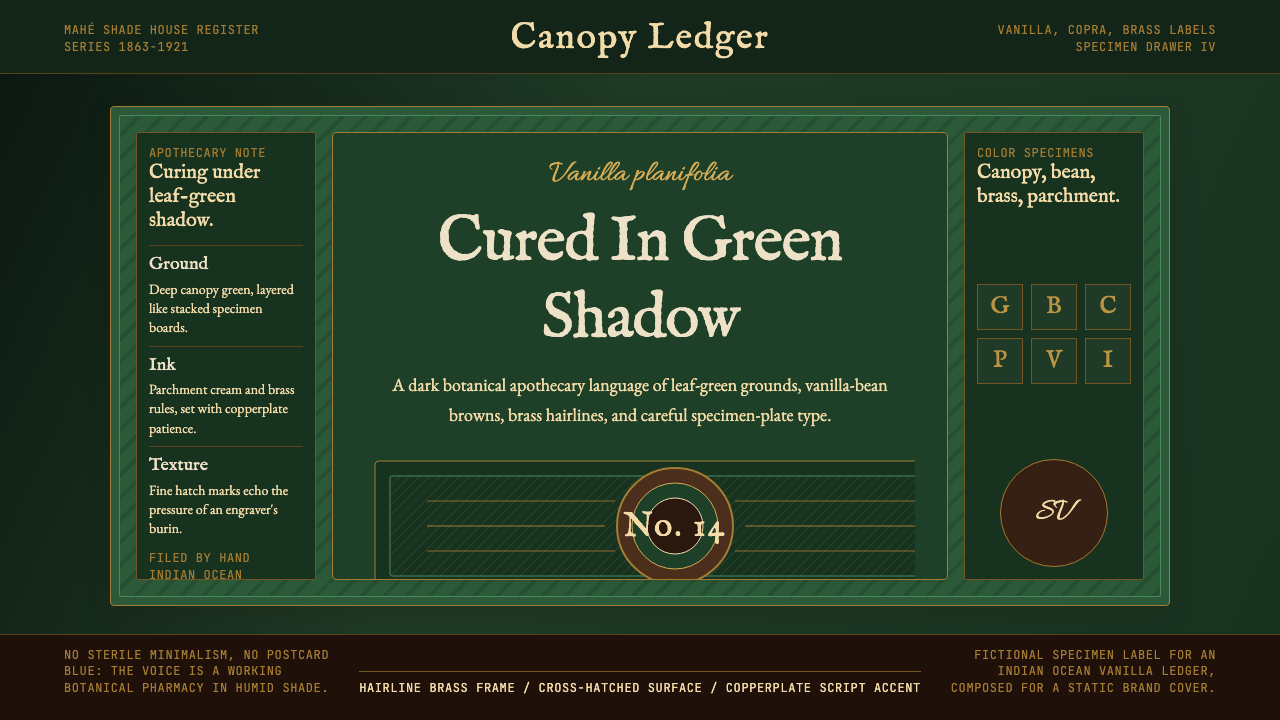 Seychellois Vanilla TakamakaBotanical apothecary in shadow. Deep green, brass hairlines, and copperplate…
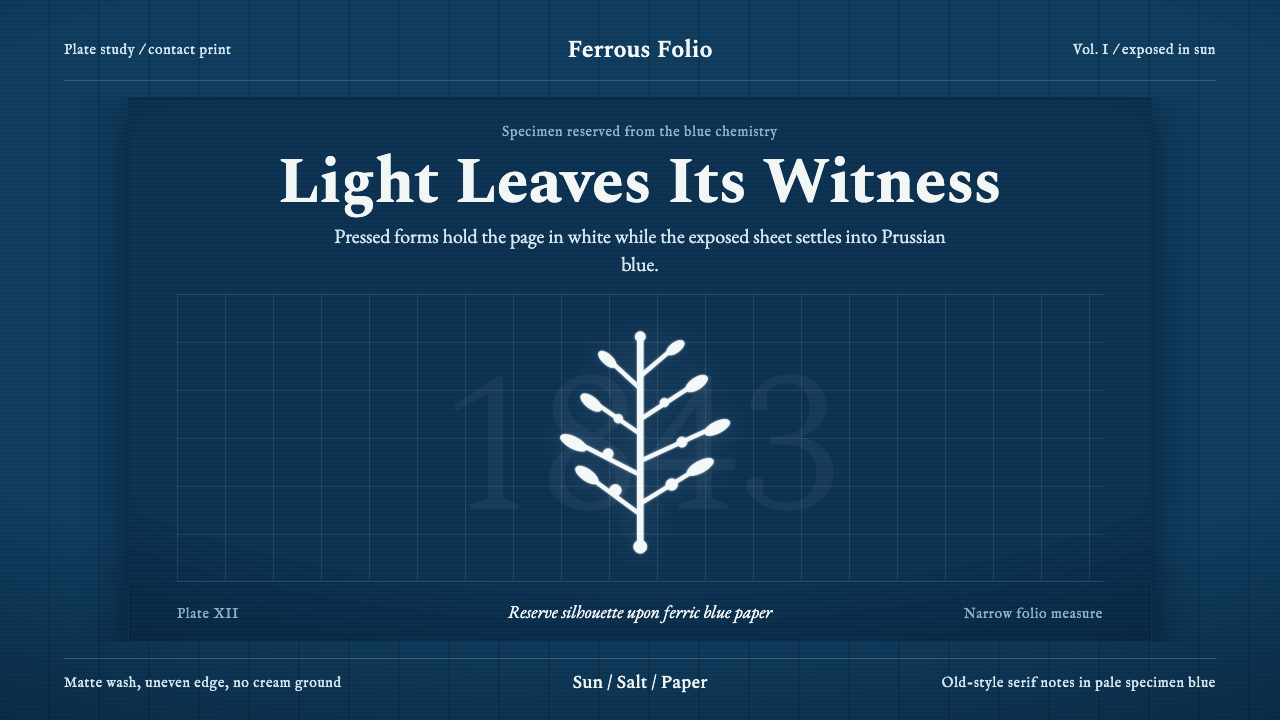 Anna Atkins CyanotypeScience turns spectral. Prussian blue ground, white reserves, Victorian serif…
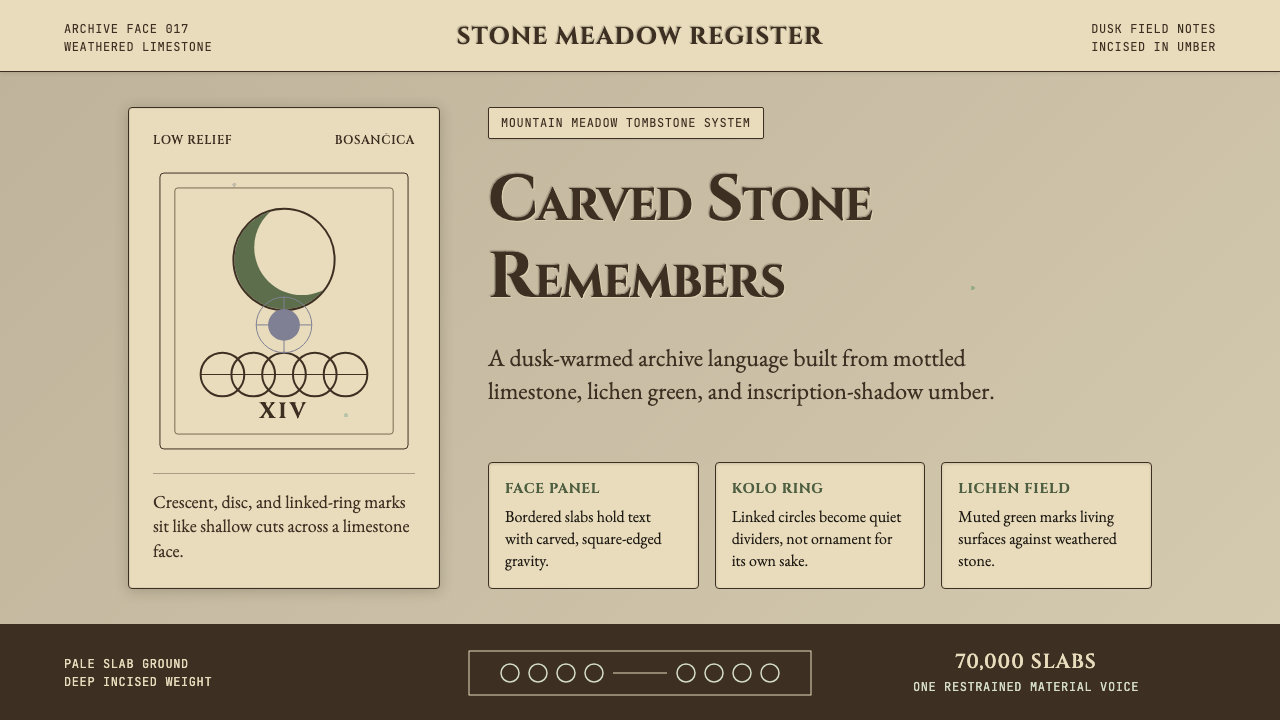 Bosnian Stećak Medieval TombstoneStone remembers quietly. Lichen green and Cinzel cuts sit on weathered limest…
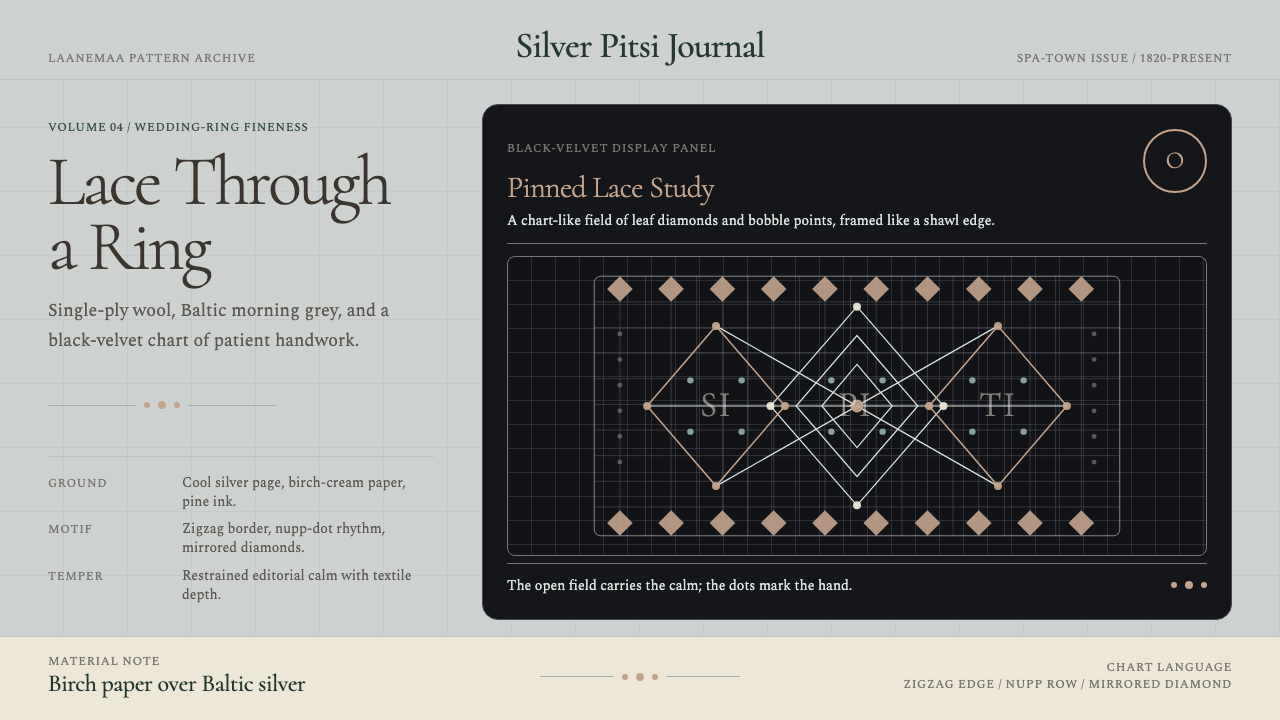 Estonian Haapsalu Lace ShawlQuiet craft, held in silver light. Cormorant type meets nupp dots and velvet…
 Faroese KvæðiThe room sings as one. Silver type and red refrain bands rule a tar-black man…
 Jordanian Bedouin Black TentNight camp honesty. Goat-hair black, sadu crimson, brass lines.