What is Rapa Nui Moai Petroglyph?
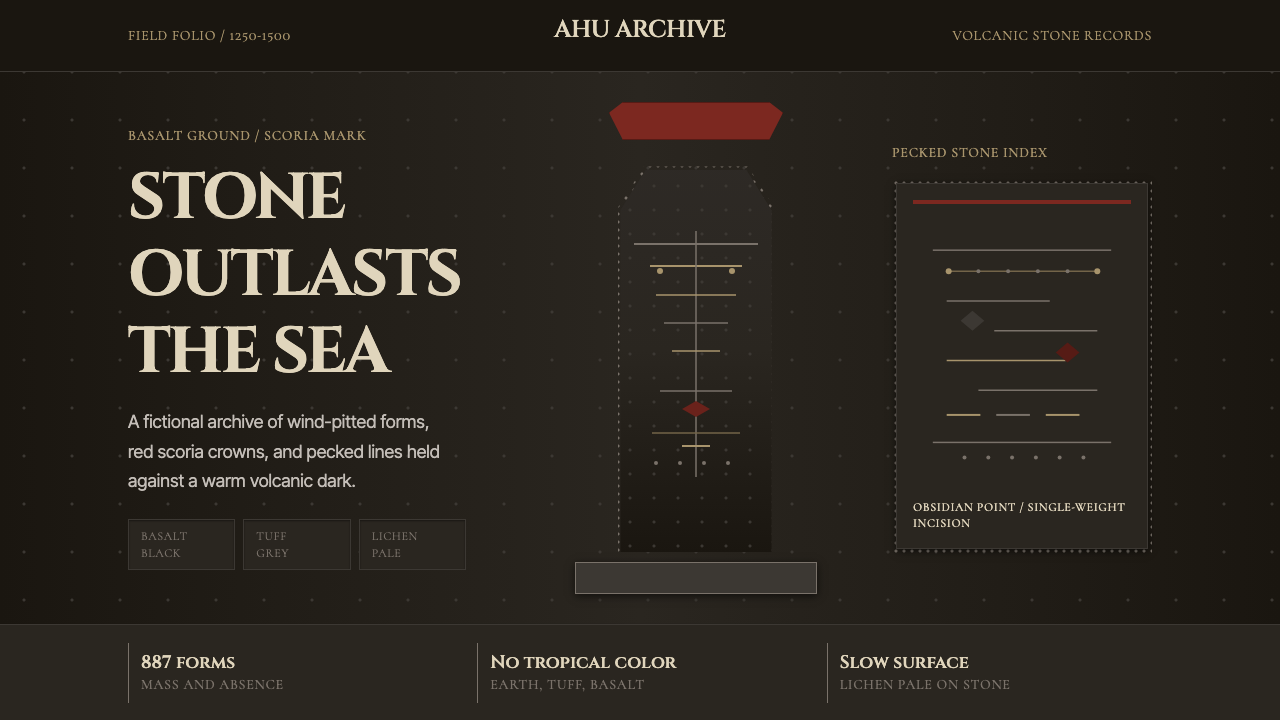
From the volcanic silence of the Pacific's most remote island, a design language of monumental austerity — dark stone, massive silhouettes, and marks pecked by hand into eternity.
Rapa Nui Moai Petroglyph in brief
Rapa Nui Moai Petroglyph is a design system rooted in the visual culture of Easter Island — one of the world's most isolated human settlements, located more than two thousand kilometers from the nearest inhabited land. Its aesthetic vocabulary is drawn from two intertwined traditions: the colossal moai stone figures carved between roughly 1250 and 1500 CE, and the thousands of petroglyphs — birds, fish, spirals, and human faces — pecked into basalt and tuff across the island's volcanic landscape.
The visual identity this system embodies is one of extreme restraint imposed by environment and intention. Color is limited to what the island's geology provides: the charcoal grey of basalt, the warm red-brown of scoria cinder, the pale ashen tone of volcanic tuff, and the faint silver-green of lichen slowly colonizing every exposed surface. Against these tones, carved marks gain their power through contrast — dark line on dark stone, relief cut just deep enough to catch the angle of the sun. There are no bright hues here, no decorative flourishes, no color applied as embellishment. The palette is the landscape.
What distinguishes this aesthetic from other monumental traditions is its combination of massive vertical scale and intimate mark-making. The moai range from compact figures to giants exceeding twenty meters, yet every one was shaped by hand, each stroke of the toki stone chisel a human-scale decision. The petroglyphs alongside them are even more direct: fingertip-sized depressions pecked one by one into an unyielding surface. Scale and intimacy coexist. Monumentality does not erase the trace of the maker — it amplifies it.
Where does Rapa Nui Moai Petroglyph come from?
Rapa Nui was settled by Polynesian voyagers, most likely from the Marquesas or Mangareva, sometime around 1000 to 1200 CE — a feat of open-ocean navigation that remains extraordinary by any measure. The settlers found a subtropical island densely forested with the now-extinct Jubaea palm, rich in seabirds, and with no land mammals beyond the colonizers' own animals. Over the following centuries they developed a stratified society organized around competing lineages, each vying to erect more and larger moai on stone platforms called ahu along the island's coastline. Moai were not merely monuments: they were believed to concentrate the mana — the ancestral spiritual power — of deceased chiefs, radiating it across the land they faced, protecting and fertilizing the territory of the living.
Petroglyph carving ran alongside and sometimes predated moai construction, with the richest concentrations found at Orongo — a ceremonial village on the southwestern crater rim — and Rano Raraku, the tuff quarry where most moai were carved and many were left unfinished, still embedded in the rock face. The dominant petroglyph motif at Orongo is the tangata manu, or birdman: a crouching human figure with a bird's head, commemorating the annual competition in which representatives of rival clans swam to the islet of Motu Nui to retrieve the first egg of the sooty tern, with the winner's clan chief becoming tangata manu for the year. The birdman cult replaced the moai-building tradition after the latter's collapse, suggesting a society that could reinvent its visual and ritual language under catastrophic pressure.
European contact began with Jacob Roggeveen's Dutch fleet arriving on Easter Sunday 1722 — giving the island its colonial name. By that time, the moai had already been toppled, probably in internecine warfare following ecological collapse. The population, estimated at a peak of several thousand, had fallen dramatically. What the Dutch and later Spanish, British, and French visitors found was a society in the process of cultural reinvention — still practicing petroglyphs, still holding the birdman ceremony, but with the ahu platforms standing empty and the fallen moai slowly being reclaimed by vegetation.
Systematic study of Rapa Nui's visual culture began in earnest in the twentieth century. Thor Heyerdahl's Kon-Tiki expedition (1947) and his later work on the island in 1955–56 drew global attention, though his theories about South American origins have since been largely refuted by genetic and linguistic evidence. Jo Anne Van Tilburg's moai inventory project, running from 1982 onward, produced the definitive catalog of all 887 moai. Steven Roger Fischer spent years attempting to decode rongorongo — the undeciphered script tablets found on the island — without reaching a consensus solution. Sebastian Englert, a German priest who lived on the island from 1935 until his death in 1969, produced the foundational dictionary of the Rapa Nui language and documented hundreds of oral traditions that might otherwise have been lost. It is through this layered archaeological and anthropological record that the island's visual language became legible to the wider world.
What defines the Rapa Nui Moai Petroglyph look?
Palette
The color vocabulary is drawn entirely from volcanic geology: the deep charcoal of basalt, the warm red-brown of scoria cinder, and the pale ashen grey of volcanic tuff. Lichen adds a faint, silvery note. There is no color in the system that does not exist on the island itself. Tonal contrasts are achieved by layering these near-neutrals — shadow against stone, stone against sky — rather than by introducing hue. The effect reads as both ancient and powerfully graphic.
Silhouette and Mass
Moai are defined primarily by silhouette: the elongated rectangular head, the jutting compressed brow, the long nose, the thin compressed lips, the ears extending to shoulder level. These features are not naturalistic — they are abstracted toward maximum iconic legibility at great distance. In design application, this translates to a preference for bold, readable exterior shapes over interior detail. Forms should be recognizable at a glance, across the room, and in reduced reproduction.
Verticality and Scale Contrast
Moai figures are almost exclusively vertical in orientation, their height dramatically exceeding their width, standing against the low, broad sweep of the Pacific horizon. This extreme verticality creates scale contrast — the human figure dwarfed, the sky vast, the stone figure mediating between the two. Design work in this idiom uses strong vertical rhythm, exploits the tension between a dominant tall element and a wide, sparse ground, and treats negative space not as emptiness but as the 'open sea' that gives the vertical form its power.
Pecked Mark and Surface Texture
Petroglyphs are made by repetitive percussion — an obsidian point struck against stone, thousands of times, to remove material and leave a depression. The resulting marks have a characteristic rough-edged quality: not the clean line of a brush or engraving tool, but a stippled, slightly uneven path that retains the evidence of labor. This aesthetic values controlled imprecision — marks that clearly came from a hand, not a machine. Applied to graphic work, it suggests texture achieved through repetitive unit patterns rather than smooth continuous fills.
Symbolic Compression
Both moai faces and birdman petroglyphs reduce complex subjects — a human chief, a mythological figure — to their most essential identifying marks. The moai face, for instance, carries no expression in the conventional sense, yet is instantly recognizable as a face and as specifically Rapa Nui. This is the logic of the pictograph: strip away everything that varies, keep only what is constant and necessary. In design, this maps to icon systems, logotype reduction, and the discipline of asking what the minimum visual information is that still unambiguously communicates the intended meaning.
Darkness as Ground
This is fundamentally a dark-ground system. Basalt is near-black; the night sky over the open Pacific is absolute. Light — the pale lichen, the ashen tuff, the bleached bone of old coral — emerges from darkness rather than sitting against a bright background. Marks are legible because they catch light in a dark field, not because they are printed onto a white page. This reverses the conventional light-ground default of print culture and demands that layouts be structured around how light and detail emerge from depth.
Sparse Composition
Moai typically stand alone or in a row along an ahu platform, separated by generous intervals of empty coastline. The negative space between figures is not wasted — it is what gives each figure its monumental weight. Petroglyphs are similarly distributed: a single birdman against a broad expanse of stone carries more presence than a field of competing motifs. This aesthetic of deliberate sparseness privileges the isolated element and treats surrounding emptiness as a compositional force in its own right.

Who shaped Rapa Nui Moai Petroglyph?
The Norwegian explorer brought Rapa Nui to global popular consciousness through the Kon-Tiki expedition of 1947 and his excavations on the island in 1955–56. Heyerdahl was the first to conduct systematic archaeological work on the moai, partially re-erecting several figures and documenting the construction techniques of the ahu platforms. His theories about South American migration to the Pacific, while largely discredited by subsequent genetic and linguistic research, had the lasting effect of framing Rapa Nui as a site of world-historical significance rather than a regional curiosity. His writings and films introduced the island's monumental visual vocabulary to a mid-twentieth-century audience.
The American archaeologist who directed the Easter Island Statue Project from 1982 onward, producing the definitive catalog of all 887 moai — their dimensions, materials, carving stages, and locations. Van Tilburg's systematic inventory transformed what had been impressionistic and sometimes fanciful accounts of the statues into a rigorous archaeological record. Her computer modeling work investigated how the moai might have been transported from Rano Raraku to their ahu platforms — findings that shifted scholarly understanding of Rapa Nui society's logistical capabilities. Her work made the formal vocabulary of the moai statistically accessible and analytically precise.
A German Capuchin priest who arrived on Rapa Nui in 1935 and remained until his death in 1969, Englert is the island's foremost linguistic and ethnographic documentarian. His Rapa Nui language dictionary and grammar, along with his collection of oral traditions, myths, and ritual practices, preserved cultural knowledge that was rapidly being lost. His museum on the island — now the Museo Anthropológico Padre Sebastián Englert — holds the primary collection of artifacts documenting the petroglyph and material culture traditions. Without his decades of patient fieldwork, much of what is now understood about the symbolic content of the visual tradition would not be recoverable.
A New Zealand scholar of Oceanic linguistics who has devoted decades to the study of rongorongo — the undeciphered script found on wooden tablets from Rapa Nui — and to the broader linguistic and cultural history of the island. Fischer's attempts to decode rongorongo remain contested, but his exhaustive documentary work on the tablets, combined with his comprehensive history of the island published in 2005, constitutes one of the most thorough scholarly treatments of Rapa Nui's intellectual and visual traditions available in English. His research keeps alive the question of what written or proto-written language may have accompanied the island's visual culture.
How do you use Rapa Nui Moai Petroglyph today?
Rapa Nui Moai Petroglyph is a high-conviction dark aesthetic. Before applying it, the designer must accept its core premise: darkness is the ground, not the exception. Attempting to run the system on a light background fundamentally misreads what gives it power. The palette of charcoal, basalt-black, scoria-red, and ashen tuff works because these tones are close enough in value that contrast must be earned through deliberate placement, not assumed from light-against-dark defaults.
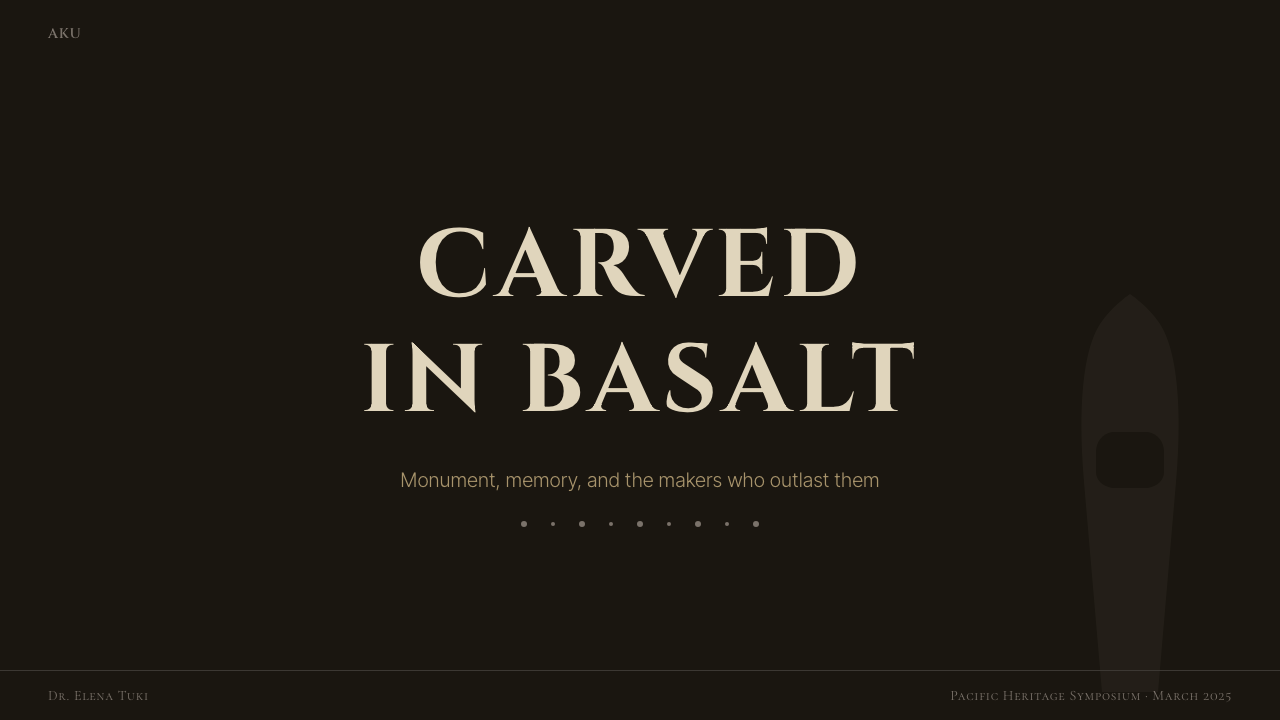
For presentation slides, this style is most effective on cover and section-divider pages where monumental impact is the goal. A cover page built in this idiom might feature a single large silhouette form — derived from moai proportions, strongly vertical — against a near-black ground, with a title in a wide-spaced, architecturally weighted typeface occupying the lower third. Content slides should resist overcrowding: one thought per slide, generous margins, and any data visualizations treated as geometric objects in their own right rather than as chartjunk. Dark bar charts with scoria-toned highlight bars and ashen grid lines read as lapidary — carved, not generated.
For web UI, this system suits products where authority, depth, and permanence are brand values: archival platforms, cultural institutions, high-end portfolio sites, or any service that wants to signal solidity in contrast to the bright and ephemeral defaults of mainstream web design. Dashboard components should use card surfaces with very subtle raised texture achieved through close-value dark tone-on-tone variation rather than light drop shadows. Navigation should be typographic and sparse — few items, generous spacing, no icon decoration. Interactive states are best indicated through a single accent tone drawn from the scoria-red range applied consistently across hover, focus, and active states.
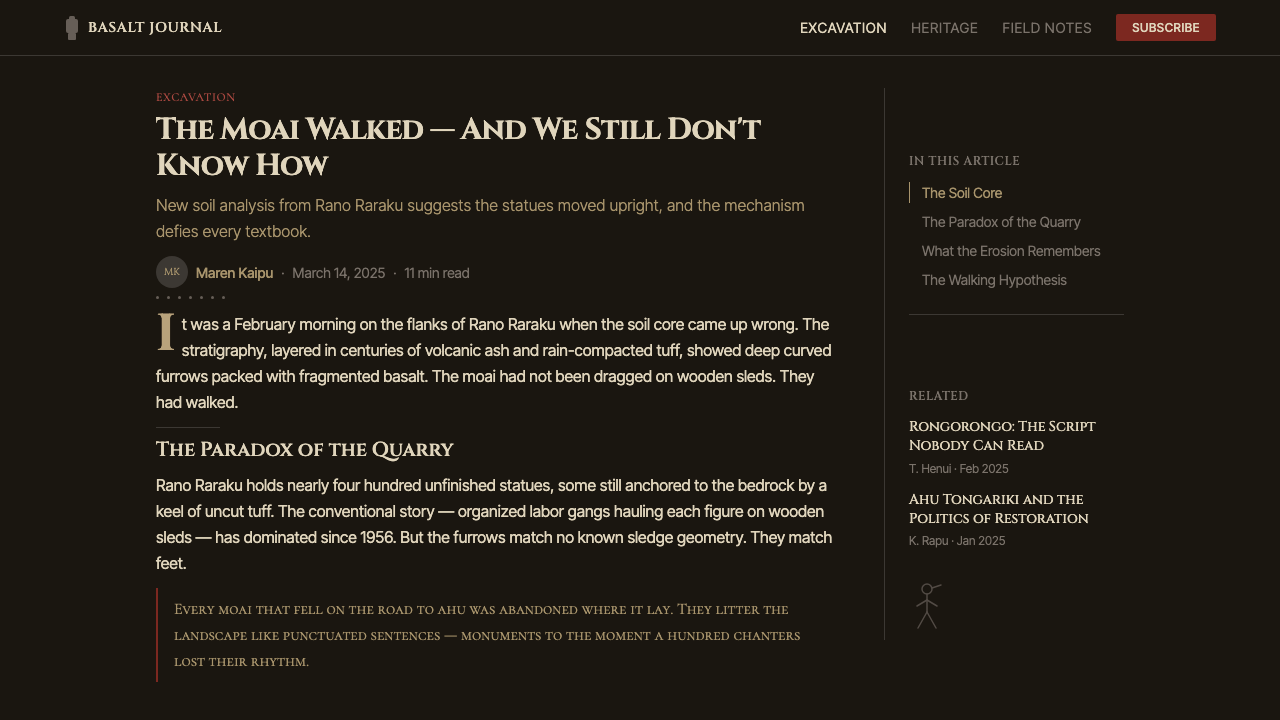
For editorial and marketing applications, the style supports the kind of authority typically associated with cultural heritage, archaeology, and long-form storytelling. A feature article layout might open with a full-bleed dark image — stone, sky, ocean — with a headline in stark contrast applied directly over it. Pull quotes gain weight when set large and isolated on a dark panel with minimal surrounding text. Marketing pages work well when organized around a single bold claim per viewport, with the surrounding negative space treated as the Pacific horizon: not empty, but vastly, intentionally open.
The most common mistake when applying this system is filling in the negative space. Designers trained in grid-dense, content-heavy layouts will instinctively want to add secondary elements, supporting text, or decorative details to what reads as empty. Resist this impulse entirely. A moai does not require a caption to be powerful. The silence around the form is part of the form. A second common error is reaching for a brighter accent color — cyan, electric yellow, vivid orange — to 'activate' the dark palette. This destroys the system's geological coherence; the only hues that work are the ones that could plausibly occur in volcanic stone or lichen.
Rapa Nui Moai Petroglyph — FAQ
How is this different from a generic dark-mode design?
Generic dark mode is light-mode design inverted — the same layout logic applied to a dark background, typically with a single blue or purple accent color lifted from the interface's light-mode version. Rapa Nui Moai Petroglyph is not an inversion; it is a fundamentally dark-ground system whose compositional logic — sparse elements, vertical emphasis, near-neutral tonal palette with geological color — was never light to begin with. The distinction shows in spacing: dark mode tends to compress and fill; this system treats the dark field as expansive and essential.
Can the birdman or moai silhouette be used as a graphic element?
With care. The moai silhouette is a powerful and globally recognizable form, but it carries the weight of sacred cultural heritage belonging to the Rapa Nui people, who are still a living community. Using a literal moai outline as decoration trivializes a symbol that is deeply tied to ancestor veneration and identity. The more principled approach is to apply the design principles the moai embody — extreme verticality, iconic simplification, deliberate scale contrast — to original forms rather than to reproduce the silhouette itself. The system's power comes from its formal vocabulary, not from appropriating its specific icons.
Does the rough, hand-pecked quality of petroglyphs translate well to digital design?
It translates better as a principle than as a literal texture. Directly importing a photographic stone texture or a scanned petroglyph rubbing as a background risks feeling like a themed restaurant backdrop rather than a considered aesthetic. The principle behind the petroglyph surface is that marks have weight, labor, and controlled imprecision — they are not clean vectors. In digital applications, this can be interpreted through typography choices that favor slightly irregular, humanistic letterforms over geometric perfection, through icon systems built on thicker, slightly variable stroke weights, and through visual rhythm that values the handmade mark over the machine-perfect edge.
How should the scoria red be used — as a primary surface color or as an accent?
Almost always as an accent. In the island's landscape, scoria red appears as cinder cones, as the red-tinged rock around volcanic vents, and as the pukao topknots placed on completed moai — not as the primary covering of every surface. In a design built on basalt-black and tuff-grey grounds, the scoria tone works best when concentrated in a single interactive element, a category indicator, a headline emphasis, or a thin structural rule. Using it at large scale — as a full section background or a primary fill — flattens the geological hierarchy that gives the palette its sense of depth.
Is this style appropriate for brands that have no connection to Polynesian or Pacific culture?
The formal principles of the system — monumental verticality, geological color, sparse composition, deep negative space, and controlled imprecision of mark — are available to any designer willing to apply them thoughtfully. The specific iconography of Rapa Nui, particularly the moai silhouette and the birdman petroglyph, belongs to a living cultural tradition and should not be appropriated decoratively. The distinction is between using a tradition's formal logic as a design vocabulary and using its sacred objects as decoration. The former is how design has always built on history; the latter is not appropriate regardless of the brand.
Related design styles
 Tibetan Mani StonePrayer made permanent in stone. Sunk-relief glyphs incised into cool slate, p…
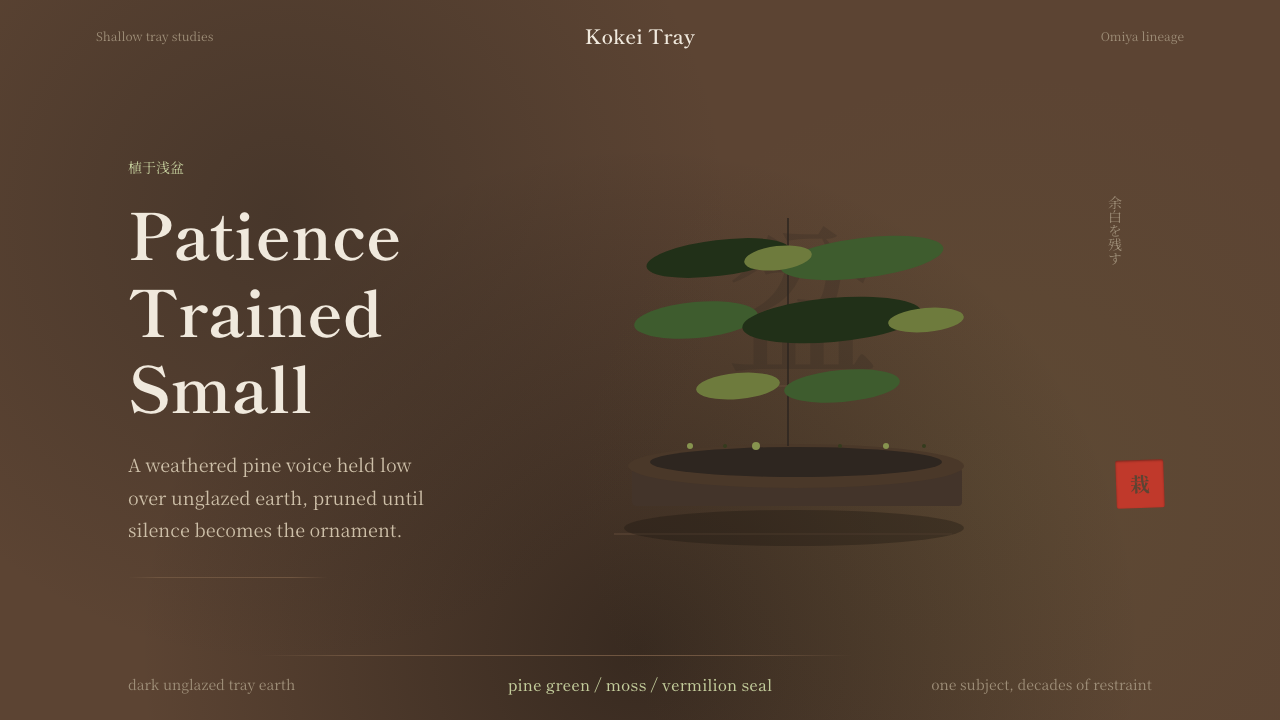 Bonsai CultivationQuiet asymmetry. Pine green rests on dark tray earth, sealed by one vermilion…
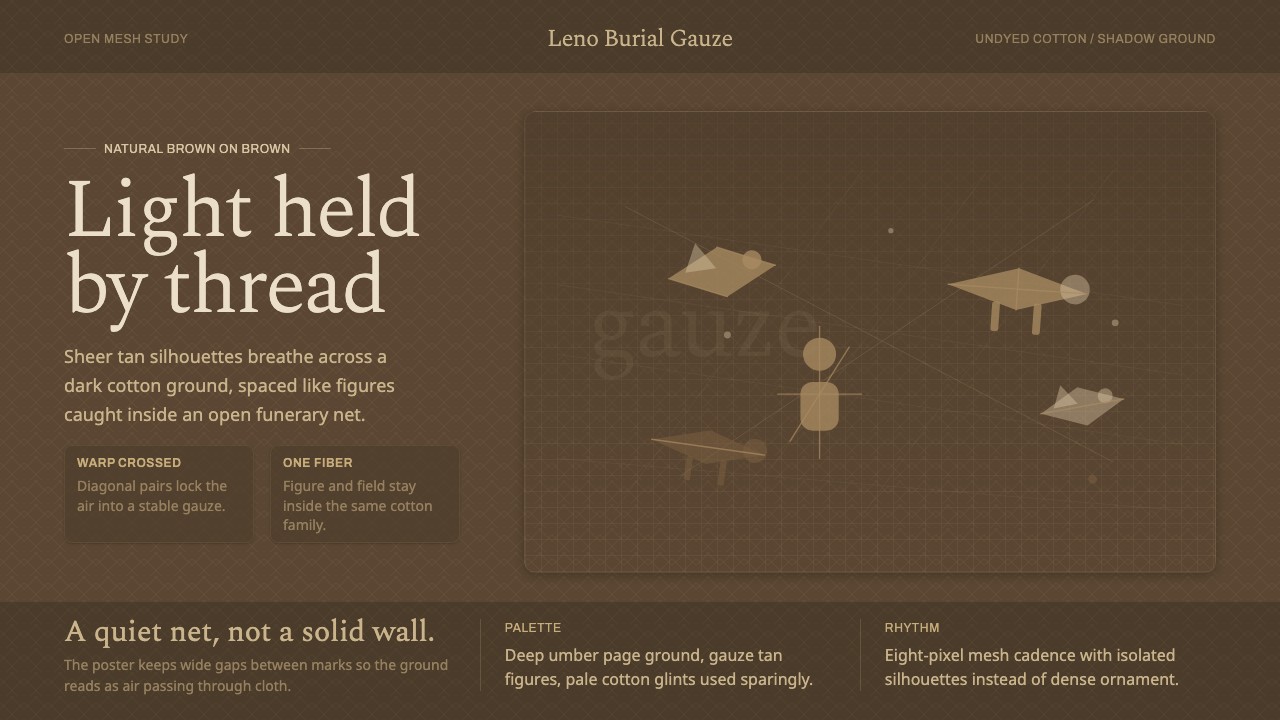 Chancay Gauze TextileQuiet woven dignity. Tan silhouettes float through a dark open cotton mesh.
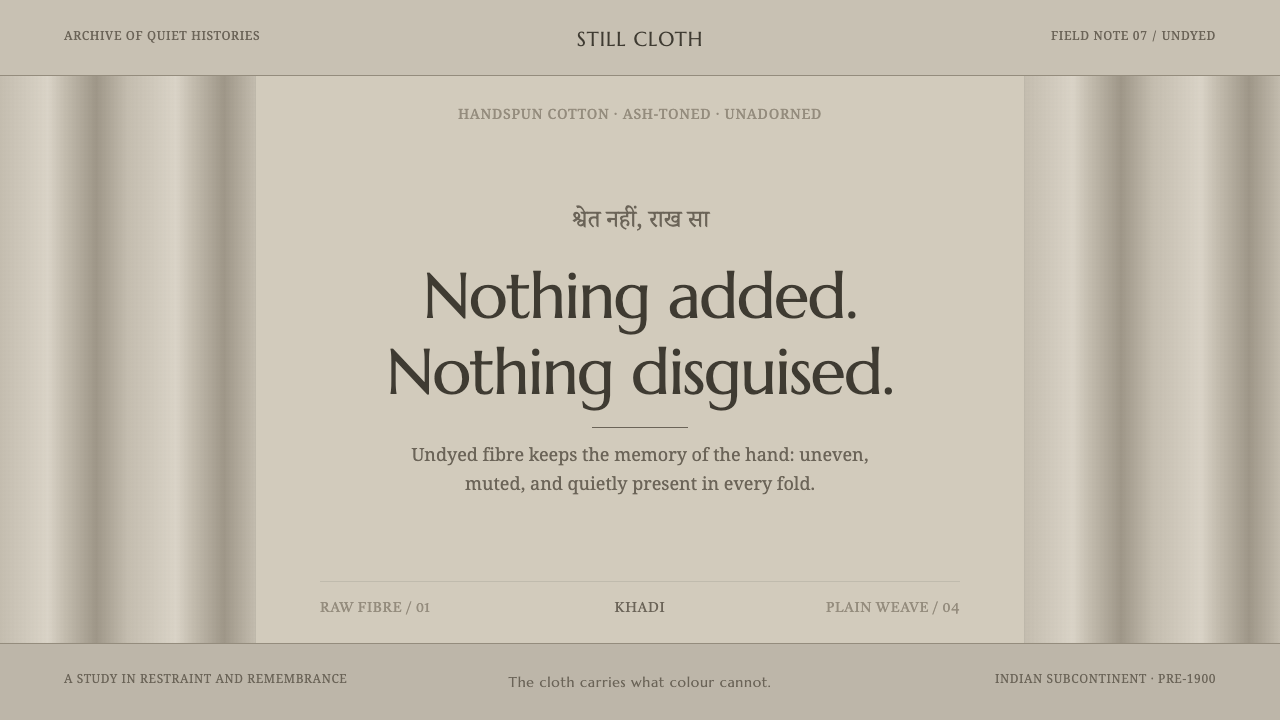 Hindu Widow White SariRestraint carries the weight. Ash-toned khadi, quiet serif type, and vertical…
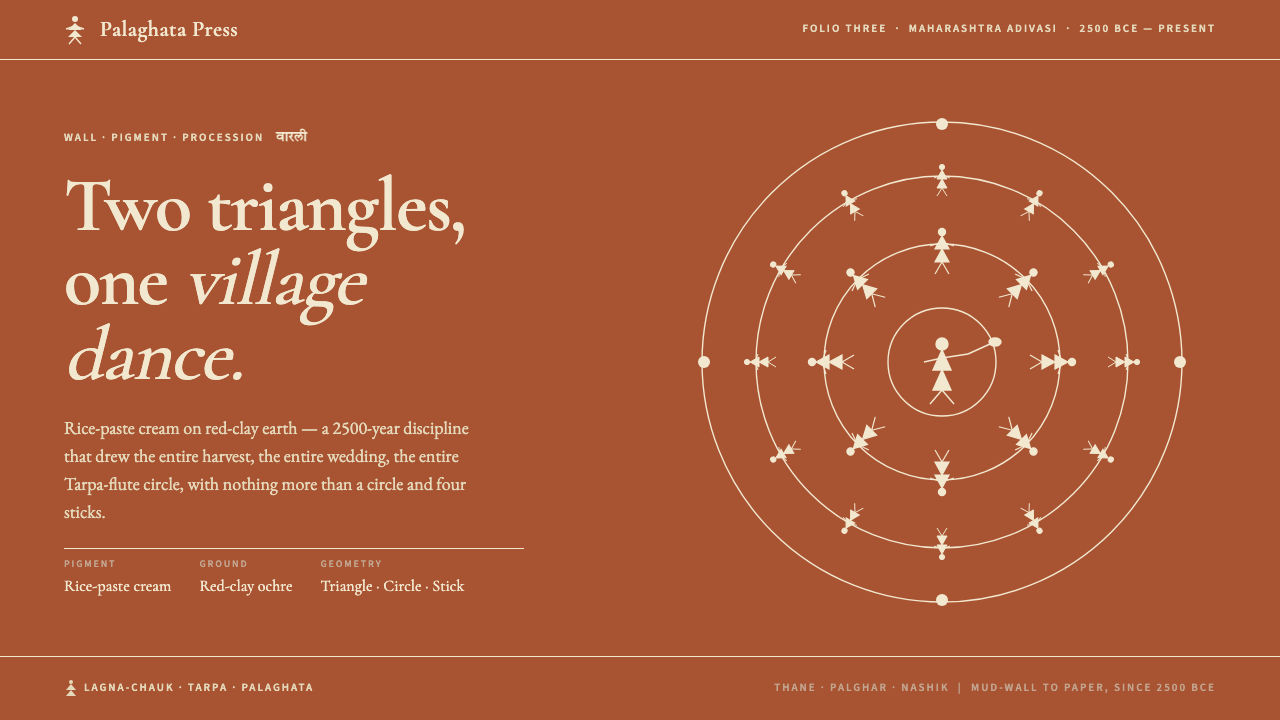 Warli Tribal PaintingTwo triangles make a human. Rice-paste cream on red-clay ochre, dancers proce…
 Hawaiian Hula Pahu DrumSacred weight, hand-marked. ʻAlaea red, kapa texture, and stacked carved regi…