What is Warli Tribal Painting?
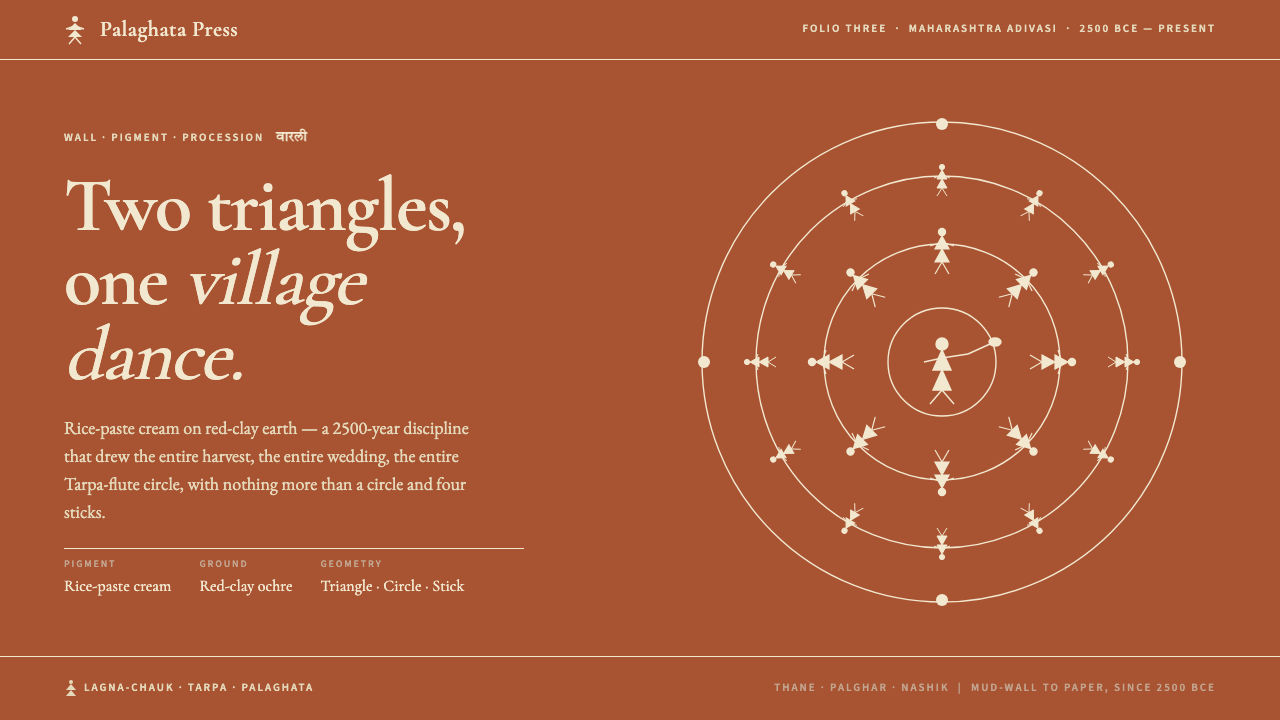
Two triangles make a human, rice-paste white on red-clay earth, and a whole village dances in concentric rings around the Tarpa flute player.
Warli Tribal Painting in brief
Warli painting is a ritual wall-painting tradition from the Warli Adivasi communities of Maharashtra's Thane, Palghar, and Nashik districts. Its visual system is among the most radically economical in the history of figurative art: the human body is two triangles placed tip-to-tip, the head is a small circle, and the limbs are four stick lines. A horse, a peacock, a fish, a tree — each is constructed from the same handful of geometric primitives. The entire pictorial vocabulary is rice-paste white pigment applied to walls prepared with a mixture of red clay, cow dung, and gum, producing a warm ochre ground that functions both as surface and as the second of the tradition's two tones.
Despite this radical reduction, Warli compositions are narratively dense. Wedding scenes, harvest rituals, hunting parties, and the communal Tarpa dance — in which villagers form a long, sinuous chain around a musician playing the horn-shaped Tarpa flute — are all rendered at a scale of information that rewards close looking. Repetition is the primary rhythm device: a ring of identical dancer-figures gains kinetic energy precisely because each figure is identical, and the eye reads motion rather than static pose. The white-on-ochre palette enforces a single tonal register, which means spatial depth and foreground-background distinction are communicated entirely through overlap and scale rather than shading or color contrast.
Warli's central compositional form is the mandala-like Palaghata, or Chavak — the square diagram associated with the mother goddess Palaghata, which appears at the center of wedding murals as a fertility symbol. The Palaghata is surrounded by concentric registers of figures and animals, expanding outward in a structure that is simultaneously cosmological map and festive frieze. This radial grammar — center expanding to periphery through accumulated repetition — gives Warli compositions their characteristic energetic stillness: everything is in motion, nothing is rushed.

Where does Warli Tribal Painting come from?
The Warli Adivasi — the name 'Warli' derives from the term 'waral', meaning a piece of land — have inhabited the coastal and forested hill terrain of what is now northern Maharashtra and southern Gujarat for millennia. Rock-shelter paintings with formal similarities to Warli figures have been dated to approximately 2500 BCE, suggesting a proto-Warli visual tradition of extraordinary longevity. Throughout this span, the paintings were not art objects in any gallery sense; they were ritual inscriptions, made by women on interior mud walls during the cycle of life ceremonies — particularly marriages, which required the creation of a fresh Palaghata mandala — and during harvest festivals in honor of the mother goddess.
The tradition was entirely women's practice until the 1970s. Married women — called 'Suvasinis' — held both the technical knowledge and the ceremonial responsibility. Wall paintings were made with a bamboo stick frayed at the tip to produce a fine brush, loaded with a paste of rice flour, water, and sometimes gum. The ochre ground was prepared seasonally. Because the paintings were made on earthen walls and renewed annually, no historic examples survive in their original form; the tradition was transmitted through practice rather than preserved objects, making its continuity an act of living cultural memory rather than archival documentation.
Outside contact came abruptly in 1974 when Jivya Soma Mashe, a Warli man from Ganjad village in Thane district, began painting on paper at the encouragement of Bhaskar Kulkarni, a Delhi-based artist and activist who recognized the tradition's formal power. This was a significant rupture: a man adopting what had been an exclusively female practice, and transferring it from wall to portable paper surface. Yashodhara Dalmia, the art historian who documented the tradition's emergence into the art world, has written extensively about how this transition changed both the formal conventions and the gender dynamics of the practice. Mashe's work subsequently appeared at the Museum of Modern Art in New York and at the Centre Pompidou in Paris, establishing Warli as a recognized form of contemporary tribal art internationally.
The 1970s discovery coincided with broader Indian and international interest in folk and tribal art traditions as valid aesthetic and cultural objects, not mere ethnographic curiosities. Craft institutions, government cultural bodies, and NGOs began supporting Warli practitioners, and the style entered the commercial textile, print, and product design markets. This mainstreaming created its own tensions: simplified, decorative Warli-derived motifs began appearing on mass-market goods, stripped of their ritual context and geometric discipline. Practitioners and scholars have noted the importance of distinguishing between the living ritual tradition — still practiced in village communities — and the commercial reproduction, which varies widely in fidelity to the original visual grammar.
What defines the Warli Tribal Painting look?
Two-Tone Palette
The entire pictorial world of Warli is built from two tones: rice-paste white against warm ochre-red earth. No secondary colors intrude. This is not a palette chosen for aesthetic variety but a direct consequence of materials — the pigment is what is available, the ground is what the wall is made from. The effect is visually powerful precisely because of its constraint: the eye receives no color information and must read everything through shape, scale, and density of mark. Contemporary designers applying this palette work with a warm off-white deployed against a deep, slightly dusty terracotta — not the vivid orange of commercial ethnic print, but the muted warmth of actual fired earth.
Geometric Figure Construction
Every living figure in Warli — human, animal, bird — is assembled from a fixed set of geometric primitives: triangles, circles, and lines. The human body is the clearest demonstration: torso is two triangles tip-to-tip (one pointing up for the chest, one pointing down for the hips), the head is a circle, and each limb is a single straight stroke. This is not stylization in the conventional sense — it is reduction to the minimum unit of legibility. The system is modular: once you understand the grammar, any figure can be read immediately, and compositions of hundreds of figures remain legible at a distance because no single figure demands decoding.
Concentric and Radial Composition
Warli compositions organize figures in rings, chains, and spirals rather than in horizontal registers or rectangular frames. The Tarpa dance — the tradition's most iconic motif — shows a long human chain winding around a central musician in an expanding spiral. Wedding murals place the Palaghata mandala at center and radiate outward through concentric bands of figures, animals, and flora. This radial logic gives Warli its energetic, centrifugal quality: compositions feel as though they are expanding from a center, or spinning. There is no fixed top or bottom; the image addresses all directions equally.
Repetition as Rhythm
Warli paintings are built on serial repetition of nearly identical units. A chain of twenty dancers, each figure a near-clone of the last, creates a visual rhythm that reads as collective motion rather than individual portraiture. This repetition is neither laziness nor limitation — it is the tradition's primary expressive device. Variation, where it occurs, is achieved through scale and spatial interval: a figure slightly larger than its neighbors reads as a chief or deity; a gap in the chain reads as pause or transition. The system encodes social and ceremonial hierarchy entirely through positional and scalar difference within a field of repeated units.
Ground as Active Surface
In most painting traditions, the background is empty or neutral — the figures exist against it. In Warli, the ochre ground is not empty space but a material presence with its own texture and warmth. The white rice-paste marks float on this surface rather than occupy it, and the ground shows through between marks, between figures, between rings of the dance. This interplay of mark and ground creates a visual breathing — a density that never becomes claustrophobic because the earth is always visible beneath the figures. The tradition has no concept of covering the entire ground; incompleteness is intrinsic.
Flatness and Anti-Naturalism
Warli figures have no shadows, no volume, no foreshortening, no perspective recession. A human figure and a tree twenty times its size can coexist in the same register without contradiction, because scale encodes importance rather than physical proximity. Animals are drawn in strict profile; humans are drawn facing the viewer with legs in profile — a composite pose reminiscent of ancient Egyptian conventions. There is no attempt to simulate three-dimensional space. The world of the painting is organized by ritual logic and social meaning, not by optical naturalism, and this produces a visual world that is immediately legible precisely because it makes no effort to reproduce visual reality.
Narrative Without Sequence
A large Warli mural condenses an entire ceremonial cycle — the wedding rituals, the procession, the feast, the dance — into a single simultaneous image rather than a sequential narrative strip. Different episodes exist in the same pictorial space, separated by compositional registers or mere proximity rather than by panels or explicit borders. The viewer reads the image not left-to-right or top-to-bottom but centrifugally, following chains of figures outward from a focal point. This non-linear narrative mode is entirely natural within the tradition's cosmological world view, in which ritual events are understood as recurring cycles rather than one-directional timelines.

Who shaped Warli Tribal Painting?
Jivya Soma Mashe (1934–2018) of Ganjad village, Thane district, is the figure most responsible for introducing Warli painting to the international art world. In 1974, encouraged by Bhaskar Kulkarni, Mashe began working on paper — a significant departure from the tradition's exclusively female, exclusively wall-based practice. His compositions expanded the traditional vocabulary while retaining its geometric grammar, and his work entered major international museum collections. He received India's Padma Shri award in 2011. Mashe's career demonstrated that a living ritual tradition could engage with the contemporary art market without abandoning its formal foundations, though this engagement also transformed the tradition in ways that remain debated among scholars and practitioners.
Sadashiv Soma Mashe, son of Jivya Soma Mashe, represents the second generation of Warli artists who have navigated the space between ritual practice and contemporary art production. Working in both the traditional ochre-and-white palette and in expanded color schemes for commercial commissions, Sadashiv has helped sustain the community's livelihood through the craft economy while grappling with questions of authenticity and adaptation. His work illustrates the ongoing negotiation between preservation and evolution that defines contemporary tribal art practice.
Yashodhara Dalmia is the art historian and author whose 1988 book 'The Painted World of the Warlis' remains the foundational scholarly document of the tradition. Dalmia conducted extended fieldwork in Warli villages and documented the ritual context, the gender dynamics, and the formal grammar of the paintings before outside commercialization significantly altered their practice. Her work established the critical framework for understanding the distinction between the living ritual tradition and its commercial derivatives, and has been essential reading for designers and curators seeking to engage with the tradition responsibly.
Bhaskar Kulkarni, a Delhi-based artist and activist, was the outside figure most directly responsible for the 1974 introduction of Warli painting to the broader Indian and international art world. It was Kulkarni who recognized the formal power of the tradition and encouraged Jivya Soma Mashe to work on paper, thereby initiating the process by which Warli became visible beyond its home communities. Kulkarni's role is a reminder that the 'discovery' of many folk and tribal traditions has depended on individual cultural brokers whose motivations, methods, and impacts deserve scrutiny alongside the traditions they helped publicize.
Anil Vangad is among the contemporary Warli practitioners who have worked to document and transmit the tradition's formal grammar to younger community members while also producing work for contemporary audiences. His practice raises questions about how a tradition that was historically transmitted through embodied ritual practice — not through schools or manuals — can be preserved when the ritual contexts that sustained it are themselves under pressure from urbanization and economic change. Vangad's work represents the ongoing effort to keep the tradition a living practice rather than a heritage object.
How do you use Warli Tribal Painting today?
Warli's visual system — two tones, geometric figures, radial composition, dense repetition — translates into contemporary design most successfully when designers adopt its structural logic rather than its surface motifs. Lifting individual Warli figures as decorative stamps is the most common misapplication. The tradition's power comes from the system: the relationship between ground and mark, between center and periphery, between the individual unit and the collective ring. Designs that engage this systemic quality produce something with genuine Warli character; designs that merely borrow isolated figures produce ethnic decoration.
For presentation slides, Warli offers a distinctive cover treatment: a warm terracotta ground with white geometric figures arranged in a radial or concentric pattern around the central title. The figures should be simple and repeated — not complex single illustrations — and the composition should feel as though it is expanding from the center outward. Content slides work best with a stripped-back version of this logic: white marks on a warm ground, with section headers treated as the compositional focal point from which supporting content radiates. Data visualizations gain character when chart elements — bars, segments, connectors — are treated as geometric marks in the Warli idiom rather than as conventional chart shapes, though this requires care to maintain readability.
For web interfaces and dashboards, Warli's two-tone discipline can ground an entire design system. A near-white background with warm, slightly dusty terracotta as the primary accent color — used for interactive states, active navigation, and key data values — stays faithful to the tradition's tonal logic. Pattern elements derived from Warli's geometric vocabulary work effectively as dividers, loading states, empty-state illustrations, and background textures, provided they are used sparingly enough that the ground remains active. Pricing pages and feature comparison grids benefit from the tradition's modular, repeated-unit logic: identical cards differentiated by scale and position rather than by color.
In editorial and marketing contexts, Warli is best deployed as a visual system for brands and campaigns with a connection to craft, community, sustainability, or Indian cultural heritage — not as a generic exotic texture. The warm two-tone palette gives editorial spreads an immediate warmth that photographic color treatments rarely achieve. Marketing materials work well with large-scale Warli-derived pattern as a hero element — a full-bleed terracotta ground with white geometric composition — contrasted against clean white typographic sections. The tradition's radial grammar translates naturally into hero section layouts in which product or message sits at the center of a composition that draws the eye inward.
A common mistake when applying Warli-inspired design is over-rendering individual figures. Authentic Warli figures are sketchy, quick, and imperfect — the frayed bamboo brush produces marks with slight variation that gives the tradition its handmade vitality. Digitally perfect, over-smoothed geometric figures lose this quality entirely and produce something closer to icon design than to the tradition. A second common mistake is expanding the palette: adding a third color, even a muted one, breaks the two-tone discipline that gives Warli its visual force. Stay with the warm ground and the white mark, resist the temptation to add accent colors, and the system will hold.

Warli Tribal Painting — FAQ
Is Warli painting the same as other Indian folk painting traditions like Madhubani or Pattachitra?
They are distinct traditions with different geographic origins, materials, visual grammars, and ritual contexts. Warli is from Maharashtra's Adivasi (tribal) communities and uses a strict two-tone system — white rice paste on red-ochre earth — with figurative content built from triangles, circles, and lines. Madhubani (from Bihar) uses multiple colors, filled forms, and complex patterned borders, with imagery rooted in Hindu mythology. Pattachitra (from Odisha and West Bengal) is a scroll or cloth painting tradition with elaborate color and outline work. The three are sometimes grouped under the label 'Indian folk art' for convenience, but they have no more in common than, say, Japanese ukiyo-e and Chinese ink painting. Understanding their differences matters for applying any one of them with integrity.
Can Warli style be used in digital products with more than two colors?
It can, but expanding the palette requires clear discipline about what the additional colors are doing. The two-tone logic of the tradition is not just an aesthetic choice — it is the formal principle that gives Warli compositions their visual coherence. When a third color is introduced in a digital application, it should serve a specific functional role — interactive state, error condition, data differentiation — rather than decorative enrichment. The warm terracotta ground and white mark should remain the dominant tonal relationship; additional colors should appear sparingly enough that they read as functional signals against the base system. Treating Warli's two-tone discipline as a starting point rather than a constraint produces more coherent results than treating it as a limitation to overcome.
How do you apply Warli's radial composition logic to rectangular screen layouts?
The radial logic does not require a circular canvas — it is a compositional principle about the relationship between a focal point and its surrounding content. In a rectangular web layout or slide, this translates to: identify the primary message or element, place it at a compositional center (which need not be the geometric center of the rectangle), and organize supporting elements in a way that draws the eye toward that center or radiates outward from it. Hero sections with a central product image surrounded by radiating feature callouts apply this logic directly. In data visualizations, radial bar charts and sunburst diagrams are the most literal translations; concentric-ring progress indicators and orbit-style relationship maps are other natural forms. The key is to resist the default left-to-right, top-to-bottom linear reading direction and ask instead what the image's center of gravity is.
Is it appropriate to use Warli motifs in commercial design, or is this cultural appropriation?
This is a genuinely contested question, and the honest answer is that context and intention matter enormously. The Warli tradition is a living practice, not a historical artifact, and its practitioners are an economically marginalized Adivasi community. Commercial use of Warli motifs without acknowledgment, without compensation to practitioners, or without engagement with the tradition's actual cultural significance strips the visual system of its meaning while extracting its market value — which is the pattern that most clearly constitutes appropriation. Responsible engagement looks different: sourcing work directly from Warli artists and craftspeople, crediting the tradition clearly in all materials, educating the audience about the cultural context, and ideally directing some commercial value back to the community. Applying Warli-inspired visual logic at a systemic level — as a design system that honors the grammar rather than lifts the motifs — is generally less fraught than decorative surface borrowing.
What is the Tarpa dance, and why is it so central to Warli imagery?
The Tarpa is a wind instrument made from a gourd and bamboo, traditionally played by a designated musician during Warli festivals. The dance that accompanies it — called the Tarpa dance — involves the entire community forming a long, winding chain of linked hands, with the dancer at the head of the chain following the movements of the Tarpa player, and the rest of the chain following the dancer at the head. The musician leads; the community follows. In Warli paintings, this produces the most visually distinctive motif: a long sinuous chain of identical stick figures spiraling around a central musician. It encodes the tradition's social values directly into visual form — collective motion, community cohesion, the centrality of music and rhythm to communal life. For designers, the Tarpa dance motif is the clearest example of how Warli uses repetition of identical units to convey collective experience rather than individual identity.
Related design styles
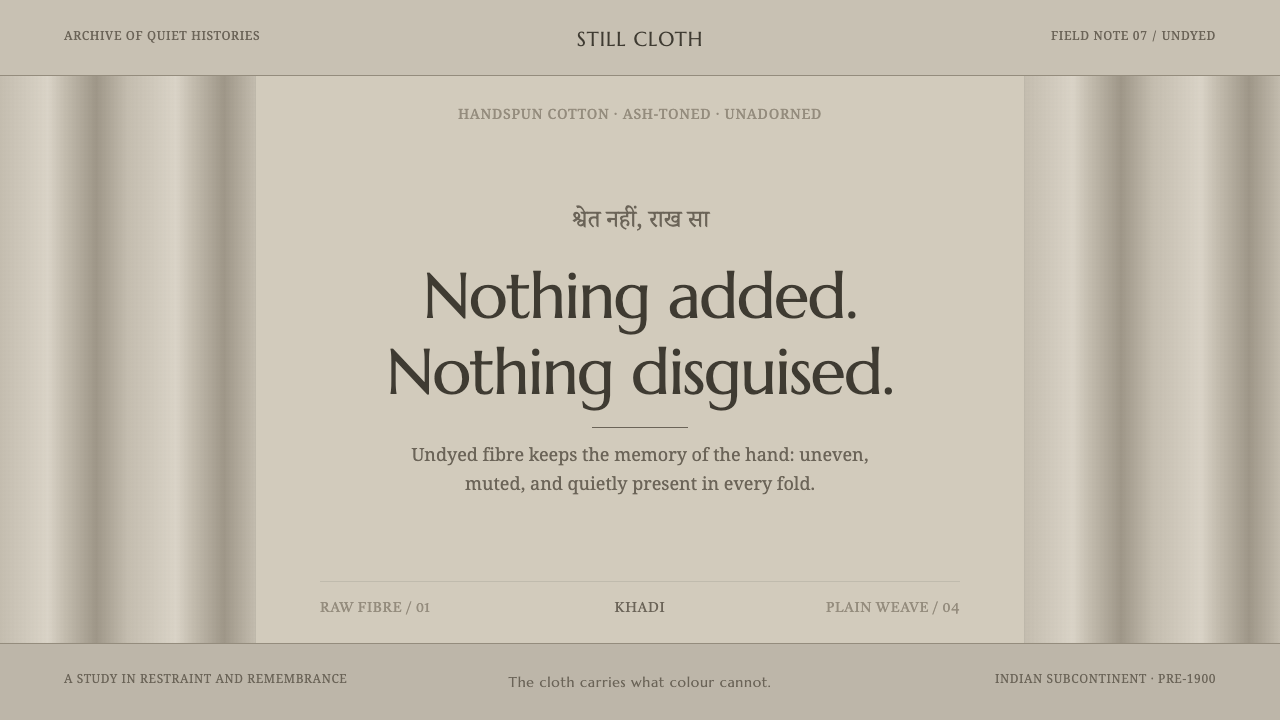 Hindu Widow White SariRestraint carries the weight. Ash-toned khadi, quiet serif type, and vertical…
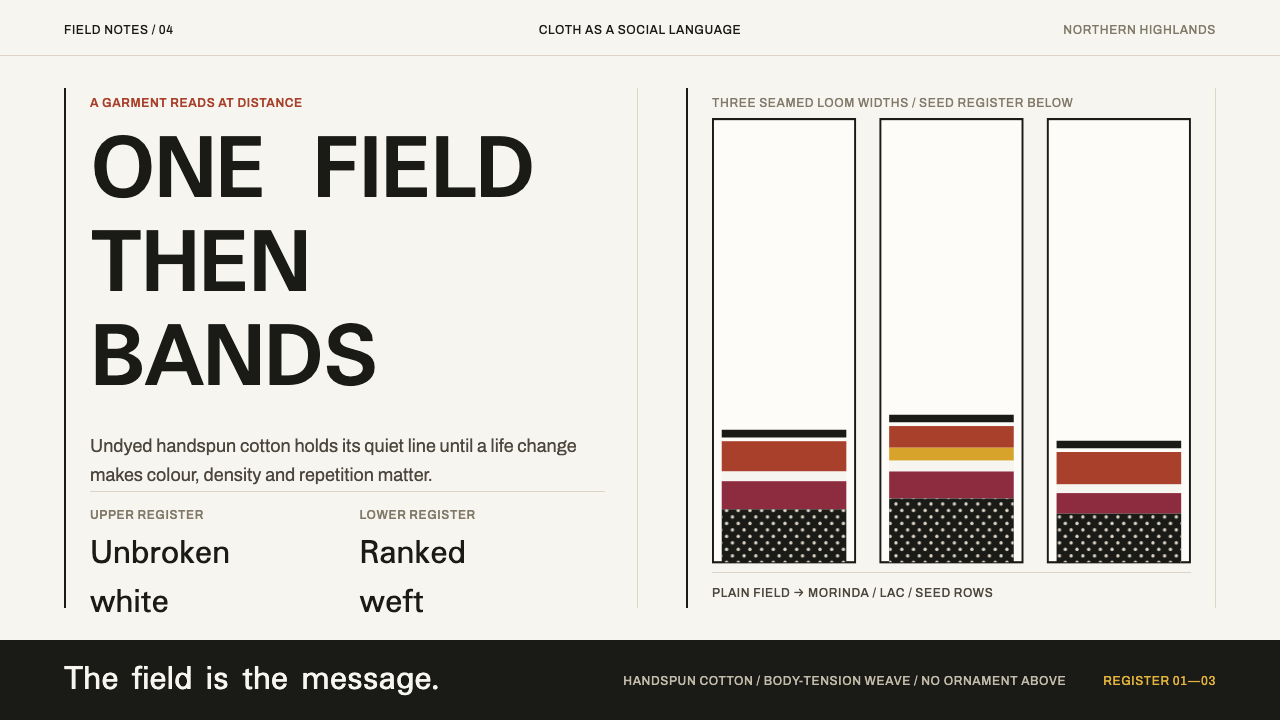 Karen Woven TunicOne field, then bands. Warm cotton white gives way to morinda registers and r…
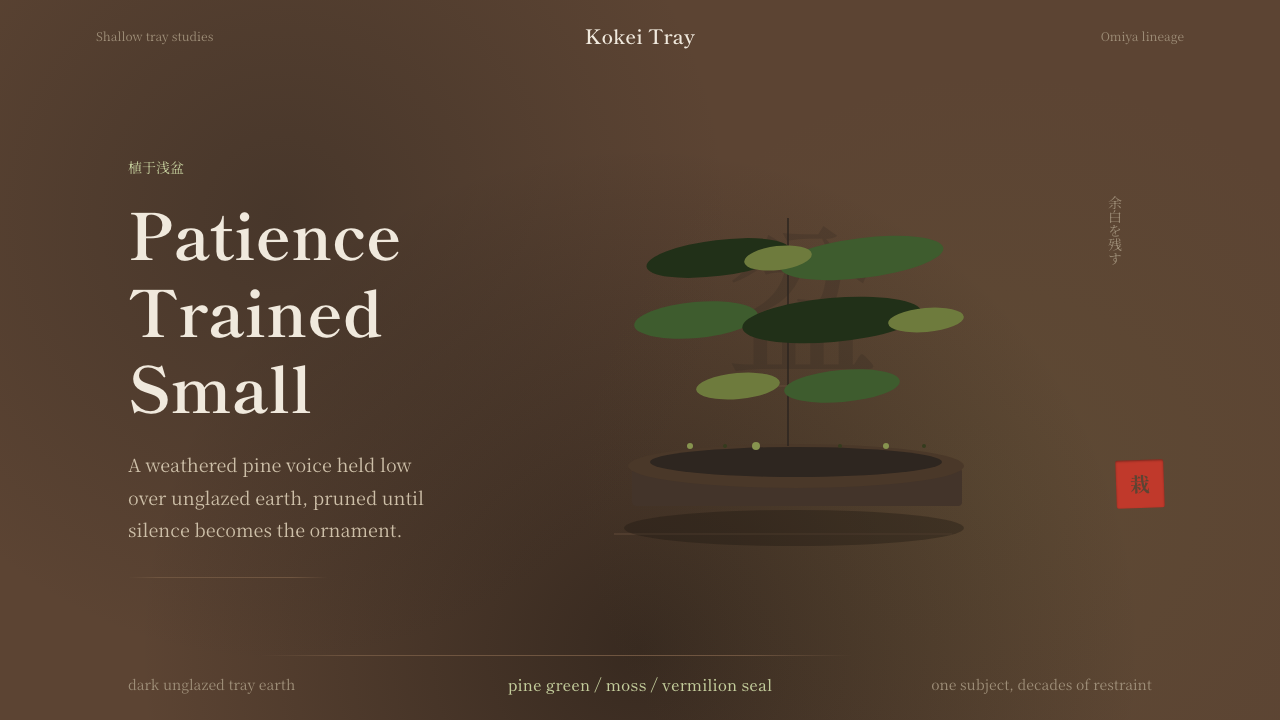 Bonsai CultivationQuiet asymmetry. Pine green rests on dark tray earth, sealed by one vermilion…
 Chancay Gauze TextileQuiet woven dignity. Tan silhouettes float through a dark open cotton mesh.
 Konso WagaWeather makes the monument. Silver-grey timber, hard planes, and ochre held i…
 Moriori Rakau MomoriPressure, not incision. Literata shadows sink softly into pale, lichened bark.