What is Tamil Kolam (Rice Flour Threshold)?
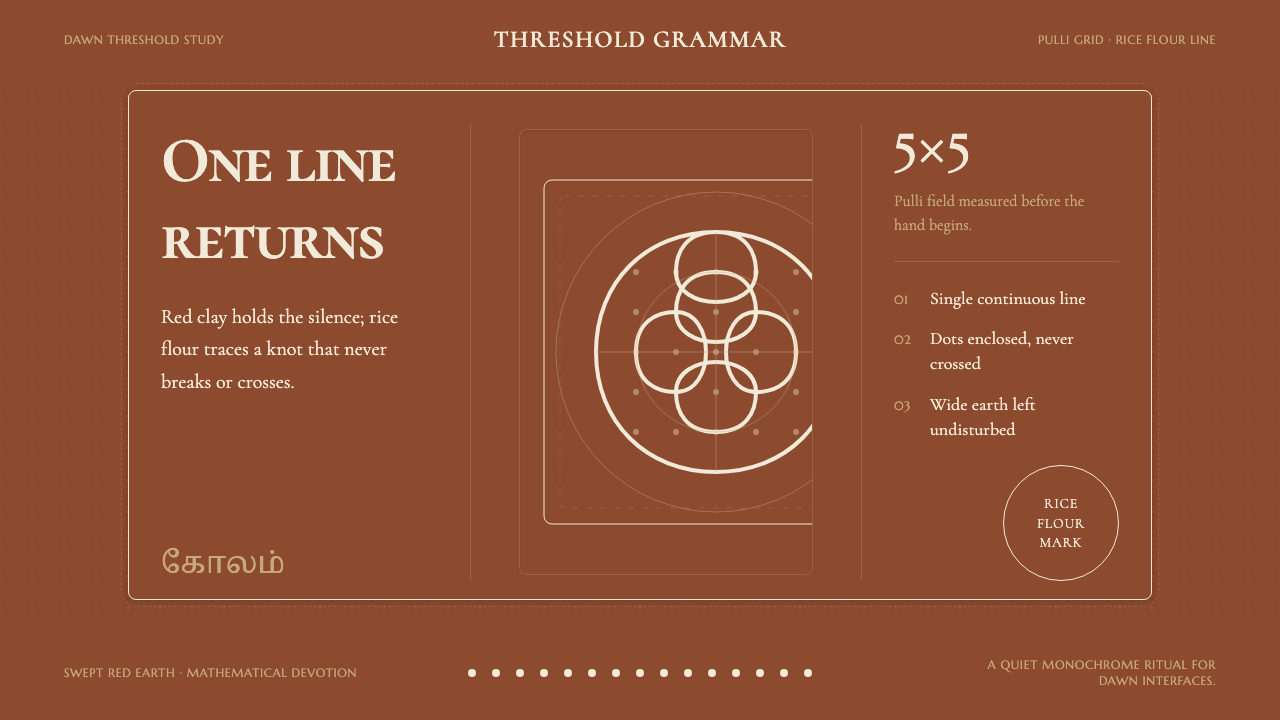
Every dawn for three millennia, Tamil women have drawn the world's most mathematical living art onto their thresholds — a continuous line knotting around a dot grid, always returning to where it began.
Tamil Kolam (Rice Flour Threshold) in brief
Tamil kolam is a threshold art form practiced daily across Tamil Nadu and Tamil diaspora communities worldwide. Each kolam is drawn freehand — no ruler, no stencil — by dropping rice flour through the fingers onto a swept, dampened surface. The canonical sikku-kolam variety follows a strict rule: a single continuous line must weave around a grid of dots without ever crossing itself, and it must return to its starting point. The result looks like a Celtic knot compressed into a radially symmetric mandala, yet it is drawn from memory in minutes, every morning, before the household wakes.
The design language that emerges from this practice is instantly distinctive. Red-clay earth provides the dominant ground — the deep terracotta of Indian thresholds, sun-baked courtyard floors, and the red-oxide plaster used across South Indian domestic architecture. Against that warm, mineral darkness, rice-flour white functions as the sole accent: luminous, stark, and fragile. There is no third color, no gradation, no shadow fill. The geometry is all dots and the lines that navigate between them, producing forms that are simultaneously ancient and startlingly modern in their economy.
What makes kolam unique among world threshold arts is the mathematical structure underlying its visual elegance. Researchers studying kolam since the 1980s have found that many traditional patterns encode concepts from graph theory, topology, and matrix algebra — not as abstract exercises, but as embodied knowledge transmitted through daily practice across generations of women who had no formal mathematical education. The art is a living proof that rigorous structure and devotional beauty are not in tension.
Where does Tamil Kolam (Rice Flour Threshold) come from?
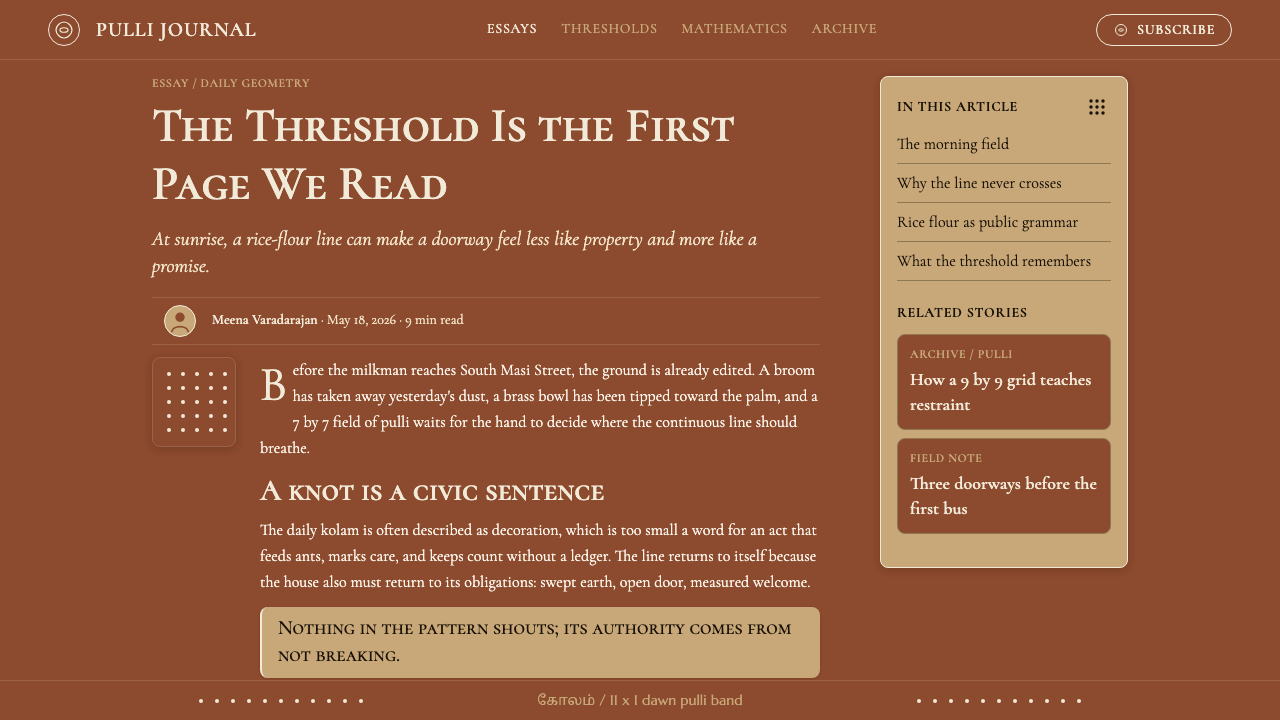
The word kolam derives from the Tamil root meaning beauty or form, and the practice is documented in Tamil Sangam literature from at least the first centuries of the common era — making it among the oldest continuously documented visual traditions in the world. Ancient texts describe the practice as both auspicious and protective: rice flour feeds the ants and insects that might otherwise enter the home, and the act of drawing each morning marks the threshold as a sacred boundary between household and world.
Two main forms evolved over the millennia. Pulli-kolam, the dot-grid variety, places a precise array of dots on the ground and requires the practitioner to connect them according to local conventions, producing regionalized forms that vary between villages in Tamil Nadu, Sri Lanka, and diaspora communities. Sikku-kolam, the knotted-line variety, imposes the no-crossing, must-return-to-start rule, which is the constraint responsible for the mathematically complex topological properties that researchers later identified. Festival kolams — drawn for Pongal, Karthigai Deepam, and other occasions — may grow to fill entire courtyards and incorporate rice paste colors alongside the flour white.
The mathematical study of kolam began in earnest with the anthropologist and mathematician Marcia Ascher, who in the 1980s and 1990s analyzed kolam patterns alongside other indigenous mathematical traditions worldwide. Around the same time, Gift Siromoney at Madras Christian College developed formal grammars to describe kolam generation computationally. Vijaya Nagarajan's fieldwork in Tamil Nadu documented the social and cosmological dimensions of the practice — the oral transmission, the dream-patterns, the competitive virtuosity between neighbors. The Mozambican mathematician Paulus Gerdes later connected kolam structures to similar knotted-line traditions in sub-Saharan Africa, situating the form within a global ethnomathematical conversation.
The cultural meaning of kolam is inseparable from the social context of its making. It is traditionally a practice of women, drawn before dawn, in the moment between sleep and the day's activity. The kolam marks the threshold moment as much as the physical threshold. It is impermanent by design: by evening, foot traffic, wind, and birds will have erased it, and a new kolam will be drawn the next morning. This deliberate impermanence connects the form to broader South Asian aesthetic traditions of devotional ephemera — rangoli, sand mandalas, flower offerings — in which the act of making is as significant as the made object. The kolam does not aspire to survive; it aspires to have been made.
What defines the Tamil Kolam (Rice Flour Threshold) look?
Ground Color
The dominant field is red-clay earth — the deep, warm terracotta of South Indian thresholds, sun-baked courtyards, and red-oxide plaster walls. This is not a decorative choice but a material fact of origin: kolam is drawn on actual red-clay surfaces, and the design system preserves that chromatic identity as its foundational ground. The darkness and warmth of this ground is what makes the rice-flour white so luminous by contrast.
Accent Color
Rice-flour white is the sole accent, used exclusively for the drawn lines and knot forms. It is not a neutral — it is a positive, assertive mark against the dark ground, the way chalk on a blackboard is not absence but presence. No secondary accent colors appear in the canonical monochrome form of kolam. The system achieves all its visual complexity through the geometry of the single white line, not through chromatic variety.
Dot Grid Geometry
All kolam pattern generation begins with a dot grid. Dots are placed at regular intervals in square, diamond, or offset arrangements, and the drawn line must navigate around or between every dot without touching it. The dot grid is invisible in the finished work — swept away or absorbed into the surface — but its ghost determines every curve and angle of the resulting pattern. This invisible underlying structure is analogous to a design grid: it is the constraint that generates the freedom.
Single Continuous Line
The defining formal rule of sikku-kolam is that a single unbroken line must complete the entire pattern — no lifting of the hand, no second stroke, no crossings, and a return to the start. This constraint is what produces the knotted, interlaced quality that distinguishes kolam from other floor-art traditions. Visually it creates forms that have no obvious entry or exit point, a quality of wholeness and closure that feels deeply resolved even when the underlying mathematics is complex.
Radial Symmetry
Most kolam patterns are radially symmetric — they read the same when rotated by some fraction of a full turn. This is not a rule but an emergent consequence of the dot-grid and single-line constraints, which naturally tend to produce patterns that repeat outward from a center. The radial structure gives kolam its mandala-like quality: a single visual field that can be entered from any edge and read from the center outward. It also makes the pattern legible at small scales, because the repeating unit does most of the perceptual work.
Negative Space
The red-clay ground is not background — it is an active participant in every kolam composition. The white line defines enclosed regions of the ground color, and those enclosed dark shapes are as visually weighted as the white line itself. Traditional kolam practitioners are aware of this: part of the skill is controlling not just the path of the line but the size, shape, and proportional balance of the dark interior spaces it creates. The ground breathes through the pattern.
Impermanence
Kolam is made to disappear. Drawn each morning, erased by evening, redrawn the next day — the cycle is the practice. This temporal quality has no direct equivalent in screen or print design, but it informs the aesthetic in a subtler way: the visual language carries no sense of monumental permanence. Forms are precise but not heavy, refined but not overworked. There is a lightness in the line weight and an openness in the composition that recalls something made quickly, with confidence, and without the anxiety of posterity.
Who shaped Tamil Kolam (Rice Flour Threshold)?
An American ethnomathematician whose landmark work in the 1980s and 1990s placed kolam alongside other indigenous mathematical traditions — Inuit string figures, Vanuatu sand drawings, Yoruba divination patterns — as evidence of rigorous mathematical thinking outside Western academic contexts. Her analysis showed that kolam practitioners were encoding and transmitting graph-theoretic concepts through an oral-and-motor tradition with no written mathematical notation. Her work established kolam as a serious subject of mathematical study and helped legitimize ethnomathematics as a field.
A computer scientist and mathematician at Madras Christian College who, from the 1970s onward, developed formal generative grammars to describe how kolam patterns are constructed. Siromoney treated kolam as a formal language problem — specifying the rules by which valid patterns can be generated from dot-grid starting configurations — and in doing so connected the traditional art to formal language theory and computational pattern generation. His work was among the first to treat a living vernacular art form as a subject of formal theoretical analysis.
An anthropologist and religious studies scholar whose fieldwork in Tamil Nadu documented kolam practice from the inside — its social organization, its transmission between mothers and daughters and neighbors, its relationship to Hindu cosmology, and its meaning to the women who draw it every morning. Nagarajan's work recovered the human and spiritual dimensions that purely mathematical accounts of kolam tend to elide. Her research established that the practice is inseparable from Tamil women's domestic sovereignty, ritual knowledge, and aesthetic autonomy.
A Mozambican mathematician who studied geometrical thinking in African and other non-Western mathematical traditions. Gerdes identified structural parallels between Tamil kolam and similar interlaced knotted-line traditions in sub-Saharan Africa, particularly among the Tchokwe people of Angola. His comparative work widened the frame for understanding kolam: not as a local Tamil curiosity but as one instance of a broader human mathematical intuition about continuous closed curves navigating lattice structures — an intuition that appears to have been discovered independently in multiple cultures across the world.
How do you use Tamil Kolam (Rice Flour Threshold) today?
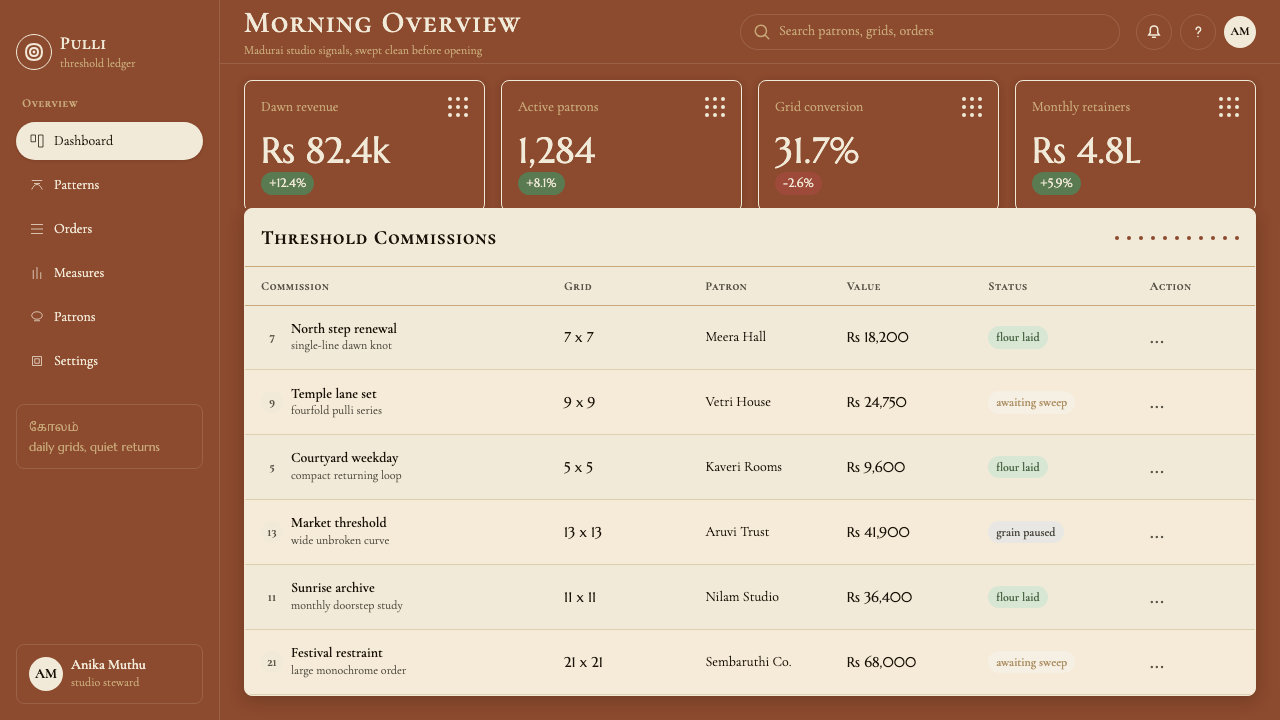
The Tamil kolam design language carries a specific set of values — mathematical precision, monochrome discipline, rich negative space, and a sense of devotional care — that transfers well to designed surfaces that benefit from similar qualities. Applying it effectively requires committing to the restraint at its core: the system works because it does only two things (dark ground, white line) with complete confidence. Introducing a third color or a soft gradient immediately dissolves what makes it distinctive.
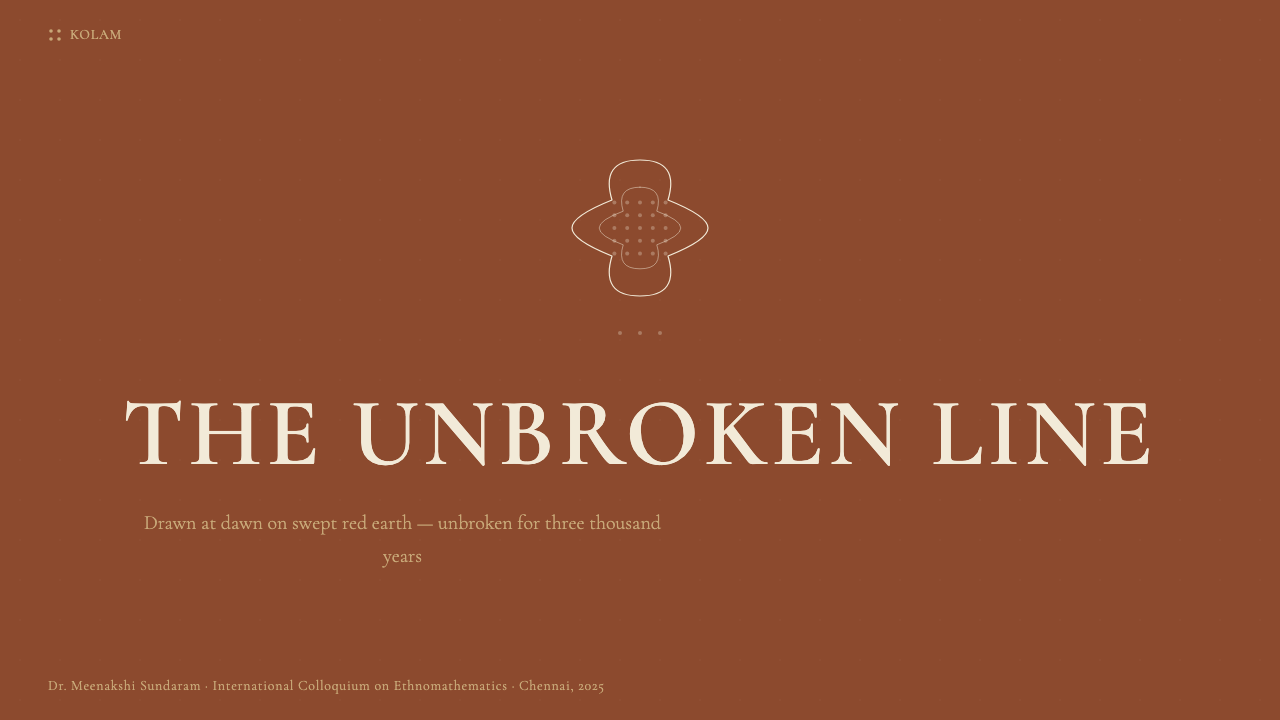
For presentation slides, the kolam palette and geometry work best on cover pages and strong section dividers. A cover built on a deep terracotta field with a single large white interlace form — even a simplified or abstracted one — immediately communicates cultural grounding and mathematical seriousness. Content slides should pull back significantly: use the terracotta for headers or accent rules only, keep body text on a near-white or cream field, and allow generous margins. For data slides, treat charts as geometric objects built on the red ground, using white bars or lines to echo the kolam line against the dark surface.
For web interfaces, kolam is most effective in contexts where atmosphere and cultural specificity matter more than clinical efficiency. Landing pages, feature showcases, and brand-story sections benefit from the deep terracotta as a full-width section background with white type and white illustrative geometry. Dashboard and utility interfaces are harder to pull off — the very low contrast of white-on-red at small sizes creates legibility challenges, and the palette's warmth can feel mismatched with analytical contexts. Navigation, pricing tables, and data-heavy layouts are better served by pulling the palette back to near-white backgrounds with terracotta used only for active states or primary calls to action.
For editorial and marketing work, the style supports richly atmospheric layouts where the cultural reference is intentional and understood. Magazine-style editorial spreads using a full terracotta bleed with white interlace geometry as decorative structure — not mimicking an actual kolam precisely, but evoking its geometric spirit — can be deeply effective. Marketing pages benefit from the high contrast of the palette for hero sections, with cream or white fields for body-content sections. The dot-grid idea also transfers well to subtle background textures and section dividers in editorial contexts, giving the layout a quiet structural logic without overwhelming the content.
A common mistake is to treat the terracotta-and-white palette as decorative exotic color, applying it cosmetically while the underlying layout logic remains generic. Kolam's visual power comes from the relationship between the ground and the line — the way the dark field breathes through the white geometry. Designs that simply tint their backgrounds red-brown and add some white curves miss this: what is needed is a genuine commitment to the ground as active space, with the white element spare and structurally precise. Another failure mode is oversaturation — choosing a bright, photogenic red-orange rather than the muted, mineral terracotta of actual clay. The authentic tone is darker and dirtier than it first appears in imagination.
Tamil Kolam (Rice Flour Threshold) — FAQ
Is kolam the same as rangoli?
They are related but regionally and formally distinct. Rangoli is the broader North Indian term for threshold and festival floor art, and it commonly uses colored powders, flower petals, and multiple hues. Kolam is the specifically Tamil tradition, and in its canonical form it is monochrome — rice flour white on the red-clay or stone ground. The mathematical knotted-line constraint (the single continuous no-crossing line that must return to its start) is characteristic of kolam sikku tradition specifically; rangoli patterns tend to be built up from individually drawn elements rather than from a single continuous circuit. Both share the quality of deliberate impermanence and devotional making.
Why is the mathematical complexity of kolam significant?
The mathematical complexity of kolam matters for two reasons. First, it demonstrates that rigorous abstract reasoning can be transmitted and preserved through practice, embodied ritual, and visual form without recourse to formal written notation — challenging assumptions about where and how mathematical knowledge can exist. Second, the specific structures encoded in kolam patterns — closed Eulerian paths on lattice graphs, topological knot equivalence classes — are the same structures that appear in graph theory, knot theory, and computational linguistics. Researchers studying kolam have made genuine contributions to formal mathematics using the tradition as a generative source, not merely as an illustration.
Can the kolam palette work on a light background?
The canonical kolam relationship is rice-flour white on red-clay dark ground — the dark ground is structural, not decorative. Inverting this to produce dark lines on a light field is possible, but it produces something quite different in feeling: the line becomes a drawing rather than a luminous mark, and the quality of the ground breathing through the pattern largely disappears. If a light-background application is required, the most coherent approach is to use a deep terracotta for the line elements themselves against a cream or parchment field — preserving the warmth of the original palette while adapting the figure-ground relationship. A pure white background with black lines will lose the cultural resonance almost entirely.
Who traditionally makes kolam, and is it changing?
Kolam is a traditionally female practice — historically the work of women in Tamil households, drawn before dawn as part of the daily domestic ritual of threshold-marking and household purification. The skill is transmitted informally from mothers, grandmothers, and neighbors, typically learned by watching and then practicing on small scales before attempting larger or more complex patterns. In contemporary Tamil Nadu and diaspora communities, the tradition persists but is under pressure from urbanization, apartment living (which eliminates the clay threshold), and the time demands of professional employment. Some practitioners have adapted by using kolam stencils or chalks rather than rice flour, or by drawing on paper rather than ground. The practice has also moved into new contexts: competition kolam (for festivals and civic events) can reach enormous scales, and kolam-derived geometric imagery has been widely adopted in Tamil graphic design, textile patterns, and digital art.
How does kolam relate to other knotwork traditions like Celtic knots?
Kolam and Celtic knotwork share the formal property of being single continuous closed curves with no crossings (in the case of sikku-kolam) or with regular over-under weaving (in the case of Celtic interlace), and they share the visual effect of producing complex, self-referential patterns from simple generating rules. But they evolved independently on opposite ends of Eurasia, from different cultural contexts and with different purposes. Celtic knotwork is primarily a decorative manuscript and stonework tradition associated with medieval Christian Europe; kolam is a living daily ritual tradition associated with Tamil Hindu domestic life. The mathematical researcher Paulus Gerdes identified similar structures in sub-Saharan Africa as well, suggesting that this particular class of knotted-line geometry may be something close to a mathematical universal — a formal possibility that human beings arrive at across cultures when working with the constraint of closed continuous paths on lattice structures.
Related design styles
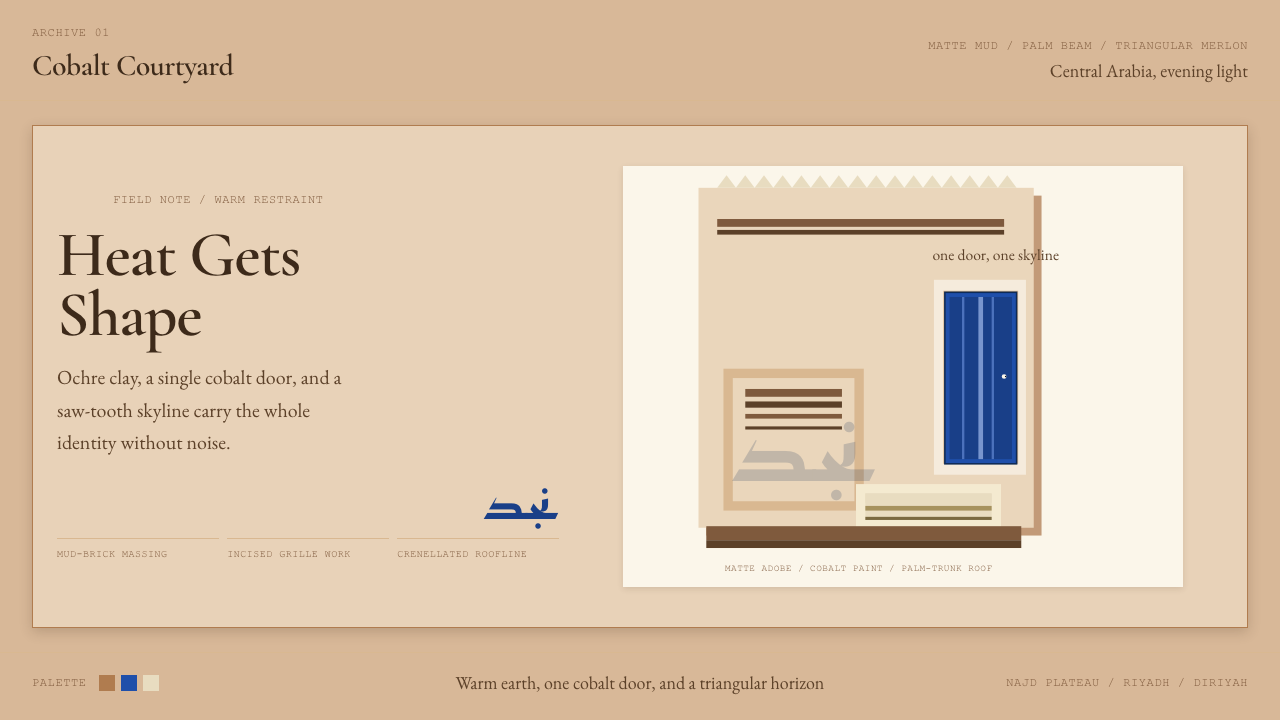 Saudi Najdi Vernacular ArchitectureHeat gets shape. Ochre clay, a single cobalt door, and a saw-tooth skyline.
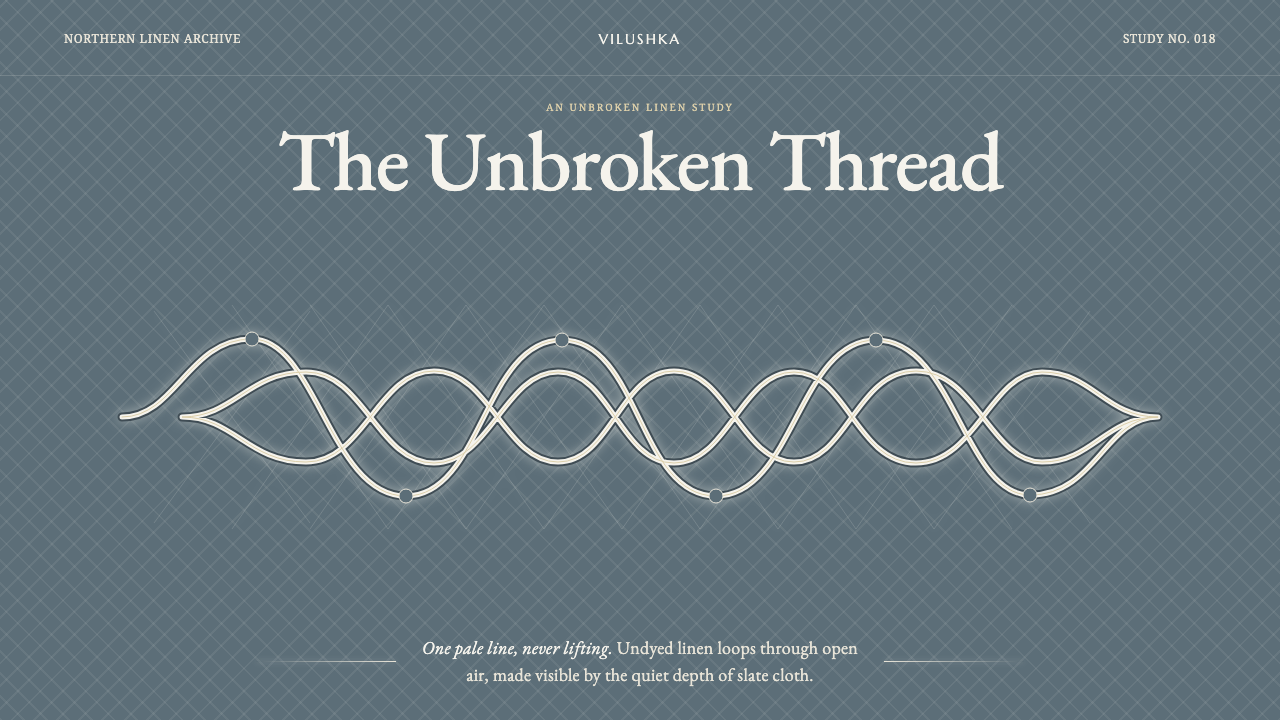 Vologda Bobbin LaceOne thread never lifts. Warm white linen loops glow across a quiet slate-blue…
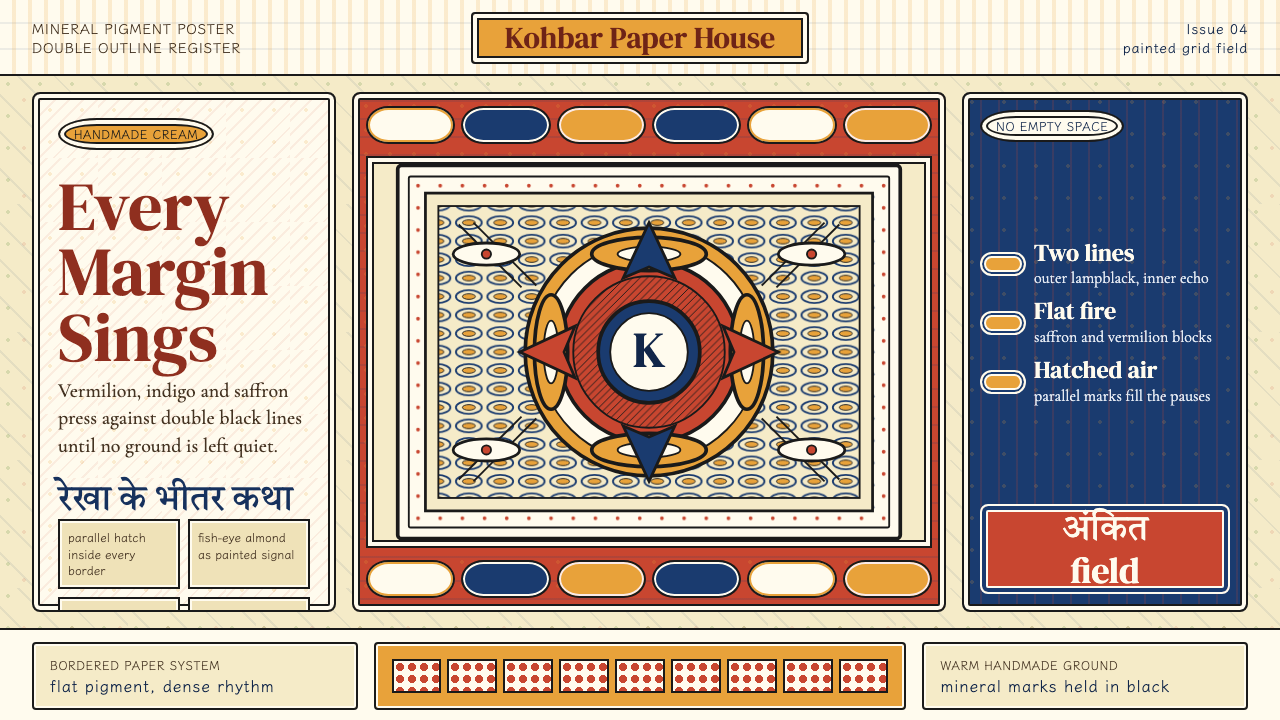 Madhubani (Mithila Folk Painting)No empty ground. Vermilion, indigo and saffron pack double-outlined panels wi…
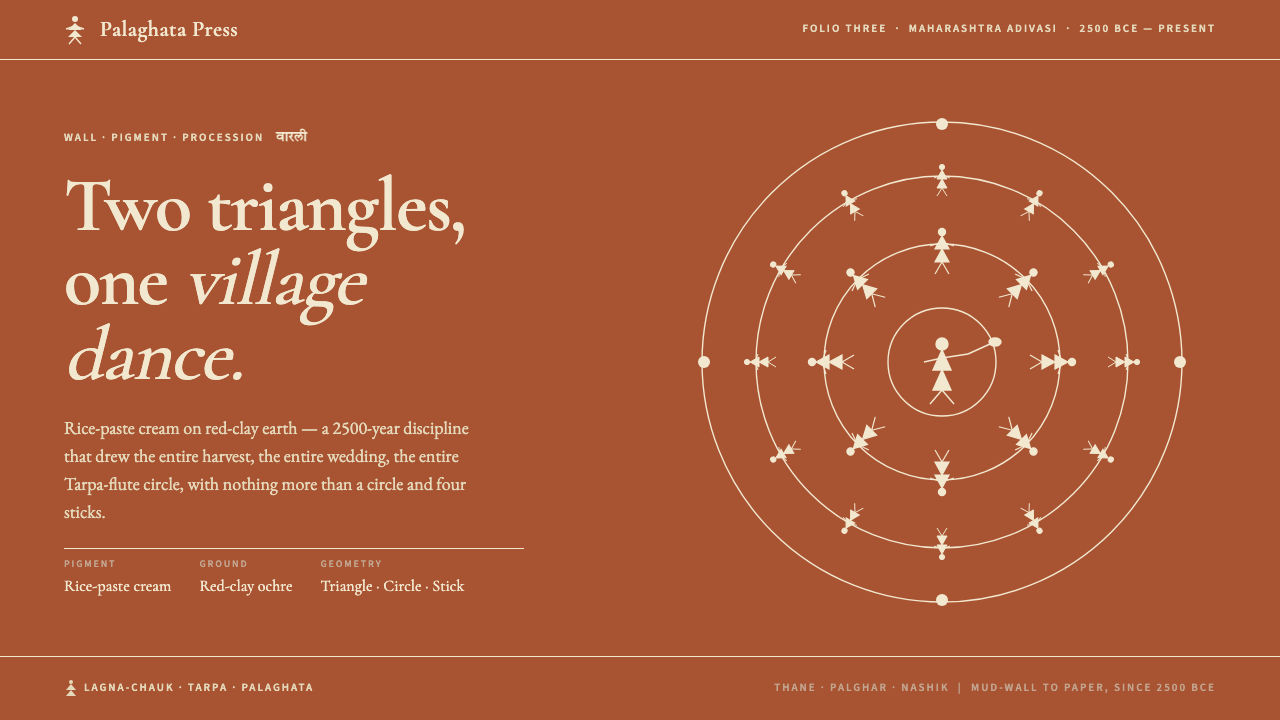 Warli Tribal PaintingTwo triangles make a human. Rice-paste cream on red-clay ochre, dancers proce…
 Bedouin Desert Textile (Sadu)Woven memory, not ornament. Vermilion-black bands count triangles and diamond…
 Bengali Jamdani WeavingLuxury whispers. Pearl cream, tonal buta, and one gold hairline make woven ai…