What is Imigongo (Rwanda Cow-Dung Geometric Art)?
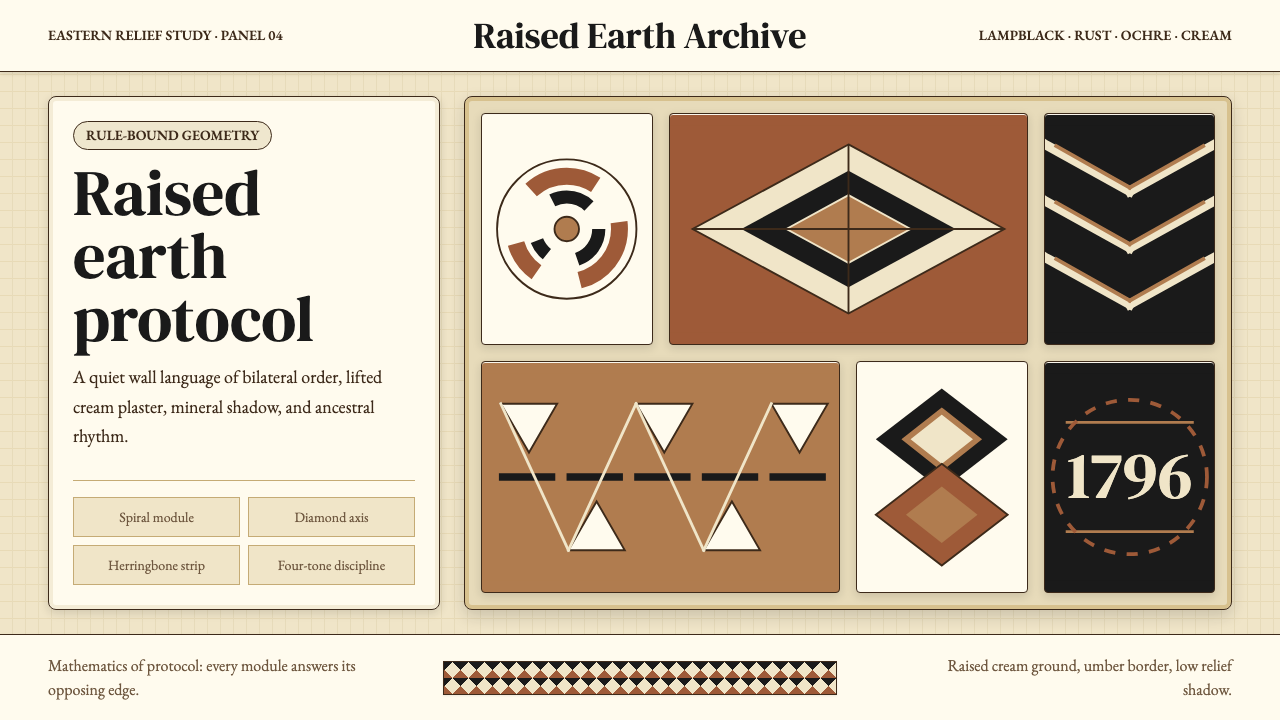
Imigongo turns cow dung and earth pigment into mathematical precision — Rwanda's ancestral spiral art, where every line is a rule and every panel a resolved geometric proof.
Imigongo (Rwanda Cow-Dung Geometric Art) in brief
Imigongo is Rwanda's centuries-old tradition of geometric wall painting executed in raised relief. Artists work a paste of fermented cow dung and white clay into shallow bas-relief ridges on a smooth plaster ground, then fill the resulting compartments with a restrained palette of earth pigments: lampblack, iron-oxide rust, pale ochre, and off-white cream. The finished surface is simultaneously sculpture and painting — the play of light across the ridged contours gives the pattern a quiet three-dimensionality that flat paint alone cannot achieve.
The visual grammar of Imigongo is built on strict geometric motifs — spirals, concentric diamonds, zigzag chevrons, herringbone bands, and stepped meanders — arranged according to bilateral or rotational symmetry. Each panel is a self-contained module whose internal logic must resolve cleanly at every edge, because panels are often assembled into larger wall compositions. This modular, rule-bound quality makes Imigongo closer in spirit to mathematical tiling than to freehand painting; improvisation is not the point. The discipline is the art.
What distinguishes Imigongo from other African surface-decoration traditions is its tonal restraint. Where Kente weaving deploys vivid polychrome and Bambara mud-cloth works in bold black-on-cream improvisation, Imigongo operates in a four-tone palette so controlled that the palette itself functions as a constraint system — the entire expressive range of a panel must be achieved through geometry, relief, and the subtle interplay of four earth tones rather than through chromatic variety.

See the Imigongo (Rwanda Cow-Dung Geometric Art) design system
Where does Imigongo (Rwanda Cow-Dung Geometric Art) come from?
The founding of Imigongo is attributed by oral tradition to Prince Kakira ka Kimenyi, a Tutsi nobleman of the Gisaka kingdom in what is now Rwanda's Eastern Province, around 1796. According to the tradition, the prince decorated the interior walls of his residence with patterns made from cow dung — a material plentiful in a cattle-herding society — mixed with natural earth pigments. Whether or not a single originating moment is historically verifiable, the tradition took root in the region and was sustained through transmission within families and across generations of artisan communities in the Kakira, Nyaruguru, and Kibungo areas.
For much of the colonial period, Imigongo declined as imported manufactured goods displaced local craft traditions and colonial administrators showed little interest in sustaining indigenous material culture. The art survived in attenuated form in a small number of rural households but lost the social and ceremonial visibility it had once enjoyed. What had been a prestige art form associated with chiefly residences became marginal.
The genocide of 1994 devastated Rwanda's Eastern Province — the heartland of Imigongo — along with the rest of the country. In the years that followed, the reconstruction of Imigongo became part of a broader movement of post-genocide economic and cultural recovery. Women's cooperatives, most notably the Kakira Imigongo Cooperative and the Nyamirambo Women's Center in Kigali, took up the craft as a livelihood strategy and a vehicle for community healing. These organizations trained new practitioners, standardized production for export markets, and — crucially — gave women who had survived the genocide an economic foothold and a connection to a living tradition.
By the 2010s and 2020s, Imigongo had acquired the status of a national design identity for Rwanda. It appears in airport terminals, hotel lobbies, government buildings, and contemporary craft export collections. International design interest has made it a recognized example of African geometric art, and its mathematical symmetry has attracted attention from designers working on pattern libraries, textile development, and interior decoration. This resurgence is inseparable from the women's cooperatives that sustained it: Imigongo's contemporary identity is simultaneously an ancient geometric system and a story of craft-based post-conflict reconstruction.
What defines the Imigongo (Rwanda Cow-Dung Geometric Art) look?
Palette
Imigongo's color system is deliberately bounded: lampblack, iron-oxide rust, pale ochre, and natural cream or off-white constitute the entire working palette. These four tones are not a limitation but a discipline — they are all derived from materials locally available in Rwanda's Eastern Province, and their collective value range spans from the darkest dark to the lightest light without ever reaching the vivid saturation of synthetic pigments. The palette reads as warm and earthy at a distance and reveals its subtle tonal distinctions only on close inspection.
Relief and Texture
The defining physical quality of Imigongo is its raised bas-relief surface. The cow-dung paste is shaped by hand into ridges — typically very shallow, just enough to cast a perceptible shadow under raking light — that define the boundaries of each geometric compartment. This relief means that Imigongo is always site-specific and light-dependent: the same panel reads differently at different times of day as light angle changes the depth of shadow in the ridges. Photography captures only a fraction of the tactile and optical complexity of the original.
Geometric Motifs
The formal vocabulary of Imigongo is drawn from a finite set of recurring motifs: the logarithmic spiral (the most iconic form, often arranged in opposed pairs or radiating clusters), the concentric diamond, the chevron or zigzag band, the herringbone, and the stepped meander. Each motif has established conventions governing its proportions and the width of its relief ridges relative to the compartments it defines. Departures from these conventions are not stylistic choices but errors — fidelity to geometric rule is the measure of quality.
Symmetry System
Every Imigongo panel is governed by one of two symmetry types: bilateral (mirror) or rotational. In bilateral panels, a central axis divides the composition into two mirrored halves; in rotational panels, the design repeats through ninety- or one-hundred-eighty-degree rotation around a central point. Multi-panel wall compositions may combine both symmetry types across their full extent, creating a higher-order visual logic in which individual panels are nodes in a larger pattern. This systematic use of symmetry links Imigongo to mathematical traditions of tiling and tessellation.
Material Origin and Process
The choice of cow dung as a primary material is not incidental — in Rwanda's Eastern Province, cattle have historically been the primary marker of wealth and status in Tutsi culture, making the material itself a carrier of cultural meaning. Dung is collected, mixed with white clay or ash, and fermented before use; this process improves its adhesive and workable qualities. Earth pigments — charred organic matter for black, pulverized iron-rich soil for rust and ochre, uncolored clay for cream — are applied by hand or with simple tools in successive layers, each layer allowed to cure before the next is added.
Modular Composition
Individual Imigongo panels are designed as self-resolving units: every motif completes its geometric logic within the panel boundaries. This allows multiple panels to be juxtaposed on a wall without requiring the pattern to continue seamlessly across panel edges — each panel holds its own — while still contributing to a coherent overall composition. The modular principle makes Imigongo inherently scalable: a single panel is a complete statement; an assembly of twelve panels on a wall is also a complete statement at a different scale.
Cooperative and Collective Authorship
Unlike art traditions centered on individual authorship, contemporary Imigongo is primarily produced in cooperative settings where multiple practitioners contribute to design, relief-building, and pigment application. This collective process reinforces the tradition's essentially rule-governed character: when no single hand controls the whole, the shared geometric conventions become the binding language. The cooperative model also reflects the post-1994 social context in which the craft was revived — community solidarity encoded in production method.

See the Imigongo (Rwanda Cow-Dung Geometric Art) design system
Who shaped Imigongo (Rwanda Cow-Dung Geometric Art)?
The figure to whom oral tradition attributes the founding of Imigongo, circa 1796, in the Gisaka kingdom of what is now Rwanda's Eastern Province. Whether the tradition had a single founder or whether Kakira ka Kimenyi represents a crystallization of collective origins into a named origin story, his name has become inseparable from Imigongo's identity. The cooperative and the village most closely associated with the tradition today bear his name, making him simultaneously a historical anchor and a living brand for the craft.
The primary production cooperative located in Kirehe District, Eastern Province, on the site most closely associated with the tradition's origins. The cooperative brought together women survivors of the 1994 genocide and has since grown into the most recognized Imigongo production center, supplying museums, design retailers, and international craft markets. Its standardization of panel formats and quality benchmarks has been influential in shaping what the broader public recognizes as authentic Imigongo, and it has played a central role in training a new generation of practitioners.
A Kigali-based women's cooperative that has brought Imigongo production into the capital and connected it with Rwanda's tourism economy. By situating Imigongo workshops within an urban cultural center offering guided neighborhood tours, the center has introduced the tradition to a global audience of visitors and transformed it from a rural Eastern Province craft into a nationally visible design form. The center exemplifies how craft revival can be embedded in a broader model of women's economic empowerment and intercultural exchange.
A practitioner and instructor associated with the revival of Imigongo in the post-genocide period, Umugeni represents the generation of artisans who bridged the near-loss of the tradition with its contemporary resurgence. Practitioners of her generation learned from the few remaining elder artisans who had kept the tradition alive through the colonial decline and the upheaval of 1994, and then trained the cooperative members who now produce Imigongo for domestic and international markets. The transmission across that rupture was not automatic — it required deliberate effort and documentation.
How do you use Imigongo (Rwanda Cow-Dung Geometric Art) today?
Imigongo's design language translates into contemporary visual work through its three core structural features: a bounded earth-tone palette, strict geometric symmetry, and the conceptual primacy of pattern over figure. Applying it well means internalizing these constraints rather than simply borrowing motifs — the spiral and diamond shapes alone, lifted out of context, produce pastiche. The system only fully works when color restraint, geometric discipline, and structural symmetry operate together.
For presentation slides, Imigongo offers a distinctive alternative to both minimal white-ground decks and the maximalism of pattern-heavy ethnic-themed templates. A cover slide built in this idiom uses a large, centered geometric panel — spiral or diamond motif — against a warm cream ground, with the title set in clean, unadorned type that does not compete with the pattern. Section-divider slides can use smaller motifs as full-bleed background textures at reduced opacity. Data slides work best when the Imigongo vocabulary informs the structural framing rather than the data visualization itself: a rust-colored horizontal band as a slide header, cream and lampblack as the chart's primary two tones, ochre as an accent for highlighted data points.
For web interfaces and digital dashboards, the palette translates into a warm-neutral system well suited to editorial platforms, cultural institution websites, craft marketplaces, and any product positioning itself at the intersection of heritage and contemporary design. The key translation principle is to treat the four earth tones as a complete system: cream as the default background, lampblack for body text and primary borders, rust as the primary interactive and accent color, and ochre sparingly as a secondary highlight. Hard-edged geometric dividers replace soft shadows; pattern-filled headers or sidebars reference the motif vocabulary without reproducing the full relief complexity.
For editorial and marketing work, Imigongo's visual authority comes from its restraint. A brand or publication that adopts this idiom is making an implicit claim: complexity through precision, not through accumulation. Editorial layouts built in this spirit use generous margins, a limited type hierarchy that lets the geometric framing carry visual weight, and section breaks marked by bold geometric bands rather than decorative flourishes. Marketing materials — packaging, posters, social cards — benefit from the style's poster-like clarity: a single dominant motif, a two-tone treatment, and a typographic element that respects rather than overcrowds the geometry.
A common mistake when adapting Imigongo for digital or print contexts is expanding the palette in the name of accessibility or brand alignment. Adding a fifth or sixth color — even a muted one — disrupts the tonal logic that makes the system work. The four tones are in careful relative balance; an addition shifts every other tone's perceived weight. A related error is treating the geometric motifs as decorative wallpaper, tiling them at small scale across an entire background. Imigongo motifs are meant to be read as deliberate geometric statements, not as texture; using them at too small a scale or too high a repetition frequency reduces them to visual noise. Scale up, use sparingly, and let negative space carry its weight.

See the Imigongo (Rwanda Cow-Dung Geometric Art) design system
Imigongo (Rwanda Cow-Dung Geometric Art) — FAQ
Is Imigongo exclusively a Tutsi tradition, or is it shared across Rwanda?
The tradition is attributed by oral history to a Tutsi prince and was historically concentrated in the Eastern Province, an area historically associated with Tutsi cattle-herding culture. However, since its post-1994 revival, Imigongo has been intentionally cultivated as a pan-Rwandan national design identity — an emblem of the country rather than of any single ethnic group. The cooperatives that produce it today include practitioners from multiple backgrounds, and the Rwandan government has supported Imigongo as a national craft without ethnic designation. In contemporary contexts, treating it as exclusively Tutsi would be both historically reductive and contrary to how Rwanda currently frames its cultural heritage.
Can Imigongo be applied in dark-mode or dark-background digital designs?
A direct inversion is problematic. The tradition's visual logic is built around a light, warm ground — cream or off-white — with the darkest tone (lampblack) providing the deepest contrast. On a dark background, this hierarchy inverts in a way that works against the palette's internal balance: lampblack disappears into the dark ground, rust and ochre can appear harsh or isolated, and the warmth that characterizes the system is largely lost. A more successful adaptation for dark contexts treats the lampblack as the background, uses cream as the primary pattern tone, and restricts rust and ochre to accent roles only — accepting that the result will feel like a referenced translation rather than an authentic application.
How does Imigongo differ from other African geometric traditions like Kente or Kuba cloth?
The differences are substantial. Kente, from Ghana and Côte d'Ivoire, is a woven textile tradition with a vivid, multi-color palette in which color combinations carry explicit social and ceremonial meaning — different color arrangements denote specific occasions, ranks, and messages. Kuba cloth, from the Democratic Republic of Congo, is a cut-pile textile known for interlocking geometric patterns in which form complexity is a primary value. Imigongo, by contrast, is a wall-based relief medium with an extreme chromatic restriction (four tones only) in which mathematical symmetry and tonal restraint, rather than color richness or pattern intricacy, carry the expressive weight. All three are rigorously geometric, but their materials, color philosophies, and functional contexts are entirely distinct.
What is the significance of the spiral in Imigongo — is it purely decorative?
The spiral is the most iconic of Imigongo's motifs and, within the tradition, carries significance beyond pure decoration — though its precise symbolic meanings are not rigidly codified in the way that, say, heraldic symbols are. The logarithmic spiral form appears extensively in natural phenomena observable in pastoral environments (the curve of a horn, plant growth patterns), and its use in Imigongo connects the geometric system to the natural world from which the tradition's materials also come. In contemporary applications outside the tradition's original cultural context, the spiral should be treated with formal respect — understanding that it is the structurally most demanding of the motifs, requiring precise execution to read as deliberate geometry rather than an approximation.
Is it appropriate for designers outside Rwanda to use Imigongo in commercial work?
This question does not have a single authoritative answer, and designers should approach it with awareness rather than avoidance. Imigongo is a living tradition sustained by specific communities — primarily women's cooperatives in Rwanda — for whom it represents both livelihood and cultural continuity. Using the aesthetic vocabulary in commercial work is not inherently extractive, but doing so without attribution, without sourcing materials or products from the cooperatives when physical goods are involved, or without any engagement with the tradition's context, tends toward appropriation. A thoughtful approach includes acknowledging the tradition's origins explicitly in any public-facing work, considering whether the cooperatives can be involved or credited in ways that direct economic benefit toward them, and avoiding reductions of the tradition to a generic 'tribal pattern' framing that erases its specific Rwandan identity.
Related design styles
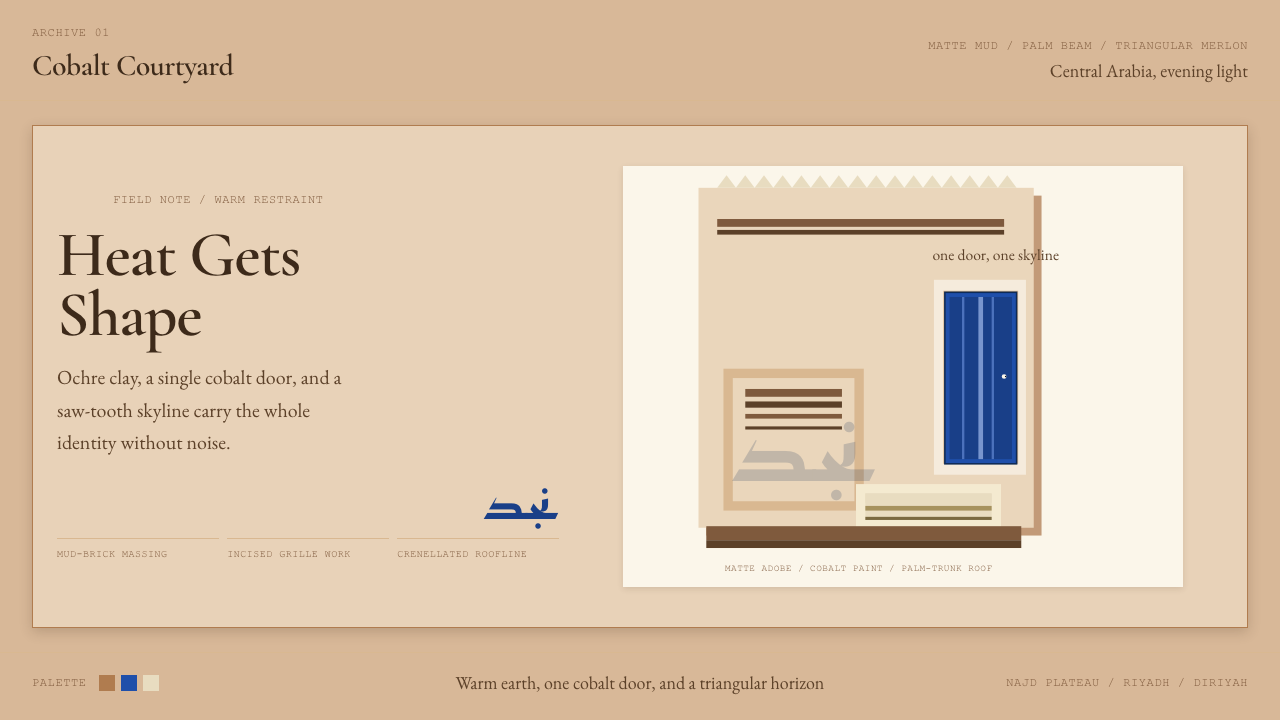 Saudi Najdi Vernacular ArchitectureHeat gets shape. Ochre clay, a single cobalt door, and a saw-tooth skyline.
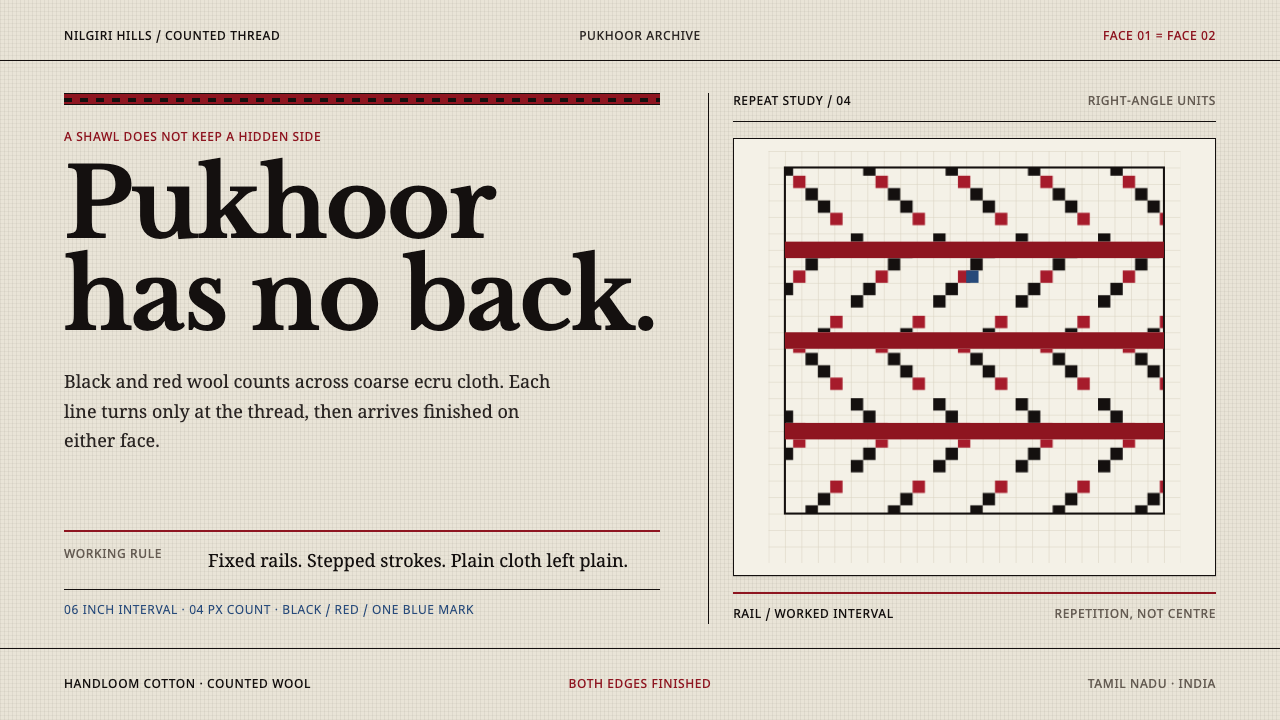 Toda PukhoorNo hidden side. Black-red stepped wool repeats across ecru rails, finished fr…
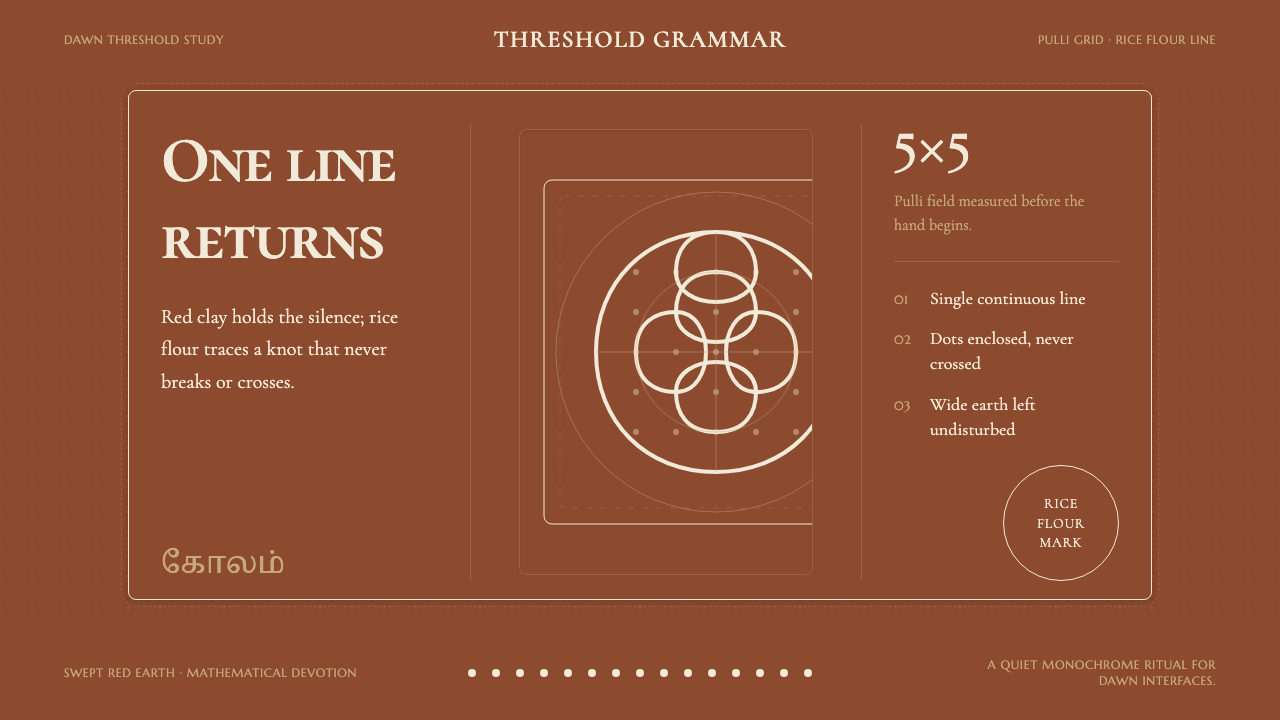 Tamil Kolam (Rice Flour Threshold)Mathematics becomes devotion. Rice-white knots breathe on red-clay negative s…
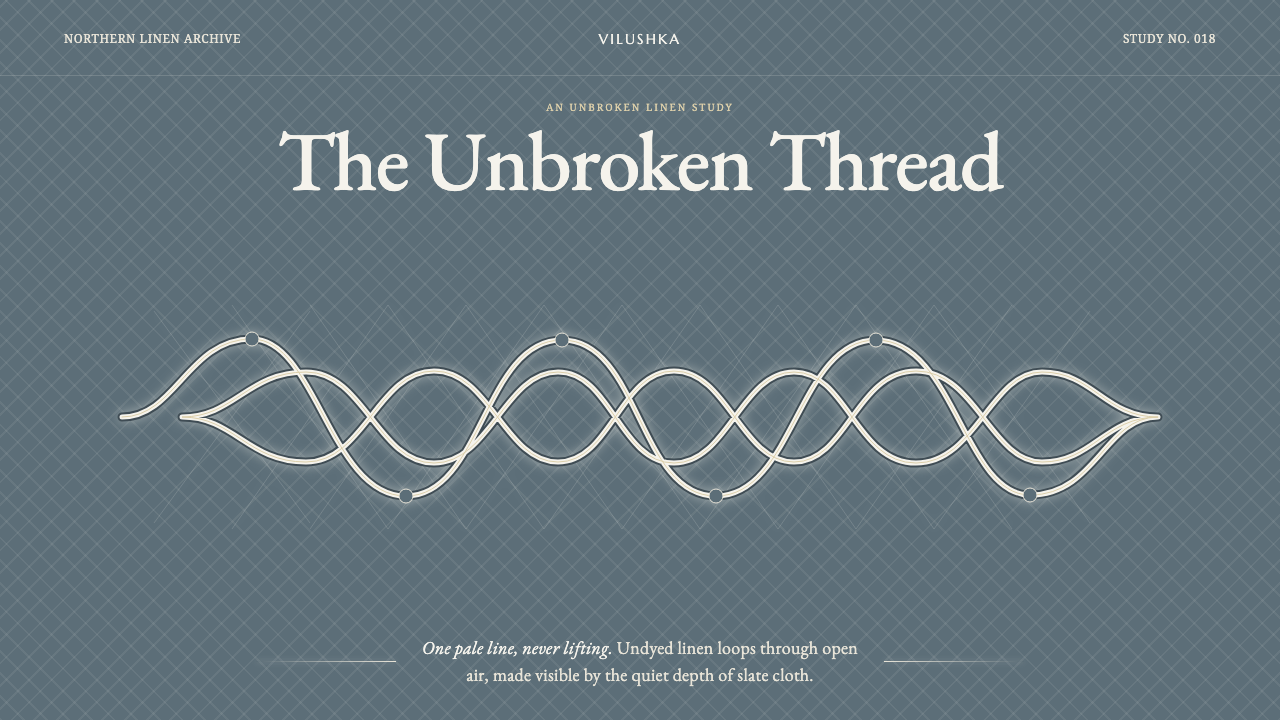 Vologda Bobbin LaceOne thread never lifts. Warm white linen loops glow across a quiet slate-blue…
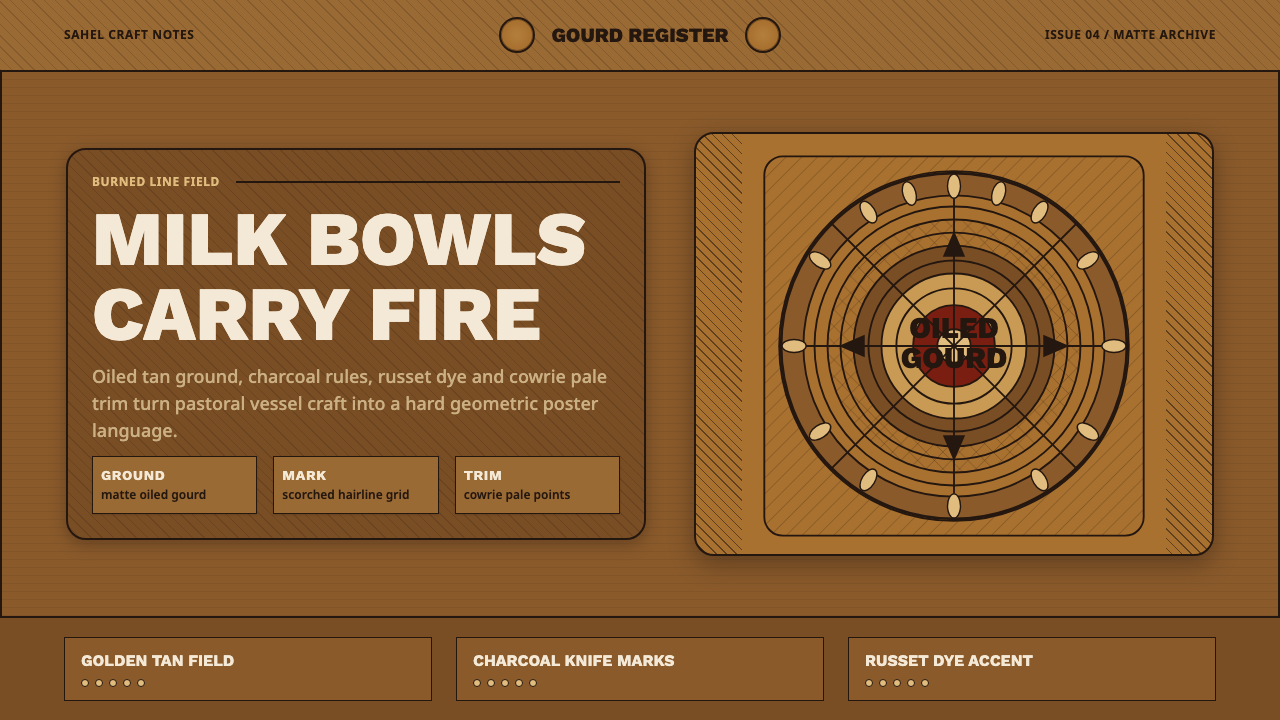 Fulani Milk CalabashMatte craft burns bright. Oiled gourd tan meets charred concentric linework.
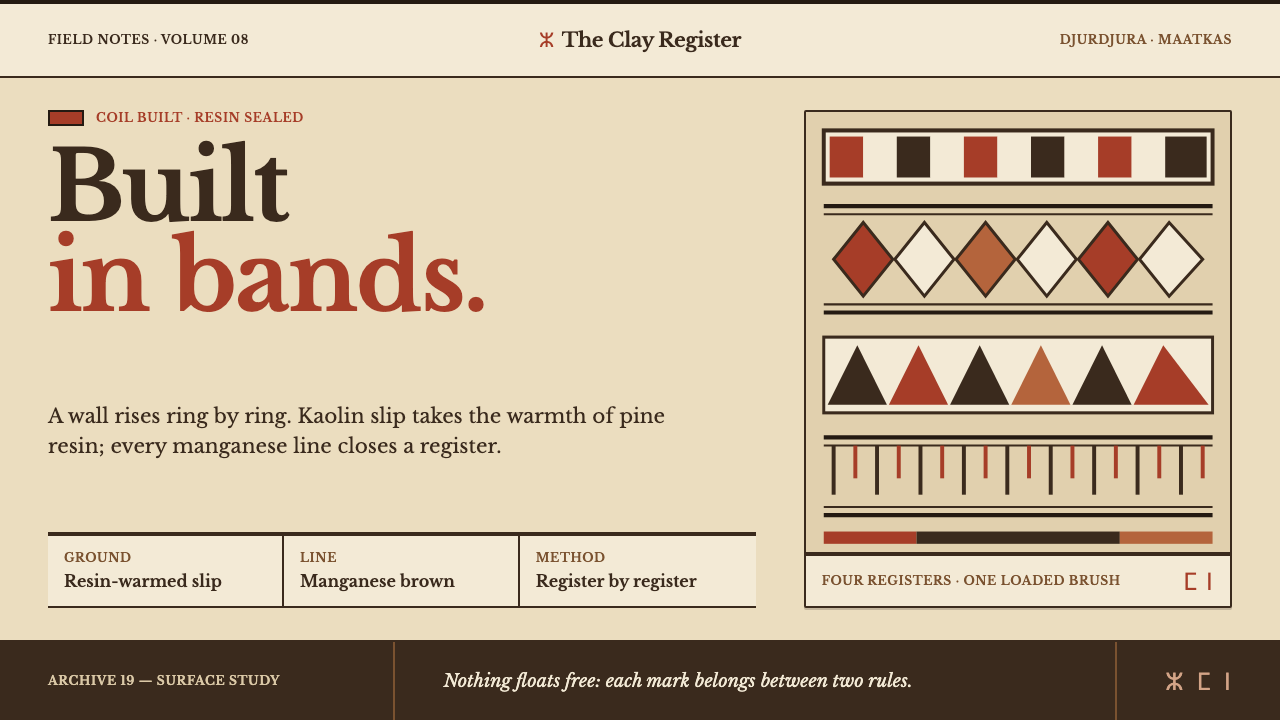 Kabyle PotteryBuilt band by band. Resin-warm kaolin carries manganese rules and iron-red ge…