What is Bonsai Cultivation?
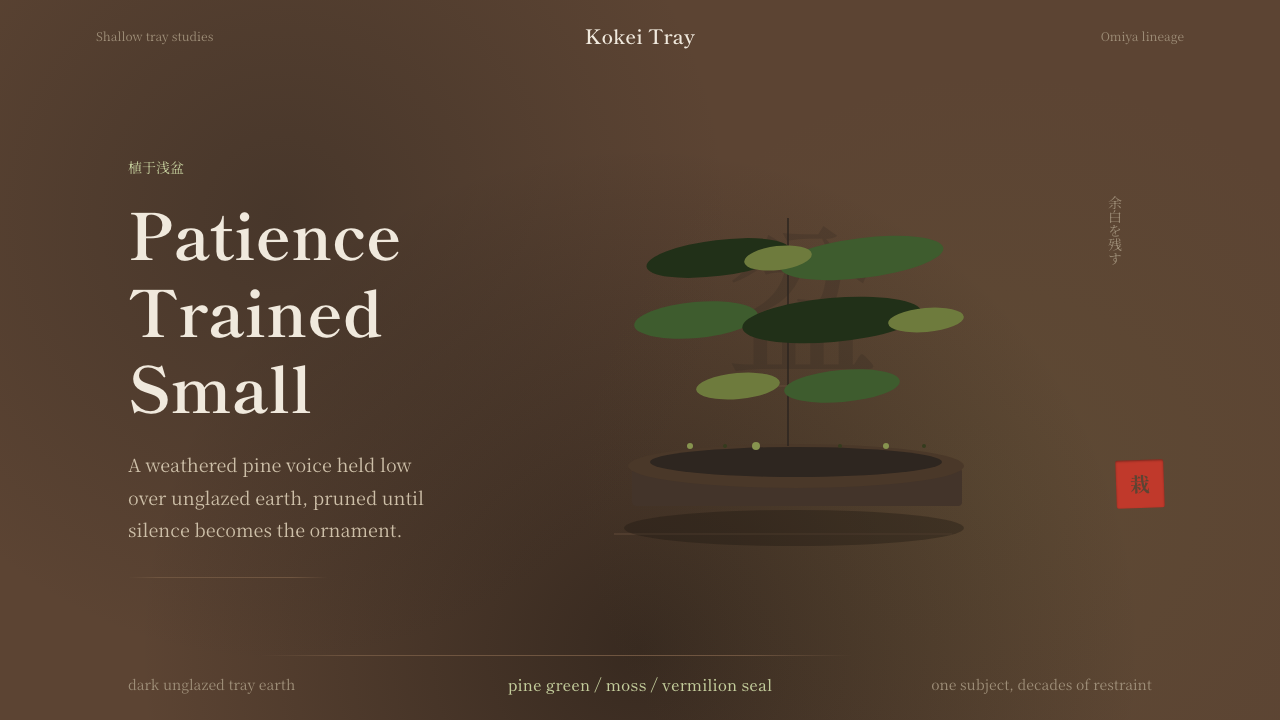
Bonsai Cultivation is the art of controlled patience made visible — centuries of Japanese horticultural discipline distilled into a design language of quiet asymmetry, aged pine green over dark unglazed earth, and a single vermilion seal as the only bright accent in an otherwise spare, muted composition.
Bonsai Cultivation in brief
Bonsai Cultivation as a design system takes its formal vocabulary directly from the traditional Japanese practice of growing miniaturized trees in shallow ceramic trays — pots called bonsai-hachi. The visual logic of an aged juniper or pine, its trunk twisted by decades of deliberate training, moss gathered at its roots, positioned off-center on a display stand — all of this translates into a design language defined by asymmetric placement, earned aged textures, restrained color, and the generous use of empty space as a compositional force in its own right.
At its philosophical core, the style draws on the same wabi-sabi sensibility that pervades much of Japanese visual culture: the beauty of things that are imperfect, incomplete, and transient. An ancient bonsai tree is beautiful not despite its gnarled bark and missing branches, but because of them. Applied to design, this principle means texture is authentic rather than decorative, age is legible rather than polished away, and every element earns its place through quiet presence rather than visual assertion.
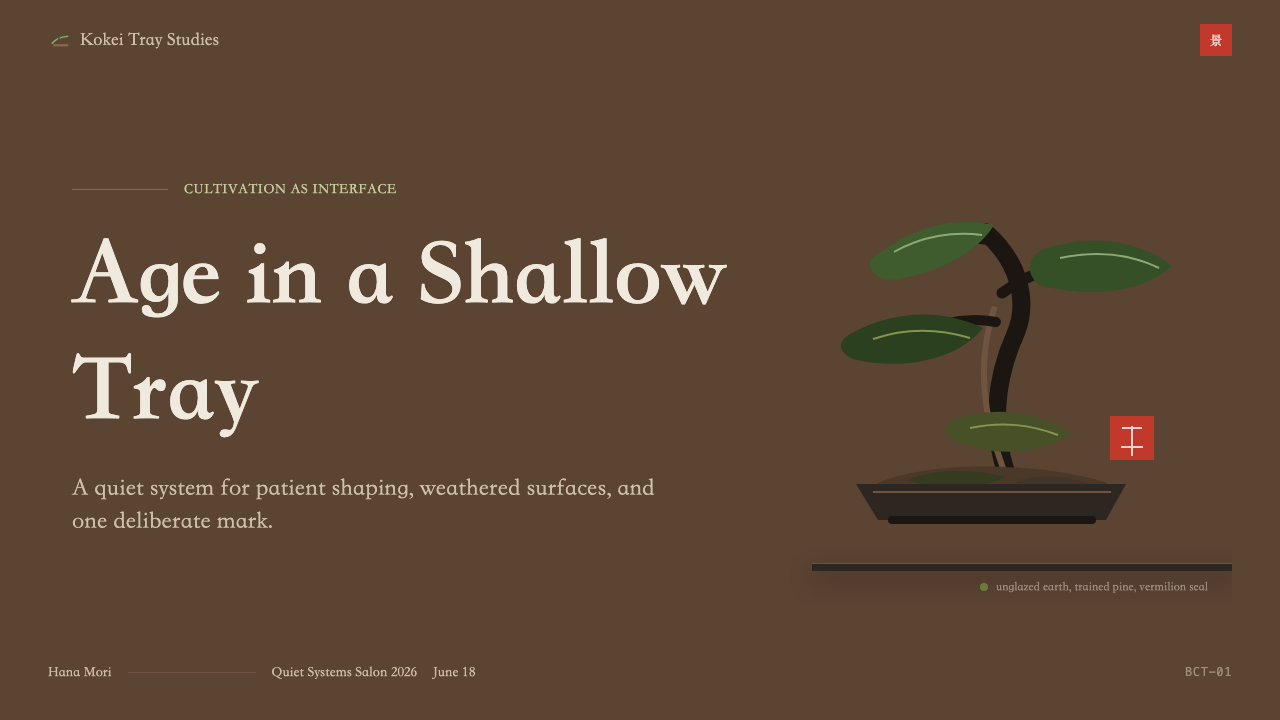
The color logic of the style is stark and purposeful. A deep, muted pine green — the green of aged needles and moss-covered soil — grounds the composition. Against it, the dark, almost black-brown of unglazed ceramic provides the base. The composition rests in cool shadow and earthy depth. Then one vermilion mark — inspired by the hanko seal placed on tokonoma displays — arrives as a sudden, controlled brightness. Nothing else competes with it. The palette has been chosen over centuries, not assembled in an afternoon.
Where does Bonsai Cultivation come from?
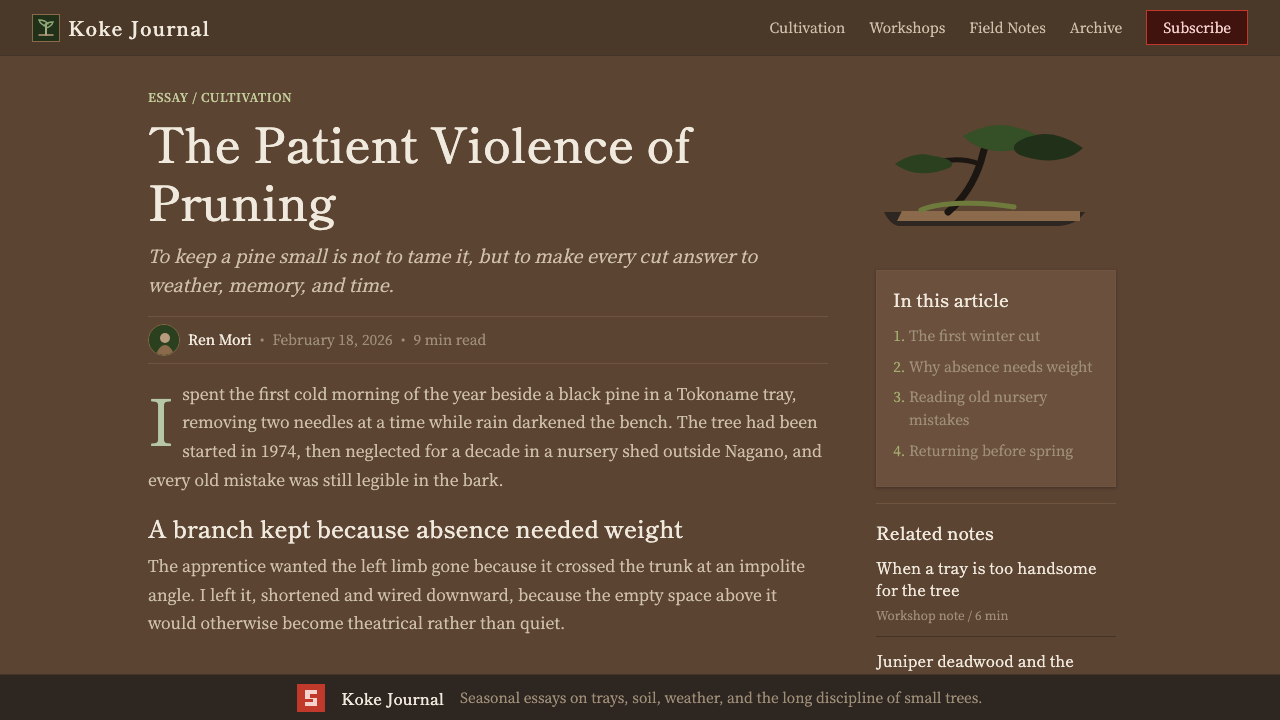
The art of cultivating miniaturized trees in containers originated in China, where it was known as penjing or penzai — the practice of recreating idealized landscapes in miniature form, complete with trees, rocks, and sometimes water features, all arranged in shallow vessels. Chinese Buddhist monks brought the practice to Japan during the Heian period (794–1185), where it gradually transformed into a distinct horticultural discipline with its own aesthetic philosophy, vocabulary, and codified display traditions.
During the Edo period (1603–1868), bonsai cultivation became a refined practice closely associated with the samurai class and Zen Buddhist communities, both of which prized disciplines that cultivated patience, attention, and the ability to find depth in simplicity. The display of bonsai on a tokonoma — the raised alcove in a traditional Japanese room — alongside a hanging scroll and a single flower arrangement became formalized as a triad of complementary arts. The scroll, the flower, and the bonsai were chosen to echo one another across season and mood.
The city of Omiya in Saitama Prefecture, Japan became the historic center of bonsai cultivation in the modern era. Following the Great Kanto Earthquake of 1923, a community of Tokyo-based bonsai masters relocated to Omiya, where the sandy soil and clean air proved ideal for the practice. Over the following decades, the Omiya Bonsai Village became a living repository of rare, centuries-old trees — some specimens hundreds of years in cultivation — alongside the accumulated craft knowledge of dozens of successive generations of masters.
The design language that Bonsai Cultivation encodes draws directly from this tokonoma display tradition: the asymmetric placement of a single dominant form, the generous surrounding void that gives the form room to breathe and be seen, the dark and quiet ground against which the tree's silhouette reads most clearly, and the single punctuation mark — the vermilion seal — that anchors the composition without overwhelming it. Each of these visual decisions is not aesthetic caprice but the product of a tradition refined over more than three centuries of display practice.
What defines the Bonsai Cultivation look?
Asymmetric Placement
Nothing in a bonsai composition is centered. The tree occupies one side of the display space — typically a third to a fifth of the total width — while the remaining space is left deliberately empty. This is not a failure to fill the canvas but a structural principle: the empty space is called ma in Japanese, and it is considered as active a compositional element as the tree itself. In design terms, this means primary content elements are positioned with deliberate off-center intent, and the surrounding void is never treated as residual or accidental.
Aged Texture and Earned Imperfection
A bonsai tree of great value is one that looks its age — bark split and furrowed, deadwood bleached by sun and wind, roots emerging from the soil like grasping fingers. These marks of time are not defects to be smoothed away but the evidence of a life lived under genuine conditions. The design system carries this aesthetic into surface treatment: textures are rough, aged, and honest; grounds feel like unglazed ceramic, weathered wood, or compressed soil; nothing is uniformly smooth, uniformly bright, or uniformly new.
Restrained, Purposeful Color
The palette is narrow to the point of austerity. Deep pine green — the specific muted, grey-tinged green of aged conifer needles — is the dominant hue, grounding the composition in organic coolness. The base is dark earth brown, almost black, suggesting the unglazed stoneware of traditional bonsai pots. Against these two tonally close, muted fields, a single spot of vermilion — the color of a carved seal inked in cinnabar — arrives as the only warm, saturated accent. Secondary colors, pastels, and gradients are entirely absent. Each color present has a specific origin in the physical world of bonsai display.
Stillness and Contemplative Pace
Bonsai display is not meant to be quickly scanned. A viewer is expected to sit, look, and allow meaning to accumulate over time — to notice the angle of a branch, the texture of bark, the way moss gathers at the base of the trunk. The design system inherits this contemplative pace: compositions resist visual busyness, transitions are absent or extremely slow, interactive elements respond with calm deliberation rather than snap responsiveness. The system is unsuited to contexts where speed and high information density are paramount values.
The Seal as Punctuation
In traditional Japanese and Chinese art, a carved seal stamped in red ink is applied to a finished work as a mark of authorship, provenance, or completion. In bonsai display, a small vermilion mark — whether on an accompanying scroll or a ceramic label — performs the same function: it closes the composition and gives the viewer a resting point for the eye. The design system uses this logic for its accent element: a single small shape in the vermilion accent color, placed with clear intention, that acts as the punctuation mark of the entire composition. It is never repeated, never enlarged, never used decoratively.
Organic Form Against Structured Ground
The formal tension at the heart of the style is between the organic, irregular silhouette of the trained tree and the clean, deliberate geometry of the display tray and stand. The tree is wild nature — even if carefully cultivated — while the tray is human craft: its edges are straight, its surface intentionally roughened but bounded. This tension between the organic and the geometric, held in precise equilibrium, gives the visual system its characteristic energy. Neither element overwhelms the other; together they create a dialogue that neither alone could sustain.
Void as Active Space
Perhaps the most demanding aspect of the style for designers trained in Western conventions is the treatment of empty space as a positive element. In bonsai display, the void around the tree is not background — it is the air through which the tree breathes, the silence that makes the single form eloquent. Filling this space with additional elements would destroy the composition's meaning, not enhance it. The design system asks practitioners to resist the instinct to fill every corner, to trust that a composition with a single strong element in generous space is more powerful than one crowded with incident.

Who shaped Bonsai Cultivation?
The masters of the Edo period (1603–1868) codified the display traditions, pruning philosophies, and aesthetic classifications that still define what a well-formed bonsai tree looks like. They established the categories of tree form — formal upright, informal upright, slanting, cascade, and others — and the rules governing which pot shape, size, and surface finish is appropriate for which tree form. Their accumulated decisions are what the visual system draws on when it prescribes asymmetric placement and deliberate void.
After the 1923 Great Kanto Earthquake, master bonsai cultivators from Tokyo relocated to the Omiya area of Saitama and collectively established what became known as the Omiya Bonsai Village. Over the following century, this community became home to some of the oldest and most celebrated trees in the world, with some specimens representing more than five hundred years of continuous cultivation. The village represents the living repository of the style's most refined expressions: trees whose form has been shaped by generation after generation of master judgment.
The tokonoma — the raised decorative alcove found in traditional Japanese reception rooms — is the institutional context within which bonsai display aesthetics were formed. The convention of placing a single bonsai on a stand within the tokonoma, alongside one hanging scroll and one simple flower arrangement, governed how trees were trained to be viewed: from a fixed frontal position, at a specific distance, in contemplative silence. The visual rules of the style — asymmetry, void, single accent, dark ground — all originate in this display context.
The hanko — a carved personal seal used in Japan and across East Asia to authenticate documents, artworks, and correspondence — is the source of the vermilion accent element in the Bonsai Cultivation design system. In traditional display, a seal might appear on an accompanying scroll, on a wooden nameplate identifying a tree's lineage, or on the ceramic marker of a collection. The practice of using a single red seal as a signature element of visual authentication gives the design system its most distinctive mark: small, precise, unexpected, and warm against a cool and muted ground.
Bonsai did not originate in Japan — it arrived from China, where the art of penjing (literally 'tray scenery') had been practiced for more than a thousand years. Tang Dynasty records from the seventh and eighth centuries show miniaturized landscape art as a refined court practice. The aesthetic of recreating wild nature in miniature — mountains, gorges, ancient trees — in a contained vessel controlled entirely by human hand gave rise to the essential tension of the art: nature domesticated, wilderness held in the palm. This founding paradox is embedded in the design system as the contrast between organic tree form and bounded geometric tray.
How do you use Bonsai Cultivation today?
Bonsai Cultivation is a contemplative, high-context style whose strengths are subtlety, depth, and a sense of earned quietness. It is most appropriate for products and presentations where the desired emotional register is calm authority, refined taste, and patient attention — not urgency, boldness, or rapid information processing. Understanding this character is the prerequisite for applying it well.
For presentation slides, the style demands a restrained approach to composition. A cover slide works best as a near-empty field: a single strong organic or semi-organic element positioned in the left third or lower quarter, its silhouette clear against a deep, muted ground, and a small vermilion mark — a date, a logo, a single word — placed in the opposite quadrant as the sole point of warmth. Content slides should carry very little text: one thought per slide, set in a text size large enough to convey measured weight, with generous margins on all sides. Data slides are the most challenging — the style resists chart density and color coding. One data point or comparison per slide, rendered simply.
For web interfaces, the style suits portfolio sites, studio presences, craft-focused brands, cultural institutions, and any digital product where unhurried browsing and contemplative engagement are the intended user behavior. The interaction model should be slow: full-page transitions rather than instant navigation, text that loads into place rather than appearing instantly, images that reveal rather than burst onto screen. A dashboard or data-heavy interface in this style would feel at odds with itself — the style asks the viewer to slow down, which contradicts the speed-oriented function of most utility software.
For editorial and marketing work, the style is most effective when used for long-form content where depth is the primary value proposition — a book about craft, a brand that positions itself around patience and mastery, a feature article on a subject that rewards sustained attention. Marketing materials in this style work against the grain of standard conversion optimization: there are no urgent calls to action, no countdown timers, no bold benefit claims. The style signals that the product does not need to shout. This can be a powerful positioning statement, but only if the product genuinely merits the patience it asks of the viewer.
The most common mistake when applying Bonsai Cultivation is treating it as a general minimalist style and defaulting to the familiar conventions of Scandinavian or Swiss minimalism — white backgrounds, sans-serif type, clean geometric shapes. This misses the essential character of the style entirely. Bonsai Cultivation is not cold minimalism: it is warm, organic, aged, and deeply rooted in specific cultural references. The ground should feel like earth, not like paper. The sole accent should feel like a seal, not like a brand color. Applying the style means accepting its slowness, its asymmetry, and its muted warmth — not finding ways to make it faster, more balanced, or brighter.
Bonsai Cultivation — FAQ
Is Bonsai Cultivation the same as wabi-sabi?
They are closely related but not identical. Wabi-sabi is a broad Japanese philosophical and aesthetic sensibility — the appreciation of imperfection, impermanence, and incompleteness as sources of beauty. Bonsai Cultivation is a specific design system derived from one tradition within that broader sensibility. A Bonsai Cultivation design will carry wabi-sabi qualities — aged texture, asymmetry, quietness, restraint — but it also has specific visual elements tied to bonsai display practice in particular: the dark ceramic ground, the pine-green palette, the vermilion seal accent. Wabi-sabi is the philosophy; Bonsai Cultivation is a specific visual language that embodies it.
Does the style work in a light-background version?
The canonical Bonsai Cultivation palette is dark — the near-black of unglazed ceramic earth is essential to the style's night-garden quality. A light version is possible but requires care and significant reinterpretation. On a pale, warm paper-white or aged-cream ground, the deep pine green shifts from dominant earth color to calligraphic mark, and the composition takes on qualities closer to Japanese ink painting — sparse, gestural, open. The vermilion seal still works as an accent. However, the characteristic depth and shadow of the original dark palette — the sense of looking into a dimly lit tokonoma — is lost. Light-background variants feel more like spring; the dark palette feels like late autumn.
How does this style handle photography and illustration?
Photography in this style, where it appears at all, should feel documentary and austere rather than produced or commercial. Close studies of bark, root systems, aged ceramic surfaces, and moss textures are natural subjects — images that reward extended looking rather than immediate impact. Photographs should be treated with significant desaturation, leaning toward the muted green-brown-grey tonal range of the palette, and cropped asymmetrically with generous space around the subject. Bright, saturated, or high-contrast lifestyle photography is entirely out of character. Illustration, if used, should take its cue from Japanese ink painting or woodblock print traditions — sparse marks, white or near-white ground, and strong negative space.
Is this style appropriate for digital products with frequent user interaction?
Generally not, and the mismatch is philosophical rather than technical. Bonsai Cultivation is a style built around slowness, singular focus, and the experience of allowing meaning to emerge over time. Most digital products with frequent interaction — e-commerce, social feeds, task management, communication tools — require the opposite: rapid scanning, multiple simultaneous information tracks, and clear affordances for immediate action. Forcing this style onto those contexts produces a product that fights its own users. Where it does work digitally is in contexts where slowness is itself the product: a digital art gallery, a meditation or mindfulness application, an archival or library interface, or a brand story page designed to be read rather than used.
How does Bonsai Cultivation relate to other Japanese design styles like Muji or Japanese minimalism?
They share roots in Japanese aesthetic philosophy but arrive at very different visual outcomes. Contemporary Japanese product minimalism — the style associated with Muji, Kenya Hara, and the broader Japanese minimalist design movement — is typically light, precise, and industrial in sensibility: neutral grounds, tight tolerances, no visible craft marks, a kind of perfected emptiness. Bonsai Cultivation is warmer, more organic, and more explicitly historical: the grounds are dark and earthlike, surfaces carry texture, and the craft history of centuries is legible in the forms. Muji minimalism says 'nothing unnecessary'; Bonsai Cultivation says 'nothing that has not been earned.' The distinction is between an aesthetic of elimination and an aesthetic of accretion — of things becoming themselves through time.
Related design styles
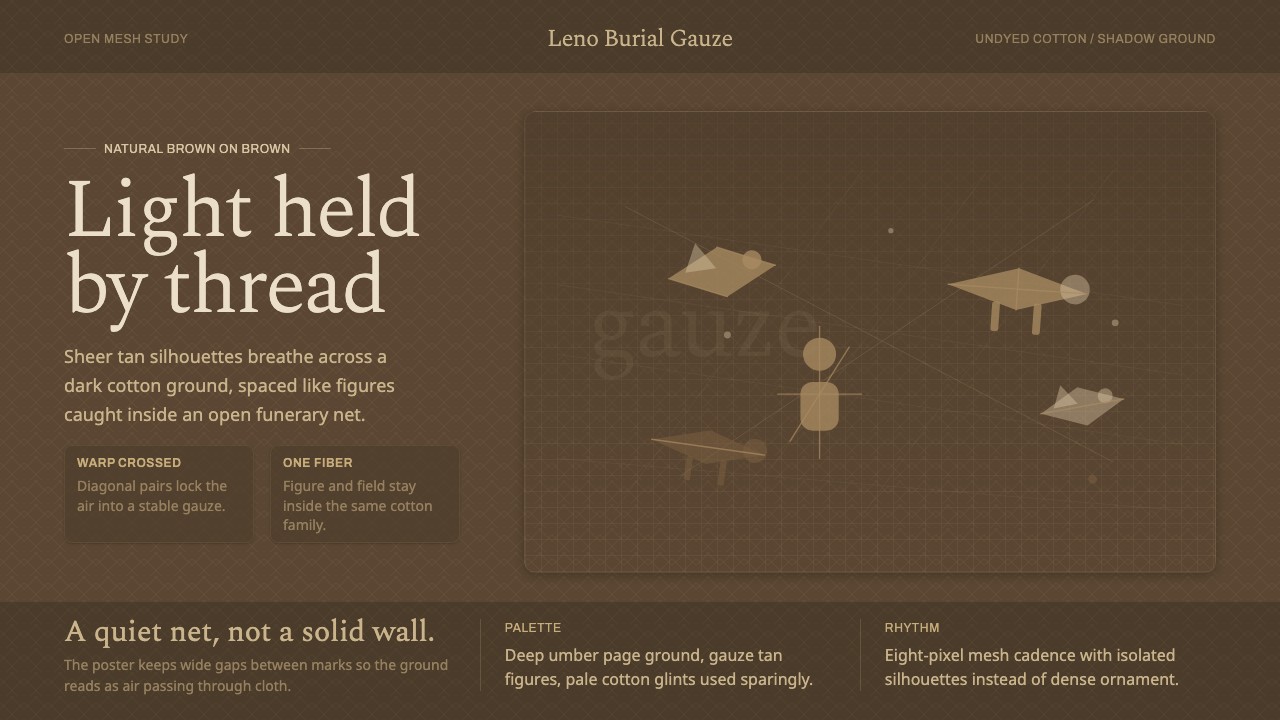 Chancay Gauze TextileQuiet woven dignity. Tan silhouettes float through a dark open cotton mesh.
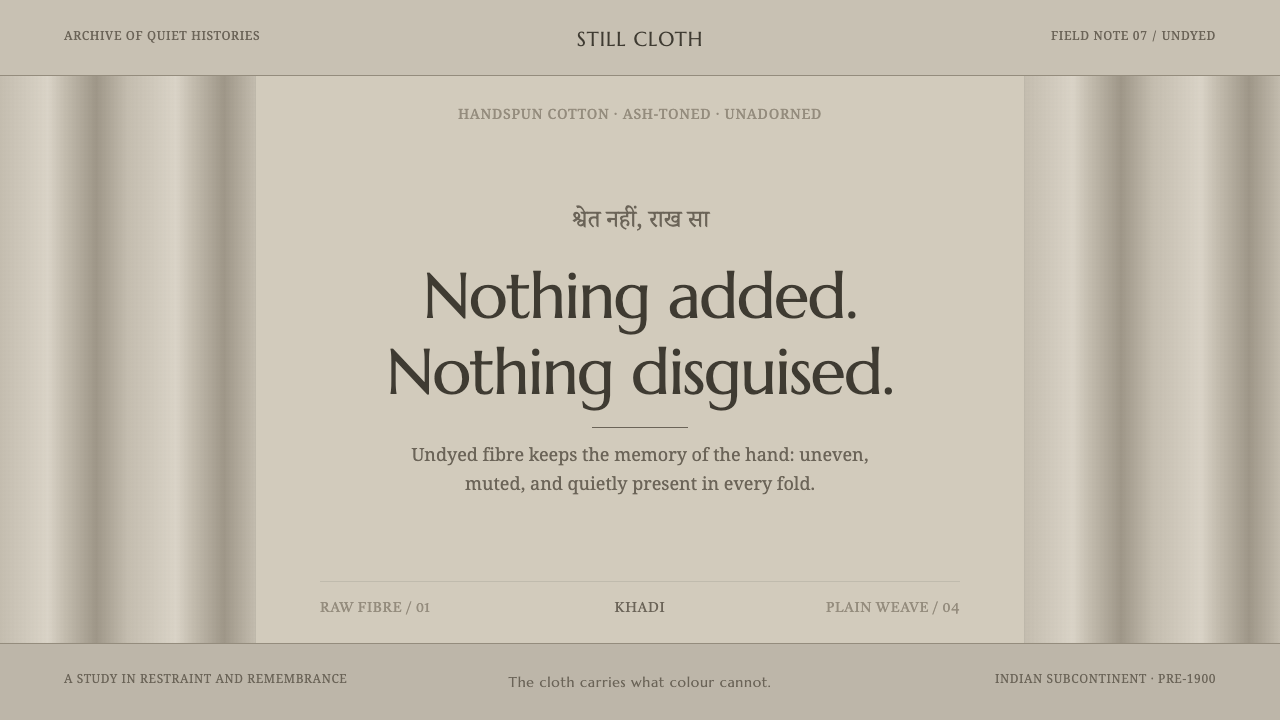 Hindu Widow White SariRestraint carries the weight. Ash-toned khadi, quiet serif type, and vertical…
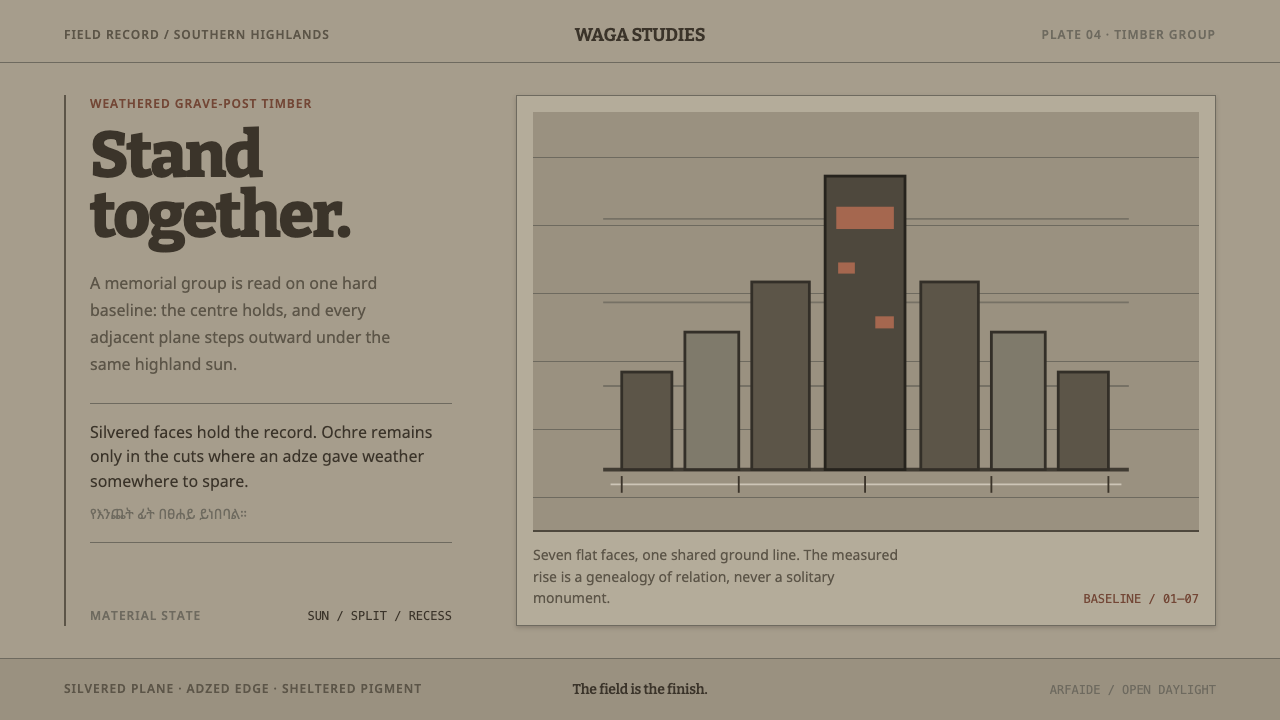 Konso WagaWeather makes the monument. Silver-grey timber, hard planes, and ochre held i…
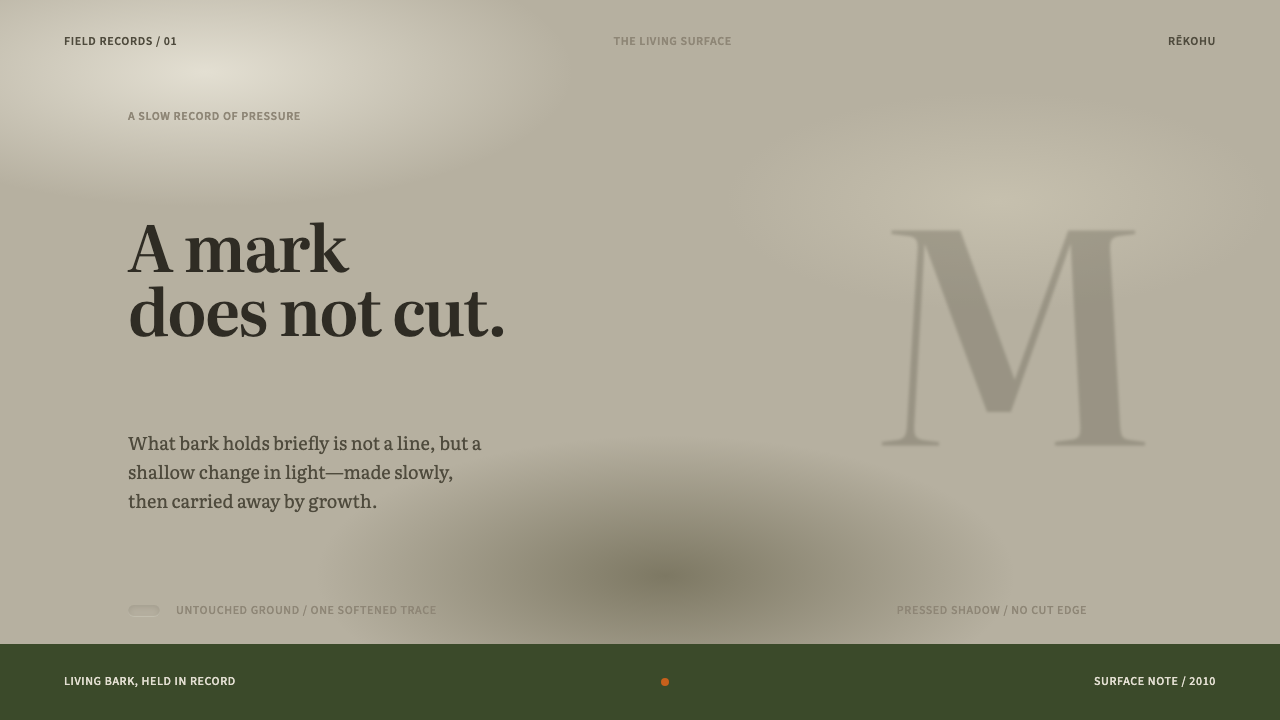 Moriori Rakau MomoriPressure, not incision. Literata shadows sink softly into pale, lichened bark.
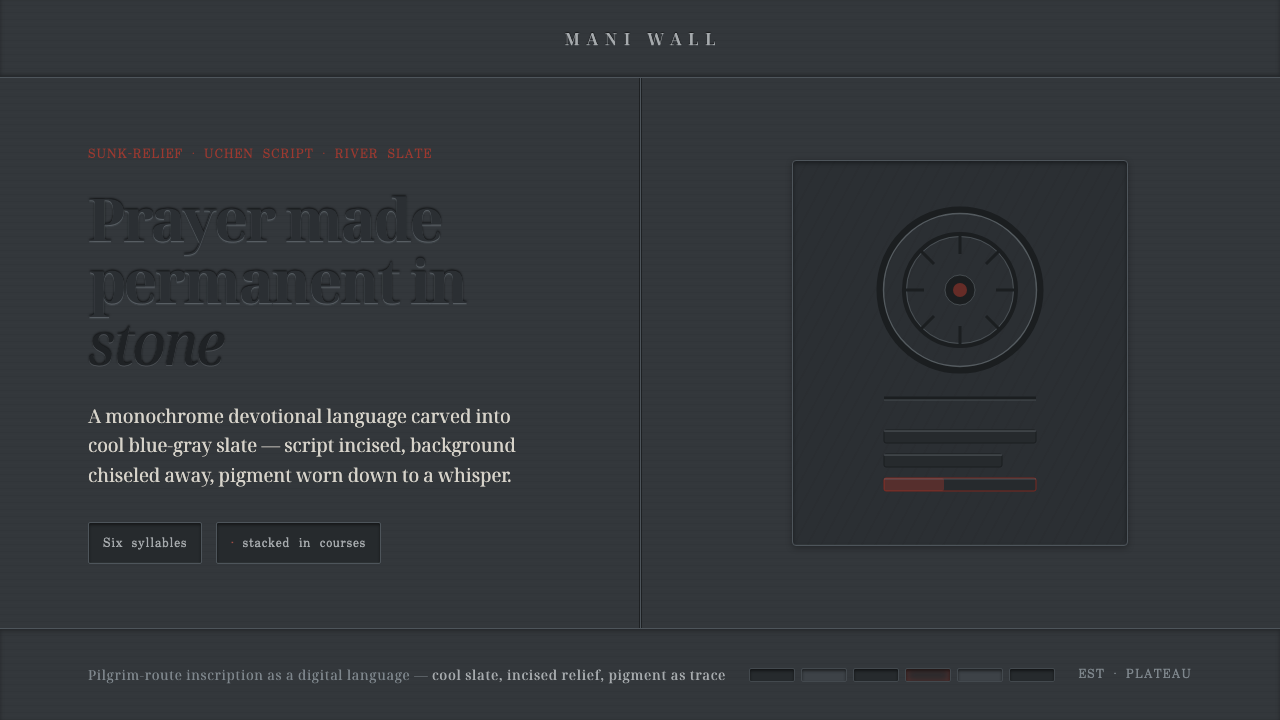 Tibetan Mani StonePrayer made permanent in stone. Sunk-relief glyphs incised into cool slate, p…
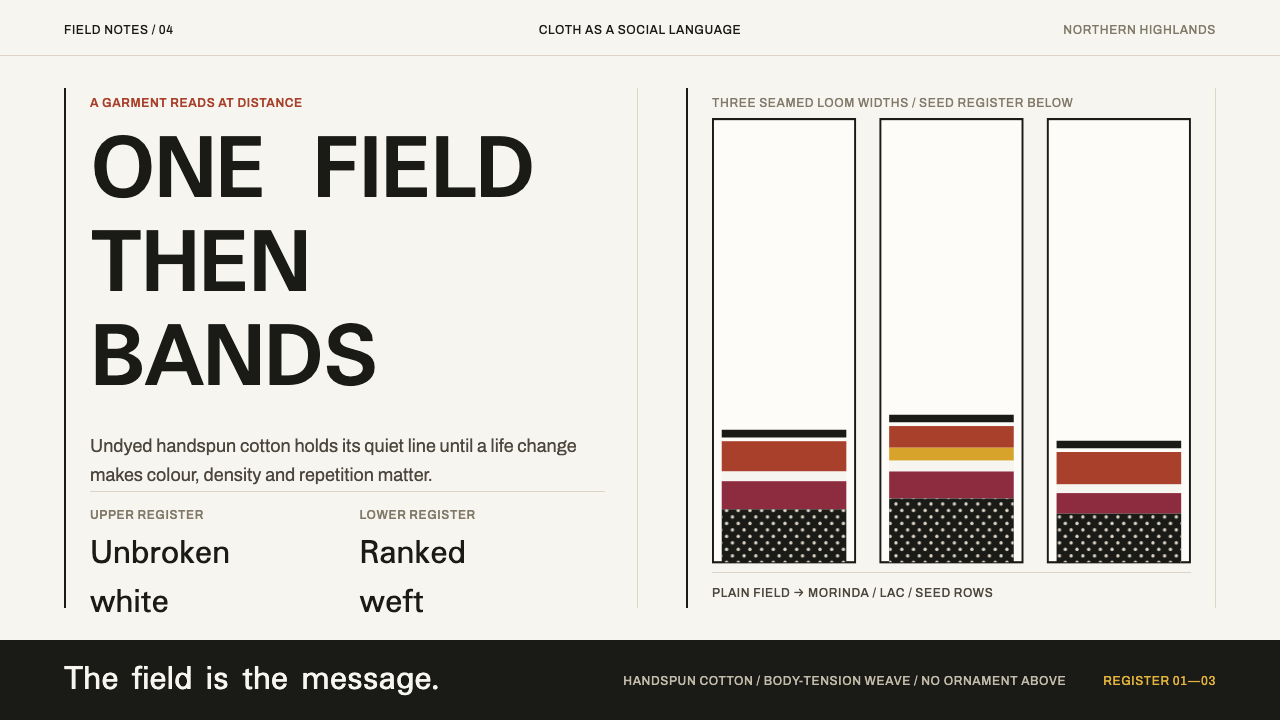 Karen Woven TunicOne field, then bands. Warm cotton white gives way to morinda registers and r…