What is Song Landscape Painting (1100)?
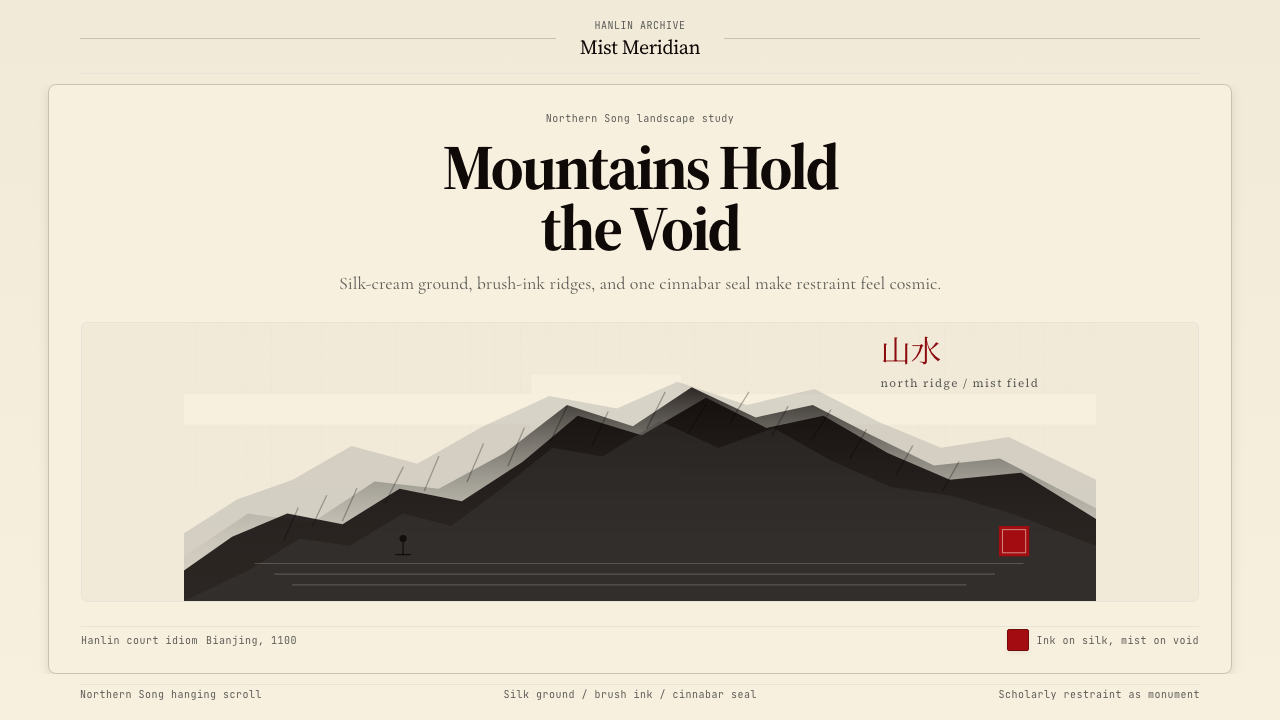
Northern Song landscape painting distills the cosmos into ink-washed silk — monumental peaks, swirling mist, and a single cinnabar seal holding centuries of scholarly silence.
Song Landscape Painting (1100) in brief
Northern Song landscape painting, produced at its height between roughly 950 and 1100 CE, represents one of the most sophisticated visual philosophies ever committed to a painted surface. Working on silk and paper with ink ground to varying densities, artists such as Fan Kuan, Guo Xi, and Li Cheng developed a pictorial language governed not by realistic depiction but by the felt experience of natural grandeur. Mountains were not topographic records; they were philosophical presences — embodiments of permanence, cosmic order, and the relationship between human transience and geological time.
The visual hierarchy of a Northern Song hanging scroll is immediately legible and profoundly deliberate. The foreground contains near details — boulders, gnarled pines, a traveler or fisherman rendered at diminutive scale. The middle ground dissolves into mist, a zone of atmospheric uncertainty where solid form yields to suggestion. The far distance reasserts itself as pale, towering peaks, rendered in lighter ink washes so that they seem to float. This three-zone recession, combined with the vast unpainted silk that stands for sky, cloud, and void, creates a sense of space that Western perspective systems of the same era never quite matched for psychological depth.
As a design language translated into digital contexts, Song landscape painting offers a tonal palette anchored in warm, undyed-silk grounds, dense ink passages graduating from charcoal to near-black, and the punctuating accent of vermilion that appears in artists' seals. The compositional logic is asymmetric and breathing: heavy tonal masses cluster in one region while vast open fields of ground color expand elsewhere. Everything in the system resists symmetry, avoids loudness, and insists on the expressive power of restraint.

Where does Song Landscape Painting (1100) come from?
The Northern Song dynasty (960–1127 CE) unified China after the fragmented Five Dynasties period and established its capital at Bianjing, the city now known as Kaifeng, in the Central Plains. The court supported an extraordinarily rich cultural life. The Imperial Painting Academy (Hanlin Huayuan) trained and employed professional painters, while the literati class — scholar-officials who had passed the civil service examinations — pursued painting as a form of philosophical self-cultivation rather than professional practice. These two streams, court professionalism and literati idealism, produced a generation of artists who synthesized technical mastery with cosmological ambition.
The intellectual climate that shaped Song landscape painting drew heavily from Neo-Confucian philosophy, which was codified during this period by thinkers such as Cheng Yi and later Zhu Xi. Neo-Confucianism held that the patterns underlying natural phenomena (li, or principle) were also the patterns of moral and social order — that to contemplate a mountain was, in some sense, to study the structure of the cosmos and the proper conduct of human life. Guo Xi articulated this explicitly in his treatise Linquan Gaozhi (The Lofty Message of Forests and Streams), written around 1080, in which he described landscape painting as a substitute for the actual mountain experience that a busy official could not always seek out. The painting was not a representation of nature; it was nature, reorganized and distilled.
Fan Kuan, working in the late tenth and early eleventh centuries, developed the monumental style that became the defining model of Northern Song landscape. His surviving masterwork, Travelers Among Mountains and Streams (currently held in the National Palace Museum, Taipei), presents a nearly vertical cliff face that fills the picture plane from edge to edge, with a thin waterfall thread descending through its center and a caravan of traders barely visible at its base. The sheer scale of the mountain relative to the human figures was not dramatic license — it was philosophical statement. Fan Kuan lived as a recluse in the Zhongnan Mountains and is said to have spent years simply observing the landscape before painting it.
Guo Xi, active in the mid-to-late eleventh century and serving as a court painter under Emperor Shenzong, extended the monumental tradition toward greater atmospheric complexity. His Early Spring (1072, also in the National Palace Museum, Taipei) depicts a mountain emerging from mist with a quality of seasonal transformation — the forms are not fixed but caught in a moment of becoming. Guo Xi articulated the concept of the 'three distances' (sanyuan): the deep distance looking down from above, the level distance looking straight across, and the high distance looking up — a spatial vocabulary that organized the hanging scroll's vertical format into a legible system of recession. Mi Fu, the scholar-calligrapher, later developed a looser, horizontally accumulating dot-brush technique (Mi dots) that dissolved mountain form into atmospheric pattern, prefiguring the literati abstraction that would fully flower in the Yuan dynasty.
What defines the Song Landscape Painting (1100) look?
Tonal Palette
The system is built on two anchoring tones and a single accent. A warm, undyed-silk ground — neither pure white nor beige, but something between the two, with the faint golden warmth of aged textile — provides the base. Against this ground, ink moves through a full range from pale diluted wash to near-black concentrated brushwork. The only departure from this monochrome range is the vermilion of the artist's seal: a small, dense rectangle or square of saturated red that anchors the composition at its lower corner. This red functions as a full stop — compositionally and philosophically terminal.
Atmospheric Void
Unpainted ground — the bare silk left untouched by ink — is not absence but active presence. It reads simultaneously as mist, cloud, sky, water surface, and the philosophical void out of which form emerges. The proportion of unpainted area to painted area is typically generous, often exceeding the ink-worked passages. This breathing negative space is the quality most often lost when the style is translated by designers who mistake emptiness for incompleteness.
Monumental Scale Contrast
Scale relationships in Song landscape are philosophically charged rather than naturalistically observed. Mountains and cliff faces occupy the vast majority of the pictorial field; human figures, boats, and dwellings appear at a fraction of their comparative real-world scale. This is not a perspective error but a value system made visual: nature is vast, permanent, and indifferent; the human presence is transient and small. In design application, this translates to compositions that let one dominant formal element — a large tonal mass, a commanding typographic block — overwhelm its surroundings intentionally.
Brushwork Texture
Rock and mountain surfaces in Northern Song painting are described through accumulated brushstrokes called cun (texture strokes or wrinkle strokes). Fan Kuan favored the raindrop cun — short, dense, vertical marks that cover a rock face like rain stippling a surface — which gives his mountains a rough, granular presence. Guo Xi developed the cloud-scroll cun, in which curling, organic strokes suggest stone formed by millennia of water and wind. Translated into digital design, this texturing principle suggests surfaces that carry subtle directional grain — not smooth or gradient, but built through accumulation.
Asymmetric Composition
Northern Song hanging scrolls are organized around a strong vertical axis but are never symmetrically balanced about it. The main mountain mass typically anchors one side — often the right — while the opposing side opens into mist and distance. Weight and counterweight are achieved through tonal contrast: a dense ink mass on one side answered by a smaller but more intense accent (the seal, a dark cluster of pines) on the other. This is balance through tension rather than balance through mirroring, and it produces compositions that feel both stable and dynamic simultaneously.
Three-Zone Recession
Guo Xi's doctrine of the three distances — high, deep, and level — structured the hanging scroll into three distinct spatial zones that correspond to different viewing experiences and tonal densities. The foreground is most textured, darkest, and most resolved. The middle ground is atmospheric and intermediate. The far distance is palest, least detailed, and treated with diluted ink that gives peaks a quality of near-dissolution. In screen design, this translates to depth through tonal value rather than shadow blur: foreground elements are richest, mid-tier elements softer, background elements near-monochrome.
Seal as Accent
The artist's seal — typically carved in negative on a small block of stone and impressed in vermilion paste — provides the composition's single chromatic departure from the ink-and-silk range. Its placement is never casual: the seal appears at the lower margin of the scroll, grounding the composition and simultaneously signaling authorship, authenticity, and the passage of connoisseurs' hands through time (later owners and collectors added their own seals, creating a palimpsest of red marks). In design terms, the seal is the one element of high-chroma color in a predominantly achromatic system — used sparingly, placed deliberately, and never multiplied.

Who shaped Song Landscape Painting (1100)?
Fan Kuan (active c. 960–1030) is considered the founding master of the Northern Song monumental landscape style. He lived as a recluse in the Zhongnan Mountains south of the Tang capital Chang'an, reportedly spending years in direct observation of the mountain environment before attempting to paint it. His Travelers Among Mountains and Streams is among the most studied works in the history of Chinese painting: a vertical cliff that fills the entire format, its surface described in thousands of individual raindrop-cun brushstrokes, dwarfing the caravan of traders below. The work established the fundamental compositional and philosophical logic — human smallness before cosmic nature — that would define the style.
Guo Xi (c. 1020–1090) served as a court painter under Emperor Shenzong and was the most influential theorist of Northern Song landscape practice. His treatise Linquan Gaozhi articulates both the philosophy and the technique of the monumental landscape — the three-distances spatial system, the importance of seasonal transformation, the instruction to paint a mountain from the perspective of someone who truly inhabits it. His Early Spring (1072) is the technical summit of Song atmospheric landscape: a mountain that seems to breathe, dissolving into mist at its shoulders and reforming above the clouds. His cloud-scroll brushstroke vocabulary became the standard against which later court painters measured themselves.
Li Cheng (919–967) predated the height of Northern Song monumental landscape but established many of the conventions that Fan Kuan and Guo Xi would develop further. His compositions favored a level-distance view — looking across a wide, open terrain rather than up at an overwhelming peak — with bare winter trees rendered in the distinctive 'crab-claw' branch pattern that became his signature. Li Cheng's work introduced the element of seasonal desolation and quietude that gave Song landscape its characteristic emotional register: not sublime terror before nature, but a contemplative melancholy within it. His reputation was so great that even in his own lifetime, authentic works were rare and forgeries abundant.
Mi Fu (1051–1107) was primarily a calligrapher and connoisseur — one of the great collectors and critics of his age — who also developed a radically experimental painting technique that dissolved the mountain-as-solid-form in favor of the mountain-as-atmospheric-impression. His signature Mi-dot technique accumulated horizontal oval brushstrokes to build up misty hillsides that seem to evaporate rather than stand. Mi Fu was deeply critical of the monumental tradition's attachment to descriptive technique and viewed his own method as a return to the calligraphic essence of painting. His approach influenced literati painting theory for the next eight centuries and provided the conceptual bridge between Song monumental landscape and Yuan dynasty ink abstraction.
Emperor Huizong (reigned 1100–1125) was himself a gifted painter and calligrapher who reorganized the Imperial Painting Academy into a formal institution with examination requirements modeled on the civil service. He favored meticulous court painting — precisely observed birds, flowers, and genre scenes — rather than the monumental landscape, but his administrative patronage created the institutional context in which the late Northern Song synthesis occurred. His reign marked both the cultural apex of the dynasty and its political catastrophe: the Jurchen Jin dynasty captured Bianjing in 1127, taking Huizong and his son into captivity, ending the Northern Song. The tragedy of his captivity gave the entire Northern Song cultural achievement a retrospective quality of lost grandeur that influenced how later dynasties remembered and idealized the period.
How do you use Song Landscape Painting (1100) today?
Song landscape painting is among the most demanding historical styles to apply in digital design, because its power depends almost entirely on proportion, restraint, and tonal calibration rather than on recognizable surface elements. Applying it correctly means internalizing its compositional logic — the breathing void, the asymmetric tonal mass, the single chromatic accent — rather than simply adding ink-wash textures to an otherwise conventional layout.
For presentation slides, the style works with exceptional authority on cover pages and section dividers. A cover built on this logic uses the warm silk-toned ground as the full bleed background, places a large tonal mass (a deep ink-gradient illustration, a heavy typographic block) to one side and toward the upper register, and leaves the opposing lower field entirely open. The title appears at a scale that commands the composition rather than merely labeling it. A single vermilion element — a dot, a line, a seal-like rectangle — anchors the lower corner. Content slides should be treated as minimal: wide margins as breathing voids, body text in warm near-black against the ground color, with section hierarchy built through size contrast alone. Data visualizations translate naturally: bar charts and area charts rendered in graduated ink tones, with a single accent color used only for the most significant data series.
For web interfaces, the palette and compositional logic suit premium editorial products, long-form reading environments, documentation sites, and any context where the desired user experience is one of calm authority and considered depth. Dashboard applications can apply the three-distance principle to information hierarchy: dense and detailed in the immediate foreground (active metrics, primary actions), softer and more atmospheric in the mid-tier (trend charts, secondary data), near-absent in the background layer (structural grid, quiet navigation). The key discipline is maintaining the proportion of void to content: resist the impulse to fill every grid cell. Navigation and pricing pages benefit from the seal logic — one saturated accent color reserved exclusively for the primary call to action, used nowhere else.
For editorial and marketing work, the style supports a register of quiet prestige that few other historical systems achieve. A brand identity or editorial spread built on this palette reads as assured, unhurried, and culturally literate without resorting to pastiche. The warm silk ground translates well to paper stocks and screen backgrounds alike. Marketing pages can alternate between silk-ground and deep-ink sections — the ink sections carrying reversed-out near-white type — with the vermilion accent appearing only in the most emphatic calls to action. Photography, when used, should be treated as a tonal element: desaturated or converted to warm near-monochrome, cropped to emphasize abstract form over representational content.
A common mistake when applying this style is mistaking 'ink wash' for the system's essential character and applying painted or illustrated textures to otherwise standard layouts. The result looks decorative rather than structural — a costume rather than a grammar. The actual logic is compositional and tonal: how much ground is left open, where the heaviest mass sits, how the single accent is placed. A second common error is overusing the vermilion. In original Song paintings, the seal is one small element in an overwhelmingly restrained composition; its impact derives from its singularity. A design that applies the accent color to headlines, buttons, borders, and icons simultaneously has misunderstood how the system creates its effect. Use the accent once, deliberately, and trust the restraint to do the work.

Song Landscape Painting (1100) — FAQ
How is this style different from other Chinese ink-painting traditions?
Northern Song monumental landscape is specifically a court-era, large-format, vertical hanging-scroll tradition focused on mountains and atmospheric space. It differs from later literati painting (Yuan dynasty onward), which is smaller, more gestural, and foregrounds the artist's personal emotional state over objective natural grandeur. It differs from Tang figure painting in its near-absence of human narrative. It differs from the Southern Song academic tradition (after the dynasty moved to Hangzhou in 1127) in scale and ambition: Southern Song masters like Ma Yuan and Xia Gui favored one-corner compositions of lyrical intimacy rather than the overwhelming scale-contrast of the northern school. When designers reference 'ink wash aesthetics,' they may mean any of these traditions; Song monumental landscape is the most architecturally structured and formally severe among them.
Can this style work effectively in dark-mode interfaces?
The historical canon is entirely light-ground — silk is warm and pale, and the ink works against this luminous base. A dark inversion is possible but requires a fundamental reinterpretation: the deep-ink passages become the ground, and light values become the mark. In practice, a dark variant works best when it commits to deep, warm charcoal rather than cold black for the background, uses near-white passages that suggest the luminosity of pale ink wash, and retains the vermilion accent with care — against dark grounds, saturated red tends to vibrate aggressively, so it may need to be proportionally smaller or slightly warmed. The three-zone atmospheric recession still functions: the nearest elements are highest-contrast, mid-tier elements fade toward the ground tone, and distant elements nearly dissolve.
Does the style require actual ink-wash illustration, or can it work with type and flat shapes alone?
The style does not require illustration to function. The compositional and tonal logic — a warm ground, a heavy asymmetric mass in ink tones, generous void, one vermilion accent — can be achieved entirely through typographic and geometric means. A large block of deep-toned text, a wide ruled line, a heavy rectangular shape, or a full-bleed photograph treated to near-monochrome all serve the same compositional function as a painted mountain mass. In fact, some of the most successful contemporary applications of this aesthetic use no illustration at all: the design system's logic operates through proportion, tone, and the deliberate use of empty space. Illustration adds richness but is not the prerequisite.
What kinds of brands or products is this style poorly suited for?
The style carries cultural and tonal associations that limit its range. It reads as scholarly, contemplative, and prestige-oriented — qualities that align well with financial services, premium publishing, luxury goods, and cultural institutions, but that work against categories requiring immediacy, playfulness, accessibility, or broad populist appeal. Consumer technology products targeting fast adoption, children's education platforms, fitness and wellness applications, food and beverage brands, and any product whose primary emotional register is energetic or celebratory will find this style resistant. Its restraint can also read as exclusive or opaque in contexts where warmth and approachability are strategic priorities. The question is whether the product's values — patience, depth, authority, permanence — genuinely align with what this visual language communicates, or whether the aesthetic is being applied as prestige borrowing without substantive fit.
How should the vermilion accent be used in a multi-screen digital product?
The seal's logic in the original paintings is instructive: one occurrence, small relative to the whole, placed with deliberate compositional intent, never decorative. In a digital product, this translates to reserving the vermilion accent for a single, consistent semantic role — the primary call to action, the active navigation state, the error indicator, or the brand mark — and never using it for multiple purposes simultaneously. Its scarcity is what gives it force. A useful test: if the accent color were removed entirely from the interface, would the product still function legibly? If yes, the accent is being used correctly as a signal amplifier rather than a structural load-bearer. If removing it would cause the layout to collapse in hierarchy, it is being overloaded. The warm-ground, ink-tone palette should carry all structural communication; the vermilion is reserved for the moment of decision or emphasis.
Related design styles
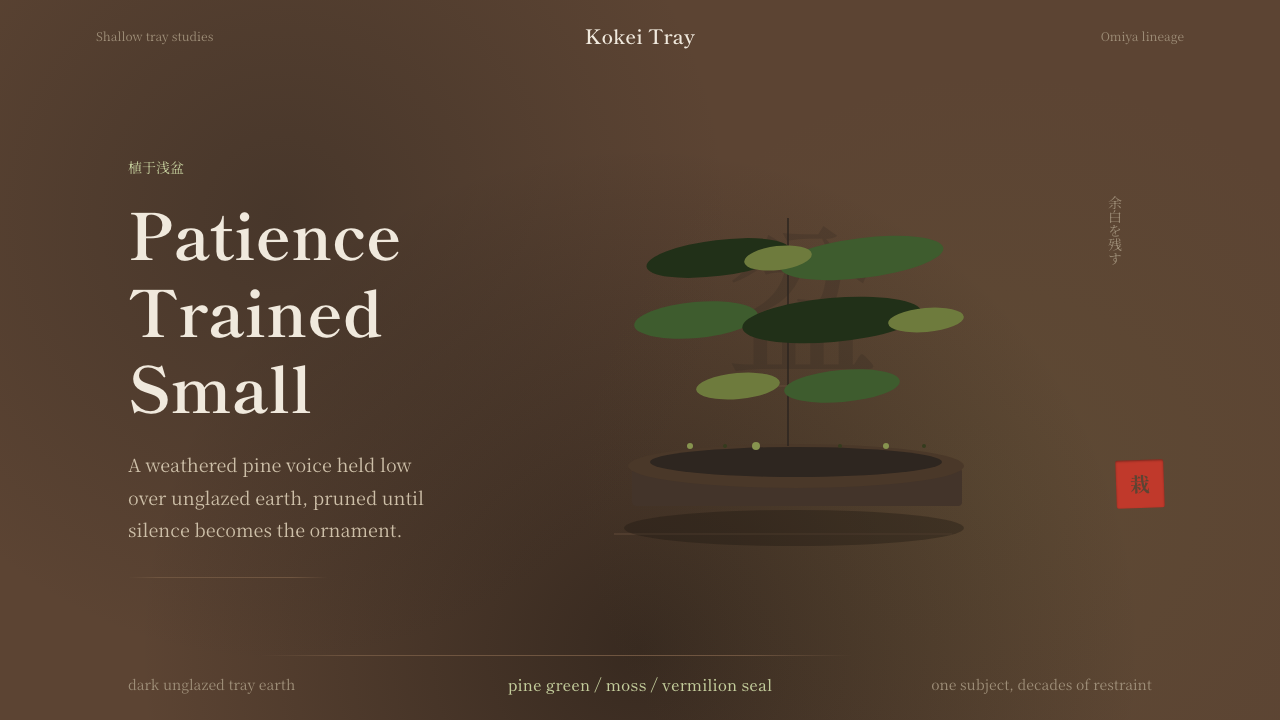 Bonsai CultivationQuiet asymmetry. Pine green rests on dark tray earth, sealed by one vermilion…
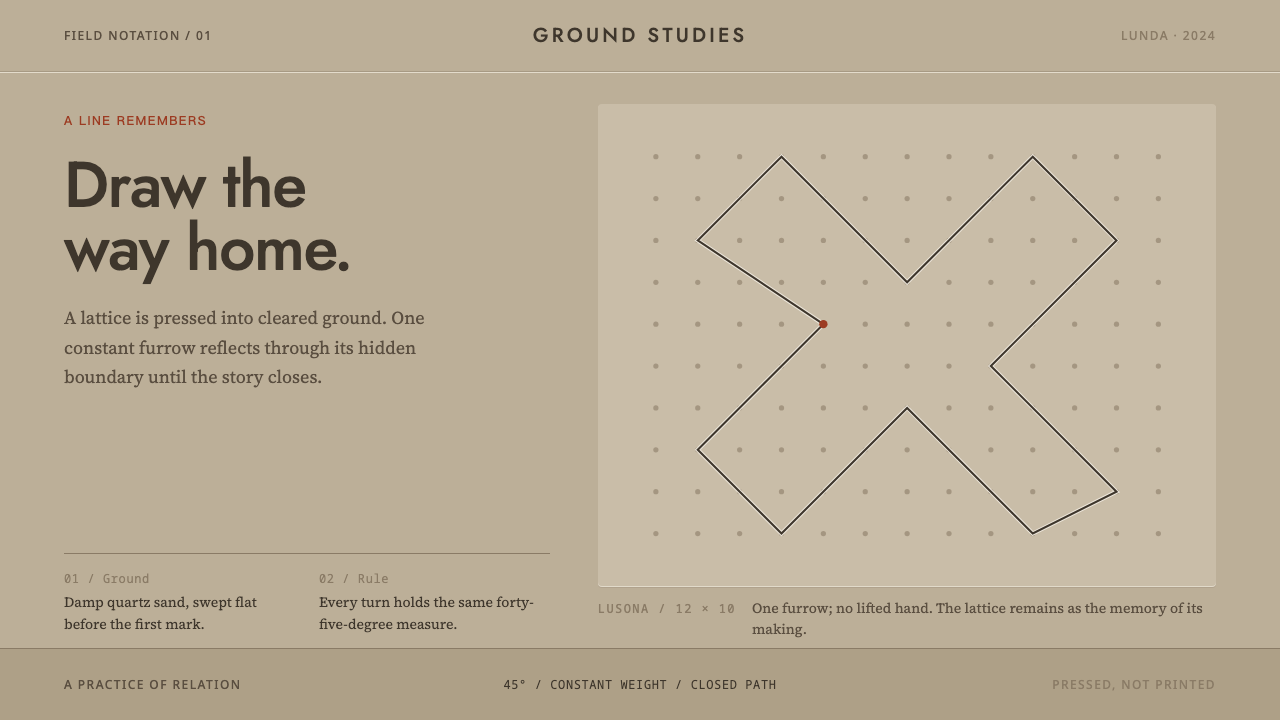 Angolan SonaA story closes in one stroke. A 45° furrow crosses visible dots on damp sand.
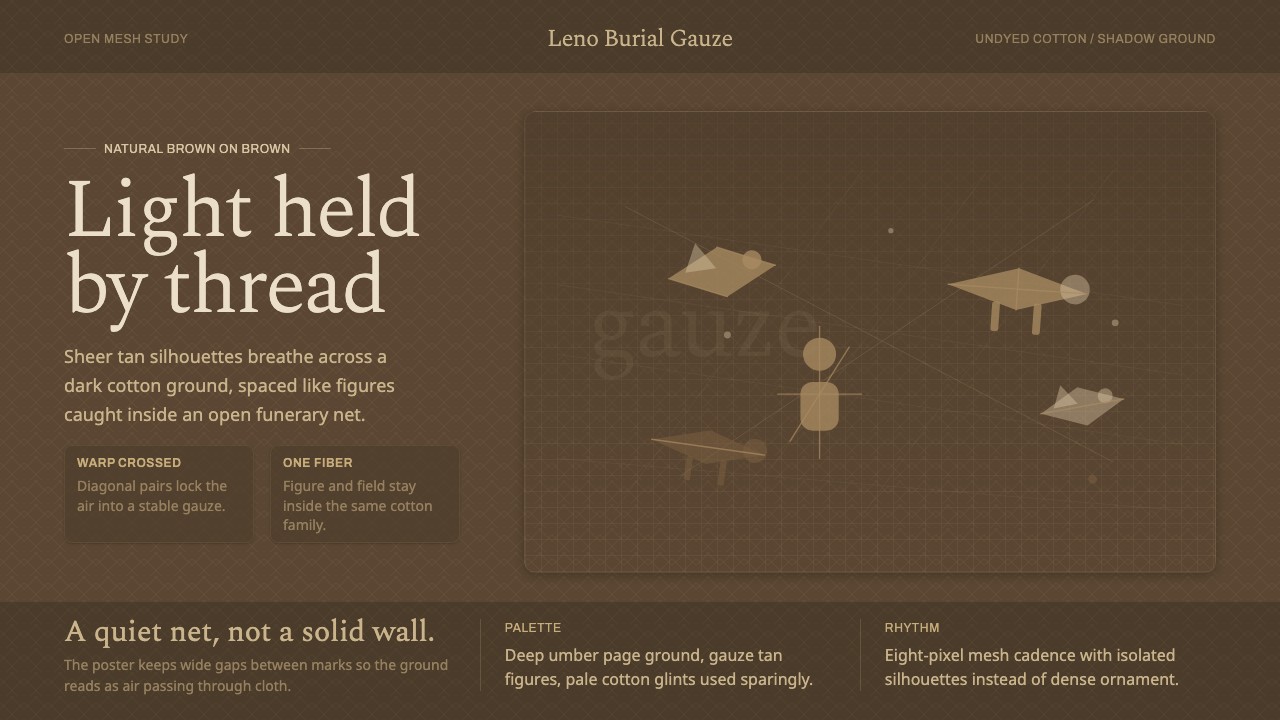 Chancay Gauze TextileQuiet woven dignity. Tan silhouettes float through a dark open cotton mesh.
 Goryeo Celadon 高麗青瓷Stillness carries ornament. Bisaek jade ground holds white and black hairline…
 Hindu Widow White SariRestraint carries the weight. Ash-toned khadi, quiet serif type, and vertical…
 Jingdezhen BlancQuiet porcelain glows. Warm glaze-white on slate reveals hidden anhua incisio…