What is Ecuadorian Montecristi Panama Hat?
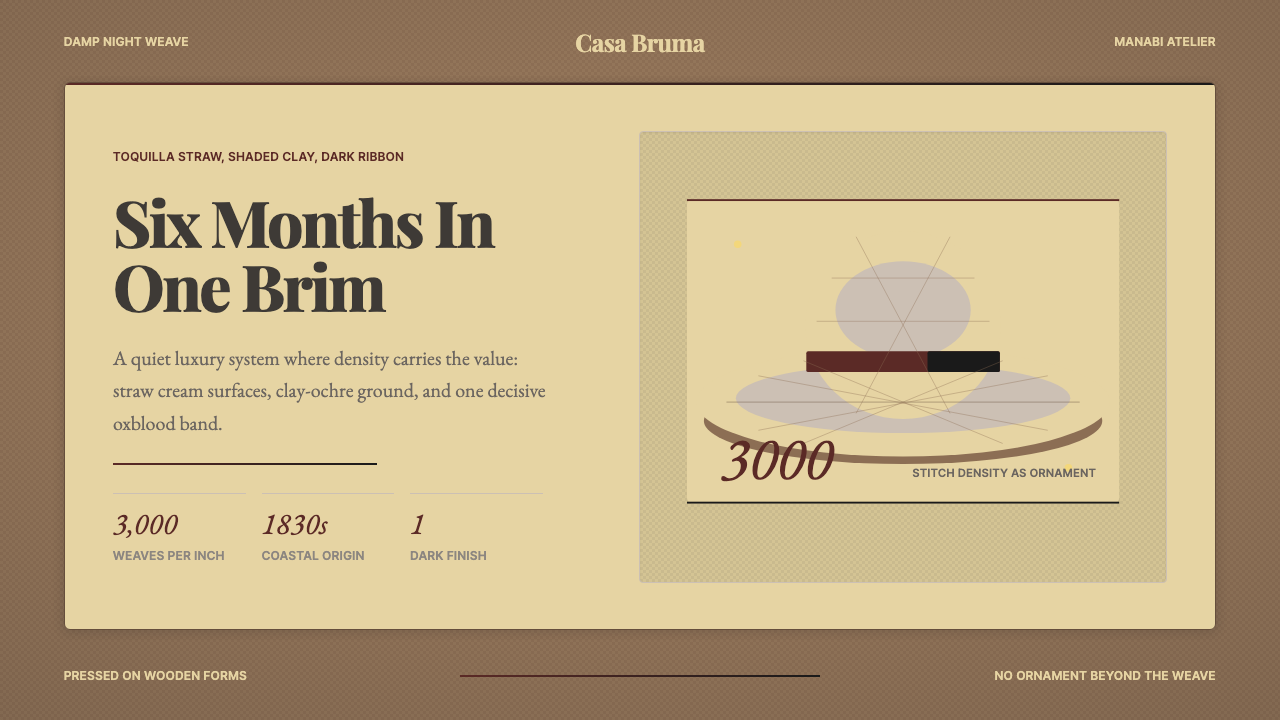
The Montecristi superfino is proof that luxury can be invisible — a hat so finely woven it holds water, whose cream-and-clay palette speaks in whispers while a single dark ribbon strikes the only sharp note.
Ecuadorian Montecristi Panama Hat in brief
The Montecristi Panama Hat design system is drawn from one of the world's most labor-intensive craft objects: the Ecuadorian superfino straw hat, whose finest examples require a single weaver six months of uninterrupted work to complete. What makes this aesthetic distinctive is not display but density — every surface earns its place through an almost fanatical commitment to precision weaving, and any visual excess is simply absent by nature.
The palette is built from the materials themselves: the pale ivory of dried toquilla palm, the warm shadow of shaded clay walls, the burnished amber of ochre earth, and one deep oxblood-black stripe — the hat band — that serves as the only graphic accent. This is a system that treats restraint not as a stylistic choice but as a consequence of craft: nothing is added because everything that belongs is already there.
In contemporary design terms, the style translates as a warm minimalism with an artisanal grain. It rejects both the cool austerity of Swiss modernism and the exuberant color of folk traditions, occupying instead a middle register that feels simultaneously ancient and quietly sophisticated. Surfaces suggest texture without becoming decorative; the single dark accent creates hierarchy with surgical economy.
Where does Ecuadorian Montecristi Panama Hat come from?
The hat known worldwide as the Panama hat has nothing to do with Panama. It was born and has always been made in Ecuador, specifically in the coastal province of Manabí. The towns of Montecristi and nearby Pile are home to the finest weavers, and a Montecristi superfino — the highest grade, graded by the closeness of its weave — represents the summit of the craft. The misnaming is a historical accident rooted in nineteenth-century trade routes: Ecuadorian hats were shipped to the isthmus of Panama, where they were sold to prospectors heading to the California Gold Rush and to workers later recruited for the French and then American canal projects. By the time the hats reached North American and European consumers, they bore the label of their point of transit.
The weaving tradition is far older than the export trade. Evidence of toquilla palm weaving in coastal Ecuador dates to pre-Columbian times, with indigenous communities in Manabí producing woven goods for centuries before Spanish colonization. The plant itself — Carludovica palmata, not a true palm but a relative of the cyclanths — grows in the humid lowlands of the Ecuadorian coast. Its young shoots are harvested, boiled, split into fine strands, and bleached in sulfur smoke to achieve the characteristic pale cream color. Each strand is a fraction of a millimeter wide; a superfino is woven entirely at night or in the damp pre-dawn hours, when cooler, more humid air keeps the fibers supple enough to work without splitting.
The hat's fame in the wider world grew dramatically during two pivotal moments. The first was the Paris Universal Exposition of 1855, where Ecuadorian toquilla hats were exhibited and coveted by European fashion. The second — and more decisive for the name confusion — came with the construction of the Panama Canal. Theodore Roosevelt's famous 1906 photograph, taken during his inspection visit, showed him wearing a broad-brimmed toquilla hat, and the image circulated worldwide with the caption identifying the hat as Panamanian. In 2012, UNESCO inscribed the traditional weaving of Ecuador's toquilla straw hats on its Representative List of the Intangible Cultural Heritage of Humanity, finally anchoring the craft's identity to its true origin.
In Montecristi and Pile today, the tradition is maintained by a small and aging community of master weavers. The finest grades — the superfino and extra-superfino — are distinguished by their weave count per square inch, a figure that determines price more than any other single factor. A high-grade hat may sell for thousands of dollars; the most extraordinary examples command prices comparable to fine jewelry. After weaving, the hats travel to Cuenca, Ecuador's third city, for finishing: blocking on wooden hormas to achieve the classic oval crown, trimming, and the application of the hat band — typically a simple ribbon of dark grosgrain or silk, in black or oxblood — that provides the only applied ornament on an otherwise entirely natural object.
What defines the Ecuadorian Montecristi Panama Hat look?
Palette
The color system is built from three natural registers: a dominant warm ivory drawn from the bleached toquilla straw, a supporting mid-tone of shaded clay or warm ochre that reads as the shadow of a sunlit wall, and a single deep accent of oxblood-black derived from the traditional hat band. The two ground tones are close in warmth and value, creating a monochromatic harmony that reads as restful and coherent. The accent is used with extreme economy — it appears once, at most, per composition, providing directional emphasis without competing for the surface.
Texture and Surface
The defining visual quality of this style is its implied texture: the surface reads as finely woven rather than printed, suggesting repetitive handwork at a scale just below visual resolution. In digital application, this quality is achieved through subtle tonal variation within a near-uniform field rather than explicit pattern or grain. The texture should feel earned and structural rather than decorative — not a background treatment, but evidence of the object's making.
Hierarchy Through Density
In a system this chromatically spare, hierarchy cannot be achieved through color contrast alone. Instead, the Montecristi aesthetic uses weight and density as its primary organizational tools: the finest, most complex element sits at the center of attention; supporting elements are progressively simpler and less dense. This mirrors the craft logic of the hat itself, where the weave is tightest at the crown — the focal point — and slightly looser at the brim.
The Single Dark Accent
The hat band is the only applied ornament on an otherwise entirely natural object, and it does a remarkable amount of organizational work for its slenderness. In this design system, the equivalent of the hat band — a single horizontal or linear element in near-black — functions as both a compositional anchor and a device for defining scale. It tells the eye where the object ends and negative space begins; it also signals craft and intentionality in a way that color alone cannot.
Warmth Over Coolness
Unlike many minimalist systems that skew neutral or cool, the Montecristi palette has a consistently warm cast drawn from its natural materials. The ivory is not stark white but sun-bleached cream; the shadow tones lean toward amber rather than gray. This warmth is not sentimentality — it is the literal color of the materials from which the tradition is made. In application, it results in a style that feels human and handmade even at its most restrained.
Negative Space as Luxury
In the Montecristi world, emptiness is not absence — it is the field against which precision reads. A superfino hat with three thousand weaves per square inch looks almost uniformly pale at a distance; the luxury is only fully revealed on close inspection. The same principle governs the design system: generous negative space is not a failure to fill but a deliberate choice to let what is present be fully perceived. Crowding destroys the effect entirely.
Symmetry with Handmade Tolerance
Montecristi hats are shaped on wooden molds but woven entirely by hand, which means that no two are perfectly identical — there is always a slight irregularity in the weave that distinguishes them from machine-made goods. The design system honors this quality by favoring compositions that are structurally symmetrical in intent but not mechanically so in execution: slight variations in weight distribution or spacing that signal human origin rather than digital perfection.
Who shaped Ecuadorian Montecristi Panama Hat?
One of the most cited master weavers of Montecristi, Espinal represents the lineage of craftspeople who maintained the superfino tradition through the twentieth century when cheaper, coarser hats from other Ecuadorian towns threatened to overshadow the Montecristi grade. His practice exemplifies the intergenerational transmission that UNESCO identified when inscribing the toquilla weaving tradition in 2012 — the knowledge passes through families and communities, not institutions, and the loss of even a single master weaver represents an irreplaceable narrowing of the tradition's range.
Carranza is associated with the preservation of the most exacting grading standards for Montecristi hats — the distinction between a fino, a superfino, and an extra-superfino is not a marketing gradation but a technical one, measurable by placing the hat against a light source and counting the weave per square inch. Weavers like Carranza who maintained the capacity for the highest grades became the benchmark against which the tradition's health is measured, and their techniques are the subject of the most careful documentation efforts by cultural heritage organizations.
Chávez represents the artisan community of Pile, a small village near Montecristi where some of the finest weavers have historically concentrated. Pile weavers are known for maintaining the night-weaving tradition — working in the cool, humid hours between midnight and dawn when the fibers are least likely to crack. The village-level concentration of expertise means that the Montecristi style is not an abstract category but a geographically specific community practice, with slight differences between family lineages in how tensions are held and patterns initiated.
The 2012 inscription of toquilla straw hat weaving on UNESCO's Representative List of Intangible Cultural Heritage was a turning point for the tradition's global recognition. The decision formally attributed the craft to Ecuador and to the specific communities of Manabí province, correcting nearly two centuries of misattribution. Beyond the symbolic rectification, the inscription created practical obligations: Ecuador committed to documentation, transmission programs for younger weavers, and the promotion of the craft's true origin to international buyers and cultural institutions.
While the weaving itself belongs to Montecristi and Pile, the finishing of Panama hats has historically been concentrated in Cuenca, Ecuador's highland colonial city. The blockers and trimmers of Cuenca — craftspeople in their own right — use wooden hormas to shape the crown, steam the brim into its final curve, and apply the hat band. The collaboration between coastal weavers and highland finishers is a geographical division of labor that has persisted for generations and represents a distinct second chapter in the hat's making, one that contributes significantly to its final aesthetic character.
How do you use Ecuadorian Montecristi Panama Hat today?
The Montecristi Panama Hat aesthetic is one of those rare styles that communicates premium quality without resorting to conventional luxury signals — no metallic finishes, no deep saturated jewel tones, no obvious opulence. Applying it correctly requires understanding what the visual system is actually doing: using the warmth and density of natural materials to signal time, care, and exactitude. The worst misapplication is to treat it as simply a beige-and-cream color scheme and leave it at that.
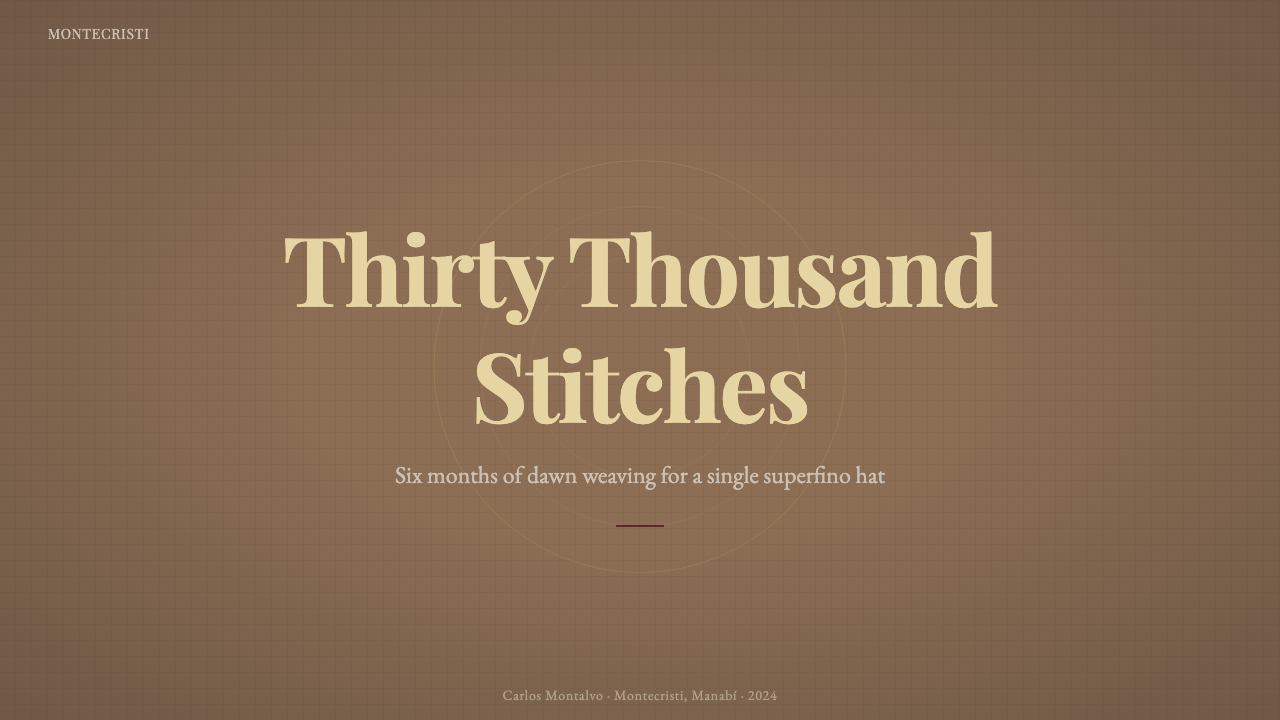
For presentation slides, the style works best when density and restraint are allowed to carry the narrative. A cover page built on this aesthetic should feature an expanse of warm ivory with a single headline in a warm near-black, and — optionally — one horizontal dark rule running beneath the title as the hat-band equivalent. Content slides benefit from a strict hierarchy: large titles in a slightly warmer dark tone, body text in a lighter weight, and data labels in the ochre middle register. Resist the urge to colorize charts fully; a single-color chart in oxblood or deep amber against a cream ground reads as intentional and cohesive.
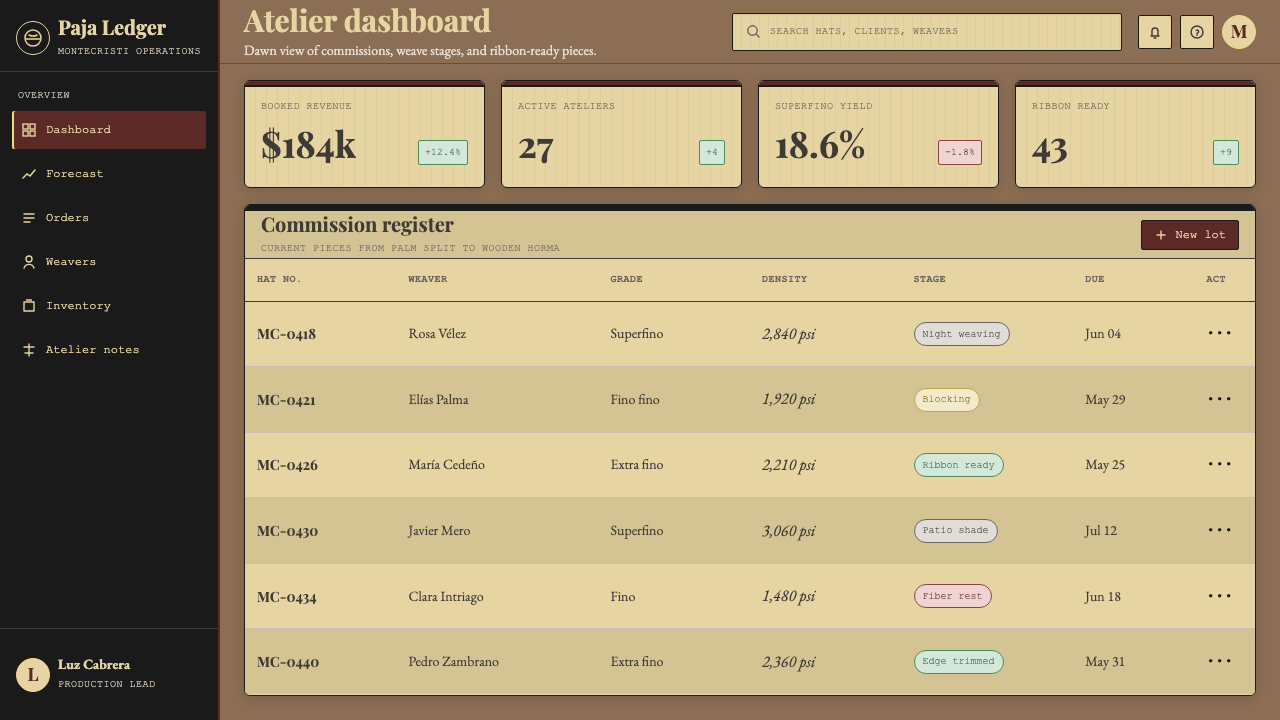
For web interfaces, this system is well-suited to luxury goods pages, artisan marketplaces, heritage brand microsites, and any context where the product's value is rooted in craft and time rather than innovation and speed. The approach on a pricing page: a cream or warm-white field, one dark horizontal divider between tiers, tier names in a heavier weight of the same warm near-black, and the premium tier differentiated not by a splash of color but by a darker card background in the clay-ochre range. Interactive elements — buttons, links — should use the oxblood accent as a single consistent signal, never appearing in multiple saturations or states simultaneously.
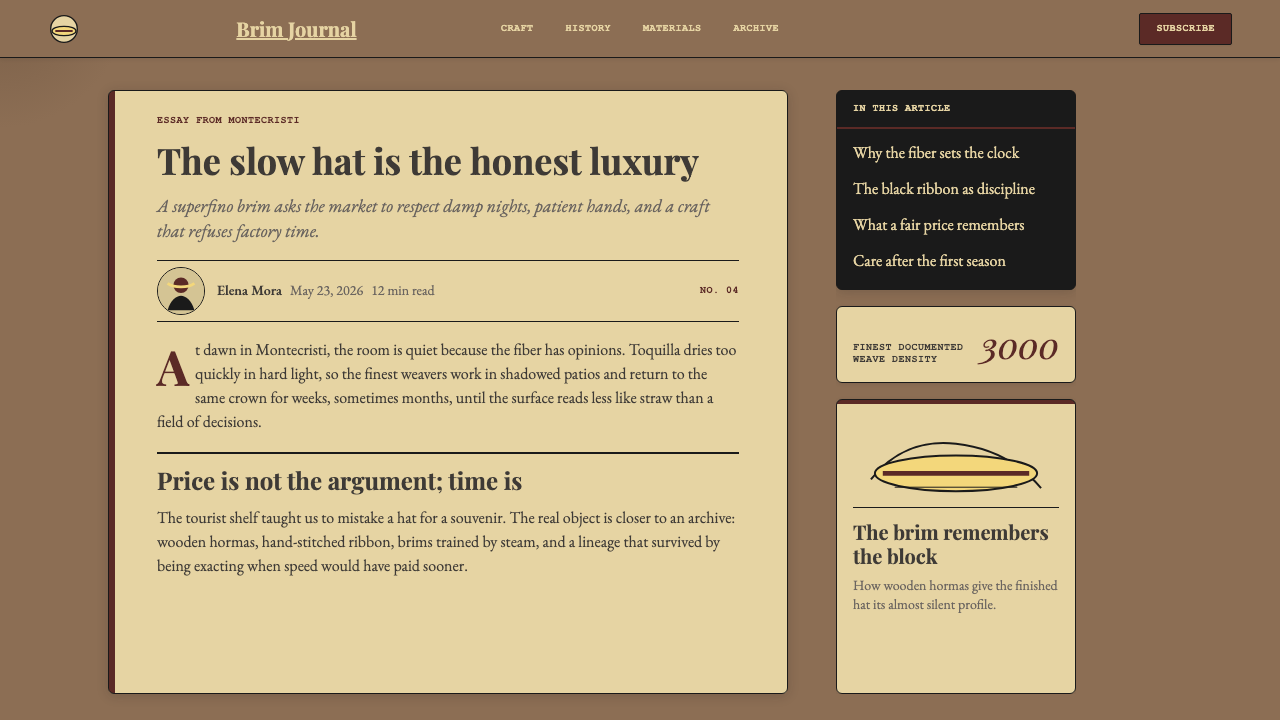
For editorial and marketing contexts, the style supports long-form content beautifully. A Montecristi-derived article layout uses a wide, generous column with substantial margins — the negative space is not wasted but essential. Section headers can be distinguished by slightly increased weight in the same warm near-black rather than color shifts; pull-quotes work well as isolated lines in the ochre register, spaced as generously as if each word cost something. Photography, if used, should be warm-toned and closely cropped — details of texture and surface rather than wide establishing shots.
The most common mistake when applying this style is overworking the palette. Designers who add a second accent color, or who substitute a cooler gray for the warm ochre shadow, or who use a clean digital white instead of the sun-bleached cream, pull the system away from its material logic and toward something that reads as merely tasteful rather than genuinely rooted. The oxblood-black accent should appear at most once per composition; doubling it or varying its weight or opacity undermines the hat-band principle — that the single dark note derives its power entirely from its singularity.
Ecuadorian Montecristi Panama Hat — FAQ
Why is it called a Panama hat if it comes from Ecuador?
The name is a trade-route accident. Ecuadorian toquilla hats were shipped through the port of Panama for distribution to North American and European markets in the nineteenth century. Gold Rush prospectors headed to California, and later workers on the French and American Panama Canal projects, bought the hats at their transit point. By the time the hats reached final consumers, they were associated with Panama in the popular imagination. Theodore Roosevelt's widely circulated 1906 photograph wearing such a hat during a canal inspection visit cemented the misnaming. The UNESCO inscription of 2012 formally recognized the craft as Ecuadorian intangible cultural heritage, but the commercial name has proven too entrenched to dislodge globally.
What makes a Montecristi hat more valuable than other toquilla hats?
The single most important factor is weave density, measured in threads or weaves per square inch. A basic toquilla hat might have a weave count in the dozens; a Montecristi fino reaches into the hundreds; a superfino can reach over one thousand weaves per square inch, and extraordinary examples approach three thousand. At the highest densities, the hat becomes almost translucent and can hold water like a bowl. Achieving this density requires fibers split to a fraction of a millimeter in width, worked in the cool humid hours of the night to prevent splitting, and the undivided attention of a weaver with decades of practice. The time investment alone — up to six months for a top-grade hat — is reflected directly in its price.
Does this design style work for brands that are not in the luxury sector?
It can, but the fit depends less on industry category and more on whether the brand's values align with what this palette communicates: patience, precision, natural origin, and a kind of understated authority that assumes the audience will lean in rather than be shouted at. A boutique coffee roaster, a heritage seed company, a small-batch ceramics studio, or an independent publishing house could all carry this aesthetic convincingly. A startup prioritizing speed and disruption, a consumer app optimizing for fun and virality, or a brand whose primary value proposition is accessibility and affordability would find the system works against their message — the warmth and restraint signal exactly the opposite of urgency and democratization.
How do I use the oxblood accent without it overpowering the rest of the palette?
The key is to treat the accent exactly as the hat band is treated: one continuous element at a fixed weight, not a scattered or repeated motif. In a layout, this means committing the oxblood-black to a single role — a call-to-action button, a section divider, a key data series in a chart — and not varying its application. The moment it appears in more than one role or at different opacities, it loses its anchor function and becomes noise. It also helps to keep the accent at the same tonal depth as the original hat band: a deep, slightly warm near-black rather than a vivid red or a bright burgundy. The restraint in the original object is what gives the accent its weight; trying to brighten or intensify it undoes the system's logic.
What is toquilla palm, and why does the weaving have to happen at night?
Toquilla palm — scientifically Carludovica palmata — is not a true palm but is related to cyclanths, and grows in the humid lowland regions of coastal Ecuador. Its young shoots are harvested before the leaf frond opens, boiled in large pots to remove resin, then split by hand and sun-dried. For the finest grades, the split strands are further bleached using sulfur smoke, which gives them the characteristic pale cream color. The reason the highest-grade weaving happens at night or in the cool pre-dawn hours is purely practical: dry air causes the fine strands to crack and break as they are handled. The higher the humidity, the more the fibers remain supple, and only the most demanding weave counts are impossible to achieve in the drier heat of midday. Master weavers working on a superfino may begin at midnight and work through to sunrise, then rest during the day.
Related design styles
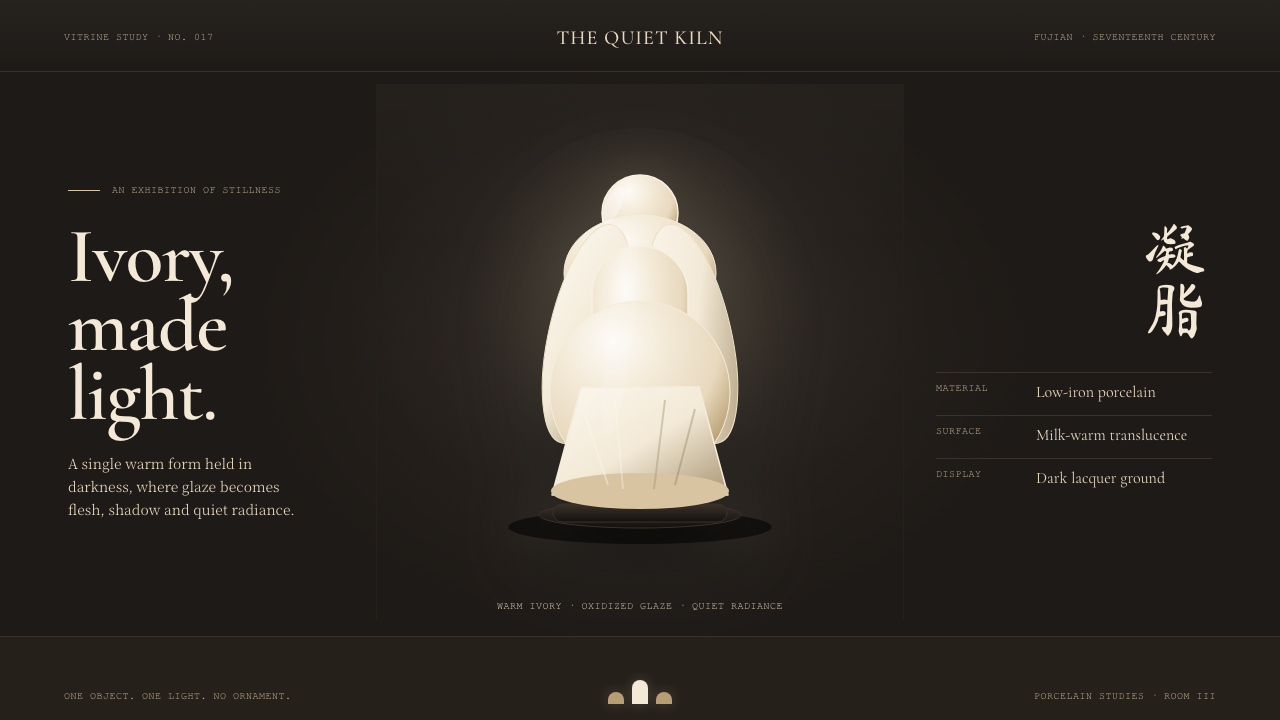 Dehua Blanc de ChineIvory becomes light. Warm porcelain glows as one quiet form against a near-bl…
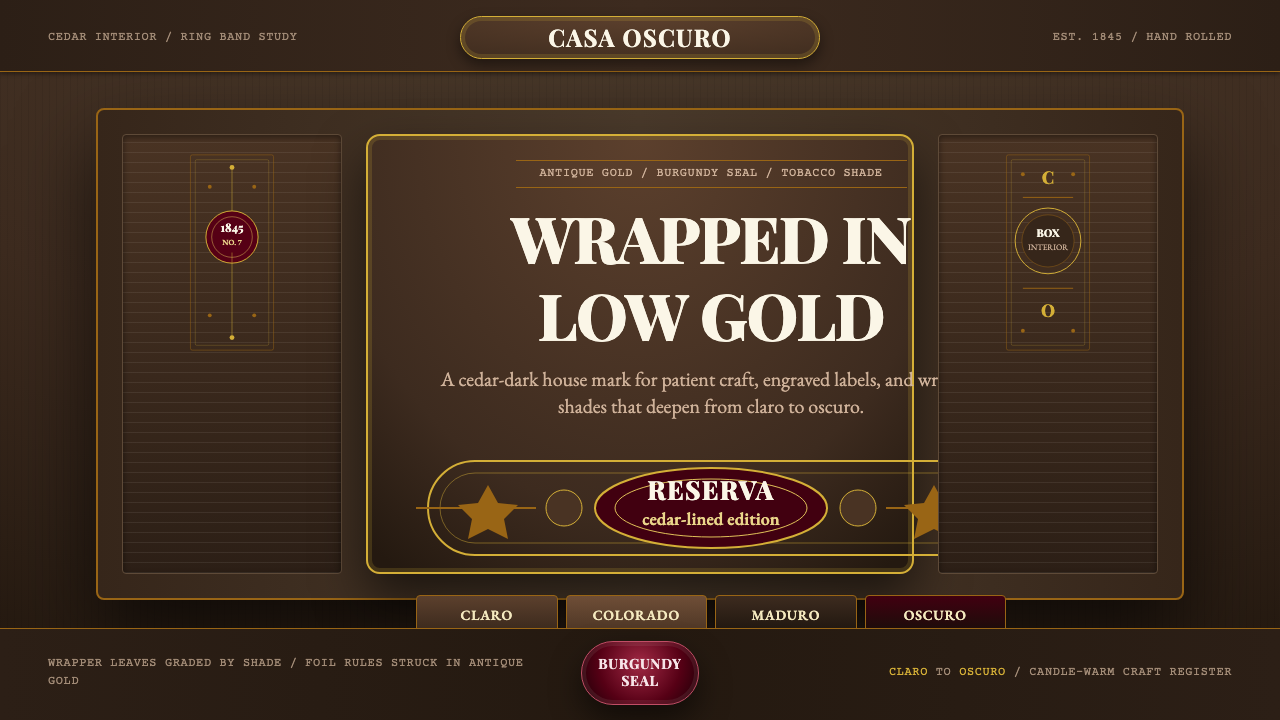 Cuban Habano CigarLuxury sleeps in shadow. Tobacco brown, antique gold rules, and burgundy seal…
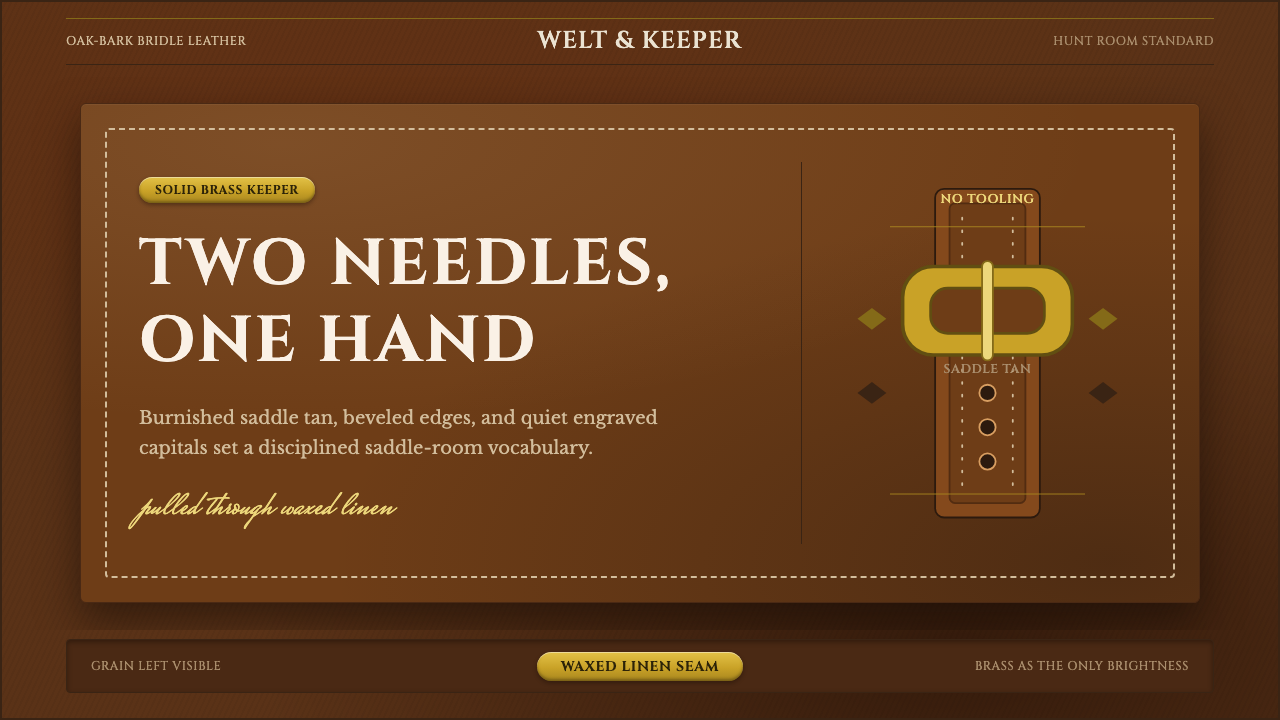 English Saddlery TanQuiet hand-made luxury. Saddle tan leather, brass accents, and waxed-linen st…
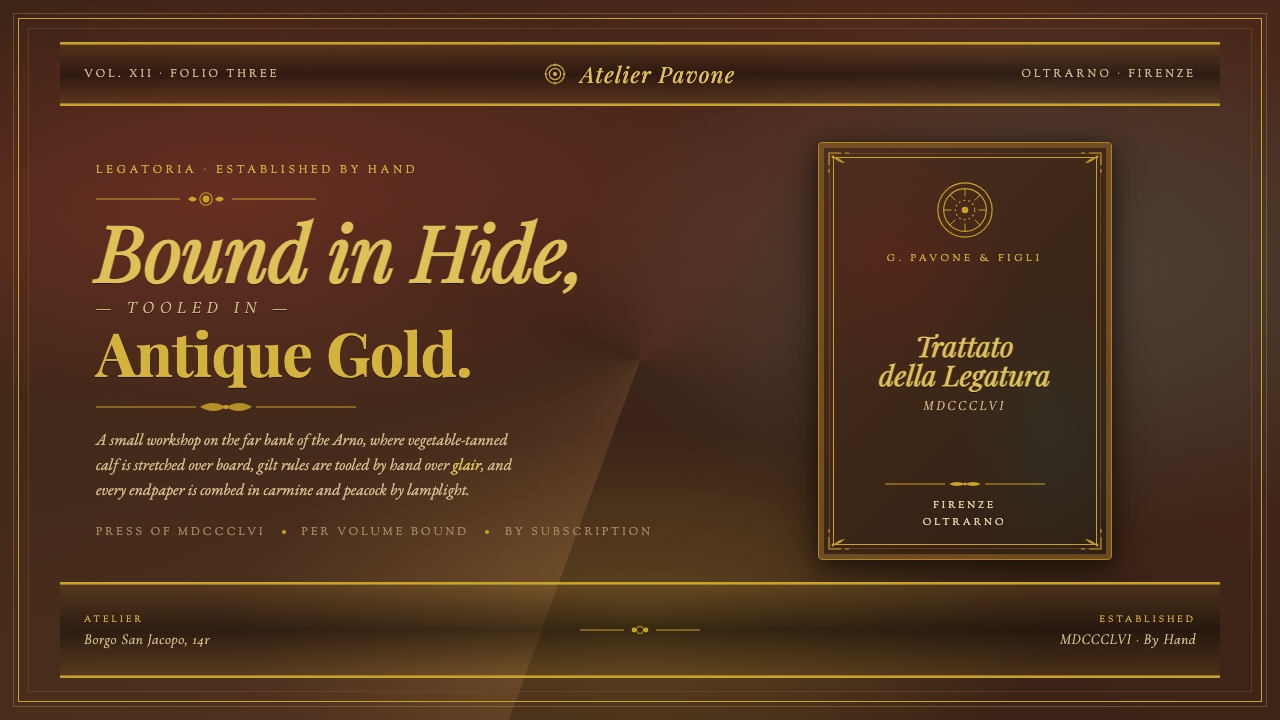 Florentine Leather BinderyRenaissance craft as luxury. Tanned hide, antique gold tooling, carmine-and-p…
 Guérande Fleur de SelCrystal white is the exception. Mineral serif and hairline grids rise from we…
 Wool FeltingHandmade stillness. Oatmeal-gray felt, humanist serifs, and soft rolled panel…