What is Tuareg Silver Jewelry (Sahara)?

Twelve centuries of hand-engraved coin-silver from the Sahara's inadan smiths — matte geometry, warm leather, and a desert discipline that refuses every temptation of flash or ornament.
Tuareg Silver Jewelry (Sahara) in brief
Tuareg silver jewelry is the visual and material expression of one of the Sahara's most enduring craft traditions — a system of signs, symbols, and hand-wrought forms produced by the inadan, a hereditary smith caste who serve the matrilineal-nomadic Kel Tamasheq Tuareg people. The tradition is not decorative in the casual sense. Every object carries encoded social information: a single cross pendant, the Croix d'Agadez, exists in twenty-one distinct regional variants, each identifying the wearer's place of origin and social standing as legibly as a written address.
The aesthetic is built from an extreme economy of means. The palette is near-monochromatic: the cool grey-white of hand-hammered matte silver against the warm cream of Saharan sand, with leather-tanned brown as the only consistent accent. There are no saturated colors, no polished mirror surfaces, no applied pigments. Surface richness comes entirely from the tooled geometric line — dense hatching, crosshatching, concentric lozenges, and repeating chevron fields engraved directly into the metal with a steel burin. The effect reads as both ancient and strikingly graphic.
In design terms, Tuareg silver occupies a rare position: it is simultaneously a badge system, a portable archive of cultural identity, and an aesthetic object whose visual vocabulary — matte ground, incised line geometry, warm neutral accent — translates with remarkable fidelity into contemporary digital and print design contexts. The style rewards exactness. Its authority comes not from complexity but from the precision and confidence with which every element is placed.

Where does Tuareg Silver Jewelry (Sahara) come from?
The inadan smith caste has been active across the central Sahara since at least the eighth century CE, when trans-Saharan trade routes linking sub-Saharan West Africa to the Mediterranean were at their most commercially intensive. The crossing of the Sahara — by camel caravan through Agadez, Timbuktu, Gao, and Tamanrasset — created sustained demand for portable, durable wealth objects that could serve simultaneously as currency, identity marker, and protective amulet. Silver, imported as coins and later as European trade silver, became the medium of choice: it was light enough to carry in quantity, malleable enough to tool by hand, and culturally legible across the many peoples who met along the caravan routes.
The Tuareg world is matrilineal and traditionally organized around a strict caste hierarchy. Within that hierarchy, the inadan occupy a paradoxical position: they are socially subordinate to the noble warrior class yet indispensable to it, because only the inadan possess the technical knowledge — the specific engraving techniques, the regional cross-form vocabularies, the methods for constructing Tcherot amulet-boxes from silver sheet — that the noble class requires for its ritual and ceremonial life. This dependency created a form of protected specialization that allowed the tradition to develop in remarkable technical depth over centuries. The peak period of ceremonial production ran roughly from 1500 to 1900, coinciding with the height of trans-Saharan commerce and the political stability of the Songhai Empire and its successor states.
The Croix d'Agadez — the form most recognizable to outside audiences — is not one object but a family of twenty-one regional crosses, each named for the Tuareg territory or settlement it represents: the cross of Agadez, of In-Gall, of Tahoua, of Iferouane, and so on across the central Sahara. The crosses are worn on the body and given by fathers to sons with the instruction: 'I give you the four corners of the world, because one does not know where one will die.' The sentiment is nomadic and cosmological; the object is a navigational and social instrument. A Tuareg man wearing a cross from Agadez is announcing his origin to every person he encounters across thousands of kilometers of desert.
The colonial period (primarily French in the central Sahara, from the late nineteenth century through 1960) disrupted but did not destroy the tradition. French administrators documented and collected Tuareg jewelry, and the cross forms entered European ethnographic collections and eventually tourist markets. This commercialization created a long-standing tension between the tradition's function as an internal social coding system and its reception as an exotic decorative style. Contemporary inadan smiths — including figures such as Hamadi Boulanaa and Saïdi Oumarou, working in Agadez and Niamey — continue to produce traditional forms while also navigating international craft markets, with scholars such as Helene Hagan and Lloyd Cabot Briggs having documented the tradition's depth and regional variation in academic detail.
What defines the Tuareg Silver Jewelry (Sahara) look?
Palette
The palette is built on three relationships rather than a spectrum of hues: the cool near-white of matte hammered silver, the warm sand-cream of the ground or background, and the deep warm brown of tanned leather binding. These three tones span a narrow value range and are near-achromatic — there is no saturated color anywhere in the authentic tradition. The effect reads as desert-toned restraint: the silver's grey is never cold chrome, the sand is never yellow, the leather is never orange. Each tone stays close to its natural material source.
Surface and Texture
The silver surface is always matte — achieved through hammer-work that leaves a fine, even texture across the metal face — never polished to a reflective shine. This matte quality is a defining distinction of the tradition: inadan work has none of the high-gloss finish associated with Western fine jewelry. Against this matte ground, the engraved lines read with maximum contrast, their incised valleys catching shadow while the slightly raised field catches diffuse light. The interplay of matte surface and incised line is the primary visual effect of the style.
Geometric Line Grammar
The engraved decoration is built from a strict repertoire of geometric motifs: parallel hatch lines, diagonal crosshatch grids, concentric lozenges (diamond forms nested within one another), chevron bands, and dot-punched fields. These motifs are never free-hand or organic — every line is governed by the geometry of the burin and the regularity of the craftsman's hand. The density of line work varies by region, with some traditions filling every available surface and others leaving broad areas of plain matte silver as negative space. The linearity of the work is its most directly graphic quality.
Bilateral Symmetry
Unlike Bauhaus composition, which uses asymmetric tension as a deliberate organizing principle, Tuareg silver work is rigorously bilaterally symmetrical. The Croix d'Agadez and the Tcherot amulet-box are both constructed on vertical axes of symmetry, with each half mirroring the other in both form and engraved pattern. This symmetry is not a limitation but a structural conviction: the cross form maps cosmological directions, and its legibility as a directional object requires that it be balanced. Symmetry here carries the same logic as it does in heraldry — it signals authority, completeness, and order.
Leather Integration
Leather — typically natural tanned hide in a range from light tan to deep saddle brown — appears in Tuareg jewelry not as a substitute for metal but as a structural and aesthetic partner. On pendant crosses, a leather cord replaces the metal chain, bringing warmth and softness against the cool matte silver. On Tcherot amulet-boxes, leather panels are often inlaid or bound alongside the silver, and the two materials alternate in a rhythm that is simultaneously practical (leather is flexible and light) and aesthetic (the warm-cool contrast is deliberate). The leather is never dyed a strong color; it is always in its natural tanned range.
Form as Sign
In Tuareg jewelry, form is never arbitrary or purely decorative — every shape is a sign within a specific cultural code. The cross form encodes origin; the amulet-box shape contains scripture or protective text; the anklet's weight and form signals marital status. This semiotic density is invisible to outside observers but transforms the visual vocabulary when understood: the bold, confident geometry of the cross is not chosen for graphic appeal alone but because it needs to be recognizable at a distance, unambiguous in identity, and stable across generations of hand production. The result is a style that looks authoritative because it is — every form is load-bearing.
Scale Contrast
Within a single piece of Tuareg jewelry, scale contrast is carefully calibrated. The bold primary form — the arm of a cross, the face of an amulet-box — is large and unbroken, providing visual anchor. Against this large plain or lightly worked field, small-scale engraved detail creates a secondary register of richness without competing with the primary shape. This two-register structure — large bold form plus fine detailed field — is one of the most transferable aspects of the style: it maps directly onto the relationship between headline type and body text, or between a hero image and supporting metadata in a digital layout.

Who shaped Tuareg Silver Jewelry (Sahara)?
A master inadan silversmith based in Agadez, Niger, Boulanaa represents the continuity of the living craft tradition into the contemporary era. He has worked to document regional cross-form variants and to distinguish authentic inadan production from the tourist-market imitations that proliferate in the same commercial spaces. His practice bridges the ceremonial function of the original work and the international craft-exhibition circuit, bringing traditional Croix d'Agadez forms to audiences in Europe and North America without decontextualizing their social meaning.
Working across both Agadez and Niamey, Oumarou is known for technically rigorous engraving work that maintains the density and precision of historical inadan production. His commissions include both ceremonial pieces for Tuareg families and exhibition objects for international museum collections. He has collaborated with documentary photographers and ethnographic researchers, contributing to the growing body of visual and scholarly documentation of the inadan tradition in its contemporary form.
A scholar and author who dedicated sustained academic attention to Tuareg silver and the inadan caste, Hagan produced some of the most detailed published documentation of the tradition's symbolic vocabulary, regional variation, and social function. Her work brought the interpretive depth of the cross-form system — its twenty-one regional variants, its cosmological significance, its role in marking Tuareg identity across the diaspora — to English-language scholarly and design audiences, and remains a primary reference for anyone working seriously with the aesthetic.
An American physical anthropologist and ethnographer, Briggs conducted extensive fieldwork across the central Sahara in the mid-twentieth century and produced systematic documentation of Tuareg material culture, including jewelry forms, geographic distribution, and the social organization of the inadan caste. His surveys recorded cross-form variants at a regional precision that subsequent scholars have built on, and his published plates of Tuareg jewelry remain among the most comprehensive visual archives of the tradition in its mid-century state.
How do you use Tuareg Silver Jewelry (Sahara) today?
Tuareg silver translates into contemporary design not by copying its objects but by internalizing its logic: a palette held to near-monochrome warm and cool neutrals, surface richness achieved through linear detail rather than color variety, bold primary geometry anchoring each composition, and bilateral symmetry communicating authority. These principles work across a wide range of applications — but they require the same discipline the inadan bring to the metal: nothing arbitrary, every element placed with intention.
For presentation slides, the style excels at both cover and content treatments. A cover built in this language leads with a single large geometric form — a lozenge, a cross-derived shape, or a symmetrical frame — rendered in a warm near-white or sand tone against a deeper neutral ground. The title sits within or alongside this form in clean, medium-weight type, with no decorative flourishes. Content slides use a grid of fine horizontal rules — analogous to the parallel engraved lines of the silverwork — to organize text into clear bands. Data slides adopt the same linear discipline: charts use thin-line outlines rather than filled bars, values are labeled directly, and the matte neutral palette prevents any single data series from dominating visually.
For web interfaces — dashboards, pricing pages, product landing pages — the Tuareg silver vocabulary supports hierarchical layouts with strong visual identity. The approach keeps backgrounds in the sand-to-warm-white range, uses deep charcoal rather than true black for body text, and reserves the cool silver-grey for structural dividers, card borders, and secondary labels. Interactive elements — buttons, active states, selected tiers — take on the leather-brown accent as the single warm color in the system. Hard-edged, thinly bordered card components replace soft-shadow equivalents; the border itself, fine and precise like an engraved line, carries more visual weight than a shadow would. Navigation is typographic and minimal, with no icon embellishment beyond simple geometric indicators.
For editorial and marketing work, the style lends itself to bold, identity-forward layouts. A feature spread in this vocabulary might use a large central geometric frame — symmetrical, with fine ruled detail at its interior edges — to contain a photograph or headline, with body text set in a narrow measure on either side. The overall impression is of something ceremonial and considered rather than casual or trend-driven. Marketing pages work well with alternating registers: a sand-ground section followed by a deep charcoal section, with the leather-tone accent applied consistently to calls to action. The key discipline is restraint with accent: the warm brown should appear sparingly, as the inadan use leather — as a structural and visual counterpoint, not a decoration.
A common mistake when working with this aesthetic is over-saturating the palette or introducing a bright color as an accent on the grounds that the matte scheme needs energy. It does not. The tension in authentic Tuareg silver comes entirely from the contrast between the engraved line and the matte field, between cool silver and warm leather, between the geometric precision of the form and the handmade imprecision of the surface texture. Introducing a saturated color destroys this by replacing tonal tension with color contrast — a categorically different and weaker effect. Similarly, using a reflective or glossy finish anywhere in the design breaks the material logic entirely. If the system feels too quiet, the answer is to increase the density of the linear detail, not to introduce color.

Tuareg Silver Jewelry (Sahara) — FAQ
Is this style too culturally specific to use in general design work?
The concern is legitimate but navigable. The visual principles of Tuareg silver — matte neutral palette, incised linear geometry, bilateral symmetry, warm-cool tonal contrast, leather-tone accent — are sufficiently abstracted from their cultural origin to function as a design language without requiring the designer or audience to know the source tradition. What matters is that the application does not misrepresent the source: using the aesthetic vocabulary while acknowledging its origin is different from directly lifting sacred object forms and selling them as logos. Design languages travel; the obligation is not to avoid use but to avoid trivialization.
How does this style differ from other geometric craft traditions, such as Berber weaving or Islamic geometric pattern?
All three traditions share Amazigh and broader North African roots and use geometric form as their primary visual vocabulary, but they differ in palette, material logic, and compositional approach. Berber weaving (as in Beni Ourain or Azilal carpets) uses high-contrast black-on-white or polychrome fields and an irregular, hand-woven geometry that embraces asymmetry and improvisation. Islamic geometric pattern (as in zellige tilework or arabesque) works with complex interlocking tessellations, often polychromatic, built on mathematical precision and infinite repeat. Tuareg silver is distinct in its near-monochrome palette, its use of bilateral symmetry over infinite repeat, and its integration of a warm material accent (leather) against the cool metal ground. It is the most austere of the three in color and the most heraldic in structure.
Can the style work in a dark or deep-background layout?
Yes, and the inversion is natural rather than forced. The authentic tradition already includes dark-ground contexts: the shadow-filled valleys of deep engraving against a lighter surface create micro-scale dark grounds within each piece. At the macro layout scale, a deep charcoal or near-black ground with warm sand-toned type and cool silver-grey geometric line work is a coherent extension of the style's logic. The leather-brown accent becomes more prominent and warm against a dark ground, which is appropriate. What to avoid is introducing warm gold or bright amber as a substitute for the leather tone — these read as a different tradition entirely and undermine the desert-matte quality that defines the style.
How should photography be handled within this design language?
Photography in a Tuareg silver-derived layout should be treated as a tonal field rather than a naturalistic window. The most coherent approach is to desaturate photographs toward a warm or cool monochrome — leaning toward the sand or silver tones of the palette — and to crop them into geometric shapes consistent with the overall form vocabulary: rectangle, lozenge, or framed square. High-contrast treatments that emphasize texture over color work particularly well, because they echo the engraved-line quality of the silverwork itself. Avoid full-color, high-saturation photographs placed freely on the page — the color variety will immediately compete with and undermine the palette discipline that gives the style its authority.
What kinds of products and brands are the best fit for this aesthetic?
The Tuareg silver aesthetic is best suited to products and brands whose values align with craft heritage, considered restraint, and material authenticity. Strong fits include: independent jewelry and craft brands, luxury goods that emphasize handmade process over mass production, heritage or archival fashion labels, travel and hospitality brands with a desert or North African focus, editorial and documentary publishing, and cultural institutions presenting material or craft history. The style is a difficult fit for consumer technology products that need to read as fast and innovation-forward, for children's products and wellness brands that depend on warmth and softness, and for any context where users expect bright color as a signal of energy or approachability. The test is simple: does the brand want to communicate depth, craft, and authority — or speed, warmth, and friendliness?
Related design styles
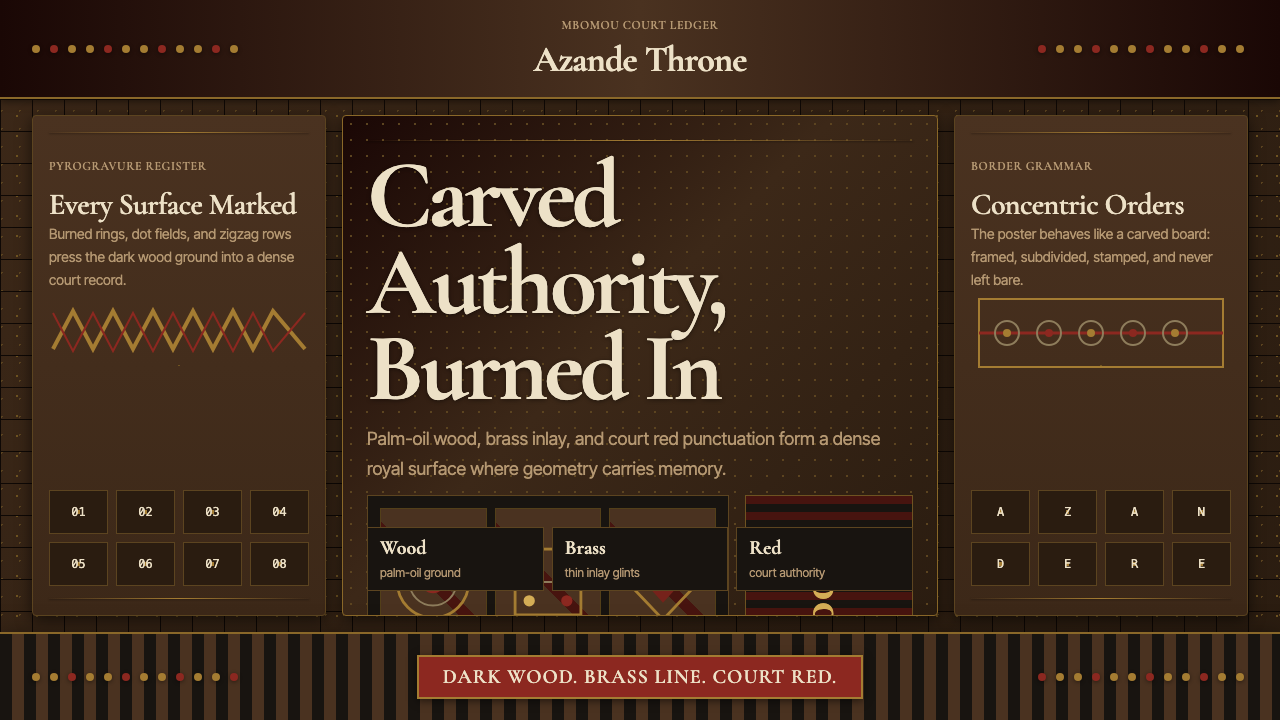 Central African Azande ThroneDense court gravity. Dark wood grids, brass dots, and court red cover every s…
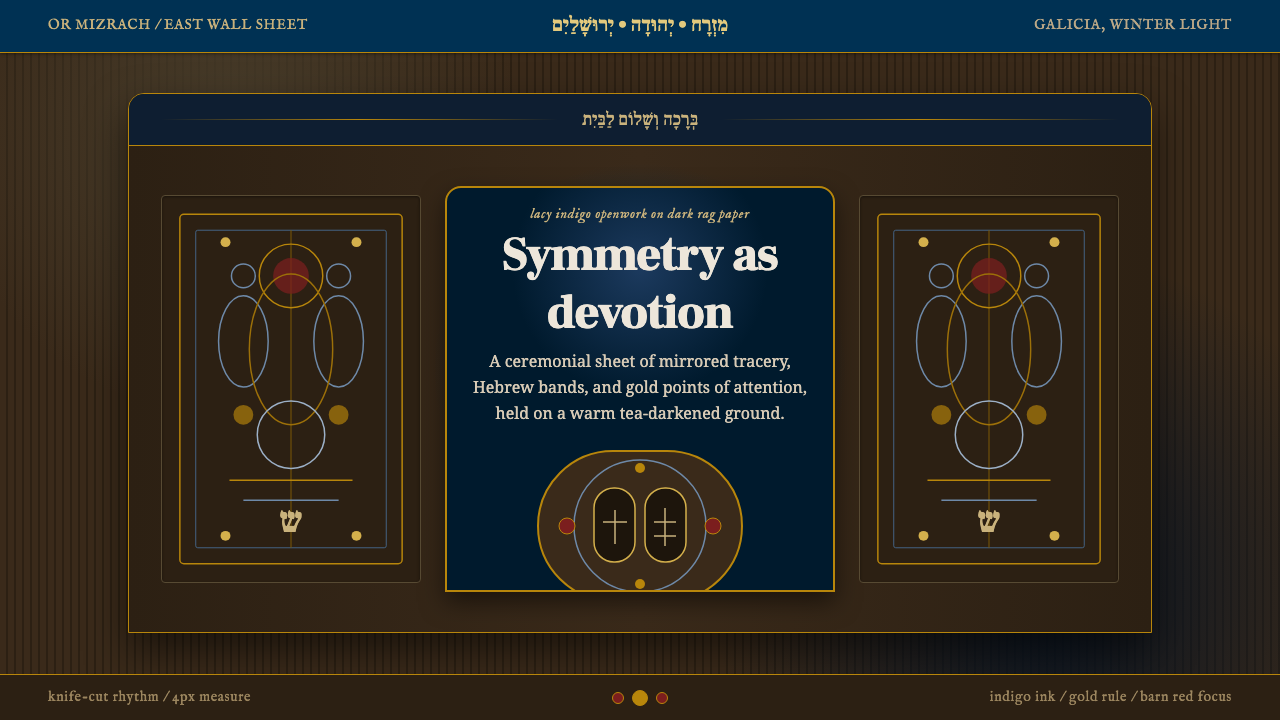 Jewish Papercut MizrahDevotion as openwork. Indigo filigree and Hebrew bands glow on dark rag paper.
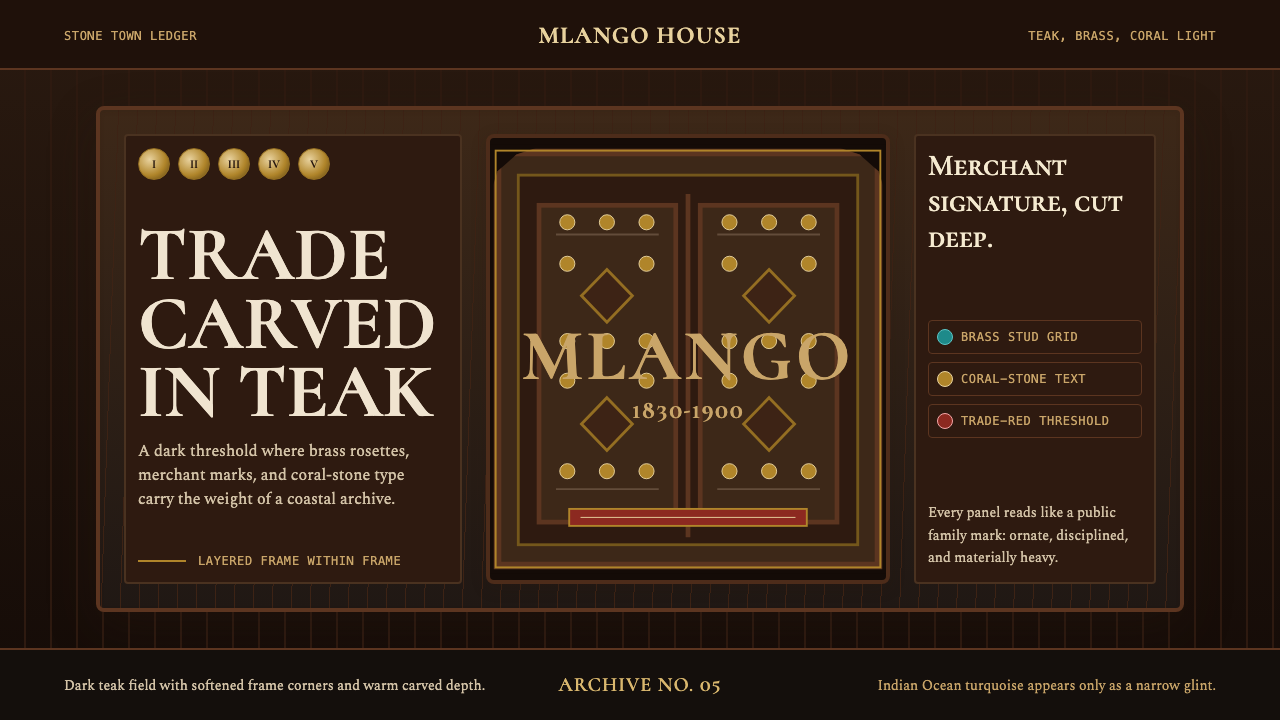 Swahili Stone Town DoorTeak darkness remembers. Brass studs and Cormorant small caps frame a carved…
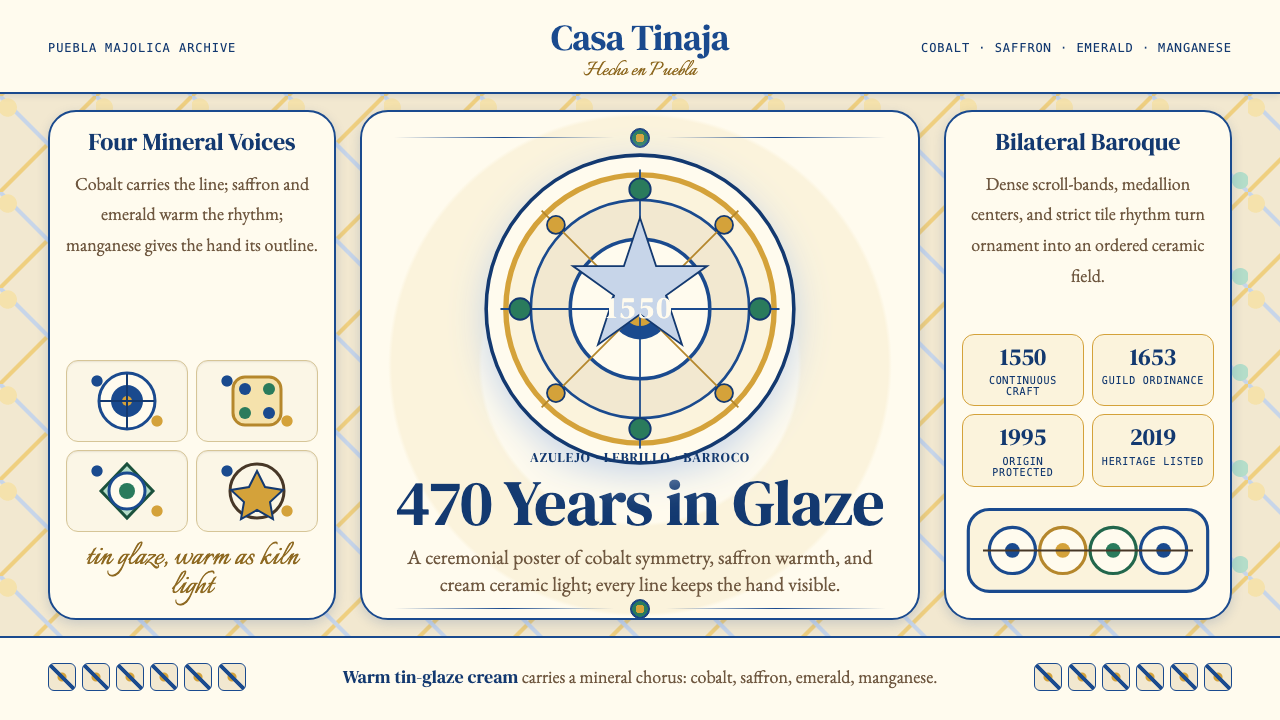 Talavera Poblana CeramicBaroque craft breathes. Cobalt scrollwork on warm tin-glaze cream frames stri…
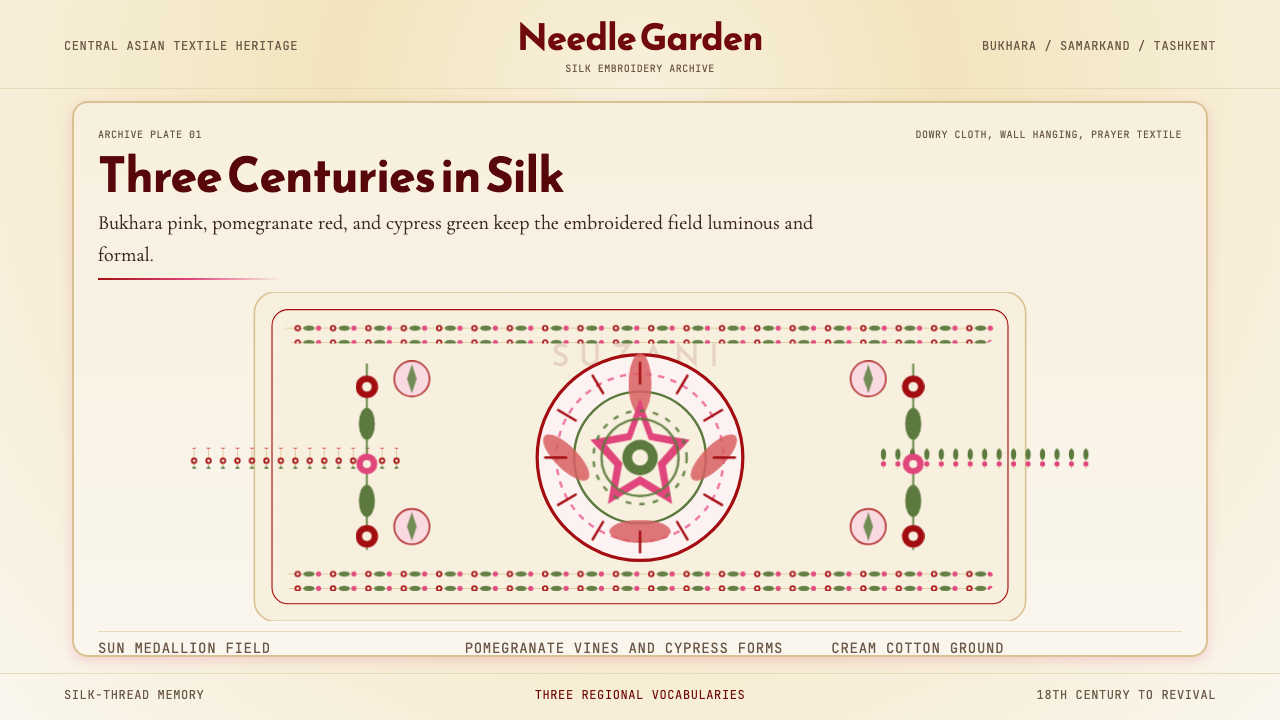 Uzbek Suzani TextileThree centuries in silk. Cream ground, pink medallions, vine borders, cypress…
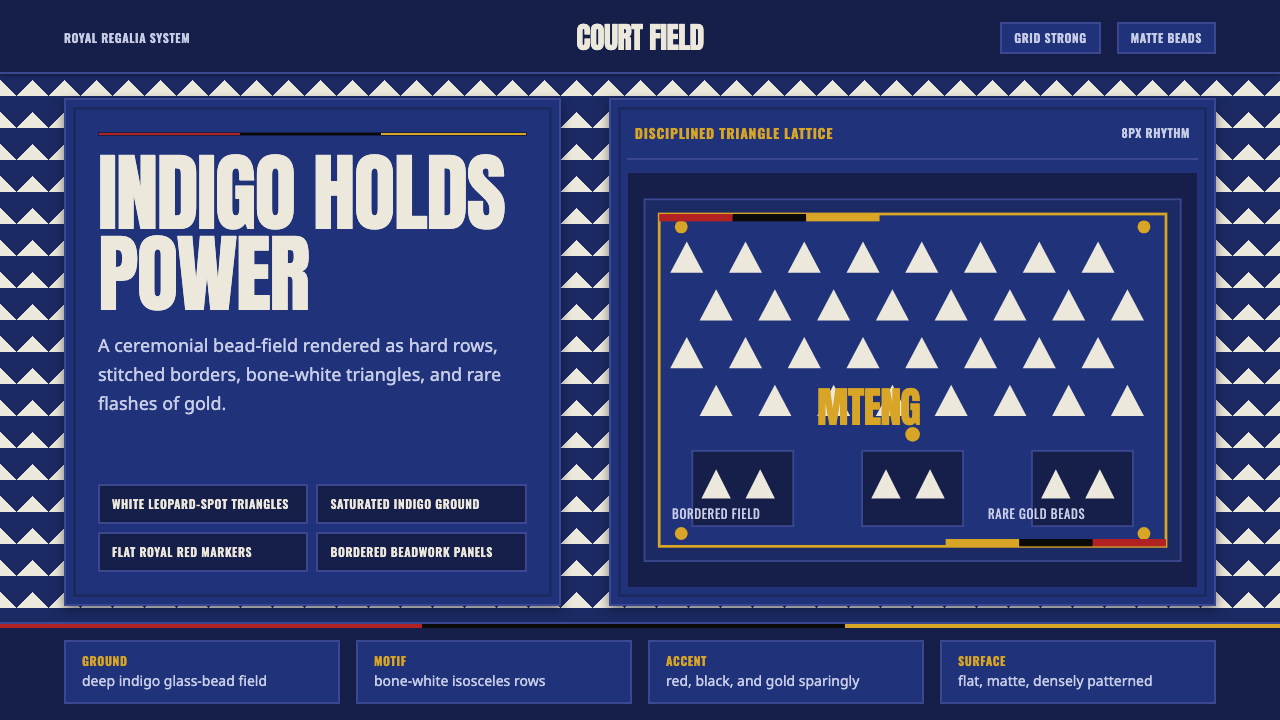 Bamileke Elephant MaskRoyal density. Indigo bead fields lock white triangle rows into ceremonial po…