What is Uzbek Suzani Textile?
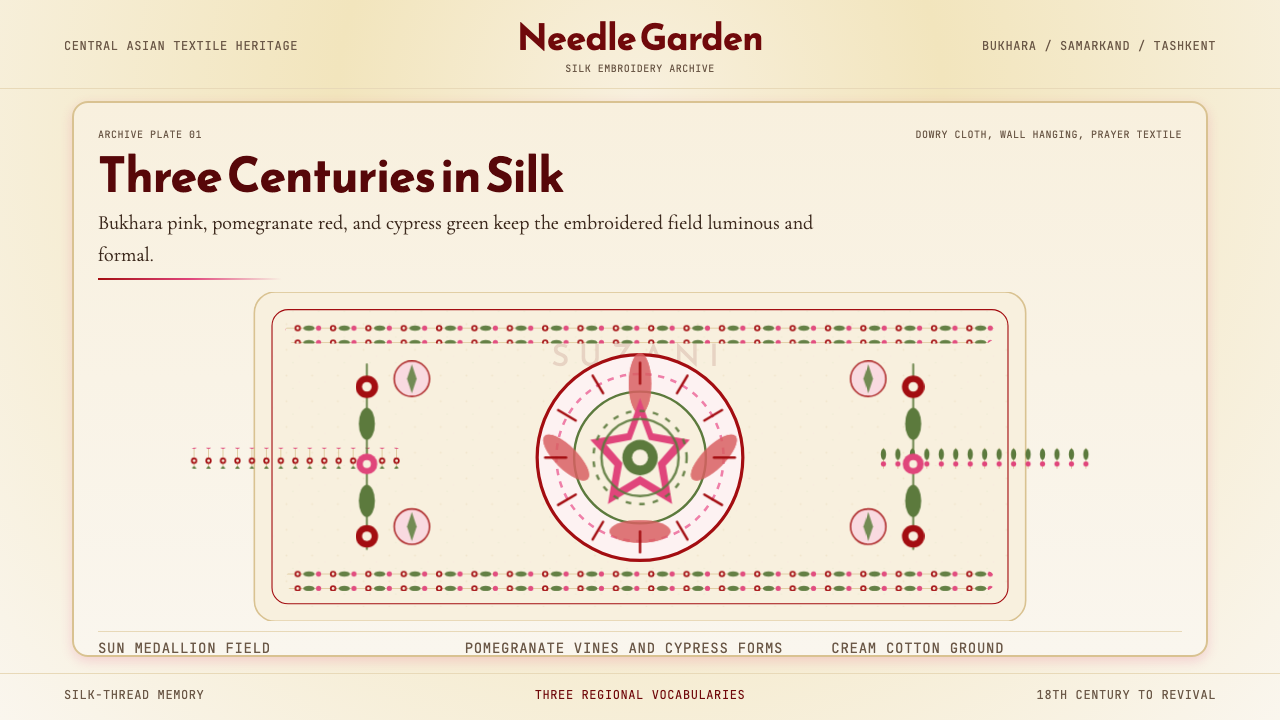
Stitched by brides across three centuries, Uzbek suzani embroidery encodes sun, pomegranate, and vine into a warm, layered visual language that feels simultaneously ancient and alive.
Uzbek Suzani Textile in brief
Suzani — from the Persian word for 'needle' — is the monumental embroidered textile tradition of Uzbekistan and the broader Central Asian region. Working on large cotton or linen grounds, women stitched silk threads into dense, curvilinear compositions of sun medallions, pomegranate clusters, cypress trees, and interweaving vine borders. The resulting cloths were not decorative objects in the domestic sense; they were repositories of family identity, ritual objects used at weddings, and physical embodiments of years of concentrated female creative labor.
As a design system, suzani translates this heritage into a warm, ornament-rich visual vocabulary. The palette draws from the specific regional dye traditions of Bukhara, Samarkand, Tashkent, and the Fergana Valley: a luminous sun-pink, a deep pomegranate red, a grounded cypress green, and the cream-colored cotton ground that gives the whole composition its warmth. Unlike strictly geometric traditions, suzani is fundamentally curvilinear — its motifs swell and spiral, tendrils branch and reconnect, medallions radiate outward in concentric rings of petal and flame.
The aesthetic operates through layered density rather than minimalist clarity. A suzani composition is never empty; the ground is always engaged, the border always active, the interior field always populated with overlapping ornament. Yet within this density, there is hierarchy: a central medallion commands the eye, secondary motifs fill the field, and a repeating vine or reciprocal pattern frames the whole. This structure — focal point, field fill, border frame — is the core organizing logic that translates into contemporary design applications.

Where does Uzbek Suzani Textile come from?
The suzani tradition took its mature form in the eighteenth century across the khanates of Bukhara, Samarkand, Kokand, and the Fergana Valley, though the embroidery practices it draws on are considerably older, reaching back into the textile cultures of the Silk Road. Central Asia had for centuries been a crossroads where Persian, Chinese, Indian, and nomadic Turkic visual traditions intersected and hybridized. Suzani embroidery absorbed all of these influences: the radiant medallion forms echo Persian carpet design; the pomegranate motif carries Indian and Persian symbolism of abundance and fertility; the cypress tree, a recurrent symbol of life and resilience, appears throughout Islamic decorative arts from Anatolia to the Mughal court.
Suzani was inseparable from the institution of marriage. In Uzbek tradition, a bride's trousseau was expected to include embroidered cloths — bed covers, wall hangings, prayer mats, and decorative panels — that she and her female relatives had stitched over years, sometimes beginning when she was a child. The cloths were displayed prominently at the wedding ceremony and then used throughout the couple's domestic life. This context is visible in the visual vocabulary itself: the sun medallion symbolizes light and prosperity, the pomegranate fertility, the cypress eternal life, and the bird joy. The embroideries were not illustrations of these meanings so much as concentrated acts of wishing, sewn into silk.
Regional styles diverged significantly. Bukharan suzani is characterized by its large, radiant sun medallions covering nearly the full ground, with bold pomegranate branches filling the spaces between — the palette tends toward the warmer end, with pinks and corals dominant. Samarkand suzani favors a more restrained field of repeating cypress-tree motifs arranged in rhythmic rows, with the ground playing a more prominent role. Tashkent embroidery is distinguished by its use of fine, tightly packed chain stitch (basma) and its preference for dense pomegranate vine compositions. Fergana Valley work is often the most delicate, with finer silk threads and more intricate petal articulation. Each regional vocabulary is a distinct dialect of the same visual language.
The nineteenth century brought peak production, coinciding with Russian imperial expansion into Central Asia and increased European interest in regional textiles. Collectors, ethnographers, and design reformers acquired suzanis and brought them into European collections, where they influenced the Arts and Crafts movement and later twentieth-century textile revival movements. The Soviet period suppressed private dowry practice but maintained state-sponsored craft production for export and tourism. After independence in 1991, a major artisan revival began, with cooperatives and individual craftswomen relearning historical techniques, establishing workshops in Bukhara and Samarkand, and bringing suzani embroidery into the international design market as both functional textile and fine art object. Figures such as Madina Kasimbaeva and institutions like the Uzbek Textile Heritage Foundation have been central to documenting historical pieces and training a new generation of embroiderers.
What defines the Uzbek Suzani Textile look?
Color
The suzani palette is warm and saturated, but never harsh. The dominant ground is cream or undyed cotton — a warm off-white that softens every color placed against it. Against this ground, three colors carry the primary ornamental weight: a luminous sun-pink (the rose-to-coral range of Bukharan embroidery), a deep pomegranate red that anchors the heaviest medallion forms, and a grounded cypress green used for leaf, stem, and vine. Secondary accents of saffron yellow and sky blue appear in petal detailing and border work. The palette reads as rich and generous rather than austere, with every color appearing to have been absorbed slightly by the warm cream beneath it.
Motifs and Iconography
The core motif vocabulary is botanical and celestial. The sun medallion — a large radiating disc of concentric petals — anchors the center or repeats across the field. The pomegranate appears both as a crowned fruit form and as a branching vine whose tendrils fill every interval between larger motifs. The cypress tree, rendered as a flame-shaped vertical form, creates rhythm in Samarkand compositions. Birds — stylized into near-abstract almond shapes — appear among branches as signs of joy. These motifs are never isolated specimens; they interlock, share stems, and overlap, creating a composition where negative space is nearly eliminated.
Composition Structure
Every suzani composition resolves into three zones: a central field, an interior fill, and a border frame. The central field is dominated by one or more large medallions that establish the hierarchical anchor. The fill — pomegranate vine, star rosette, or palmette lattice — populates the ground between medallions at a consistently smaller scale. The border completes the composition with a reciprocal or running pattern that is visually subordinate to the field but essential for containing and focusing it. This three-zone logic is the primary structural principle transferable to contemporary layout design.
Line Quality and Stitch Character
In authentic embroidery, the primary stitches — basma chain stitch, yurma couching, and ilma stem stitch — produce lines with a distinct physical character: slightly raised, with a gentle texture that catches light differently depending on direction. In a digital design system, this quality translates to an embrace of slightly organic line weights and forms that avoid the mechanical perfection of vector geometry. Outlines are present and deliberate — motifs are not floating shapes — but they carry a warmth and slight irregularity that distinguishes suzani from hard-edged geometric traditions.
Symmetry and Rhythm
Suzani compositions use bilateral symmetry for large structural elements — medallions are radially symmetric, the overall layout is vertically balanced — but introduce deliberate irregularity at the level of individual motifs. A pomegranate on the left may differ in its petal count or leaf arrangement from the one on the right; a vine tendril may branch in one fewer direction on one side. This combination of structural symmetry and ornamental variation creates compositions that feel both ordered and alive, never static. In digital applications, this principle argues against perfectly uniform repeating patterns in favor of systems where the macro-structure is regular but the individual elements carry some variation.
Ground and Density
Where Bauhaus treats negative space as an active structural element and Muji treats it as a breathing rest, suzani treats the ground as a resource to be generously filled. Emptiness in a suzani is not a design decision so much as a space awaiting its next motif. This high-density aesthetic carries over into digital applications: suzani-influenced interfaces are not minimal. They layer decorative elements — ornamental borders, textured backgrounds derived from embroidery repeat patterns, richly ornamented header zones — with the understanding that density, when ordered by a clear hierarchy, reads as richness rather than chaos.
Heritage Warmth
Beyond color and form, suzani carries an unmistakable tonal quality that can be called heritage warmth: the sense that these visual choices have accumulated over generations, that they carry embodied human labor and cultural memory rather than having been optimized by algorithm. In digital design, this quality is achieved not through any single design decision but through the accumulation of choices — cream rather than stark white, slightly swelling curves rather than perfect arcs, ornament that references specific historical motifs rather than generic pattern-fill. The result is a design system that communicates continuity, craft, and cultural depth.

Who shaped Uzbek Suzani Textile?
The overwhelming majority of suzani's visual history was made by women whose names were never recorded. In Bukhara — the city whose name became synonymous with the most celebrated regional style — workshops of female embroiderers worked within family and neighborhood networks, transmitting design knowledge orally and through shared practice across generations. The Bukharan sun-medallion composition, with its distinctive warm palette and radial petal arrangements, is one of the most recognizable decorative achievements in Central Asian textile history. That it was produced collectively, anonymously, and primarily as a form of domestic preparation for marriage makes it a rare case of major art history made entirely outside of institutional or commercial patronage.
A leading figure in Uzbekistan's post-independence embroidery revival, Kasimbaeva has worked to document historical suzani specimens, reconstruct lost regional patterns, and establish sustainable training workshops for contemporary embroiderers. Her work bridges ethnographic preservation and living craft practice, ensuring that the visual vocabulary of suzani remains a practiced skill rather than a museum artifact. Her public advocacy has raised awareness of suzani both within Uzbekistan and internationally, contributing to its recognition as an intangible cultural heritage and its growing presence in international design markets.
Operating across Bukhara, Samarkand, and Tashkent, the Uzbek Textile Heritage Foundation has been instrumental in the institutional documentation of regional suzani traditions. The Foundation's archival work — cataloguing historical specimens, mapping regional style variations, and recording oral histories from master embroiderers — has created the scholarly foundation on which contemporary revival efforts depend. Its educational programs connect young craftswomen with historical patterns and techniques, creating continuity between the nineteenth-century peak of production and twenty-first-century practice.
Not a single person but the defining historical force behind suzani's visual richness: the overland trade routes connecting China, Central Asia, Persia, and the Mediterranean that ran through Samarkand, Bukhara, and the Fergana Valley for more than a millennium. The Silk Road made Central Asia a site of sustained visual exchange, bringing Chinese silk-weaving techniques, Persian medallion design conventions, Indian botanical motifs, and Byzantine symmetrical composition into productive contact. Suzani embroidery is, in visual terms, the product of this long accumulation — a local synthesis of everything that passed through.
How do you use Uzbek Suzani Textile today?
Suzani is a richly ornamental design system — applying it well requires committing to its logic of layered decoration rather than treating its motifs as surface appliqué on an otherwise minimal layout. The style works when the ornamental vocabulary is integrated structurally: border frames that actually contain and define the composition, medallion anchors that establish genuine hierarchy, and fill patterns that relate systematically to the primary motifs rather than floating independently. Half-committed suzani — one small pomegranate icon in an otherwise stripped-down interface — reads as cultural decoration rather than designed coherence.
For presentation slides, suzani is strongest in contexts where warmth, heritage, and craft are part of the message. A cover slide in this style builds around a central medallion form — perhaps derived from a Bukharan sun composition — with the title placed within or directly adjacent to the focal ornament. The color field should be the warm cream ground, with the primary motif colors reserved for the decorative frame and headline. Content slides work best when a consistent border treatment — a simplified vine or reciprocal pattern running along one or two edges — creates visual continuity across the deck without overwhelming the information. Data slides in this style call for a restrained approach: use the palette for chart fills and limit ornamental elements to headers or footers rather than competing with the data itself.
For web interfaces, suzani is particularly well-suited to heritage brand pages, cultural institution sites, craft marketplace platforms, and editorial contexts where richness of visual context communicates authenticity. Dashboard and productivity interfaces are more challenging territory: the high-density ornamental approach can compete with data readability if applied to functional components. The recommended approach is zonal: apply the full suzani vocabulary — textured backgrounds, ornamental headers, medallion accent elements — to structural framing zones such as navigation headers, footers, and section dividers, while keeping the content body clean and legible. Pricing pages benefit from the style's natural ability to communicate value and richness, with tier differentiation expressed through palette variation across the regional color range.
For editorial and marketing work, suzani supports a storytelling register that few other design traditions can match. A feature article layout might use a full-spread medallion composition as the opening image, with body text set on the cream ground and ornamental drop capitals derived from vine motifs at chapter heads. Marketing pages for luxury goods, food and hospitality brands, or travel content find in suzani a visual language that communicates abundance, craftsmanship, and geographic specificity without resorting to photography alone. Campaign materials can use the palette's warmth and the motifs' symbolic richness — pomegranate for abundance, cypress for longevity, sun medallion for celebration — as a consistent visual argument across formats.
A common mistake when applying suzani is importing the motifs without the underlying compositional logic, resulting in isolated ornamental elements scattered across a layout that lacks the three-zone structure of central field, fill, and border. Another frequent error is palette desaturation: diluting the pomegranate red to a dusty rose or the cypress green to a sage gray in an attempt to make the style feel more contemporary. This removes the warmth that makes suzani legible as a heritage tradition and produces instead a generic earthy palette without cultural specificity. A third error is mixing suzani's curvilinear ornamental vocabulary with hard geometric traditions — pairing it with strict Bauhaus geometry or Swiss grid typography produces a clash of underlying assumptions about what ornament means.

Uzbek Suzani Textile — FAQ
Is suzani the same as other Central Asian embroidery traditions?
No — suzani is a specific tradition defined by its large format, silk-on-cotton construction, particular motif vocabulary (sun medallions, pomegranates, cypress, vine), and its connection to the Uzbek dowry practice. It is distinct from the embroidery traditions of neighboring regions: Tajik embroidery tends toward a finer, denser stitch pattern on silk grounds; Kazakh and Kyrgyz textile traditions are more closely associated with felt-making and woven flat-woven kilims; Afghan embroidery uses different stitch vocabularies and a darker palette. Within Uzbekistan itself, suzani should not be confused with ikat silk fabric (adras or shoyi), which is a resist-dyed woven textile rather than an embroidered one. Suzani is defined by the needle, not the loom.
How should suzani handle light versus dark backgrounds?
The canonical suzani background is the warm cream of undyed cotton — this is not an arbitrary color choice but the ground that all of the traditional dye colors were calibrated against. A dark background inversion is possible, and historical examples do exist using deep indigo grounds, but it fundamentally changes the character of the palette: on a dark ground, the pomegranate red and cypress green lose the warmth that the cream backing gave them and read as cooler and more jewel-like. If a dark variant is required, the most historically grounded approach uses a deep indigo or aubergine ground rather than neutral black, preserves the full saturation of the decorative colors rather than muting them, and compensates for the lost warmth by increasing the proportion of the saffron yellow accent.
Can suzani work in minimal, text-heavy interfaces?
With modification, yes — but it requires a deliberate reduction strategy rather than simply removing ornament until the interface feels clean. The effective approach is to concentrate the suzani vocabulary into structural boundary zones — a richly ornamented masthead, an ornamental footer, section-break dividers derived from vine or reciprocal patterns — while keeping the content field itself on the plain cream ground with minimal decoration. This creates a frame-and-field relationship where the suzani ornament defines the outer architecture of the page and the inner content area is allowed to breathe. The color palette and the warm ground can be maintained throughout even when motifs are minimal, ensuring the heritage character persists without density overwhelming the text.
What distinguishes Bukharan, Samarkand, and Tashkent suzani in practice?
The three regional styles represent distinct visual dialects within the broader suzani tradition. Bukharan suzani is the most immediately recognizable: large, radiant sun medallions — sometimes a single massive one per cloth, sometimes three or five arranged in a vertical axis — with bold pomegranate branches filling every interval. The palette is the warmest of the three, with pinks, corals, and reds dominant. Samarkand suzani tends toward an all-over repeat of smaller, more restrained motifs — repeated cypress trees or small star-flower rosettes arranged in a rhythmic grid — with the cream ground playing a more prominent, breathing role. Tashkent suzani is characterized by dense chain-stitch coverage, often using a finer thread, and a preference for vine compositions where pomegranate branches interconnect across the full field in a flowing, continuous network. In design applications, the choice between these dialects determines whether the dominant quality is bold focal hierarchy (Bukhara), rhythmic all-over pattern (Samarkand), or continuous flowing ornament (Tashkent).
How does suzani relate to contemporary sustainability and craft conversations?
Suzani sits at a productive intersection of several contemporary concerns. As a tradition made from natural dyes, silk, and cotton over long time horizons by skilled artisans in cooperative networks, it represents a pre-industrial model of production that aligns with slow-fashion and craft-revival values. The post-Soviet revival of suzani cooperatives in Bukhara and Samarkand — many of which provide fair-wage employment specifically for women — has made suzani embroidery a case study in how heritage craft can support sustainable livelihoods in a globalized economy. For design systems, invoking suzani's visual language carries an implicit cultural argument: that heritage, handcraft, and the accumulated knowledge of generations of women workers are legitimate sources of design authority. This is a different argument from historical styles that derive from institutional or commercial patronage, and it carries different ethical responsibilities — including the responsibility to credit the tradition accurately and avoid reducing it to surface pattern.
Related design styles
 Jewish Papercut MizrahDevotion as openwork. Indigo filigree and Hebrew bands glow on dark rag paper.
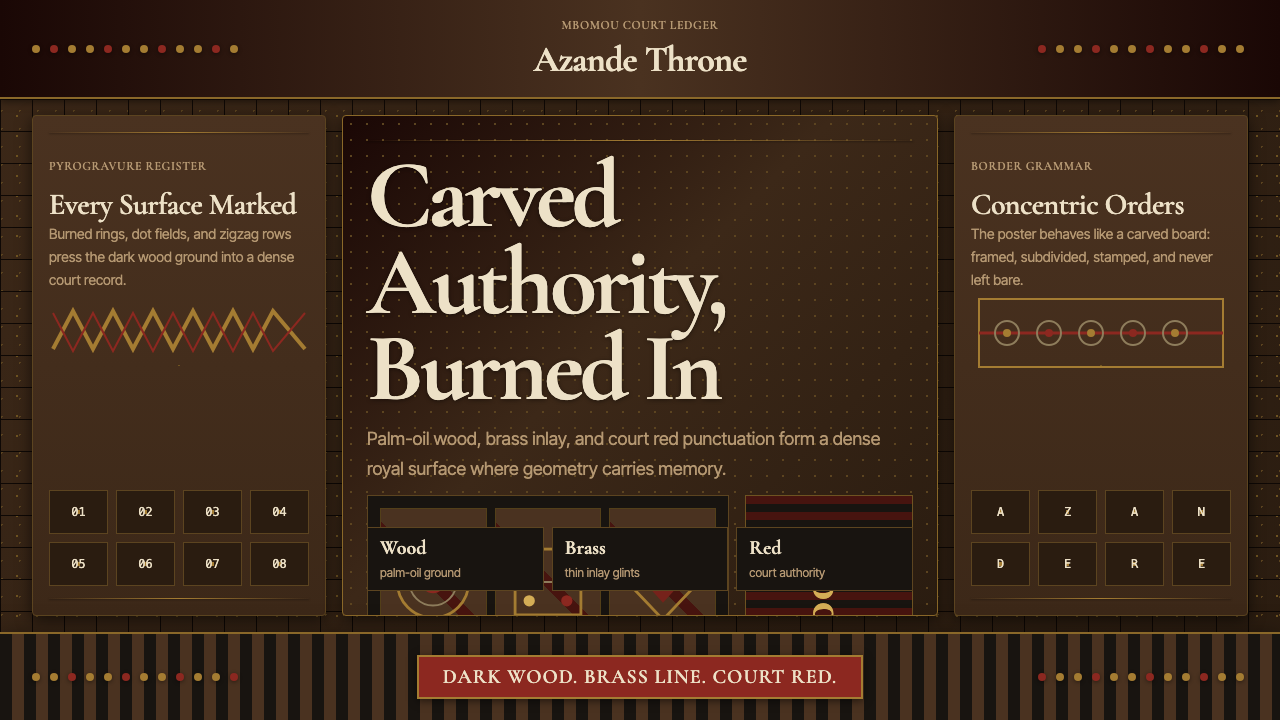 Central African Azande ThroneDense court gravity. Dark wood grids, brass dots, and court red cover every s…
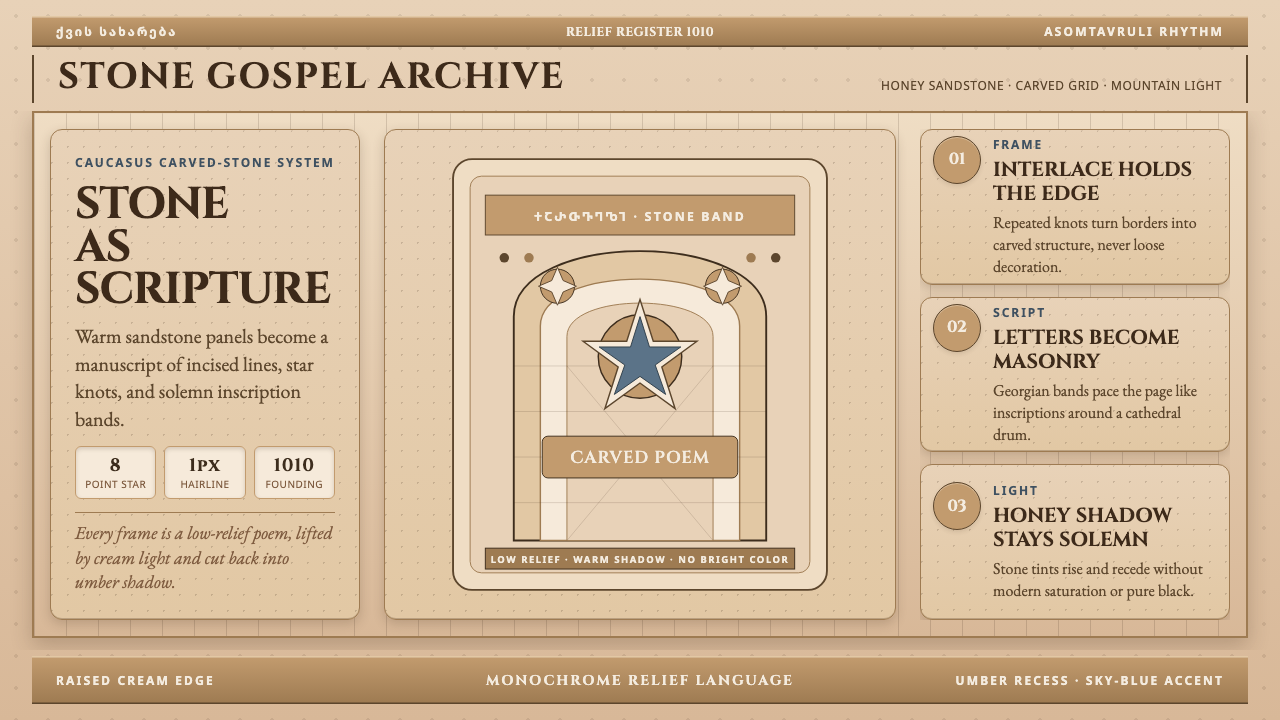 Georgian Nikortsminda Stone-CarvingStone becomes scripture. Cinzel caps and Georgian bands carve honey-sandstone…
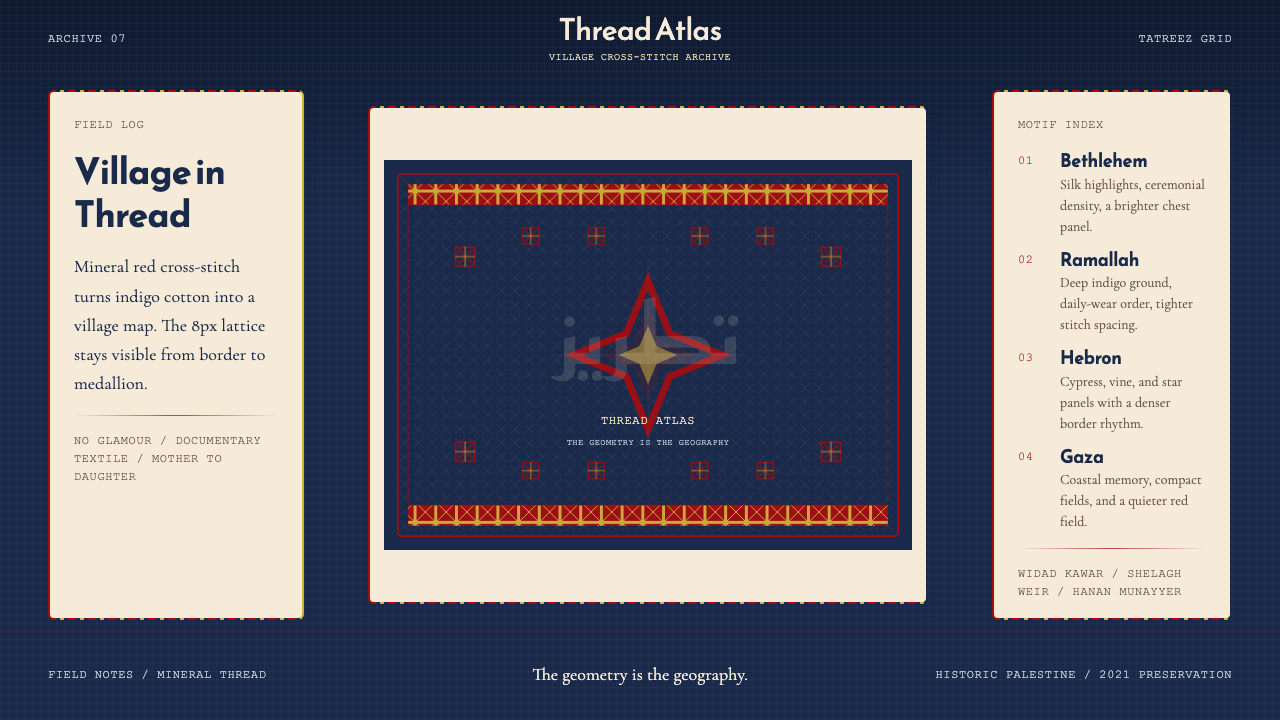 Palestinian Tatreez Cross-StitchMemory in thread. Red cross-stitch on indigo cotton, built on an 8px grid.
 Suriname Maroon TembeDense memory, carved in rhythm. Kaolin lines cross hardwood brown in bilatera…
 Swahili Stone Town DoorTeak darkness remembers. Brass studs and Cormorant small caps frame a carved…