What is Gabonese Fang Mask & Byeri?
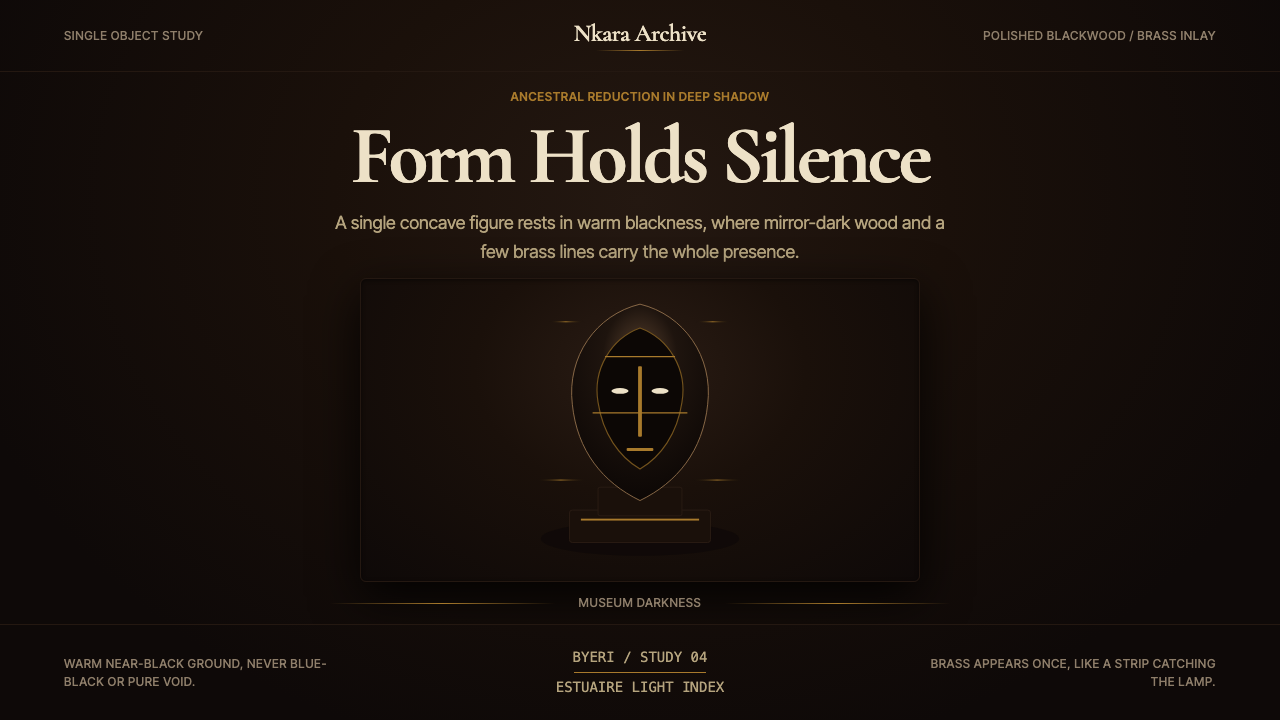
The Fang byeri tradition turns ancestral reverence into mirror-black sculpture — and its visual logic of isolated objects, deep shadow, and razor-thin brass accents translates into one of the most commanding dark aesthetics available to contemporary designers.
Gabonese Fang Mask & Byeri in brief
The Gabonese Fang Mask and Byeri design style draws its entire visual vocabulary from a single ritual object: the byeri reliquary figure of the Fang people of Gabon, Equatorial Guinea, and southern Cameroon. A byeri was a carved ancestor guardian — typically a head or half-figure in blackened hardwood — mounted atop a cylindrical bark box holding the family's ancestral bones. The object was not made to be displayed; it was made to concentrate sacred presence, and every formal decision in its making served that purpose.
What results from that purpose is an aesthetic of extraordinary reduction. The face is concave, heart-shaped, and oiled to a mirror-black finish that absorbs light rather than reflecting it. The eyes may be set with metal discs or glass. Brass strips are inlaid at hairlines and brow edges — not as decoration but as conductive markers, materials believed to carry spiritual charge. Negative space is not background; it is the field in which the object exerts its authority. The whole composition reads like a single object on a plinth in a darkened museum room, because that is almost exactly how it has reached the contemporary design imagination: through the vitrines and photographs of European ethnographic collections.
As a design system, Gabonese Fang Mask and Byeri translates this ritual economy into a visual language for dark-background digital and print work. The signature moves are deep near-black grounds, forms that emerge from shadow rather than sitting on top of it, hairline accents in warm metallic tones, and absolute restraint in the number of elements allowed on any surface. It is not minimalism in the contemporary Scandinavian sense — it is a different kind of severity, rooted in weight and reverence rather than efficiency.
Where does Gabonese Fang Mask & Byeri come from?
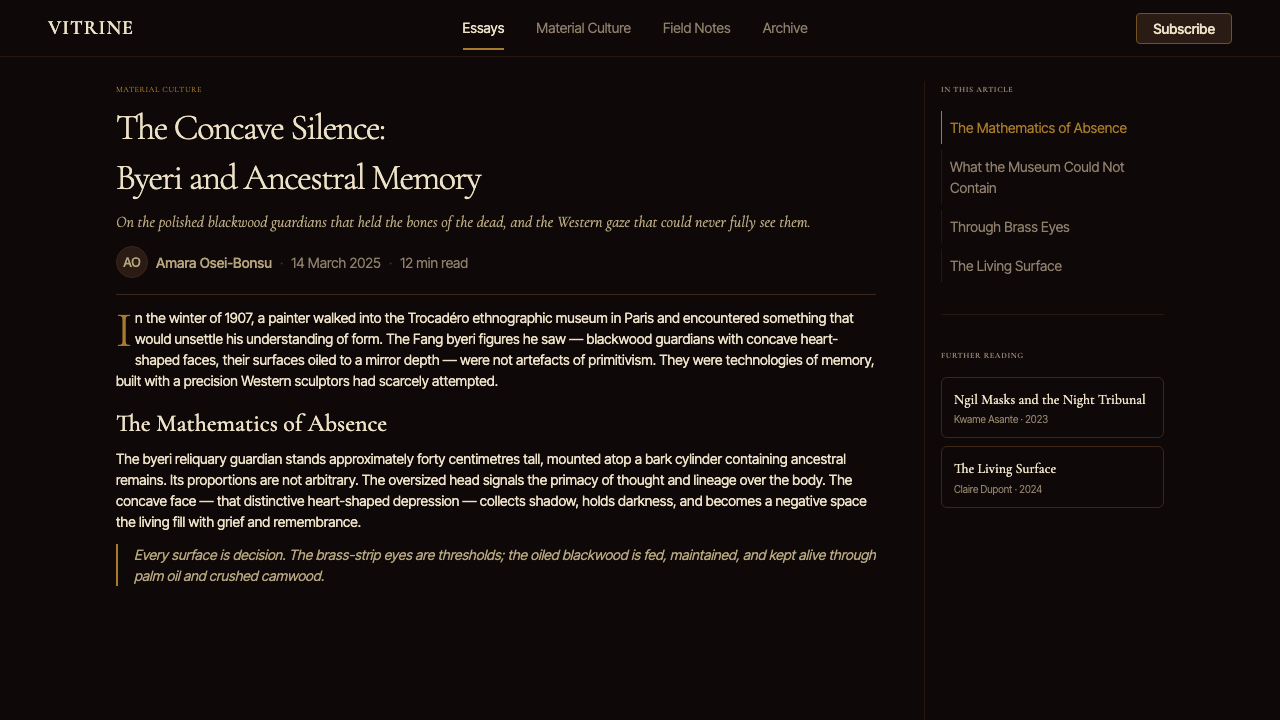
The Fang people are an Equatorial Atlantic Bantu group whose migrations from the interior toward the coast accelerated during the nineteenth century under pressure from slave raids and the disruption of regional trade networks. By the time European explorers and missionaries arrived in force in the 1880s and 1890s, Fang communities were distributed across a wide arc from what is now southern Cameroon through Equatorial Guinea and into Gabon's Estuaire and Woleu-Ntem provinces. The byeri cult — centered on the maintenance of reliquary boxes containing ancestral crania and bones, guarded by carved figures — was already ancient and highly developed. Scholars such as Louis Perrois and the anthropologist James Fernandez documented the cult extensively in the mid-twentieth century, establishing the scholarly framework through which the objects are now understood.
The classic byeri figure reached its most refined form between roughly the eighteenth century and the early twentieth century, the period before Christian missionary activity and colonial administrative pressure suppressed the reliquary cults. The formal qualities that define the style — the concave heart-shaped face, the high domed forehead, the mirror-black oiled surface, the contrast between the compressed facial features and the expansive brow — were not arbitrary. The concave face is understood as a receptive vessel, the surface that absorbs the gaze of the living and holds the attention of the ancestors. The large forehead housed spiritual intelligence. Oil blackening was a material act of consecration, not cosmetic finish.
European collection of Fang objects began in earnest during the colonial wave of 1880 to 1920. French colonial administrators, missionaries, traders, and eventually collectors swept through Gabon and brought objects back to Paris, where they entered both public ethnographic museums and private collections. The dealer Paul Guillaume was among the first to present Fang masks and figures in a fine-art rather than ethnographic frame, exhibiting them alongside Picasso, Matisse, and Braque and arguing that they possessed formal qualities equal to any European modernist work. The scholar and collector André Lefèvre assembled one of the most important early collections. This recontextualization — from ritual guardian to gallery object — was the act that gave the byeri tradition its second life in design culture. Once placed against a white gallery wall or a dark vitrine, the formal logic of the objects became legible as pure design: isolated form, deep shadow, concentrated presence.
The primitivist art appropriation that defined French art circles between roughly 1900 and 1930 was not an innocent encounter. European collectors and artists drew from African sculptural traditions freely while generally erasing the names, communities, and ritual contexts that gave those objects their meaning. The Fang byeri tradition entered design culture through that appropriation, which is why any serious engagement with the style requires acknowledging this history. The visual language is genuinely powerful and distinct; its adoption in contemporary design carries both the formal strength of the tradition and the ethical responsibility to represent it honestly rather than as mere exotic atmosphere.
What defines the Gabonese Fang Mask & Byeri look?
Ground and Shadow
The defining ground is a near-absolute black or very deep warm charcoal — not a neutral dark grey but a surface with depth and slight warmth, evoking oiled hardwood rather than digital void. Shadow is not cast shadow in the conventional sense; the ground itself is shadow, and forms emerge from it as if slowly surfacing. Elements that need to recede do so by darkening into the field rather than fading toward transparency.
Isolated Form
The byeri aesthetic is organized around the single object: one principal form per composition, given maximum breathing room by the surrounding field. Crowding is antithetical to the style. Each design element is treated as a sculptural presence requiring space to assert itself — a heading, an image, a data point. The more isolated an element, the more authority it commands.
Metallic Hairline Accents
The most distinctive detail of the byeri figure is the brass inlay at the hairline and brow — a thin, warm, luminous line against the blackened surface. In design application, this translates to hairline rules, thin borders, or single-pixel highlights in warm gold or antique brass tones. These accents are used sparingly: one or two per composition at most, placed where they catch the eye the way metal catches museum light.
Concave and Convex Contrast
The byeri face is famously concave — a heart-shaped bowl rather than a projecting relief. This inversion of expected sculptural depth creates a sense of gravity pulling inward, of attention being drawn toward a center rather than pushed outward. In design terms, this principle manifests as compositional decisions that lead the eye toward a focal point through surrounding negative space, rather than using projecting or 'raised' elements to demand attention.
Warm Dark Palette
Unlike cool-black minimalist systems, the byeri palette tends toward warmth even in its darkest registers. The black is oiled wood black, not cold pitch. Accents are brass, amber, or aged ivory rather than pure white or silver. Any light text appears in warm off-white or cream, never stark white. The warmth is what prevents the aesthetic from reading as merely stark or corporate — it carries the specific temperature of aged organic materials.
Museum Lighting Logic
The byeri figure in a vitrine is typically lit by a single focused overhead or angled source that catches the oiled surface and the metal inlays while leaving surrounding space in darkness. This dramatic single-source logic — one thing brightly present, everything else receding — is the spatial principle of the design system. In screen terms: one element is highlighted through contrast, texture, or a subtle warm glow while the rest of the composition holds back.
Absolute Restraint in Element Count
A byeri figure is a single object. The reliquary it guards is a single box. The ritual space around it is cleared. This principle of radical reduction in element count is perhaps the hardest to maintain when applying the style to complex design problems — the temptation to add another section, another card, another accent is constant. The style demands that decisions be made about what is truly essential and that everything else be removed entirely, not merely made smaller.

Who shaped Gabonese Fang Mask & Byeri?
The French ethnologist and art historian Louis Perrois spent decades studying Gabonese reliquary arts, producing the foundational scholarly works on Fang byeri figures and the broader tradition of Equatorial African ancestral sculpture. His catalogues and monographs gave Western design and art communities their primary analytical framework for understanding byeri objects as formally coherent systems rather than exotic artifacts. His documentation of the distinctions between regional substyles within Fang production is essential to understanding the diversity within what is often treated as a single aesthetic.
The anthropologist James Fernandez conducted fieldwork among the Fang in the 1960s and produced seminal studies of byeri ritual practice, including detailed accounts of how the figures were used in initiation ceremonies and ancestor consultation. His work grounded the byeri tradition in living practice rather than treating the objects as purely historical artifacts, and his writing on the relationship between the concave facial form and concepts of receptivity and spiritual attention has been influential in design discourse about the aesthetic's formal logic.
Paul Guillaume was a Parisian art dealer who became one of the most important early champions of African art in European cultural circles. Between roughly 1910 and 1930, he exhibited Fang masks and figures alongside leading European modernist painters, arguing that African sculpture possessed formal sophistication equal to contemporary avant-garde work. His framing — which was genuinely transformative for how these objects were received in design and art culture, however ethically complicated its colonial context — is the direct reason why byeri figures entered the visual vocabulary of Western modernity.
André Lefèvre was a French lawyer and early collector of Fang objects who assembled one of the most significant private holdings of byeri figures in the early twentieth century. His collection attracted scholarly attention and was subsequently studied by ethnologists and art historians who helped establish the formal criteria by which byeri figures are evaluated. Collections such as his were the material basis for the photographic and museum encounters through which the byeri aesthetic entered wider design consciousness.
How do you use Gabonese Fang Mask & Byeri today?
The Gabonese Fang Mask and Byeri style is best suited to design contexts where gravitas, singularity, and ceremonial presence are the intended qualities — luxury product launches, cultural institution identities, editorial features on heritage or craft, and any interface where the experience of encountering something rare and significant is the point. It is not a versatile all-purpose dark theme; it is a highly specific register, and its power depends on using it with restraint and intentionality.
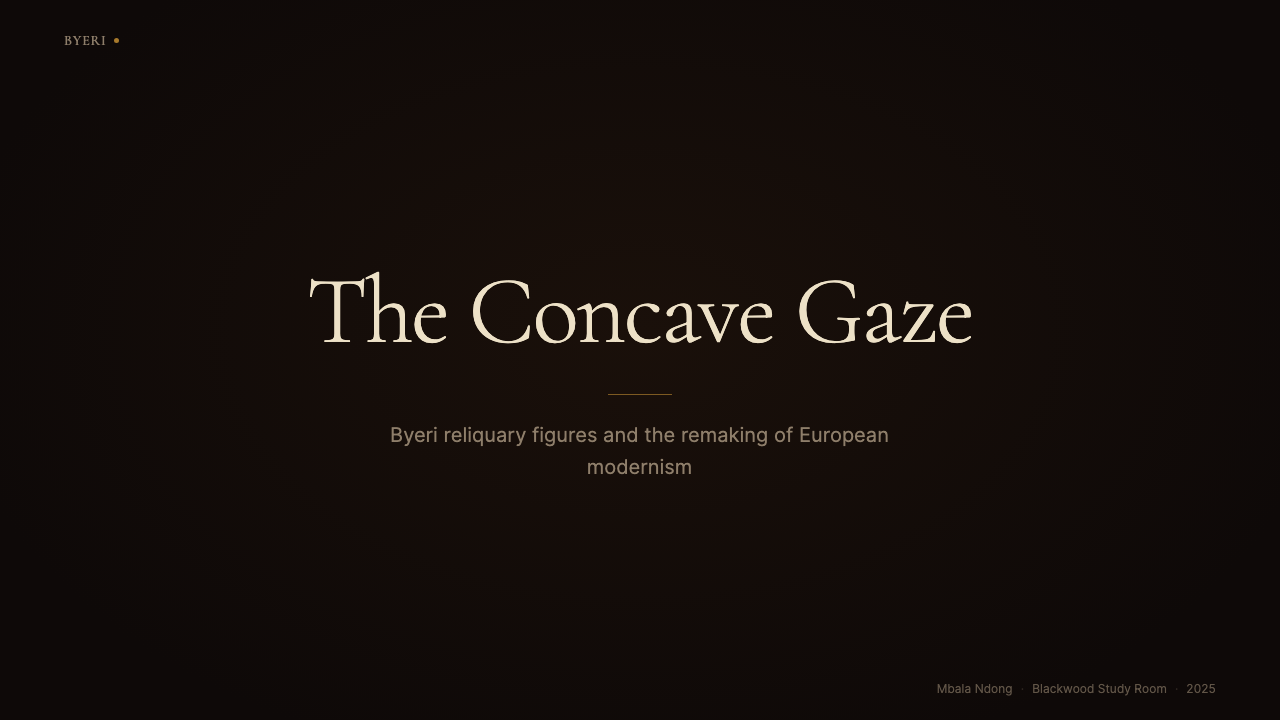
For presentation slides, the style works with exceptional force on covers and section dividers. A cover built in this idiom places one image — a product, a symbol, a face — against a near-black ground with generous negative space on all sides, a single brass-toned hairline rule separating the title from the image, and type in warm cream at a considered scale. Content slides should follow the museum-vitrine logic: one main element per slide, centered or deliberately off-center, with minimal supporting text in a lighter weight. Data slides become reliquary objects themselves — a single chart or number given maximum space, labeled in fine warm-toned type, with no decorative grid lines or chart borders beyond what is functionally necessary.
For web interfaces and dashboards, the style translates well to product showcases, portfolio landing pages, and premium subscription upgrade flows. The approach is to treat each card or section as a single object: one image or icon, one headline, one piece of supporting information — nothing more. Interactive states are signaled through the warm metallic accent rather than color shifts; hover states might bring a hairline border to visibility or shift a surface from deep black to deep charcoal. Navigation should be minimal and typographic, set in a warm off-white against the dark ground, with maximum spacing between items.
For editorial and marketing work, the byeri aesthetic supports long-form features, brand heritage campaigns, and cultural storytelling. A byeri-inflected editorial spread uses a near-black page with a single large image bleeding to one or two edges, body text in warm off-white at a comfortable reading measure, and section breaks marked by the brass hairline rather than a rule in the page color. Marketing pages work well when each feature is treated as a singular reveal rather than a feature list — one benefit per section, given the full page width, introduced by an image that emerges from the dark ground as if surfacing from shadow.
A common mistake when applying this style is treating the dark ground as permission to use multiple accent colors, heavy gradients, or glowing effects in order to 'enliven' the composition. The byeri aesthetic depends on restraint being total: one warm metallic accent, used rarely; surfaces that are flat and absorptive rather than luminous or textured; and a composition where each element is chosen because nothing else would do. Adding glow effects, multiple highlight colors, or decorative patterns destroys the sense of singular presence that makes the style powerful. When in doubt, remove an element rather than add one.
Gabonese Fang Mask & Byeri — FAQ
Is this style appropriate to use given its colonial collection history?
The question is worth asking seriously. The byeri tradition entered Western design culture through the colonial appropriation of sacred objects, stripped of their ritual context and presented as formal curios for European aesthetic consumption. Using the visual language thoughtfully — acknowledging its origins, avoiding caricature or exoticization, and understanding what the formal choices actually meant in their original context — is qualitatively different from using it as vague dark-luxury atmosphere. The style has genuine formal power; engaging with it honestly rather than superficially is both more interesting design practice and more respectful of the tradition it draws from.
How is this style different from generic luxury dark-mode design?
Generic luxury dark-mode design typically uses cool or neutral blacks, silver or white accents, and a sense of sleekness associated with contemporary high-end consumer products. The byeri aesthetic is specifically warm in its blacks, uses brass or amber rather than silver, and prioritizes singular presence over the sense of a curated collection of premium objects. The feeling is closer to standing in a darkened museum room before a single ancient thing than to browsing a luxury e-commerce site. The silences are different — one is marketing restraint, the other is something closer to reverence.
Can this style work for digital products that need frequent user interaction, like apps?
With careful adaptation, yes — but the style's natural territory is low-interaction, high-attention contexts. For an app, the byeri aesthetic is most effective applied to onboarding flows, feature reveal moments, or subscription upgrade screens where you want the user to pause and take in a single proposition. Applied to a high-density interface with many interactive elements, the demand for restraint creates tension: the style works against the need for visual differentiation among many simultaneous options. Successful adaptations tend to use the full byeri palette for moments of significance and a lighter variation — maintaining the warm darks and metallic accents but loosening the spatial compression — for everyday interface states.
What kind of typography pairs well with this aesthetic?
The byeri aesthetic favors type that is quiet and authoritative rather than expressive or decorative. A single well-proportioned serif or a geometric sans-serif set at considered scale works best — one that respects the negative space around it rather than competing for attention. Weight contrast is useful: a comparatively heavy weight for headlines against a light or regular weight for body text, with the lighter weight appearing in the warm off-white that anchors the palette. Avoid condensed display faces, ornamental scripts, and anything with aggressive optical features. The type should feel inscribed rather than printed — deliberate, permanent, and slightly formal.
How much negative space is enough?
In byeri-style work, the instinct should always be that the current amount of negative space is insufficient. If the composition feels generous, it probably needs more. The benchmark is the object-in-vitrine experience: the viewer's eye has nowhere to go except to the primary element, and the surrounding field is part of the meaning rather than merely the area between things. Practically, this means margins that feel extravagant by conventional standards, single-element sections where other styles might use three or four, and a willingness to leave entire areas of a composition empty. The emptiness is not dead space — it is what gives the present elements their weight.
Related design styles
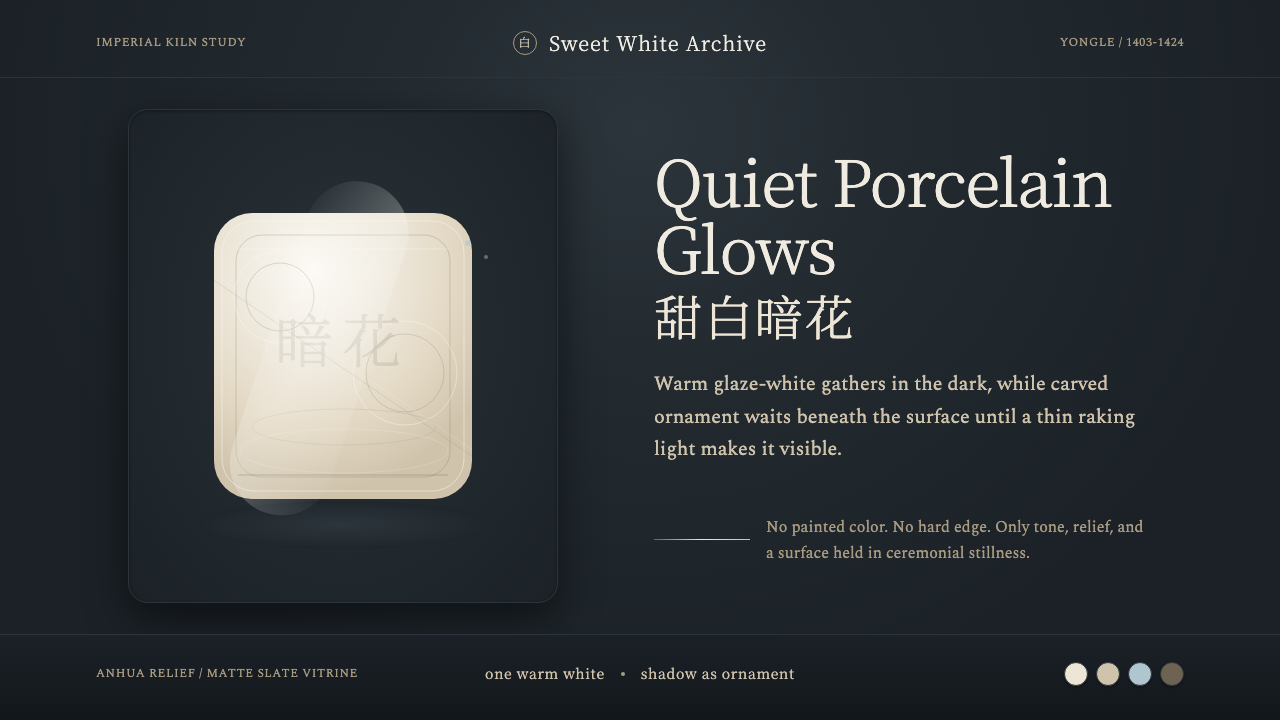 Jingdezhen BlancQuiet porcelain glows. Warm glaze-white on slate reveals hidden anhua incisio…
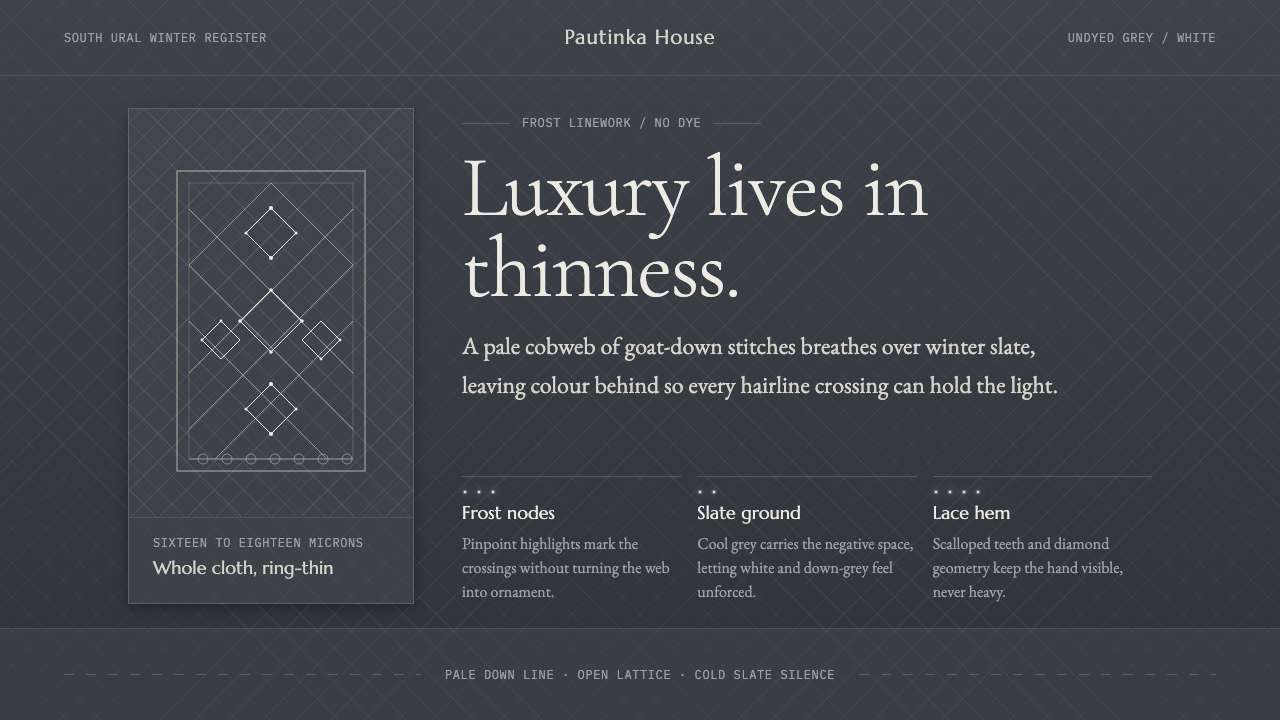 Orenburg Goat-Down Gossamer ShawlLuxury in thinness. Pale Cormorant type and down-lace lines breathe on Ural s…
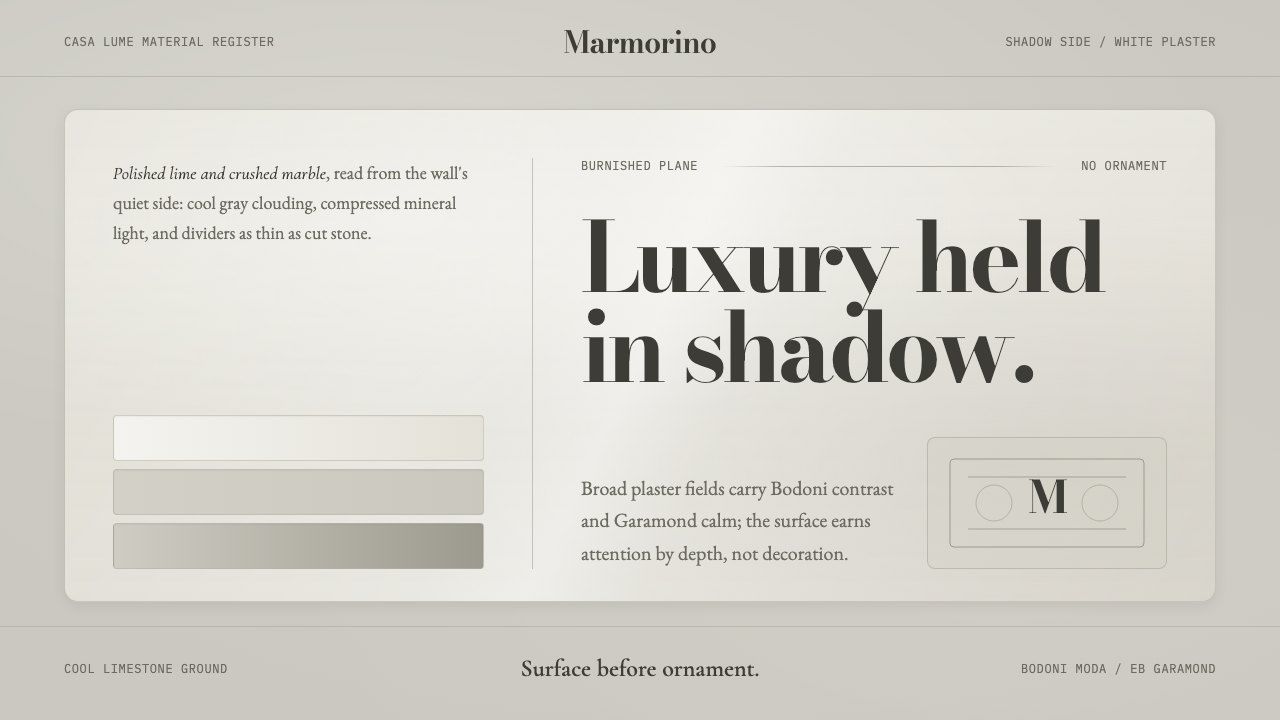 Venetian Plaster WhiteQuiet luxury in cool shadow. Bodoni type rests on clouded gray plaster planes.
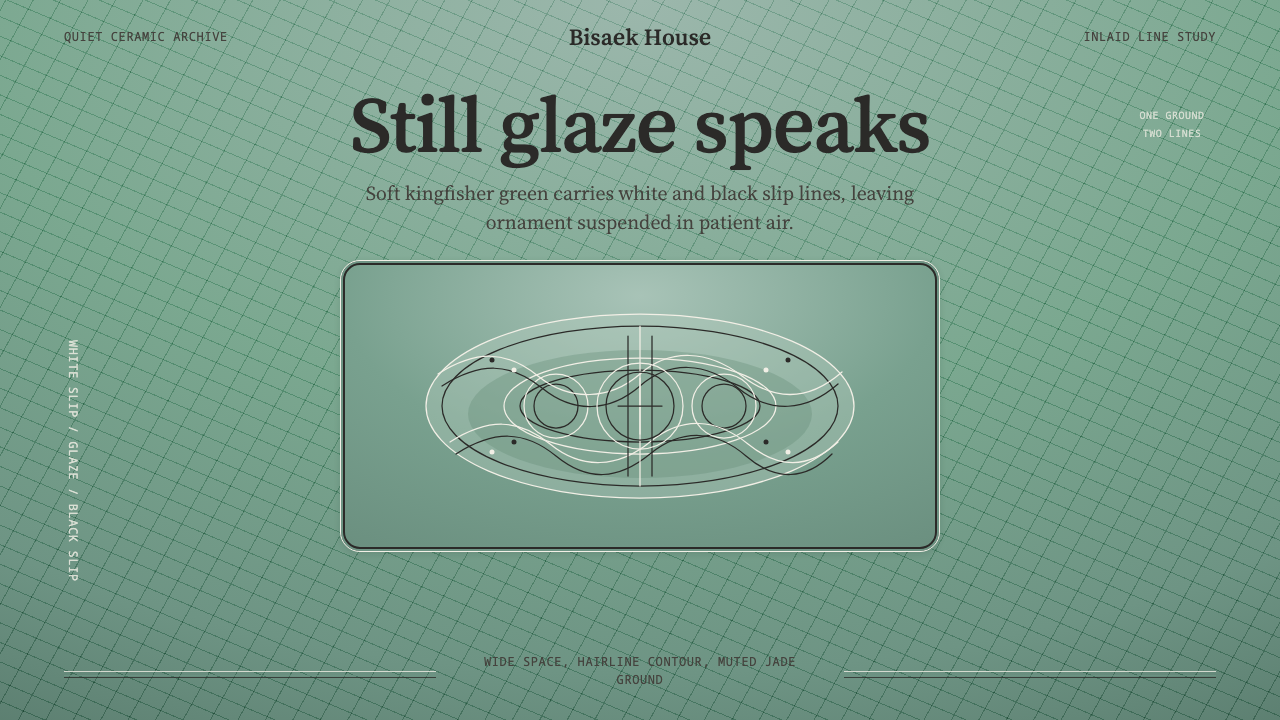 Goryeo Celadon 高麗青瓷Stillness carries ornament. Bisaek jade ground holds white and black hairline…
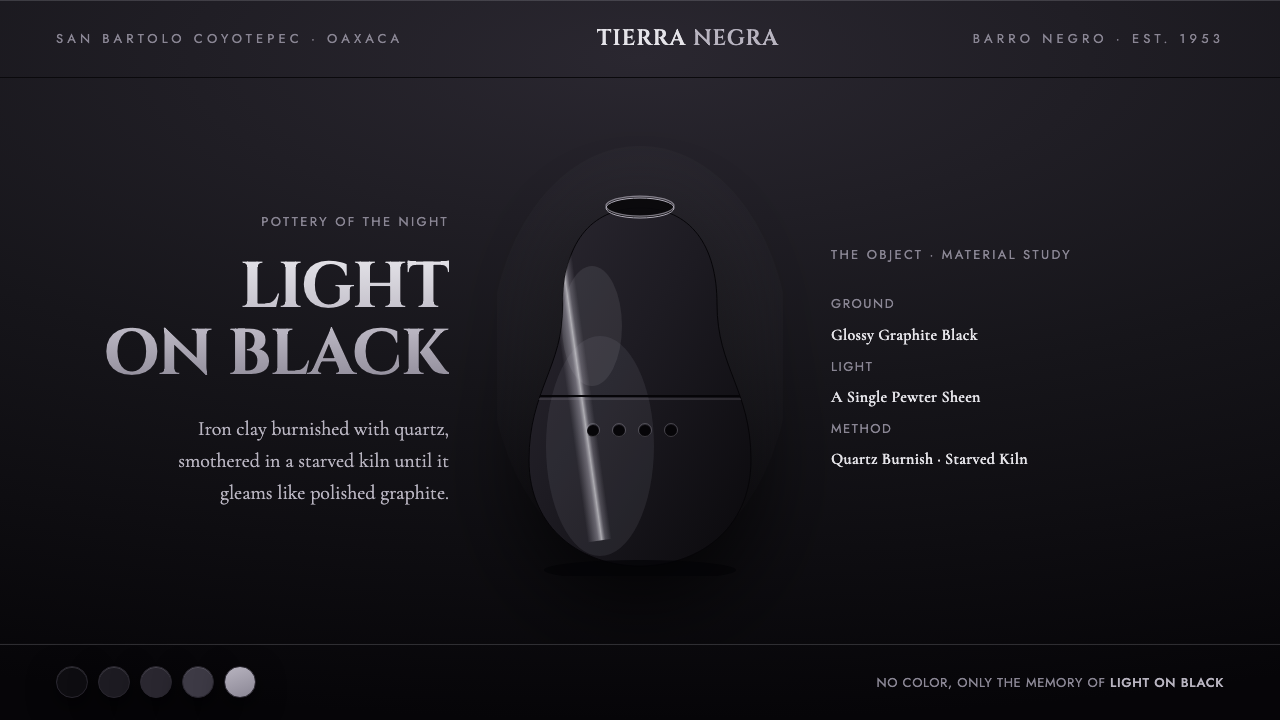 Oaxaca Barro NegroPottery of the night. Glossy graphite on matte black, one pewter sheen on the…
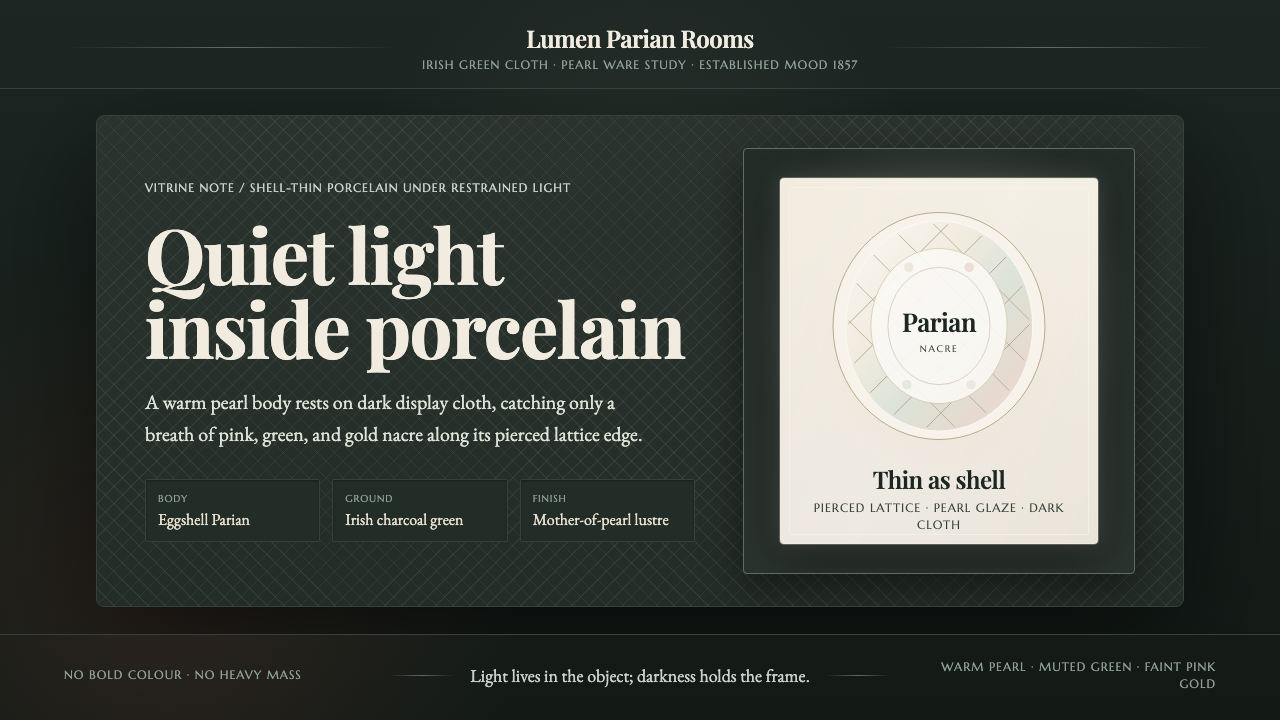 Belleek Parian ChinaPorcelain glows in restraint. Pearl white, nacre tints, and lattice sit on da…