What is Rwandan Imigongo Cow-Dung Relief?
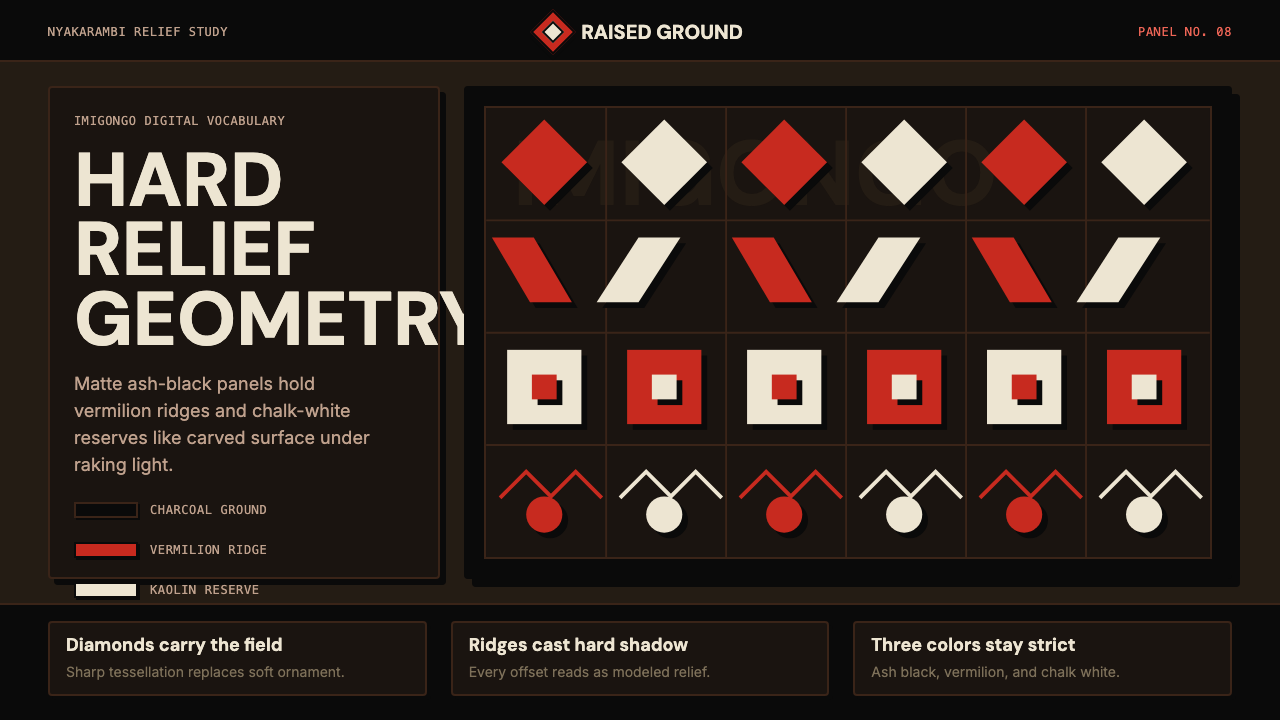
Imigongo transforms humble cow dung and ash into a bold three-color geometry that has decorated Rwandan walls for three centuries — and now brings that same hard-shadow relief language to digital surfaces.
Rwandan Imigongo Cow-Dung Relief in brief
Imigongo is a Rwandan geometric relief art form built from cow dung mixed with volcanic ash, pressed and modeled into raised ridges on wooden panels, then painted in a strict three-color palette of black, deep red, and chalk white. The interplay of raised ridges and recessed fields under raking light produces hard, precise shadows that are inseparable from the visual identity of the style — depth is not an illusion here, it is a physical fact built into the substrate.
The visual vocabulary is built entirely from interlocking geometric motifs: diamonds, chevrons, stepped spirals, and concentric bands. There is no figurative imagery, no gradation, no decorative flourish outside the geometry itself. Each panel is a tight tessellation where positive and negative space trade roles continuously across the surface, creating an optical rhythm that reads as both static pattern and implied movement.
As a digital design system, Imigongo translates this analog relief language into a vocabulary of matte dark grounds, hard-offset shadows, vermilion accent ridges, and chalk-white reserves. The three-color discipline is absolute: the palette does not expand, the forms do not soften, and depth is created through offset shadow rather than gradient or blur. The result is a surface that feels weighty and tactile even on a flat screen.
Where does Rwandan Imigongo Cow-Dung Relief come from?
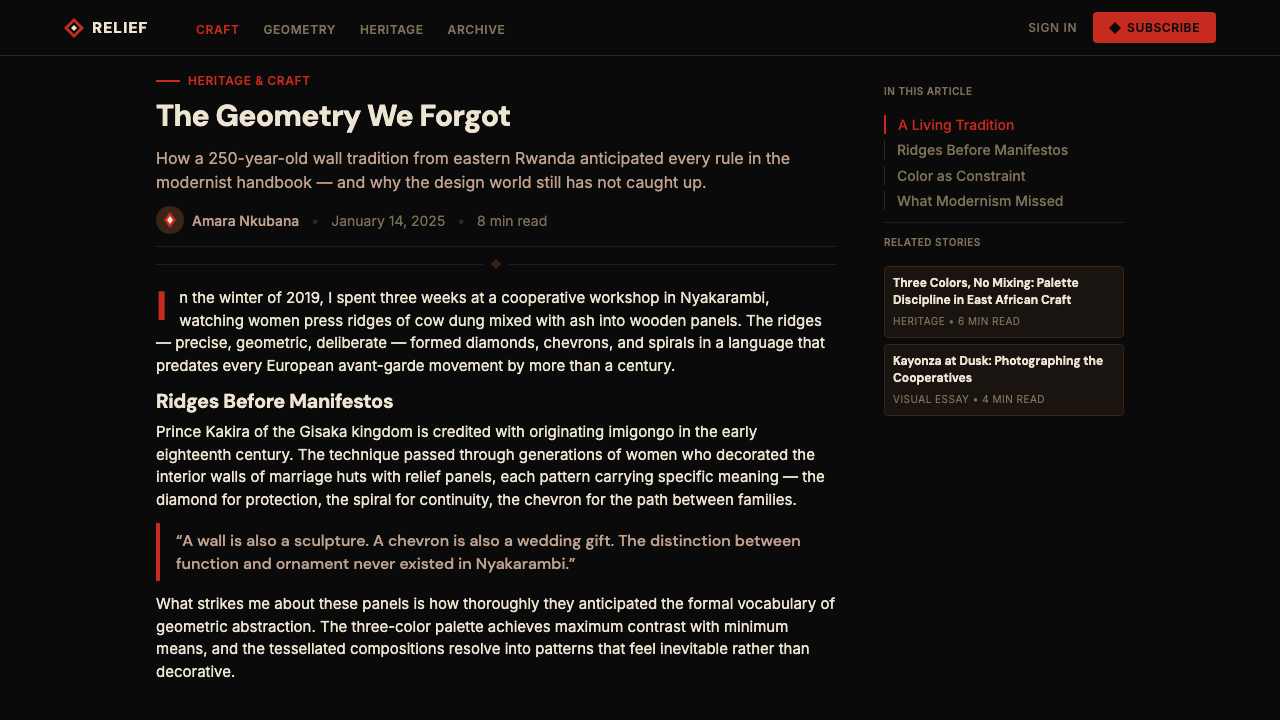
The tradition of Imigongo is credited to Prince Kakira of the Gisaka kingdom, in what is now the Eastern Province of Rwanda, dating to approximately the mid-eighteenth century. Historical accounts describe Kakira decorating the interior walls of royal residences with geometric relief panels made from the most readily available building material in a cattle-herding society: cow dung. Mixed with ash and dried grass, the paste hardened into a durable surface that could be painted and repainted across generations. The practice spread from royal patronage into the domestic sphere, where it became associated particularly with the decoration of newlywed couples' homes.
For over two centuries, the art was sustained almost exclusively by women artisans in the village of Nyakarambi, in the Kirehe district of what is now Eastern Province. The craft was transmitted through female lineages — mothers teaching daughters the proportional systems, the interlocking logic of the motifs, and the discipline of working within the three-color constraint. Each panel required collective effort: one artisan might model the raised ridges while another mixed and applied the pigments, which were derived from natural materials — charred wood for black, iron-oxide-rich clay for red, kaolin for white.
The genocide of 1994 devastated the communities in which Imigongo had been practiced. In the aftermath, women's cooperatives became one of the central mechanisms of reconciliation and economic reconstruction. The Kakira Imigongo Cooperative in Nyakarambi, named in honor of the tradition's founding prince, brought together survivors from across divided communities and resumed production specifically as an act of cultural recovery. International attention — including that of ethnographers like Margaret Trowell, who had documented the tradition in the mid-twentieth century — helped position Imigongo as a recognized heritage craft rather than a local curiosity.
Post-1994 revival also brought formal institutional recognition. Imigongo panels began appearing in Rwandan government buildings, hotels, and international exhibitions. The cooperative model professionalized production while preserving the traditional motif vocabulary and three-color discipline. Today, Nyakarambi remains the primary center of authentic production, and the cooperative's work is considered the canonical reference for the style's geometric logic and material standards. The translation of Imigongo into a digital design vocabulary is a direct extension of this ongoing revival — an attempt to honor the visual intelligence of the tradition by giving it a contemporary surface to inhabit.
What defines the Rwandan Imigongo Cow-Dung Relief look?
Palette
The palette is confined to three colors: an ash-black ground derived from charred wood and volcanic ash, a vermilion-to-deep-red accent color from iron-rich clay, and a chalk or kaolin white for reserve areas. No fourth color is permitted, no tints or tones, no warm-cool variation within a single hue. The black is not neutral — it carries the warmth of burnt organic material. The red is not decorative — it marks the raised ridge, the structural emphasis. The white is not background — it is an active shape with the same geometric weight as the black and red.
Relief and Shadow
The defining characteristic of Imigongo is its physical relief — ridges raised above the panel surface, casting hard, directional shadows under raking light. In the digital system, this physicality is translated into hard-offset shadows that are flat, opaque, and consistent in direction: no blur, no spread, no ambient glow. The shadow is a geometric shape, not a lighting effect. Depth reads immediately and unambiguously; there is no softness, no atmosphere.
Geometric Motifs
The vocabulary consists of interlocking diamonds, stepped chevrons, concentric bands, and squared spirals. These forms are not decorative in origin — each motif type carries a conventional meaning within Rwandan visual culture, encoding ideas about abundance, protection, and community structure. In the design system, the motifs function as both pattern elements and structural dividers: a diamond grid can serve as a background texture, a chevron band as a section separator, a spiral as a focal-point ornament on a hero panel.
Tessellation Logic
Every Imigongo panel is a complete tessellation — no motif begins or ends at an edge without resolution. The geometric logic is self-closing: the positive shape of one motif creates the negative shape of its neighbor, and the two trade roles continuously across the surface. In digital application, this means layouts have no orphaned elements; every component is part of a larger repeating system, and the grid is never broken by an element that floats free of it.
Matte Surface
The original medium — dried cow dung and ash — produces a surface that is completely matte, with no reflective quality whatsoever. This material fact translates into a digital constraint: no glass effects, no gloss overlays, no specular highlights, no reflections. Backgrounds are flat opaque fills; interactive states are indicated through hard-shadow shifts or color swap rather than luminance change. The matte discipline gives the system a quality of weight that gloss would immediately undermine.
Bilateral Symmetry Within Panels
Individual Imigongo panels are typically organized around one or two axes of symmetry, creating a balanced, contained composition within each unit. At the macro level — when panels are arranged side by side on a wall — the symmetry gives way to a larger additive rhythm. In digital application, this suggests a design approach where individual cards or sections are internally balanced, but the overall page layout can be asymmetric, building visual complexity through the accumulation of ordered units rather than through compositional tension.
No Gradient, No Blur
Imigongo knows no gradients and no soft transitions. The shift from black to red to white is always a hard edge, a physical ridge, a boundary with no ambiguity. The digital system enforces the same rule: all fills are solid, all shadows are offset hard rectangles or shapes rather than blurred glows, all borders are defined rather than faded. This restraint produces a visual system that is uncompromising in its clarity — every element knows exactly where it ends.
Who shaped Rwandan Imigongo Cow-Dung Relief?
The eighteenth-century Rwandan prince credited with originating Imigongo as a form of interior wall decoration in the royal residences of the Gisaka kingdom. Historical tradition attributes to him the decisive act of elevating cow dung from a construction material to a vehicle for geometric art — combining it with ash to produce a workable paste and establishing the three-color discipline that has defined the form ever since. The Kakira Imigongo Cooperative in Nyakarambi takes its name directly from him, positioning the post-1994 revival as a continuation of a specifically royal and named cultural lineage.
A British art historian and ethnographer who documented traditional African art forms across East and Central Africa in the mid-twentieth century. Trowell's fieldwork brought systematic scholarly attention to Imigongo at a time when its practice was largely confined to Nyakarambi and unknown outside Rwanda. Her documentation of the motif vocabulary, production techniques, and community context provided the archival foundation that later enabled the cooperative revival movement to position Imigongo as internationally recognized heritage rather than a regional folk practice.
The women's collective based in Nyakarambi, Eastern Province, founded after the 1994 genocide as a vehicle for community reconciliation and economic recovery. The cooperative brought together survivors from communities that had been on opposite sides of the violence, using shared craft production as a mechanism for rebuilding social trust. It professionalized Imigongo production — standardizing panel dimensions, preserving the canonical motif vocabulary, and establishing quality standards for export — while ensuring that the social and intergenerational transmission of the craft continued. The cooperative remains the primary living authority on authentic Imigongo practice.
A contemporary Rwandan artist and practitioner associated with the revival of Imigongo in the post-genocide period, and a key figure in connecting traditional production techniques with contemporary art contexts. His work helped establish that the formal vocabulary of Imigongo — the hard-edged geometry, the three-color discipline, the relief structure — was not a museum artifact but a living visual language capable of engaging with modern design and fine art practice. His contributions support the ongoing legitimacy of Imigongo's extension into digital and graphic design systems.
How do you use Rwandan Imigongo Cow-Dung Relief today?
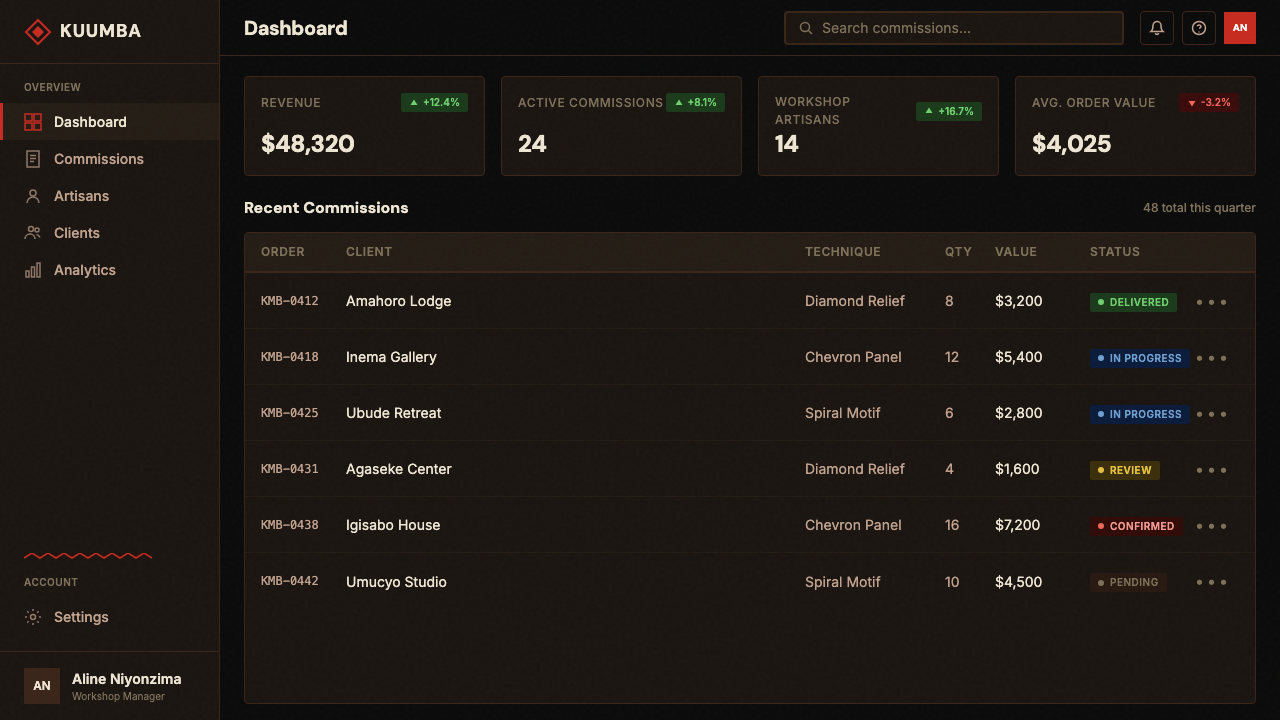
Imigongo is a high-contrast, high-conviction style — it does not accommodate ambiguity or half-measures. The three-color constraint and the hard-shadow logic mean that every element on a surface must earn its place within that system. This makes Imigongo particularly effective for contexts where visual authority and cultural distinctiveness are priorities: editorial covers, brand identity systems for cultural institutions, and digital surfaces that need to feel both bold and grounded.
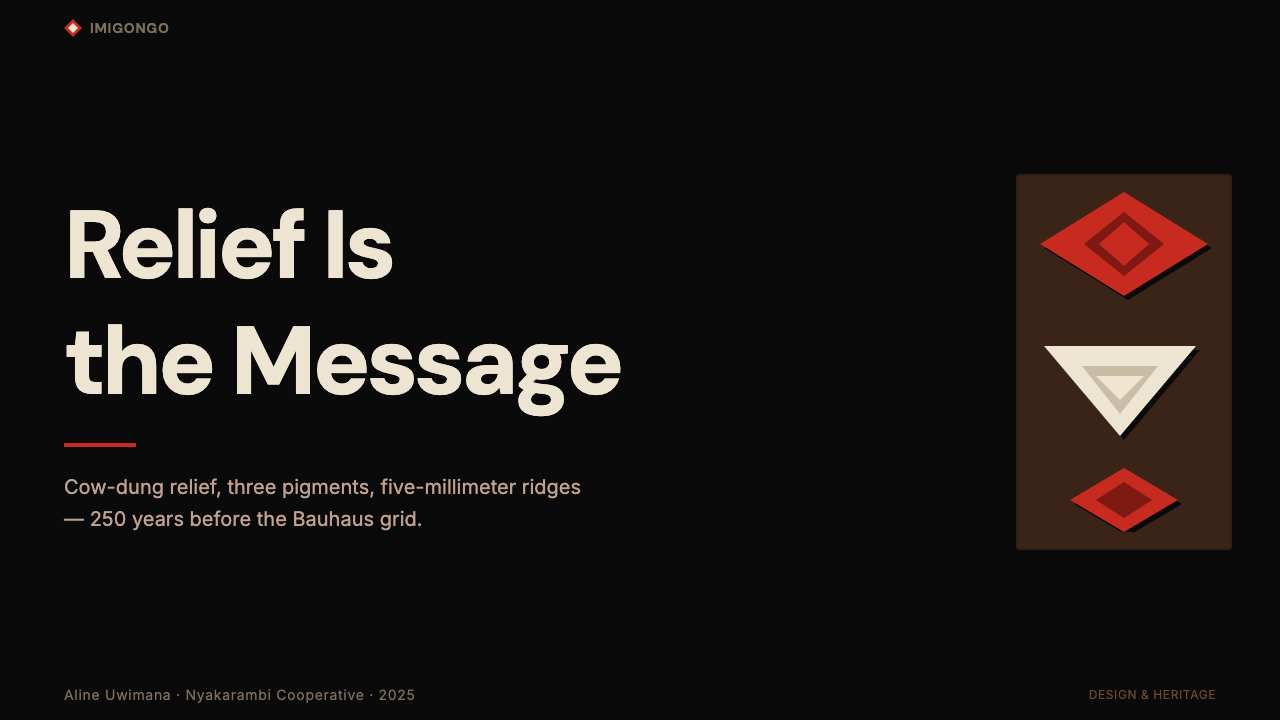
For presentation slides, Imigongo works powerfully on cover and divider pages. A cover built on an ash-black ground with a full-width chevron or diamond band in the upper or lower register, a vermilion rule dividing content zones, and a title set in a heavy geometric face in chalk white creates immediate impact without clutter. Content slides should restrain the palette to two colors — black ground, white text — reserving the vermilion exclusively for key data points, highlighted figures, or section markers. Data slides take on the quality of the relief panels themselves: bar charts become stacked horizontal forms with hard black offset shadows; pie charts become segmented disc shapes with no rounded softening at the cuts.
For web interfaces, Imigongo is most at home in hero sections, landing page panels, and marketing surfaces that call for visual boldness. A hero built on an ash-black ground with a geometric pattern band — a repeating chevron or diamond in a slightly lighter matte black — provides textural depth without color noise. Vermilion is used sparingly: primary call-to-action buttons, active navigation states, and price-tier highlights. Card components should use hard-offset box shadows rather than diffuse drop shadows; borders, if present, are solid and single-weight rather than hairlines. The style is less suited to dense text-heavy interfaces — its visual weight can overwhelm long-form reading environments.
For editorial and marketing applications, Imigongo's relief logic translates directly into print and poster contexts. Full-bleed panels alternating between ash-black with white type and chalk-white with black type create a strong rhythm across a multi-page document. Pull quotes can be framed in vermilion rule borders — solid, single-weight — rather than decorative ornaments. Marketing materials for cultural events, museums, or social-enterprise brands benefit particularly from the style's combination of visual forcefulness and narrative depth: the geometric vocabulary signals order and intelligence without the cold rationalism of purely Swiss or Bauhaus approaches.
A common mistake when applying Imigongo is using the three-color palette at full saturation simultaneously across a surface. In the original craft, the three colors are never visually equal — black always dominates as ground, white opens relief areas, and red appears as accent on the raised ridges. The digital application should maintain this hierarchy: black should occupy the largest share of any composition, white the second, and vermilion the least. When vermilion is over-used, the surface becomes visually chaotic and loses the taut clarity that makes the style effective. Similarly, softening the shadows — adding blur or reducing opacity — collapses the relief logic that is the style's defining characteristic.
Rwandan Imigongo Cow-Dung Relief — FAQ
Is Imigongo only suitable for dark-background designs?
The canonical Imigongo palette is dark-ground: ash-black backgrounds with white and red working against them. A light inversion — chalk-white ground with black and vermilion — is possible and produces a very different reading: cooler, more graphic, less physically weighty. The inversion works when the three-color discipline and hard-shadow logic are preserved exactly. What breaks the system is not the choice of dominant ground color, but any softening of the edges or introduction of a fourth color. A light-ground Imigongo-derived system reads more like a printed woodblock than a relief panel, which may suit editorial or packaging contexts where maximum legibility matters more than textural weight.
How strictly must the three-color rule be followed in a digital product?
The three-color discipline is the core structural principle of Imigongo, not an aesthetic preference. Introducing a fourth color — even a neutral gray, even a lighter tint of one of the three — immediately dilutes the visual logic and moves the system toward generic dark-mode design rather than Imigongo. Within the three colors, however, there is more latitude than the constraint might suggest: the black can range from near-charcoal to near-neutral, the white can carry a slight warm or cool cast, and the red can shift from vermilion toward rust or deep carmine depending on the surface being served. The discipline is about maintaining the number of distinct color identities, not about locking each to a single precise value.
What is the relationship between Imigongo and other African geometric traditions?
Imigongo belongs to a broad family of Great Lakes African geometric visual traditions that include Kuba textiles from the Democratic Republic of Congo, Ethiopian cross-pattern embroidery, and East African kanga and kitenge printed cloths. What distinguishes Imigongo within this family is its three-color constraint, its relief medium, and its exclusive association with a single geographic and cultural community. The interlocking diamond and chevron motifs are shared with other traditions, but the specific combination of material, color limitation, and relief structure is unique to the Rwandan context. Designers applying Imigongo should be careful not to conflate it with other African geometric traditions — the motif vocabulary looks superficially similar, but the principles governing its use are specific.
How does the style handle typography?
Imigongo has no indigenous typographic tradition — it is a pre-typographic visual language. When text is introduced into an Imigongo-derived design system, the guiding principles are the same as those governing the geometry: hard edges, high contrast, no ornamentation. A heavy geometric sans-serif in chalk white on black, or in black on white, aligns naturally with the motif vocabulary. Condensed or extended letterforms can echo the proportions of the chevron and diamond shapes. Script typefaces and humanist sans-serifs introduce a warmth and fluidity that works against the system's material logic. Avoid any typeface that relies on optical illusions, ink traps, or calligraphic stroke variation — the type should read as cut, not drawn.
Can Imigongo work alongside photography or illustration?
Photography and illustration can coexist with Imigongo, but they require strict treatment to avoid undermining the system's visual logic. Photography should be converted to high-contrast black-and-white, then masked or framed within geometric shapes — a diamond crop, a chevron-shaped cutout — so that it behaves as a flat geometric element rather than a naturalistic window. Avoid photographic gradients, soft bokeh, or any tonal range that introduces atmospheric depth incompatible with the relief flatness. Illustration should be reduced to flat geometric forms in the three-color palette; any illustrative element that uses more than three colors, blends, or rounded organic shapes will appear foreign to the system. The rule of thumb: anything that cannot be reproduced as a woodblock print probably does not belong in an Imigongo-derived layout.
Related design styles
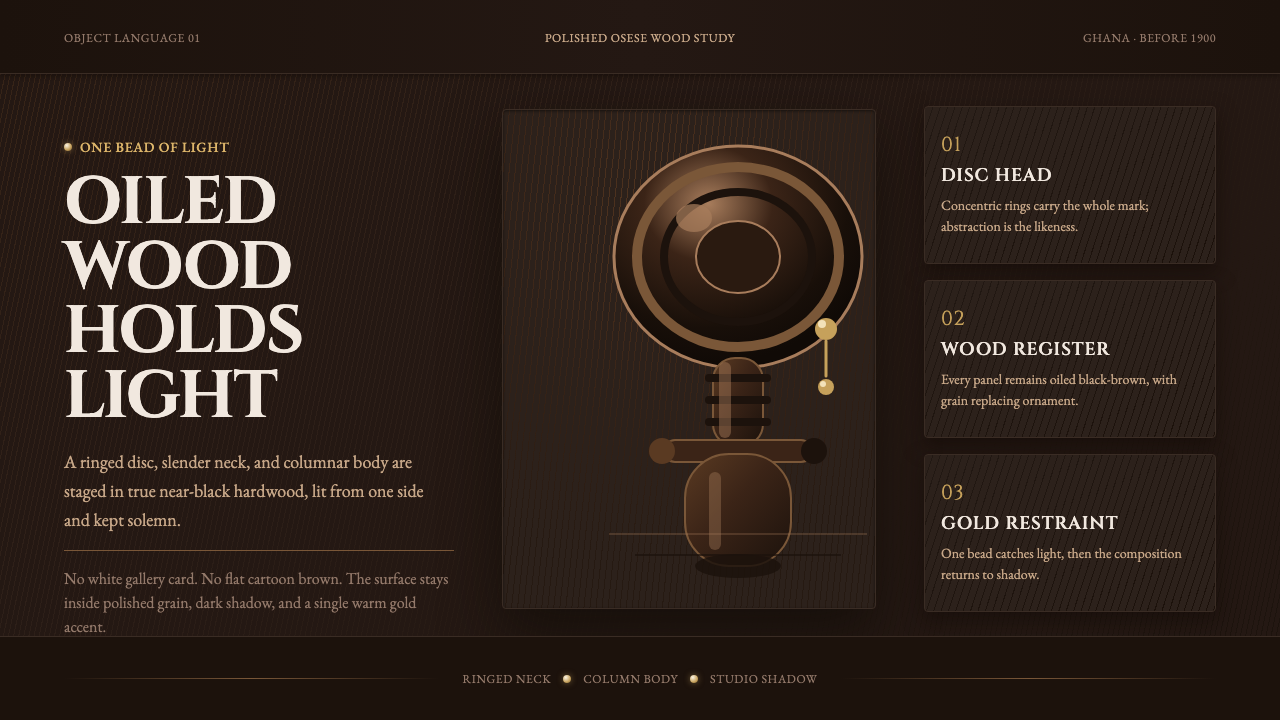 Akuaba Akan Fertility DollDarkness becomes sculpture. Near-black wood, ringed geometry, and one gold be…
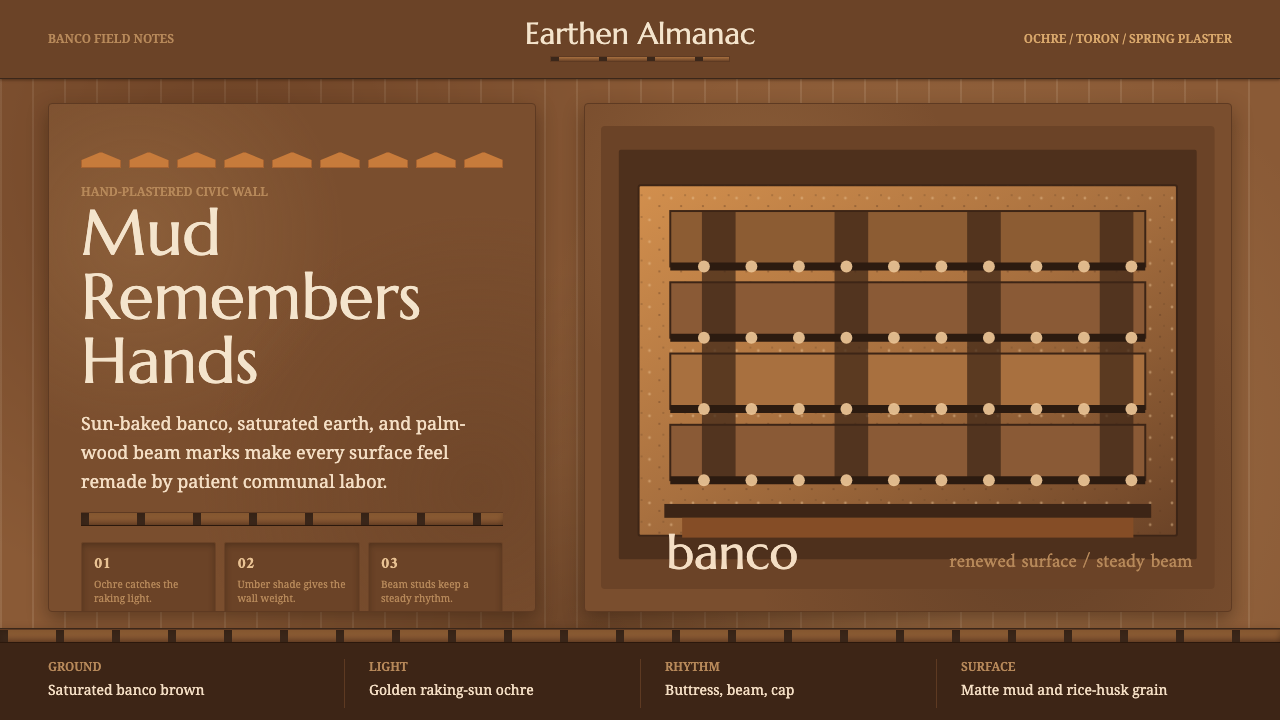 Djenné Mud MosqueBuilt from renewal. Banco brown, ochre caps, and toron grids feel hand-plaste…
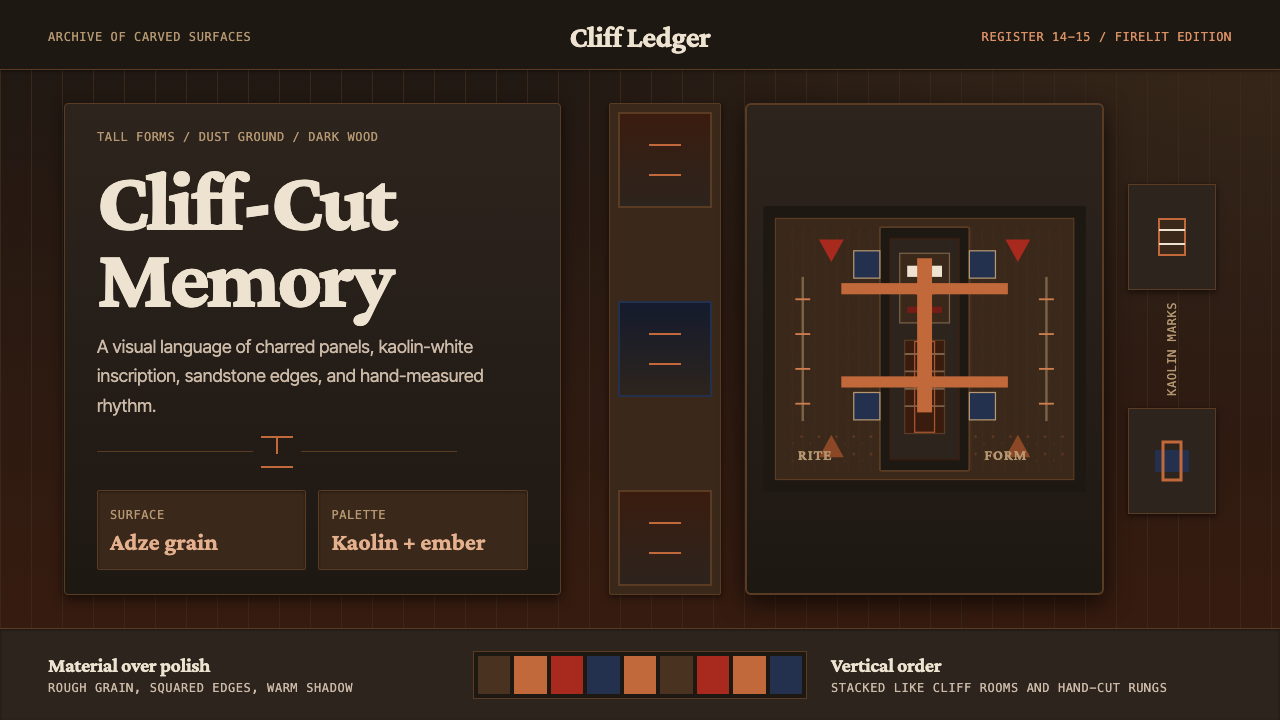 Dogon Bandiagara Cliff MaskHand-hewn gravity. Charred wood, kaolin type, and sandstone geometry stack li…
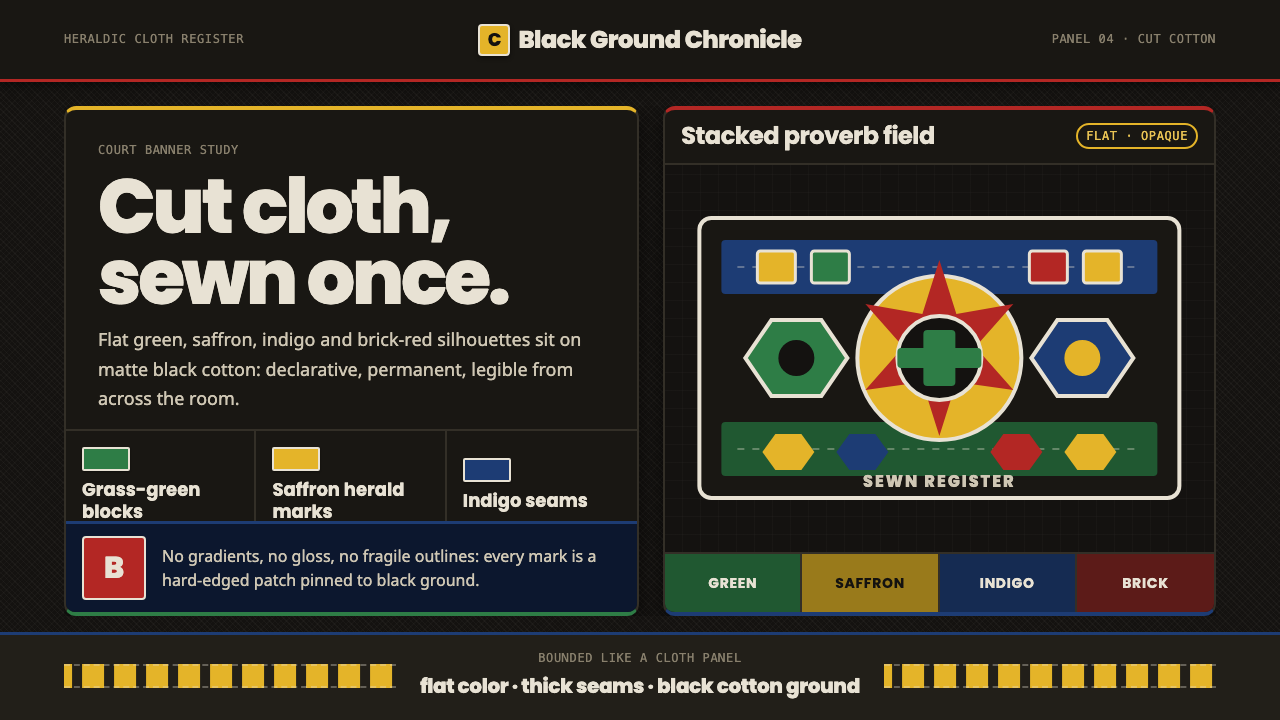 Fon Applique Banner AbomeyRoyal cloth speaks plainly. Flat saffron, green and indigo silhouettes on bla…
 Kongo Nkisi Nkondi FigurePower accumulates in darkness. Black wood, iron studs, and one mirror glint h…
 Mossi Burkina Plank MaskCarved, not rendered. Charcoal fields, dust-red cuts, and kaolin bands stack…