What is Mursi Omo Valley Lip Plate Paint?
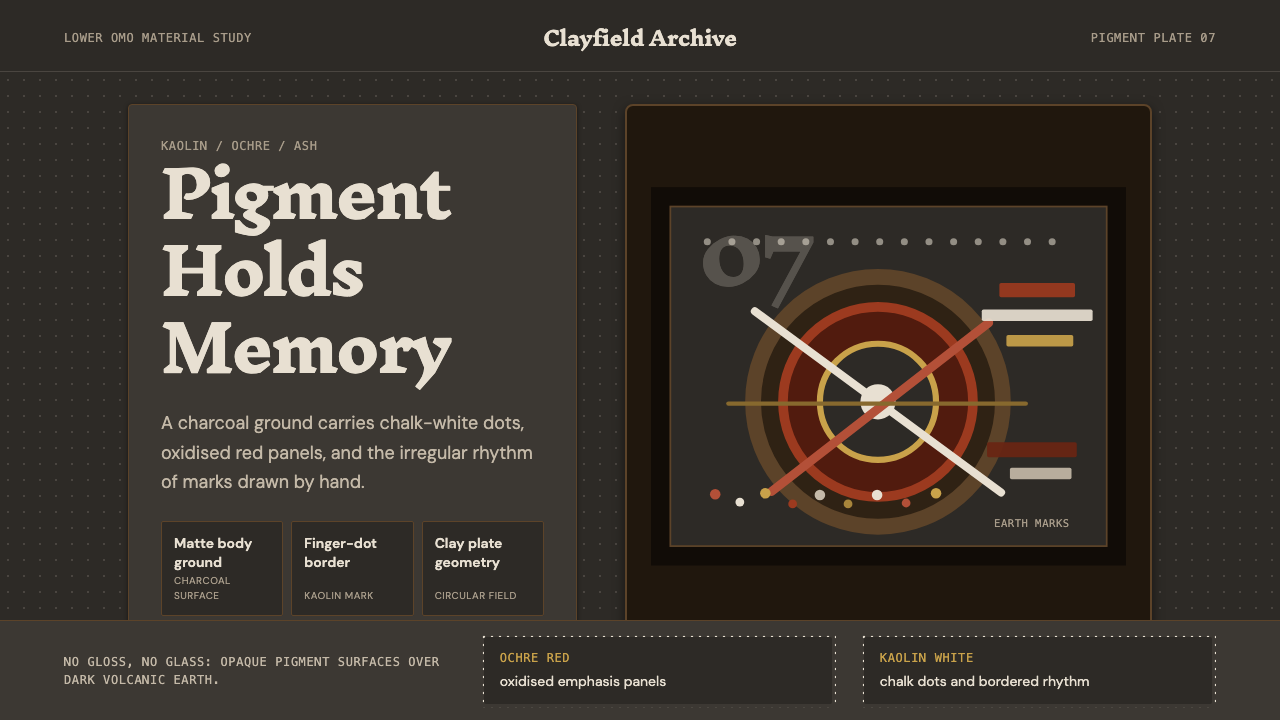
On the banks of Ethiopia's Omo River, kaolin clay, ash, and ochre become a daily ritual of identity — raw earth pigments drawn onto dark skin with fingers and palms, proud and never decorative for decoration's sake.
Mursi Omo Valley Lip Plate Paint in brief
The Mursi Omo Valley Lip Plate Paint design system takes its name and spirit from the body painting traditions of the Mursi people of southwestern Ethiopia. Their daily face and body paintings — finger-drawn dots, palm prints, concentric rings of white kaolin clay, and bold ochre stripes — are not fixed patterns but living compositions that shift with mood, ceremony, and the availability of pigment. The result is an aesthetic of raw dignity: purposeful, matte, and grounded in the earth itself.
What makes this tradition remarkable as a visual language is its materiality. The palette is defined entirely by what the earth provides: chalky white from kaolin clay, warm deep red from iron-rich ochre, cool near-black from ash and charcoal. These pigments sit on the surface of dark skin, never sinking in, always present as a texture you can almost feel. Marks are made quickly with fingers, palms, and sticks — gestural rather than precise — yet the resulting compositions carry enormous graphic authority.
As a design system, Mursi Omo translates that earth-pigment-on-skin materiality into digital surfaces. The charcoal ground is deep and matte, never glossy. Marks appear as hand-applied rather than machine-drawn. The tension between the chalky near-white of kaolin and the warm oxidised red of ochre drives all compositional energy, against a shadow-dark field that gives every mark weight and presence.
Where does Mursi Omo Valley Lip Plate Paint come from?
The Mursi are a Nilotic people inhabiting the remote lower Omo Valley in southwestern Ethiopia, a region where multiple ethnic groups — including the Surma, Suri, Karo, and Hamar — have maintained body adornment traditions largely untouched by outside influence. The Omo River valley's geographic isolation, lying between highland and lowland ecosystems, allowed these practices to develop over centuries with considerable depth and continuity. While the exact antiquity of Mursi body painting is difficult to establish, the practice is understood to be centuries old and remains actively practised today.
The Mursi are best known in the wider world for the clay lip plates worn by adult women. These ceramic or wooden discs, inserted into a cut in the lower lip beginning in adolescence and gradually increased in size, are understood as a marker of social status, beauty, and individual identity. But the lip plate is inseparable from the broader body painting tradition: face, neck, and torso paintings accompany the plate as part of a unified visual identity that the wearer assembles and modifies daily. The paintings are not permanent tattoos but fresh compositions — washed off and reapplied — making them closer in spirit to performance than to fixed inscription.
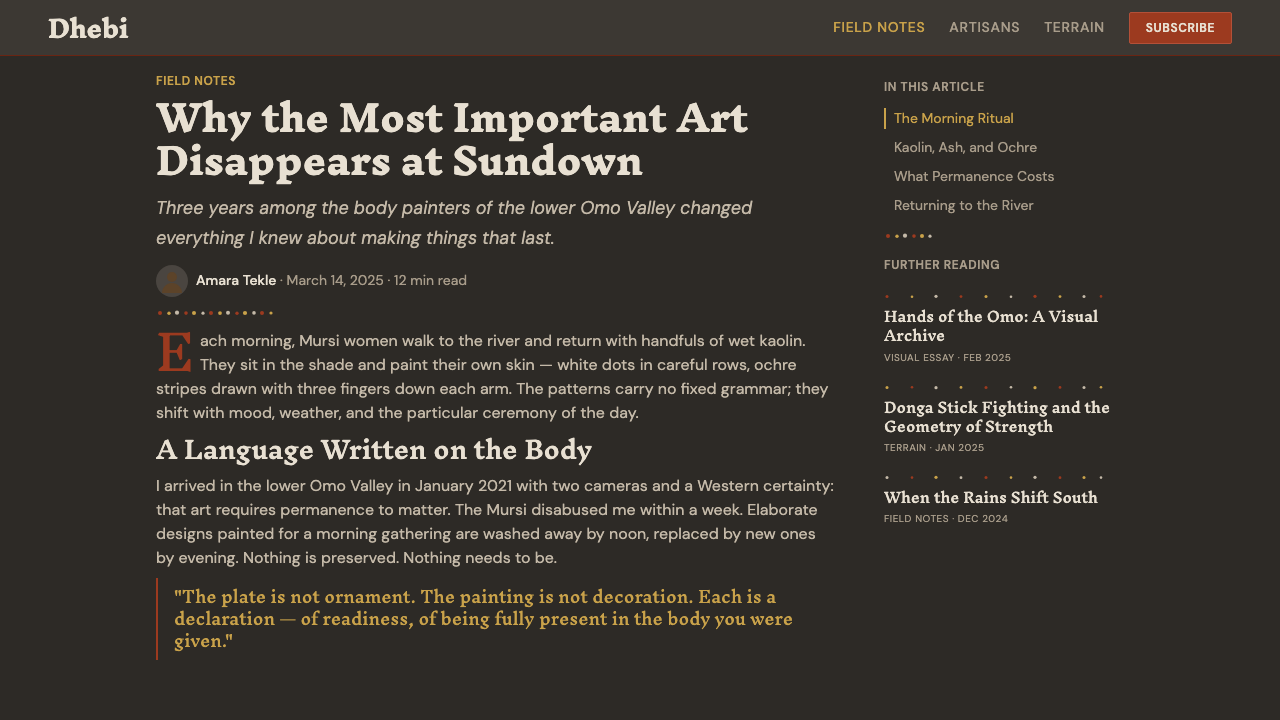
The pigments used are entirely local and mineral. White kaolin clay is sourced from riverbanks and applied in thick, chalky strokes that retain a slight relief. Ochre — ground from iron-oxide-rich stone — provides warm deep reds and oranges. Ash and charcoal yield the near-black tones. These materials are mixed with water or animal fat and applied directly with fingers, palms, thin sticks, and broad blades of grass. The marks are gestural and confident: dots laid with a single finger press, rings drawn with a sweeping palm, stripes made with the flat of the hand. There is no sketch beneath, no hesitation.
Western awareness of the Mursi body painting tradition grew significantly through the photographic work of Hans Silvester, whose widely published images from the 1990s and 2000s brought the tradition to international attention — along with significant debate about representation and the ethics of photographing isolated communities. The anthropological record was also shaped by David Turton, who spent decades studying the Mursi and documented the social meanings embedded in their body practices, and by photographers Carol Beckwith and Angela Fisher, whose long-term documentation of East African ceremonial cultures provided important comparative context for the Omo Valley traditions.
What defines the Mursi Omo Valley Lip Plate Paint look?
Ground Color
The foundational tone is deep charcoal — not pure black, but the rich near-black of ash on dark earth. It is matte and absorptive, giving the impression of a surface that drinks in light rather than reflecting it. This dark ground is essential: it is what makes the chalky kaolin marks luminous and gives the ochre stripes their warmth. Without the deep shadow field, the marks lose their presence.
Chalky White Marks
Kaolin clay marks are the primary graphic element: dots, concentric circles, palm outlines, and broad stripes rendered in a chalky, slightly textured white that never achieves the cleanness of a printed white. The marks carry visible grain and slight irregularity at their edges — the trace of the finger or palm that applied them. In digital translation, this quality is achieved through slightly softened edges and subtle surface texture, never through crisp geometric precision.
Ochre and Earth Red
Warm iron-red occupies the accent position in the palette — present but not dominant. It reads as oxidised, aged, and mineral rather than bright or saturated. When ochre appears alongside kaolin white on the charcoal ground, it creates a visual warmth that suggests fire, ceremony, and the heat of the Omo Valley landscape. The earth reds are never vivid primaries; they carry the weight of something dug from the ground.
Gestural Mark-Making
The vocabulary of marks is bodily and direct: dots pressed with a single fingertip, rings swept with the pad of a thumb, parallel stripes laid with the flat of four fingers, broad areas filled with a palm print. There is no attempt to achieve mechanical regularity — the slight wobble of a hand-drawn circle, the fading pressure at the end of a stroke, the occasional double-mark where a finger lifted and reset, are all part of the system's authenticity. Perfection in the conventional sense is not the goal.
Texture Over Flatness
Where most contemporary digital design systems prize the smooth and the flat, Mursi Omo celebrates surface. The matte chalky pigment, the visible grain of the clay, the slight variance in opacity across a single mark — these qualities signal that something was made by hand from natural material. Digital implementations of this aesthetic introduce controlled noise, irregular edges, and subtle material variation to maintain the sense of an applied rather than generated surface.
Circular and Radial Geometry
The dominant geometric form is the circle and its relatives: concentric rings, arc segments, dot clusters arranged in radial patterns, oval lip-plate echoes. Rectilinear grids exist but are subordinate; the organizing principle is centripetal rather than Cartesian. Compositions tend to radiate outward from a central point — the face, the mouth, the eye — and the surrounding marks respond to that center of gravity.
Purposeful Sparsity
Mursi body paintings are not dense all-over patterns. Large areas of unmarked skin — the dark ground itself — remain visible between marks, and this negative space is as active as the marks. The paintings breathe. This sparsity is purposeful: in a composition where the ground is rich and dark, leaving it exposed is itself a decision of presence. Over-marking destroys the balance; restraint gives each mark its maximum weight.

Who shaped Mursi Omo Valley Lip Plate Paint?
A French photographer whose extended documentation of Omo Valley body painting from the 1990s onward brought the Mursi and neighboring peoples to wide international attention. His book-length compilations introduced these painted bodies to design, fashion, and art audiences worldwide — though his work also generated sustained debate about the ethics of staging and aestheticizing practices from a community with which he had no deep prior relationship. Regardless of the controversy, Silvester's images remain the most widely circulated visual record of Omo Valley body adornment.
A British social anthropologist who spent decades conducting fieldwork among the Mursi, beginning in the late 1960s. Turton's scholarship provided the foundational ethnographic account of Mursi society, including the social meanings of the lip plate and body painting within their broader systems of identity and status. His work is the primary academic source for understanding these practices as something other than spectacle — as embedded in specific social logics that outsiders frequently misread.
An American photographer who, alongside Angela Fisher, spent decades documenting ceremonial life across sub-Saharan Africa. Beckwith and Fisher's collaborative work created one of the most comprehensive visual archives of African ceremonial adornment, providing comparative context for the Omo Valley traditions and helping establish the broader East African body painting aesthetic in the visual culture record. Their approach emphasized long-term relationship-building with communities rather than brief photographic visits.
A British-Australian photographer and scholar whose long-term fieldwork across East and southern Africa — conducted in close collaboration with Carol Beckwith — documented ceremonial body practices including those of the Omo Valley peoples. Fisher's written accounts accompanying the photographic work provided cultural context that helped international audiences understand body adornment as a sophisticated social and aesthetic system, not merely an exotic visual spectacle.
How do you use Mursi Omo Valley Lip Plate Paint today?
The Mursi Omo Lip Plate Paint system occupies a specific niche: it is best applied where rawness, material weight, and cultural depth are communicative assets rather than liabilities. It works strongly for projects that want to signal authenticity, non-corporate identity, or a connection to craft and earth — creative portfolios, cultural organizations, artisanal brands, music and arts platforms, and documentary or editorial design contexts. It is the wrong choice for projects that require clinical precision, cheerful lightness, or the polished finish of mainstream consumer technology.
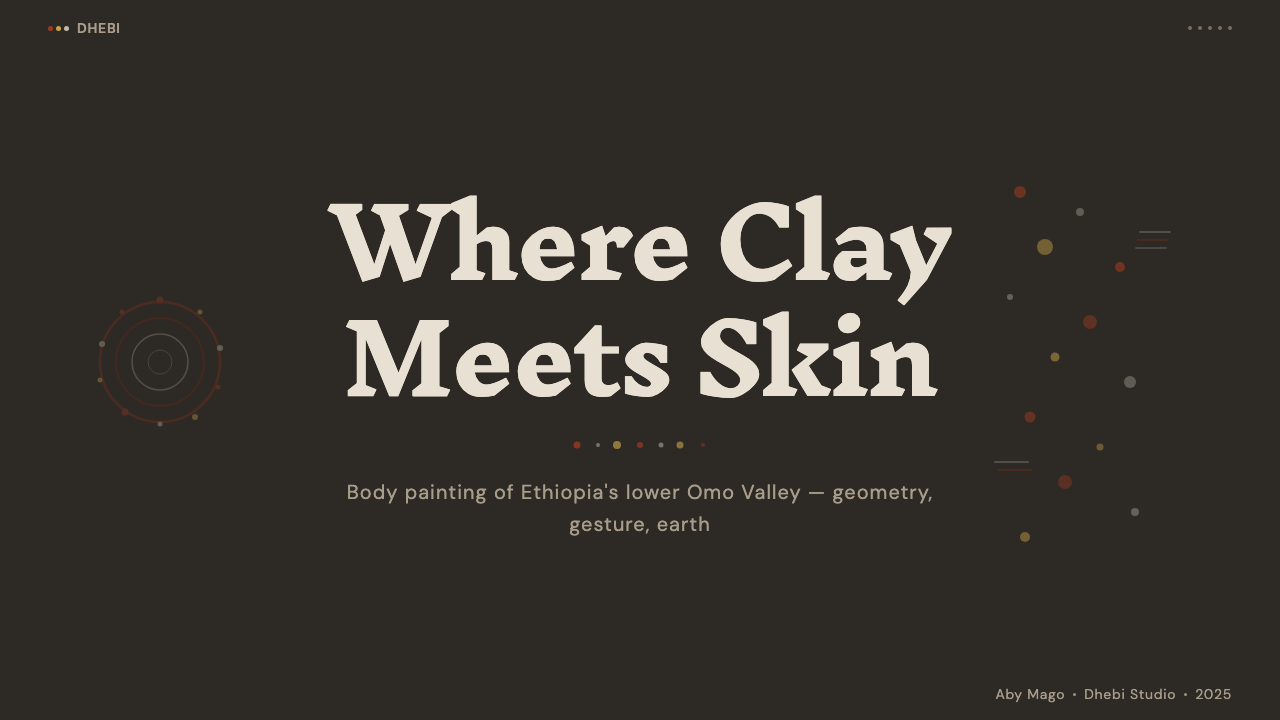
For presentation slides, the system works at its most powerful on covers and section-break pages. A cover built on the deep charcoal ground with a single large circular mark — perhaps a ring of kaolin dots around a sparse central space — gives an immediate visual authority that no amount of slick gradients can match. Content slides should practice restraint: white text on the dark ground, mark-inspired dividers used sparingly, and the earth-red accent reserved for key callouts or data highlights only. Overloading a content slide with the decorative vocabulary of the system defeats the effect. Data visualizations in this palette take on a ceremonial quality — bar lengths and ring segments in warm earth tones against the dark field read as weighted and deliberate.
For web interfaces and dashboards, the system demands commitment. A charcoal-ground dark UI using Mursi Omo principles should keep its layout sparse and breathable — wide margins, generous vertical rhythm, restrained typographic hierarchy. Navigation and label text should be the chalky near-white; active states or selected items shift to the warm ochre accent. Avoid implementing this system in a light-background variant: the entire palette logic depends on the depth of the dark ground, and a light inversion loses everything essential about the system. This is one of the more demanding styles to implement correctly in a UI context, because digital design conventions tend toward lightness and density; going the other way requires explicit discipline.
For editorial and marketing work, the system is well-suited to contexts where cultural weight and visual distinction are the primary goals. A magazine spread, cultural institution identity, or arts organization campaign can use the charcoal ground, kaolin white, and ochre palette to establish an immediate sense of depth and seriousness that lighter, brighter styles cannot achieve. The gestural mark vocabulary — dots, rings, palm echoes — works well as graphic texture in backgrounds, chapter breaks, and section openers, provided it is not reproduced at mechanical regularity. A grid of perfectly uniform dots loses the hand; slightly varied sizes and pressures restore it.
The most common mistake when applying this system is importing contemporary digital polish into what is fundamentally an anti-polish aesthetic. Smooth anti-aliased edges, glowing shadows, high-saturation color, or crisp geometric precision all contradict the system's logic. A second common mistake is attempting to lighten the palette — using a pale grey background instead of deep charcoal, or substituting a bright red for the muted ochre. These substitutions produce a result that has neither the warmth of Mursi Omo nor the clarity of a more conventional system. Trust the darkness of the ground and the chalkiness of the marks; the tension between them is the design.
Mursi Omo Valley Lip Plate Paint — FAQ
Is it appropriate to use a tradition from an indigenous community as a design aesthetic?
This is a question worth sitting with seriously rather than answering quickly. The Mursi Omo system as a design language draws from a visual vocabulary — earth pigments, gestural marks, dark grounds, sparse composition — rather than directly reproducing sacred or ceremonially restricted imagery. The aesthetic qualities of kaolin dots and ochre rings on charcoal are available as a design reference in the same sense that wabi-sabi or Bauhaus are design references: as a set of visual and compositional principles that have been studied, documented, and made available for creative interpretation. What would be inappropriate is misrepresenting the source, claiming cultural ownership, or reproducing specific ceremonial imagery outside its context. Using the system thoughtfully, with credit to its origins, is a different act than appropriation.
Can this system work in a light-background variant?
Not without losing what makes it work. The entire visual logic of Mursi Omo depends on the depth and absorptive quality of the dark ground. On a light background, the kaolin white marks become invisible (white on white), and the ochre loses its luminous warmth — it simply reads as a muted tan. The system is fundamentally a dark-ground system. If a light-ground application is required, the honest answer is that a different design system will serve better. Trying to force Mursi Omo onto a light background produces something that neither reads correctly as this system nor works well as an independent light design.
How do you apply the gestural mark quality in a digital medium without it looking gimmicky?
Restraint is the answer. The gestural quality comes from specific mark types — dots, rings, stripes — used sparingly and in positions of structural significance, not scattered as decoration. A single large ring used as a framing device around a title, or a row of dots as a section separator, reads as designed. A page covered in randomly placed dots at different scales reads as a texture wallpaper. The rule is: every mark should be in the position it is in because of the composition, not because the style suggests marks. Digital implementations should also avoid over-perfecting the marks — a circle with perfectly identical edge quality at every point no longer reads as gestural. Introducing controlled variation in edge softness and opacity at small scale preserves the hand without making the result look naively rough.
What kinds of typefaces pair well with this system?
Typefaces that carry their own material weight work best — faces with visible stroke contrast, slightly rough or humanist qualities, or a monospaced evenness that recalls the regularity of repeated marks. Ultra-geometric sans-serif families with clinical precision tend to fight the system's handmade quality. Slab serif faces with sturdy bracketed serifs can work, particularly in display sizes, because their structural weight echoes the weight of the kaolin marks. Avoid delicate high-contrast editorial serifs, which read as too refined, and avoid thin ultralight weights, which disappear against the dark ground. The typographic texture should feel as substantial as the marks it sits alongside.
Does this system work for commercial brands, or is it too niche?
It is a strong fit for a specific type of commercial brand and a poor fit for most others. Brands where it works: independent record labels, cultural festivals, documentary film production companies, artisanal food or craft producers positioning against mass-market competitors, and creative agencies or studios that want to communicate depth over polish. The system signals seriousness, cultural awareness, and a preference for authenticity over convenience — all of which are brand values for a particular audience. Where it fails commercially: consumer technology, mass retail, children's products, health and wellness, financial services, and any brand where the primary communication need is clarity, friendliness, or approachability. The system's darkness and rawness are not universally readable as trustworthy; for audiences unfamiliar with the reference, they can read as simply heavy.
Related design styles
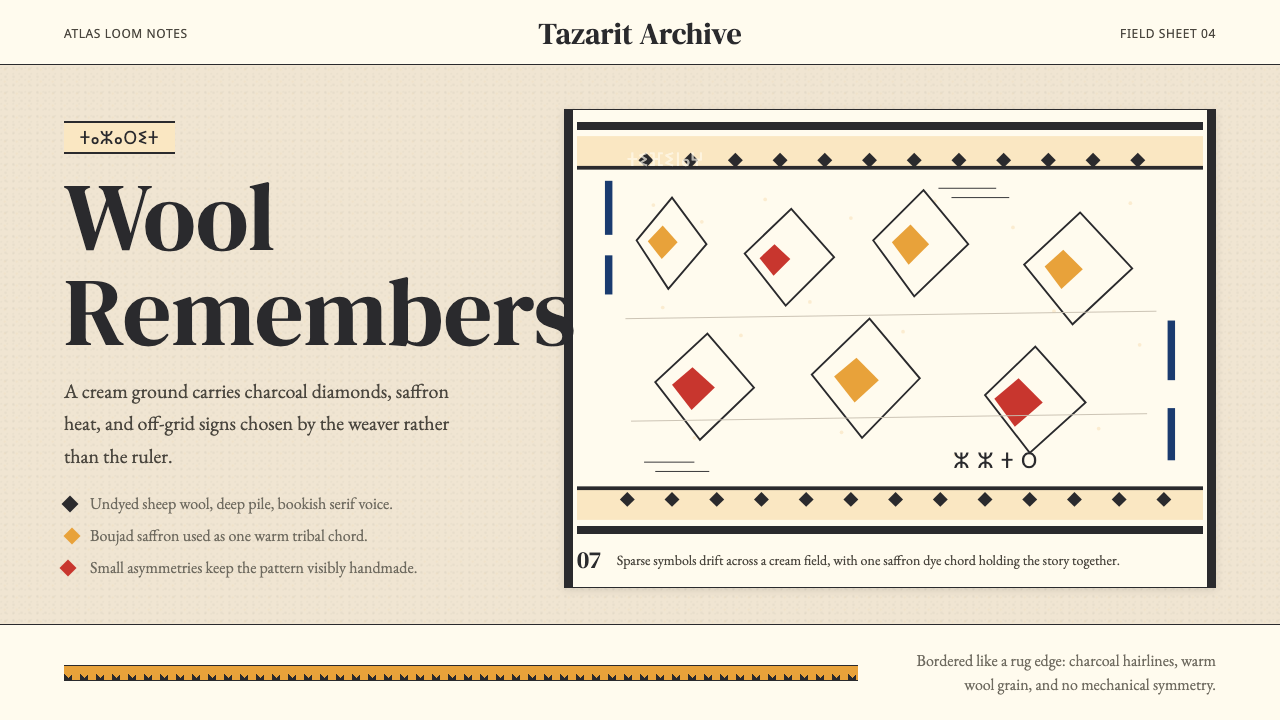 Moroccan Amazigh Berber RugAutobiography in wool. Cream ground, charcoal diamonds, saffron bands drift o…
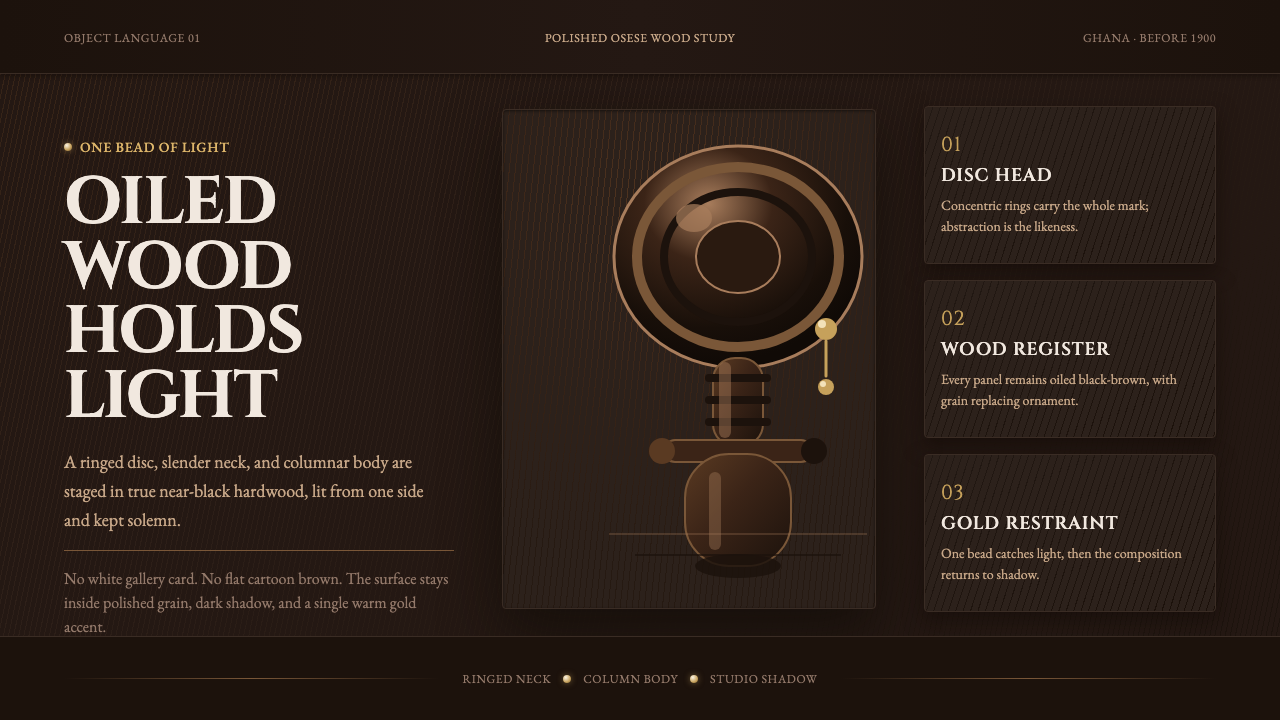 Akuaba Akan Fertility DollDarkness becomes sculpture. Near-black wood, ringed geometry, and one gold be…
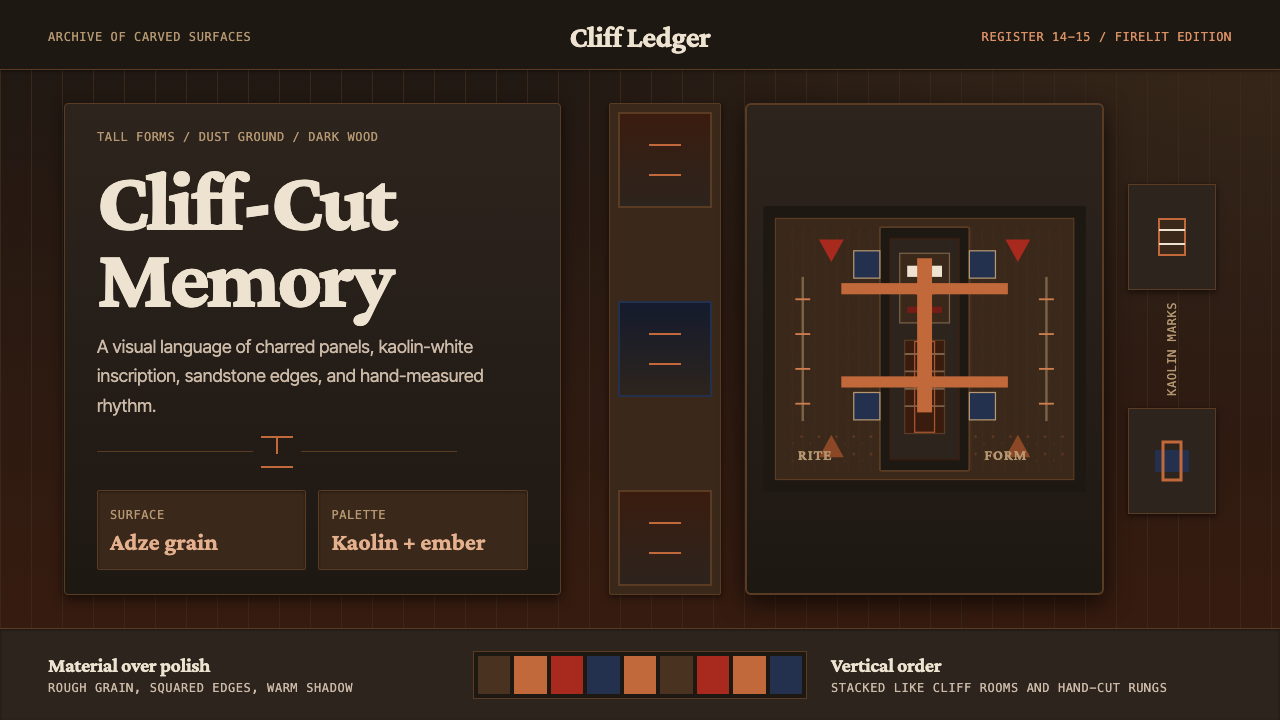 Dogon Bandiagara Cliff MaskHand-hewn gravity. Charred wood, kaolin type, and sandstone geometry stack li…
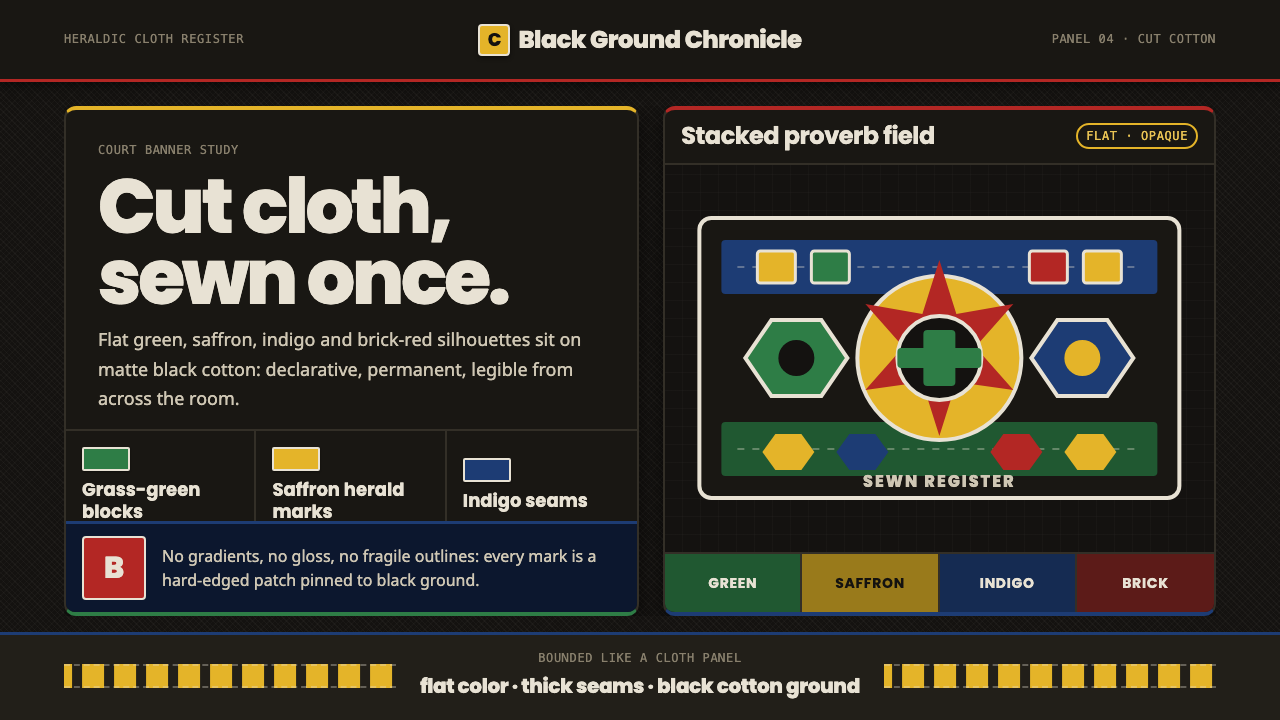 Fon Applique Banner AbomeyRoyal cloth speaks plainly. Flat saffron, green and indigo silhouettes on bla…
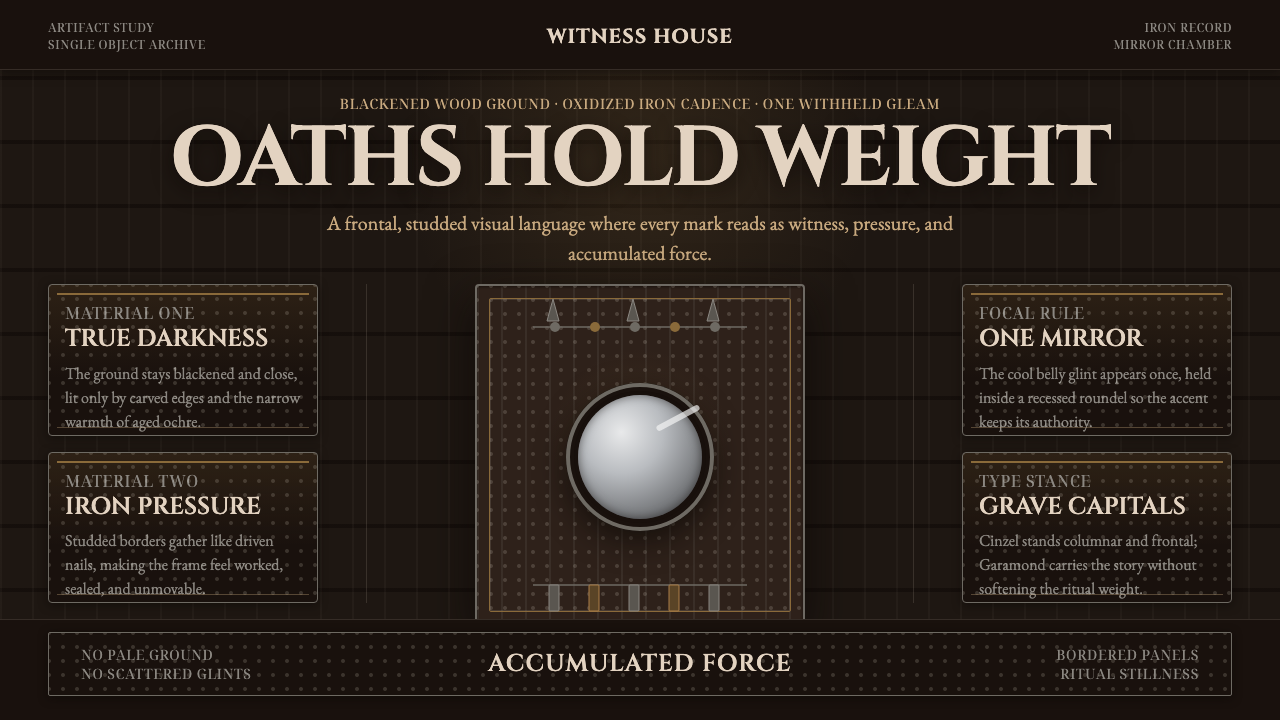 Kongo Nkisi Nkondi FigurePower accumulates in darkness. Black wood, iron studs, and one mirror glint h…
 Senufo Firespitter MaskRitual darkness has heat. Smoked wood tones hold back tiny orange-gold sparks.