What is Moroccan Amazigh Berber Rug?
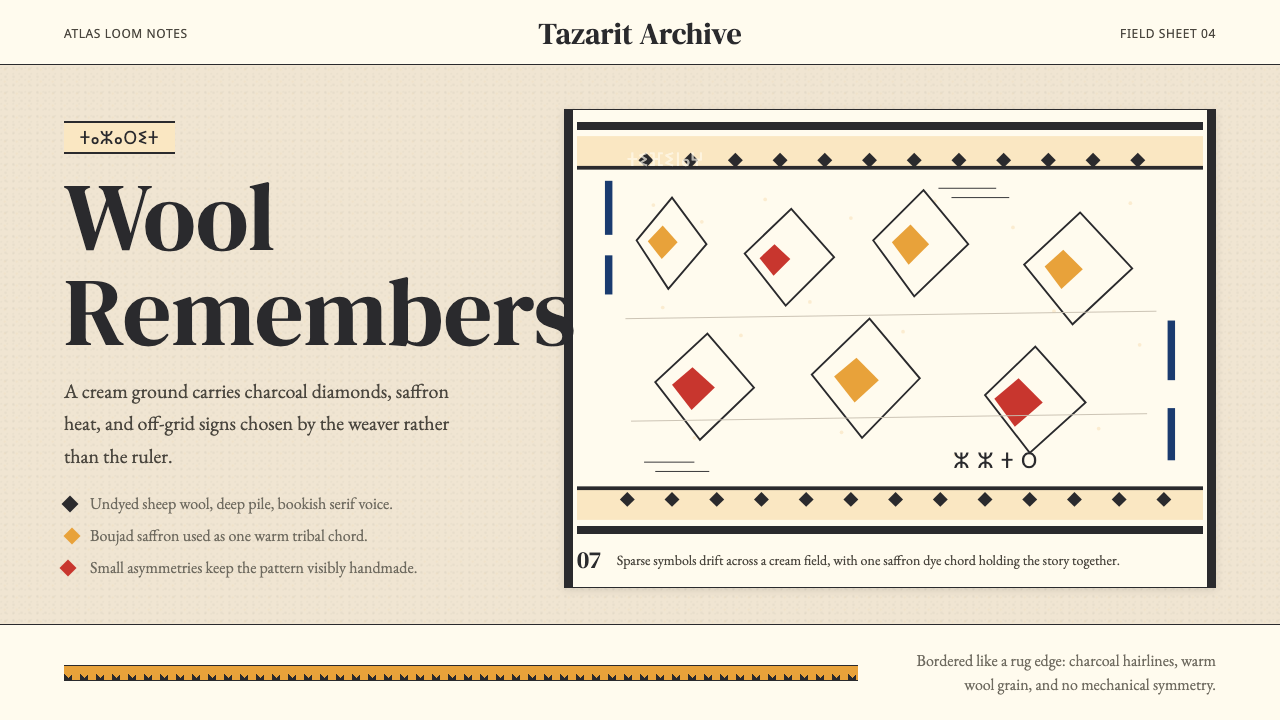
Amazigh women have been weaving their personal histories into wool for millennia — no pattern book, no court commission, just a woman, a loom, and a visual language passed from mother to daughter across the Atlas Mountains.
Moroccan Amazigh Berber Rug in brief
Amazigh Berber rugs are the autobiographical textiles of North Africa — handwoven by Berber women on vertical looms using a pictographic vocabulary of diamonds, zigzags, snakes, scorpions, and evil-eyes that functions simultaneously as personal diary, protective talisman, and tribal identifier. Unlike court weaving traditions from Persia or China, there is no pattern book, no master template, no institutional authority over composition. Each rug is the sole authorship of its maker.
The most globally recognized expression is the Beni Ourain rug from the Middle Atlas plateau: a deep, shaggy pile on an undyed sheep-cream ground, with spare, asymmetric charcoal symbols distributed across the surface with what looks like studied casualness. The off-grid quality — symbols slightly tilted, rows gently uneven — is not imprecision but presence. It records the individual hand.
Beyond Beni Ourain, the tradition splinters into dozens of regional dialects. Boujad rugs from the Middle Atlas warm the palette toward orange and saffron. Zemmour weavings from north of Rabat erupt in dense vermilion-and-cream geometric grids. Beni Mguild textiles bring in deep indigo fields. Boucherouite rugs from the twentieth century recycle scrap cloth into vivid abstract patchwork. Each sub-tradition is a coherent visual language, not a variation on a single master style.

Where does Moroccan Amazigh Berber Rug come from?
The Amazigh — the name means 'free people' or 'noble people' in Tamazight — are the indigenous inhabitants of North Africa, predating the Arab conquest of the seventh century by millennia. Their weaving tradition is among the oldest documented in the region: Roman-era sources note North African woven textiles, and archaeological evidence suggests the practice extends well into prehistoric times. The mountain communities of Morocco — the High Atlas, Middle Atlas, Anti-Atlas, and Rif ranges — developed their textile traditions in relative isolation, which is precisely why they retained such distinctive regional identities.
Weaving in Amazigh culture was and largely remains a female practice. A girl would learn the symbolic vocabulary from her mother and aunts, absorbing the meaning of each motif — the diamond as a protective eye, the zigzag as water and fertility, the snake as guardian of thresholds — as naturally as she learned the language. A woman's rugs constituted a kind of visual autobiography: her marital status, her children, her fears and wishes could be read by those who knew the code. The rugs also served as dowry, insulation against mountain cold, and portable markers of tribal affiliation.
The global recognition of Amazigh rugs is largely a twentieth-century phenomenon, catalysed by two separate forces. The first was the mid-century modernist encounter with Beni Ourain rugs: European collectors and designers in the 1950s and 1960s recognized in the cream-and-charcoal Beni Ourain an accidental resonance with Abstract Expressionism and minimalist design. Pierre Bergé and others collected them seriously; they appeared on the floors of modernist interiors from Paris to New York. The second catalyst was the global interior design market of the 2000s, which canonised the Beni Ourain as the neutral, organic rug for contemporary spaces, driving demand and — as a consequence — industrial imitation.
Scholars and advocates including Bert Flint, who spent decades in Morocco documenting the material culture of Amazigh communities, and the art historian Cynthia Becker, whose research focused on Amazigh visual culture and identity, have worked to establish the rugs not as decorative objects but as cultural texts. Their efforts, alongside those of Amazigh cultural organizations, have contributed to growing recognition of these textiles as a living intellectual and artistic heritage — not a static craft frozen in time, but a tradition that continues to evolve as its makers navigate the twenty-first century.
What defines the Moroccan Amazigh Berber Rug look?
Ground Color
The foundational tone of Amazigh rugs is almost always derived from the natural color of the wool itself — undyed sheep cream, ranging from near-white to warm ivory to a deeper oatmeal. This is not a design choice imposed from outside but a consequence of using the animal's fiber without chemical intervention. The warmth of the ground is variable and alive: no two rugs will share the same exact ground tone because no two flocks share the same fleece. Against this organic warmth, all other marks — charcoal lines, colored bands, knotted accents — register with particular clarity.
Symbolic Vocabulary
The marks that appear on Amazigh rugs are not decorative patterns in the Western sense — they are a system of signs whose meanings are transmitted matrilineally and vary by tribe and region. The diamond is the most universal: it functions as a protective eye, a symbol of femininity, and a marker of the weaver's presence. Zigzag lines evoke water and fertility. Snake motifs guard thresholds and transitions. Scorpion forms invoke protection from harm. The evil-eye appears as a warding device. These symbols may be combined, mirrored, fragmented, or densely massed according to the weaver's intentions — there is no single correct arrangement.
Asymmetric Composition
Persian and Anatolian rug traditions are governed by strict formal symmetry — the medallion-and-field system, the mirror-image border, the exactly repeated unit. Amazigh rugs reject all of this. Symbols drift across the field without anchoring to a central medallion. Bands may appear on one edge and not the other. Motifs are not repeated with mechanical regularity but placed with intuitive spacing. This asymmetry is not disorder — it is a different organizing principle, one that values the improvised decision over the predetermined plan, and that leaves readable traces of the individual hand in the final cloth.
Regional Color Languages
While the Beni Ourain cream-and-charcoal palette is the most globally recognized, it represents only one node in a much broader chromatic tradition. Boujad rugs from the Middle Atlas are saturated with warm oranges and saffron yellows, their colors as vivid as heat. Zemmour weavings from the northern plains compress bold red and cream into dense, repeating geometric tessellations. Beni Mguild rugs from higher elevations introduce deep indigo fields alongside rust, amber, and natural wool. Boucherouite compositions, woven from recycled fabric scraps since roughly the mid-twentieth century, are chromatic explosions — pink, turquoise, green, violet — with an energy closer to outsider art than to traditional craft. Each palette is a cultural signature.
Pile and Texture
The pile of an Amazigh rug is a tactile and visual event in itself. High-pile Beni Ourain rugs have a shaggy, almost architectural depth — the long wool fiber creates a surface that absorbs light rather than reflecting it, so the rug seems to change character depending on the angle of view and time of day. Flat-weave kilim-style Amazigh textiles offer the opposite: a crisp, graphic surface where colors and patterns have hard edges. Between these poles are medium-pile rugs with the warmth of high pile but sharper symbol definition. The choice of pile height was not purely aesthetic but practical — higher pile provided more insulation in mountain winters.
Productive Imperfection
Industrial rug production optimizes toward perfect regularity — each repeat identical, each line straight, each knot counted and even. Amazigh hand-weaving operates by a different standard. Tension variations across the warp produce gentle undulations. A symbol begun on one scale may be completed at another as the weaver adjusts. Rows wander slightly from strict horizontality. These are not failures — they are signatures. The variation that a trained eye can detect between one section of a rug and another is evidence of the weaving session: its rhythm, its interruptions, the moments when something shifted in the maker's thinking or circumstance. An authentic Amazigh rug carries time inside it.
Matrilineal Transmission
The design knowledge embedded in Amazigh rugs is transmitted exclusively through the female line — from mother to daughter, aunt to niece, elder weaver to apprentice. This is not merely a social custom but a structural feature of the tradition: because there is no written pattern manual, the code lives in memory and muscle, and it is reproduced only through direct teaching and observation. This transmission path means that each regional tradition is, in effect, the accumulated intelligence of generations of women from a specific community, continuously edited and extended by each new maker who adds her own symbols, her own scale preferences, her own solutions to compositional problems.

Who shaped Moroccan Amazigh Berber Rug?
The primary authors of this tradition have no individual names in the historical record — they were women living in rural mountain and desert communities whose creative work was understood as craft rather than art by the outside world, and as natural domestic practice by their own communities. Their anonymity is collective, not incidental. The tradition they maintained and evolved across centuries constitutes one of the most significant bodies of pictographic textile art in the world, and recognizing their authorship — even in the absence of individual attribution — is foundational to understanding the rugs correctly.
Bert Flint was a Belgian-born collector and researcher who spent much of his career in Morocco documenting and acquiring Amazigh material culture. His collection, which he donated to the Agadir Amazigh Museum and the Tiskiwin Museum in Marrakech, constitutes one of the most systematic archives of Moroccan Berber textiles, jewelry, and household objects assembled in the twentieth century. Flint's approach treated the rugs as primary cultural documents rather than decorative commodities — a framing that influenced subsequent scholarship and helped legitimize the academic study of Amazigh visual culture.
Cynthia Becker is an American art historian whose scholarship focuses on Amazigh visual culture, identity, and the politics of cultural recognition. Her research engages with questions of how Amazigh communities have asserted and maintained cultural identity through visual practice under successive waves of external political and cultural pressure — Arab, French colonial, and Moroccan nationalist. Her work has been significant in positioning Amazigh textile arts within a broader framework of indigenous rights and cultural heritage, moving the conversation beyond aesthetics into questions of sovereignty and self-representation.
Pierre Bergé, the business partner and companion of Yves Saint Laurent, was among the most prominent European collectors of Moroccan Amazigh objects in the second half of the twentieth century. The YSL-Bergé household at the Villa Oasis in Marrakech, with its floors and walls draped in Amazigh textiles, became an influential image of the Berber aesthetic in the world of international design and fashion. The 2009 auction of the YSL-Bergé collection brought significant international attention to Moroccan decorative arts, including Amazigh rugs, and contributed to the sharp rise in their market valuation in subsequent years.
Bruno Barbatti is a dealer and advocate based in Morocco who has worked at the intersection of Amazigh textile commerce and cultural documentation. His work exemplifies the complex position of the serious specialist in a market that has increasingly been flooded with machine-made imitations: the task of distinguishing authentic handwoven pieces from industrial copies, and of communicating the cultural significance of the authentic object to buyers who may initially be drawn to the aesthetic alone. Barbatti's contributions reflect the broader challenge of sustaining indigenous craft traditions within a globalized marketplace that simultaneously elevates and commodifies them.
How do you use Moroccan Amazigh Berber Rug today?
The Amazigh Berber rug aesthetic translates into digital and print design through a particular set of visual values: organic warmth rather than clinical coolness, deliberate imperfection over mechanical precision, symbol-as-meaning rather than ornament-as-decoration, and a layered textural quality that reads as handmade rather than generated. Applying this style well requires understanding what it is actually doing culturally — respecting its pictographic logic rather than reducing it to a surface pattern.
For presentation slides, the Amazigh rug aesthetic works best as a backdrop sensibility rather than a literal transcription. Cover slides benefit from the cream-ground approach: a warm off-white field, generous negative space, and a single strong geometric motif — diamond, zigzag, or repeating lozenge band — used as a compositional anchor rather than allover coverage. Content slides should maintain the warmth of the ground and use sparse, bold symbols to organize hierarchy rather than relying on boxes or dividers. Data slides can draw on the weaving tradition's geometric vocabulary: bar segments and category markers rendered as angular, handcraft-quality forms rather than smooth digital shapes, evoking the visual texture of a woven grid.
For web interfaces and dashboards, the style suits platforms where warmth, cultural authenticity, and artisanal quality are brand values — travel platforms, design marketplaces, food and wellness brands with a connection to North African or broader Mediterranean culture. A dashboard in this mode uses a warm near-neutral ground, card elements with slight texture rather than flat white, and typographic hierarchy that leans toward generous spacing and variable weight rather than tight grid compression. Pricing pages benefit from the vocabulary of banded structure — horizontal registers in alternating warm tones, with key information isolated in a high-contrast field the way a dominant motif floats against the ground of a rug.
For editorial and marketing work, the Amazigh visual language is well suited to feature photography contexts where the rug itself or related artisanal textures appear. A layout in this style uses warm cream or aged-parchment grounds, anchors its visual hierarchy in bold geometric forms derived from the rug vocabulary, and treats photographic imagery as a textural element — cropped tightly, given rough or irregular frame treatment, integrated with the background rather than floating above it. Marketing campaigns can draw on the style's deep layering: overlapping symbols, banded text sections, and a deliberate tension between regularity and variation that gives the work energy without chaos.
A common mistake when adapting the Amazigh rug aesthetic is reducing it to a pattern-tile exercise — taking a diamond or chevron motif and repeating it across a surface as a seamless geometric fill. This misses the point entirely. Authentic Amazigh composition is asymmetric, intentional, and sparse: each symbol is placed with purpose, and the ground — the cream field — is as much a part of the design as the marks. Over-patterning collapses the tension that gives the style its power. Similarly, mistaking maximalist colorfulness for authenticity leads to work that resembles generic global-craft decoration rather than the specific visual intelligence of Amazigh textile tradition. Choose one regional color language — the Beni Ourain palette, the Zemmour red-and-cream, or the Boujad warm-orange register — and commit to it rather than blending all traditions simultaneously.
A second common error is applying the aesthetic as pure decoration without acknowledging its symbolic dimension. The most resonant uses of this style in design maintain some legibility of meaning — using the diamond motif as a protective or focal element, the zigzag as a rhythmic connector, the banded register as a marker of section or status. Designs that treat the symbols as arbitrary shapes produce work that is visually busy but semantically empty. The tradition's power comes from the coherence between mark and meaning; even in a contemporary digital context, carrying some of that intentionality forward produces more compelling results.

Moroccan Amazigh Berber Rug — FAQ
How do I distinguish an authentic handwoven Amazigh rug from a machine-made imitation?
Several physical characteristics separate handwoven from machine-made. On the back of an authentic rug, knots are individually visible and slightly irregular — no two are perfectly identical. The pile height varies subtly across the surface rather than being uniform. Slight warp undulation is visible when the rug is laid flat; machine-made rugs lie perfectly flat because the tension is mechanically consistent. The wool of an authentic rug has a natural lanolin quality — slightly waxy to the touch — that synthetic fiber cannot replicate. Composition asymmetries are a further indicator: symbols that drift, bands that are not perfectly parallel, a field that is not perfectly rectangular. In a market context, price remains a rough guide — genuine antique or high-quality contemporary Amazigh rugs command significant prices, and implausibly cheap alternatives almost certainly involve industrial production.
Is using Amazigh rug motifs in design work culturally appropriate?
This is a serious question without a simple answer. The symbols in Amazigh rugs carry specific protective and biographical meanings within their source culture — they are not abstract geometric shapes invented for visual pleasure. Using them in commercial design without acknowledgment of their origin and meaning reduces a living cultural system to surface decoration. The most defensible approach is to engage with the visual language as inspiration derived from a specific tradition, to credit that tradition explicitly in contexts where attribution is possible, and to avoid directly reproducing individual sacred or protective symbols in commercial contexts where the cultural significance would be lost entirely. Working with Amazigh makers and designers when possible — commissioning rather than copying — is a substantially more ethical path.
What makes the Beni Ourain rug so specifically suited to contemporary minimalist interiors?
The Beni Ourain's appeal to minimalist sensibility rests on several structural coincidences between the traditional rug and modernist aesthetics. The undyed cream ground reads as neutral — it does not introduce color into a space, only warmth and texture. The sparse charcoal mark-making has the quality of abstract drawing: it looks intentional without being decorative in the period-furniture sense. The asymmetric composition avoids the centripetal pull of medallion rugs, which anchor a room's geometry too firmly. And the deep pile introduces tactile richness without visual complexity. The irony is that these qualities emerged not from a minimalist design intention but from a set of material and cultural practices — using undyed wool, marking in natural dye, composing intuitively — that happen to produce an aesthetic resonant with twentieth and twenty-first century reduction.
How does the Amazigh rug tradition differ from other North African textile traditions?
The most significant distinction is authorship and system. North African urban weaving traditions — including the formal workshop traditions of Fez and other imperial cities — were typically male, guild-organized, and governed by established pattern vocabularies transmitted through institutional training. Amazigh mountain and rural weaving was female, domestic, individually improvised, and transmitted matrilineally outside any formal institution. The visual results differ accordingly: urban Moroccan textiles tend toward formal symmetry, dense allover pattern, and refined technical execution. Amazigh rugs tend toward asymmetry, symbolic sparseness, and a visual rawness that prioritizes expressive mark over technical polish. The Amazigh tradition is also more pictographically narrative — each rug tells something specific about its maker — whereas formal urban weaving tends toward abstract geometric pattern that demonstrates technical mastery without biographical content.
What is Boucherouite, and how does it fit within the broader Amazigh tradition?
Boucherouite — the term derives from a Moroccan Arabic phrase meaning 'a piece torn from used clothing' — refers to rugs woven from recycled textile scraps rather than spun wool. The practice developed primarily in the twentieth century as a response to economic constraints: wool was expensive, but fabric waste was abundant. The aesthetic result is wildly chromatic — synthetic dyes in fabric scraps produce saturated pinks, electric blues, acid greens, and vivid oranges that wool traditions never achieved. The compositions are often more abstract and less symbolically legible than wool rugs, though they maintain the improvisational asymmetric spirit of the broader Amazigh tradition. In the design world, Boucherouite rugs have attracted significant interest from collectors of outsider art and contemporary textile art precisely because their energy is so far from the refined and the traditional — they look like something that happened, rather than something that was planned.
Related design styles
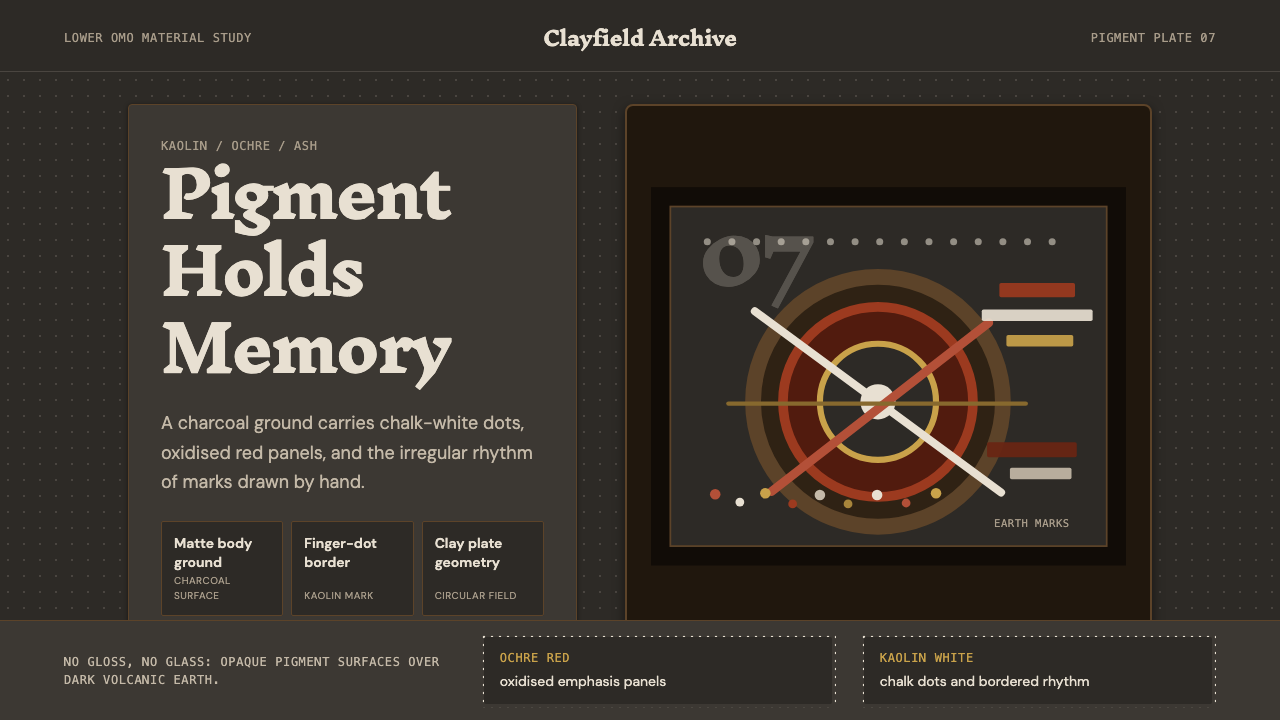 Mursi Omo Valley Lip Plate PaintRaw dignity, matte and proud. Kaolin dots and ochre rings sit on charcoal gro…
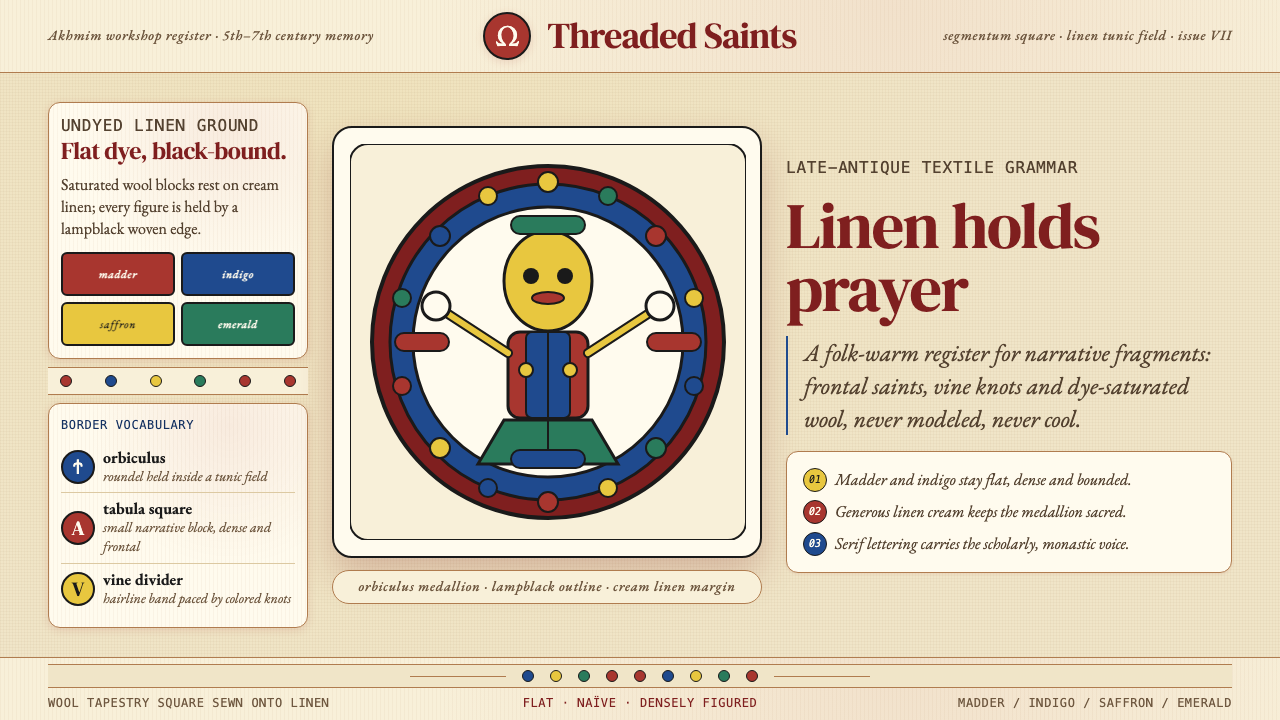 Egyptian Coptic TextileWarmth woven flat. Madder, indigo and saffron medallions sit on linen cream.
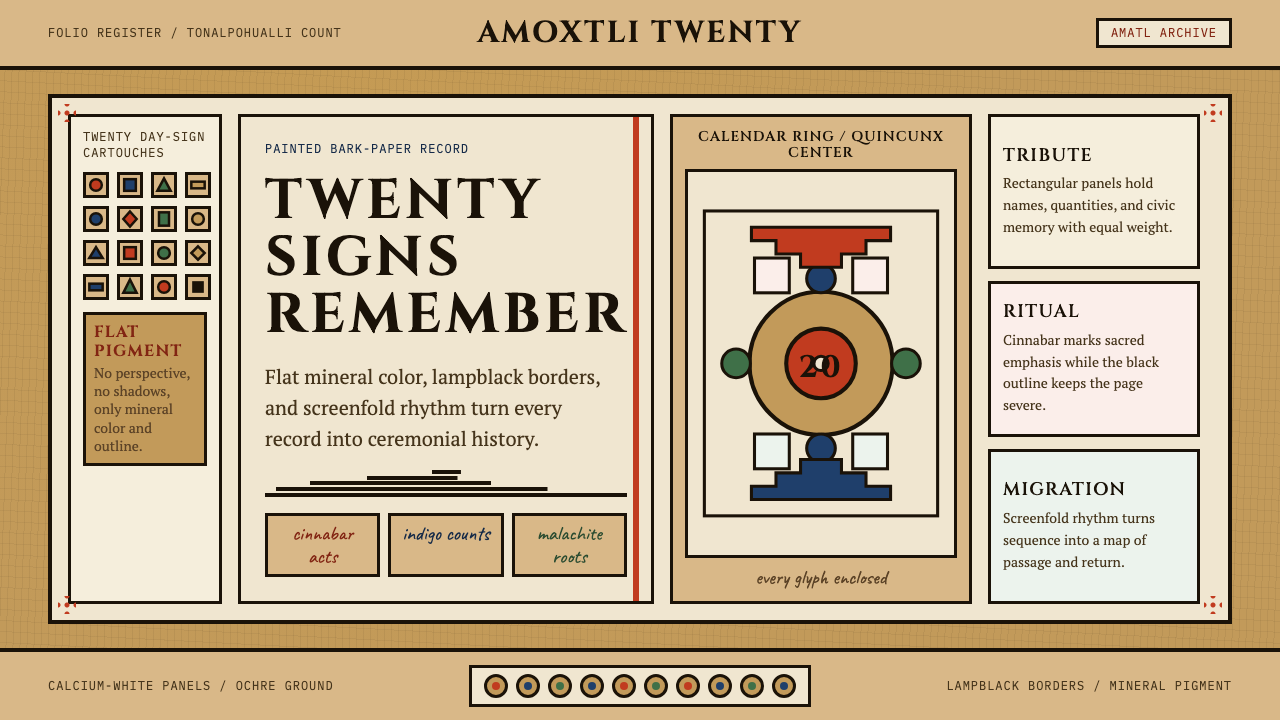 Aztec CodexSacred records stay severe. Ochre amatl ground, Cinzel capitals, black cartou…
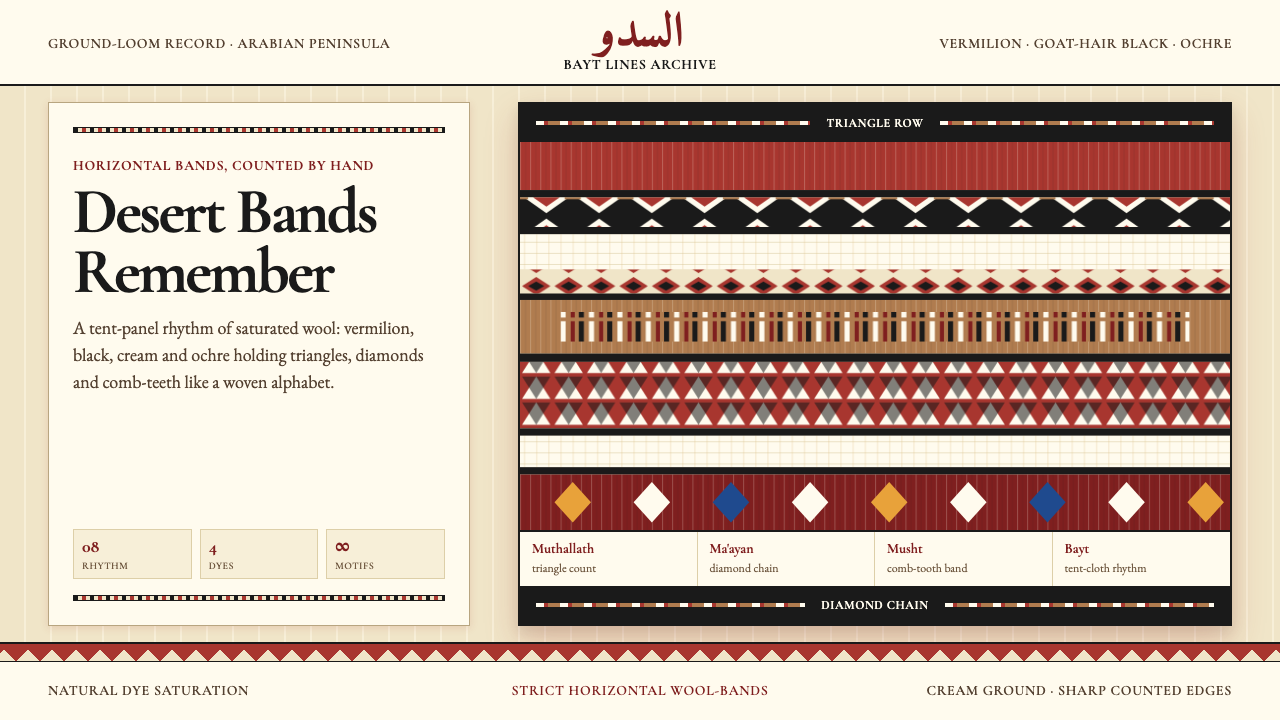 Bedouin Desert Textile (Sadu)Woven memory, not ornament. Vermilion-black bands count triangles and diamond…
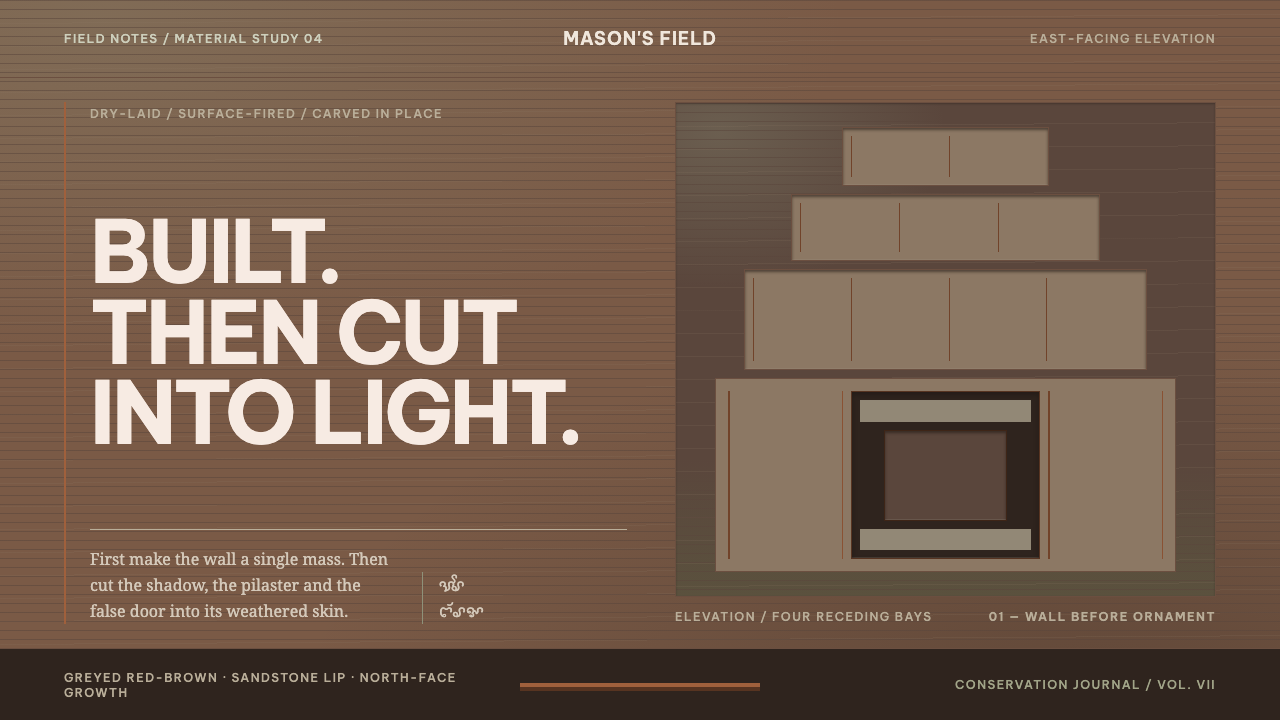 Cham My Son TowersWall before ornament. Greyed brick bays recede around cut shadows and sandsto…
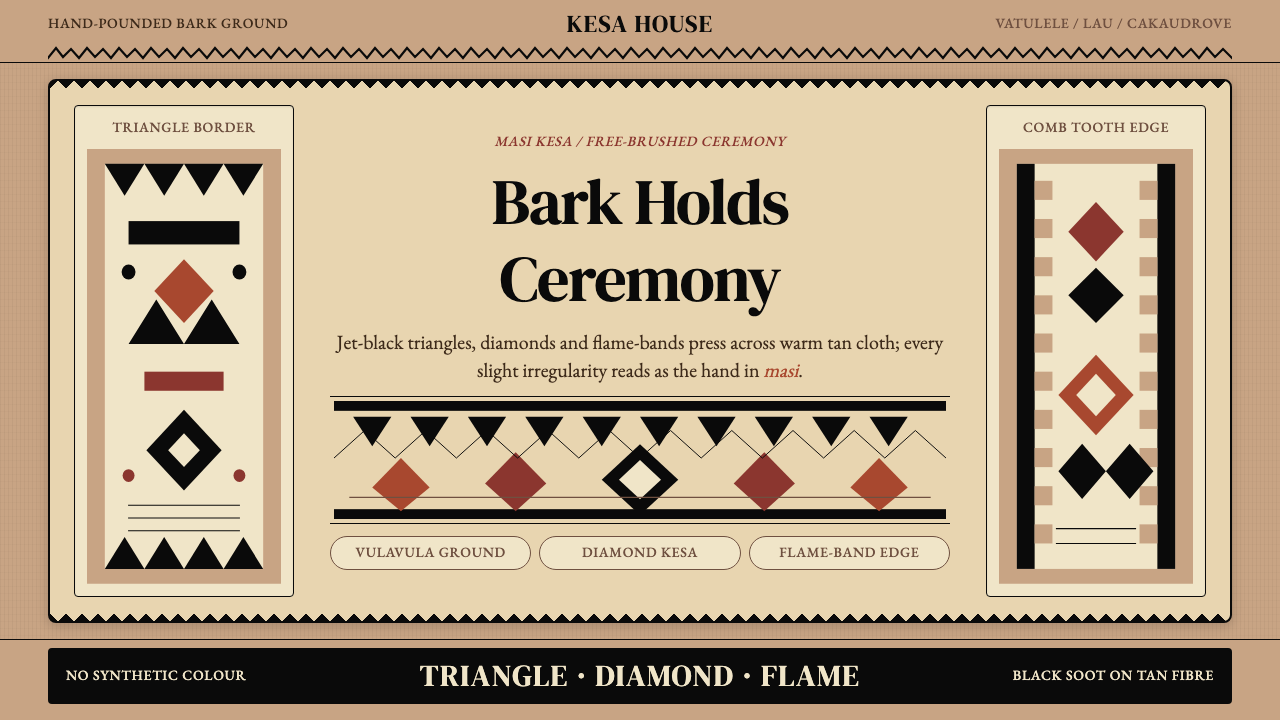 Fijian Masi (Tapa Cloth)Ceremony hits in black. Tan bark ground carries diamonds, zigzags and flame-b…