What is Syrian Aleppo Laurel Soap?
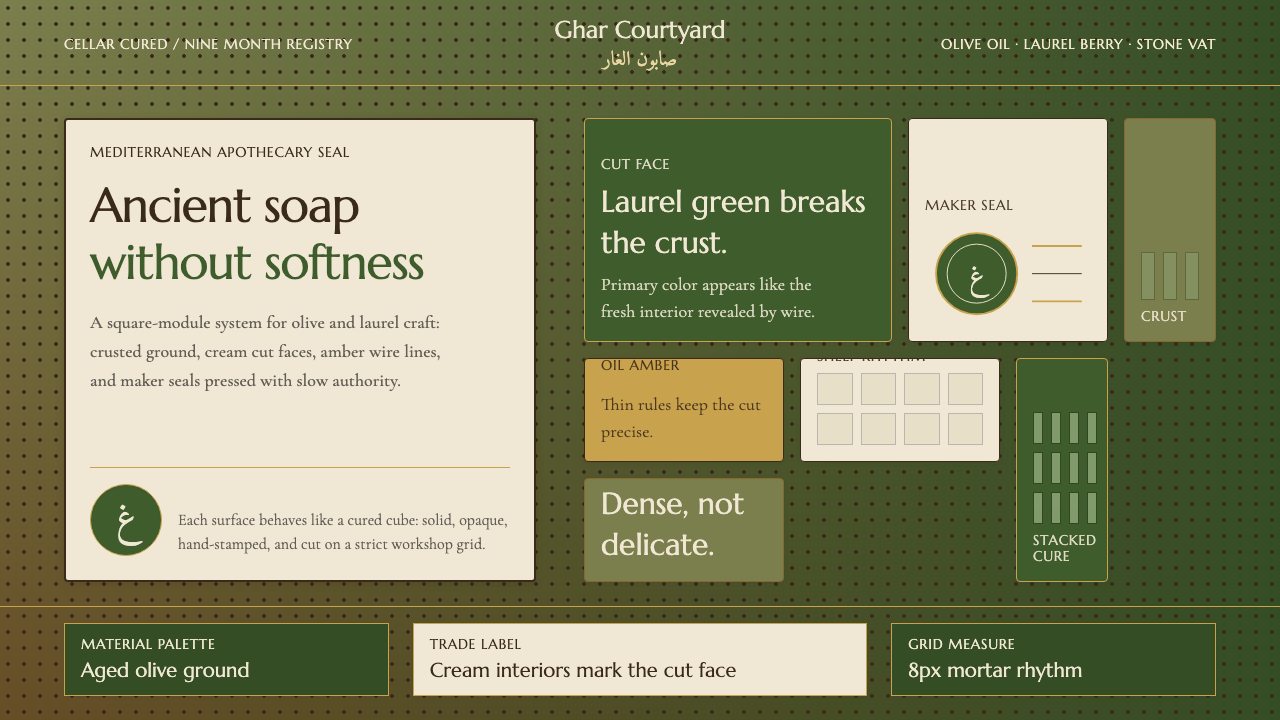
Aleppo laurel soap — the world's oldest documented soap — pressed from olive groves and laurel forests into a design language of earth-cured cubes, stamped seals, and a palette that only reveals its true green when you cut it open.
Syrian Aleppo Laurel Soap in brief
Syrian Aleppo Laurel Soap is a design style rooted in the visual and material culture of Aleppo's ancient stone-workshop soapmaking tradition. For centuries, master soap-makers in the Bab Antakia and Jdeydeh quarters of Aleppo have pressed olive oil and laurel berry oil together, stacking the cured blocks in cathedral-like towers to age for nine months or longer. The design system distills this craft into a visual language: cubes arranged like ancient ashlar masonry, an olive-brown exterior that conceals a rich interior green, and the unmistakable authority of a stamped maker's seal.
What distinguishes this aesthetic from other craft-inspired styles is its refusal of softness. Spa aesthetics and modern wellness branding borrow earthy tones and round them into something gentle and approachable. Aleppo soap design does the opposite — its palette is earned, mineral, and slightly severe. The olive-brown crust is not warm or welcoming; it carries the weight of a nine-month cure in a stone warehouse. The laurel green that appears on the cut face is unexpected, almost medicinal, certainly ancient. Cream appears only in controlled doses, like the clean interior of a freshly sliced block.
As a design system, it operates through the visual grammar of workshop craft: the weight and proportion of a carved seal, the stacking geometry of cured cubes, the contrast between aged surface and revealed interior. Every element is stamped, pressed, or stacked — nothing is painted on for decoration. The result is a style that reads as both archaic and contemporary, at home in heritage branding, artisanal product packaging, and editorial design that values material honesty over trend-driven surface treatment.
Where does Syrian Aleppo Laurel Soap come from?
Aleppo soap's documented history reaches back to at least the twelfth century, though oral tradition and some historians place its origins considerably earlier, in the pre-Islamic Levantine world where olive cultivation and laurel forests overlapped in the hill country around Aleppo. The Crusaders who passed through the city in the eleventh and twelfth centuries encountered the soap and brought it back to Europe — it is widely credited as a forerunner of Marseille soap and Castile soap, both of which adopted the olive-oil base while dispensing with the laurel. Aleppo thus occupies a unique position in the history of Western personal care: not merely old, but generative.
The production method that defines the soap's character also defines its visual identity. Olive oil and laurel berry oil are cooked together in large stone vats, then poured across the floors of underground cellars where the liquid soap hardens into a solid slab. Workers then cut the slab into individual bars using long-handled tools and stack the bars in towering formations to cure. During curing, the exterior oxidizes to a deep olive-brown — sometimes nearly black — while the interior remains a vivid green. Each bar is stamped with the maker's seal before curing. The resulting object is not a commodity bar of soap; it is a document of time, craft, and regional identity.
The guild system that sustained Aleppo soapmaking through the Ottoman period produced specific family names synonymous with the trade. The Zanabili and Fansa families operated workshops in the Bab Antakia district for multiple generations. Adib Dada and Constantin Zanabili are among the master soap-makers whose names appear in twentieth-century accounts of the craft. The guild structure enforced quality standards: the ratio of laurel oil to olive oil — expressed as a percentage — became a mark of grade, with higher laurel content indicating higher quality and commanding a premium. This grading logic, written into the stamped seal itself, is one of the oldest forms of product certification in the world.
The Syrian civil war, which began in 2011, devastated Aleppo's historic soapmaking districts. The ancient stone warehouses in Bab Antakia and Jdeydeh were damaged or destroyed. Many master soap-making families fled to Turkey, Lebanon, and further afield, attempting to continue production in exile. Some succeeded; others did not. What survives of Aleppo soapmaking today is geographically dispersed and institutionally fragile. The design tradition this style draws from is therefore not merely historical — it is actively endangered, which gives the aesthetic register a dimension of witness and memory that most craft-revival design systems do not carry.
What defines the Syrian Aleppo Laurel Soap look?
Palette
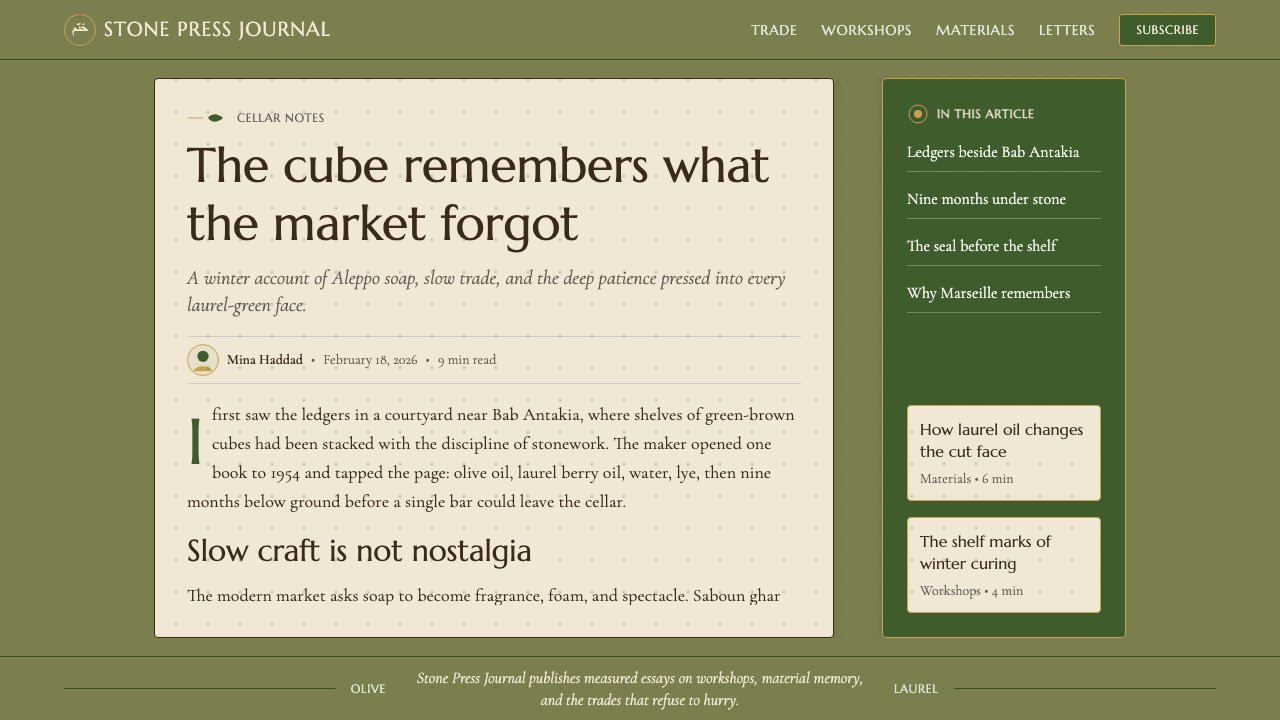
The color system is built around the life cycle of the cured bar. Aged olive-brown — sometimes tipping toward near-black — anchors the palette as the dominant surface tone, evoking the oxidized exterior of a nine-month-cured block. Laurel green, unexpected and slightly medicinal in character, serves as the primary accent, revealed only at cut edges or interior fields — never spread broadly. Cream is reserved for interior zones: card surfaces, text fields, inset panels. The palette refuses warm beige or spa green; its greens lean cool and botanical rather than friendly or soft.
Form and Geometry
The dominant form is the cube and the rectangular block — not as an abstract modernist gesture, but as a direct reference to the stacked, cut bars of soap themselves. Layouts favor stacking and stratification: elements sit on top of one another with clear horizontal divisions rather than floating in open space. Circles appear specifically as the stamp motif — the pressed maker's seal — used as medallions, watermarks, or focal points rather than as general decorative shapes. Nothing rounds softly; corners are decided and straight.
Texture and Surface
The style acknowledges texture, but only as visual fact rather than decorative effect. The aged crust of the soap bar — rough, uneven, slightly mineral in its surface quality — informs the handling of background areas and container edges. This means surfaces may carry a faint grain or patina suggestion, but never a smooth, polished finish. The contrast between the rough exterior and the clean interior is the defining textural gesture of the style: outside is aged and worn; inside, once cut, is fresh.
Typography
Type in this system carries the weight and presence of carved or stamped letterforms — think inscriptions pressed into wax or cut into stone, not letterforms rendered for screen lightness. Serifs are appropriate and even preferred, particularly those with a classical or lapidary quality, though they should carry visible mass rather than delicacy. Arabic script, where used, draws from historical calligraphic traditions appropriate to the Levantine origin of the material. Type weight and size contrast is used to signal hierarchy, but always within a restrained range — nothing shouts, everything declares.
Stamp and Seal Motif
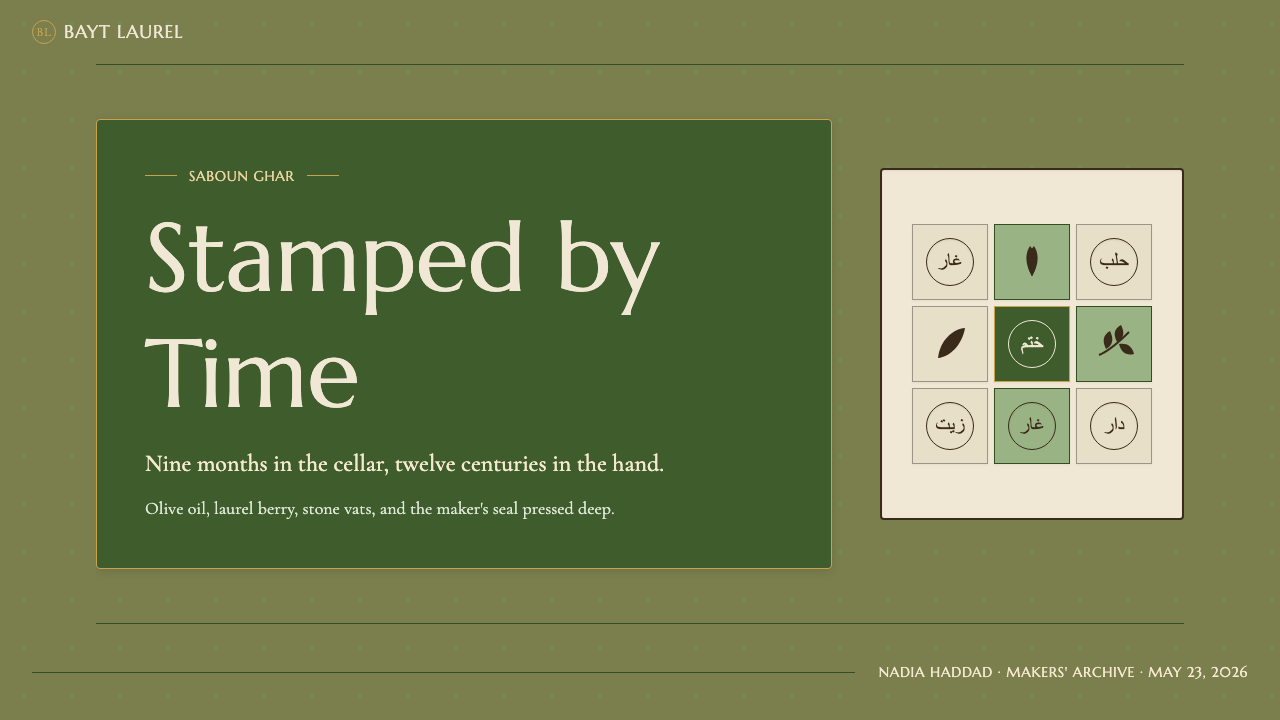
The maker's seal is the system's most distinctive signature element. Every bar of authentic Aleppo soap carries a stamped circle or cartouche identifying the producer, the laurel-to-olive ratio, and often the year of production. Translated into design, this becomes a recurring circular badge — used for producer credits, quality marks, edition indicators, or simply as the visual anchor of a composition. The seal should feel pressed rather than printed: slightly imperfect at its edges, suggesting physical force, not digital rendering.
Composition and Layering
Compositions in this style are layered vertically — like stacked soap bars — rather than spread horizontally or arranged in floating grids. The visual logic moves from exterior to interior: the frame or container is the aged crust, and the content within is the revealed green interior. Information hierarchy follows this logic: outer zones are darker and more textured, inner zones are lighter and cleaner. There is no visual breathing room achieved by floating elements in whitespace; instead, space is created by controlled stratification.
Restraint Without Warmth
Perhaps the most important characteristic to internalize: this is not a cozy or inviting style. It shares material references with natural and artisanal design movements, but its emotional register is closer to old civic architecture than to a farmers' market aesthetic. The restraint is that of a centuries-old workshop, not a contemporary wellness brand. This means resisting the temptation to soften — to add a warmer cream, a rounder corner, a friendlier green. The severity is the point. When softened, the style collapses into generic earth-tone design and loses what makes it specific.
Who shaped Syrian Aleppo Laurel Soap?
The Zanabili family operated one of the most prominent soapmaking workshops in Aleppo's Bab Antakia district across multiple generations. Their name became synonymous with quality production in the region's guild system. Constantin Zanabili was among the master soap-makers documented in twentieth-century accounts of the craft, representing a lineage of production that spanned the Ottoman period through the modern era. The family's workshops exemplified the guild tradition of linking maker identity to product through the stamped seal.
Another of the great soap-making dynasties of Aleppo, the Fansa family maintained workshops in the historic quarters of the city through the Ottoman and modern periods. Their production contributed to Aleppo's reputation as the center of quality laurel soap manufacture in the Levant. The Fansa name appears in guild records and trade documentation that trace the transmission of recipe ratios, curing methods, and seal design from one generation to the next — demonstrating that the visual identity of the soap was as carefully maintained as its formula.
Adib Dada is among the named master soap-makers whose craft was documented in twentieth-century records of Aleppo's soapmaking traditions. Figures like Dada represent the last fully trained generation of masters to have learned the craft within the intact guild system of pre-war Aleppo. Their practice carried the full vocabulary of Aleppo soap production — the timing of the cook, the ratio of oils, the geometry of the cut, the design of the stamped seal — and their displacement following the Syrian civil war placed that knowledge at acute risk of loss.
Rather than a single individual, the broader Levantine craft tradition of combining olive oil and laurel berry oil represents a collective authorship spanning centuries. This tradition — which gave rise not only to Aleppo soap but to its European descendants, Marseille soap and Castile soap — originated in a region where both crops grew in close proximity and where trade networks moved finished goods across the Mediterranean world. The design visual language of the style thus inherits from an entire regional craft ecology, not a single workshop or inventor.
The historical connection between Aleppo soap and Marseille soap — the famous French soap whose visual and product identity became a global reference in the nineteenth and twentieth centuries — is design-historically significant. Marseille soap adopted the olive-oil base introduced by Levantine production but replaced laurel with fragrance and developed its own stamp-and-seal tradition, its own stacking visual, and its own earth-toned palette. Tracing this lineage helps clarify what is specifically Aleppo's: the laurel green, the oxidized crust, the maker's seal used as grade certification rather than mere branding.
How do you use Syrian Aleppo Laurel Soap today?
Applying the Aleppo laurel soap aesthetic correctly requires understanding its core tension: it is a heritage style that is also unusually austere. The visual reference points are ancient and artisanal, but the emotional register is not nostalgic or cozy — it is weighted, material, and slightly severe. Design work in this style should feel as though it has been pressed rather than assembled, cured rather than launched. The design decisions that flow from this understanding are specific: commit to the olive-brown and laurel-green palette without softening either into friendlier variants, use the stamp motif with purpose rather than decoration, and never allow the texture references to tip into generic craft-market aesthetics.
For presentation slides, the style works best for heritage brands, artisanal product launches, and cultural or documentary contexts where craft history and material provenance are central to the story. Cover slides benefit from the stacked-block compositional logic: a dominant olive-brown field anchored by a stamped circular seal, with the presentation title in weighty serif type. Content slides should be treated as stratified layers — darker header zones giving way to lighter content areas, like the exterior-to-interior reveal of a cut soap bar. Data slides can adopt the stacking metaphor directly: bar charts rendered as layered block forms in the olive-brown and laurel-green range, with cream as the neutral ground.
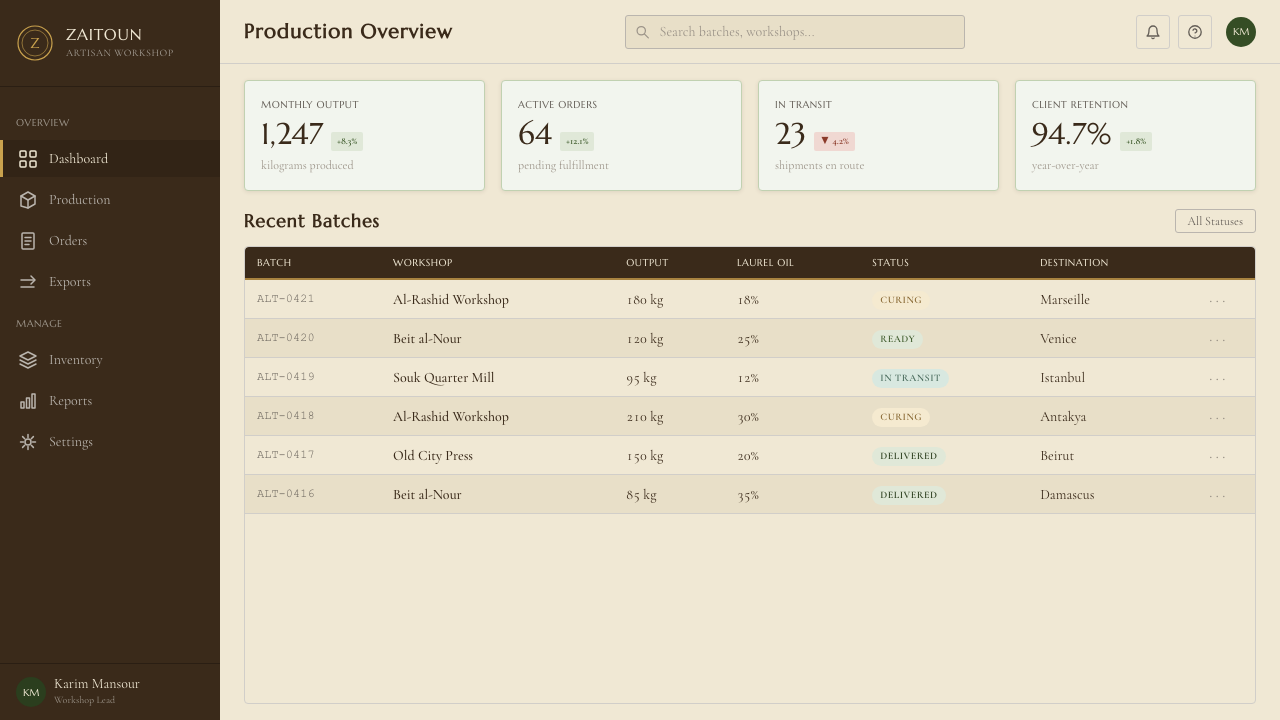
For web interfaces and dashboards, the style is well-suited to heritage brand websites, artisanal e-commerce platforms, and cultural institution sites where gravitas and material honesty matter more than approachability. The grid should be tight and vertical rather than airy; cards use the exterior-interior contrast — darker outer shell, lighter inner content area — rather than the flat-on-white treatment of contemporary minimal design. The stamp motif functions naturally as a badge or certification mark in product listings, quality tier indicators, or producer attribution. Navigation should be typographic and slightly formal; icon use should be minimal and when present, should favor geometric or seal-like forms over friendly rounded pictograms.
For editorial and marketing design, this style suits contexts where the reference to craft, provenance, and durability is the primary message. A heritage brand's editorial layout might alternate full-width olive-brown fields — carrying large stamped-circle medallions or producer names in high-contrast type — with cream-ground content areas holding the detailed story. Marketing pages for artisanal products can use the crust-to-interior reveal as a structural metaphor: the hero section is dark and weighty, establishing the exterior character, and subsequent sections become progressively lighter as the content moves from atmosphere to detail to offer. The style pairs naturally with rich photography of the physical product — weathered surfaces, cut cross-sections, hands at work — when photography is handled as a geometric element cropped to block proportions rather than as a lifestyle scenic.
The most common mistake when applying this style is defaulting to generic earth-tone aesthetics by softening the palette. Swapping the mineral olive-brown for warm terracotta, the cool laurel green for sage or avocado, or the cream interior for warm ivory produces a result that looks indistinguishable from dozens of contemporary wellness and natural-products brands. The distinctiveness of Aleppo soap design comes from the precision of its specific palette and the severity of its composition — not from a broad gesture toward earthiness. A second common mistake is treating the stamp motif decoratively rather than functionally, scattering circular seal shapes across a layout without the purpose they carry in the source tradition. Each seal in the original context carried specific information; in design, the stamp motif works only when it designates something.
Syrian Aleppo Laurel Soap — FAQ
How does this style differ from other Mediterranean or artisanal craft design aesthetics?
Most Mediterranean craft design aesthetics trend toward warmth and hospitality — terracottas, warm whites, rounded forms, and a generally inviting emotional register. Aleppo soap design is defined by its refusal of warmth. The olive-brown it draws from is specifically the oxidized, mineral-tinged crust of a nine-month cure, not a friendly earthenware brown. The green is cool and botanical, not the cheerful sage of a kitchen herb garden. The composition references ancient masonry and guild documentation, not open-air market abundance. When you soften any of these specific choices toward warmth, you leave the style and enter a generic Mediterranean craft aesthetic that has been thoroughly colonized by wellness branding.
Is this style appropriate for digital products, or is it primarily suited to print and packaging?
The style translates well to digital contexts, but it requires specific adaptation. The texture references — aged surface, mineral grain — need to be handled with restraint in screen environments, where overuse of texture can read as visual noise rather than material character. The stamp motif works exceptionally well as a badge component in digital product UI. The exterior-to-interior compositional logic — darker outer container, lighter inner content — maps naturally onto card and modal design patterns. Where the style struggles in digital is in contexts that demand high interactivity density or micro-animation richness; the weighted, press-and-cure quality of the aesthetic is better served by stillness than by motion.
What is the significance of the laurel-to-olive ratio, and how does it translate into design?
In traditional Aleppo soap, the percentage of laurel berry oil relative to olive oil is the primary quality indicator. Higher laurel content — which produces a greener, more medicinal soap — signals superior grade and commands a higher price. The ratio is typically stamped directly on the bar as a number. In design terms, this grading logic translates into the idea that the presence of laurel green is not arbitrary — it should signal something, be earned by context. A layout that uses laurel green sparingly and purposefully carries more authority than one that spreads it broadly. The color should appear where quality or distinction is being declared, not as a general accent.
How should this style handle photography?
Photography in this system should be treated as material evidence rather than lifestyle scenery. The most effective imagery is close-up and specific: the weathered surface of an aged soap bar, the cross-section of a freshly cut block revealing the color contrast between exterior crust and interior green, hands pressing a seal into soft soap, the geometry of stacked curing bars. This kind of photography should be cropped to block proportions and integrated into the compositional grid as geometric elements rather than used as full-bleed lifestyle backgrounds. Color-grading should lean toward the cool-mineral range of the palette, pulling saturation out of warm registers and emphasizing the olive-green and brown tones.
Does using this style carry any ethical or cultural responsibility given the current situation in Aleppo?
It does, and designers working in this aesthetic should be aware of the context. Aleppo soap is not a safely historical craft — it is a living tradition that was severely disrupted by the Syrian civil war beginning in 2011. Many of the workshops, families, and guild structures that defined this tradition have been damaged, displaced, or destroyed. Using the visual language of this craft without acknowledging its source is a form of cultural appropriation; using it while actively crediting the tradition — naming the specific workshops, the families, the geographic origin — is something closer to cultural amplification. The design system is most authentically applied when it carries the weight of its origin rather than wearing it as costume.
Related design styles
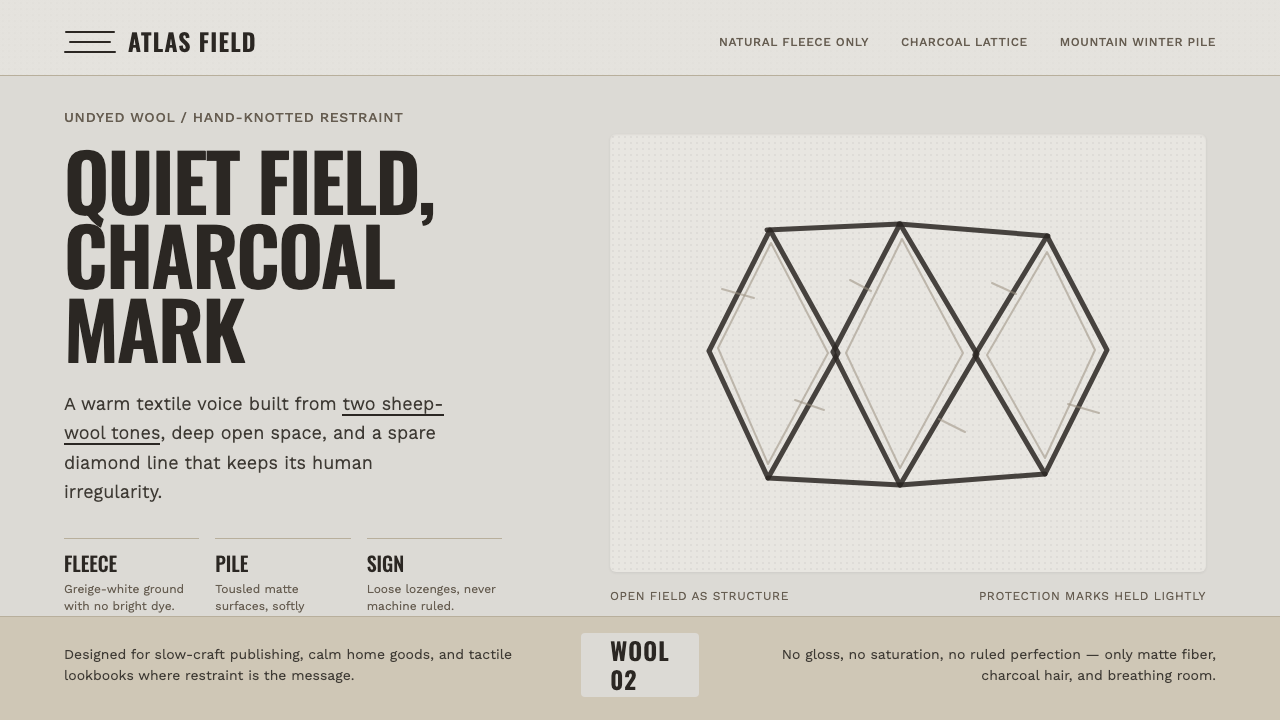 Beni Ourain Berber CarpetRestraint feels tactile. Greige wool field, Oswald type, and a loose charcoal…
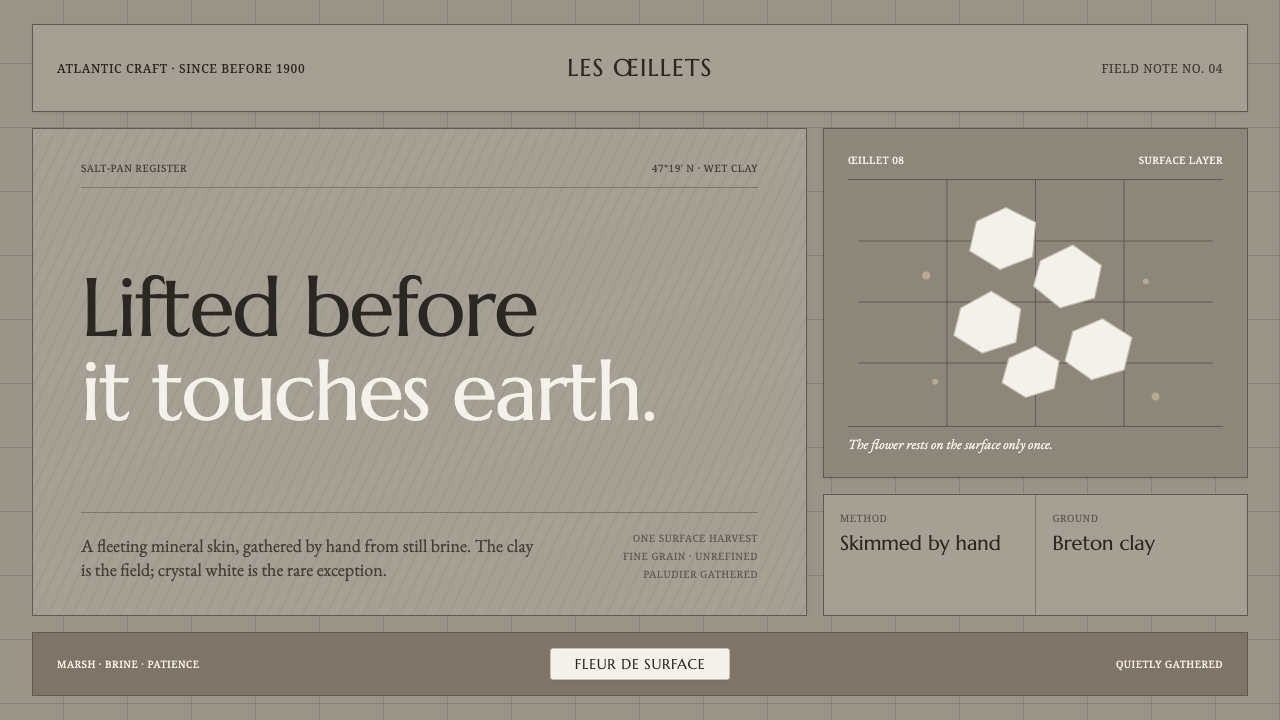 Guérande Fleur de SelCrystal white is the exception. Mineral serif and hairline grids rise from we…
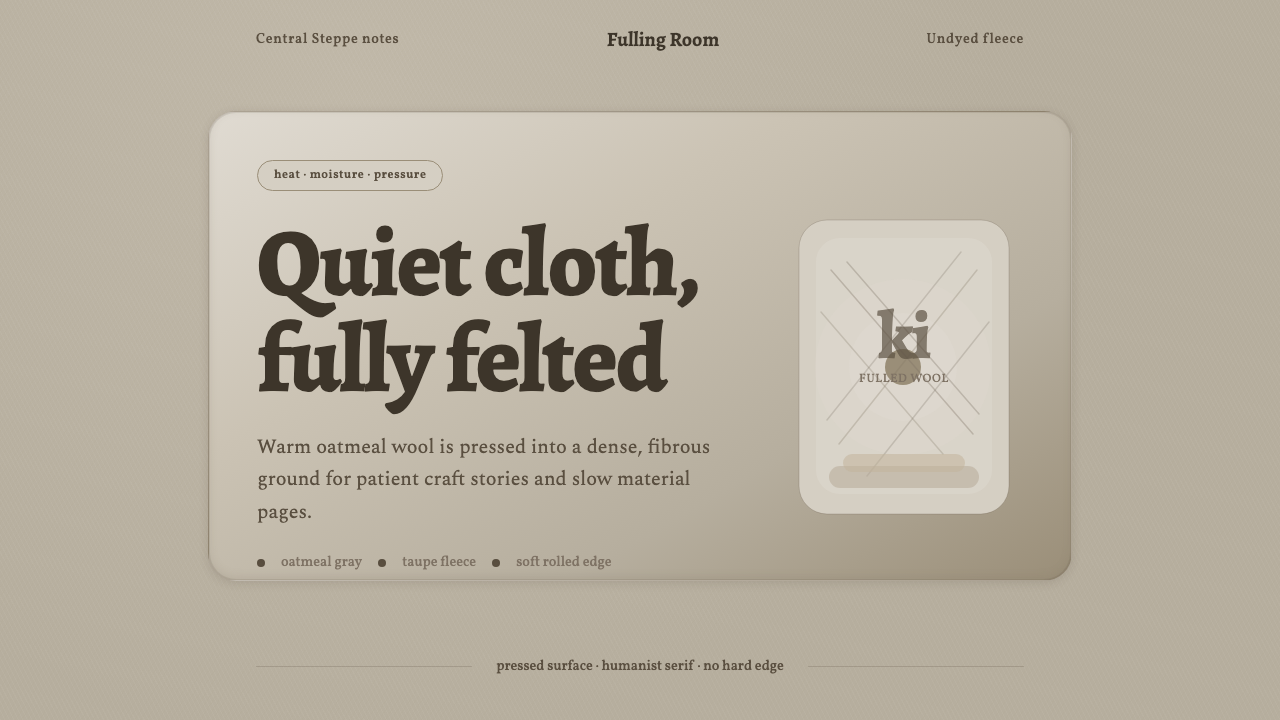 Wool FeltingHandmade stillness. Oatmeal-gray felt, humanist serifs, and soft rolled panel…
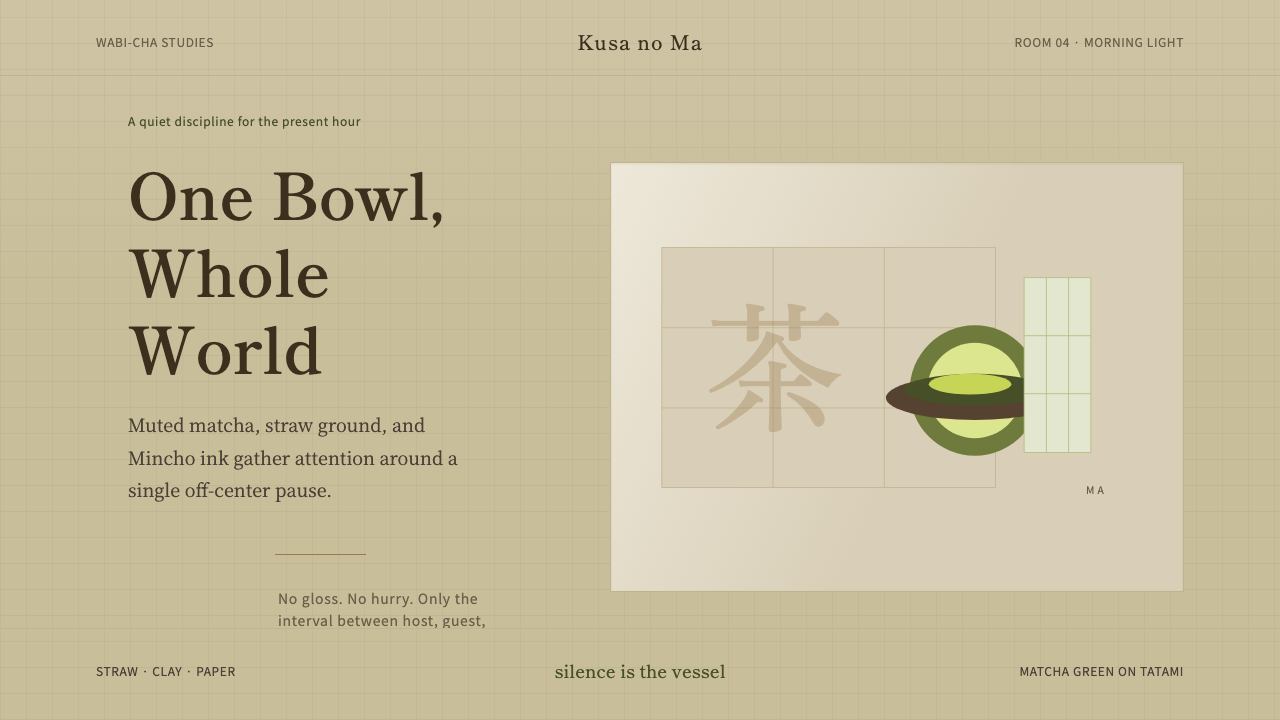 Japanese Tea CeremonyStillness has weight. Tatami straw, matcha green, and Mincho type leave room…
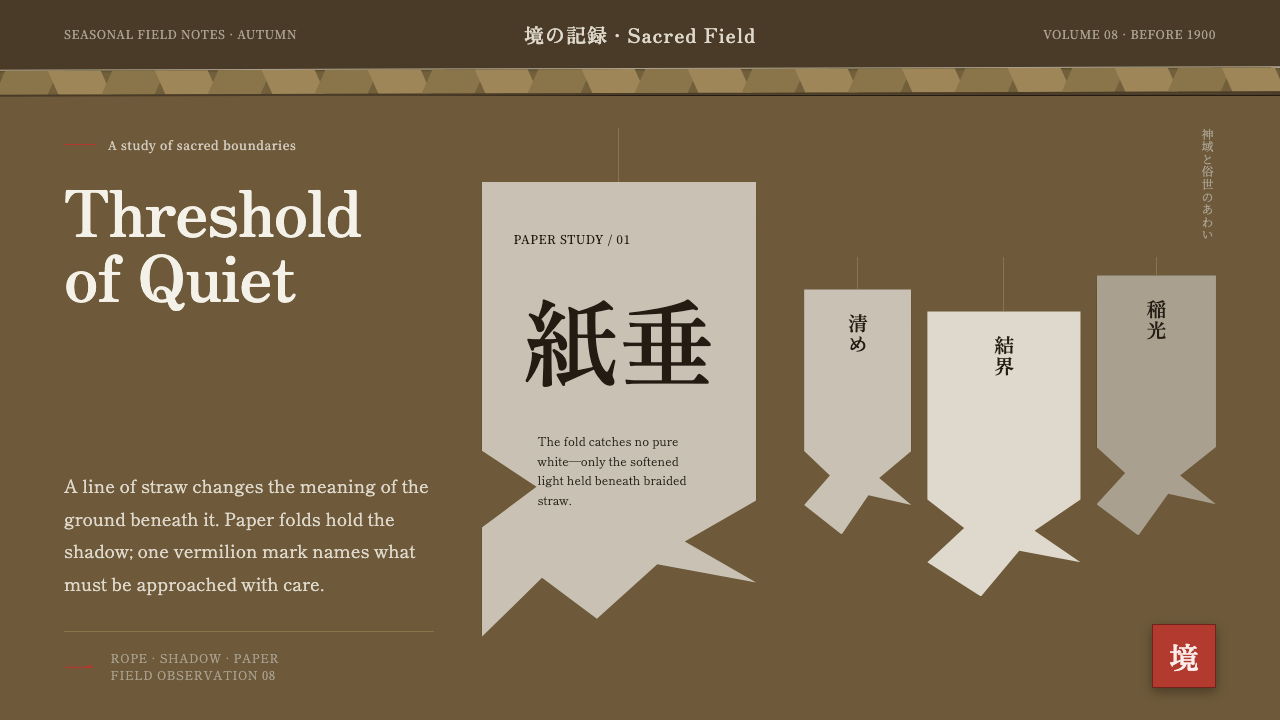 Shinto Shide Paper StreamerQuiet becomes sacred. Shadowed washi hangs from a straw-gold line, marked onc…
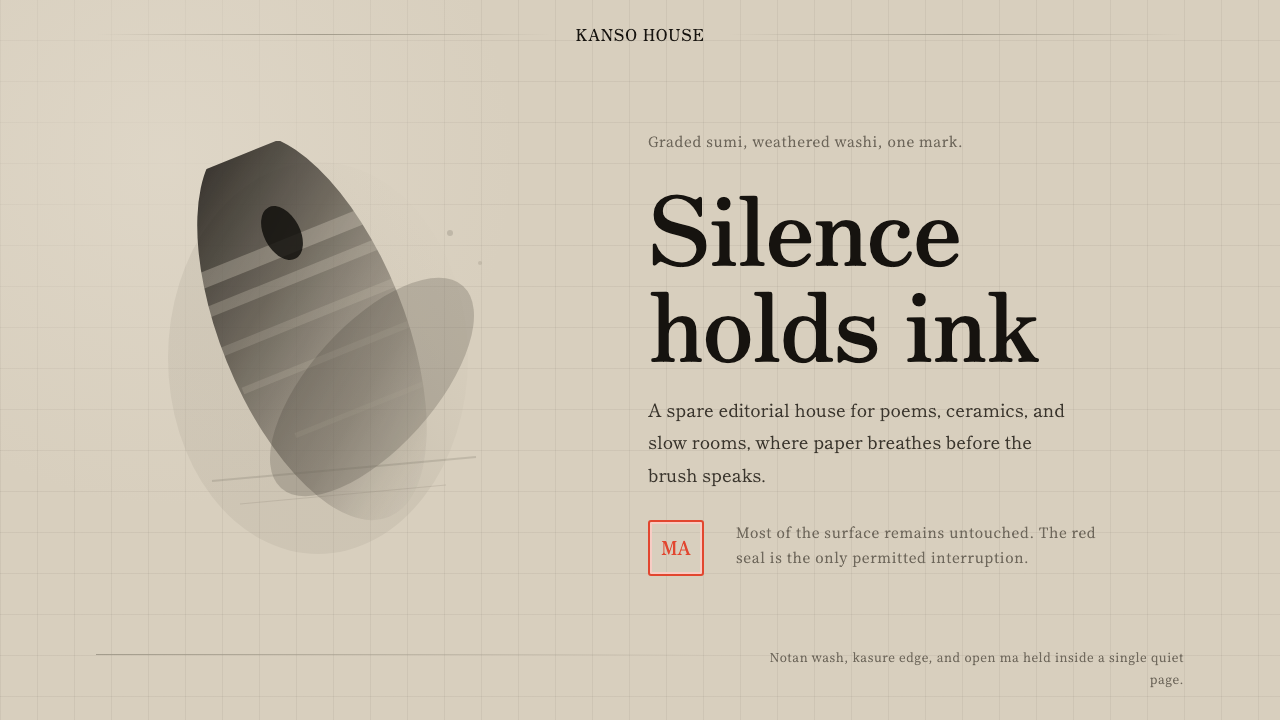 Sumi-e Ink WashRestraint carries weight. Washed black ink floats on oatmeal washi, anchored…