What is Yapese Stone Money (Micronesia)?
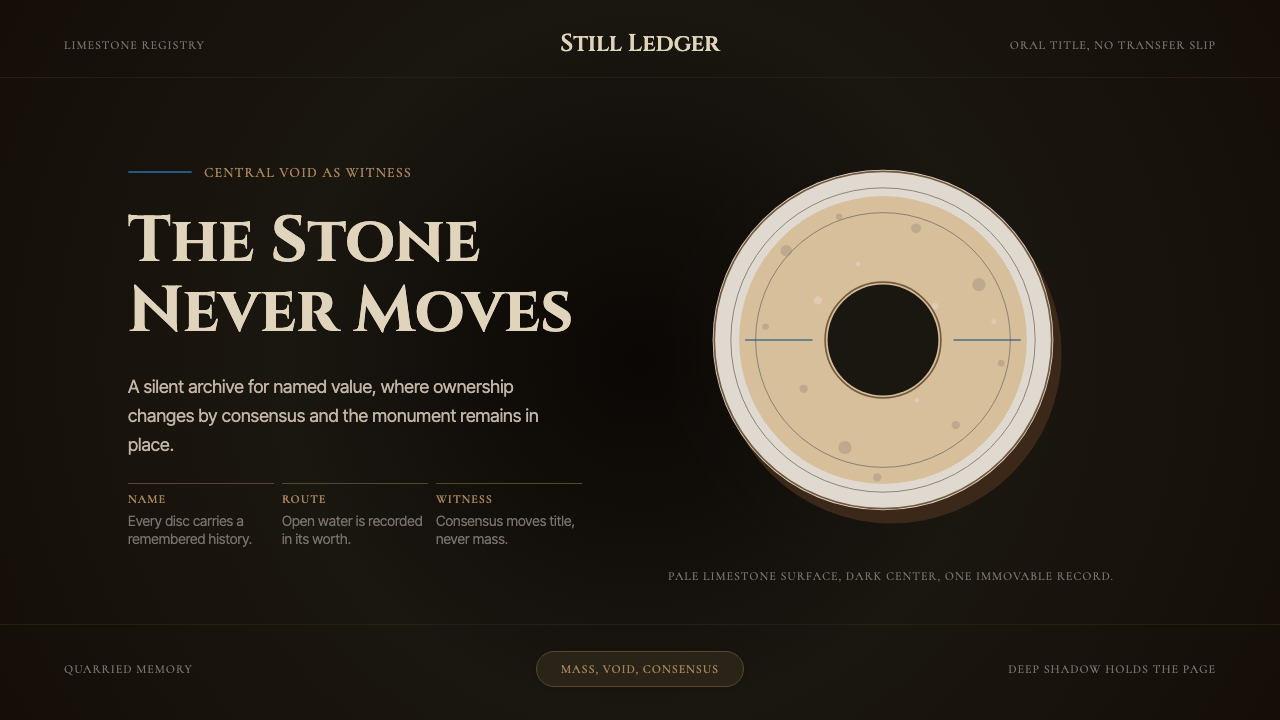
Rai stones — limestone discs up to four metres across, canoed five hundred kilometres of open Pacific — are the most radically still currency ever made, and their monumental circular form translates into a design language of singular, unhurried authority.
Yapese Stone Money (Micronesia) in brief
The Yapese Stone Money design system takes its visual logic from the rai stone tradition of Yap, a small island group in the western Pacific. Rai stones are massive limestone discs — some taller than a person, some small enough to carry — each bearing a hole at the centre and a personal history recorded in oral tradition rather than written ledger. The defining quality of a rai stone is not its physical location but its social existence: ownership transfers through spoken consensus even as the stone remains immovable, sometimes underwater after a canoe sank en route from the quarry.
Translated into visual form, this tradition produces an aesthetic of monumental stillness. A single large circle — the primary compositional element — dominates every layout, evoking the disc itself. The central void of that circle is not empty space but the most charged element in the composition, just as the hole in a rai stone is its structural and symbolic heart. The surrounding palette is drawn from the material world of the stones: the warm cream of freshly quarried limestone, the deep shadow pooling inside the central hole, and the dark ochre of ancient weathered rock.
What distinguishes this style from generic minimalism is its sense of geological weight. Layouts do not feel lightweight or airy — they feel dense and settled, as if the elements have been there for centuries and intend to remain. This quality makes the system unusually suited to contexts that require authority without aggression, and permanence without stiffness.
Where does Yapese Stone Money (Micronesia) come from?
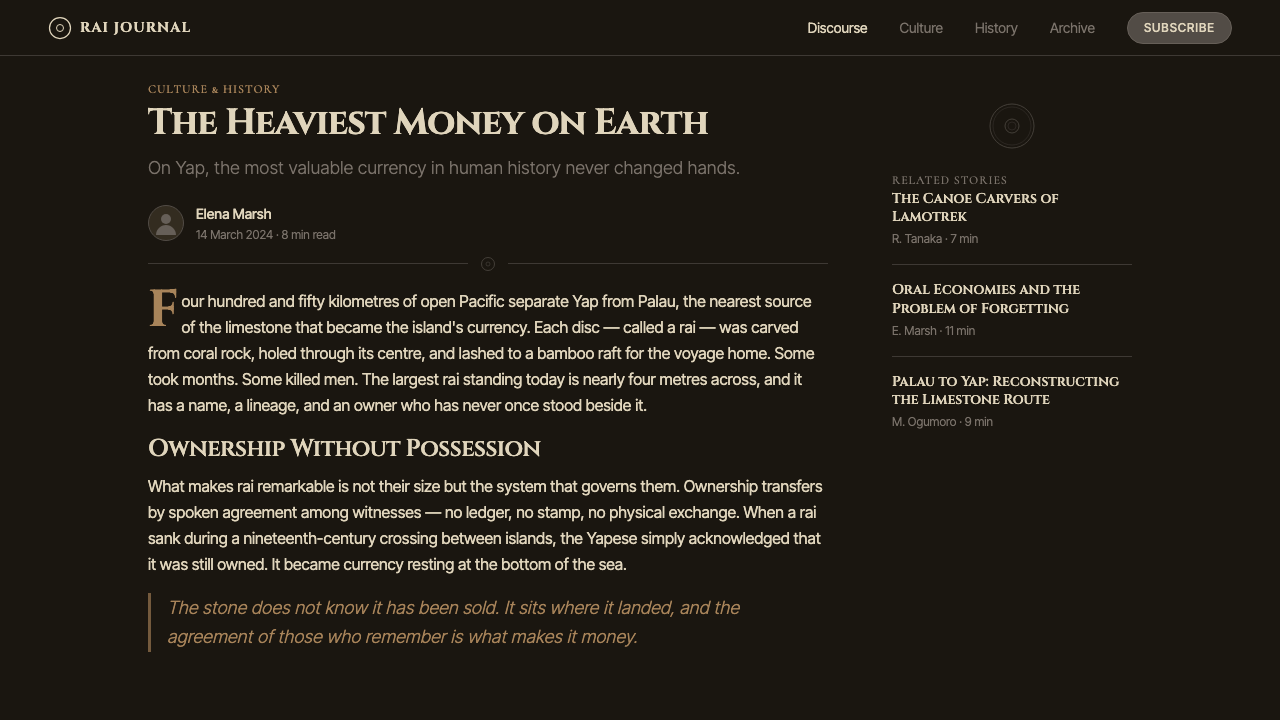
The rai stone tradition of Yap has roots stretching back to around 1000 CE, with quarrying activity reaching its peak intensity between roughly 1700 and 1900. The stones were carved not on Yap itself but on Palau — an archipelago some four hundred and fifty kilometres to the southeast — because the particular crystalline limestone there was prized above any rock available on Yap. Yapese navigators made the open-ocean crossing in outrigger canoes, quarried the discs on Palau, and then transported them home, a journey of extraordinary physical risk. The effort required to obtain a stone became part of its social value: the labour, the ocean crossing, the lives risked were all folded into the stone's history and memory.
Ownership and exchange operated through a system that fascinated and perplexed Western economists for over a century. The stones were not physically exchanged when property changed hands — instead, the community acknowledged the transfer verbally, and the stone remained where it stood. One stone, too large to move and reputedly resting on the sea floor after its transport canoe foundered, continued to circulate as valid currency for generations, its ownership recorded only in collective memory. This led the American economist Milton Friedman to write about Yap's monetary system in a 1991 essay, noting the parallels with modern currency systems in which value rests on social agreement rather than physical substance. The anthropologist William Henry Furness III provided the first detailed English-language account of the rai system in his 1910 book, after spending several months living among the Yapese.
The colonial period introduced significant disruption. Germany administered Yap from 1899 to 1914, and German colonial authorities — frustrated by the Yapese refusal to maintain roads — reportedly marked certain stones with black crosses to declare them government property, effectively removing them from circulation until road work was performed. The Yapese found this deeply offensive, since the stones' social standing had nothing to do with their physical condition or location. Japan controlled the islands from 1914 to 1945, followed by United States administration under a UN trusteeship until 1986, when the Federated States of Micronesia gained independence.
Scholars including the archaeologist Scott Fitzpatrick and the museum curator Cora Lee Gillilland have studied the stones in depth, and the tradition continues: rai stones remain legally recognized as currency in Yap today, used in ceremonial exchanges and to settle significant social debts. They are displayed outside the offices of Yap's state government, lined up along roadsides in village squares, and protected under Federated States law. The design system draws on this remarkable continuity — a visual language built around an object that has functioned as currency for perhaps a thousand years and shows no sign of being retired.
What defines the Yapese Stone Money (Micronesia) look?
The Dominant Circle
A single large circle is the anchor of every composition, directly evoking the profile of the rai stone. Unlike geometric shapes used decoratively, this circle carries structural weight — it organises everything around itself, and the void at its centre is treated as the most important element on the page. Secondary elements orbit this form rather than competing with it. The composition depends on this one shape; nothing else contends for primacy.
Limestone and Shadow Palette
The palette is narrow and derives directly from the material world of the stones: warm off-white suggesting freshly quarried limestone; a deep, warm black evoking the shadow pooled in the stone's central hole; and a muted ochre or stone-grey recalling the surface of ancient rock weathered by centuries of salt air. There are no cool greys, no blue-tinged shadows, no neutral whites — every tone carries the warmth of organic mineral material.
Geological Weight and Stillness
Elements in this style do not float, hover, or animate with lightness. They sit — settled, heavy, as if placed there permanently. Generous spacing is not airy but ceremonial: the emptiness around a form amplifies its gravity rather than lightening the composition. This quality of stillness is the central visual argument of the style, and any element that introduces visual agitation or rapid change works against it.
Oral-Ledger Typography
Type in this system has the quality of inscription rather than printing — weighty, deliberate, and spaced as if each word has been considered independently. Letterforms are set with generous tracking at large sizes and minimal decoration. The typographic hierarchy is simple: a single headline of monumental scale, a secondary body of modest weight, and very little else. Body text is set with measured line spacing — not tight, not loose — and reads with the unhurried pace of oral tradition.
Textured Surface, Flat Structure
While the style embraces the idea of material texture — the roughness of coral limestone, the pitting of ancient rock — it renders that texture through tonal variation and grain rather than through depth or dimensionality. Surfaces feel textured but remain flat. There is no simulated three-dimensionality, no drop shadow suggesting a lifted card; the texture is in the pigment, not in the architecture of the layout.
Consensual Hierarchy
In the rai system, the stone's value is established by collective agreement rather than decree. The design system reflects this in its information hierarchy: importance is communicated through scale and position rather than through assertive color contrasts or bold graphic interventions. A primary element earns its prominence by occupying more space, not by shouting in a brighter color. The hierarchy feels agreed-upon, not imposed.
The Immovable Negative Space
The circular void at the centre of every rai stone is structurally necessary — it allowed the stones to be moved on carrying poles — but it also became the stone's most distinctive feature, the shape that makes it immediately recognisable. In the design system, negative space carries the same weight as positive form. The hole, the gap, the unprinted area is not absence but presence. Compositions are balanced by attending to the negative space as carefully as to the elements themselves.
Who shaped Yapese Stone Money (Micronesia)?
The American physician and anthropologist William Henry Furness III spent several months on Yap at the turn of the twentieth century and published the first detailed English account of the rai stone system in his 1910 book. His descriptions of stones resting on the ocean floor yet still functioning as valid currency captured the imagination of economists and anthropologists for generations. His insistence that the stones' value resided entirely in social memory — not physical possession — anticipated later debates about the nature of money and trust by decades.
The Nobel laureate economist Milton Friedman devoted a 1991 essay to Yap's monetary system, drawing explicit parallels between the rai stones and the modern international gold standard — specifically the Bank of France's gold holdings in New York, which shifted ownership through accounting entries without the metal ever moving. Friedman's engagement brought the Yapese tradition to a new audience and cemented its status as a canonical case study in the theory of money, value, and institutional trust. His analysis emphasized that the rai system was not primitive but logical — a pure expression of money's social rather than physical nature.
Cora Lee Gillilland was the curator responsible for the Smithsonian Institution's research and documentation of Yapese stone money, producing scholarly work that helped establish the stones as objects of serious museum study rather than mere curiosities. Her careful documentation of individual stones — their sizes, origins, oral histories, and circulation records — provided the foundational archive that later researchers built upon. Her work represents the careful, patient attention to material evidence that the rai tradition itself requires.
The archaeologist Scott Fitzpatrick conducted fieldwork in both Yap and Palau to trace the material history of the rai tradition, including mapping quarry sites on Palau and studying the logistics of the open-ocean transport that gave the stones their extraordinary social weight. His work confirmed and refined earlier accounts of the quarrying period and helped establish a more precise timeline for when the tradition reached its peak. His research underscores the extraordinary practical achievement that each stone represents — the outcome of a feat of navigation and labour that modern observers often underestimate.
How do you use Yapese Stone Money (Micronesia) today?
The Yapese Stone Money style is a deliberate choice for contexts that need to communicate authority, permanence, and weight without resorting to conventional corporate visual language. It is not a style to apply quickly or lightly — its strength comes from commitment to its core principles: the dominant circle, the narrow limestone palette, and the quality of geological stillness. Applied half-heartedly, it reads as unfinished; applied with conviction, it is unmistakable.
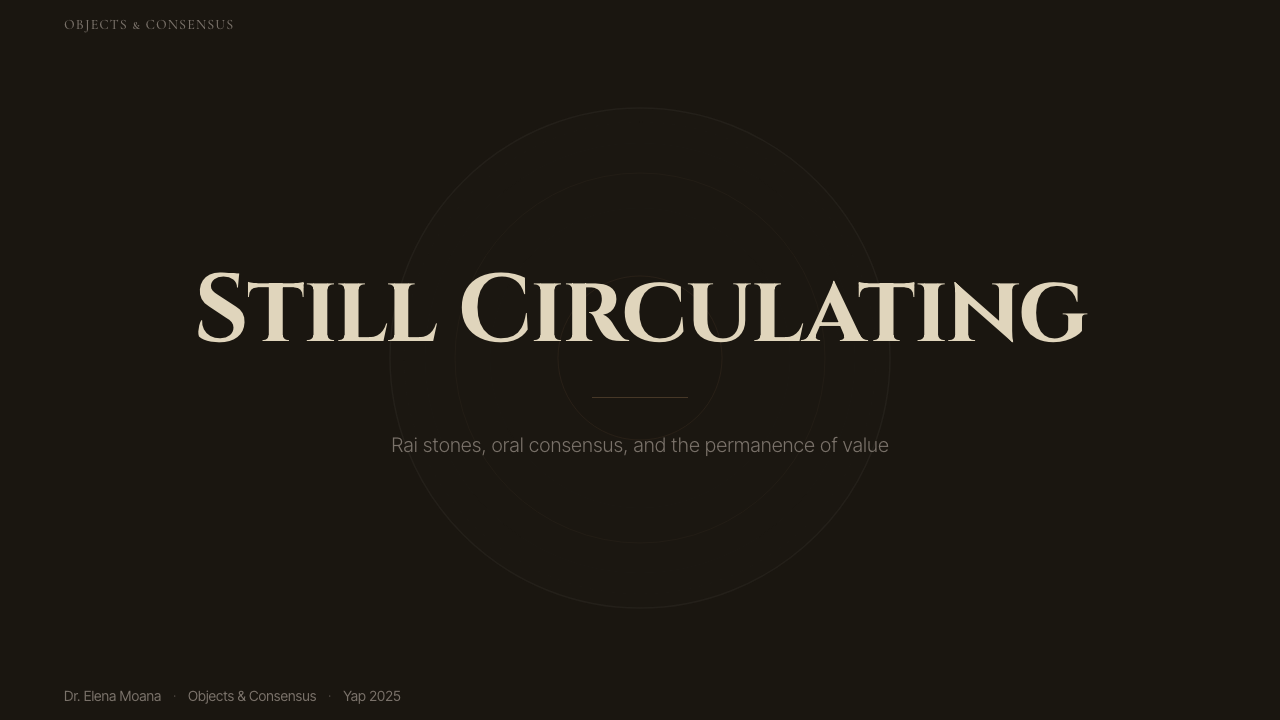
For presentation slides, this style works best on cover and section-break pages that need to command attention without aggression. A cover built on this system places the large circle centrally or slightly offset, fills it with the deep shadow tone, and floats the title in pale limestone type within or beside it. The result is a slide that stops the room before a word is spoken. Content slides should be treated with extreme restraint: one idea per slide, generous margins, type that breathes. Data slides can incorporate the circular motif as a framing device — a donut chart or circular progress indicator feels native to this aesthetic — but should resist the temptation to introduce decorative secondary colors.
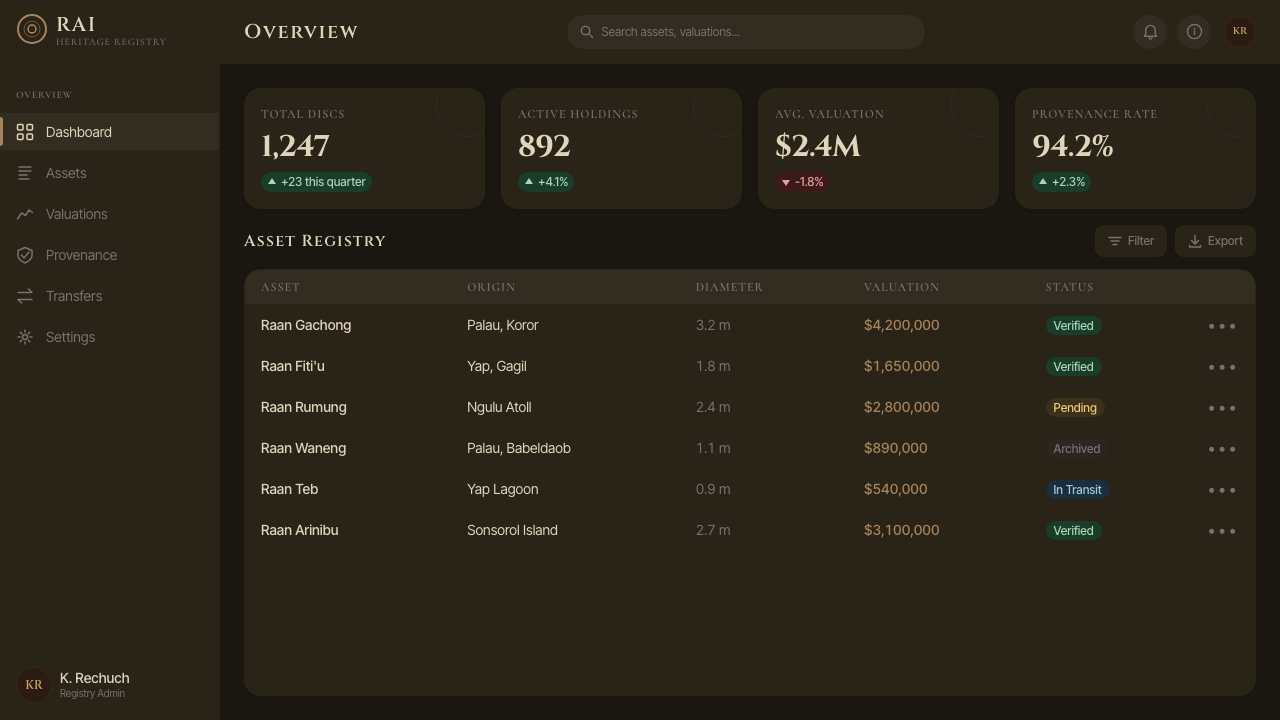
For web interfaces, this system suits landing pages, editorial journals, cultural institution sites, and any product that wants to signal seriousness and depth rather than speed and novelty. The approach on a dashboard or pricing page is to anchor the layout with a large circular graphic element, keep the background warm rather than cold, and use the ochre and limestone tones to differentiate tiers or states. Interactive elements should feel weighty — buttons with substantial padding and minimal radius, inputs with visible borders rather than ghost outlines. Navigation is typographic and horizontal, without icon decoration.
For editorial and marketing work, this style naturally supports long-form reading experiences. An article layout using these principles would give the headline monumental scale, set body text in a narrow column with measured spacing, and use the circle as a pull-quote frame or section marker. Marketing pages benefit from the poster-like quality of a full-width circle on an off-white ground — a single, arresting image that does the work a dozen competing elements cannot. The limestone and shadow palette reads equally well in print as on screen, making it a reliable choice for brands that span both media.
A common mistake when applying this style is treating the circle as decoration rather than structure. When the circle becomes one element among many — scaled down, repeated, used as a bullet-point alternative — the geological authority of the style collapses into something merely geometric. The circle must dominate. A related error is reaching for cooler, lighter tones to make the palette feel more modern or digital: cool greys and blue-tinged whites work against the warmth that connects the colours to their mineral origins. Trust the ochre and the warm black — they are what give the style its sense of time and weight.
Yapese Stone Money (Micronesia) — FAQ
Why does the style use a circle rather than another geometric form?
The circle is not a stylistic choice in the conventional sense — it is a direct quotation from the source object. The rai stone is a disc, and the disc's profile is a circle. The central void is also circular. Using any other geometric form would sever the connection to the tradition being referenced. The circle also carries universal associations with wholeness, continuity, and the absence of a beginning or end — qualities that align naturally with a currency system designed to endure across generations.
Can this style work for digital products that need to update frequently or show real-time data?
It can, but with care. The style's strength is stillness, and a product whose primary promise is speed or freshness will work against the aesthetic rather than with it. Where real-time data must be shown, the approach is to contain the dynamic elements within the stable structural frame — present live numbers in a typographic column anchored beside the dominant circle, rather than making the updating data the visual centrepiece. The surrounding structure should feel immovable even when specific values change.
How does this style handle colour for information coding — such as status colours in a dashboard?
The limestone palette is deliberately narrow, which means status colours must be introduced with restraint. The approach is to reserve a single warm accent — a muted terracotta or a deep gold — for positive or primary states, and to signal warning or error through typographic weight or scale rather than conventional red-green coding. Where a second semantic colour is unavoidable, it should be desaturated enough to read as part of the mineral palette rather than as an imported convention. Bright signal colours break the spell of geological time that the style depends on.
Is this a dark-mode style?
The style's natural form is dark-ground — the deep shadow of the stone's central hole is its primary visual field, with pale limestone type and elements floating on top of it. This makes it inherently dark in orientation, but not in the conventional sense of a software dark mode, which typically uses a near-black grey. The Yapese Stone Money palette uses a warm, slightly brown-tinged black that evokes organic shadow rather than a digital dark canvas. A light-ground inversion is possible — limestone white as the background, deep shadow as the type colour — and retains the style's character, but the dark version is truer to the tradition it references.
What kinds of content or brand values does this style communicate most naturally?
The style communicates permanence, trust, collective memory, and weight — qualities associated with things that are meant to last and are valued by agreement rather than by display. It suits institutions, archives, publishing houses, financial or legal services positioning themselves as stable and principled, and cultural products that want to feel deep-rooted rather than trend-driven. It is also well suited to any context where the slow accumulation of value — rather than instant gratification — is the product's core promise. Brands that need to communicate urgency, playfulness, or youth will find it resistant rather than accommodating.
Related design styles
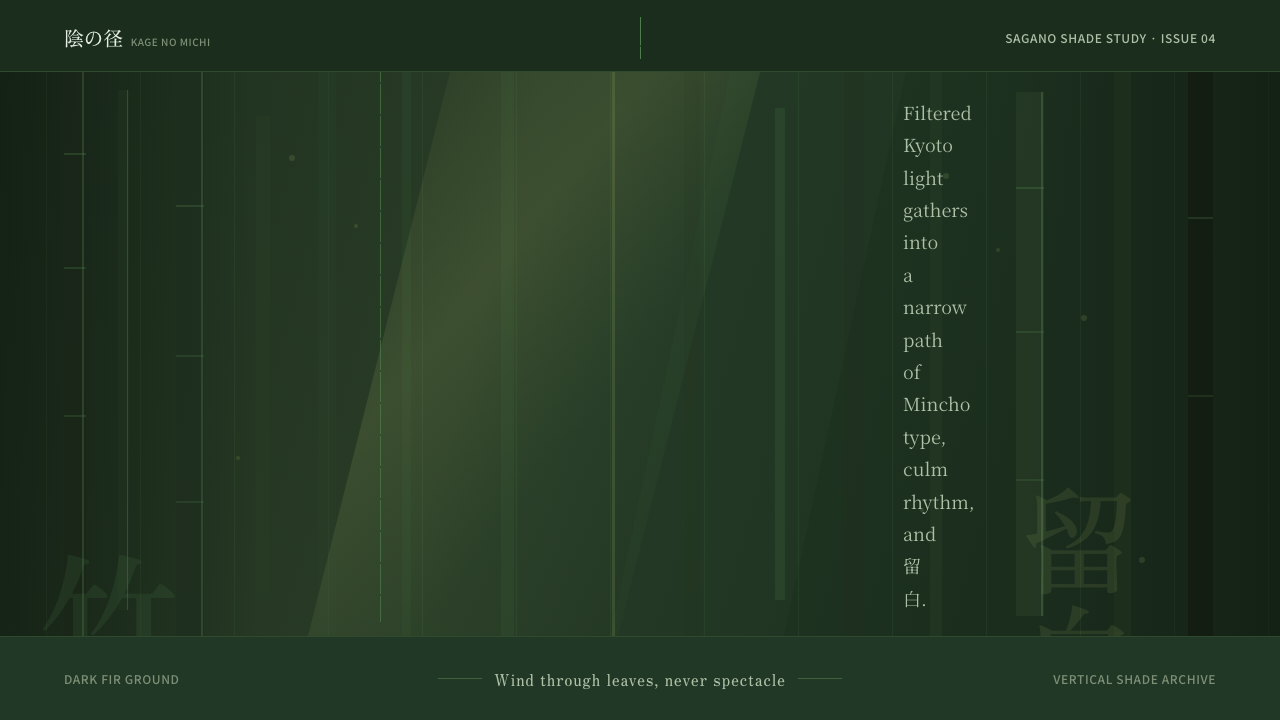 Bamboo GroveQuiet goes vertical. Fir green, Mincho type, and dappled culm rules create de…
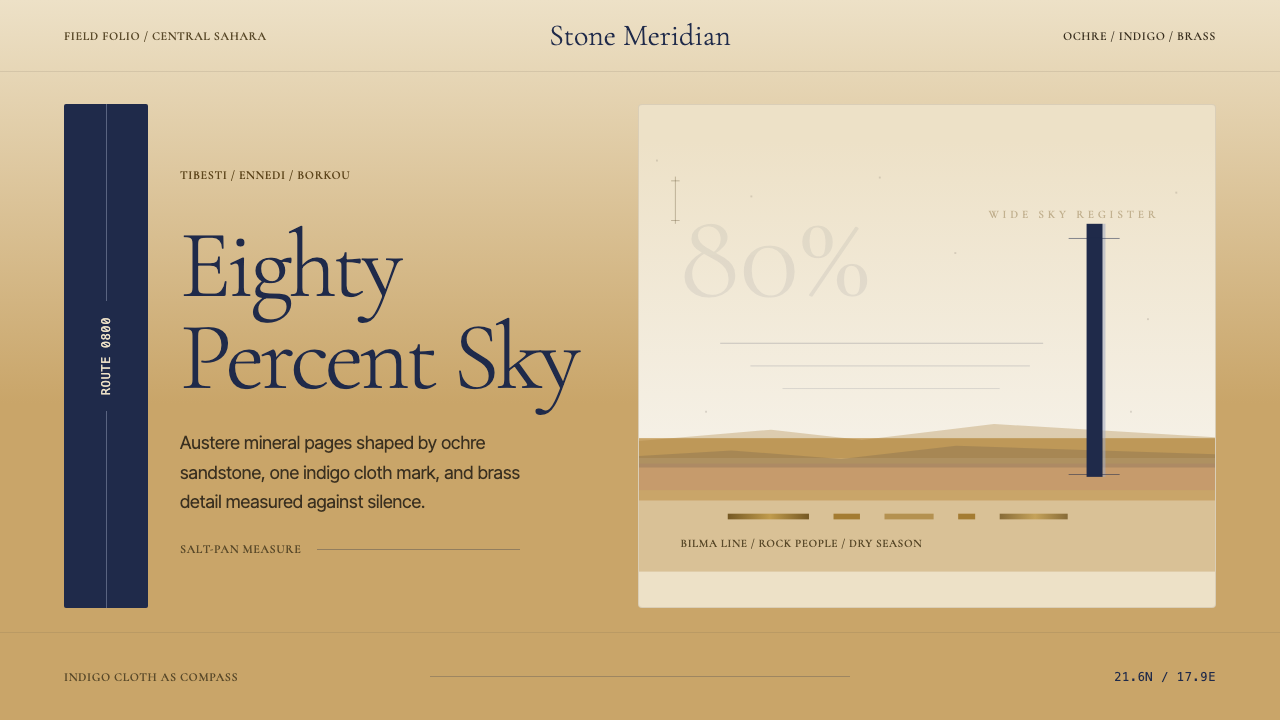 Chadian Toubou Saharan RouteRadical emptiness holds. Sandstone ochre, indigo serif, and one vertical mark…
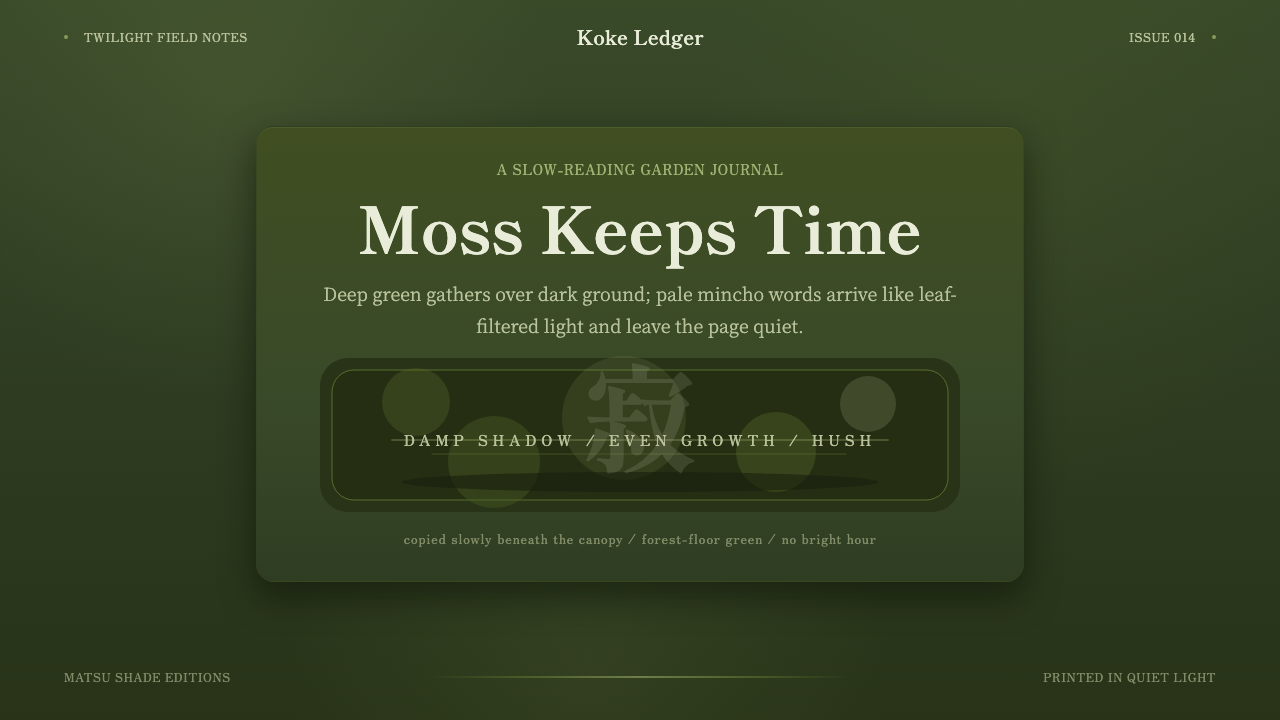 Kyoto Moss GardenStillness grows slowly. Deep moss greens, mincho serif, and dappled dark laye…
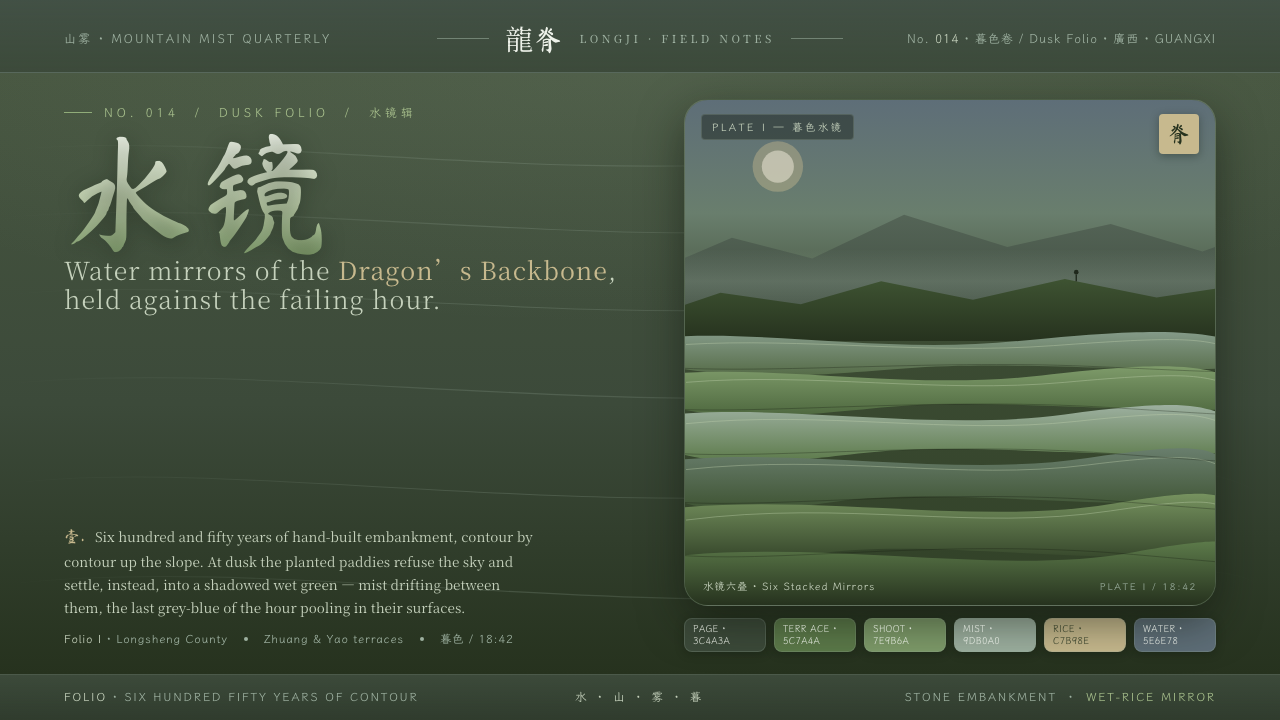 Rice TerraceRefuses the noon sky. Dusk paddy green ground, stacked water mirrors, brush c…
 Hawaiian Hula Pahu DrumSacred weight, hand-marked. ʻAlaea red, kapa texture, and stacked carved regi…
 Rapa Nui Moai PetroglyphMonumental sparseness. Basalt black, scoria red, and pecked-dot borders hold…