What is New Caledonia Kanak Totem?
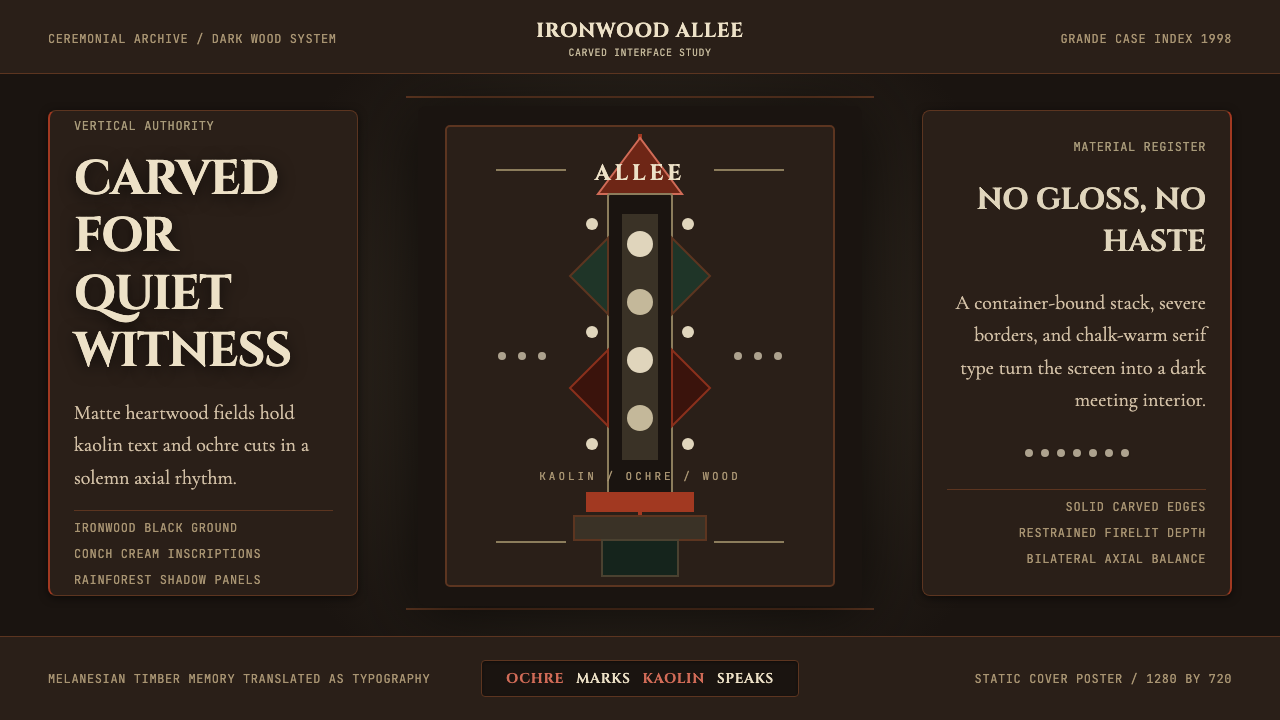
From the carved roof finials of the grande case meeting house to the solemn darkness of ironwood, New Caledonia Kanak Totem translates an ancestral sculptural tradition into a digital visual language of ritual weight and vertical power.
New Caledonia Kanak Totem in brief
New Caledonia Kanak Totem is a design style rooted in the material culture of the Kanak people of New Caledonia — an archipelago in the southwest Pacific — and especially in the carved wooden sculptures known as flèches faîtières, the soaring roof finials that crown the grande case, the communal meeting house at the center of Kanak social and ceremonial life. The style takes its visual logic from three primary materials: the near-black density of ironwood timber, the stark white of kaolin chalk used for face markings and ancestor figures, and the burnt orange of ochre body paint worn during ritual ceremonies.
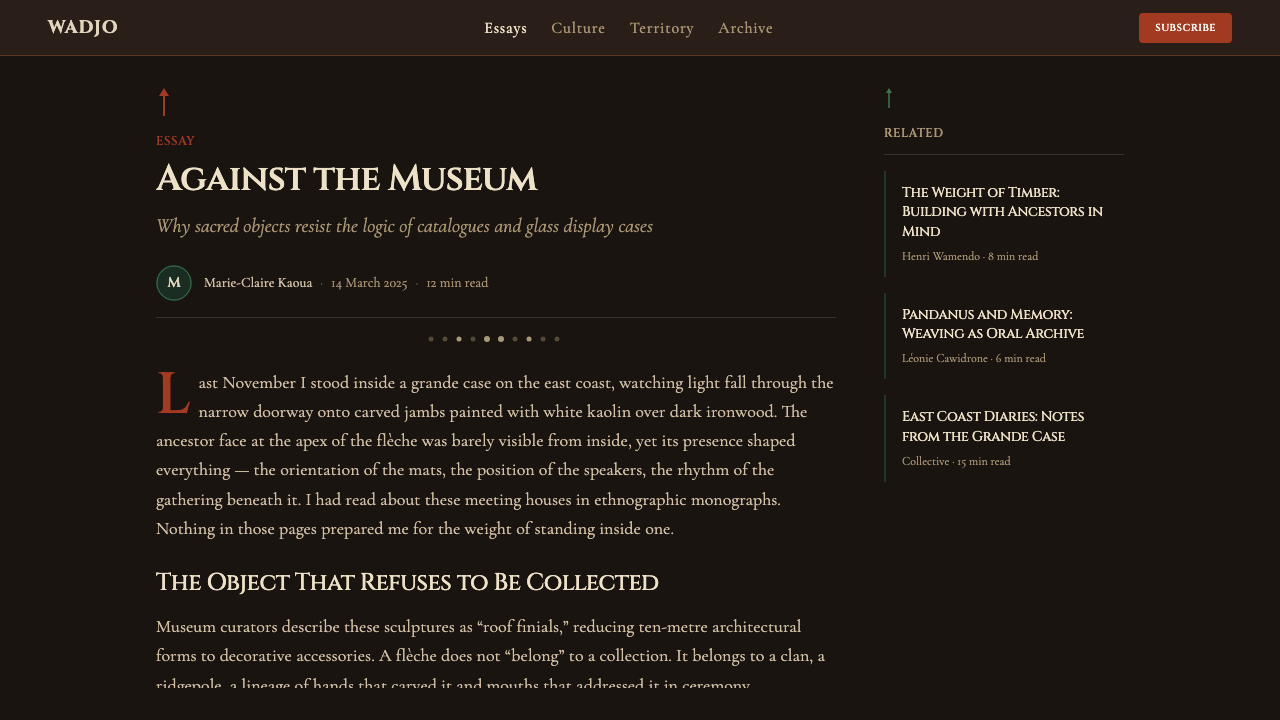
Visually, the style is characterized by deep, almost lightless backgrounds — the interior darkness of a ceremonial space — against which vertical forms and chalky markings emerge with stark clarity. The composition moves along a dominant vertical axis, echoing the posture of carved ancestor figures and the upward reach of roof finials. This verticality is not merely aesthetic but structural: in Kanak visual tradition, height and upward orientation signify ancestral connection and sacred authority.
The 1998 opening of the Tjibaou Cultural Centre in Nouméa, designed by Italian architect Renzo Piano, provided a contemporary anchor for the style. Piano's towering timber-ribbed structures — built to suggest traditional Kanak architecture without directly imitating it — bridged the gap between ancestral form and modernist construction. In the same spirit, New Caledonia Kanak Totem bridges carved wood and pixel, ritual space and screen, without collapsing one into the other.
Where does New Caledonia Kanak Totem come from?
The Kanak people have inhabited the islands of New Caledonia for more than three thousand years, developing a material culture in which carved wood plays a central symbolic and social role. The most significant sculptural form is the flèche faîtière — a tall, composite wooden sculpture mounted at the apex of the grande case. These finials are not purely decorative: they represent the founding ancestor of the clan whose meeting house they crown, and their height signals the prestige and spiritual standing of that lineage. The carved faces at the top of each finial are schematic rather than portrait-like, built from geometric reductions of the human face — concentric rings for eyes, a projecting ridge for a nose, a horizontal bar for a mouth. This schematic quality makes them legible from a distance and imbues them with a timeless, archetype quality that distinguishes them from naturalistic figuration.
European contact in the nineteenth century brought both disruption and documentation. The French colonial administration, which formally annexed New Caledonia in 1853, suppressed many aspects of Kanak ceremonial life, including certain uses of the grande case. At the same time, French ethnographers and missionaries began systematically collecting and studying Kanak material culture. Among the most significant scholars was Maurice Leenhardt, a Protestant missionary and ethnologist who spent more than two decades in New Caledonia and produced foundational studies of Kanak cosmology and social structure, including the landmark 1937 work Gens de la Grande Terre. His documentation preserved knowledge of forms and practices that were being actively suppressed by the colonial administration.
The Kanak independence and cultural revival movement of the late twentieth century brought new urgency to questions of visual and material identity. Jean-Marie Tjibaou, the charismatic leader of the Kanak socialist independence movement (FLNKS), argued that political independence and cultural renewal were inseparable — that the Kanak people could not establish political sovereignty without first affirming the vitality of their own cultural forms. Tjibaou was assassinated in 1989, but the cultural centre that bears his name, built in Nouméa and opened in 1998, became a monument to his vision. The centre was designed by Renzo Piano, who worked closely with Kanak community members to develop structures that evoke traditional architecture through abstraction rather than replication.
The academic and curatorial work of Roger Boulay, a specialist in Melanesian art at the Musée du Quai Branly, brought rigorous art-historical attention to Kanak carving traditions and helped establish the flèche faîtière as a form recognized within international design discourse. His research connected the specific formal qualities of Kanak sculpture — the verticality, the geometric schematism, the relationship between dark ground and bright marking — to broader questions of how non-Western visual traditions could be understood on their own terms rather than through a European primitivist lens. This intellectual groundwork has made it possible to approach Kanak visual culture not as exotic raw material but as a developed aesthetic tradition with its own internal logic.
What defines the New Caledonia Kanak Totem look?
Background Depth
The defining ground of this style is an extreme darkness — not merely dark grey but the near-total darkness of ironwood timber and the unlit interior of a ceremonial space. This depth is not empty: it carries weight and gravity, functioning as a presence rather than an absence. Against it, every lighter element carries the force of emergence, as if surfacing from ancient darkness into visibility.
Vertical Axis
Composition is organized around a pronounced vertical spine — echoing the posture of carved ancestor figures and the upward thrust of the flèche faîtière roof finial. Content elements are stacked vertically with deliberate spacing between them, creating a rhythm of ascent. This vertical discipline conveys authority and solemnity; horizontal interruptions are used sparingly and only to mark structural transitions of significance.
Ochre and Kaolin Marks
The palette draws from two ceremonial materials: the burnt orange-red of ochre body paint and the chalky, almost luminous white of kaolin clay. Against the ironwood ground, ochre functions as the primary accent — warm, urgent, ceremonially charged. Kaolin white is used for finer marks, outlines, and text, suggesting chalk drawings on dark surfaces or the pale face markings of carved ancestor figures. Neither color is used decoratively; both carry the weight of ritual use.
Schematic Geometry
Figurative elements — when they appear — are abstracted to their geometric essentials in the manner of Kanak carving: concentric rings, lateral ridges, stepped profiles, and vertical stacking. This schematic quality gives icons and marks a timeless, archetype quality distinct from either naturalistic illustration or contemporary flat design. Decorative curves are absent; forms are built from deliberate geometric reductions.
Dot and Mark Rhythm
Repeated small marks — dots, short dashes, conch-shell-like circular accents — are used as textural elements and rhythmic punctuation within the composition. These echo the surface texturing on carved wooden objects, where patterns of incised marks distinguish different clans and lineages. In a digital context, they function as decorative-structural elements that add visual density without breaking the fundamental darkness of the ground.
Serif Gravitas
Typography in this style draws on kaolin-influenced letterforms: a serifed type with slightly worn, chalk-like edges that echo hand-applied marks on dark surfaces. The weight is significant — letterforms are neither delicate nor mechanical but carry the substantiality of carved marks. Type is used sparingly, with generous surrounding space; the rare letter or word on a dark field carries the same visual weight as a carved inscription.
Material Honesty
The style avoids simulated gradients, soft glows, and polished surface effects in favor of the matte, tactile quality of actual carved and painted materials. Ironwood does not reflect light; kaolin chalk does not blend smoothly into dark ground; ochre paint sits on the surface rather than sinking into it. Digital applications that honor this material logic use flat, matte rendering that acknowledges the difference between screen and substance.

Who shaped New Caledonia Kanak Totem?
Tjibaou was the most prominent leader of the Kanak independence movement in the twentieth century, serving as secretary-general of the FLNKS (Kanak and Socialist National Liberation Front). His central argument — that political independence required cultural self-affirmation — made him as much a theorist of visual and material identity as a political leader. His 1975 staging of the Melanesia 2000 festival, which brought together Kanak cultural practitioners from across the archipelago, was a landmark assertion of Kanak cultural vitality under colonial conditions. The Tjibaou Cultural Centre, opened nine years after his assassination, remains the most internationally visible embodiment of his vision.
The Italian architect designed the Tjibaou Cultural Centre (opened 1998) in close dialogue with Kanak community members and cultural advisers. His approach — using modern engineering and timber to suggest the forms of traditional Kanak architecture without reproducing them literally — became a model for culturally engaged contemporary architecture. The centre's ten wood-ribbed cases, rising in height along the ridge of a peninsula and open at the top to the Pacific wind, translate the upward thrust of the grande case into a form legible to both Kanak and international audiences. Piano's building is the primary visual reference point for the style's treatment of vertical timber forms against open sky.
A Protestant missionary and self-taught ethnologist, Leenhardt lived and worked in New Caledonia from 1902 to 1926, producing the most detailed early documentation of Kanak social structure, cosmology, and material culture. His 1937 ethnographic study Gens de la Grande Terre and his later philosophical work Do Kamo (1947) — which examined Kanak notions of personhood, body, and myth — provided the conceptual framework through which Kanak visual tradition has been most influentially interpreted. His documentation of the grande case and its associated carved objects preserved knowledge that colonial suppression was actively erasing.
A specialist in Melanesian art and material culture at the Musée du Quai Branly in Paris, Boulay conducted extensive fieldwork and archival research on Kanak carving traditions throughout the late twentieth century. His scholarly work helped establish the flèche faîtière as a recognized form within international art history and design discourse — not as primitive artifact but as the product of a sophisticated aesthetic tradition. His cataloguing of the formal properties of Kanak sculpture (the geometric schematism, the relationship between dark grounds and light marks, the verticality and ritual function) provided the art-historical basis on which contemporary designers can engage with the tradition rigorously.
How do you use New Caledonia Kanak Totem today?
New Caledonia Kanak Totem is a high-specificity style — its power comes from commitment. Because the visual system is built on extreme darkness, ochre warmth, and vertical ceremony, it works best in contexts that call for solemn weight, cultural depth, and a deliberate departure from the lightweight brightness that dominates most contemporary digital design. Applied carelessly, it risks feeling theatrical; applied with conviction, it commands attention in a way that few other styles can match.
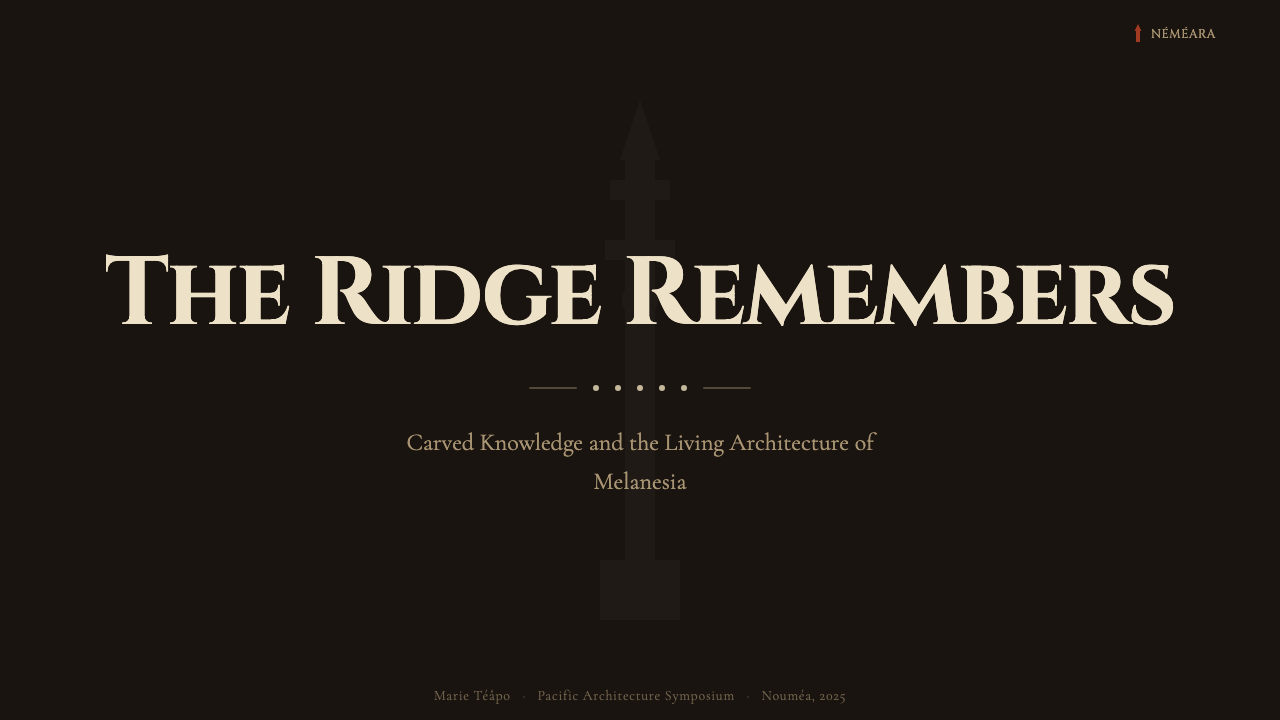
For presentation slides, the style suits cover pages and section dividers with exceptional force. A cover built on near-total darkness with a vertical arrangement of title, subtitle, and an ochre accent mark carries an authority that few light-palette presentations achieve. Content slides should maintain the dark ground and restrict text to kaolin-white with ochre highlights for essential emphasis only. Data slides take on a ritual quality: when bars, lines, and chart elements are rendered in ochre against darkness, they read as marks of significance rather than neutral information display. Reserve white-ground slides for moments when contrast with the dominant darkness is itself the message.
For web interfaces and dashboards, this style works well in contexts where gravitas and distinction matter more than approachability — portfolio sites for artists and cultural institutions, editorial interfaces for long-form writing, or product dashboards for industries where solemnity is appropriate. The dark ground reduces eye fatigue in low-light environments; the high contrast between ochre and darkness makes hierarchy immediately legible without color-coding complexity. Navigation and structural elements should remain typographic and restrained, allowing the dark field to dominate.
For editorial and marketing work, the style is particularly effective for contexts involving cultural heritage, archival material, documentary subjects, or brands that position themselves against mainstream lightness. A full-spread editorial opener built on Kanak Totem darkness with a single large ochre headline and sparse kaolin body text creates an immediate sense of occasion. Marketing applications work best when the style is allowed to occupy the full visual field rather than appearing in a box or panel — cropping the darkness diminishes its power.
The most common mistake when applying this style is diluting the darkness. A medium-dark grey background with small ochre accents produces neither the lightness of a conventional palette nor the depth of authentic Kanak Totem — it falls between registers and loses the style's fundamental gravity. Commit to the ironwood depth or do not use the style. A second common error is adding decorative elements drawn from other dark-palette traditions — Nordic, Japanese, or Brutalist. The style's marks have specific ceremonial reference; substituting unrelated geometric ornament produces pastiche rather than coherent visual language.
New Caledonia Kanak Totem — FAQ
Is this style appropriate to use in commercial design without cultural permission?
This is a live question in design ethics, and there is no universal consensus. The Kanak Totem style draws on a living cultural tradition — not an extinct historical aesthetic — and its symbolic elements (the flèche faîtière form, the ceremonial ochre, the kaolin markings) carry specific meaning within Kanak society. Designers using this style should approach it with the awareness that they are working with abstracted forms of a living tradition, and should be prepared to acknowledge that source directly and publicly. Using the visual vocabulary of the style while removing or ignoring its cultural reference is the least defensible approach; using it while explicitly crediting its origins and context is more honest. Engaging with contemporary Kanak cultural institutions when undertaking significant commercial projects is always the more considered path.
How does this style differ from other dark-palette design systems?
Many dark-palette design systems — from Scandinavian moodboard darkness to Japanese wabi-sabi restraint to contemporary dark mode UI — share the use of dark grounds but differ fundamentally in their relationship to light and mark-making. Kanak Totem is distinguished by the specific warmth of its ochre accent (which differs from the cool golds of Nordic dark palettes and the subdued naturals of Japanese restraint), by the schematic geometric quality of its marks (which differ from the organic forms of wabi-sabi), and by the vertical ceremonial structure of its composition (which differs from the horizontal calm of Scandinavian design). The style's source in carving — in marks made by removing material rather than applying it — gives it a quality of revelation rather than decoration: each mark on the dark field is an uncovering.
Can this style work in a light-background context?
A light-ground inversion is technically possible but comes at significant cost to the style's fundamental character. The ironwood darkness is not a variable; it is the style's premise. Without it, what remains is a set of ochre and chalk marks on a neutral ground — which loses both the ceremonial gravity and the specific visual logic of emergence against depth. A more productive approach for contexts where dark backgrounds are not appropriate is to use a restricted application: a dark header band or section accent within an otherwise light layout, rather than attempting a full light-ground version of the style. This preserves the system's integrity while adapting to practical constraints.
What kinds of imagery pair well with this style?
Imagery that pairs best with Kanak Totem has either strong sculptural presence or high tonal contrast that can hold its own against the dark ground. High-contrast black-and-white documentary photography — particularly of physical objects, architectural forms, or human figures — works well when treated as flat, non-naturalistic elements rather than windows into scenes. Close-up photography of carved or textured surfaces (wood, clay, stone) resonates with the style's material logic. Avoid photography with soft naturalistic lighting, bright outdoor scenes, or vibrant unrelated color, which will fight the dark ground rather than integrate with it. Abstract marks and geometric elements tend to work better than photographic imagery in most applications.
How does the Tjibaou Cultural Centre inform the style without making it purely architectural?
The Tjibaou Cultural Centre matters to this style not as a building to be reproduced but as a set of translated principles. Piano's design demonstrated that Kanak visual logic — verticality, timber darkness, the relationship between upward thrust and open sky — could be reinterpreted in a modern structural language without losing its cultural resonance. The lesson for digital design is the same: the style's elements (the dark ground, the vertical axis, the ochre and kaolin marks) are abstractions of deeper cultural principles, not literal copies of physical objects. Designers who understand this can apply the style's logic to any medium — screen, print, physical space — without the result feeling like an architectural illustration. The goal is to carry the same qualities of weight, emergence, and ceremonial presence that the Centre embodies, translated into the specific conventions of the design medium at hand.
Related design styles
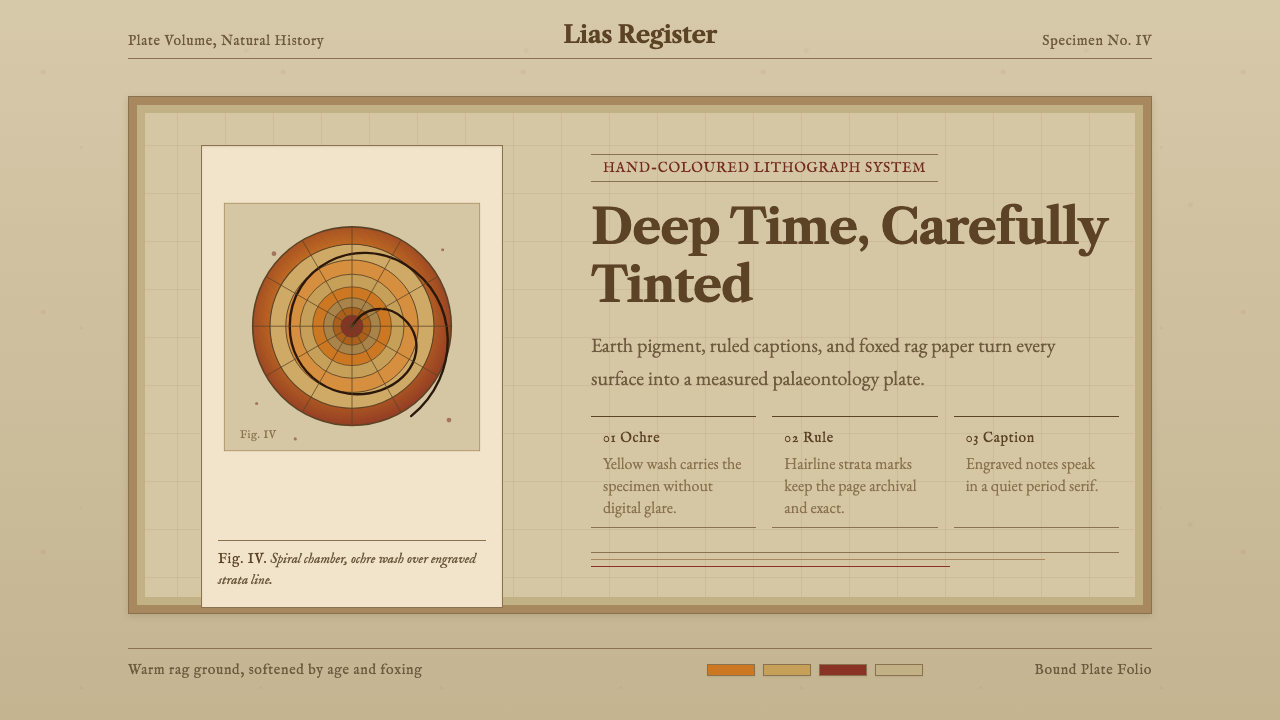 Ammonite Fossil PlateDeep time feels hand-tinted. Ochre spiral, foxed paper, and engraved captions…
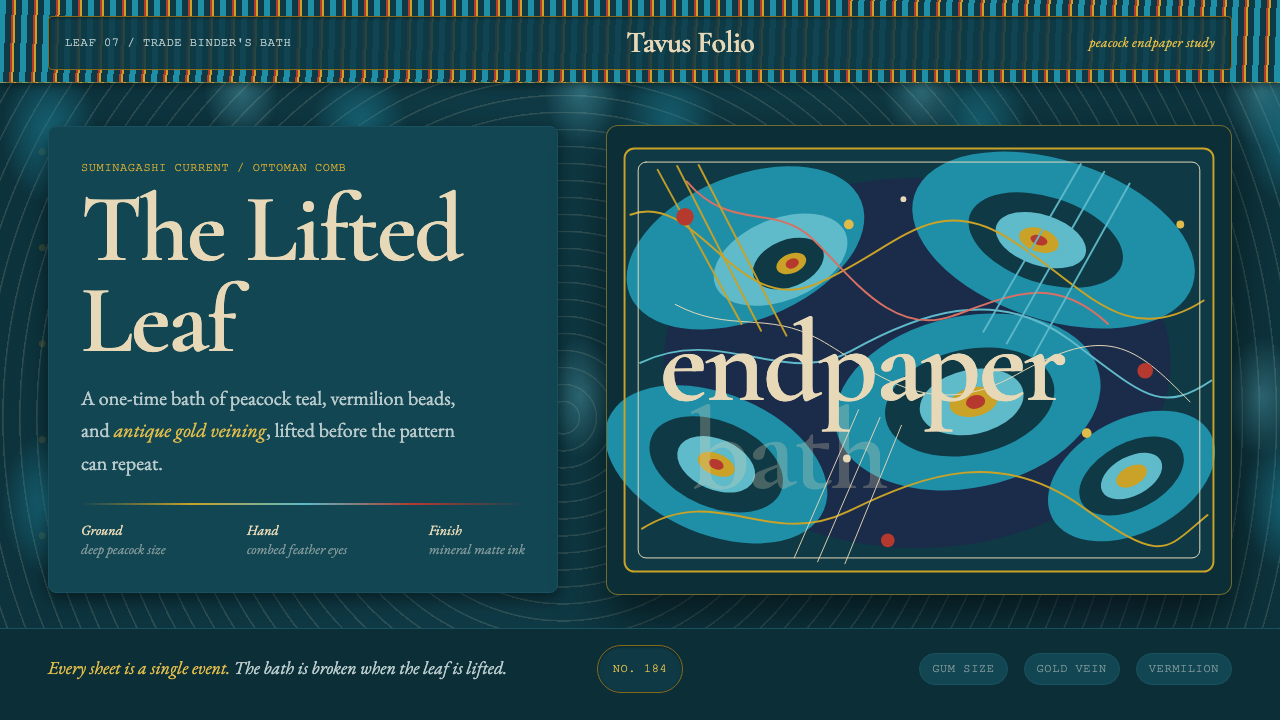 Marbled EndpaperInk refuses repetition. Peacock teal, vermilion beads, and gold veins drift l…
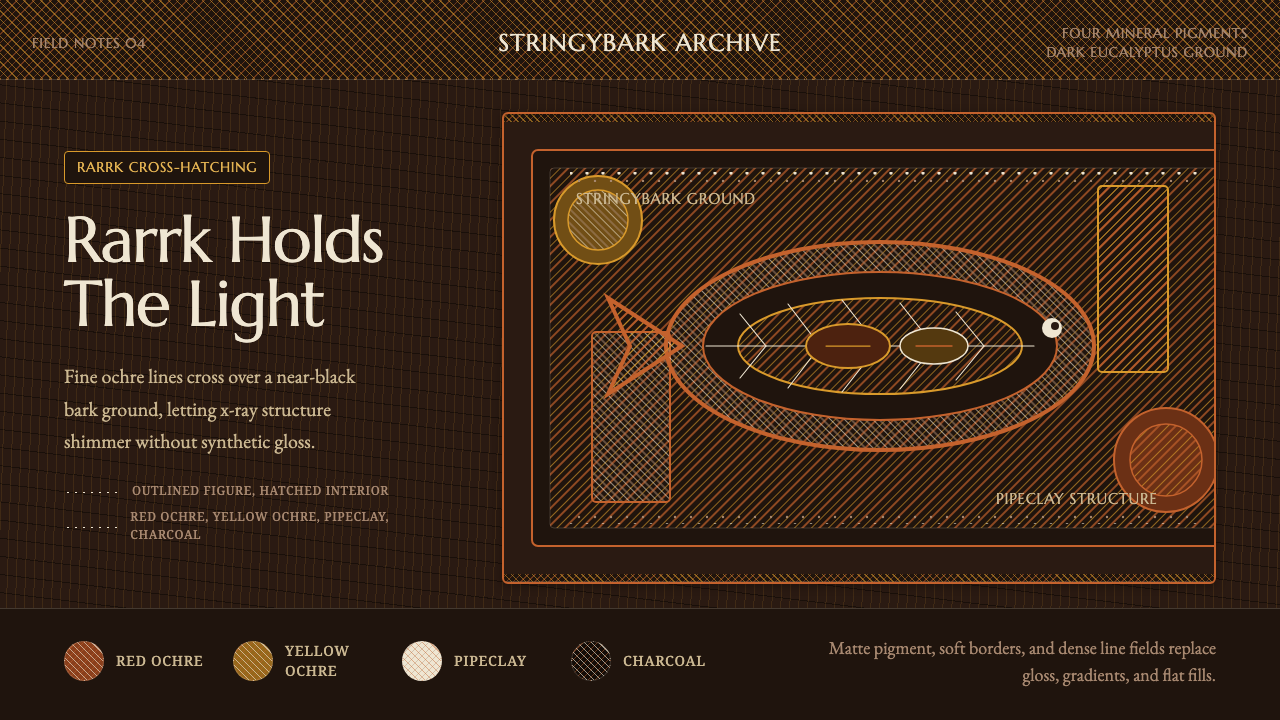 Arnhem X-Ray Bark PaintingShimmers without gloss. Ochre rarrk lines vibrate on dark stringybark.
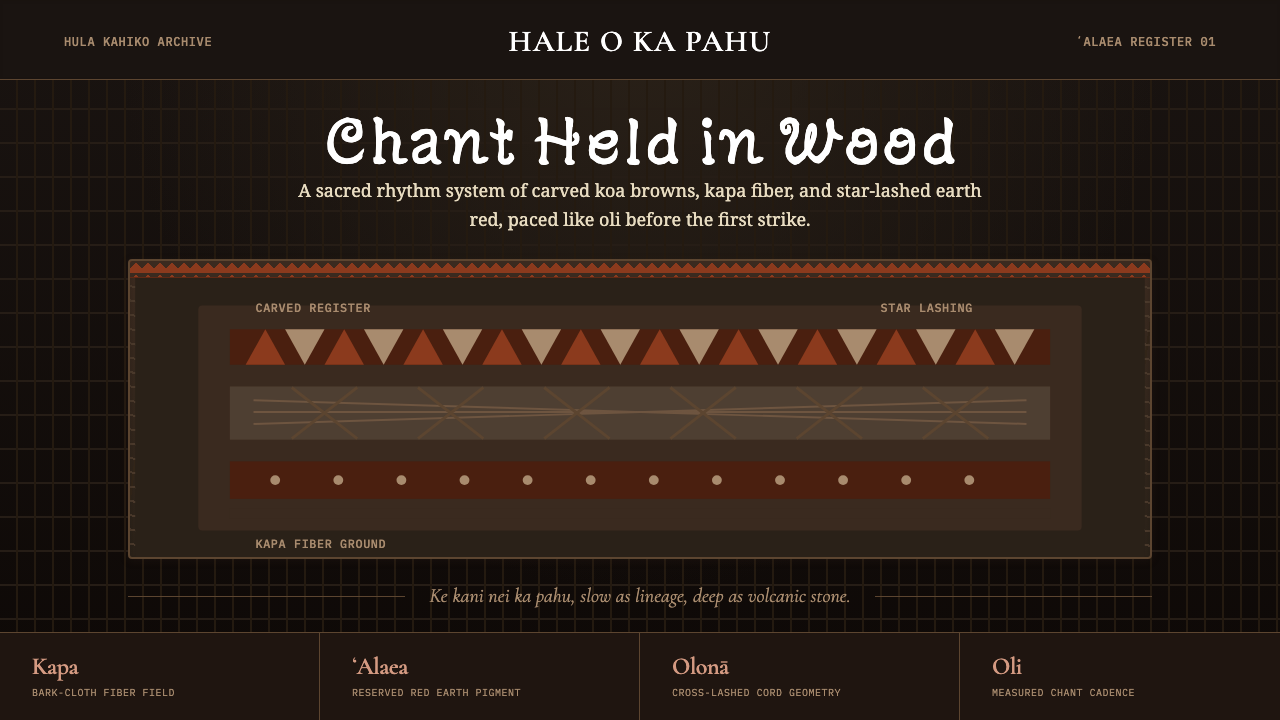 Hawaiian Hula Pahu DrumSacred weight, hand-marked. ʻAlaea red, kapa texture, and stacked carved regi…
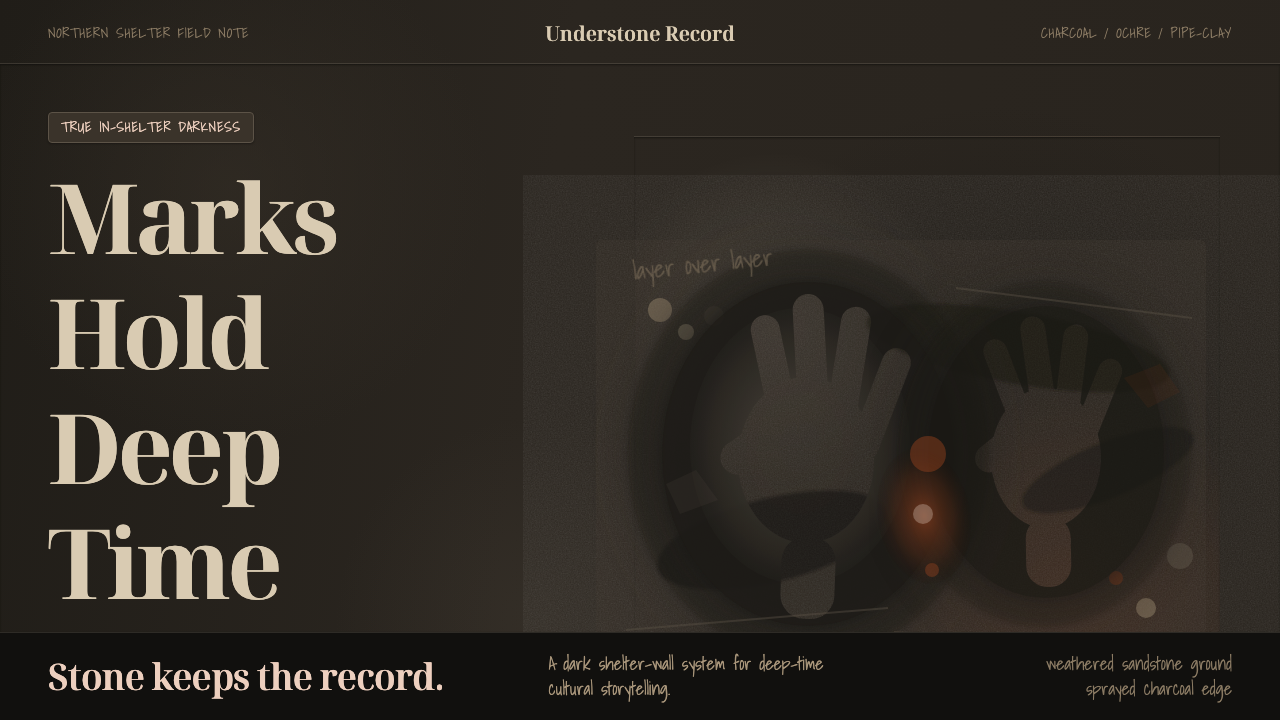 Kakadu Rock Shelter CharcoalDarkness carries memory. Charcoal stencils and haematite dust sit on weathere…
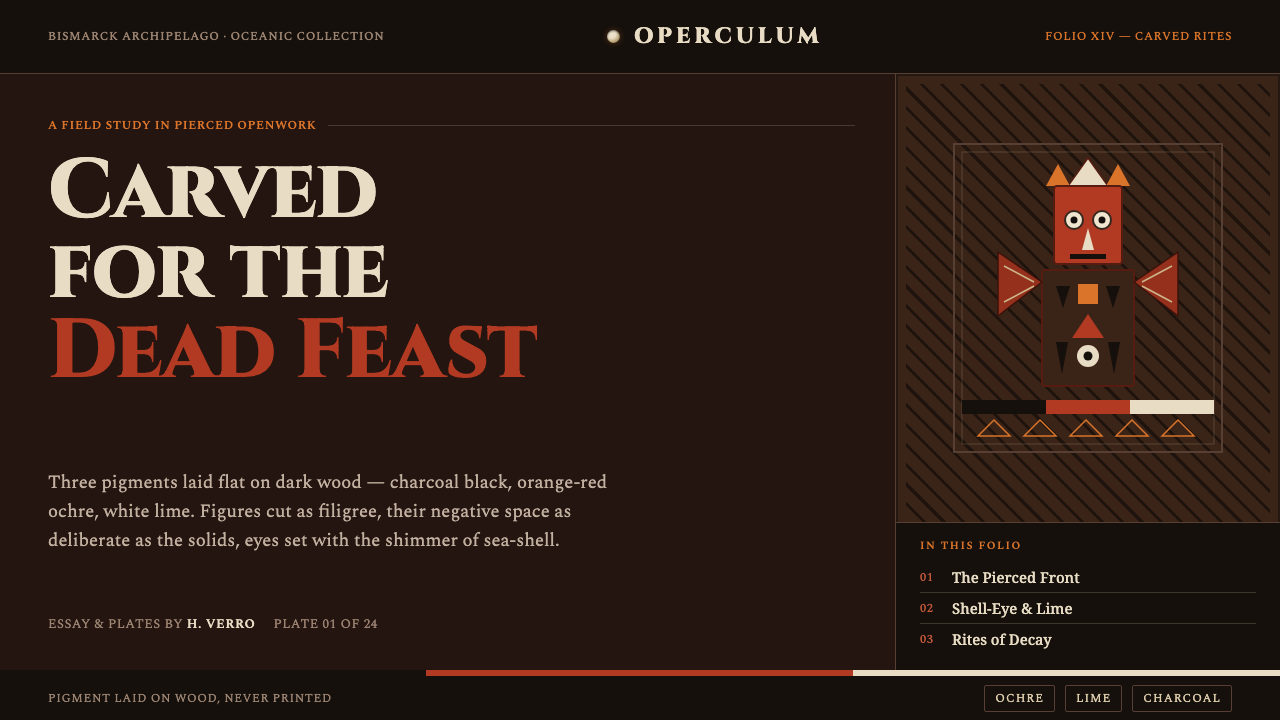 Malagan CarvingCarved for the dead feast. Ochre, lime and charcoal pierced into dark wood, e…