What is Simon Stålenhag — Tales from the Loop?
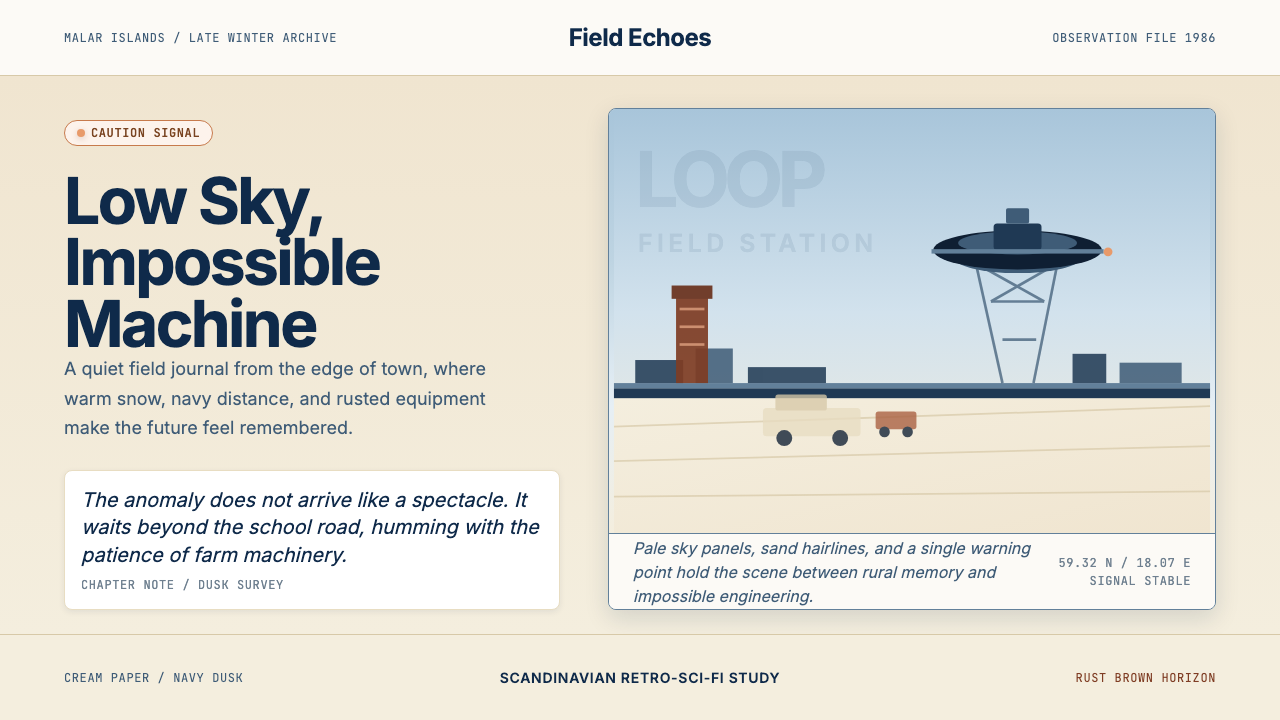
Simon Stålenhag planted impossible machines in the cream snow of a Swedish suburb, and the light has never quite left.
Simon Stålenhag — Tales from the Loop in brief
Simon Stålenhag's visual world — crystallized in the art books Tales from the Loop (2014), Things from the Flood (2016), and The Electric State (2017) — is one of the most influential aesthetic systems to emerge from contemporary digital painting. It is not a movement in the institutional sense but a singular vocabulary: warm cream snow, low Scandinavian skies pressing down like a ceiling, rusting mechanical giants half-buried at the edge of wheat fields, and children walking home through a landscape that is simultaneously ordinary and utterly wrong. The emotional register is one of quiet dread inflected with nostalgia — a past that never existed, remembered with perfect melancholy.
As a design language, the Stålenhag palette has been translated far beyond its painted origins. The interface interpretation retains the atmosphere while converting it into typographic and compositional decisions: cream paper grounds, deep navy or charcoal type, sky-panel asides rendered in the muted grey of a Swedish winter overcast, and one carefully rationed saturated-orange accent that functions like a caution lamp at a field's edge — present, unmistakable, slightly unsettling. The visual effect is editorial restraint at the service of an unmistakable mood.
What distinguishes this aesthetic from other retro-science-fiction styles is its emphasis on the pastoral scale. The machines in Stålenhag's paintings are enormous, but they are almost never the subject — they are background, context, weather. The human figures are small, quotidian, and only faintly aware that anything is unusual. This compositional proportion — the anomalous enormous behind the mundane small — translates into interface work as hierarchy through scale contrast and the deliberate use of negative space to isolate the thing that should unsettle the eye.

Where does Simon Stålenhag — Tales from the Loop come from?
Simon Stålenhag was born in Stockholm in 1984 and grew up in the Swedish countryside during the decade when the Cold War was ending and Sweden's landscape was being threaded with power lines, antenna arrays, and the first generation of industrial wind turbines. He studied at the Royal Institute of Art in Stockholm and worked as a concept artist and game designer before the Tales from the Loop art book — self-published and funded through Swedish arts grants — reached a global audience via the internet in 2014. The timing coincided with a widespread appetite for exactly this combination: analog-era aesthetics, wide-open suburban melancholy, and the creeping presence of technology that is understood to be powerful but not quite understood to be controlled.
The key imaginative premise of Tales from the Loop is that a particle physics research facility — the Loop — has been built beneath the Swedish lakeland, and its energetic byproducts have leaked strange phenomena into the surrounding countryside. Gravity anomalies. Mechanical animals. Machines that move on their own long after their operators have left. Stålenhag populated this setting with images from his own 1980s childhood: Swedish red wooden houses, the particular amber of late-afternoon winter light on birch bark, the unlit gas stations and half-frozen lakes of the Stockholm archipelago. The result was not nostalgia for technology but nostalgia filtered through technology — a rusted machine crying in a field is as sad as the field itself.
The Amazon Prime television adaptation of Tales from the Loop in 2020, produced with Stålenhag serving as executive producer and visual consultant, brought the aesthetic to a mass audience and cemented its influence on production design, game art, and advertising. The show's color grading — muted warm tones, sky-dominant compositions, a restrained use of saturated color for emphasis — translated the paintings' grammar into cinematography and expanded the vocabulary's reach into motion and time-based media.
Beyond the Loop books, The Electric State (2017) transported the same atmosphere into an alternate 1990s American Southwest, replacing Swedish lakeland with Nevada desert and juniper scrubland, while retaining the same compositional logic: vast derelict machines, small human figures, a sky that goes on forever and says nothing comforting. This geographic expansion demonstrated that the aesthetic was portable — it was not tied to Sweden or the 1980s but to a specific emotional relationship between scale, technology, and human smallness. The vocabulary had become a grammar, and the grammar was independent of its original setting.
What defines the Simon Stålenhag — Tales from the Loop look?
Cream and Cool Ground
The foundational ground is almost never pure white. Stålenhag's snowfields read as warm cream, and his skies as a desaturated grey-blue that sits somewhere between overcast and dusk. In interface translation, this produces a background that is slightly warm where white would feel clinical, and slightly cool where grey would feel inert — a narrow thermal band that reads as naturalistic without being photographic. The warmth of the ground and the coolness of the sky palette create a subtle chromatic tension that keeps surfaces from feeling flat.
Deep Navy and Charcoal Type
Text and strong structural elements take on a deep navy or near-black charcoal rather than pure black. The distinction is subtle but meaningful: navy carries a slightly maritime, slightly melancholic quality that harmonizes with the cool sky palette, while pure black would feel like a different visual register entirely — too graphic, too assertive for the atmospheric quietness the style is built on. Headlines, navigation, and body text all inhabit this dark-cool end of the spectrum, providing contrast against cream without the harshness of absolute black.
The Single Orange Accent
Saturated warm orange — the color of an industrial caution lamp, a safety vest at dusk, a sodium streetlight through winter fog — is the sole high-saturation element in the palette, and its use is strictly rationed. In Stålenhag's paintings, such warm-orange lights appear as isolated points in predominantly cool, desaturated compositions; they function as emotional anchors and compositional focal points simultaneously. In interface work, this means orange is reserved for a single active state, a single call-to-action category, or a single alert tier — never diffused across the layout as a general highlight color.
Sky-Panel Horizontal Bands
One of the most recognizable compositional features of Stålenhag's work is a low horizon line, with sky occupying the upper half to two-thirds of the canvas. The sky zone is desaturated and slightly lighter than the snow, often carrying faint atmospheric gradation from a cool near-white at the horizon to a deeper grey-blue toward the zenith. Translated into interface layout, this becomes a recurring panel or section background in desaturated cool grey — a sky-tone stripe that signals a shift in register, a side-panel background, or a data-context aside. It is not decorative but atmospheric: it changes the emotional temperature of content without introducing a new color.
Scale Contrast and Anomalous Scale
A defining tension in Stålenhag's work is the relationship between human scale and machine scale. Children are painted with realistic proportions while the structures looming behind them are rendered at a scale that quietly violates the rules of perspective — they are simply too large, too present, too far from any human logic of size. This produces a persistent unease that is never fully resolved. In interface terms, this translates to deliberate scale contrast: a number or statistic rendered at a size that commands the page while surrounding metadata recedes to near-illegibility, or a hero image that extends beyond the container implied by the grid. The contrast is not accidental but structural.
Editorial Quietness
Stålenhag's books are not poster art; they are image-and-text narratives, paced like a novel, with passages of prose set in a typeface that suggests a literary rather than commercial register. The design of the books — wide margins, unhurried text setting, image and prose given equal weight — is a direct precedent for the interface translation. Typography is restrained and editorial: proportional spacing, generous leading, column widths that prioritize readability over information density. The overall impression is of a printed journal from the early 1990s, set with care by someone who believed the words mattered as much as the pictures.
Rust and Weathered Surface
The machines in Stålenhag's paintings are almost never pristine. They are rusting, cracking, half-reclaimed by vegetation or snow. This weathered quality is central to the emotional register — it suggests time, entropy, and the indifference of a landscape that will outlast any technology. In interface work this does not mean applying literal rust textures, which would be illustrative decoration, but rather embracing a slightly worn quality in surface treatment: aged parchment rather than fresh stock, slightly softened borders rather than razor-sharp rules, and a general preference for warmth and imperfection over sterile precision.

Who shaped Simon Stålenhag — Tales from the Loop?
Stålenhag is the sole originator and continuing practitioner of this aesthetic. Born in Stockholm in 1984, he developed his signature style through digital painting that combined photographic reference, painterly atmosphere, and narrative concept art. His self-published books became international bestsellers after spreading through design, gaming, and speculative fiction communities online. As executive producer and visual consultant on the Amazon adaptation, he ensured that the television translation remained faithful to the compositional and atmospheric principles of the original work rather than simply borrowing its surface imagery. His ongoing publishing output — including The Labyrinth (2023) — continues to develop and extend the vocabulary.
The art direction and book design of the original Tales from the Loop volume established the typographic and layout conventions that have since become part of the visual system's grammar. The wide-margin, image-forward layout — treating the paintings as primary documents with prose commentary rather than illustrated text — set a precedent for how the aesthetic transfers into page and screen design. The book design is not commonly attributed in public discourse but is integral to understanding how the painted aesthetic became a design system.
Romanek's direction of the Amazon Prime series — particularly its pilot episode — translated Stålenhag's painted compositions into cinematographic language. His background in music video and film (One Hour Photo, Never Let Me Go) gave him the tools to handle the series's dominant emotional register: long takes, static or very slowly moving camera, compositions that leave vast amounts of negative space around small human figures. The show's visual grammar became an important reference point for motion designers and video producers working in the aesthetic, demonstrating how the still-image principles adapt to duration.
The Swedish tabletop role-playing company Free League Publishing produced the official Tales from the Loop RPG in 2017, which became one of the most awarded tabletop games of the decade and introduced the aesthetic to a large global gaming audience. Free League's adaptation required developing a full graphic design system from Stålenhag's paintings — rulebook layout, character sheet design, supplementary materials — and in doing so produced one of the most thorough documented translations of the visual vocabulary into applied design. Their subsequent games set in the same world (Things from the Flood RPG, The Electric State RPG) extended and refined the design language further.
How do you use Simon Stålenhag — Tales from the Loop today?
The Stålenhag aesthetic transfers well to any designed artifact that needs to carry emotional weight without visual noise. The key discipline is restraint in the use of the orange accent — which functions as a warning light, not a decoration — and faithfulness to the cream-and-navy ground, which provides the atmospheric base that makes everything else cohere. Applying this style means committing to the mood before the layout: the question is not where to put the orange but whether the overall composition reads as quiet, unhurried, and slightly melancholy.
For presentation slides, the style works powerfully on both cover and chapter-break pages. A cover benefits from a compositional structure borrowed from the paintings: a large desaturated image or illustration occupying the upper two-thirds of the slide, with title and subtitle set in deep navy at the lower third on a cream ground. The orange accent, if used at all, should be confined to a single word, a line rule, or a symbol. Content slides should be treated as pages from a well-designed journal — generous margins, text hierarchies distinguished purely by scale and weight, no decorative dividers. Data slides gain authority when charts are rendered in the navy-and-cream palette with orange reserved for a single data series of special significance.
For web interfaces — dashboards, pricing pages, editorial platforms, and portfolio sites — the system provides a strong typographic foundation. The approach: establish a warm cream or near-white background for primary content areas, use cool grey sky-tone panels for secondary or supporting content zones, set all body text in deep navy for contrast and mood, and allow orange to appear only in interactive states, active navigation indicators, or primary call-to-action elements. Card components benefit from soft outer shadows rather than hard borders, approximating the gentle separation between foreground and background in the paintings. Avoid the temptation to use gradients — the atmosphere should come from color temperature contrast, not from blending.
For editorial and marketing design — book covers, magazine spreads, campaign materials, and social cards — the style provides immediate visual distinctiveness in a contemporary landscape dominated by either hypersaturated maximalism or sterile white minimalism. A Stålenhag-derived editorial layout uses a wide-margin structure, sets images to bleed or float in large negative-space fields, and limits accent color to a single repeating element across the spread — a column rule, a pull-quote container, a running folio line. Marketing pages translate the paintings' compositional logic directly: full-width scene-setting images in the cool-cream palette alternate with text sections, building a slow narrative rhythm rather than an aggressive pitch.
A common mistake when applying this aesthetic is over-using the orange accent until it loses its warning-light quality and simply becomes a warm-colored design element competing with the navy for attention. Once orange appears more than twice per screen or spread, the carefully maintained tension between the cool atmospheric ground and the isolated warm signal collapses, and the result feels generically warm-retro rather than specifically melancholic. The other common error is substituting a pure cool blue for the sky-panel grey — the sky in Stålenhag's world is desaturated and complex, not the clean medium blue of a clear day, and using a pure blue creates a completely different mood. When in doubt, desaturate further.

Simon Stålenhag — Tales from the Loop — FAQ
How is the Stålenhag aesthetic different from other retro-sci-fi styles like synthwave or vaporwave?
Synthwave and vaporwave are both built on the neon-saturated, high-contrast, purple-and-cyan palette of 1980s commercial aesthetics — arcade games, VHS graphic intros, pop music. They are maximalist and urban. The Stålenhag aesthetic is their opposite: rural, desaturated, subdued, built on the palette of the natural world rather than artificial light. Where synthwave is warm and energetic, the Loop aesthetic is cool and melancholy. Where vaporwave is ironic and nostalgic about consumerism, Stålenhag is earnest and nostalgic about nature, childhood, and the uncanny. They share an era but draw from entirely different source materials.
Can this style work without photographic or illustrative imagery?
Yes, and the typographic-only variant is one of its most useful applications for digital product design. Without images, the atmosphere is carried entirely by color temperature — the cream ground, sky-grey panels, navy type, and rationed orange — plus the editorial pacing of the layout. A text-heavy dashboard or document interface can still read as Stålenhag-derived if the color relationships are correct and the typographic spacing is generous and unhurried. The absence of illustration actually emphasizes the quiet quality the style is known for, as long as the temptation to fill negative space with decorative elements is resisted.
Why is the orange accent described as 'rationed' rather than simply used as a standard accent color?
Because the orange's emotional effect in Stålenhag's paintings depends entirely on its isolation. A single orange caution lamp in a grey winter field is alarming and beautiful because it is alone. Two orange lamps are a parking lot. The same principle applies in interface design: orange used sparingly, at one location per screen, in a composition that is otherwise cool and quiet, carries the full weight of the original paintings' signal-in-the-noise quality. Orange used as a standard secondary palette color — headers, link underlines, hover states, icon fills — becomes decoration and loses its affective power entirely. Ration it as if it were a consumable.
Is this aesthetic suitable for dark-mode interfaces?
A direct dark inversion is possible but requires careful recalibration. The original palette is fundamentally a light-ground system — cream and sky grey are its atmospheric anchors. Inverting to a dark background risks losing both the warmth (cream becomes charcoal, which reads as tech-industrial rather than pastoral) and the cool-warm tension (the navy type disappears into a dark ground, leaving only the orange as a surviving accent). A more successful dark variant works by treating the night sky as the new ground: very deep navy-black, with cream used for primary text and sky grey for secondary text, and orange retained in its same rationed role. The result reads as moonlit field rather than inverted palette.
What kinds of products or brands should avoid this style?
The Stålenhag aesthetic is fundamentally a style of melancholy and quiet dread — it is beautiful but it is not cheerful, warm in the human sense, or optimistic. Brands that depend on communicating happiness, energy, approachability, or cultural celebration will find it works against them. Children's products, food and beverage brands, fitness applications, community platforms, and anything positioning itself around joy, health, or social connection should look elsewhere. Similarly, products that need to communicate speed, urgency, or real-time dynamism — trading platforms, sports applications, live event technology — will find the style's deliberate slowness and atmospheric quietness a liability. The aesthetic rewards patience and fits contexts where users are expected to linger, read carefully, and sit with complex feelings.
Related design styles
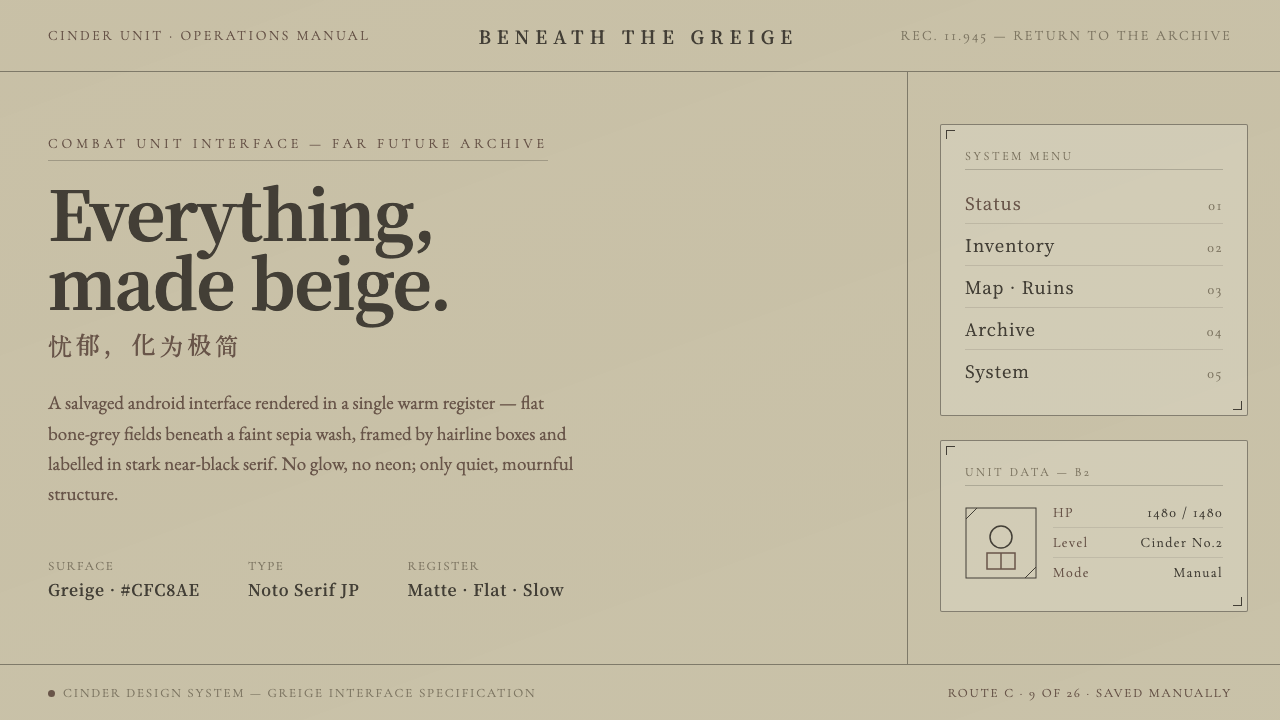 NieR: AutomataSci-fi that refuses neon. Flat greige fields under sepia wash, hairline boxes…
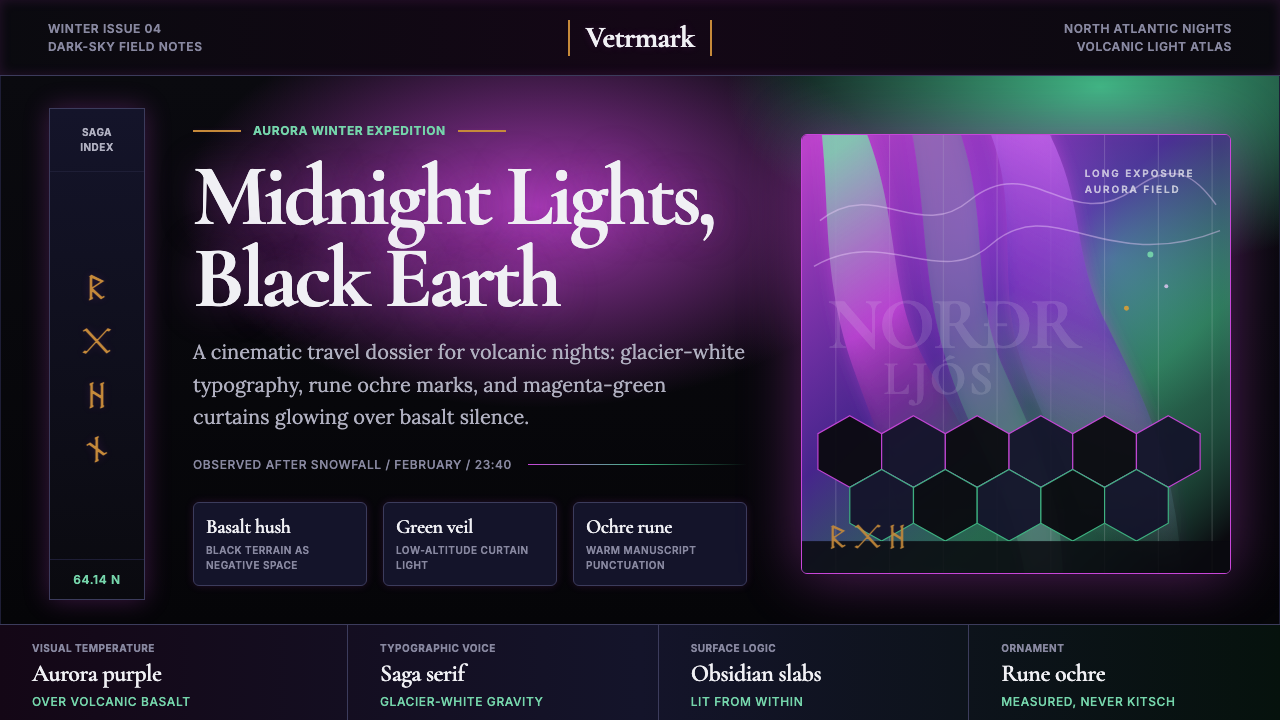 Icelandic Aurora TourismMidnight tourism turns mythic. Basalt black, aurora magenta-green, saga serif…
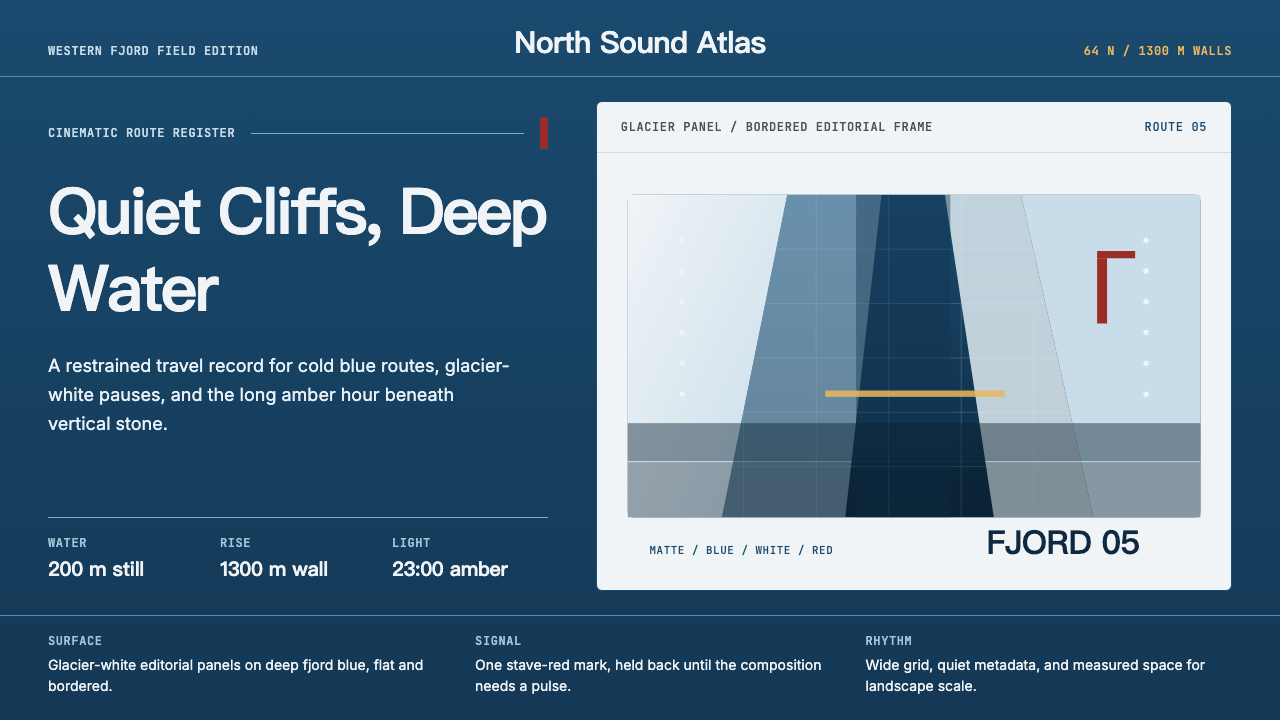 Norwegian Fjord TourismMonumental, not loud. Fjord blue, glacier-white panels, and one stave-red acc…
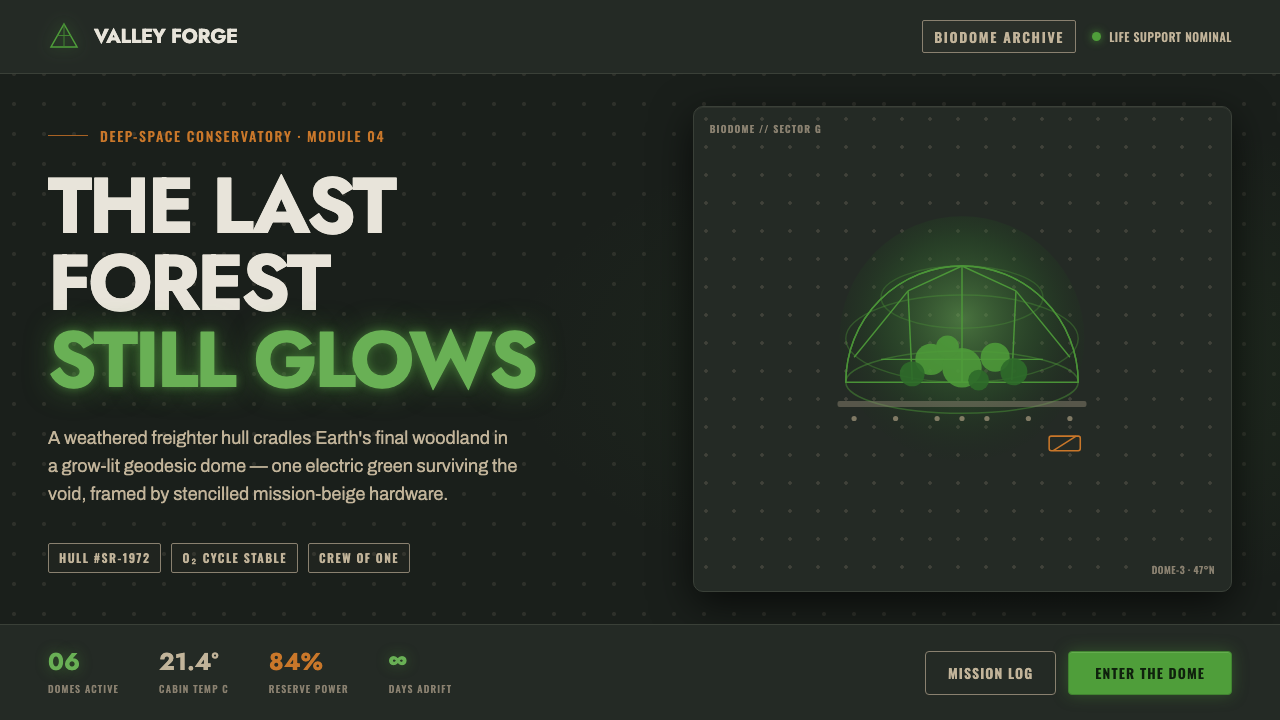 Silent RunningEarth's last forest in a freighter hull. One glowing green against near-black…
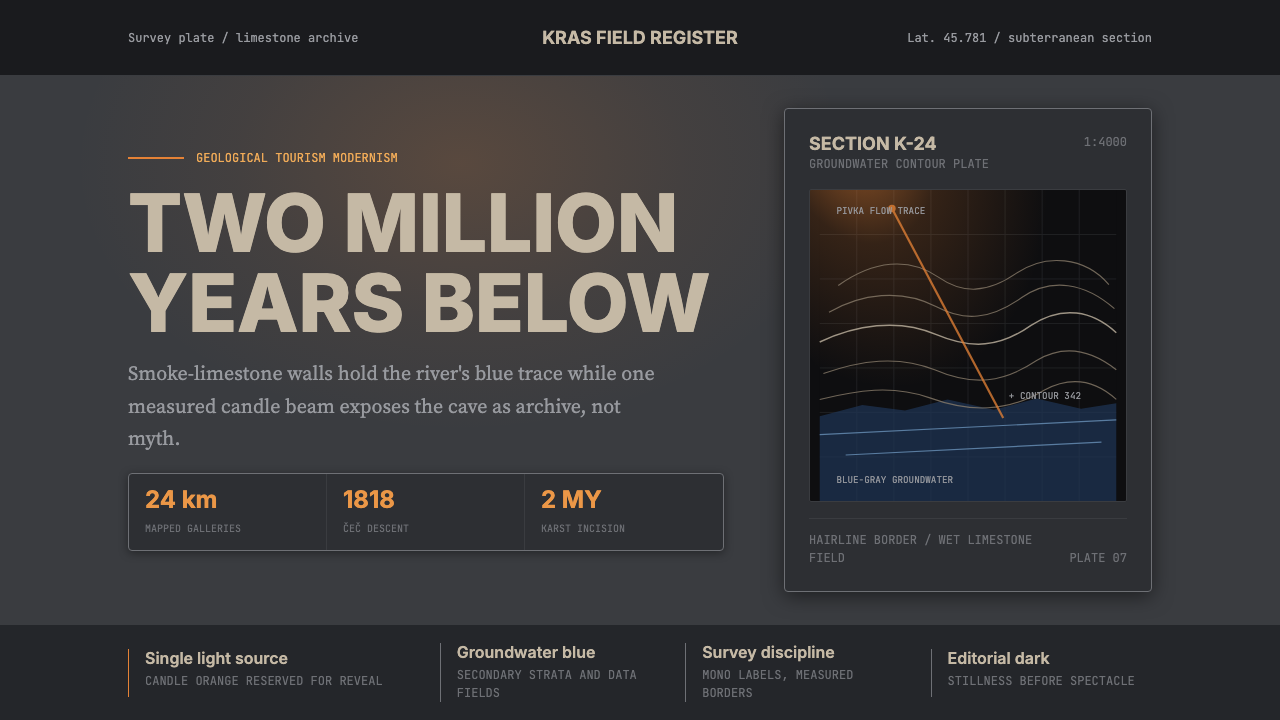 Slovenian Postojna Cave (Karst)Serious geology. Limestone gray, groundwater blue, and Inter type cut by one…
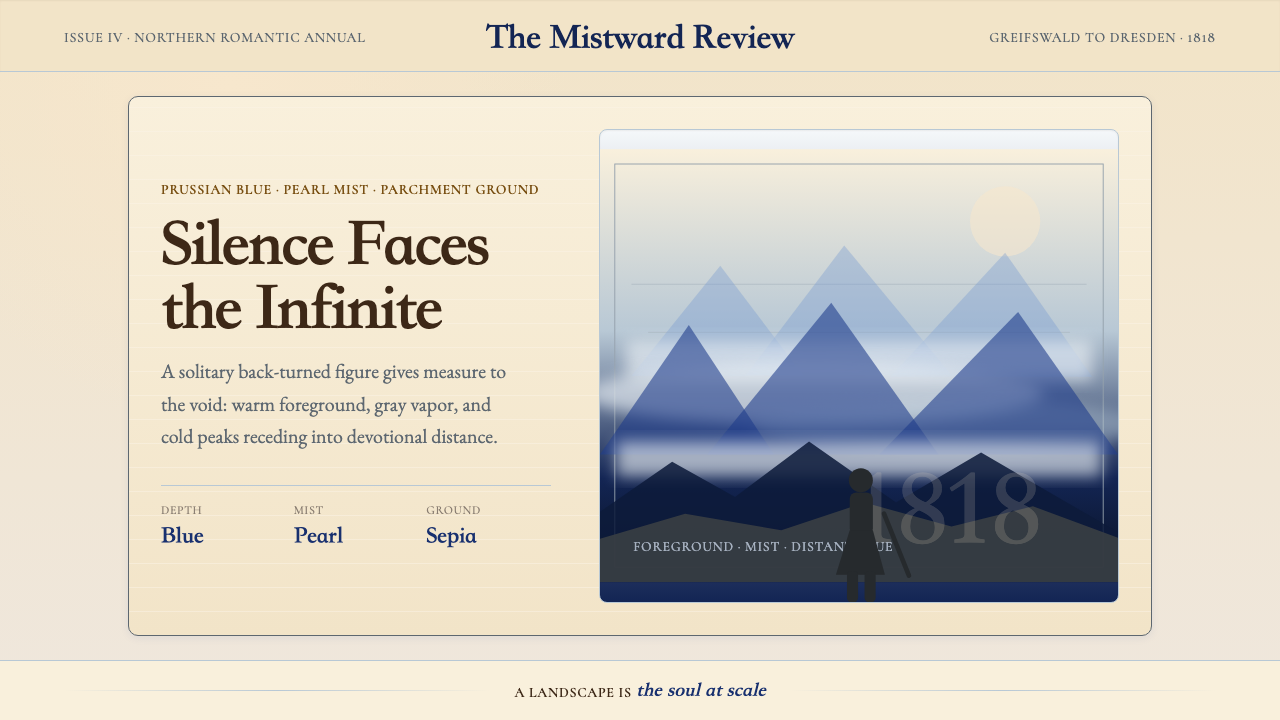 Caspar David FriedrichSilence becomes vast. Prussian blue depth, pearl mist, and parchment framing…