What is Korean Hanok Eaves Revival?
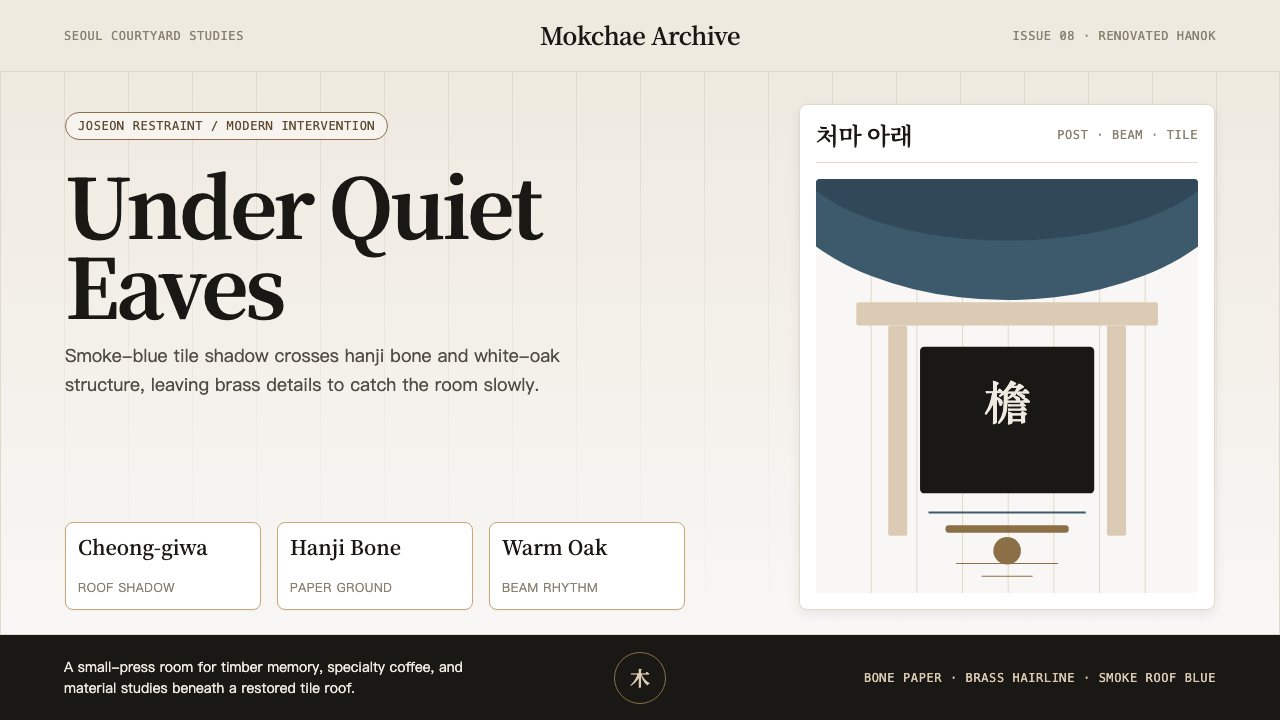
Korean Hanok Eaves Revival translates eight centuries of Joseon courtyard architecture into a living contemporary aesthetic — smoke-blue roof-tile shadow, warm white-oak beams, and brass fixture details that feel earned rather than applied.
Korean Hanok Eaves Revival in brief
Korean Hanok Eaves Revival is a design sensibility rooted in the 2010s–2020s transformation of Joseon-era courtyard houses into contemporary cultural spaces. Specialty cafés, small-press bookshops, ceramics studios, and soap workshops opened inside centuries-old timber frames across Seoul's Bukchon, Ikseon-dong, and Seochon neighborhoods — and the visual language that emerged from those renovations became a coherent aesthetic in its own right.
The style is defined by a precise layering of materials and tones rather than by geometry or graphic boldness. Smoke-blue roof-tile shadow acts as the dominant cool register; warm white-oak beams and hanji-white plaster walls supply the warm ground; and fine brass hardware — door pulls, lighting fixtures, shelf brackets — introduces a third register of aged warmth that keeps the palette from reading as cold. Nothing in the system is stark or high-contrast in the Western minimalist sense. The contrasts are subtler: aged versus fresh, structural versus decorative, interior versus threshold.
Crucially, Hanok Eaves Revival is not generic Asian minimalism and is not the same as Japanese wabi-sabi. Where wabi-sabi foregrounds imperfection and the passage of time as primary aesthetic values, Hanok Revival foregrounds the structural logic of the timber frame — the hierarchy of column, beam, purlin, and rafter — and the cultural specificity of the Korean building tradition. The eaves overhang, with its characteristic upward curve at the corner, is not an ornamental flourish but a functional and identity-bearing element. The style treats that overhang as a compositional anchor.
Where does Korean Hanok Eaves Revival come from?
The hanok — a Korean traditional house organized around a central courtyard, built with timber columns, earthen walls, and a distinctive ceramic tile roof — traces its mature form to the Joseon dynasty (1392–1897). Joseon-period hanok design synthesized earlier Unified Silla construction traditions (dating to the eighth century and famous for the giwa, or clay roof tile, fired in characteristic blue-grey) with Confucian spatial principles that organized domestic life around hierarchies of public and private, male and female, family and guest.
By the late nineteenth and early twentieth centuries, rapid urbanization under Japanese colonial rule (1910–1945) and later under the compressed industrialization of the postwar Korean economic miracle meant that hanok neighborhoods were demolished at a rate that alarmed cultural preservationists. Seoul's old tile-roofed districts — once the domestic fabric of the Joseon capital, Hanseong — shrank dramatically. The preservation movement that arose in response was initially driven by heritage policy but gained its contemporary cultural resonance through a different channel: the independent café and creative industry scene of the 2010s.
Studios including Mass Studies, led by architect Minsuk Cho, and Guga Urban Architecture, led by Cho Jung-goo, along with the practice of Hwang Doo-jin (Doojin Hwang Architects), pioneered a renovation approach that preserved and exposed the structural timber rather than concealing it behind modern cladding. The approach set a register: raw timber grain alongside smooth lime plaster, the dark ceramic tile of the roof visible at the eaves from the interior, brass and steel hardware selected for material affinity rather than decorative novelty. Jeonju Hanok Village, south of Seoul, served as a parallel laboratory for this aesthetic outside the capital.
The influence of architect Itami Jun — a Korean-Japanese architect born Yoo Dong-ryong, whose work meditated on the sensory qualities of Korean materials — provided a theoretical underpinning. Itami Jun's buildings in Jeju Island and elsewhere demonstrated that the specific weight and hue of Korean clay, tile, stone, and timber could anchor a contemporary architecture without becoming nostalgic reproduction. This precedent legitimized the revival not as heritage preservation but as a live visual language capable of being extended into new programs, new scales, and new media.
What defines the Korean Hanok Eaves Revival look?
Eaves as Compositional Anchor
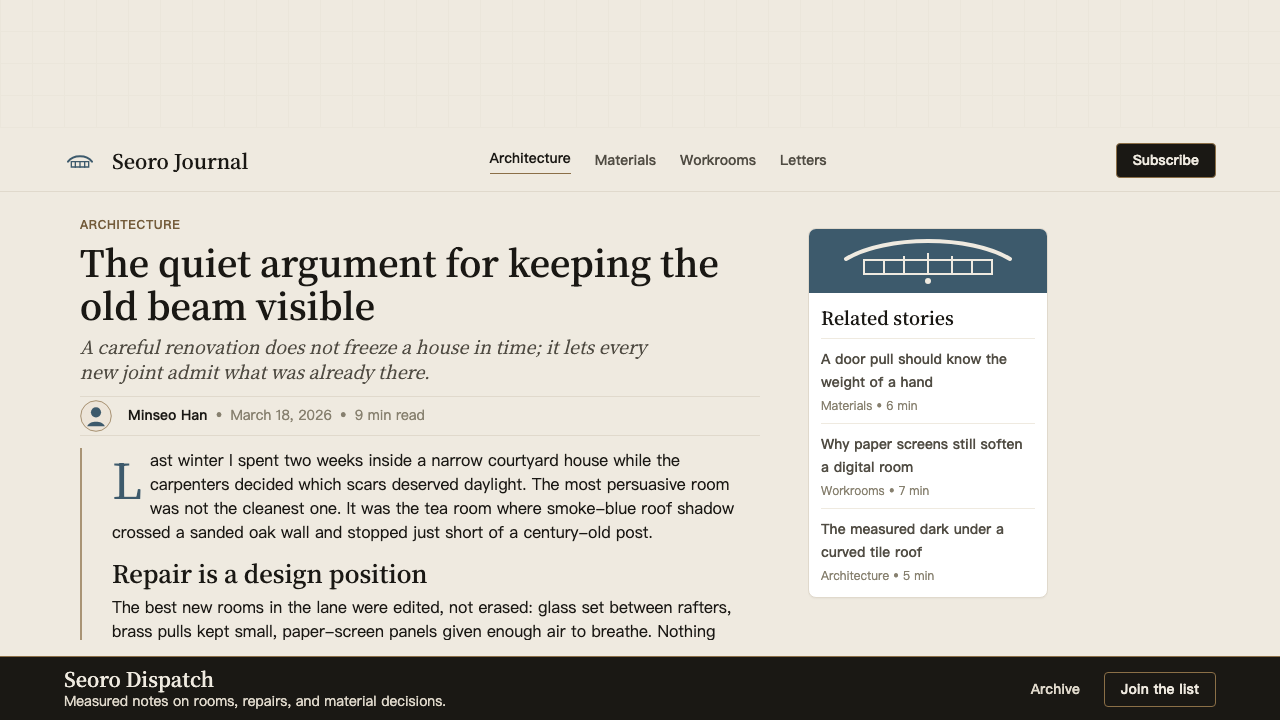
The defining element of the style is the treatment of the eaves overhang — the deep horizontal projection of the roof that casts a band of shadow across the wall below. In Hanok Revival interiors and graphics, this shadow band functions as a compositional horizon: a cool, dark register that sits above a warmer, lighter field. The gentle upward curve at the corner eave is echoed in subtle curved details elsewhere — the lip of a shelf, the arc of a lamp arm — without being literally reproduced. The eave is an attitude rather than a copy.
Layered Tonal Register
The palette works through three distinct tonal layers rather than through color contrast. The cool layer is the smoke-blue grey of fired ceramic roof tile — a desaturated blue with significant grey and a slight olive undertone that reads differently in natural versus artificial light. The warm layer is hanji white — the off-white of Korean mulberry-bark paper and lime plaster, warmer and more alive than a pure white. The accent layer is aged brass, which introduces warmth without sweetness. These three layers never compete; they are assigned to different material categories and held apart by structural logic.
Timber Frame Hierarchy
The Joseon hanok is organized by a clear structural hierarchy: major columns carry the main horizontal beams, which carry the purlins, which carry the rafters. Hanok Revival applies this hierarchical logic to visual design — a primary structural line (equivalent to the column) anchors the composition, secondary lines define zones (the beams), and fine lines articulate detail (the rafters). In digital and print contexts, this translates to a deliberate sizing rhythm where the gap between hierarchy levels is large rather than incremental, producing a layout that reads as architecturally structured.
Material Specificity Over Abstraction
Unlike design traditions that abstract materials into flat color fields, Hanok Revival retains the specific surface quality of its materials as an expressive asset. The grain of white oak is visible and directional. The roughness of lime plaster is present rather than smoothed to uniformity. The patina of brass implies use and time. In digital applications, this translates to a preference for actual photography of natural surfaces over synthesized texture, and for the kind of tonal complexity that comes from photographing real materials rather than rendering them.
Threshold and Interior Ambiguity
A defining spatial quality of the traditional hanok is the maru — the wooden-floored transitional space between exterior courtyard and interior room, neither fully inside nor outside. Hanok Revival translates this spatial idea into a compositional preference for zones that are neither foreground nor background, neither fully defined nor fully open. In layouts, this appears as generous intermediate zones — wide margins that contain neither text nor void but low-contrast graphic elements, or backgrounds that shift subtly between the cool and warm registers without a hard boundary.
Restrained Brass Accent
Brass in the Hanok Revival context is never used as decoration for its own sake — it appears only where a functional fixture or hardware element exists: the pull of a door or drawer, the socket of a pendant light, the bracket supporting a shelf. The restraint is part of the aesthetic logic. Brass is the punctuation of the system, not its subject. When it appears frequently or decoratively — as a border, a background pattern, a typographic element — it crosses into a different, more commercial aesthetic that the style consciously resists.
Courtyard Breathing Room
The traditional hanok centers on the madang — the open courtyard that gives every interior room air, light, and a relationship to sky. Hanok Revival treats generous negative space as an equivalent: not decorative emptiness but functional breathing room that allows each element to exist independently before the eye travels from one to another. This is not the tight-packed, information-dense aesthetic of much East Asian commercial design. The spacing is deliberate and almost meditative — closer to the spatial generosity of a traditional tea ceremony setting than to a contemporary Seoul café menu board.

Who shaped Korean Hanok Eaves Revival?
Minsuk Cho, principal of Mass Studies in Seoul, has been among the most internationally visible architects working with the hanok idiom since the 2000s. His practice integrates Joseon spatial logic — the hierarchy of courtyard, transitional space, and interior — into contemporary programs without mimicking historical surface detail. Cho's theoretical writing on the urban condition of Korean architecture, particularly his analysis of the pressures placed on traditional neighborhoods by rapid development, gave critical vocabulary to a generation of architects and designers who were learning to work with the city's surviving hanok fabric.
Hwang Doo-jin (Doojin Hwang Architects) is known for renovation projects that restore and re-expose the structural timber of hanok buildings with an emphasis on material honesty over period recreation. His practice has been influential in establishing the principle that a renovated hanok should declare its renovation — new interventions should be legible as new, sitting in respectful tension with the original fabric rather than masquerading as part of it. This principle, widely adopted in the Ikseon-dong and Bukchon renovation waves, is central to why the style reads as contemporary rather than historicist.
Itami Jun — born Yoo Dong-ryong in Tokyo to Korean parents — built a body of work across Jeju Island and the Korean peninsula that meditated on the sensory weight of Korean materials: the particular density of volcanic basalt, the temperature of clay tile, the silence of hanji paper. Though not a hanok revivalist in a direct programmatic sense, Itami Jun's insistence that regional material culture carries an irreducible aesthetic truth provided a philosophical foundation for the revival movement. His work demonstrated that emotional depth in Korean contemporary architecture came from material specificity, not from formal quotation.
Cho Jung-goo of Guga Urban Architecture has worked extensively on the adaptation of hanok structures to contemporary hospitality programs — cafés, small hotels, and cultural venues. His projects in Bukchon and Seochon have been particularly influential in establishing the interior language of the revival: the visible roof structure, the contrast of dark tile and warm plaster, and the use of limited brass hardware as the sole decorative accent. Guga's work helped define the hospitality register of the style that has since been widely emulated.
Kim Seung-hoy, a Seoul-based architect and academic who has written extensively on the relationship between traditional Korean spatial concepts and contemporary architecture, provided important critical framing for the revival. His analysis of the philosophical underpinnings of hanok spatial organization — particularly the concept of 'in-between' space represented by the maru and the madang — gave architects and designers language to describe what they were doing beyond the purely formal. Kim's theoretical contribution helped distinguish the Hanok Revival as a spatially and philosophically grounded movement rather than a surface-driven nostalgic trend.
How do you use Korean Hanok Eaves Revival today?
Applying Korean Hanok Eaves Revival correctly requires understanding that the style is built on a material logic rather than a color formula. Its authority comes from the specific relationship between structural and decorative elements — the way the cool eave shadow anchors the composition and the brass hardware punctuates but does not lead. Attempting to reproduce the look by selecting similar tones without attending to the underlying relational logic tends to produce something that looks like a generic East Asian café rather than the specific aesthetic the revival developed.
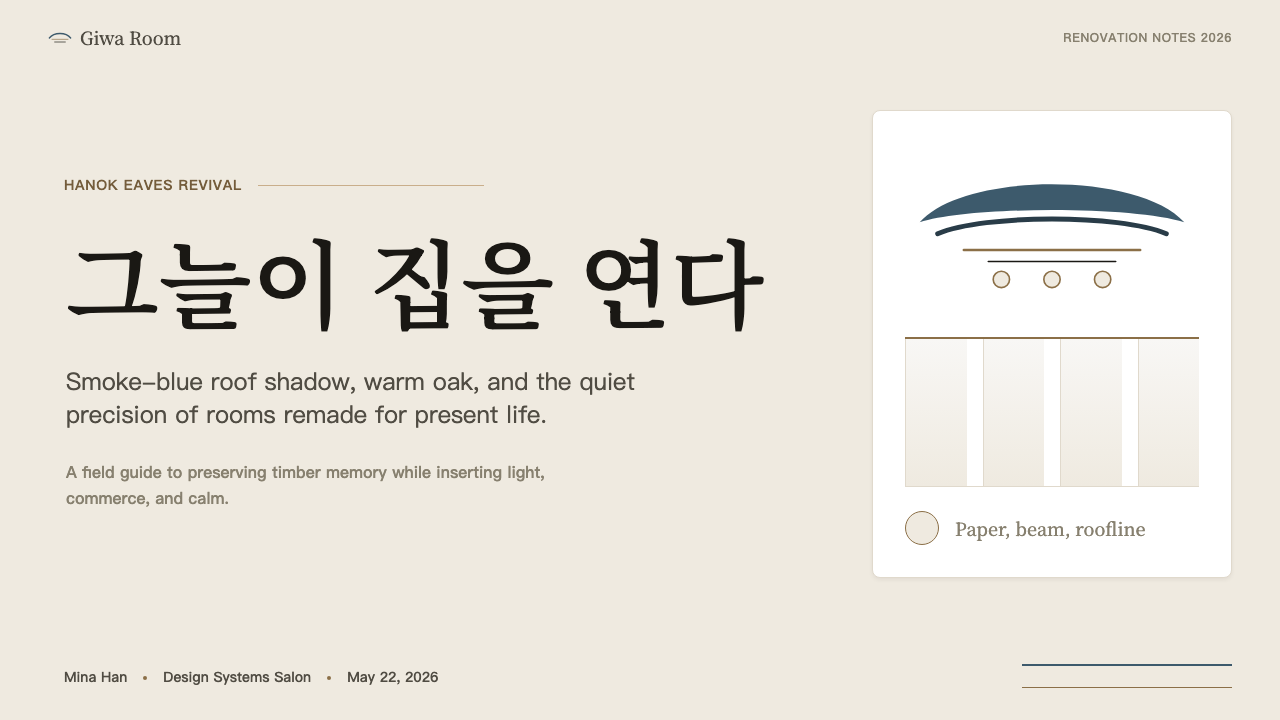
For presentation slides, the style works best in contexts where deliberate restraint and cultural specificity serve the message — cultural institution decks, architecture and interior design portfolios, artisan brand presentations, and similar work where the audience will read the visual register as intentional rather than understated by default. A cover page in this style uses the compositional horizon: a cool, darker band across the upper third (evoking eave shadow) above a warm lighter ground, with title text sitting in the warm zone in a clean, unhurried typeface. Content slides should breathe generously — the equivalent of the hanok courtyard. Data slides use the palette's three tonal layers to encode hierarchy: structural figures in the darkest register, supporting data in the middle warm tone, annotations in a lighter, more recessive register.
For web interfaces, Hanok Revival suits editorial platforms, portfolio sites, cultural venue websites, and premium product pages where considered pace and material richness are appropriate. The approach is to establish the tonal layering system in the background and surface treatments, then populate it with content that respects generous spacing. Navigation should be quiet and typographic. Cards and panels should carry a sense of material substance — slight warmth in the background, a shadow that suggests depth without drama. Interactive states should use the brass accent register: a subtle warm hover state rather than a color-pop change.
In editorial and marketing contexts, the style rewards patience and sustained reading rather than fast scanning. A long-form article layout in this register uses wide margins that hold secondary material — pull quotes, image captions, footnotes — while the body text occupies a column of considered width. Section breaks are marked by horizontal space rather than graphic dividers. Photography should show real surfaces: the grain of wood, the texture of plaster, the natural patina of aged objects. Composite imagery with rendered or synthetic surfaces will undermine the material honesty that gives the style its authority.
A common mistake when working in this style is over-applying the brass accent, either by using it across multiple element types simultaneously or by substituting a brighter, more golden tone for the specific muted warmth of aged brass. The second common mistake is using a background that is too blue — the smoke-blue of the style lives in the shadow register, not in the ground. The ground is warm. Reversing this — a cool ground with warm accents — produces something closer to Nordic design than to the Joseon-inflected aesthetic the style actually describes. The third mistake is tightening the spacing to match conventions from East Asian commercial design: the courtyard breathing room is not a detail, it is structural to the system.
Korean Hanok Eaves Revival — FAQ
How is Hanok Revival different from Japanese wabi-sabi?
The two aesthetics are frequently confused because both involve natural materials, muted tones, and a rejection of decorative excess. But their underlying values differ substantially. Wabi-sabi is centered on imperfection, transience, and the beauty of things that are incomplete or worn — the cracked glaze of a tea bowl, the moss growing on a stone. Hanok Revival is centered on structural clarity and material specificity — the precision of the timber joint, the exact hue of fired tile, the functional rightness of a brass pull. Where wabi-sabi meditates on entropy, Hanok Revival affirms the logic of making. The emotional register is also different: wabi-sabi tends toward quietude and melancholy, while the Hanok Revival sensibility, rooted in active contemporary use rather than contemplative withdrawal, has a quality of purposeful aliveness.
Can this style work for digital products that have no physical connection to Korean architecture?
Yes, but the honest version of applying a culturally specific style to a product outside its original context requires understanding what is being borrowed and why. The Hanok Revival's structural logic — tonal layering, generous negative space, material honesty, restrained accent — is transferable without cultural appropriation concerns precisely because these are spatial and compositional principles, not symbols or sacred forms. What makes the application feel considered rather than arbitrary is using the underlying spatial logic rather than applying surface markers. A product that adopts the tonal layering and the breathing-room spacing while being genuinely appropriate to its content will land more authentically than one that simply adds some warm-grey backgrounds and a brass-colored button.
How does the style handle dark mode?
The Hanok Revival is inherently a light-ground aesthetic — the warm white of hanji and plaster is structural to the system, not incidental. A dark inversion is possible but requires rethinking the layering logic rather than simply darkening the background. In a dark variant, the eave shadow that normally sits above the warm ground must find a new compositional role: it can become a slightly lighter zone in an otherwise deep field, or the relationship between cool and warm registers can be inverted while maintaining the same three-layer structure. The brass accent behaves well in dark contexts because its warmth reads as luminous against dark grounds. The risk in dark mode is losing the 'courtyard breathing room' quality — dark backgrounds tend to encourage denser layouts, which works against the style's core spatial value.
What is the relationship between this style and the broader contemporary Korean design scene?
The Hanok Revival occupies a specific and self-aware position within Korean contemporary design rather than representing the whole of it. South Korean design culture in the 2010s and 2020s includes a wide spectrum: the high-tech futurism of its consumer electronics industry, the bold graphic energy of its entertainment and fashion brands, and the internationally oriented Swiss-grid-influenced corporate design that many Seoul studios practice. The Hanok Revival is a deliberate turn toward vernacular and local, positioned in conscious contrast to both the global corporate standard and to the nostalgic folk aesthetic that preceded the revival. It is the design language of a specific cultural moment — the rediscovery of urban heritage neighborhoods by a generation of creative entrepreneurs — rather than a national style.
How does spacing work in this style, and why does it matter so much?
Spacing in the Hanok Revival style is not a passive leftover between elements — it functions the way the madang courtyard functions in the traditional hanok: as an active structural element that gives every surrounding element its identity and breathing room. The traditional courtyard is not simply a gap between buildings; it is the organizing center of the house, the space that makes sense of the rooms arranged around it. In design terms, this means that the space between a heading and its body text, between a card and its neighbor, between a section and the next, should be generous enough to read as intentional presence rather than default padding. When the spacing is reduced to match denser grid conventions, the entire tonal and material system loses its character because the elements begin to compete rather than coexist.
Related design styles
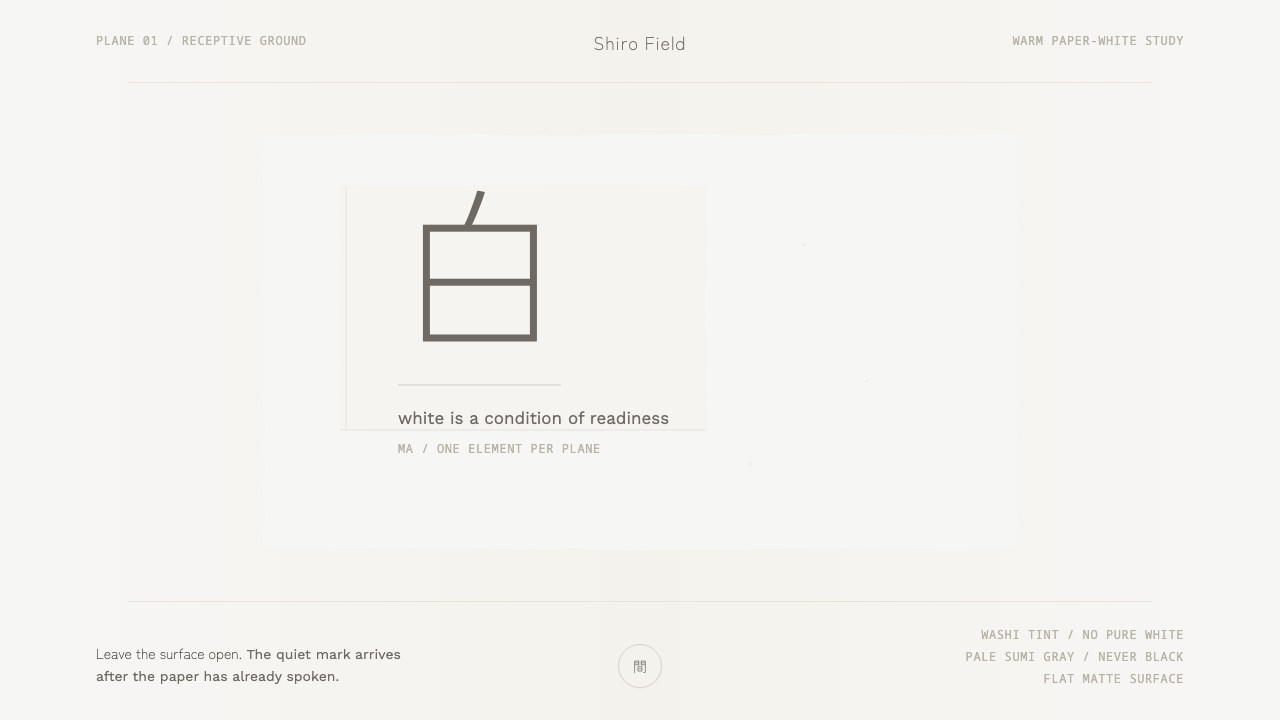 Kenya Hara «White»Emptiness is the subject. Warm washi white holds one pale sumi-gray mark.
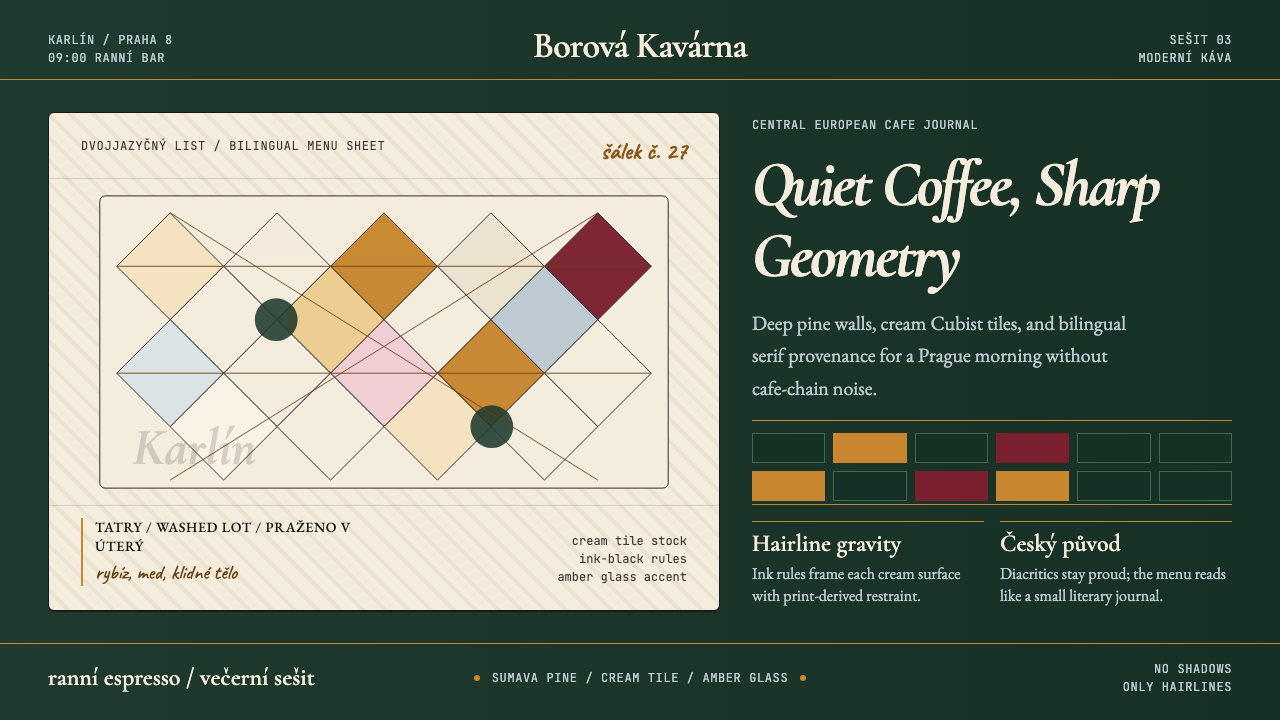 Czech Prague Modernist Cafe (2020)Quietly assured. Pine green, cream hairlines, amber Cubist tiles, and literar…
 Financial Times (Pink Paper)Authority on salmon paper. Deep navy rules and claret accents discipline dens…
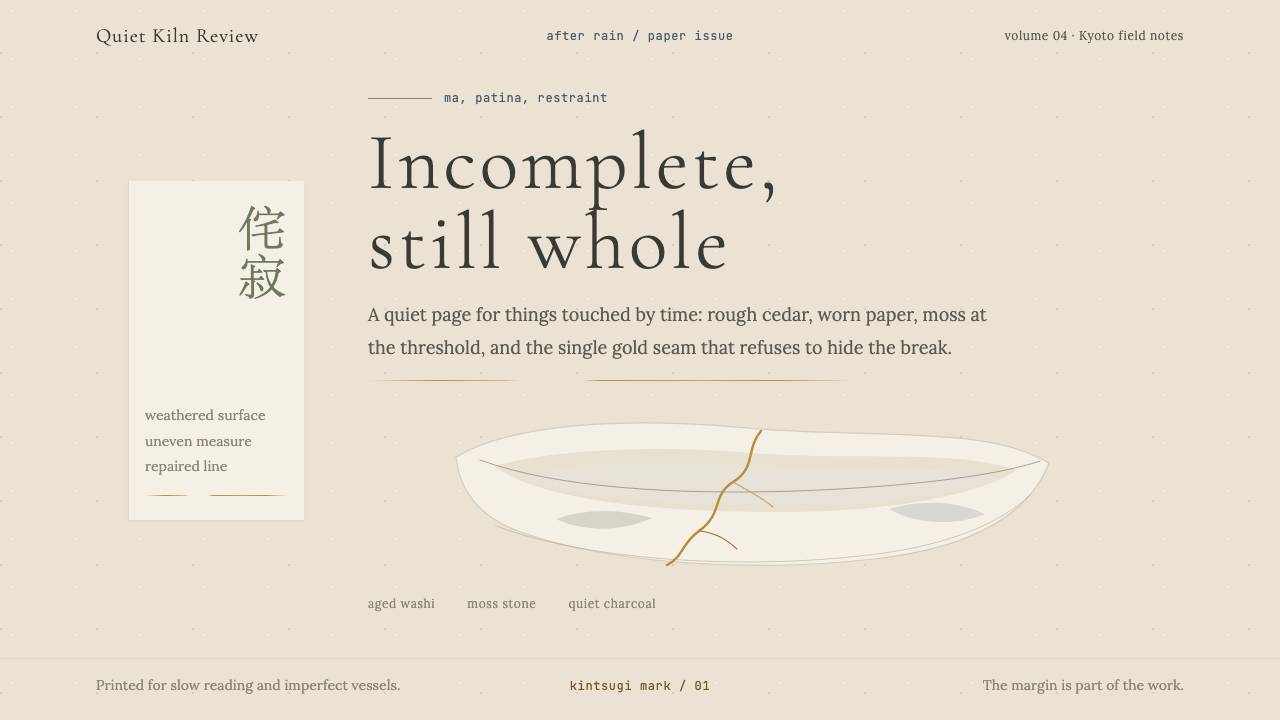 Wabi-SabiStillness makes imperfection whole. Washi beige, moss sage, and a spare gold…
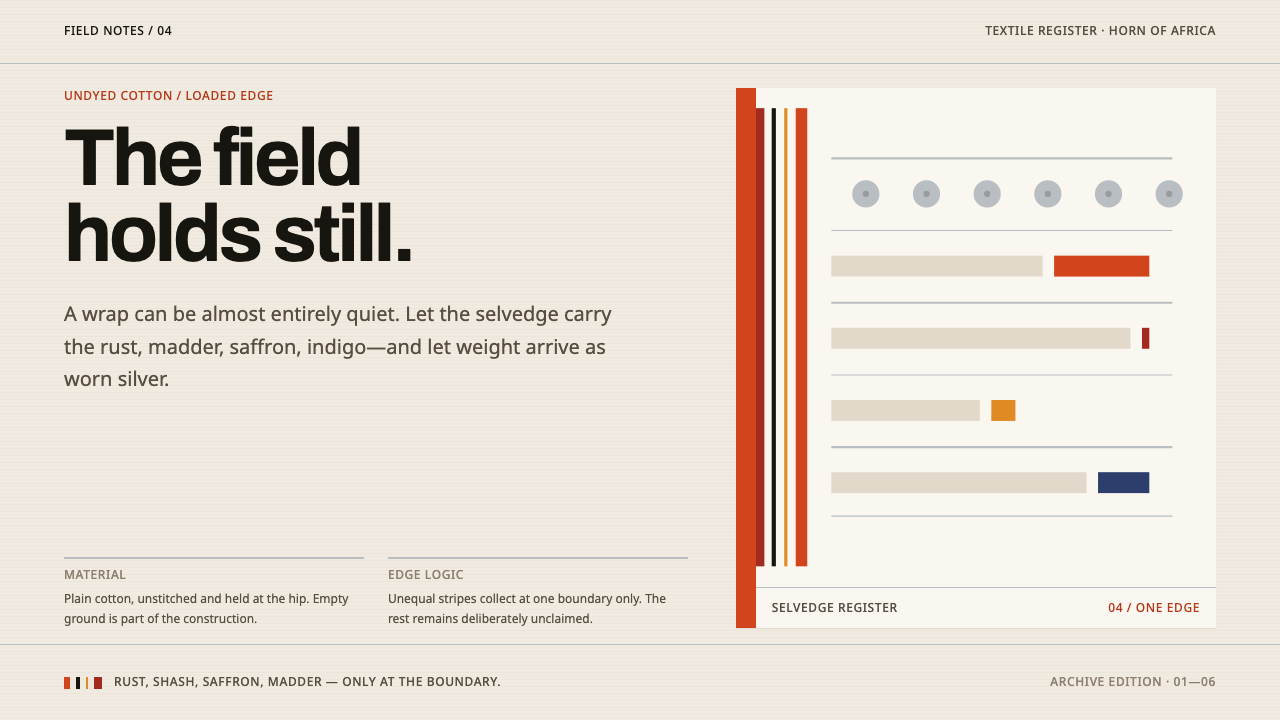 Afar Nomad TextileWeight lives at the edge. Rust and madder selvedges cut across a quiet cotton…
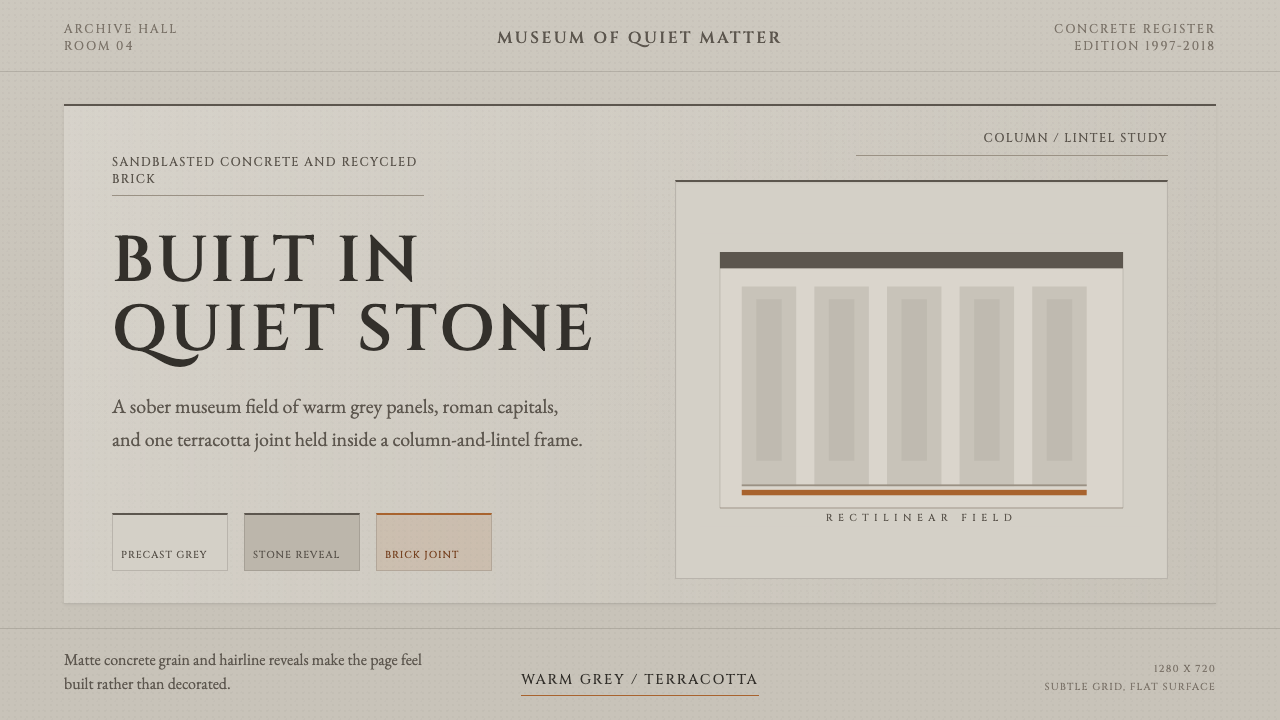 Chipperfield Museum GrayMuseum gravity, rendered quietly. Warm concrete grey, roman capitals, one ter…