What is Eritrean Asmara Italian Modernism?
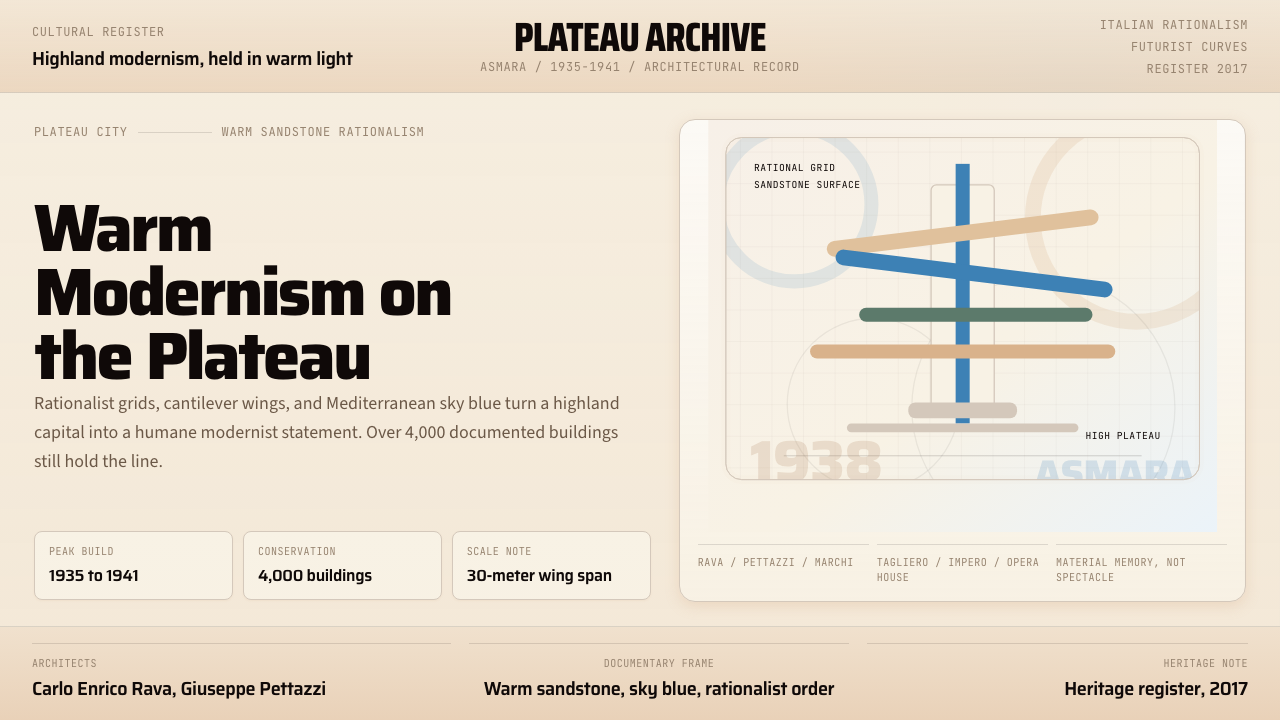
Asmara is the city where Italian Rationalist architects, freed from fascist conservatism at home, built the most concentrated collection of 1930s modernist architecture outside Europe — and left behind a visual vocabulary of warm sandstone, sky-blue cantilevers, and curvilinear futurist geometry that is at once monumental and humane.
Eritrean Asmara Italian Modernism in brief
Eritrean Asmara Italian Modernism is a design language drawn from the extraordinary built environment of Asmara, Eritrea — a highland city at 2,325 meters where Italian colonial architects constructed over 4,000 documented modernist buildings during the peak construction years of 1935 to 1941. UNESCO inscribed Asmara as a World Heritage Site in 2017, recognizing it as 'Africa's Modernist City' and the most intact surviving example of Italian Rationalist urbanism anywhere in the world.
Unlike the stark white austerity often associated with European Rationalism, Asmara's modernism absorbed the warmth of its setting: sandstone-colored stucco facades, terracotta-tinted plaster, and the vivid sky blue of the East African plateau sky. The Fiat Tagliero building — a gas station whose 30-meter cantilevered wings hover without visible support — and Cinema Impero's bold Art Deco frontage are the iconic anchors of this vocabulary, but the style pervades the entire city grid from corner bars to government ministries.
As a design system, Asmara Italian Modernism translates this built heritage into digital and graphic applications. It is defined by warmth where pure Rationalism would be cold, by curvature where Bauhaus would insist on the straight edge, and by a tectonic sense of weight and structure rooted in the Mediterranean and East African vernacular. The result is a modernism that feels grounded in place rather than universal in its ambitions — local, warm, and confident.

Where does Eritrean Asmara Italian Modernism come from?
Italy's colonial presence in Eritrea began in 1890, but it was Mussolini's imperial ambitions in the 1930s that transformed Asmara from a modest administrative town into a showcase of modern Italian civilization. The Ethiopian campaign of 1935–1936 made Asmara the logistical hub of Italian East Africa, and an enormous influx of Italian settlers, military personnel, and architects followed. The colonial government commissioned buildings at a pace and ambition that would have been impossible in Rome, where the regime's architectural preferences leaned toward a monumental neo-classicism that left little room for the avant-garde.
This bureaucratic distance from Rome paradoxically created freedom. Architects such as Carlo Enrico Rava, Giuseppe Pettazzi, Bruno Sclafani, and Carlo Marchi — working within the broad umbrella of Italian Rationalism and its sibling movement Novecento — were able to experiment with forms that the metropolitan establishment would have rejected as too radical. Pettazzi's Fiat Tagliero building (1938) is the most extreme example: an airplane-shaped service station whose engineer reportedly held workers at gunpoint to force removal of the temporary support columns, demonstrating that the cantilever could hold. It could, and it has.
The architectural movements feeding into Asmara's modernism were plural and sometimes contradictory. Italian Futurism contributed its romance with speed, the machine, and aerodynamic form — visible in the streamlined curves of the city's bars and cinemas. Italian Rationalism, drawing on the European International Style, contributed structural clarity and the rejection of historical ornament. The Novecento movement, more conservative and indebted to classical mass and symmetry, shaped the civic monumentality of government buildings. All three tendencies coexist within a few blocks of each other in Asmara, creating a city that is a compressed museum of the argument within Italian modernism about what the modern should look like.
The peak construction period ended with Italy's defeat in East Africa in 1941, when British forces occupied Eritrea. The frozen moment of construction — not resumed under subsequent Ethiopian or Eritrean administration at the same scale — is precisely what preserved the city. No postwar redevelopment wave swept away the 1930s fabric. Asmara's inscription as a UNESCO World Heritage Site in 2017 brought international recognition to a built environment that scholars of architectural history had been studying since at least the 1990s, and sparked renewed interest in the city's visual vocabulary as a design source.
What defines the Eritrean Asmara Italian Modernism look?
Warm Sandstone Palette
Where Bauhaus deploys cream as a neutral ground, Asmara modernism reaches for warmer, earthier tones — the ochre, terracotta, and sand of the Ethiopian plateau and the Mediterranean stucco tradition. These warm neutrals serve as the dominant field against which sky blue and ivory white create contrast. The palette is never cold or clinical; even at its most restrained, it retains the quality of sun-warmed plaster. Accent colors derive from the East African sky: a saturated, slightly dusty blue that reads as simultaneously atmospheric and structural.
Curvilinear Futurist Form
The defining formal gesture of Asmara modernism is the curve held in tension with rectilinear structure. Streamlined fins, rounded corners at building prows, semicircular window bays, and the sweeping horizontal bands of ship-deck railings appear throughout the city. These curves are not the organic curves of Art Nouveau, which evoke plant growth and biological form; they are aerodynamic and machine-age in feeling — borrowed from aircraft, ocean liners, and the Futurist imagination of speed made visible. In digital application, this means compositions that introduce a single assertive curve or arc against an otherwise geometric grid, never as decoration but as the dominant structural gesture.
Tectonic Weight and Horizontal Banding
Asmara's buildings read as heavy, grounded objects. Wide horizontal string courses, deep overhanging eaves, and bold projecting balconies give the facades a stacked, layered quality that emphasizes mass and gravity. This horizontal banding — borrowed from the Italian Rationalist grammar of the 1930s — is one of the style's most transferable characteristics. In layouts, it translates to strong horizontal divisions, wide color bands that run the full width of the composition, and a sense that each section carries genuine visual weight rather than floating on white space.
Mediterranean Sky Blue as Structural Color
The blue that appears on Asmara's modernist buildings — on cantilevered awnings, balcony soffits, and decorative spandrel panels — is a specific register: neither navy nor pastel but a fully saturated, slightly sun-bleached sky blue that reads as confident rather than delicate. In this design system, blue is not a background or a calm accent; it is load-bearing. It marks the elements in a composition that do the structural or navigational work — headers, key interactive elements, primary calls to action — and it does so with the assertiveness of a painted concrete surface rather than the softness of a digital tint.
Monumental Scale with Human Detail
One of the tensions that makes Asmara's modernism distinctive is its simultaneous reach for the monumental and the human-scaled. A building like Cinema Impero presents a tall, imposing vertical mass to the street — legible from a distance as civic authority — yet its ground floor is porous and accessible, with storefronts, arcades, and a cafe terrace that invite occupancy. In digital work, this principle manifests as layouts that combine bold, large-scale typographic or graphic elements with intimate, readable body content that rewards close attention. The system should not sacrifice approachability for grandeur, nor grandeur for approachability.
Geometric Ornament within Rational Restraint
Asmara's modernism permits a degree of ornament that pure Bauhaus rationalism would reject — but it is geometric ornament, never figurative or historicist. Repeating chevrons along a parapet, circular reliefs set into a spandrel, fluted pilaster-like vertical elements that read as decoration yet also reinforce structural rhythm: these are acceptable flourishes because they are abstract patterns derived from the same geometric vocabulary as the building's structural logic. In graphic and digital application, this permits the use of repeating geometric motifs — a grid of dots, a band of chevrons, a row of arcs — as textural elements, provided they are restrained in scale and clearly secondary to the structural composition.
Warm-Ground Contrast Logic
Whereas Bauhaus contrast is built on light grounds and dark type, Asmara modernism operates with a warmer contrast logic: sandstone warm neutrals as the dominant mid-ground, dark charcoal or near-black for text and structural anchors, and the sky blue as the single accent that lifts elements forward. Ivory or warm white is used for highlights and reversed text, adding brightness without the clinical coldness of pure white. This tripartite contrast — warm neutral ground, dark anchor, bright accent — gives the system its distinctive quality of being simultaneously bold and warm, a combination that is rare in grid-based modernist traditions.

Who shaped Eritrean Asmara Italian Modernism?
Pettazzi designed the Fiat Tagliero building in Asmara (1938), a fuel and service station whose aircraft-wing cantilevers extend 30 meters on each side with no lateral support columns. The building is one of the most audacious structural statements of the 1930s — anywhere in the world — and remains the defining icon of Asmara's modernist identity. Its combination of Futurist formal ambition, structural engineering bravado, and functional purpose as a humble service station crystallizes the contradictions and achievements of the colonial modernist project in East Africa.
Rava was among the most theoretically engaged of the Italian Rationalist architects who worked in or wrote about Africa. His essays in the late 1920s and early 1930s called for a 'Mediterranean modernism' that would fuse the rationalist formal principles of European modernism with the warmth, light, and material character of the southern climate — an argument that anticipated much of what Asmara actually became. Rava positioned colonial architecture not as the application of European norms to a foreign context but as an opportunity to develop a new regional expression within the modernist tradition.
Sclafani contributed several of Asmara's most sophisticated commercial buildings, demonstrating how the Italian Rationalist grammar could be adapted to the social and commercial life of a colonial city. His work is notable for the way it negotiates between monumental civic presence at the scale of the street facade and the detailed human-scale treatment of arcades, shop fronts, and interior courtyards. The integration of shade structures and deep loggias in response to the Eritrean climate represents an early and largely unacknowledged instance of climate-responsive modernist design.
Marchi's work in Asmara spans the civic and the commercial, and his buildings are among those that most clearly show the influence of the Novecento movement — a strand of Italian modernism that sought to reconcile the clean lines of Rationalism with the classical dignity of mass, proportion, and symmetry. Where the more radical Rationalists stripped ornament entirely, Marchi retained geometric relief patterns and carefully proportioned openings that gave his facades a measured, authoritative quality well-suited to public buildings. His work represents the conservative wing of Asmara's modernist diversity.
Rossi was among the architects responsible for Asmara's Cinema Impero (1937), whose name — 'Empire Cinema' — reflects the colonial moment while its architecture demonstrates the accomplished integration of Art Deco decorative logic with Rationalist structural clarity. The cinema's street facade, with its bold vertical signage tower and horizontal ribbon windows, became one of the enduring images of the city and a reference point for how the style balances commercial showmanship with modernist discipline. Buildings like Cinema Impero demonstrate that the Asmara architects were aware of, and in dialogue with, international modernist trends far beyond the Italian peninsula.
How do you use Eritrean Asmara Italian Modernism today?
Asmara Italian Modernism is best understood as a warm rationalism — it has the structural clarity and grid discipline of European modernism, but without the cold universalism. Applying it correctly means understanding its governing tension: monumental ambition held in check by material warmth and human scale. The temptation to simply use warm neutrals on a grid and call it Asmara should be resisted; the style requires that the warmth and the structure feel genuinely integrated, as they are in the buildings that inspired it.
For presentation slides, this system offers strong tools for both cover and content contexts. A cover page benefits from the style's poster-like boldness: a wide horizontal band in sandstone warm neutral anchors the lower third, while the title sits in large, confident type against a sky-blue or near-black upper field. A single arc or curved form — thin, structural, aerodynamic — cuts across the composition to recall the cantilevered futurist geometry of the source architecture. Content slides should treat the warm neutral as the dominant ground, use charcoal or deep brown for all body text, and reserve sky blue for headlines and key data callouts only. Data visualizations take on a tectonic quality — bars and columns feel like architectural sections, colored in warm earth tones and sky blue, with no decorative fills or shadow effects.
For web user interfaces, the style is particularly well-suited to dashboards, pricing pages, and marketing landing pages where visual authority is needed without emotional coldness. The approach: establish the warm sandstone or warm off-white as the page ground; use horizontal banding to divide major sections, with each band carrying genuine visual weight in a warm neutral, sky blue, or near-black. Card components should have a slight warmth in their surface color, hard-edge borders rather than soft shadows, and corner radii that are gently rounded rather than sharply square — acknowledging the style's curvilinear character without abandoning structure. Navigation should be typographic and horizontal, evoking the horizontal string courses of the source buildings.
For editorial and marketing design, the system supports strong information hierarchy built on warmth rather than severity. A Asmara-style article layout uses a warm off-white ground, generous margins, and wide horizontal rules in sky blue or sandstone to mark section transitions. Pull quotes can be set in a wide sandstone band, reversed in ivory or warm white. Marketing pages work well with the style's alternating-band logic: full-width sections in warm neutral alternate with sections in sky blue or near-black, creating a rhythm that is simultaneously bold and approachable. Campaign imagery, when used, should be treated with a warm-toned treatment that harmonizes with the sandstone palette — not cold, not desaturated, but grounded in the ochre and terracotta range.
A common mistake when applying this style is confusing it with generic warm-toned minimalism or with Mediterranean vacation aesthetics. The Asmara vocabulary is not relaxed or resort-like; it is disciplined and monumental. The curves are aerodynamic, not decorative; the warmth is material, not casual. A second common error is neglecting the structural role of sky blue and treating the palette as exclusively warm. Without the blue — used confidently, at scale, as a structural rather than accent color — the system loses its tension and collapses into an undifferentiated warm neutrality. The blue is what makes the warmth legible as architecture rather than ambiance.

Eritrean Asmara Italian Modernism — FAQ
How does Asmara Italian Modernism differ from generic Art Deco?
Art Deco is primarily a decorative style — its identity rests on chevrons, sunbursts, stepped forms, and elaborate surface treatments applied to a range of structural approaches. Asmara modernism shares the aerodynamic formal vocabulary with Streamline Moderne (a late Art Deco variant), but its underlying logic is rationalist: ornament is permitted only when it is geometric and secondary to structure. The warmth of the palette and the curvilinear futurist forms can superficially resemble Art Deco, but the tectonic discipline and the horizontal banding logic derive from Italian Rationalism, not from decorative traditions. A useful test: Art Deco ornamentation tends to elaborate the surface; Asmara ornamentation tends to reinforce the structural reading of the building.
Can this style work in dark-mode digital interfaces?
A dark inversion of the Asmara palette is possible but requires deliberate adjustment. The canonical system is light-ground — warm neutrals as the dominant field. In a dark variant, the near-black or deep charcoal takes the dominant field, and the sandstone warm neutral moves to a mid-range accent for secondary text and card surfaces. The sky blue retains its structural role but must be calibrated carefully: against a dark ground, fully saturated sky blue can feel garish rather than confident. A slightly more muted, dustier blue — still clearly in the sky register — maintains the tectonic feeling. The key is preserving the three-tier contrast logic: dark ground, warm neutral mid-tone, bright sky blue accent. Collapsing any two of these tiers loses the system's characteristic warmth-and-structure tension.
Is this design system appropriate for brands that want to feel cutting-edge and tech-forward?
It depends on what 'cutting-edge' means for the specific brand. Asmara modernism conveys authority, historical depth, and a kind of confident originality — the feeling of a style that has been fully worked out in the physical world and carries genuine cultural weight. For technology brands that want to differentiate themselves from the cold, blue-on-white minimalism of dominant tech aesthetics, it offers a genuinely distinctive alternative. It works particularly well for platforms positioning themselves as established, trustworthy, and culturally aware rather than merely novel. It is less suited to brands for which 'cutting-edge' means maximally sparse, colorless, or aggressively contemporary — contexts where historical warmth might be misread as traditionalism.
What is the right way to use curvilinear elements without the layout looking chaotic?
The rule from the source architecture is that curves are structural, singular, and assertive — not scattered. The Fiat Tagliero building has one dominant formal gesture: the cantilever wing. Cinema Impero has one: the vertical signage tower. In a layout, this translates to introducing one primary curvilinear element per composition — a single arc that divides a hero area, a rounded header band, one circular focal point — and keeping all other elements rectilinear. Multiple curves competing for attention destroy the tectonic logic that gives the style its confidence. The curve should be the gesture that the whole composition is organized around, not one among many decorative flourishes.
How does this style handle photography and imagery?
The Asmara buildings themselves are the most instructive guide. They are photographed best in strong directional light that reveals their tectonic geometry — the way shadow falls along a string course, the silhouette of a cantilever against the sky, the texture of stucco in afternoon sun. Photography used within this design system should similarly emphasize geometric form, architectural or structural subjects, and strong tonal contrast between warm highlights and cooler shadows. Warmly toned treatments that echo the sandstone palette — slight ochre lift in the highlights, subtle blue-grey in the shadows — harmonize with the system. Cold, desaturated, or blue-tinted photography works against it. When photography is not available, the style supports clean geometric illustration in the same palette: flat forms, hard edges, and the same curvilinear-versus-rectilinear tension that defines the architectural vocabulary.
Related design styles
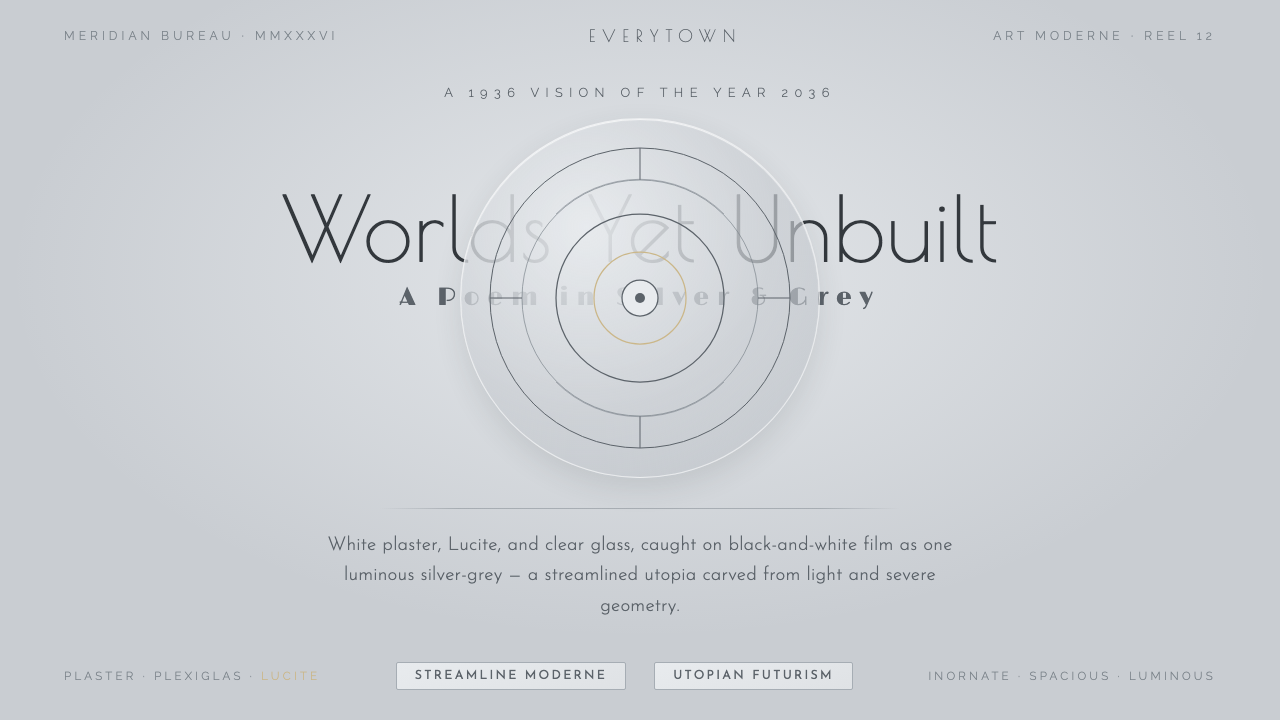 Things to Come (1936)A 1936 future cast in light. Cool silver-grey ground, geometric Poiret One ty…
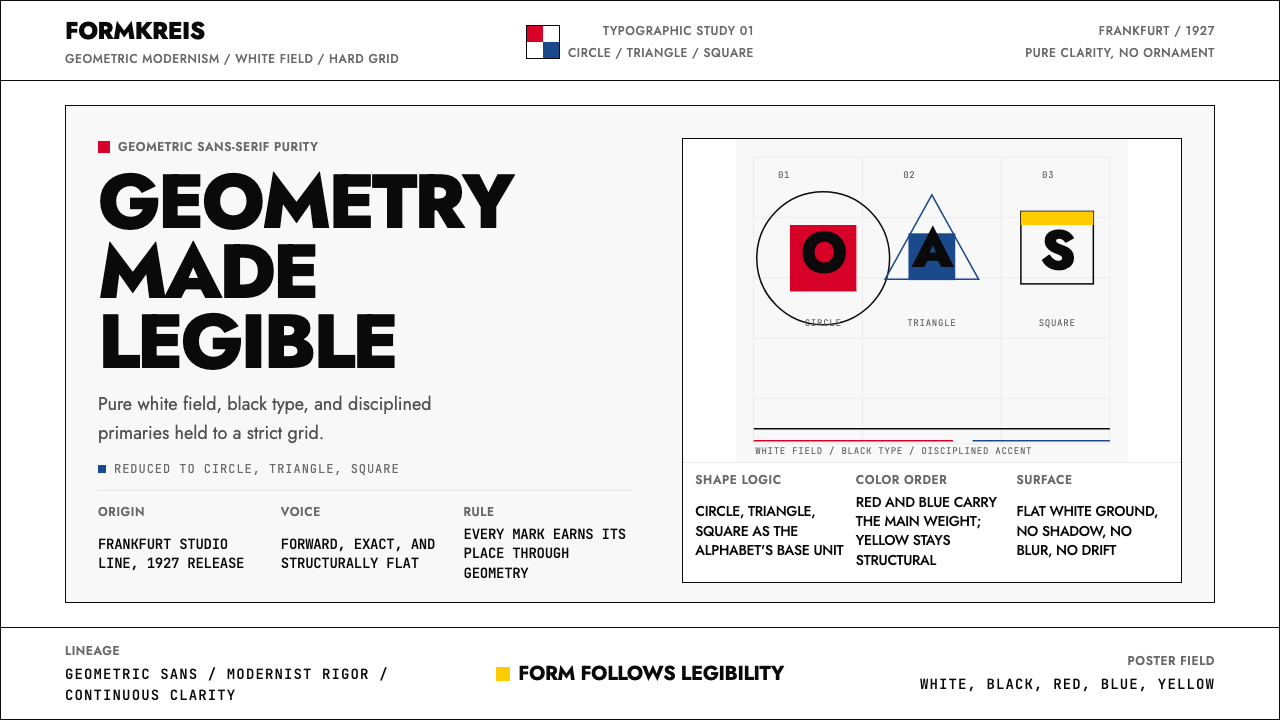 Futura Typeface (Renner, 1927)Geometry is legible. Black type and white fields, with red-blue-yellow anchor…
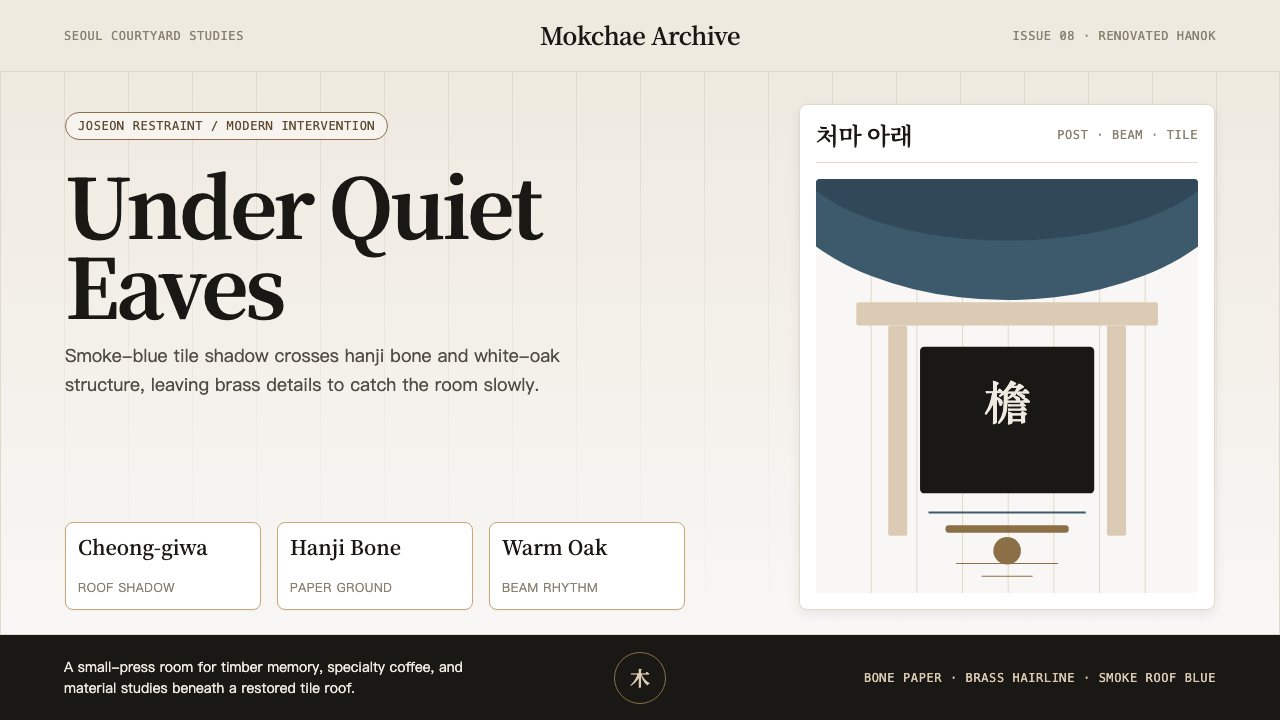 Korean Hanok Eaves RevivalJoseon restraint, not generic minimalism. Smoke-blue eaves cross hanji bone a…
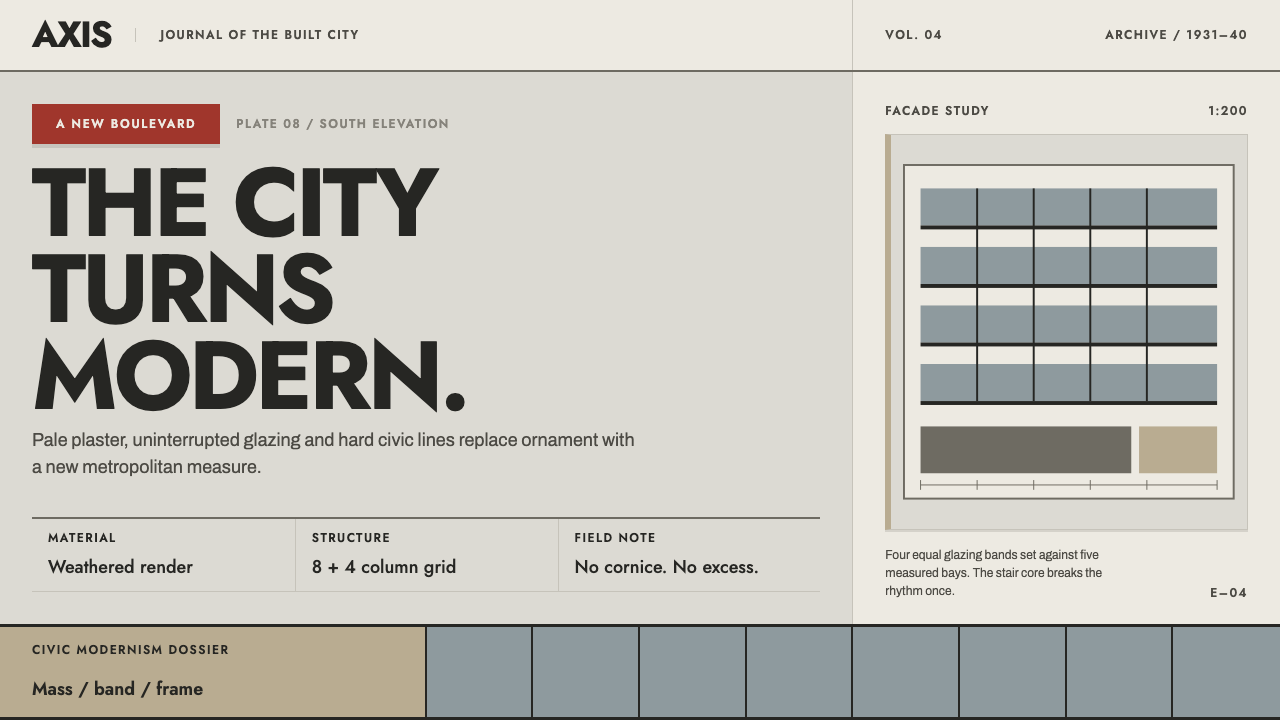 Bucharest Interwar ModernismModernism gathers civic weight. Sooted plaster, strict glazing bands and one…
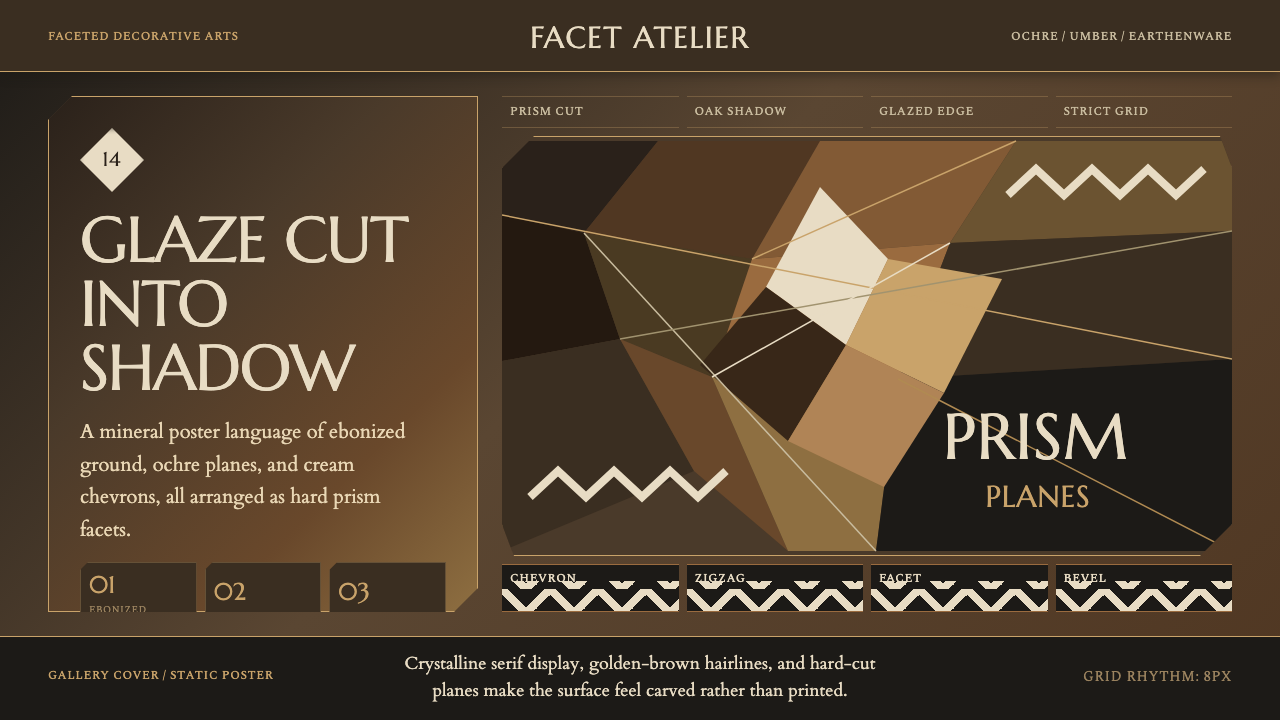 Czech Cubist Decorative ArtsGlazed geometry feels carved. Umber ground, ochre facets, and cream chevrons…
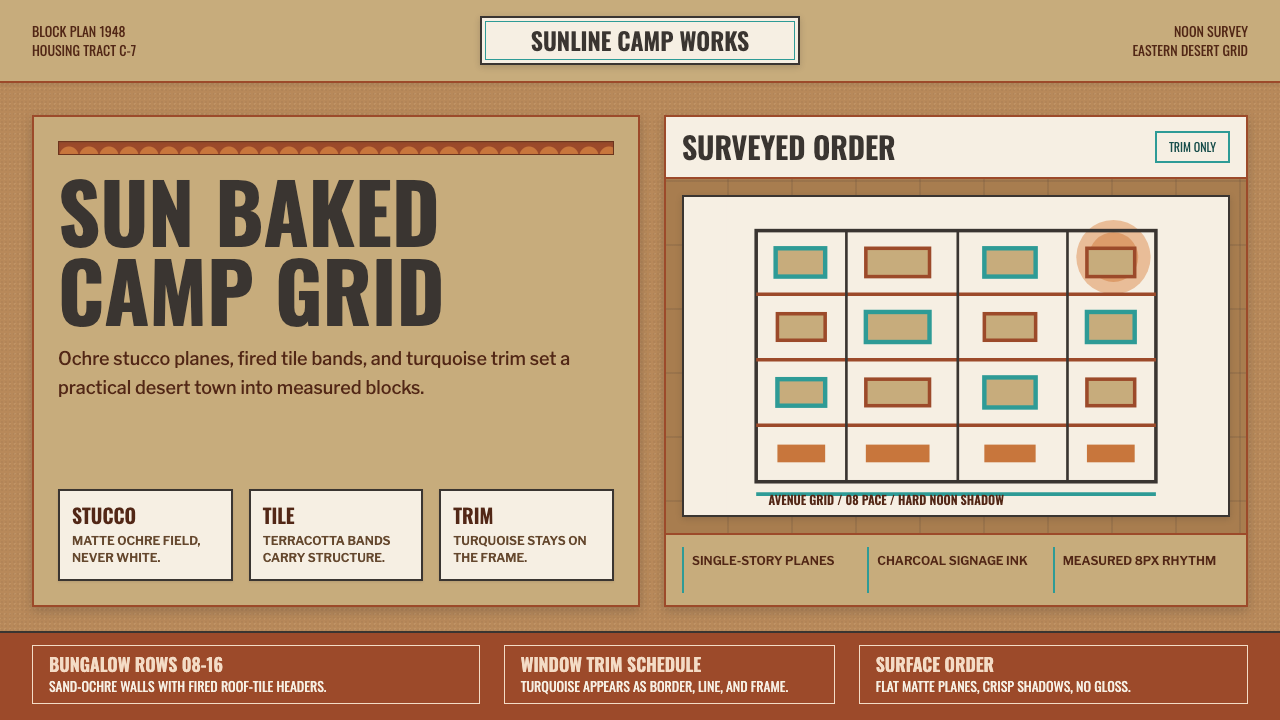 Dhahran Aramco Camp ModernismDesert order, sun-baked. Ochre stucco fields, terracotta bands, turquoise tri…