What is Wabi-Sabi?
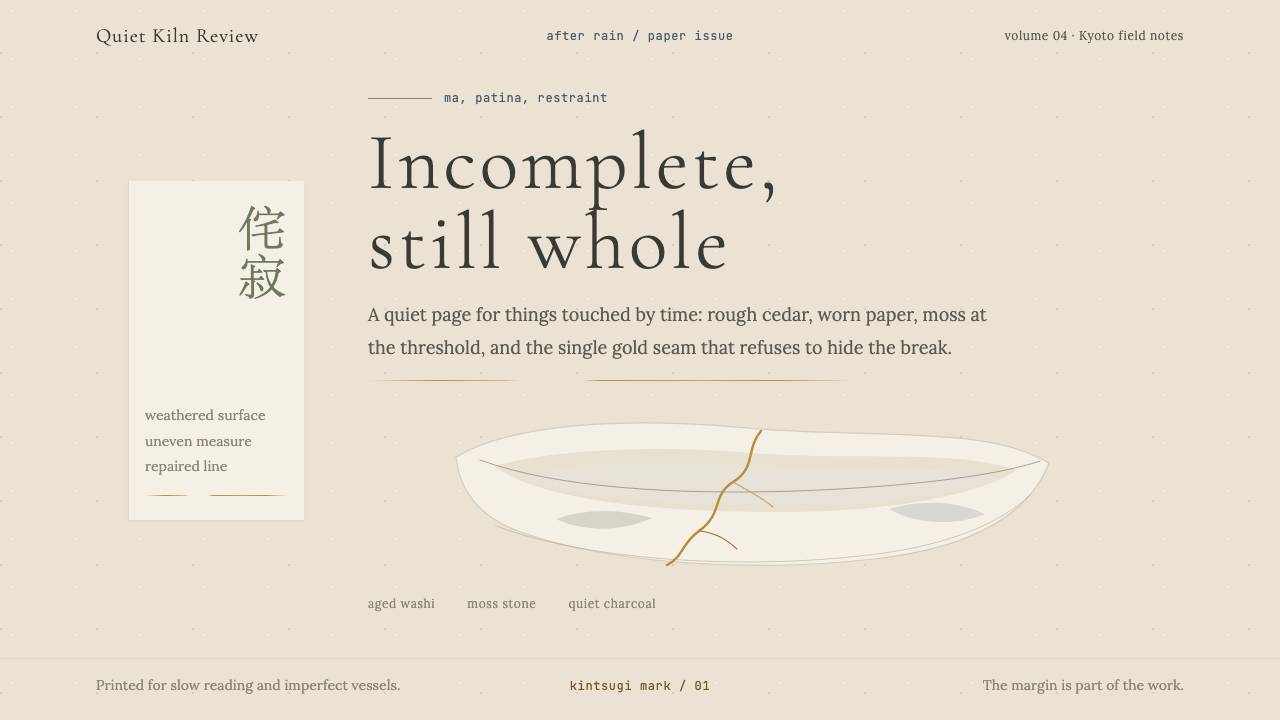
Wabi-sabi finds beauty where perfection ends — in the weathered, the asymmetric, and the quietly incomplete.
Wabi-Sabi in brief
Wabi-sabi is a Japanese aesthetic philosophy rooted in Zen Buddhism and the culture of the tea ceremony. Its name fuses two originally distinct concepts: wabi, meaning rustic simplicity and the austere beauty of solitude, and sabi, meaning the patina that time bestows on objects — the bloom of rust on iron, the crack in a glaze, the moss slowly colonizing a garden stone. Together they describe a worldview in which imperfection, transience, and incompleteness are not flaws to be corrected but qualities to be honored.
Translated into visual design, wabi-sabi becomes a system governed by restraint and authenticity rather than polish and symmetry. Its palette draws from the natural world — the beige of handmade paper, the grey-green of moss and lichen, the warm brown of unfinished clay, the muted gold of kintsugi lacquer sealing a crack. Surfaces carry texture: the grain of wood, the slight irregularity of hand-thrown ceramics, the soft tooth of washi. Negative space — known in Japanese as ma (間) — is not empty but active, giving each element room to be perceived in silence.
Unlike design systems built on rational grids and mechanical precision, wabi-sabi tolerates and even invites deviation. A headline that sits slightly off-center, a border whose weight varies faintly from one edge to the next, a background wash that is not quite uniform — these are not errors but evidence of the hand, and the hand is the point. The aesthetic asks that nothing appear too finished, too even, or too permanent, because permanence is itself a kind of dishonesty about how things actually are.

Where does Wabi-Sabi come from?
The roots of wabi-sabi reach into fourteenth and fifteenth-century Japan, when Zen Buddhism was reshaping aristocratic culture from within. Zen practice placed direct experience — the texture of a teabowl in the hand, the sound of water heating over coals — above doctrinal learning. Beauty, in this view, was not a property of objects that had been perfected but of attention brought fully to what was present. The word wabi originally carried connotations of poverty and deprivation; over the course of the fifteenth century, poets and monks transformed it into a term of praise, finding in simplicity and restraint a depth that ornament could not achieve.
The formal codification of wabi-sabi as a design philosophy came through the tea ceremony, known as chanoyu. The monk Murata Jukō (c. 1423–1502) is credited with turning the tea gathering from a display of imported Chinese luxury objects into a practice centered on humble, locally made implements — rough-surfaced bowls, bamboo whisks, plain iron kettles. Jukō argued that the asymmetry and rawness of Korean and Japanese provincial ceramics conveyed a spiritual depth that polished Chinese porcelain could not. He called this quality wabi, and its cultivation became the purpose of the tea gathering.
Sen no Rikyū (1522–1591) brought this sensibility to its fullest expression. Rikyū was tea master to the ruler Toyotomi Hideyoshi, and under his guidance the tea room itself became a wabi-sabi object: low ceilings, rough plaster walls, an entrance so small that guests were forced to bow — stripping them of rank before they entered. Rikyū designed teabowls in partnership with a tile-maker named Chōjirō, producing the first Raku ware: hand-shaped rather than wheel-thrown, low-fired, slightly irregular, warm to the touch. These bowls defined the wabi aesthetic in material form and remain the canonical reference for the style.
The twentieth century gave wabi-sabi a new audience and a new vocabulary. The American writer and designer Leonard Koren published Wabi-Sabi for Artists, Designers, Poets and Philosophers in 1994, offering the first systematic treatment of the concept in English and framing it as a counterpoint to Western modernism's pursuit of perfection, universality, and permanence. Koren identified wabi-sabi's three central qualities — impermanence, incompleteness, and imperfection — and showed how they produced a coherent visual language. Japanese industrial designer Naoto Fukasawa, though not writing about wabi-sabi explicitly, embodies many of its principles in his product work: objects that wear gracefully, that do not announce themselves, that feel as though they have always existed. The aesthetic continues to shape contemporary Japanese graphic design, packaging, and interior architecture, and its influence on Western digital design has grown substantially since the early 2000s.
What defines the Wabi-Sabi look?
Muted Earth Palette
The wabi-sabi palette is drawn entirely from natural, unprocessed materials — the off-white of handmade paper, the grey-green of weathered copper or lichen, the warm brown of raw clay, the deep near-black of iron. Colors are desaturated and slightly warm rather than pure or bright. No color competes for attention; each exists at a quieter register than the eye expects. Where accent appears, it arrives as the subdued gold of kintsugi or the occasional pale rust — a trace of something that has changed rather than been added.
Tactile Texture
Wabi-sabi design carries the memory of the hand. Backgrounds suggest the fibrous tooth of washi or the irregular surface of hand-applied plaster; type may sit on a wash that is not quite flat. These textures are not decorative patterns imposed over a clean layer; they are the ground itself, suggesting that the surface has a history. In digital contexts, this quality is achieved through photographic texture overlays of genuine natural materials — not procedurally generated noise — handled with enough restraint that the texture reads as atmosphere rather than effect.
Asymmetry and Deliberate Imbalance
Where Bauhaus achieves balance through weight and tension between geometric opposites, wabi-sabi pursues something looser: a composition that feels settled rather than resolved. A large area of empty space on one side is not balanced by an equivalent mass on the other — it simply is, and the object within it occupies its position as though it grew there. Layouts tend to be off-center, with generous breathing room on one axis and a single weighted element anchoring the composition. Nothing lines up too precisely; the grid, if it exists, is felt rather than measured.
Negative Space as Presence
Ma (間) — the Japanese concept of negative space — is not the absence of content but a full participant in the composition. In wabi-sabi design, the space around a single line of text, the silence between two visual elements, the unmarked expanse of a slide background: these are not voids to be filled but spaces in which meaning accumulates. A layout that feels sparse by Western standards may feel exactly right in wabi-sabi terms. The discipline is in resisting the impulse to fill — to trust that the pause is as expressive as the mark.
Organic and Irregular Line
Wabi-sabi does not prize the perfectly straight line or the mechanically uniform stroke. Dividers and borders carry a slight variation in weight; illustrative marks suggest a brush rather than a vector pen. Where geometric forms appear, they are softened — a circle that is nearly but not quite round, a rectangle whose corners carry the faintest irregularity. This is not clumsiness but a studied quality: the trace of process left visible. The imperfect line acknowledges that it was made, and making is part of the meaning.
Kintsugi as Visual Principle
Kintsugi — the Japanese art of repairing broken ceramics with gold-dusted lacquer — is both a historical practice and a conceptual key to wabi-sabi design. It declares that the history of an object, including its damage and repair, is more beautiful than an unmarked surface would be. In design terms, this translates to an acceptance of visible joins, of contrast between old and new, of the seam as a feature. A fine line of warm gold threading through a muted composition, a subtle contrast between two adjacent textures — these are kintsugi thinking applied to layout.
Quietude and Restraint
Every element in a wabi-sabi composition earns its place through necessity rather than decoration. There are no flourishes added for visual interest, no gradients applied for depth, no multiple competing typefaces, no busy patterned backgrounds. What remains after everything inessential is removed is not emptiness but concentration: the one thing present is more fully present for the absence of competition. This restraint is closest in spirit to Zen calligraphy — the single practiced brushstroke that contains all the training that preceded it.

Who shaped Wabi-Sabi?
Murata Jukō (c. 1423–1502) is credited as the founder of the wabi tea ceremony, transforming the tea gathering from a display of Chinese luxury into a practice of cultivated simplicity. A student of Zen under the master Ikkyū, Jukō argued that rough-surfaced Korean and Japanese provincial pottery carried a spiritual depth absent from polished imported ware. He articulated the quality of this plainness using the word wabi, giving the aesthetic philosophy its name and its original design rationale. Without Jukō's revaluation, the objects that define wabi-sabi — the Raku teabowl, the bamboo whisk, the plain iron kettle — would have no framework of meaning to inhabit.
Sen no Rikyū (1522–1591) is the figure who fixed wabi-sabi as both aesthetic and ethical commitment. As tea master to Toyotomi Hideyoshi, he had authority to shape the material culture of the most powerful court in Japan, and he used it to insist on radical plainness. His tea rooms were small, deliberately asymmetric, and built from rough natural materials. His collaboration with the tile-maker Chōjirō produced Raku ware — hand-shaped, low-fired teabowls whose uneven surfaces and warm weight set a standard for wabi design that has not been superseded. Rikyū was eventually ordered to commit suicide by Hideyoshi in a dispute whose exact causes remain debated, but his aesthetic principles survived intact and continue to govern the way the tea ceremony is practiced and understood.
Leonard Koren is the American writer and artist who introduced wabi-sabi to English-speaking designers as a coherent design philosophy rather than a vague cultural mood. His 1994 book Wabi-Sabi for Artists, Designers, Poets and Philosophers identified the aesthetic's three foundational attributes — impermanence, incompleteness, and imperfection — and provided a comparative framework against Western modernism. Koren's analytical clarity made wabi-sabi legible to designers who had no access to its Japanese cultural sources, and the book became a touchstone for the wave of Japanese-influenced minimalism that swept graphic design, product design, and interior architecture from the late 1990s onward.
Naoto Fukasawa is the Japanese industrial designer whose product work is among the most direct contemporary expressions of wabi-sabi values, though he rarely uses the term explicitly. His designs — wall-mounted CD players, simple kitchen appliances, tableware — share a quality of quiet inevitability: they appear to have always existed in their final form. Surfaces are unhurried and tactile; shapes are familiar enough to be overlooked but precise enough to feel considered. Fukasawa's concept of design dissolving into behavior — objects so natural that the user stops noticing them — is the closest contemporary analogue to the wabi principle of beauty that does not announce itself.
How do you use Wabi-Sabi today?
Wabi-sabi is among the more demanding historical aesthetics to apply faithfully, because its authority rests entirely on restraint. A layout that removes too much can read as merely unfinished; one that retains too much decoration has simply not committed. The discipline required is not minimalism in the contemporary sense — it is specific: muted natural colors, texture that suggests material history, generous negative space, and a deliberate tolerance for irregularity. Understanding what each element is doing before adding it is more important here than in almost any other visual system.
For presentation slides, wabi-sabi suits cover pages that make a single, quiet statement rather than announcing themselves loudly. A cover might carry one object — a teabowl photograph desaturated to near-monochrome, a single brushstroke character — against a large field of warm off-white, with the title set in an understated typeface at moderate size. Content slides benefit from the ma principle: one idea per slide, surrounded by space, with no bullet-point lists competing for attention. Data slides take on a contemplative rather than analytical quality — sparse charts in muted earth tones, with annotation set small and restrained, allowing the data itself to be the focal point rather than the visualization apparatus.
For web interfaces, wabi-sabi is well-suited to contexts where trust, craftsmanship, and considered quality are the primary brand values: artisan product pages, studio portfolios, wellness platforms, cultural institutions. The approach centers on a textured or near-white background, a palette of two or three muted naturals, and generous spacing between all elements. Navigation should be typographic and understated. Hero sections carry one image and very little text. Card components avoid sharp drop shadows and hard borders — a subtle tonal shift or a faint hairline is enough to delineate space. Pricing pages and dashboards are possible but require care: the aesthetic can undermine scannability if spacing becomes too diffuse.
For editorial and marketing work, the style supports a particular kind of authority — the quietness of something that does not need to be loud to be noticed. An article layout using wabi-sabi principles might set body text in a humanist typeface at a comfortable measure, with generous leading and a wide outer margin reserved for pull quotes or sparse illustration. Section breaks are marked by a hairline rule or simply by space — never by decorative ornament. Marketing materials avoid testimonial grids and feature-badge layouts in favor of single full-width images paired with short, considered copy. The effect is closer to a well-designed book than a promotional page, and that restraint is itself the signal.
A common and damaging mistake when applying wabi-sabi is aestheticizing poverty rather than honoring imperfection. Textures that look merely degraded, layouts that are sparse because nothing was designed rather than because the space was considered, colors that are muddy rather than quietly naturalistic — these produce work that reads as unresolved rather than wabi. The other frequent error is importing Japanese cultural signifiers — calligraphic characters, cherry blossom imagery, Mt. Fuji silhouettes — as surface decoration. Wabi-sabi is not a Japan-themed palette; it is a philosophy about the beauty of things that have aged, settled, and been honestly made. The discipline is in the system's values, not its symbols.

Wabi-Sabi — FAQ
Is wabi-sabi the same as Japanese minimalism?
They overlap but are not identical. Japanese minimalism, as practiced by designers influenced by the Zen aesthetic, tends toward clean surfaces, precise geometry, and the complete elimination of the unnecessary. Wabi-sabi goes further in a different direction: it not only tolerates imperfection but requires it. A perfectly smooth, precisely square, uniformly colored surface is antithetical to wabi-sabi even if it is very spare. Wabi-sabi needs the slight irregularity, the texture, the trace of time. Contemporary Japanese design brands like Muji occupy an interesting middle ground: minimalist in geometry but wabi-sabi in their celebration of natural, unprocessed materials and their explicit rejection of superficial finish.
Can wabi-sabi work in a digital product where users expect polished UI?
Yes, but it requires selective application. A full wabi-sabi UI — irregular forms, visible texture throughout, no crisp alignment — would fail usability standards and signal incompetence rather than intention. The productive approach is to apply wabi-sabi principles at the level of art direction and surface treatment while preserving functional precision where it matters. Backgrounds can carry subtle texture; spacing can be generous and slightly irregular; the color palette can be muted and naturalistic; illustrations can suggest a hand-made quality. Interactive elements — buttons, inputs, navigation — should remain legible and predictable. The aesthetic sets the emotional register; the engineering ensures the product works.
How is wabi-sabi different from the Scandinavian hygge aesthetic?
Both share an appreciation for natural materials, warmth, and the pleasures of the understated, but their emotional registers diverge significantly. Hygge is fundamentally social and comforting — it centers on gathering, candlelight, soft textiles, and the feeling of safe enclosure. Wabi-sabi is more solitary and more austere: it contemplates the single object, the crack in the bowl, the moss on the stone. Hygge invites abundance within cosiness; wabi-sabi finds sufficiency in the irreducibly simple. In design terms, hygge tends toward warmer neutrals, rounder forms, and softer layering — it reads as welcoming. Wabi-sabi tends toward cooler earths, deliberate emptiness, and visible age — it reads as contemplative.
Does wabi-sabi require Japanese visual references to be authentic?
No — and importing Japanese visual signifiers without understanding the underlying philosophy tends to produce work that is superficial rather than authentic. A wabi-sabi composition made entirely from materials and references of another culture can be fully genuine if it embodies the actual principles: aged and natural rather than pristine and synthetic, incomplete rather than resolved, textured rather than smooth, quiet rather than declarative. A cracked Moroccan tile, a worn European linen, a weathered Australian eucalyptus surface — these carry wabi-sabi qualities without requiring a Japanese reference. The philosophy is about a relationship to time, imperfection, and material honesty, not about geography.
What kinds of projects are poorly suited to wabi-sabi?
Wabi-sabi struggles wherever urgency, precision, or cheerful abundance are the required emotional registers. Financial technology products that need to convey security and reliability benefit from crisper, more rational systems. Children's educational tools require color energy and visual playfulness that wabi-sabi explicitly refuses. Fast-moving consumer goods — snacks, beverages, convenience products — depend on appetite appeal and shelf-standout that a muted, irregular aesthetic cannot deliver. Wabi-sabi is also poorly suited to data-heavy interfaces where dense information must be navigated rapidly: the style's deliberate pacing and generous spacing conflict with the need for information density. Knowing these limits is not a failure of the aesthetic — it is an acknowledgment that every visual system serves particular values, and wabi-sabi's values are those of contemplation, craft, and quiet endurance.
Related design styles
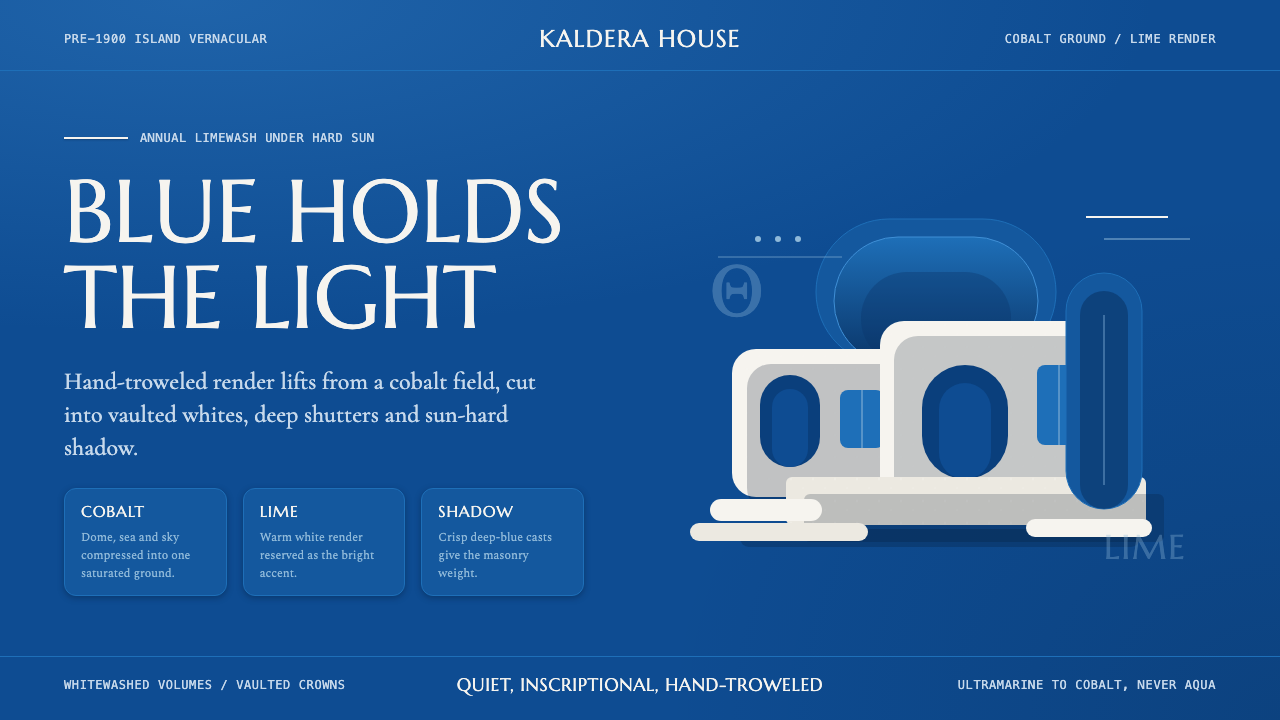 Cycladic SantoriniQuiet island gravity. Cobalt field, Marcellus capitals and white vaults hold…
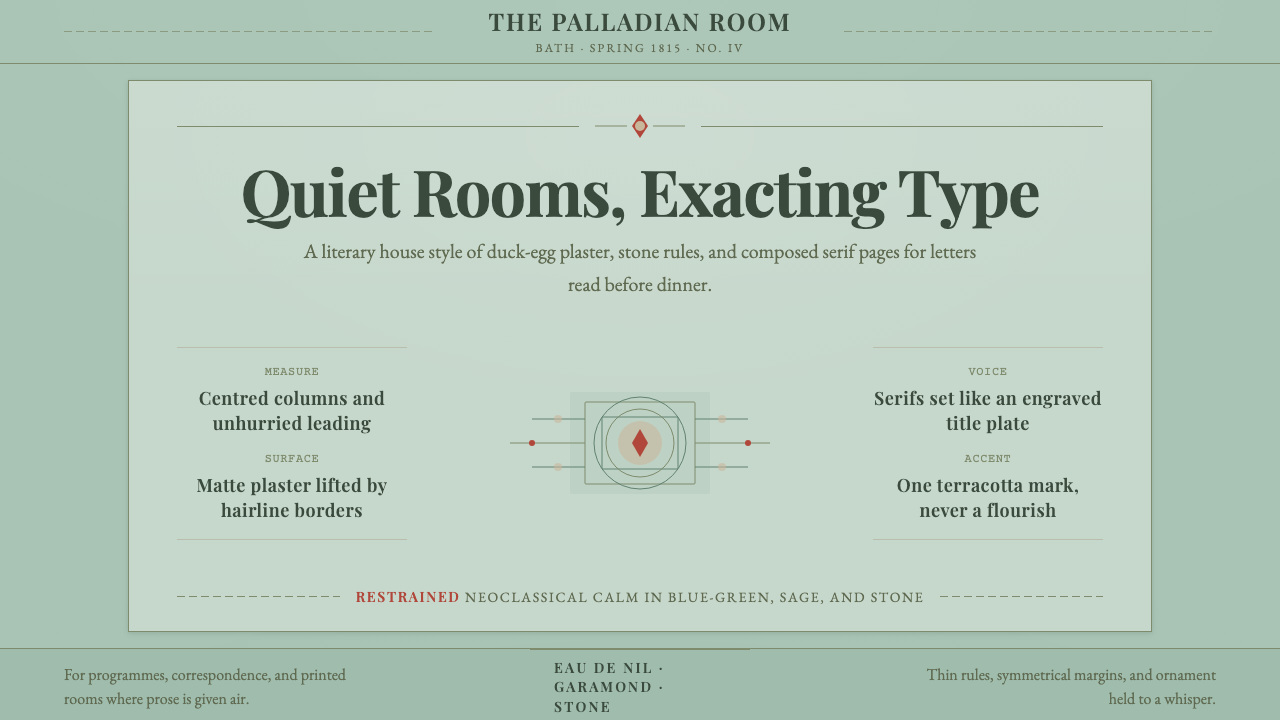 Regency EnglandCalm has authority. Duck-egg plaster, Garamond serifs, and hairline borders.
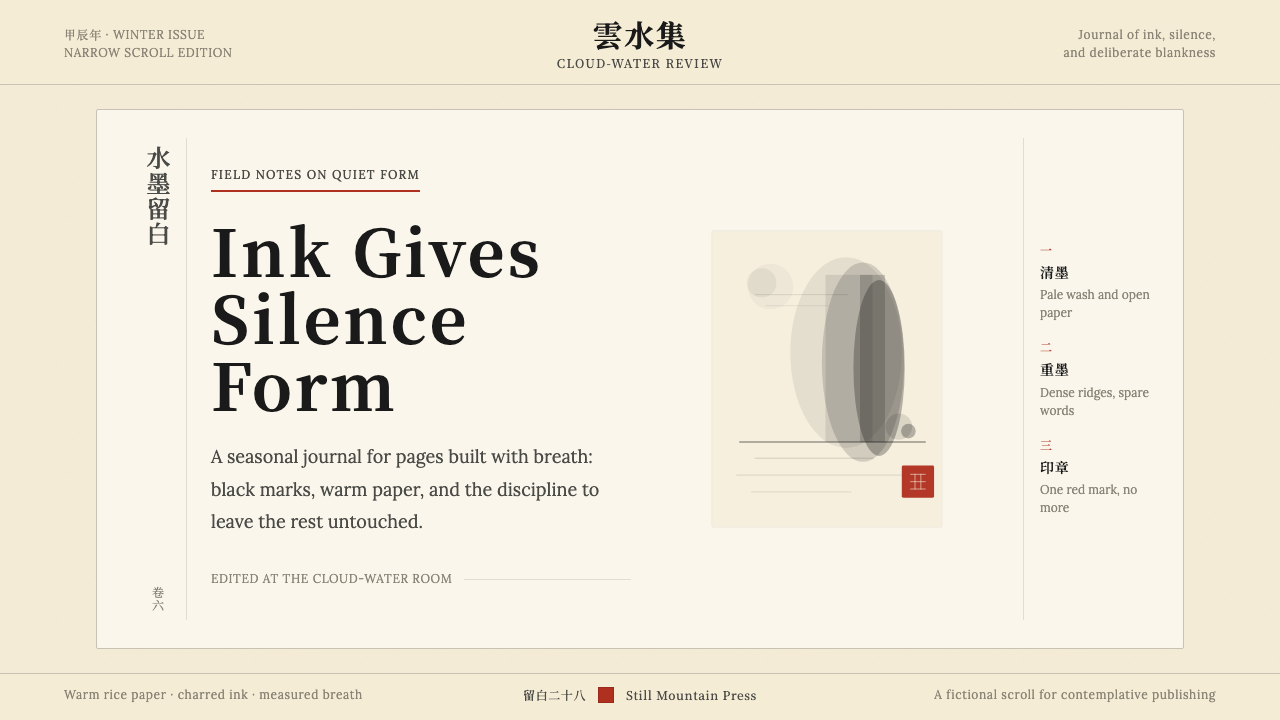 Chinese Ink Wash 水墨A thousand years of restraint. Six tones of ink on rice-paper warmth, a singl…
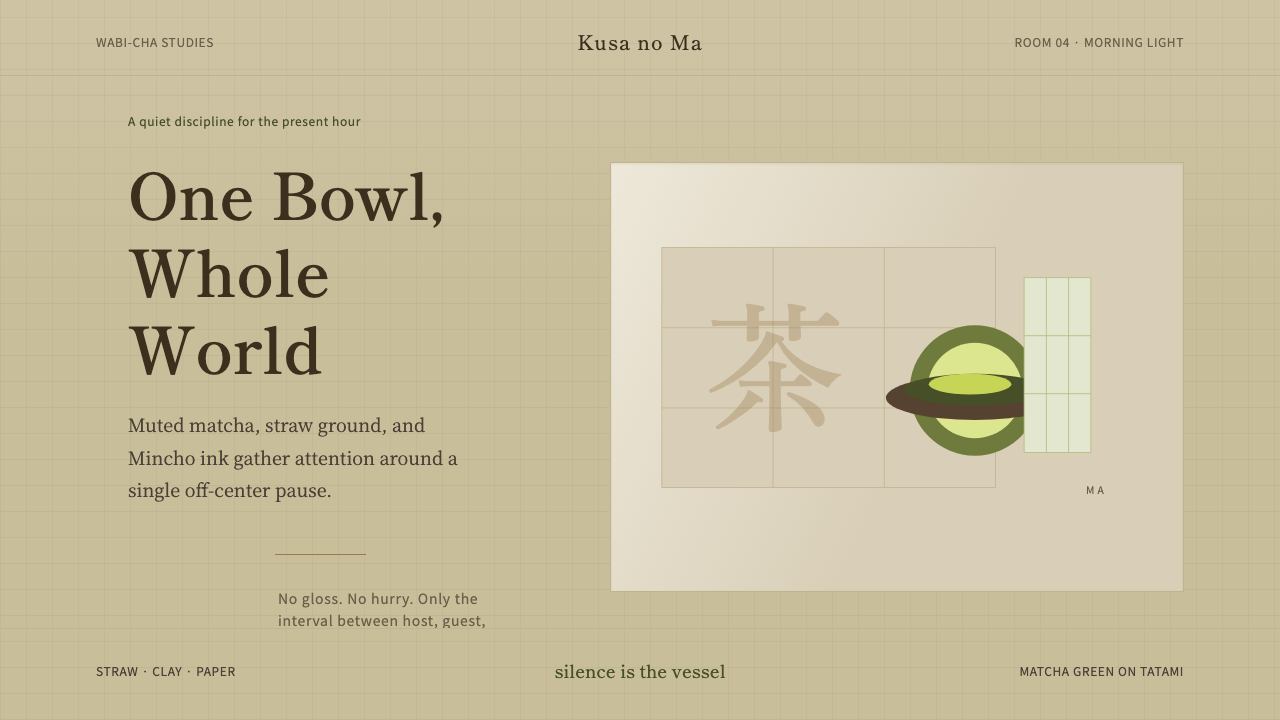 Japanese Tea CeremonyStillness has weight. Tatami straw, matcha green, and Mincho type leave room…
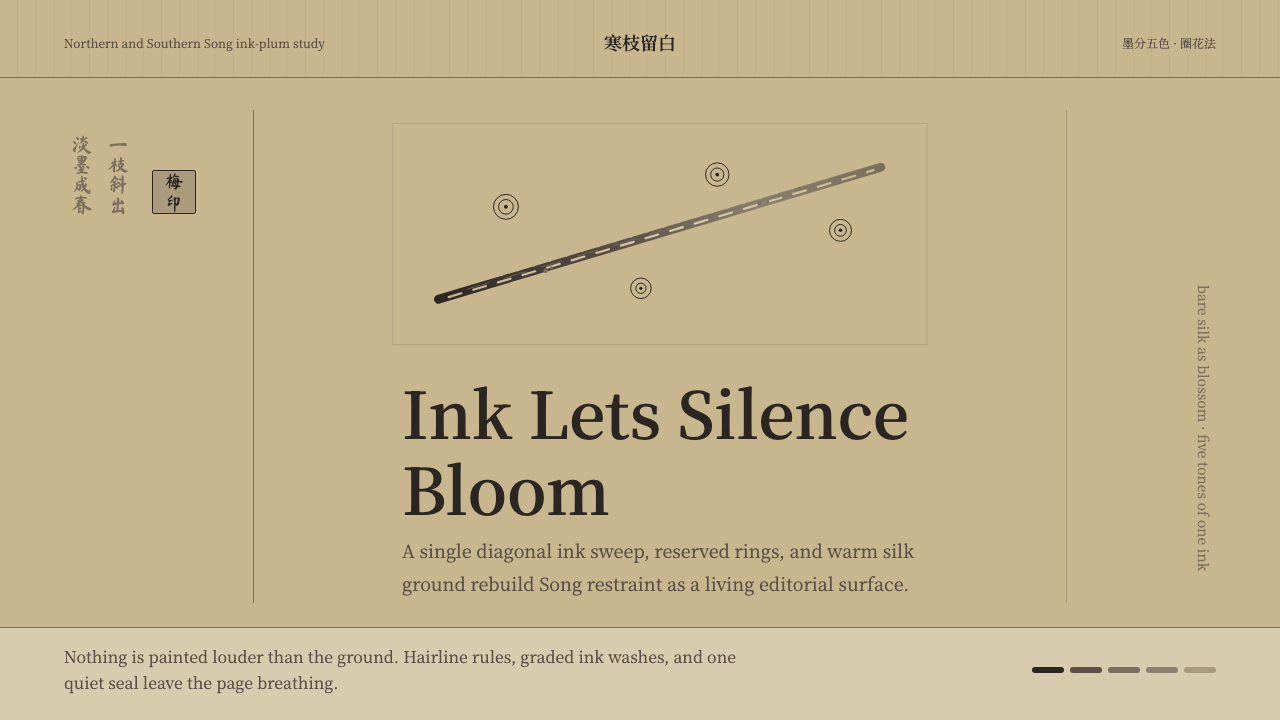 Plum Blossom Ink (宋)Silence carries the ink. Tea-tan ground, reserved blossoms, and one diagonal…
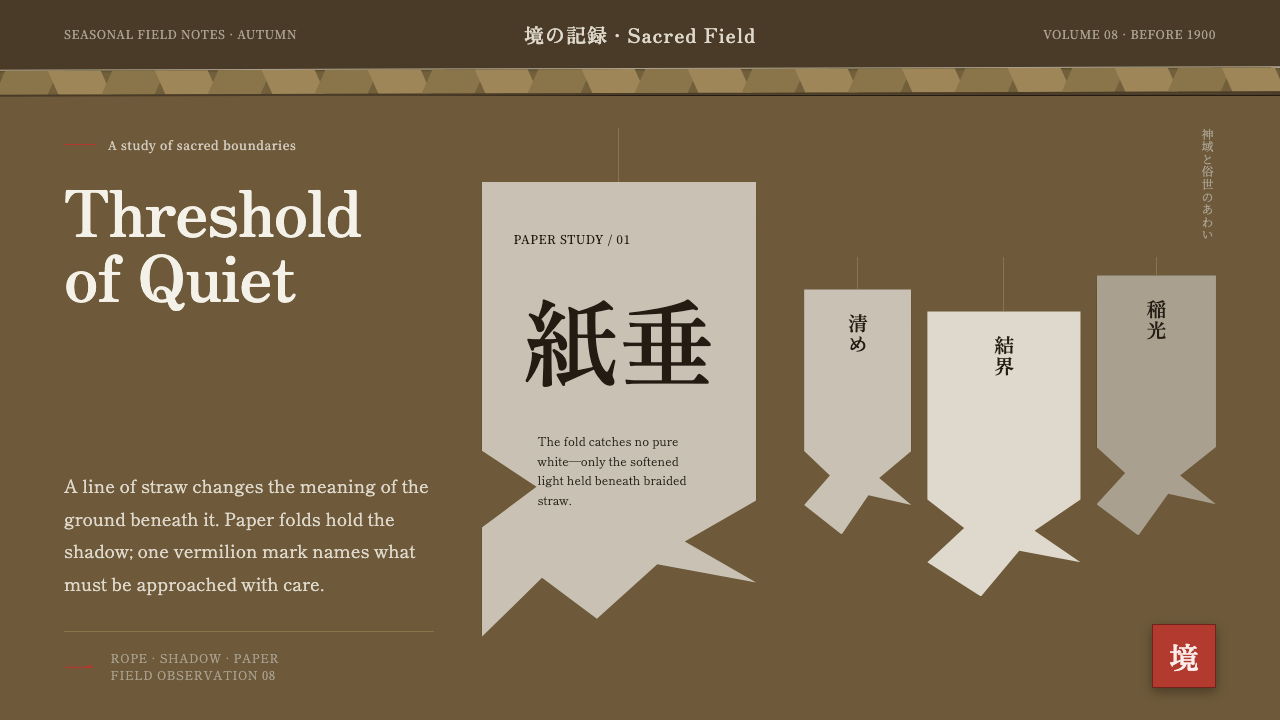 Shinto Shide Paper StreamerQuiet becomes sacred. Shadowed washi hangs from a straw-gold line, marked onc…