What is Chinese Ink Wash 水墨?
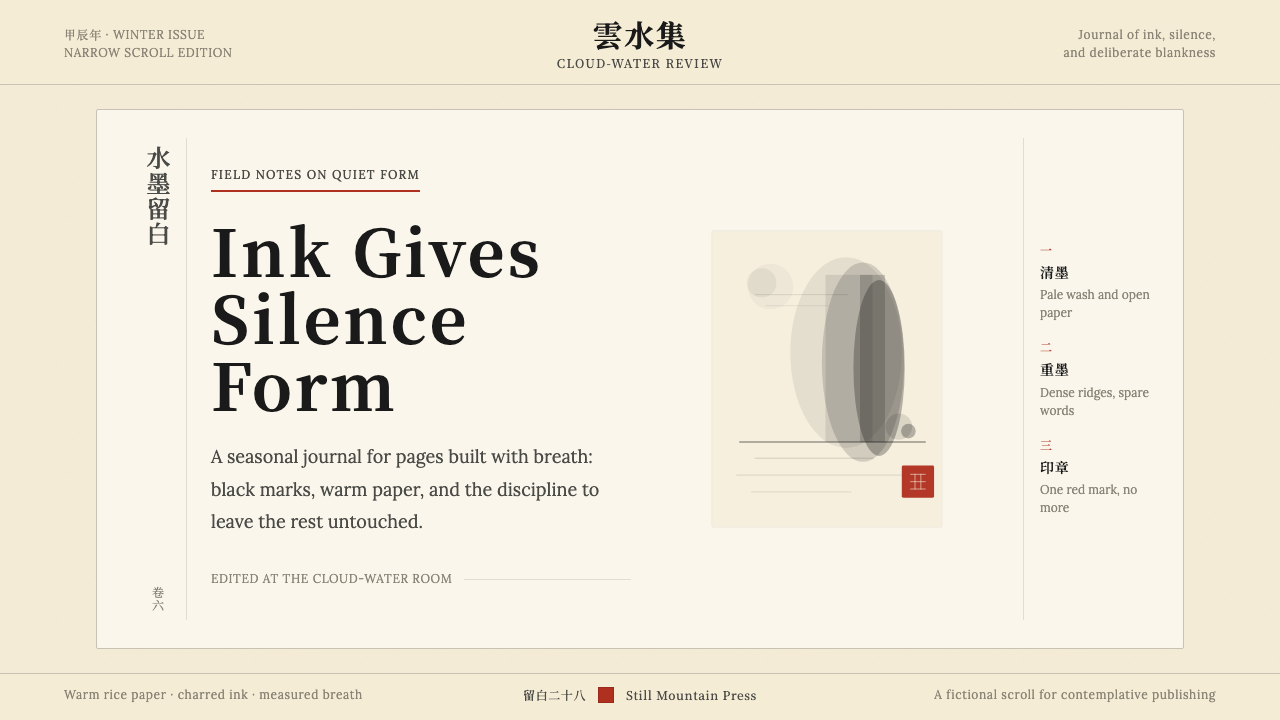
A thousand years of monochromatic restraint — ink, emptiness, and a single seal-red accent that says everything by saying almost nothing.
Chinese Ink Wash 水墨 in brief
Chinese Ink Wash (水墨) is a design language rooted in one of the world's oldest continuous painting traditions. Its visual grammar is built on a radical act of reduction: the entire chromatic vocabulary is six tonal grades of black ink — from charred, glossy black to the faintest translucent wash — laid on a warm rice-paper ground. A single seal-red accent is permitted, and it appears only where a master would press a carved stone chop onto a finished scroll: sparingly, decisively, and with full weight of meaning.
The animating principle of the style is 留白 (liú bái) — literally 'leaving white', more precisely 'deliberate emptiness'. In Chinese painting theory, the unpainted areas of a composition are not voids to be filled but active participants in the image. Fog is not absent mountain; it is mountain seen through different eyes. Applied to design, this means that generous negative space is not a stylistic preference but a philosophical commitment: the silence around a mark gives the mark its resonance.
Visually, Ink Wash work is immediately legible as a system. Brushwork ranges from the fluid, wet strokes of a bamboo stalk to the dry, broken texture of a scholar's rock. Classical serif typography — the digital descendant of Song Dynasty woodblock type — carries the weight of calligraphic authority. Vertical text orientation is natural rather than novelty. Asymmetric compositions create balance through tension rather than mirroring, and the entire arrangement breathes with a quality the tradition calls 气韵 (qìyùn): the vital rhythm that separates a living composition from a dead one.

Where does Chinese Ink Wash 水墨 come from?
Ink wash painting as a distinct aesthetic mode crystallized during the Tang Dynasty (618–907 AD), when the poet-painter Wang Wei became one of the first artists to work exclusively in monochromatic ink rather than the polychrome palette then dominant at the imperial court. Wang Wei's landscapes — rendered in ink alone, without pigment — proposed a radical argument: that the expressive range of color was not only achievable through tonality, but could be surpassed by it. His practice established the conceptual foundation that would govern the tradition for over a millennium.
The style reached its first golden age under the Song Dynasty (960–1279), a period of extraordinary cultivation in which the literati — scholar-officials trained in classical learning, poetry, calligraphy, and painting as a unified practice — elevated ink wash to the highest form of artistic expression. Mi Fu (1051–1107), one of the Four Masters of Song calligraphy, developed the 'Mi dot' technique: clusters of horizontal ink strokes that evoke misty mountain ridges without depicting them literally, prioritizing atmospheric sensation over topographic accuracy. Song painters codified the vocabulary of brushwork — the grammar of wet and dry strokes, of loaded and spent brush — that designers today inherit as the style's most recognizable texture.
The Yuan Dynasty (1271–1368) produced a second peak, shaped partly by the experience of Mongol conquest. Han literati who withdrew from government service under foreign rule turned to painting as a vehicle for expressing interior states that could not be spoken openly. The Chan Buddhist monk Mu Qi (active mid-thirteenth century) worked in a direct, spontaneous brushwork mode — his famous Six Persimmons is composed of six rough circles in graded wash, arranged asymmetrically on a near-empty ground — that carried Chan's 'sudden enlightenment' philosophy directly into visual form. The tradition's valorization of the unfinished, the gestural, and the economical traces directly to this period.
By the twentieth century, the ink wash tradition had been challenged by Western academic painting but was revitalized by figures such as Xu Beihong (1895–1953), who synthesized Western compositional rigor with classical Chinese brushwork. The tradition also spread geographically: Japanese sumi-e and Korean sumukhwa are direct descendants, sharing both techniques and philosophical premises, though each developed its own regional inflections. Contemporary designers working in the style inherit not a single fixed canon but a living conversation across twelve centuries and three cultures, in which restraint, breath, and the eloquence of emptiness remain the constant values.
What defines the Chinese Ink Wash 水墨 look?
Tonal Ink Palette
The entire color system is built on six grades of ink, from charred black through rich dark, heavy, dilute, light, and the faintest translucent wash. No pigment or chromatic color enters the palette except the single permitted accent. This radical monochromatic constraint is not poverty but abundance: the eye, deprived of hue, becomes acutely sensitive to value, texture, and edge quality. Dark areas read as presence; pale washes read as recession, mist, or atmosphere. The tonal range must be used with deliberate spacing — packing too many mid-tones together collapses the depth that makes the system work.
Deliberate Emptiness (留白)
Negative space is the style's most distinctive and most misunderstood feature. In Ink Wash, empty areas are not passive backgrounds but are compositionally active — they represent sky, water, mist, or the implied continuation of a form beyond the frame. The discipline is to resist the urge to fill. A layout in which every zone is occupied is a layout that cannot breathe. Effective 留白 means that the unmarked areas have been chosen as deliberately as the marked ones: their shape, their proportion to filled areas, and their placement all carry compositional weight.
Brushwork Texture
The tradition distinguishes between wet strokes — fluid, continuous, with pooling ink at the tip — and dry strokes, where a nearly spent brush leaves a broken, fibrous mark revealing the ground beneath. Both have their roles: wet strokes convey vitality and movement, dry strokes convey age, resistance, and structural solidity. In digital contexts these textures are evoked rather than literally reproduced — a slight feathering of a border, an unevenly weighted stroke, or a subtle grain overlay that recalls rice paper. The goal is the quality of intention: marks that look made rather than generated.
Seal-Red Accent
A single warm red — the color of cinnabar used in carved seal ink — is the style's only chromatic element. Its role is not decorative but authenticating: on a traditional scroll, the seal verifies authorship and completes the composition. In design, this accent functions the same way — it marks the one thing that matters most. It should appear once, or at most in a tightly controlled set of parallel uses. When it appears in multiple unrelated locations, it loses its weight entirely and the system collapses into something that merely looks vaguely Eastern. The accent color should feel discovered, not distributed.
Calligraphic Typography
Classical Chinese typography grows directly from calligraphy — the type forms used in Song Dynasty woodblock printing are the ancestors of today's Song and Ming typefaces (宋体, 明体). These faces carry historical authority and a structural quality that reflects the brush: vertical strokes are weighted, horizontal strokes are lighter, and the overall letterform has a tensile quality absent from most Western serifs. Vertical text setting is appropriate and historically natural. When combining Chinese and Latin type, the relative scales and weights require careful calibration so that neither script dominates inappropriately.
Asymmetric Composition
Ink Wash compositions are never symmetrically balanced. The tradition instead seeks 气韵 (qìyùn) — vital rhythm — through weight, direction, and the interplay of presence and absence. A single pine branch occupying the upper-left corner is held in balance by an expanse of empty ground below and to the right. The visual tension this creates is not instability but the tension of a held breath. In layouts, this translates to placing the primary element off-center, allowing large empty margins to function as compositional counterweights, and resisting the grid's pull toward mechanical evenness.
Economy of Mark
The great ink wash masters operated under an economy of mark: each stroke was committed to without correction, because lifting and re-laying a brush stroke destroys its vitality. This discipline of commitment translates in design to a preference for fewer elements executed with full intention over many elements hedging their bets. A composition should be complete when the last necessary mark has been placed — not when a designer has exhausted their inventory of possible additions. The question is never 'what else can I add?' but 'what can I remove without losing the essential?'

Who shaped Chinese Ink Wash 水墨?
Tang Dynasty poet, musician, and painter (699–759 AD), Wang Wei is credited as the progenitor of the monochromatic ink wash landscape tradition. Working at a time when polychrome court painting dominated, he chose to work exclusively in ink and laid the conceptual groundwork that later generations would build upon. His paintings survive only in later copies, but their influence — transmitted through generations of critical writing about his methods and intentions — shaped the entire literati painting tradition that followed.
Song Dynasty polymath (1051–1107), Mi Fu was simultaneously a calligrapher, painter, art critic, and collector. His development of the 'Mi dot' technique — layered horizontal ink strokes that evoke mist-shrouded mountains without representing them topographically — was one of the most influential formal innovations in the tradition's history. His eccentric personality, legendary passion for rocks, and exacting standards of connoisseurship made him a defining figure of the literati ideal: the artist as cultivated sensibility rather than technical craftsman.
Chan Buddhist monk and painter active in the mid-thirteenth century, Mu Qi is best known for his Six Persimmons — six roughly brushed circles in graded ink wash, asymmetrically arranged on a near-empty ground. The painting's radical simplicity and the perfection of its asymmetric spacing make it one of the most studied compositions in East Asian art history. Mu Qi's work demonstrates how Chan's emphasis on directness, spontaneity, and 'beginner's mind' translated into a visual style that influenced Japanese ink painting (sumi-e) as much as it did the Chinese tradition.
Twentieth-century painter (1895–1953) and educator who spent years studying in France and synthesized Western academic technique with classical Chinese ink methods. Xu Beihong's galloping horses — rendered in a fusion of Western volumetric form and traditional brushwork — became some of the most recognized images in modern Chinese painting. As the founding president of the Central Academy of Fine Arts in Beijing, he shaped how ink wash tradition was transmitted through the twentieth century and into the contemporary period, keeping it as a living practice rather than a historical artifact.
Self-taught master (1864–1957) who worked from a humble background as a carpenter before devoting himself entirely to painting. Qi Baishi's style combined monumental simplicity with intimate subject matter — shrimps, crabs, chicks, and vegetables rendered with a childlike directness that conceals enormous technical mastery. He demonstrated that the ink wash tradition could accommodate deep humor, tenderness, and vernacular subject matter without sacrificing its formal rigor. His work remains among the most commercially recognized in Chinese art and continues to influence contemporary designers who seek to balance gravitas with warmth.
How do you use Chinese Ink Wash 水墨 today?
Chinese Ink Wash is one of the more demanding historical styles to apply well in contemporary design, because its power depends entirely on discipline. It is not a visual mood board of Eastern imagery; it is a formal system in which every element — the weight of a stroke, the proportion of empty space, the single permitted accent color — is load-bearing. Applying it correctly means internalizing the logic of 留白 and the economy of mark before touching the design surface, not reaching for brush textures and monochrome palettes as surface treatments.
For presentation slides, the style suits both cover and content pages but in different registers. A cover works best as a near-empty field: the title in strong calligraphic type, positioned off-center with intent, against a warm off-white ground — and nothing else except perhaps a single ink gesture that anchors the composition. The seal-red accent, if used, appears once on the cover only. Content slides should embrace sparse layouts: one idea per slide, wide margins acting as breathing space, and any data rendered as ink-weight shapes rather than polished chart components. The empty areas are not failures of content; they are the style's argument.
For web interfaces and dashboards, Ink Wash performs well when the product communicates authority, craft, or cultural depth. A pricing or tier page in this style uses a light warm ground, ink-weight typography at strongly contrasted scales for hierarchy, and the accent color reserved for the single most important action. Navigation is typographic — horizontal or vertical text labels — with minimal iconography. Data visualizations work as tonal ink shapes: a bar chart where bars are rendered at different ink densities rather than different hues, a donut chart where segments graduate from deep to pale. The overall palette should feel complete and intentional, not assembled from separate design decisions.
For editorial and marketing applications, the style creates immediate cultural signal and distinctive shelf presence. An editorial layout uses a narrow body-text column with wide surrounding margins that function as compositional ground rather than wasted space. Pull quotes or captions sit in those margins, positioned according to visual tension rather than mechanical alignment. Marketing pages work well with the style's poster-like capacity for bold reduction: a full-width feature composed of a single large ink gesture against a warm ground, with a headline and the accent mark as the only other elements. The discipline of using one accent moment per spread or page is essential — it is precisely the scarcity that makes the accent legible as signal rather than noise.
A common and damaging mistake is treating this style as a collection of Eastern motifs to be combined: a bamboo texture here, a brushstroke element there, a red lantern color borrowed from a festival palette. The authentic system is not assembled from parts but derived from principles. The related error is over-texturing — applying ink wash grain or rice-paper texture everywhere to signal the style. The texture should be structural: present where it carries meaning, absent where it would compete with composition. Finally, using the accent color in more than one or two locations destroys the economy on which the entire chromatic system depends. When the red appears on five different interactive elements, it is no longer an accent — it is a second primary color, and the monochromatic system has been abandoned.

Chinese Ink Wash 水墨 — FAQ
How is Chinese Ink Wash different from Japanese minimalism or Scandinavian design?
All three value restraint and negative space, but their underlying logic differs. Japanese minimalism (ma, wabi-sabi) emphasizes impermanence, imperfection, and the beauty of natural materials — it tends toward warm neutrals, rough textures, and an acceptance of asymmetric incompleteness as an end in itself. Scandinavian design values functional warmth — light neutrals, organic curves, materials that feel tactile and livable. Chinese Ink Wash, by contrast, is rooted in scholarly and philosophical authority: its emptiness is intentional argument, its monochromatic system is a demonstration of expressive range, and its asymmetry serves composition rather than comfort. The calligraphic heritage means letterforms carry weight in ways that purely Scandinavian or Japanese minimalist typography does not require.
Can the style work in dark mode or on a deep-colored ground?
The canonical Ink Wash ground is warm off-white — the color of aged rice paper — and this is the context in which the tonal system performs best. A dark inversion is possible but requires rethinking the logic. On a deep charcoal or near-black ground, the ink tones must shift: what was deepest black becomes the lightest mark, and pale wash becomes the deepest value. The accent color shifts accordingly — on dark grounds, the warm red must be slightly desaturated to avoid glowing. The more fundamental challenge is that 留白 loses its primary metaphor on a dark ground: the empty areas no longer read as light, mist, or sky but as void. This changes the philosophical register of the composition, which may or may not suit the product's character.
How should I handle imagery and photography within this style?
Photography is not native to the Ink Wash tradition and should be used sparingly and with deliberate treatment. The most compatible approach is to convert photography to high-contrast monochromatic tones that echo the ink palette — not in the sense of a crude grayscale conversion, but processed so that the image reads in terms of ink weight rather than photographic detail. Silhouetting against a warm ground is effective: the figure or object becomes a shape in the ink system rather than a window into a literal scene. Full-color photography with naturalistic saturation and soft shadows fundamentally disrupts the monochromatic grammar and should be avoided. If representational imagery is essential, illustration reduced to gestural brushstroke form integrates more naturally than photography.
Is this style appropriate for Western or global audiences, or does it read as culturally specific?
The style carries clear cultural signal, and that signal is a feature, not a bug — for products where cultural depth, heritage, or craft authority is part of the value proposition. For a luxury goods brand, a cultural institution, an editorial publication, or a platform that explicitly references Eastern aesthetics, the cultural specificity strengthens rather than limits the work. For globally neutral consumer products or utilitarian tools with no cultural positioning, the cultural weight can feel imposed. The practical test is: does the product benefit from the associations the style carries — restraint, depth, scholarly authority, antiquity — or does the cultural framing add friction between the user and the product's purpose? The style works globally when its philosophical values align with the product's values; cultural specificity becomes a problem only when it is superficial or arbitrary.
What is the single most common mistake when applying this style?
Mistaking the style for a mood rather than a system. Designers who understand Ink Wash as 'looks Eastern' or 'uses brush textures and muted ink tones' tend to apply it as a surface treatment: they desaturate a palette, add some rice-paper grain, include a calligraphic element, and scatter the seal-red accent across several interactive components. The result has the visual vocabulary of the style but none of its logic. The style's power comes from its internal consistency — a monochromatic system that creates depth through tonal range alone, a negative space discipline that makes every marked area precious, and an accent economy that gives the single chromatic moment full weight. Break any of these principles and the result is not 'a lighter version of Ink Wash' — it is a different aesthetic that happens to borrow some visual cues. The discipline is all-or-nothing in a way that many other historical styles are not.
Related design styles
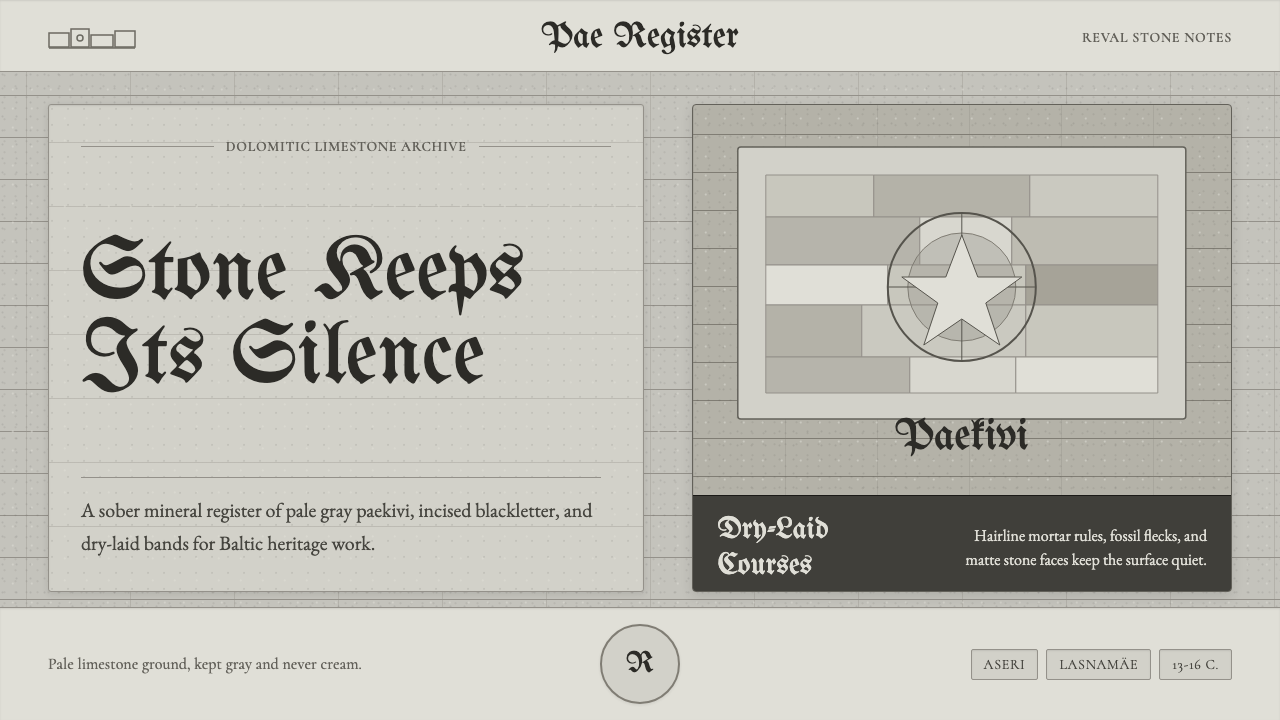 Estonian Limestone GrayStone keeps its silence. Limestone grays, blackletter, and dry-laid bands car…
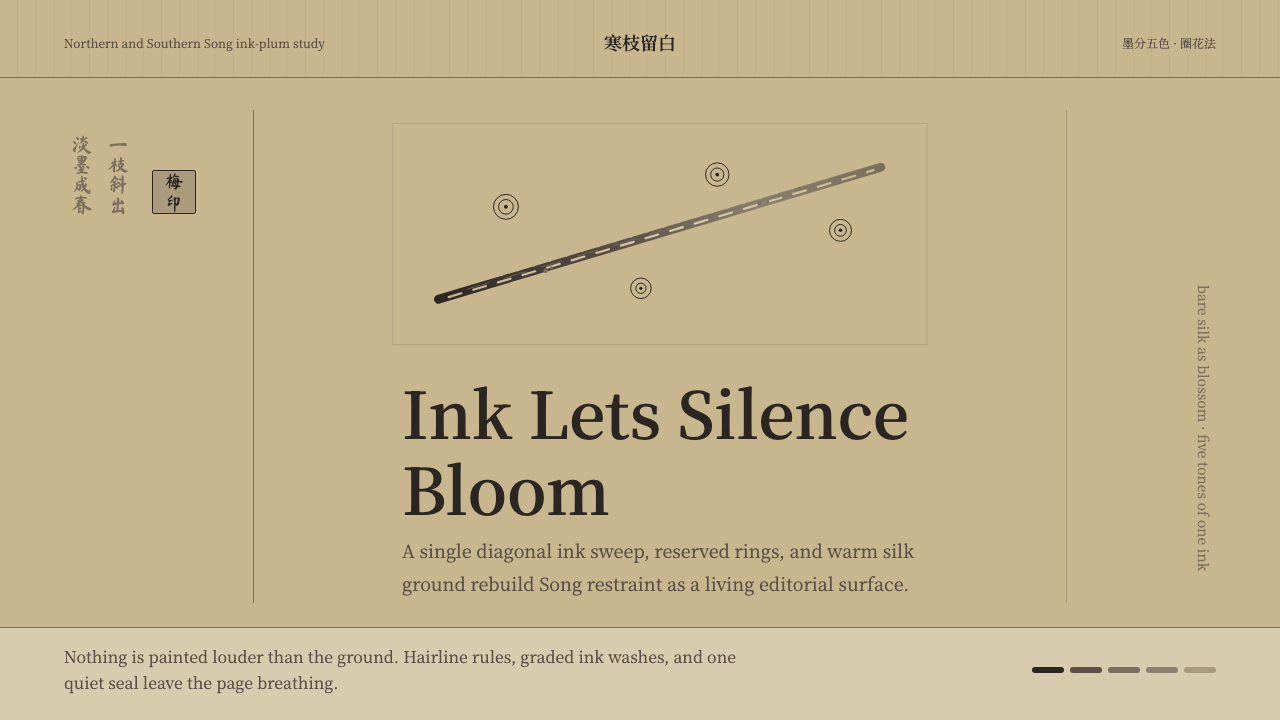 Plum Blossom Ink (宋)Silence carries the ink. Tea-tan ground, reserved blossoms, and one diagonal…
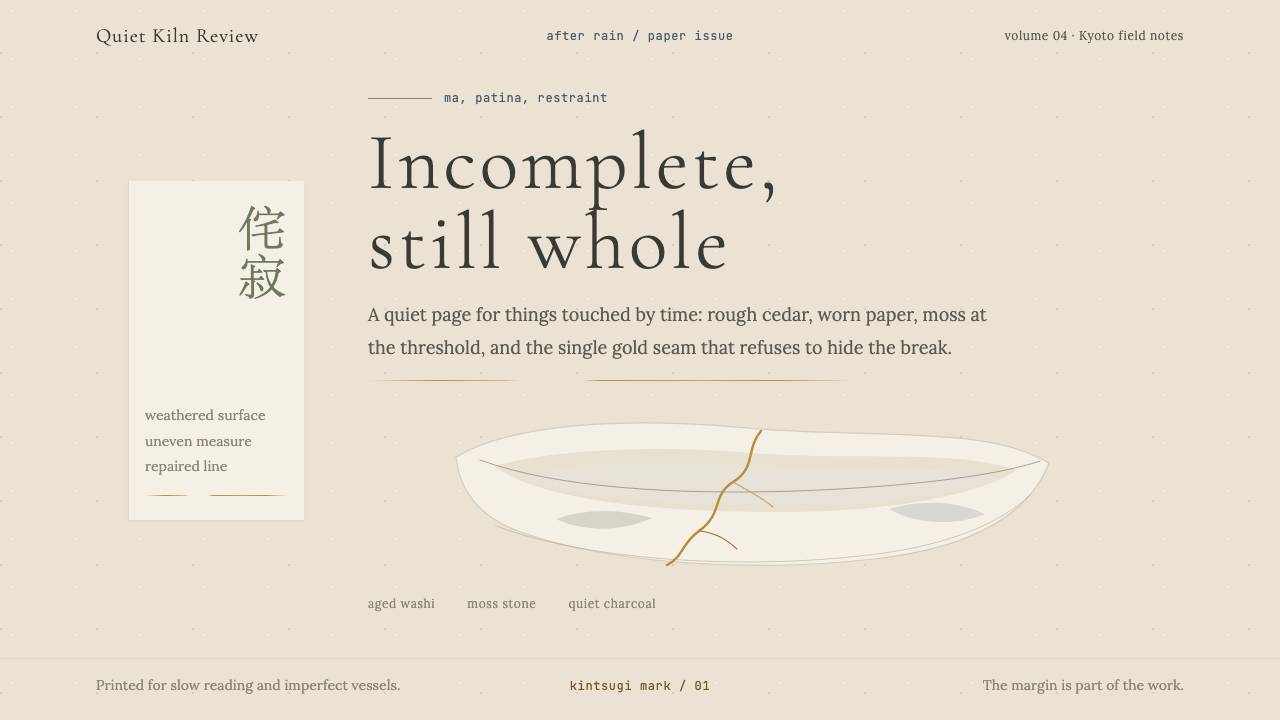 Wabi-SabiStillness makes imperfection whole. Washi beige, moss sage, and a spare gold…
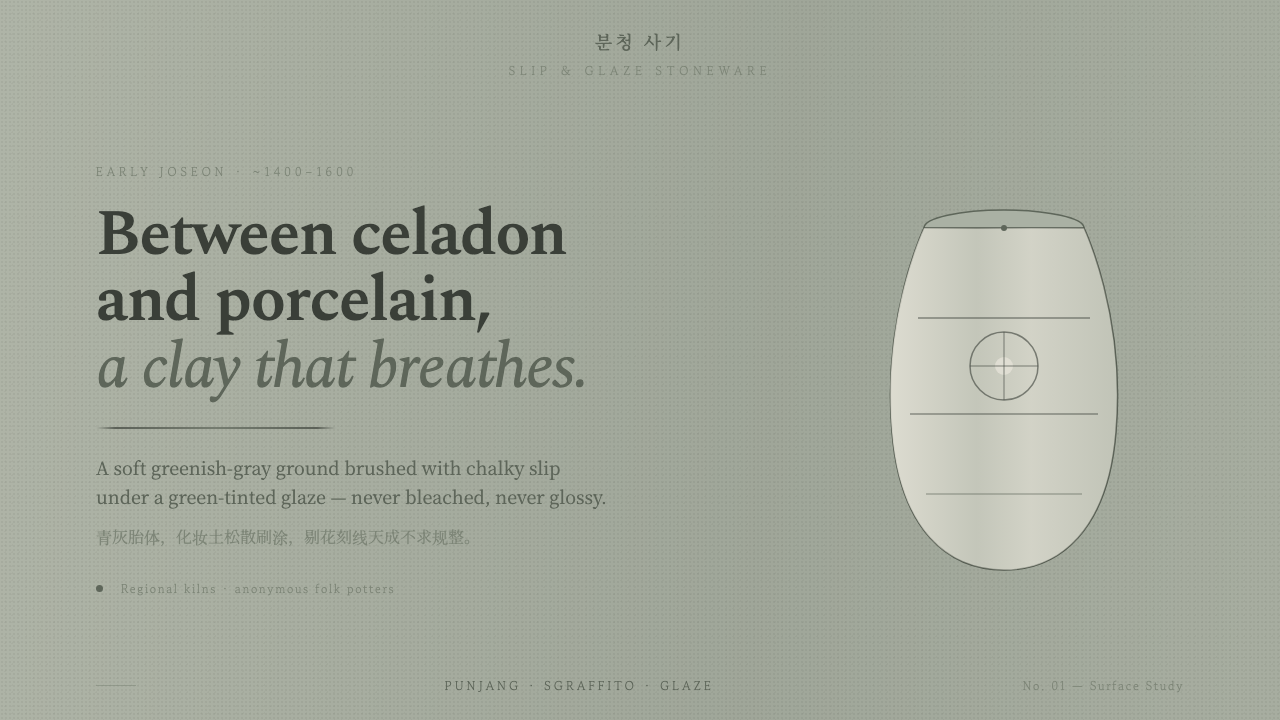 Buncheong Gray Slip WareBetween celadon and porcelain. Greenish-gray clay, chalky slip brushwork, dar…
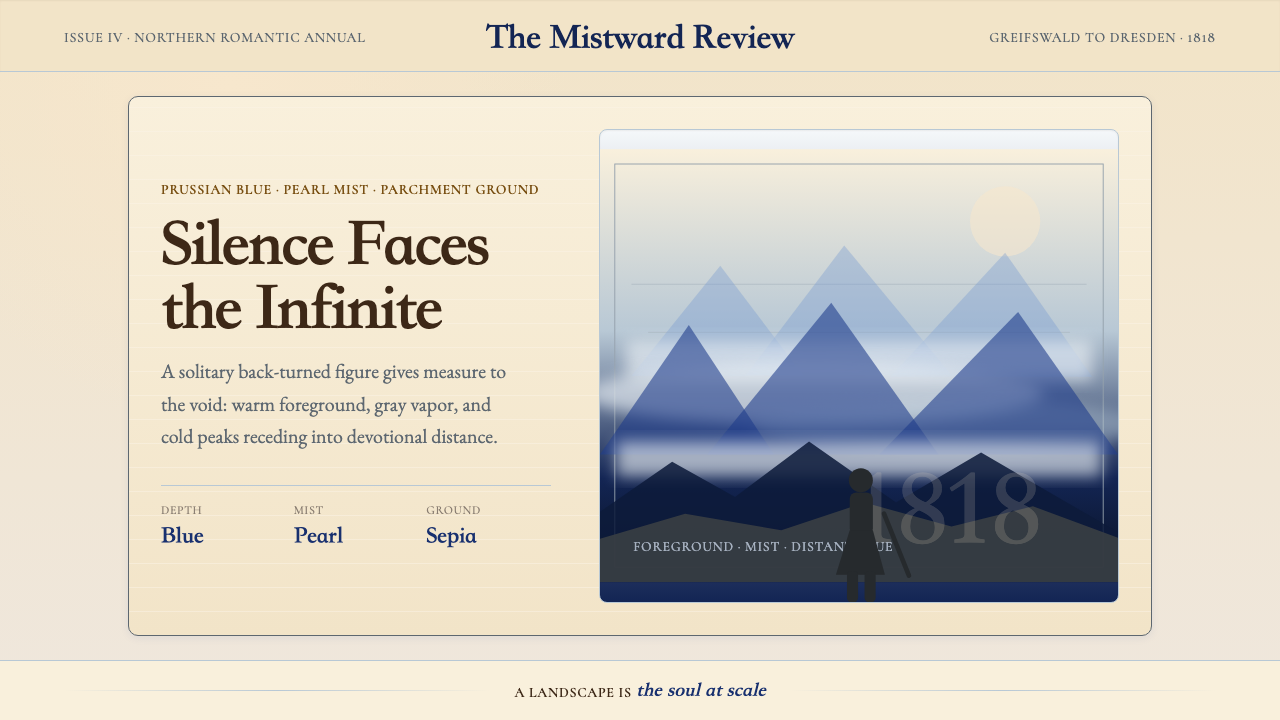 Caspar David FriedrichSilence becomes vast. Prussian blue depth, pearl mist, and parchment framing…
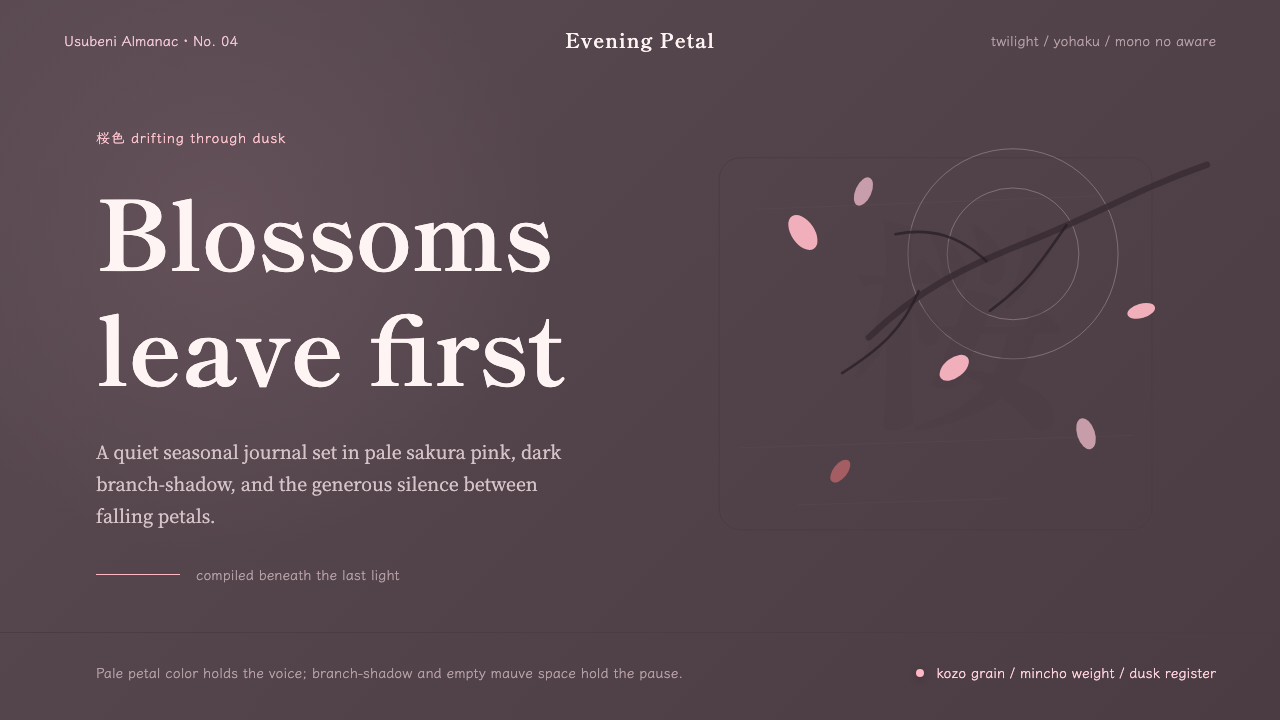 Cherry Blossom HanamiTenderness arrives in dusk. Sakura pink, branch-shadow, and Mincho type leave…