What is Bangladeshi Jute Craft?
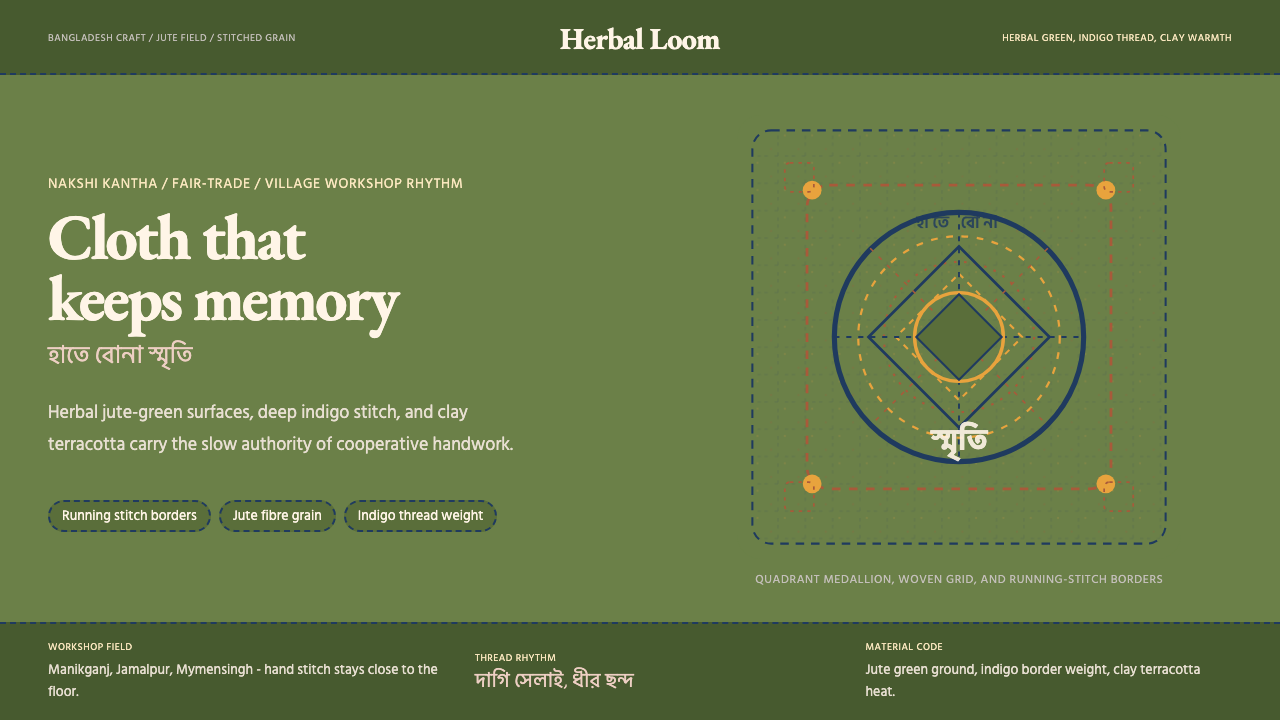
Bangladesh's craft cooperatives transformed jute and embroidery thread into a design language that feels handmade, grounded, and unmistakably alive.
Bangladeshi Jute Craft in brief
Bangladeshi Jute Craft Modern is a visual design system drawn from the living practice of Bangladesh's artisan cooperatives — Aarong, Tarango, and Kumudini chief among them. These cooperatives, many led by women in rural workshops across Manikganj, Jamalpur, and Mymensingh, have over decades refined a visual identity built from jute weaving, nakshi kantha hand-embroidery, and indigo-dyed cotton. The design language emerging from this tradition is emphatically not a folk pastiche: it is a coherent, contemporary aesthetic that has been shaped by fair-trade market demands, international craft exhibitions, and the deliberate branding choices of socially conscious cooperatives.
The palette anchors itself in muted herbal jute-green — the color of raw, processed jute fiber — rather than the beige that Western audiences might expect from natural-material craft. Deep indigo, drawn from centuries of Bangladeshi cloth-dyeing tradition, carries structural and typographic weight. A warm clay-terracotta red-brown grounds the accent register, evoking the fired-earth tones of riverside Bengal. Surfaces carry the memory of handwork: running-stitch dashed borders replace drop shadows; jute-fibre grain replaces glass-effect surfaces; Bengali script is given generous vertical breathing room to honor its organic rhythm.
What distinguishes this system from generic 'artisan craft' aesthetics is its specificity and restraint. The textures are not decorative noise — they are structural. The embroidery references are not surface ornament — they are layout logic. The result is a design language that can be applied to a digital product, a printed report, or a slide deck without losing its cultural grounding or becoming mere exoticization.

Where does Bangladeshi Jute Craft come from?
Nakshi kantha embroidery is one of the oldest continuous textile traditions of the Bengal delta. The word 'nakshi' derives from the Bengali term for decorative pattern, and 'kantha' refers to the layered cloth — typically recycled saris or dhotis — stitched together with running-stitch thread to create both warmth and imagery. Historical kanthas depicted scenes from village life, mythological narratives, and geometric patterns drawn from the natural environment: fish, birds, the lotus, the sun. The practice was widespread across the delta region that now comprises Bangladesh and the Indian state of West Bengal, and it was primarily a domestic art passed from mother to daughter across generations.
The partition of Bengal in 1947 and the emergence of Bangladesh as an independent nation in 1971 gave the nakshi kantha tradition a new political and cultural significance. In the years immediately following independence, cultural institutions and development organizations began identifying traditional crafts as both a source of national identity and a vehicle for rural economic development. The devastation of the Liberation War had displaced enormous numbers of women, and craft cooperatives became a practical and dignified means of economic reconstruction. It was in this context that BRAC — one of the world's largest development organizations, founded by Sir Fazle Hasan Abed — established Aarong in 1978. Aarong was not conceived as a handicraft souvenir shop: it was designed as a structured market channel connecting rural artisans, primarily women, to urban and eventually international buyers, with quality standards and fair pricing enforced along the supply chain.
Bibi Russell, the Bangladeshi model and fashion designer who trained and worked in Europe, returned to Bangladesh in the 1990s and began working directly with weavers and embroiderers across the country. Her collections — shown at international fashion weeks from Paris to Delhi — brought nakshi kantha and handloom jamdani cloth to global attention, positioning Bangladeshi craft not as heritage curiosity but as material for contemporary high fashion. Russell's work contributed to a repositioning of the craft's visual language: the hand-stitched running line was no longer a village practice but a signature mark of quality and ethical production. Her collaborator and successor in craft advocacy, Tahsinah Ahmed, continued this work of connecting artisan skill to contemporary design.
The global attention on Bangladeshi garment manufacturing following the Rana Plaza factory collapse in 2013 produced an unexpected consequence for the craft sector: a surge of consumer and brand interest in ethical, handmade alternatives to fast fashion. This post-Rana-Plaza repositioning brought Bangladeshi jute craft, kantha embroidery, and jamdani weaving into conversations about sustainable design and ethical sourcing. Cooperatives that had long operated in the development sector found themselves approached by international lifestyle and design brands. The visual identity conventions that had developed organically within the cooperatives — the jute-green and indigo palette, the running-stitch border, the generous use of natural texture — were increasingly recognized internationally as a coherent aesthetic system with both commercial appeal and cultural authenticity.
What defines the Bangladeshi Jute Craft look?
Color
The palette is built from three anchors: muted herbal jute-green as the dominant ground, deep indigo as the structural and typographic color, and warm clay-terracotta as the accent. None of the three is saturated or bright — they carry the slightly dusty, light-absorbed quality of natural dyes. A near-neutral warm white or undyed cotton serves as the resting ground between these colors. This palette is not 'earthy' in the generic sense; it is specifically referential to jute processing, indigo-vat dyeing, and fired clay, all of which are material realities of the Bengal delta.
Texture and Surface
Every surface in this system carries the suggestion of woven or stitched fiber. Backgrounds use a subtle jute-fiber grain — a loose, directional weave pattern visible under close inspection — rather than solid flat color or digital gradients. This texture is applied at low opacity so that it reads as material memory rather than decorative noise. The effect is warm and slightly tactile: a presentation slide or web card built in this system should feel like it could be touched.
Border and Line
The running-stitch dashed border is the system's signature structural element, replacing the drop shadows or hard rules that perform the same organizational function in other systems. These dashed lines evoke the hand-embroidered edge of a kantha and carry the spacing rhythm of actual needlework — gaps and dashes roughly equal in width, suggesting a needle moving at human pace. They appear as section dividers, card edges, and field boundaries. Where a heavier boundary is needed, a double running-stitch row stands in for a rule.
Typography
Bengali script is treated as a first-class visual element, not an afterthought. Its naturally tall ascenders and complex conjunct characters require generous line spacing — more so than Latin equivalents — and this requirement is honored rather than minimized. Latin type choices favor rounded, humanist forms over geometric or grotesque alternatives; the warmth of humanist letterforms sits more comfortably alongside the organic quality of embroidery. Headlines are set at substantial scale with minimal weight contrast, allowing the letterform itself to carry presence without competing with the textural background.
Motif and Pattern
Nakshi kantha iconography — fish, lotus, radial sun, peacock tail — appears in this system as structural motifs rather than decorative flourishes. A lotus grid organizes a dashboard; a radial sun divides a cover into sections; a stylized fish form becomes a data point marker. These motifs are simplified to their essential geometry: not photographically reproduced embroidery, but line-drawn forms that read as part of the typographic system. The key discipline is that every motif must perform a function — wayfinding, hierarchy, or emphasis — to earn its place on the surface.
Rhythm and Spacing
The system's pacing is slow and deliberate, reflecting the tempo of handwork rather than digital speed. Generous white space — or rather, warm-ground space — separates elements. Dense information blocks are avoided in favor of breathing room between sections. This is not minimalism imposed from outside but a rhythm native to the cooperative workshop context: women working in long sessions, producing objects that take time, valuing the interval between gestures as much as the gestures themselves.
Ethical and Cooperative Framing
Unlike many historical design systems, this one carries an explicit social context that is part of its meaning. The visual choices — handwork references, cooperative-scale production, women's labor visibility — are not nostalgic ornamentation but deliberate communication of values. Organizations applying this system signal a commitment to ethical sourcing, artisan skill, and slow production. The style is therefore especially well-suited to fair-trade organizations, impact-reporting documents, non-profit annual reports, and brands whose identity is inseparable from the communities that make their products.

Who shaped Bangladeshi Jute Craft?
Fazle Hasan Abed founded BRAC in 1972, one year after Bangladeshi independence, as a relief organization for war-displaced populations. Over the following decades, BRAC became the world's largest non-governmental organization by number of employees, operating in more than a dozen countries. Aarong, BRAC's craft enterprise, was established in 1978 with a direct mandate to channel income to rural artisans — particularly women embroiderers and weavers — through a sustainable market model. Abed's insistence that economic development required dignity and market access, not charity, shaped the cooperative model that gave the jute craft visual system its social grounding. He received the World Food Prize in 2015 and was knighted by the British Crown.
Bibi Russell is a Bangladeshi model and fashion designer who worked extensively in Europe — appearing in campaigns for major international fashion houses — before returning to Bangladesh in the 1990s to advocate for the country's artisan weavers and embroiderers. Her label 'Fashion for Development' became a framework for bringing handloom and kantha work to international fashion weeks, including presentations in Paris and Dhaka. Russell's work reframed nakshi kantha not as a rural domestic practice but as a contemporary design material worthy of the highest global stages. Her approach — working directly with artisan communities, respecting their production methods, and scaling through quality rather than volume — became a template for ethical craft fashion internationally.
Tahsinah Ahmed has worked at the intersection of Bangladeshi craft advocacy, design education, and international cultural diplomacy. As a figure connecting artisan cooperatives to design schools and international craft networks, she represents a generation of practitioners who translate the visual knowledge embedded in nakshi kantha, jamdani, and jute craft into frameworks that designers outside Bangladesh can engage with critically and respectfully. Her work emphasizes that the design system's textures, motifs, and color logics are not available for free appropriation but carry specific cultural meaning that requires acknowledgment when used outside their originating context.
Kumudini Welfare Trust, founded in Mirzapur in 1944 and predating Bangladeshi independence by nearly three decades, is among the oldest institutionalized craft and welfare organizations in the region. Its embroidery and handicraft programs have employed tens of thousands of women across several generations, making it both a living repository of traditional kantha technique and a demonstration that artisan cooperatives can achieve financial sustainability across the long term. Kumudini's visual identity — warm grounds, hand-stitched borders, natural dye palettes — preceded Aarong's by decades and contributed to establishing the color and texture conventions that now define the broader Bangladeshi jute craft aesthetic.
The embroidery cooperatives of Jamalpur district represent the grassroots organizational layer of the craft system — hundreds of small working groups, many operating from home compounds or shared community spaces, producing kantha panels and jute goods for aggregation by larger organizations. The visual patterns developed collectively in Jamalpur workshops — particularly the grid-and-border compositions using running-stitch in indigo and terracotta on natural jute ground — became reference points for the contemporary design system. These cooperatives are less visible internationally than Aarong or Kumudini but are the source from which the visual conventions ultimately flow.
How do you use Bangladeshi Jute Craft today?
Bangladeshi Jute Craft Modern is a design system built for warmth, specificity, and ethical communication — and its best applications lean into all three. Applying it well means understanding what it is actually doing: the jute-green ground is not a trendy earth tone, it is a material reference; the running-stitch border is not a decorative doodle, it is a layout device that carries cultural meaning. Designers who understand these distinctions produce work that feels genuine; those who treat the system as surface texture produce work that reads as appropriation.
For presentation slides, the system works at both cover and content levels with distinct but complementary approaches. A cover slide benefits from the full weight of the visual vocabulary: a jute-fiber-textured ground in muted green, a large nakshi motif — simplified lotus or radial sun — functioning as the compositional anchor, and a title set in warm rounded type with generous spacing. The running-stitch border frames the slide edge, not as decoration but as the equivalent of a formal presentation edge. Content slides should simplify: clean jute-ground background, dashed running-stitch section dividers, type hierarchy defined through scale rather than competing colors. Data visualizations take on an almost textile quality — bar charts with terracotta and indigo segments, line charts whose curves suggest embroidery thread rather than sharp vector lines.
For web interfaces, the system is especially effective on dashboards, impact-reporting pages, and pricing tiers where hierarchy and trustworthiness matter more than conversion-rate optimization. The approach: a warm near-white or muted green ground, indigo for all navigation and primary labels, running-stitch dividers between content zones, lotus-grid or radial motifs as section wayfinding icons. Card components should use the jute-fiber texture at low opacity as their background, with dashed borders replacing the soft drop shadows typical of contemporary card patterns. Form inputs work best with visible borders — consistent with the system's emphasis on material honesty — rather than ghost or floating-label styles that dissolve boundaries.
For editorial and marketing work, the system supports a poster-like directness that suits impact reports, NGO annual reports, fair-trade product brochures, and craft-market catalogs. A long-form article layout uses a warm ground, a wide outer margin for pull-quotes and Bengali annotations, and running-stitch horizontal rules between sections. Full-width feature blocks can alternate between jute-green-on-warm-white and indigo-on-jute-green for visual rhythm, with terracotta reserved for calls to action or key statistics. The system is particularly well-suited to contexts where the reader's trust is earned through transparency and craft-community storytelling rather than through sleek digital optimism.
A common mistake when applying this system is treating the jute-fiber texture and running-stitch motifs as interchangeable decorative elements — adding them to any surface for visual interest without structural justification. The textures should appear on grounds and backgrounds; the running-stitch borders should define edges and divisions; the nakshi motifs should function as wayfinding or emphasis markers. Stacking all three on the same element creates visual noise that contradicts the system's essential quality: the slow, deliberate rhythm of a practice where every mark is made one stitch at a time. Similarly, mixing the jute-green-indigo-terracotta palette with unrelated accent colors dilutes the specificity that gives this system its cultural credibility.

Bangladeshi Jute Craft — FAQ
Is this system appropriate for organizations outside Bangladesh to use?
Yes, with deliberateness. The visual system was developed in a specific cultural and social context — Bangladesh's craft cooperatives, their histories, and the communities that built them — and that context is part of what gives the aesthetic its authority and warmth. Organizations outside Bangladesh can use the system respectfully when they have a genuine connection to the values it represents: ethical production, artisan craft, cooperative economics, or direct partnerships with Bangladeshi communities. Using the system purely for aesthetic appeal, without acknowledging its origins or having any relationship to its source communities, risks a form of visual appropriation that undermines the cooperative ethos embedded in the design choices. The more explicit the connection between the organization's work and the system's values, the more naturally the visual language fits.
How does this system handle dark-mode or dark-background layouts?
The canonical palette is light-ground: the jute-green, warm white, and muted cotton tones are the foundational surfaces. A dark inversion is possible but requires careful handling. On a deep indigo ground — the most natural dark variant for this system — jute-green reads as a mid-tone rather than a dominant ground, and terracotta becomes the warmest and most active color. The running-stitch borders in this inversion work well in a warm near-white or undyed cotton tone. Avoid inverting to pure black: it loses the material warmth that is the system's defining quality and produces a generic dark-mode aesthetic rather than a contextually grounded one. A deep indigo or dark jute-brown ground preserves the connection to the textile and dye traditions the system references.
Can nakshi kantha motifs be simplified for digital use without losing their meaning?
Yes — simplification is actually consistent with the tradition's own history. Nakshi kantha motifs have always been adapted to the materials and tools at hand: a kantha made with thicker thread produces bolder, more abstracted forms than one made with fine thread. Digital simplification that reduces a lotus to its essential radial structure or a fish to its core oval-and-tail silhouette is analogous to the abstraction that happens when a skilled embroiderer works at coarser scale. The important boundary is intentionality: a simplified motif should still be recognizably derived from its source form and should function structurally in the layout. A lotus reduced to five radiating lines performs the same wayfinding function as a fully detailed lotus. A lotus reduced to a generic asterisk does not.
What makes this system different from other South Asian craft-inspired design approaches?
Specificity is the key distinction. South Asian craft-inspired design often aggregates motifs and palettes from multiple traditions — mixing block-print patterns from Rajasthan with brocade palettes from Varanasi and embroidery line weights from Gujarat — producing a generic 'Indian artisan' aesthetic that belongs to no tradition precisely. This system draws exclusively from the Bengali delta tradition: jute, kantha, indigo, the cooperative model, and the specific social history of Bangladesh's artisan organizations. The jute-green is not a generic earth tone; it is the color of processed jute. The running-stitch border is not decorative stitching; it is nakshi kantha technique. This precision is both an aesthetic and an ethical choice: it ensures that the design work stays in genuine relationship with the communities and practices that produced it.
Does this system work for commercial brands, or is it primarily suited to non-profit contexts?
It works well for commercial contexts where the brand's identity is genuinely connected to craft, ethics, sustainability, or artisan production. Brands in fair-trade food, handmade textile and homeware, slow fashion, ethical travel, and impact investment can apply the system with authenticity. It is less suited — and risks visual dishonesty — when applied to brands whose operations have no relationship to the values the system expresses. A technology product that wants to look 'warm and human' but is otherwise disconnected from craft communities will produce an uneasy combination: the aesthetic signals something the product does not deliver. Where the brand story and the visual system's values genuinely align, the system produces distinctive and trustworthy visual identity that stands out from both the generic digital minimalism and the generic luxury craft aesthetics that dominate contemporary design.
Related design styles
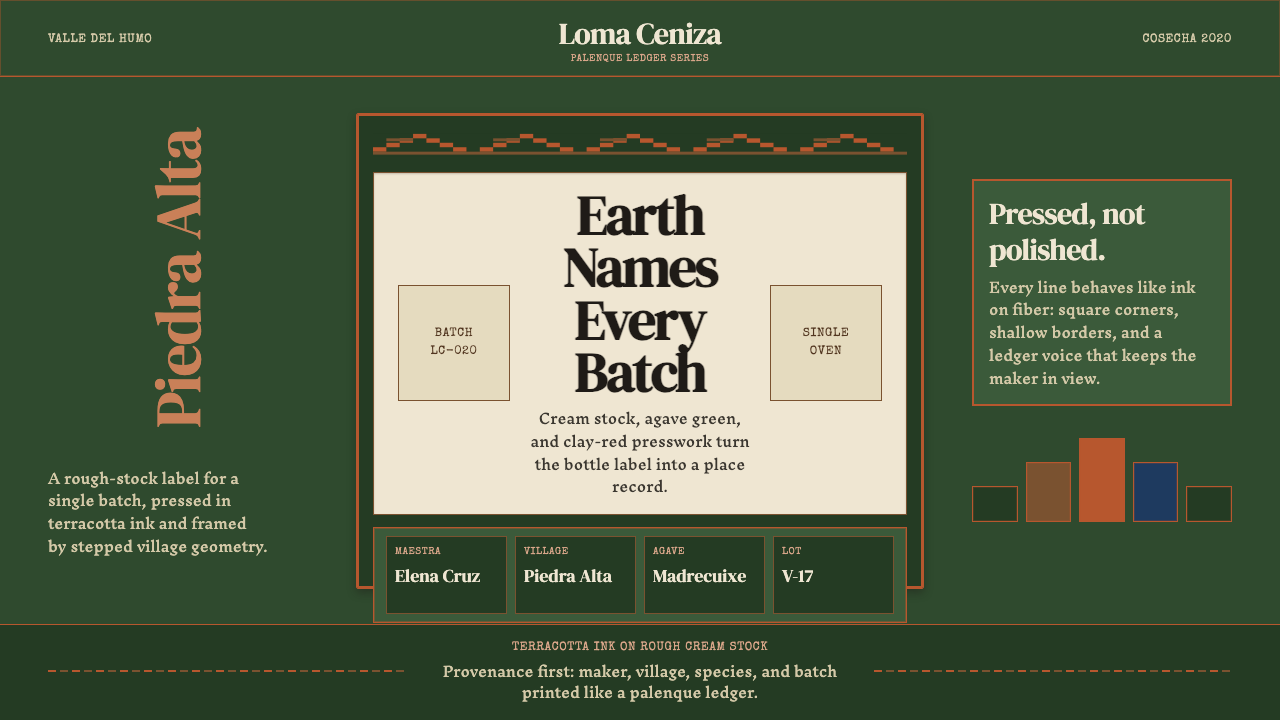 Mexican Mezcal CraftRooted and exact. Agave green, terracotta borders, and DM Serif labels tell t…
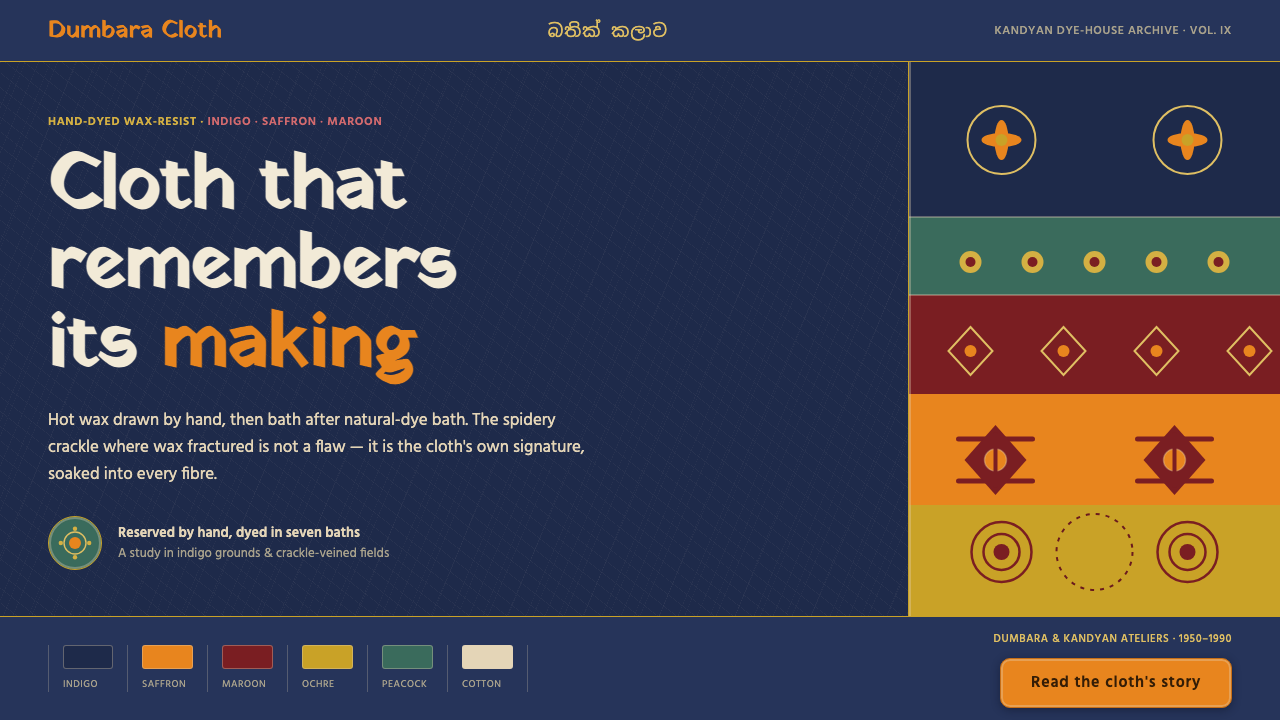 Sri Lankan BatikCloth that remembers its making. Indigo grounds, saffron motifs, veined with…
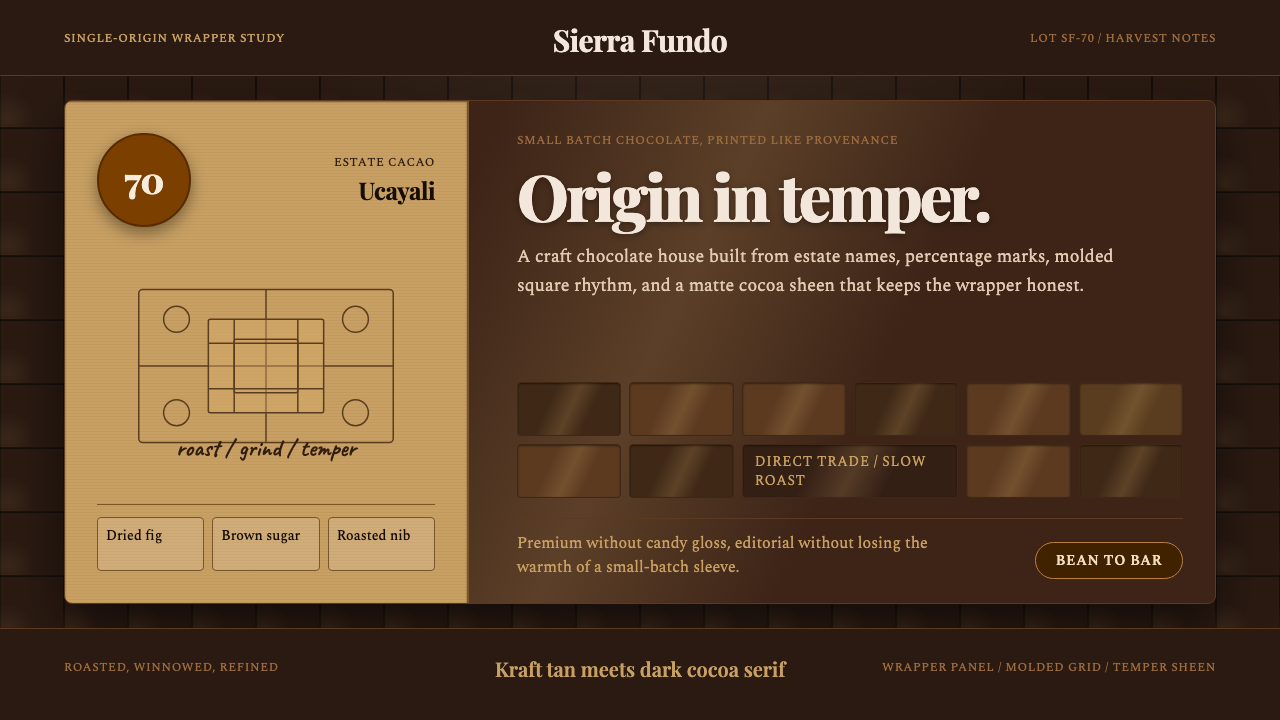 Bean-to-Bar ChocolateOrigin tastes tactile. Cocoa serif, kraft panel, and molded squares carry the…
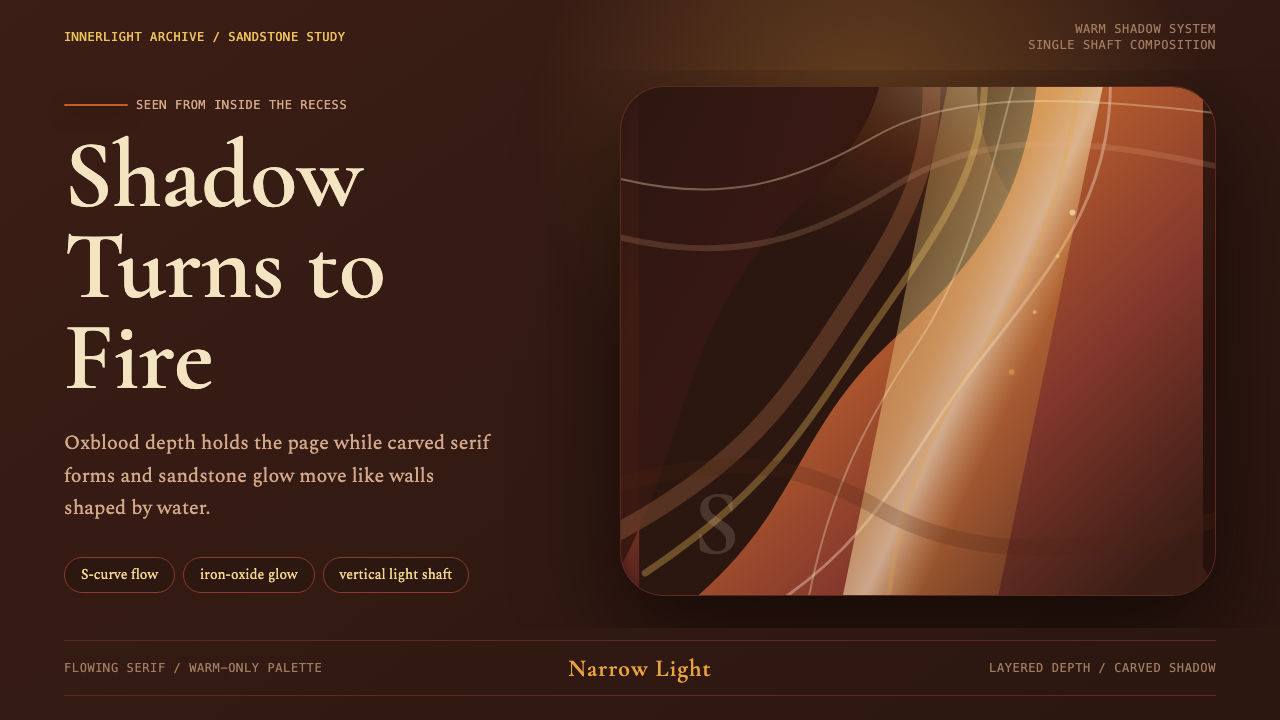 Antelope Slot CanyonGlows from shadow. Oxblood ground, sandstone S-curves, and one warm gold shaf…
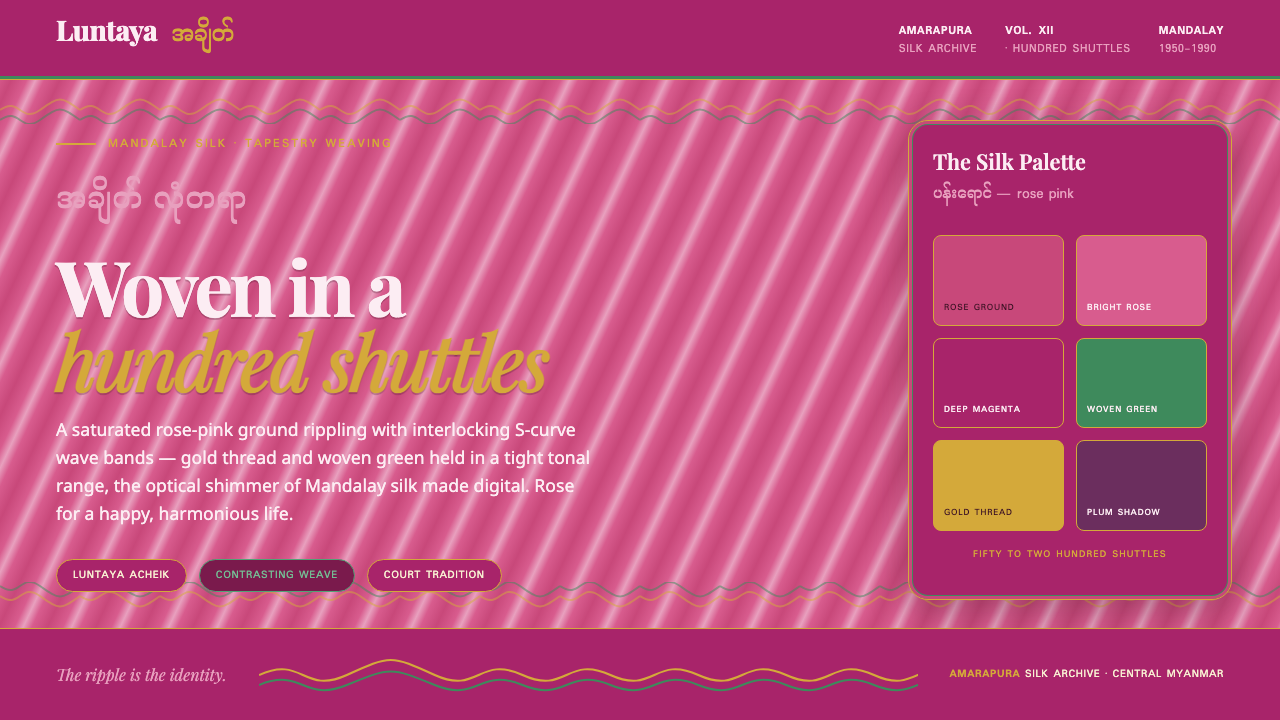 Burmese Acheik LongyiWoven silk shimmer, made digital. Rose-pink ground rippling with gold-and-gre…
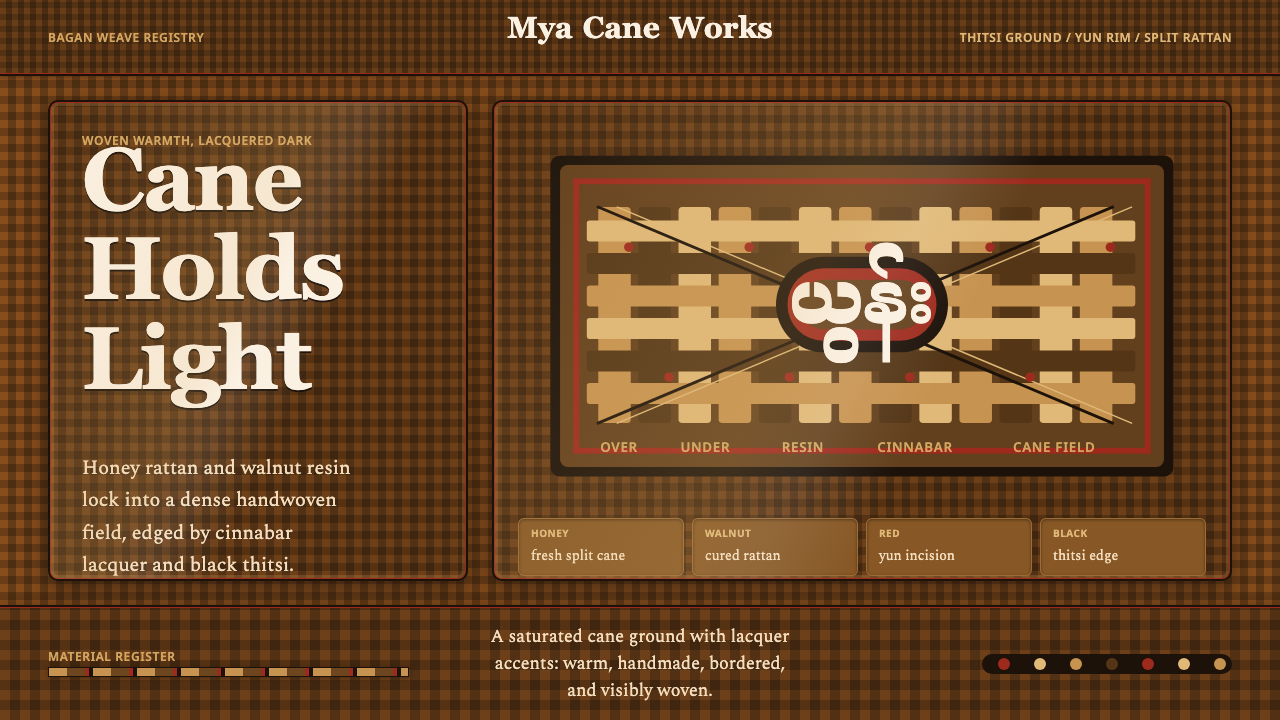 Burmese Cane RattanWoven warmth holds the page. Walnut cane lattice glows with cinnabar rim line…