What is Starbucks (Siren)?
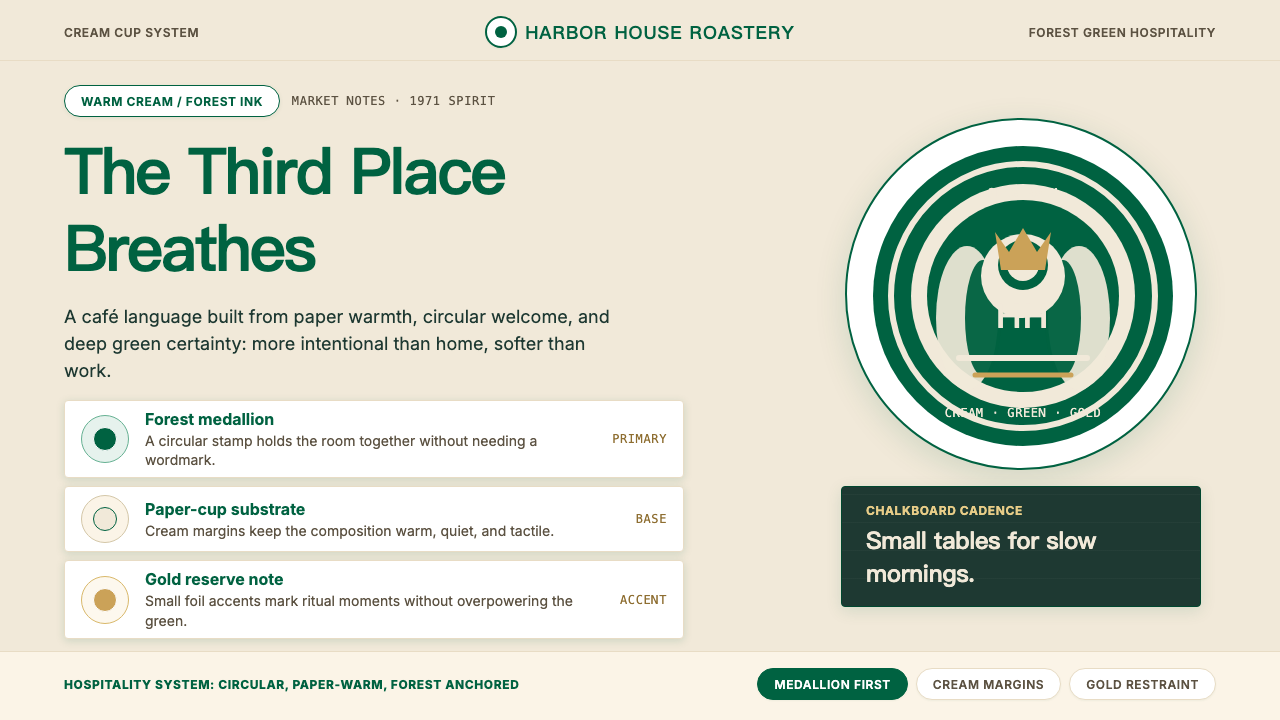
A twin-tailed Siren on forest green turned a cup of coffee into a global cultural institution — and proved that a single emblem, freed from words, can carry the warmth of an entire philosophy.
Starbucks (Siren) in brief
The Starbucks Siren identity is a hospitality-centered visual system built around a single iconic medallion: a twin-tailed mythological siren rendered in cream on a deep forest green ground. Since the 2011 rebrand removed the encircling wordmark entirely, the emblem stands alone — on cups, on storefronts, on packaging, on digital interfaces — as one of the most recognized marks in the world without a single letter of text.
The color logic of the system is deliberately organic rather than corporate. The dominant green is the color of aged copper, deep moss, and Pacific Northwest evergreens — grounding rather than aggressive, welcoming rather than commanding. Cream acts as the warm counterpart: the color of unbleached paper, steamed milk, and the inside of a well-worn notebook. Together, these two tones create an environment that reads as a place to pause rather than transact.
The overall aesthetic philosophy channels what founder Howard Schultz called the 'third place' — a space distinct from home and office, governed by ritual, warmth, and a sense of belonging. Every design decision in the Starbucks system, from the weight of the emblem's line work to the texture implied by chalkboard menus, serves that singular emotional brief: make the person holding this object feel, for a moment, like a regular.

Where does Starbucks (Siren) come from?
Starbucks was founded in Seattle, Washington, in 1971 by three partners: Jerry Baldwin, Zev Siegl, and Gordon Bowker. The original store, at Pike Place Market, sold roasted coffee beans rather than prepared drinks. The name came from Starbuck, the calm and pragmatic first mate of the whaling ship in Herman Melville's Moby-Dick — chosen for its evocation of the maritime trading heritage of the Pacific Northwest. Graphic designer Terry Heckler, working with the founders, discovered a sixteenth-century Norse woodcut of a twin-tailed siren and adapted it for the brand's first logo. The siren — a figure of allure, mystery, and the sea — complemented the seafaring name perfectly.
The original 1971 logo was a detailed brown illustration: the siren shown from the waist up, bare-chested, with two fish tails spreading to either side. When Howard Schultz joined the company in 1982 and subsequently acquired it in 1987, transforming it from a bean retailer into an espresso bar chain, the visual identity evolved alongside the business. The 1987 rebrand shifted the palette from brown to green — green tea, green money, green Pacific forests — and enclosed the siren in a circular badge with the full wordmark 'Starbucks Coffee' running around the perimeter. This format would persist, with minor refinements, for more than two decades.
The pivotal transformation came in 2011, when Starbucks — by then a forty-year-old global company with thousands of locations — undertook a comprehensive identity overhaul in collaboration with the design consultancy Lippincott, with creative leadership from Connie Birdsall. The decision to remove the wordmark entirely was audacious: a bet that the siren had become sufficiently iconic to stand alone. The emblem was enlarged within its circular field, the linework was refined, and the siren's face was brought forward — more approachable, more contemporary, more directly meeting the viewer's gaze. The outer ring, the text, the star details were stripped away. What remained was a pure emblem, freed from the necessity of naming itself.
The 2011 rebrand also signaled a broader strategic ambition: Starbucks was no longer positioning itself solely as a coffee company, and removing 'Coffee' from its visual identity was a deliberate statement of that expanded scope. The green-and-cream system that emerged from that redesign has since been applied across an extraordinary range of touchpoints — seasonal packaging, merchandise, digital interfaces, store architecture, and licensed products in dozens of countries — demonstrating that a single well-resolved emblem, paired with a committed color philosophy, can serve as the backbone of an entire experiential ecosystem.
What defines the Starbucks (Siren) look?
Color Philosophy
The system is anchored by two tones that work in careful opposition. The primary green is deep and slightly muted — closer to the forest floor than to the brightness of a traffic signal — giving it authority without aggression. Against it, cream provides warmth: the substrate reads as aged paper or natural linen, never as the sterile white of a medical environment. Gold enters only as a tertiary accent for premium or seasonal moments, never as a structural color. This disciplined trio produces an environment that feels earned rather than engineered.
The Siren Emblem
The siren figure is the entire communicative load-bearer of the identity. Post-2011, her face occupies the center of the composition with greater prominence than in any previous iteration — symmetrical, direct, meeting the viewer's gaze without evasion. The twin tails, arching upward to frame the composition, echo the circular form of the medallion itself, creating a self-contained visual world. The line weight is controlled so that the image reads cleanly at every scale from a tiny app icon to a building-sized mural — a requirement that shaped every refinement of the drawing.
Typography Register
The typeface system operates across two registers that map onto two emotional territories. The primary workhorse is a clean, humanist sans-serif — legible, contemporary, calibrated to feel neither cold nor casual. A secondary display face captures a handwritten, chalkboard energy: irregular baseline, varied stroke weight, the suggestion of chalk on slate. This second register is reserved for moments where the brand wants to feel spontaneous and personal — seasonal specials, handwritten notes, promotional headline moments — rather than institutional.
Tactile Materiality
Unlike many brand systems that exist primarily as flat screen experiences, the Starbucks visual language is explicitly designed around physical objects that people hold and touch. The paper cup is the primary canvas; its slightly rough matte surface, the way a sleeve prints, the heft of corrugated cardboard are all implicit references within the digital expression of the brand. This means textures suggesting craft paper, rough chalk, or natural linen appear in the visual system as qualitative references — the brand feels grounded in the material world even on a glass screen.
Seasonal Expressiveness
The Starbucks system is unusually elastic in its seasonal dimension. While the core green-cream-gold palette and the siren emblem remain stable anchors, the surrounding illustration language, packaging patterns, and accent colors shift dramatically with each seasonal campaign. Holiday red, autumnal terracotta, spring blush — these seasonal guests are introduced as layers over the stable foundation, never replacing it. This structure allows the brand to feel alive and timely without ever sacrificing the core recognition that makes each seasonal cup feel unmistakably like a Starbucks cup.
The Third-Place Atmosphere
Every design choice in the system serves an atmospheric goal that is harder to name than to feel: the sense that this is a place where you are known, where time moves slightly differently, where a ritual of order-and-wait is quietly meaningful. Warmth in the color temperature, legibility in the typography, approachability in the siren's gaze — these are not accidental properties but designed intentions. The visual system is, in a precise sense, an interior design language translated into two dimensions: it is meant to produce the same emotional response whether you are inside a store or holding a takeaway cup on a street.
Restraint in Gold
Gold in the Starbucks system functions as a marker of premium moments — loyalty tier signifiers, holiday foil sleeves, special-edition packaging — rather than as an ambient warmth tone. This restraint is essential: deploying gold broadly would push the system toward luxury-hotel opulence and away from the neighborhood-café approachability that is the brand's true register. When gold does appear, it is used with deliberate sparingness, so that its presence genuinely signals something elevated.

Who shaped Starbucks (Siren)?
Schultz joined Starbucks in 1982 and, after a formative trip to Milan's espresso bars, acquired the company in 1987 and transformed it from a bean retailer into a café chain. His concept of the 'third place' — a social environment distinct from home and work — became the philosophical spine of the brand's visual and experiential identity. Every design decision about warmth, welcome, and ritual in the Starbucks system traces back to the customer experience ambition that Schultz articulated and relentlessly enforced.
The Seattle-based graphic designer who co-created the original 1971 Starbucks identity, including the discovery and adaptation of the twin-tailed siren figure from a sixteenth-century Norse woodcut. Heckler's foundational choice of the siren — mysterious, maritime, mythological — established the brand's depth of character from its very first iteration. His work set the iconographic vocabulary that all subsequent designers inherited and refined.
Creative director at Lippincott who led the visual direction of the landmark 2011 rebrand — the project that removed the wordmark and freed the siren to stand alone. Birdsall's creative leadership navigated the audacious decision to strip identifying text from one of the world's most commercially valuable logos, while ensuring the refined emblem gained in presence and personality what it lost in verbal reinforcement. The result has been widely studied as a case study in brand confidence.
The New York-based brand consultancy that partnered with Starbucks on the 2011 global identity overhaul. Lippincott's role extended beyond logo refinement to encompass the broader design language — how the emblem would live across packaging, digital platforms, store environments, and merchandise at global scale. Their work on the Starbucks system is a reference point in contemporary brand strategy for its handling of the tension between simplification and recognition.
The original 1971 Pike Place Market location in Seattle is not a person but a place that shaped the brand's identity as profoundly as any individual. The market's character — fishmongers, handmade goods, the smell of roasting coffee, the texture of an urban neighborhood market — became an implicit reference for the tactile and sensory qualities that the Starbucks visual system consistently reaches toward: craft, provenance, materiality, and the particular warmth of a place with genuine local character.
How do you use Starbucks (Siren) today?
The Starbucks Siren system is one of the most study-worthy hospitality brand languages available to designers, because its success is not accidental — it is the result of a clear and internally consistent set of decisions about color temperature, emblem treatment, and the emotional priority of warmth over efficiency. Applying its principles requires understanding what each element is actually doing: the deep green is not just brand-differentiation; it is a spatial anchor that slows the visual pace. The cream is not just background; it is an invitation.
For presentation slides, the system offers a compelling alternative to the cold blue-white corporate default. A cover slide in this register uses a deep green field with cream lettering at generous scale, and a single emblem or illustrative element centered or placed in deliberate asymmetry. The effect is immediately warmer and more distinctive than a white-ground-with-logo layout. Content slides benefit from the cream ground: body text in dark charcoal rather than pure black, section headers in the deep green as colored text or as a colored band, and data elements — charts, tables — given a light cream or warm white field so they feel like physical documents rather than screen readouts. Data slides should use the primary green and its lighter siblings to color bar chart segments or line strokes, reserving cream for the background field and the space between data elements.
For web interfaces, this style is well-suited to scenarios where emotional warmth is a strategic priority alongside functional clarity — membership portals, loyalty dashboards, premium subscription landing pages, hospitality booking tools. A pricing page in this system uses a cream or warm-off-white base, with the primary green reserved for the recommended tier card background and call-to-action buttons. Secondary information — feature lists, footnotes, comparison details — sits in a quieter warm gray derived from the cream tone, ensuring the hierarchy is clear without the starkness of a purely monochrome system. Navigation elements should be typographic and unhurried: generous spacing, medium-weight humanist letterforms, no icons competing with the wordmark.
For editorial and marketing work, the style's strongest application is in contexts where craft, origin, and sensory experience are part of the message. A feature article layout in this system uses a warm-tinted background field rather than pure white, places pull-quotes in the deep green as colored text blocks, and uses illustrated or textured secondary elements — a hand-drawn border detail, a chalkboard-style section marker — to give the page a layered, physical quality. Marketing covers and social cards work best with the full boldness of the green-cream pairing: a large illustrated element (siren-style or botanical) on a forest green ground, with cream headline type set at a size that commands the composition.
A common mistake when working with this visual language is using the green too broadly at high saturation, so that the palette becomes fatiguing rather than welcoming. The system's warmth depends on the cream playing an active spatial role — it should occupy at least as much compositional area as the green, often more. A second common error is reaching for generic 'coffee shop' clichés (steam curl graphics, bean silhouettes, generic serif type) rather than letting the siren emblem carry the brand's character on its own. The Starbucks system earns its strength from restraint: the emblem, the two tones, the measured warmth of the typefaces. Adding more typically subtracts.

Starbucks (Siren) — FAQ
Why did Starbucks remove its own name from the logo in 2011?
The decision had two interlocking rationales. First, it was a statement of brand confidence: after forty years, the siren emblem had become sufficiently recognized globally that the text had become redundant rather than clarifying. Second, it was a strategic signal: by removing 'Coffee' from the wordmark, Starbucks explicitly freed itself to expand beyond coffee into tea, juice, food, and other categories without the visual identity creating contradiction. The bet paid off — the siren is now recognized in markets where no one can read Latin script, demonstrating that pure iconographic recognition can transcend language entirely.
Is the Starbucks visual system appropriate for products outside the food and beverage category?
The green-cream-siren system is so specifically associated with Starbucks that literal application outside the brand's own universe is not possible — you would simply be copying a proprietary identity. However, the underlying principles — warm hospitality color temperature, emblem-centered identity with minimal text dependency, tactile materiality references, and seasonal expressiveness over a stable core — are highly transferable. A hotel brand, a wellness product, a specialty food retailer, or a membership service can apply these principles to arrive at a system with similar warmth and distinctiveness without replicating the specific tokens.
How does this system handle dark mode or dark-background contexts?
The Starbucks system is inherently a light-ground identity — its warmth depends significantly on the cream substrate and the way it provides relief against the deep green. A true dark-mode inversion is possible but requires care: on a very dark ground, the deep green loses its spatial depth and can read as flat; cream type remains legible but loses the 'paper' warmth association it carries on a light ground. The most successful dark-context application inverts the primary relationship — cream or warm white becomes the foreground element (emblem, type) against a near-black or very dark green ground — while reintroducing small cream surface areas as card backgrounds or field fills to preserve the two-tone interplay that gives the system its character.
What makes the Siren emblem work at such a wide range of scales?
The 2011 refinement was precisely calibrated with scale performance in mind. Several decisions contribute: the siren's face is treated as the primary focal element, so at small sizes (app icon, embossed sleeve) the eyes and central face remain readable even as the tail and floral details become impressionistic. The line weight is consistent enough that it holds at large scale without appearing crude, and fine enough that it reproduces at small scale without filling in. The circular framing creates a strong silhouette that is recognizable as a shape even when the internal detail is not legible. And the high contrast between cream figure and deep green field means the emblem retains clarity across lighting conditions, surface textures, and reproduction methods that would defeat a more complex or lower-contrast mark.
Can this system work for a startup or small brand, or does it require the scale of a global company to function?
The principles are entirely scale-independent. What makes the Starbucks system work — a committed two-tone palette, a single memorable emblem, a clear emotional brief centered on a specific kind of welcome, and the discipline to say no to visual complexity — are practices available to any brand at any size. In fact, the system's restraint is arguably more achievable for a small brand than for a large one: a startup can enforce strict visual discipline without the organizational complexity of managing hundreds of touchpoints across dozens of markets. The challenge for a small brand is not scale but commitment: the system's warmth requires patience, because it accumulates through consistent repetition rather than dramatic single executions.
Related design styles
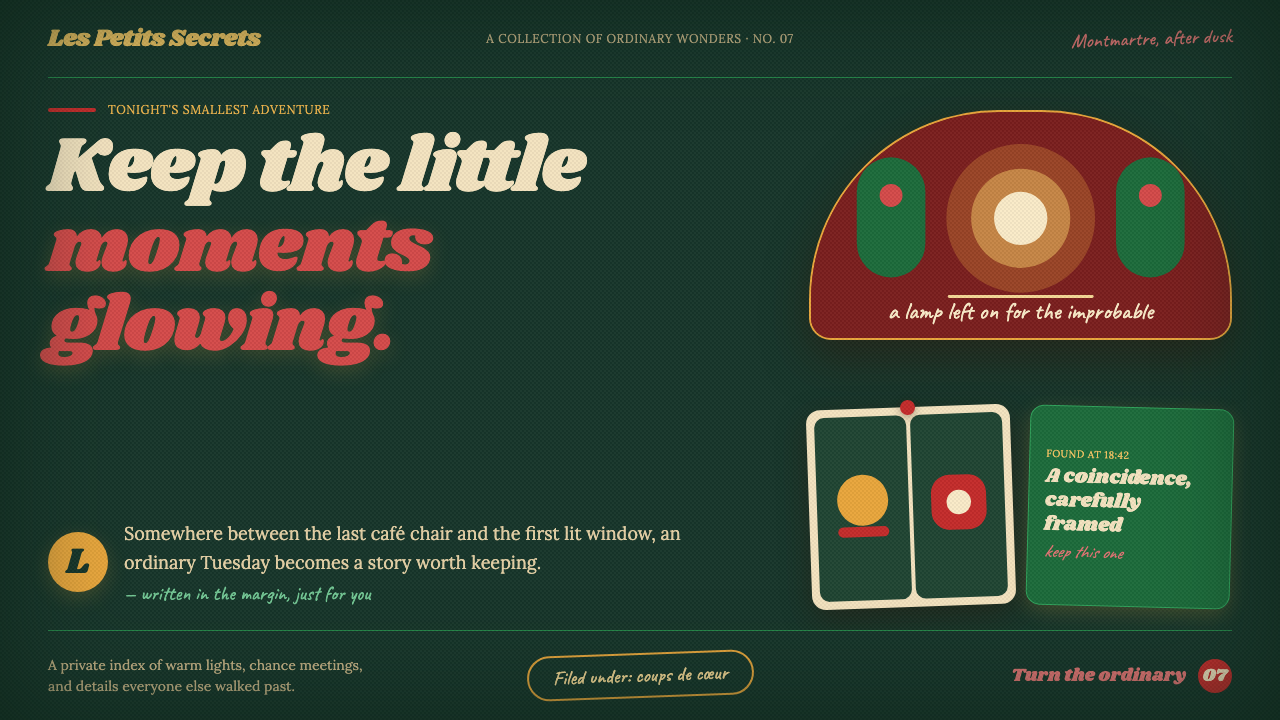 Amélie (Montmartre 2001)Ordinary moments glow like secrets. Storybook green, carmine accents, and cre…
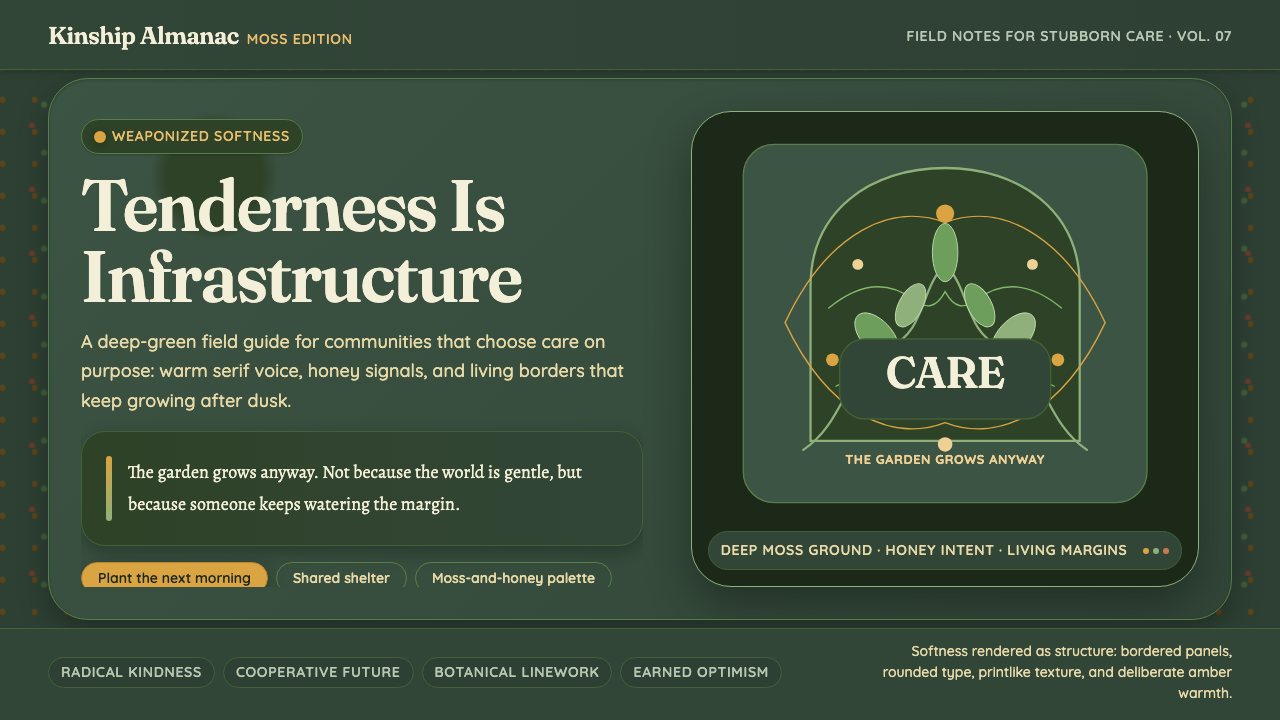 HopepunkSoftness becomes defiance. Deep moss, honey amber, and vine borders make care…
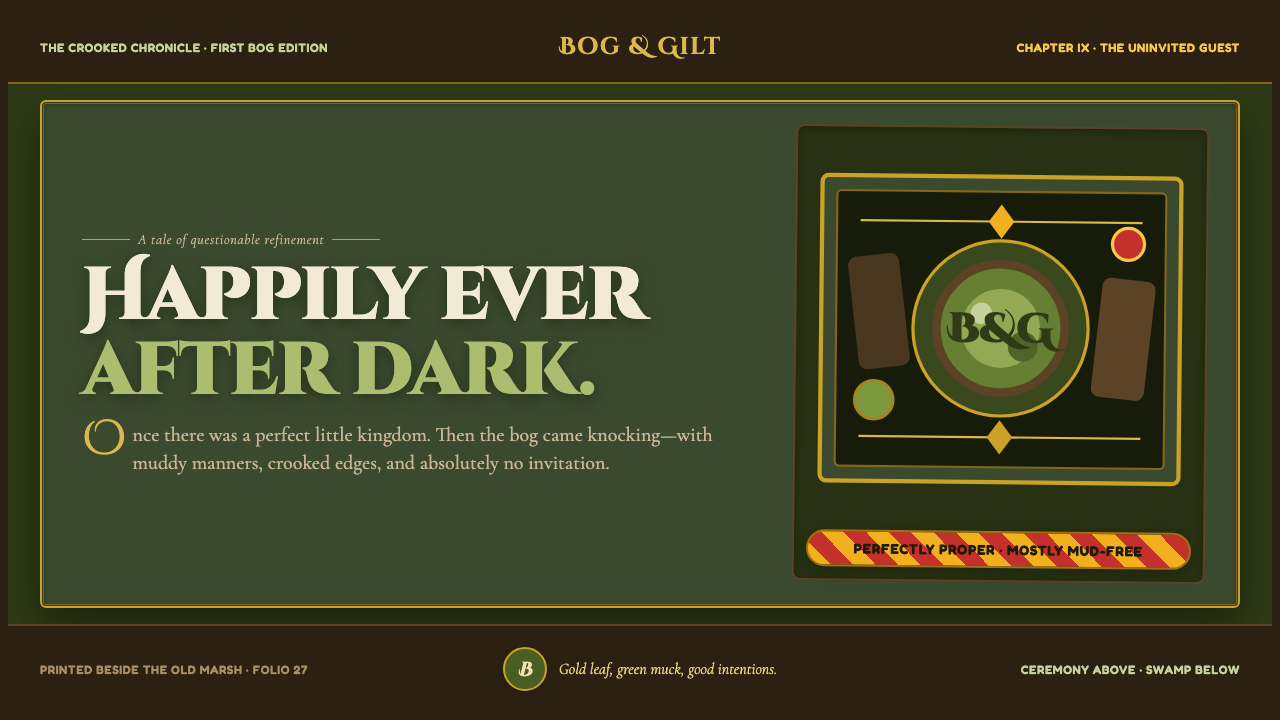 Shrek Swamp (2001)Fairy-tale ceremony gets muddy. Gilt frames collide with moss green and candy…
 Bangladeshi Jute CraftMemory stays stitched. Jute green, indigo borders, terracotta warmth.
 Macramé Fiber ArtSlow craft, hand to fiber. Undyed ecru cotton on raw-jute walnut, square knot…
 Your Name (Shinkai, 2016)Twilight makes time tangible. Magenta melts into cyan, held by one vermilion…