What is Costa Rica Pura Vida Eco?
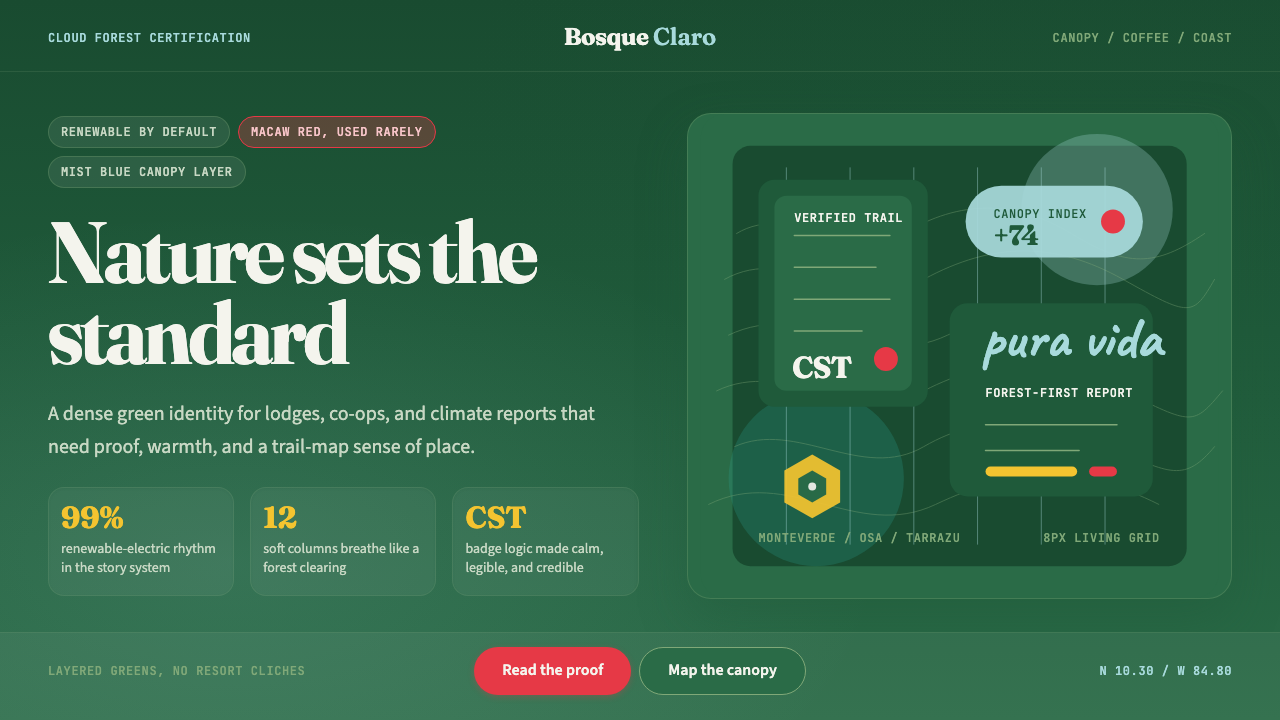
Costa Rica Pura Vida Eco translates the world's most successful small-nation sustainability brand into a design language as alive as the cloud forest it comes from.
Costa Rica Pura Vida Eco in brief
Costa Rica Pura Vida Eco is a design system rooted in the visual identity of a country that abolished its military in 1948, runs on nearly all renewable electricity, and has made ecological stewardship the cornerstone of its national brand. The aesthetic draws on the country's Esencial Costa Rica program, the eco-lodge culture of Monteverde and the Osa Peninsula, and the visual grammar of Certificación para la Sostenibilidad Turística — a national certification system that set the global template for measurable tourism sustainability. The result is a palette and typographic sensibility that feels simultaneously lush and restrained: deep cloud-forest greens anchoring a composition, scarlet-macaw red used sparingly for urgency and delight, and Caribbean mist blue offering contrast and openness.
Where many sustainability-themed design systems tip into what critics call greenwash — soft pastels, vague leaf motifs, and sentimental textures that signal ecological concern without earning it — Pura Vida Eco insists on specificity. The greens are not generic; they carry the density of a highland canopy where over half a million species coexist in roughly the size of West Virginia. The typography favors warmth and organic character without sacrificing legibility. Negative space is used generously, not to project luxury, but to let the eye rest — mirroring the unhurried quality embedded in the phrase 'pura vida' itself, which Costa Ricans deploy as greeting, farewell, affirmation, and philosophy simultaneously.
The system is light-ground by nature: backgrounds tend toward warm off-whites and natural cream tones, honoring the bright equatorial light of the Central Valley and the open sky over the Pacific coast. This lightness allows the deep greens and red accents to carry their full weight without appearing oppressive. The overall effect is one of abundance held in balance — not the cultivated serenity of a spa brand, but the living, breathing complexity of an actual ecosystem in which color, form, and negative space each occupy their ecological niche.

Where does Costa Rica Pura Vida Eco come from?
Costa Rica's reputation as an ecological exemplar did not emerge spontaneously. It was the product of deliberate policy choices stretching across several decades, beginning with the abolition of the military under President José Figueres Ferrer in 1948, which redirected defense spending into education and health infrastructure. The conservation turn came in the 1970s and 1980s, when the government began aggressively acquiring land for national parks and protected areas — today more than a quarter of Costa Rica's territory is formally protected, an extraordinary proportion for any nation. This conservation commitment created the environmental conditions that would later make the country a global destination for nature tourism and, by extension, a laboratory for sustainable design communication.
The Certificación para la Sostenibilidad Turística program, launched in 1997 by the Costa Rican Tourism Board (ICT), formalized the connection between environmental performance and visual identity in the tourism sector. Lodges, tour operators, and hotels that met rigorous criteria in areas including waste management, energy use, water conservation, and community engagement earned CST certification and the right to display its leaf-level rating — a system of one to five leaves indicating depth of compliance. The CST graphic language — organic form, clear hierarchy, forest-referenced color — became the first codified layer of what would eventually coalesce into a broader national design sensibility.
The Esencial Costa Rica country brand, developed with support from PROCOMER (the trade promotion agency) and international consultancy Hill+Knowlton Strategies and formally launched in the 2013–2016 period, elevated these visual principles to a national strategic level. The brand sought to unify the country's export identity across coffee, tourism, medical devices, and technology sectors under a single visual and values framework. The design language that emerged — warm serif typography, deep greens and earthy tones, references to biodiversity and authentic artisanship — was intended to be simultaneously premium and grounded, distinguishing Costa Rican products from lower-cost regional competitors by anchoring them in a credible sustainability narrative.
Carlos Manuel Rodríguez, who served as Minister of Environment and Energy (MINAE) and later as President of the Global Environment Facility (GEF), represents the policy and governance thread running through this design story. Rodríguez oversaw landmark payment-for-ecosystem-services programs that compensated landowners for keeping forests standing — effectively creating the economic infrastructure that made the biodiversity visual language financially viable as a brand asset. The Tarrazú coffee cooperatives of the Central Highlands, meanwhile, became early adopters of the fair-trade single-origin visual vocabulary: the emphasis on provenance, small-batch craft, and named-farm traceability that has since become standard in premium food and beverage branding worldwide. Together, these institutional and commercial actors created not a designed style imposed from outside, but one grown from the actual economic and ecological conditions of the country.
What defines the Costa Rica Pura Vida Eco look?
Color
The palette centers on deep, saturated greens that read more forest than mint — a darkness that evokes canopy rather than lawn. Against this foundation, scarlet-macaw red appears as a precision accent: never dominating, always purposeful, carrying the energy of a bird sighted through leaves. Caribbean mist blue — softer and more recessive — serves as the system's breathing room, appearing in backgrounds, data elements, and secondary information. Warm off-whites and natural cream tones provide the ground; pure white feels too clinical and is used only where maximum contrast is required. The palette avoids the pale, desaturated greens common in generic eco design, which risk reading as faded or unambitious.
Typography
The typographic character is warm and organic rather than geometric or mechanical. Serif choices carry a humanist quality — letterforms with the slight irregularity that recalls hand-drawn origins rather than the precision of drafting tools. This warmth distinguishes the system from sustainability aesthetics that default to cold sans-serif rationalism. Display type is used with restraint and generous leading; body text prioritizes readability over typographic drama. A secondary sans-serif — clean but not sterile — handles data labels, captions, and interface elements. The pairing between the warm serif and the functional sans-serif is the typographic equivalent of the palette's contrast between deep green and open sky.
Texture and Surface
Unlike purely flat design systems, Pura Vida Eco permits subtle organic texture — the slight grain of uncoated paper, the fibrous quality of handmade materials, the soft irregularity of natural surfaces — applied with genuine restraint. Texture here is not decorative appliqué; it is a reference to the material reality of the country it represents: the rough bark of a fig tree, the woven weft of an artisan textile, the matte finish of unglazed ceramics from Guaitil. The critical discipline is knowing when to use none at all: data-heavy slides and interface elements remain flat, reserving texture for editorial and brand contexts where it adds meaning rather than noise.
Imagery and Photography
Photography within this system earns its place through specificity rather than generic aspiration. A hummingbird hovering over a heliconia spike, condensation on shade-grown coffee leaves at dawn, the hands of a farmer sorting red coffee cherries — these images work because they are irreducibly particular. The processing style favors rich saturation and natural contrast rather than the faded, filmic treatment common in lifestyle photography. Green tones are allowed to be genuinely green. Wildlife and landscape subjects are preferred over curated human scenes, though portraiture — when it appears — shows work and hands rather than idealized leisure.
Layout and Space
Compositions are asymmetric but unhurried — there is more breathing room here than in a high-density urban design system, reflecting the biological diversity principle that abundance does not require crowding. Margins are wide relative to content area. Image and text often share a page at roughly equal weight rather than text dominating a narrow column. Grid structures are present but organic in feel: columns can be unequal, and the placement of accent elements follows the compositional logic of natural asymmetry rather than strict mathematical division. This spaciousness is not an artifact of content scarcity; it is a deliberate signal of unhurried confidence.
Icon and Illustration Language
Where icons appear, they draw from the natural world — leaf forms, bird silhouettes, coffee cherries, water drops — but rendered with geometric confidence rather than naive charm. They are not cute; they are clear. Illustrative elements, when used, favor a line-weight that suggests craft: heavier than a thin digital line, lighter than a bold graphic mark. Color within illustrations follows the main palette strictly, with the same restraint applied to accent colors. Decorative motifs reference Boruca woven textile patterns and pre-Columbian stonework from the Diquís Delta — historical visual languages that predate the nation-state and give the system cultural depth without appropriation.
Tone and Anti-Greenwash Discipline
The most distinctive design principle in this system is the rejection of vagueness. Every visual choice should be traceable to a specific Costa Rican reality: a named species, a documented certification, a real region, a verifiable claim. This principle manifests as a preference for specificity in labeling, for photographs with identifiable subjects, for data presented with sources. Decorative ecological motifs — the floating leaf, the rippling water reflection, the generic mountain silhouette — are treated as design failures rather than safe defaults. The system's credibility depends on it earning every green it uses.

Who shaped Costa Rica Pura Vida Eco?
Costa Rica's foreign trade promotion agency and the institutional steward of the Esencial Costa Rica country brand. PROCOMER coordinated the multi-sector design strategy that brought coffee cooperatives, medical device exporters, and tourism operators under a unified visual identity, making Costa Rica's sustainability reputation a tangible commercial asset. Its work established the principle that a country's ecological track record can function as a design brief — and that design, in turn, can reinforce policy credibility.
The international communications consultancy that partnered with PROCOMER to develop and position the Esencial Costa Rica brand for global audiences. Hill+Knowlton's involvement brought export-market sophistication to what might otherwise have remained a domestic tourism campaign: the brand was designed from the outset to be legible to buyers and travelers in Europe, North America, and Asia, not only to domestic audiences. Their work on tone — premium but not exclusionary, ecological without being preachy — shaped the visual register that practitioners now recognize as characteristic of the style.
As Minister of Environment and Energy (MINAE), Rodríguez oversaw Costa Rica's payment-for-ecosystem-services programs, which compensated private landowners for maintaining forest cover — turning ecological conservation into a formal economic transaction. This policy innovation had an indirect but decisive effect on design culture: it created a landscape worth photographing, a biodiversity worth naming, and a sustainability story that designers could illustrate with confidence rather than approximation. His later role as President of the Global Environment Facility extended Costa Rica's influence over international conservation finance and the visual standards that accompany it.
The fair-trade single-origin coffee cooperatives of the Tarrazú region — particularly CoopeTarrazú — were among the earliest commercial actors to translate Costa Rica's ecological credentials into a design language that international buyers could read. The emphasis on altitude, microclimate, processing method, and named farm originated in Tarrazú cooperative marketing in the 1990s and 2000s, predating the country brand and helping establish the visual grammar of provenance-as-identity that Esencial Costa Rica later codified at national scale. In design terms, the cooperatives pioneered the pairing of documentary specificity with premium sensory aesthetics that defines the Pura Vida Eco system at its best.
The Costa Rican Tourism Board created and administers the Certificación para la Sostenibilidad Turística, the five-leaf sustainability rating system that became the design language's first institutional visual layer. ICT's decision to make the certification rating visible and graphic — rather than purely regulatory — established the precedent for translating policy compliance into brand signal. The leaf motif and its graduated rating logic have been referenced by sustainability certification programs in at least a dozen other countries, making ICT's visual governance work one of the most widely replicated design contributions in contemporary eco-branding.
How do you use Costa Rica Pura Vida Eco today?
Costa Rica Pura Vida Eco is among the most contextually specific design systems available for contemporary work, and that specificity is precisely its strength and its discipline. Applying it correctly requires understanding that its ecological references are not decorative metaphors but verified realities — which means the more precisely you align your content to the actual values the system embodies, the more powerful the visual output becomes. A sustainability report for a company with genuine environmental credentials will carry more authority in this style than a marketing brochure for a product whose green claims are aspirational at best.
For presentation slides, the system works strongly on both cover and content pages. A cover benefits from a full-bleed photograph treated with rich natural color — a cloud forest, a coffee farm at harvest, a scarlet macaw in canopy — with the title set in warm serif type on a semi-transparent cream or deep-green overlay. The overlay should feel like mist, not a solid block: translucent enough that the image breathes through. Content slides should honor the system's spaciousness: resist the temptation to fill every column, let text sit with generous leading, and use the forest green only for primary headings or key data callouts. Data slides — charts, graphs, comparisons — benefit from the palette's natural hierarchy: the deep green for primary series, the mist blue for secondary context, the scarlet only for alerts or peak values worth specific attention.
For web interfaces, dashboards, and pricing pages, the system's strength is in creating trust without sacrificing warmth. The approach: a cream or warm off-white background prevents the clinical quality of pure white; the deep green anchors the navigation bar and primary calls to action; card components use a soft natural-paper texture only when the context justifies it (editorial cards yes, data tables no). Interactive states use the scarlet accent precisely — hover and selected states, not decorative borders. Typography on web should maintain the warmth of the editorial register: the humanist serif for marketing headers, the clean sans-serif for interface labels and data fields. Avoid generic san-serif system fonts; they undercut the carefully established organic character of the palette.
For editorial, marketing, and brand identity work, the system's power comes from documentary specificity. The layout logic favors a wide-measure body text column with a generous outer margin reserved for call-outs, certifications, source citations, and pull quotes — a structure that signals accountability alongside beauty. Section breaks should use ruled lines in forest green rather than decorative ornament. Photography should always be specific: name the species, name the farm, name the community. If you cannot be specific, choose a layout that does not depend on photographic credibility. Marketing pages work well with alternating full-width blocks: cream-ground sections for narrative text, deep-green-ground sections for featured credentials or testimonials, with the scarlet reserved for a single primary call to action per page.
The most common mistake when applying this system is mistaking lushness for density. The system's greens are rich and saturated, but the layouts must remain generous with space. Filling a composition to its edges with layered textures, multiple photography crops, gradient overlays, and competing accent colors produces the visual equivalent of greenwash — impressive surface, no clear signal. A second common error is using the ecological motifs (leaves, birds, water) as decorative filler rather than as specific references. A hummingbird illustration that appears because it feels tropical, rather than because it is a resplendent quetzal connected to a named conservation program, undermines the system's foundational discipline. Every visual element should be able to answer the question: why this, specifically?

Costa Rica Pura Vida Eco — FAQ
How is Pura Vida Eco different from generic eco-design or greenwash aesthetics?
The distinction is specificity versus aspiration. Generic eco-design reaches for soft pastels, vague leaf forms, and filmic washes because those signals feel ecologically sympathetic without requiring any particular claim to be true. Pura Vida Eco draws from a documented country brand, a measurable certification system, a named set of regions, and a verifiable conservation track record. The visual choices — the depth of the greens, the precision of the accent colors, the insistence on named subjects in photography — are all downstream of that specificity. A designer working in this system who cannot identify why a given visual choice connects to the system's source reality should treat that as a warning signal, not a stylistic preference.
Can this style work for brands or products that are not based in Costa Rica?
Yes, with an important caveat. The style is a design system that can be appropriately applied to any brand whose values and claims are genuinely aligned with what it represents: rigorous sustainability, biodiversity respect, provenance transparency, and ecological accountability. A fair-trade coffee brand from another origin, a certified B-Corp consumer goods company, or a conservation NGO working in any tropical region can use this visual language credibly — if the underlying substance is present. What the style cannot do is import credibility that the product or organization has not earned. The palette, the typography, and the composition can all be executed correctly; the moment they are applied to a brand making unverified environmental claims, the visual language collapses into the greenwash it was designed to refuse.
How should data visualization be handled within this design system?
Data visualization is one of the system's stronger applications, precisely because ecological sustainability is a data-rich domain. The approach is to treat charts and graphs as natural objects in the compositional landscape: bars become columns of varying forest density, line charts trace altitude profiles, pie segments read like a cross-section of strata. The palette's inherent hierarchy — deep green for primary data, mist blue for secondary or comparative series, scarlet as a precision alert for thresholds or outliers — maps naturally onto the visual hierarchy of a well-structured chart. What to avoid: rainbow palettes that borrow random accent colors from outside the system, gradient fills on chart elements, decorative leaf or wave patterns as chart backgrounds, and the use of high-saturation scarlet across an entire data series rather than reserving it for exception values.
What is the right way to use texture in this system without it feeling like decorative padding?
The test is purpose: texture should be present because it references a material reality relevant to the content, not because the layout feels empty. Paper grain on a printed coffee bag label connects to the physical artifact of the product; the same grain applied to a software pricing page connects to nothing and reads as noise. In practice, limit texture to contexts where the system's organic character needs reinforcement — editorial photography treatments, packaging, printed brand materials, and key brand-expression moments in web design (a hero section, an about-page background). Every interface element involved in task completion — forms, tables, buttons, navigation — should be kept flat and clean. When in doubt, remove the texture; the palette and typography carry the system's identity without it.
How does this system handle dark-mode or dark-background layouts?
Dark-ground applications are possible but require a different compositional logic. On a very dark ground — deep forest green or near-black — the cream and warm off-white tones move into the foreground as the primary typography color, and the Caribbean mist blue becomes an effective secondary tone for metadata and supporting text. The scarlet accent retains its function as a precision signal. The critical adjustment: in light-ground configurations, the deep greens carry the system's ecological weight; in dark-ground configurations, the greens used as background must be allowed to recede fully, and the composition must find its balance through the warm typography and the restrained accent palette. High-saturation greens used simultaneously as background and as accent color on dark layouts will produce visual confusion. A dark Pura Vida Eco layout works best when it commits to one role for each color and does not attempt to replicate the light-ground composition in reverse.
Related design styles
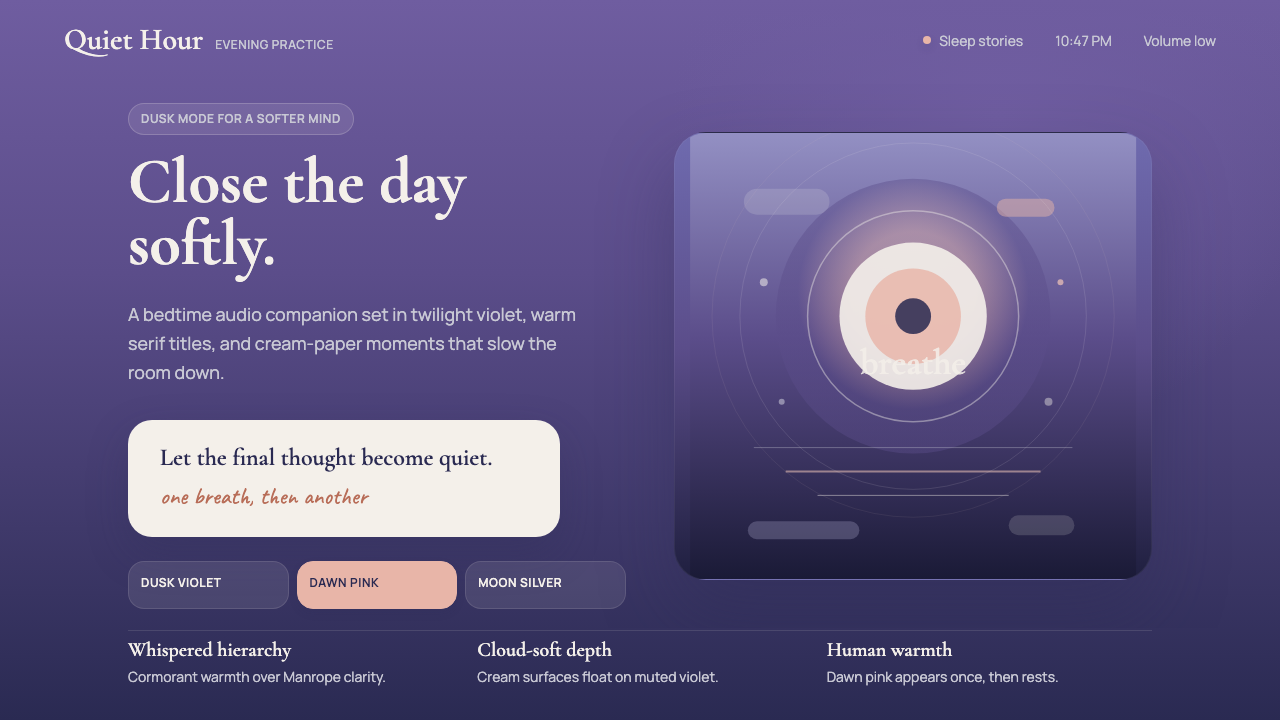 Calm App Purple MeditationWhispers at bedtime. Dusk-purple gradients, cream serif type, and dawn-pink w…
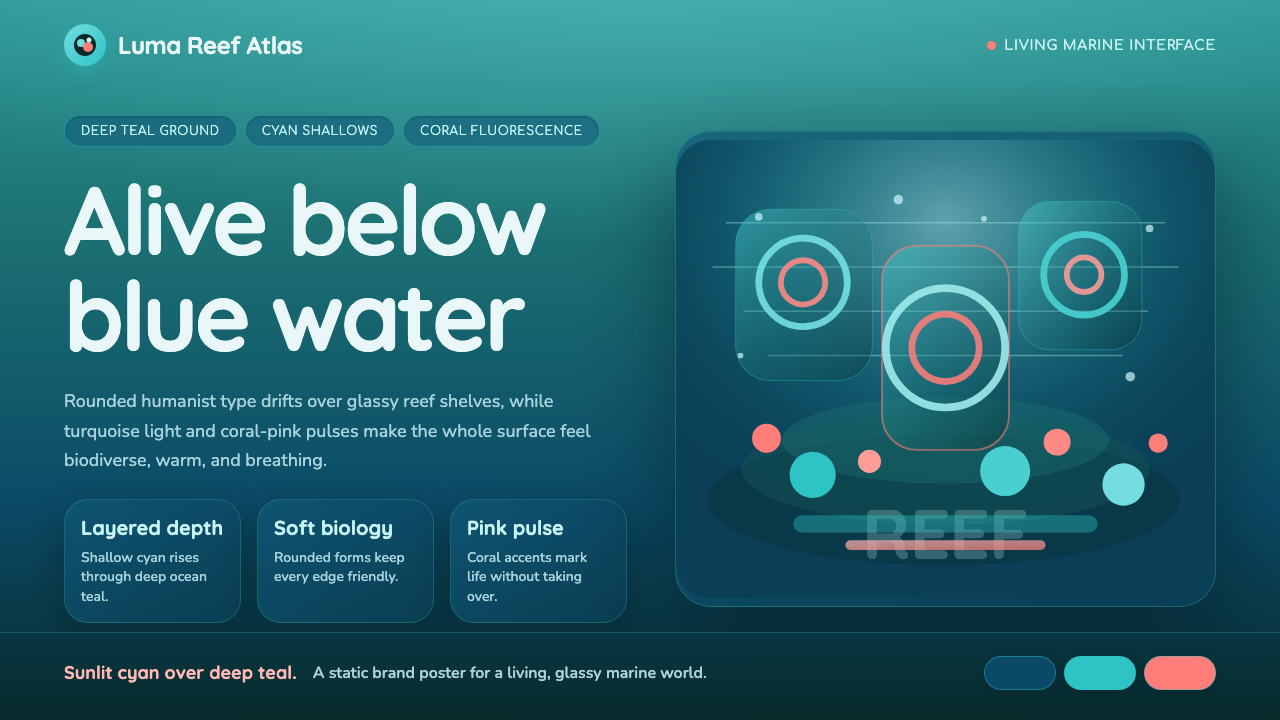 Great Barrier ReefAlive under deep teal. Quicksand curves, cyan glow, and coral-pink pulses bui…
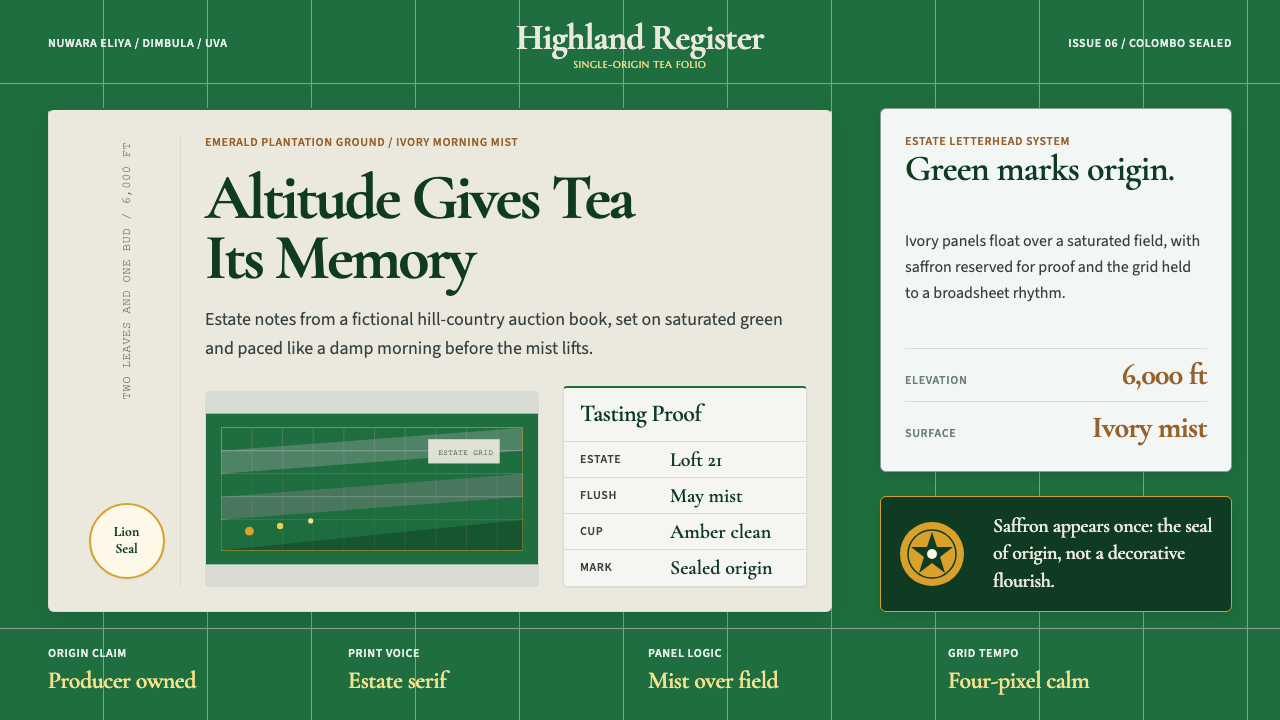 Sri Lanka Ceylon Tea ModernProvenance is emerald. Ivory mist panels and one saffron seal make origin fee…
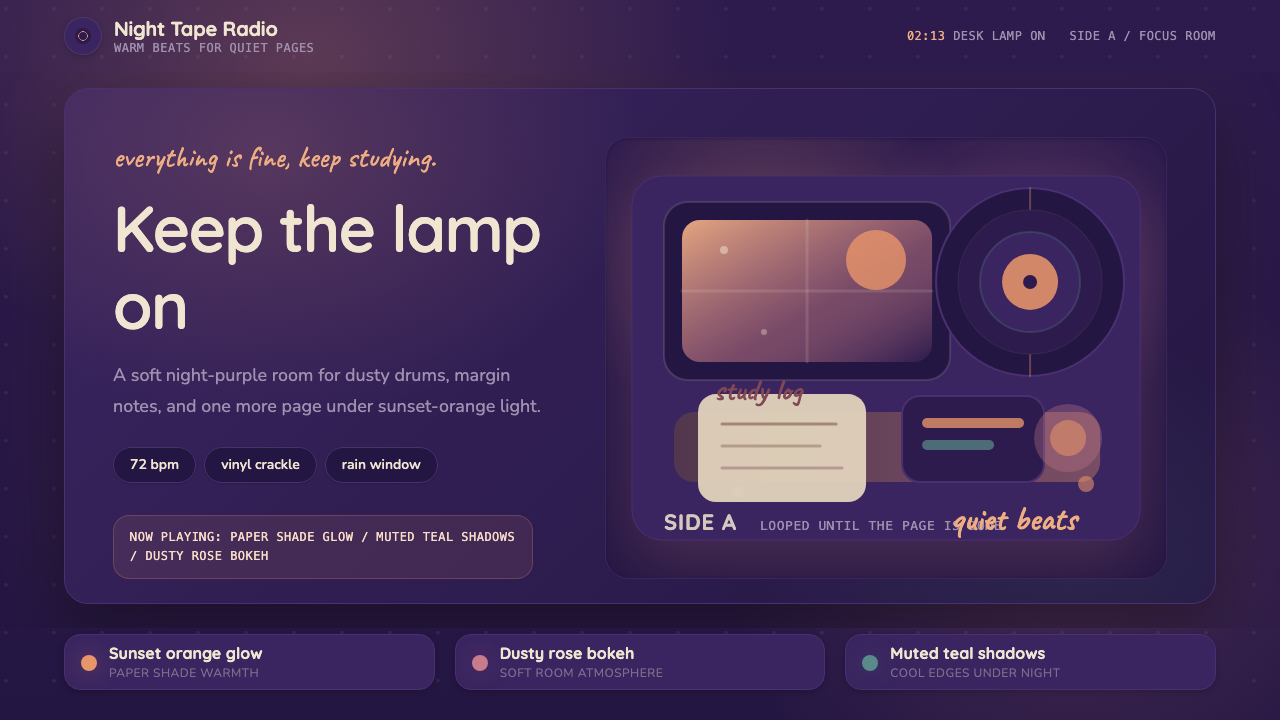 Lo-fi Hip Hop / ChillhopCozy focus at 2am. Night purple, Quicksand type, and sunset-orange lamp glow.
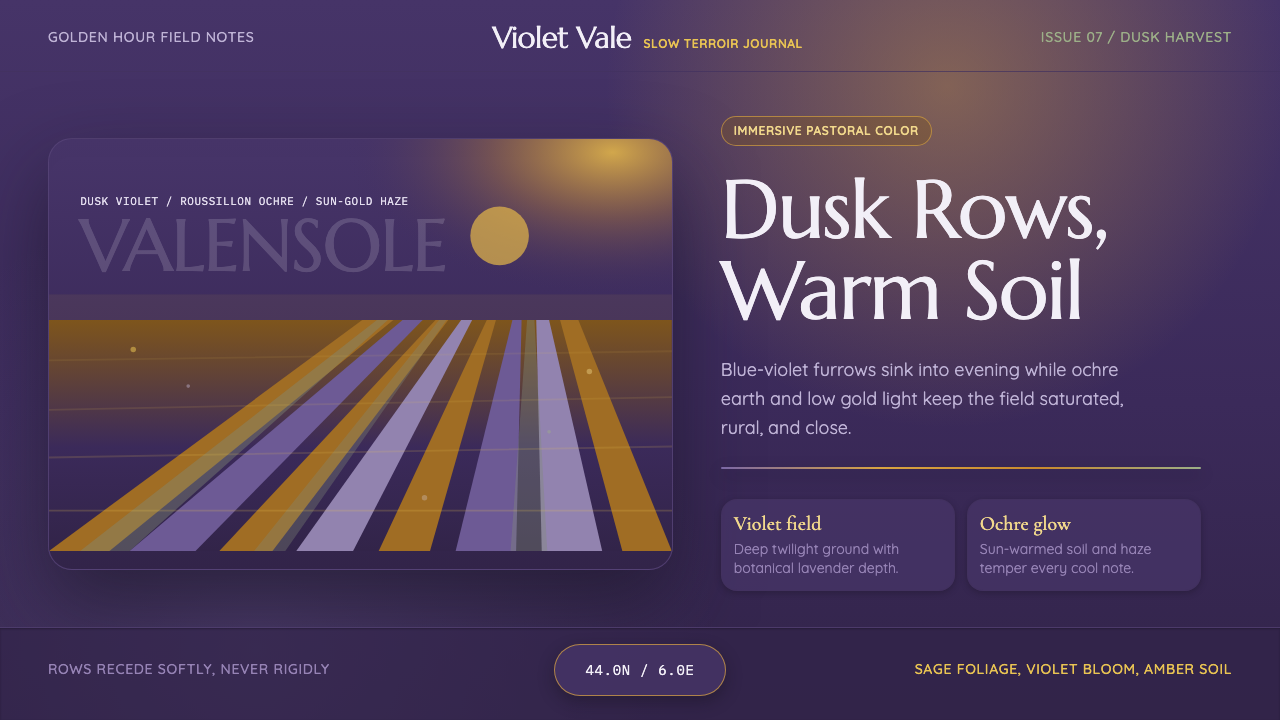 Provence LavenderSaturated pastoral dusk. Violet rows, ochre soil, and sun-gold haze build the…
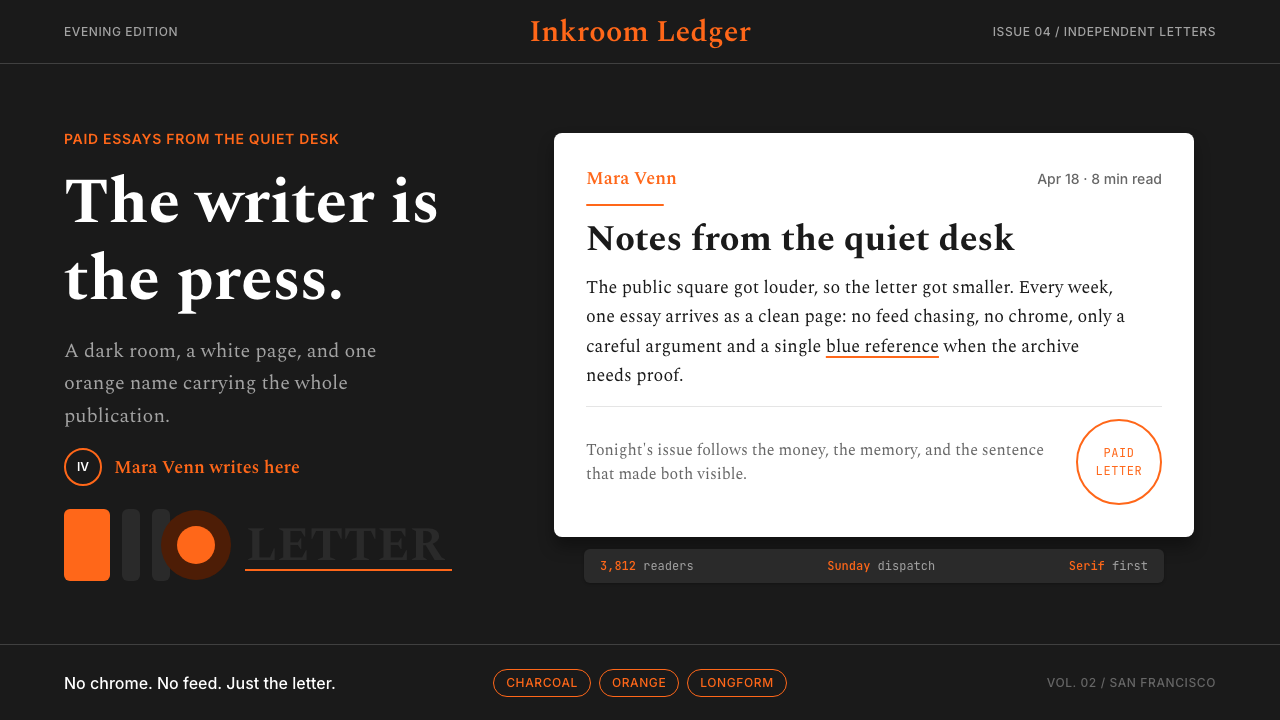 Substack Orange NewsletterLit page, dark room. Orange serif bylines ignite white cards on charcoal.