What is Ethiopian Coffee Buna?
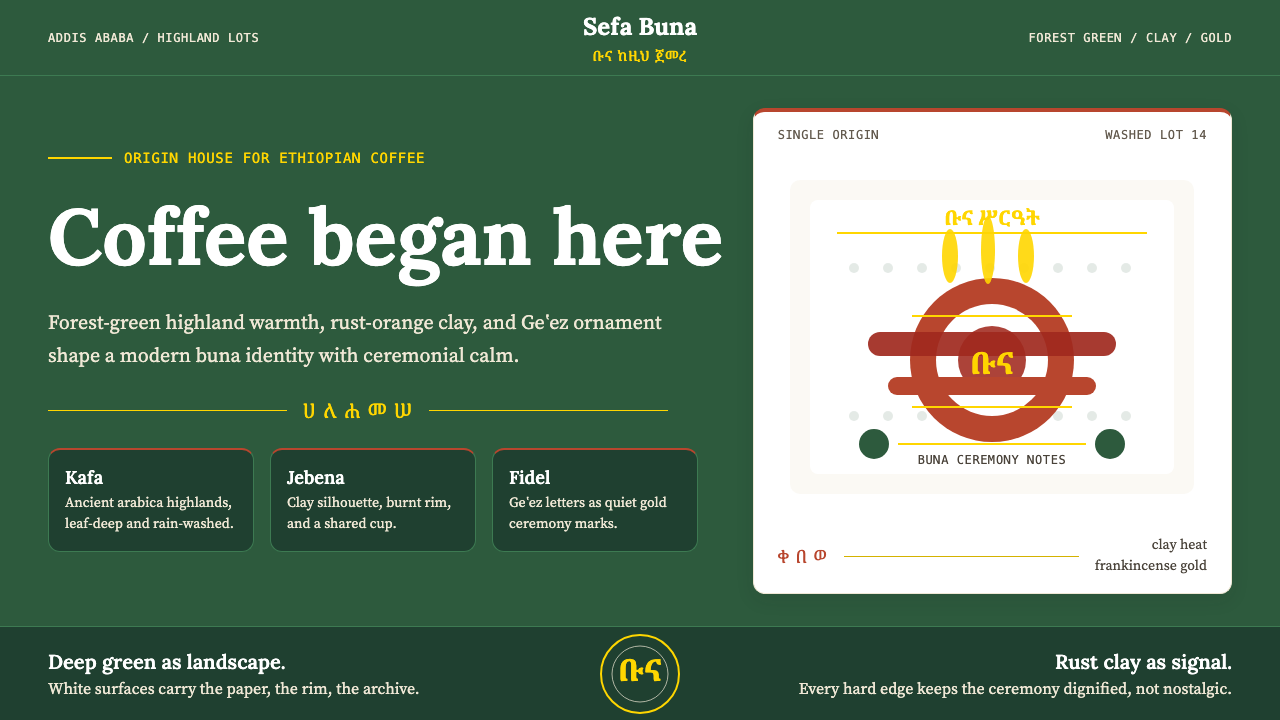
Ethiopian Coffee Buna translates the world's oldest coffee ceremony into a contemporary visual language — forest green, burnt clay, and Geʽez gold that insist coffee began here.
Ethiopian Coffee Buna in brief
Ethiopian Coffee Buna is a contemporary design aesthetic rooted in the buna ceremony — the traditional Ethiopian coffee ritual that predates any coffeehouse culture by centuries. The visual system draws its palette from the natural world of the Ethiopian highland farm: the deep, muted green of coffee-bush canopy, the warm rust-orange of a hand-thrown clay jebena pot, and a muted gold that recalls frankincense smoke and the gilded margins of ancient Geʽez manuscripts. Against these earthen anchor tones, cream and off-white grounds provide the open breathing space that keeps the palette from reading as heavy.
The typographic sensibility pairs editorial serif warmth — letterforms with visible calligraphic heritage — with Geʽez script ornaments used as dividers, drop caps, or section markers. This pairing is not decorative pastiche; it grounds the design in a specific and historically deep literate tradition. The Geʽez script, one of the oldest continuously used writing systems in the world, lends an air of quiet authority that no purely Latin typographic system could replicate. The result is a brand language that communicates both cultural specificity and international legibility.
Where the Bauhaus aesthetic empties a composition down to pure geometry, Ethiopian Coffee Buna fills it with earned material detail — the grain of handmade Ethiopian paper, the silhouette of the jebena, the patterned border of a traditional habesha kemis textile. The style is ceremonial without being ornate: every decorative element traces back to a concrete ritual or craft object, so the overall impression is one of grounded authenticity rather than surface exoticism.

Where does Ethiopian Coffee Buna come from?
Coffee's origin story is Ethiopian — and the buna ceremony is its oldest living ritual. According to the most widely circulated legend, a goatherd named Kaldi in the Kafa Province of southwestern Ethiopia noticed his goats behaving with unusual energy after eating berries from a certain tree. Monks at a nearby monastery, intrigued by his report, made a drink from the berries and found it helped them maintain alertness during long evening prayers. Whether or not this ninth-century legend is strictly historical, the broader claim is not disputed: Ethiopia is the indigenous homeland of Coffea arabica, and the forests of Kafa, Jimma, and Illubabor remain the most genetically diverse wild coffee stands on earth. The word 'coffee' itself is believed to derive from 'Kaffa,' the name of the southwestern Ethiopian province where wild coffee grew in abundance.
The buna ceremony that gave this design aesthetic its name is not merely a brewing method — it is a structured social ritual that can last two to three hours and involves three rounds of pouring. The first round, called abol, is the strongest; the second, tona, is somewhat lighter; the third, baraka, means 'blessing' in Amharic and is traditionally the mildest. Coffee is brewed in a clay jebena over charcoal, served in small handleless cups called sini, and accompanied by roasted barley or popcorn. The ceremony requires the host to roast green beans in front of guests, grind them by hand with a wooden mortar and pestle, and brew in the same session — the whole arc from green bean to shared cup unfolding as a single continuous act of hospitality. Refusing an invitation to participate in buna is considered a significant social slight.
Modern specialty coffee culture, which emerged globally in the late 1990s and accelerated through the 2000s and 2010s, found one of its most important anchors in Ethiopian origins. The Yirgacheffe zone in the Gedeo region, the Sidamo highlands, and the ancient walled city of Harrar each produce coffees with distinct flavor profiles — Yirgacheffe's jasmine-floral and bergamot-citrus notes, Sidamo's stone-fruit depth, Harrar's dry-processed wild berry character — that became reference points for the third-wave specialty movement worldwide. Ethiopian coffee exports grew dramatically after 2008, when the Ethiopian Intellectual Property Office, with support from activist groups and specialty roasters, succeeded in trademarking the Yirgacheffe, Sidamo, and Harrar appellations internationally. This marked a turning point in how Ethiopian coffee was branded and perceived: no longer an undifferentiated commodity, but a terroir-specific product with a protected name and a story.
The visual design tradition that this aesthetic draws from runs parallel to the specialty coffee story. Addis Ababa's Piazza district is home to Tomoca, a coffee bar founded in 1953 by an Italian-Ethiopian family — one of Africa's oldest continuously operating espresso cafes — whose hand-lettered signage and worn ochre walls became reference images for a generation of Ethiopian coffee brand designers. The Geʽez script revival, a broader cultural movement with roots in Ethiopian Orthodox religious scholarship and Pan-African identity politics, brought renewed attention to the visual richness of the syllabary: its angular, stacked letterforms carry a visual density and rhythm distinct from any other writing system. Contemporary Ethiopian designers and internationally trained creatives working on Ethiopian coffee brands — drawing on figures such as Atea Albabo, Sara Yirga, and Eyasu Mekonnen — began combining Geʽez ornamental elements with modern editorial layout conventions around 2010, producing the design language that this aesthetic codifies.
What defines the Ethiopian Coffee Buna look?
Color Palette
The palette anchors on three earthen tones: a deep, slightly muted forest green drawn from coffee-bush foliage; a warm rust-orange referencing the fired-clay body of the jebena pot; and a soft antique gold evoking both frankincense smoke and the gilded borders of Geʽez manuscripts. These three colors never compete at equal saturation — the green typically dominates as the field or background, the rust-orange appears at medium density as an accent, and the gold is deployed sparingly as a highlight or divider. Cream and parchment grounds replace pure white, lending the palette a warm, material quality. Black is reserved for body text and precision line work.
Typography
The typographic core is an editorial serif — a letterform with visible stroke contrast and bracketed serifs that reads as warm and authoritative rather than cold and mechanical. This is paired with Geʽez script characters used as structural ornaments: section dividers, large initial characters, or decorative borders. The pairing works because both writing systems share a quality of visible hand-making — the Geʽez syllabary was historically inscribed with reed pens, and the editorial serif carries its own calligraphic origins. Headlines are set large and spaced openly; body text is set at a comfortable reading measure with generous line height, reinforcing the unhurried, ceremonial pace of the buna ritual itself.
Texture and Material
Unlike geometric modernist styles that insist on flatness, Ethiopian Coffee Buna embraces visible texture as a carrier of meaning. The grain of handmade Ethiopian paper — characteristically uneven, warm, and slightly fibrous — appears as a background treatment or overlay that softens digital sharpness. Woven patterns drawn from habesha kemis textiles, characterized by their geometric border bands in contrasting colors, appear as framing devices for content blocks. These textures are always legible as references to specific material culture, not applied as generic 'organic' decoration. The effect is warmth without nostalgia, materiality without clutter.
Form and Silhouette
The primary graphic form of this aesthetic is the silhouette — specifically the jebena pot, which appears as a logo anchor, section marker, or large illustrative element. The jebena's form is distinctively readable: a bulbous lower body, a long angled neck, and a small looped handle produce a silhouette that is both functional and sculptural. Secondary silhouettes include the coffee cherry cluster (three berries on a curved stem), the small handleless sini cup, and abstracted Geʽez letterforms used as graphic shapes. These silhouettes are rendered as flat solid forms, not as illustrations with shading, preserving the clarity of the overall compositional system.
Composition and Rhythm
Layouts in this style favor a slow, vertical rhythm rather than the horizontal speed of grid-heavy modernist design. Content is divided into generous sections separated by gold Geʽez ornamental dividers or bold horizontal rules, creating a sense of deliberate pacing — each section is a pause, like the three rounds of the buna ceremony. Asymmetry is present but unhurried: a large silhouette element anchors one side of a composition while open cream-colored space occupies the other, creating balance through weight rather than mirroring. The overall impression is that of a beautifully composed page in an illustrated book rather than a dashboard or a functional application screen.
Ornament and Restraint
Unlike purely minimalist systems, Ethiopian Coffee Buna does use ornament — but only ornament with cultural provenance. A Geʽez border is not generic decoration; it is a specific reference to a literate tradition. A textile-derived geometric band is not filler; it is a material memory. The discipline of the system lies in restricting decoration to elements with traceable origin, and in deploying each such element once and deliberately rather than repeatedly as pattern fill. The result is a sense of ceremonial sufficiency: everything present is meant to be there, and its presence carries weight.
Imagery and Photography
When photography appears in this style, it is treated as a warm, textured document rather than a high-gloss commercial image. Coffee cherries on a branch, hands cupping a sini, the roasting of green beans over charcoal — images favor close physical proximity, natural light, and visible material imperfection. In layout, photography is framed with generous white or cream margins and sometimes overlaid with a warm tone wash that harmonizes the image with the earth-tone palette. Abstract illustrations — especially floral and botanical forms drawn from the coffee plant — appear as spot elements, rendered in the palette's three anchor colors against cream backgrounds.

Who shaped Ethiopian Coffee Buna?
A pioneering voice in Ethiopian specialty coffee branding, Albabo's work on origin storytelling helped establish the visual and narrative framework through which Yirgacheffe and Sidamo coffees were presented to international specialty markets. By grounding brand materials in the specific geography and cultural practices of highland farming communities rather than generic African imagery, this approach set an early precedent for the terroir-specific visual language that later designers working in this aesthetic would formalize.
Working at the intersection of Ethiopian contemporary art and international brand design, Yirga contributed to the development of a visual system in which Geʽez script ornaments moved from ecclesiastical contexts into commercial and editorial design. Her practice demonstrated that the syllabary's visual weight and angular geometry could function as a modern design element without requiring the viewer to be literate in Geʽez — the forms carry authority and cultural signal independently of their semantic content.
Mekonnen's contribution to Ethiopian coffee visual culture centers on the integration of traditional craft objects — particularly the jebena, the sini, and the mekete roasting pan — into contemporary graphic systems as primary visual elements rather than nostalgic props. This move elevated everyday ceremony objects to the status of design icons, establishing the silhouette-based graphic vocabulary that is now central to the Ethiopian Coffee Buna aesthetic.
As a writer and communications strategist whose work helped shape how the specialty coffee industry narrated its Ethiopian origins to global audiences, Neuschwander's influence runs through the editorial layer of this aesthetic. The style's practice of pairing visual richness with precise, encyclopedic origin storytelling — naming specific kebeles, elevation ranges, and processing methods — reflects the communications framework she helped develop. The text and the image work together to argue for specificity over generality.
How do you use Ethiopian Coffee Buna today?
Ethiopian Coffee Buna is one of the more contextually specific design aesthetics in the Curio library — its authority derives from its cultural rootedness, and that rootedness makes it exceptionally effective for certain applications while genuinely unsuitable for others. Used well, it communicates ceremony, origin, warmth, and depth. Used carelessly, it reads as superficial cultural borrowing. The first question to ask before applying the style is whether the content has an honest relationship with the values the aesthetic embodies: slowness, provenance, material honesty, and communal ritual.
For presentation slides, the style works best in contexts where storytelling and brand narrative take precedence over data density. A cover slide should anchor a large jebena silhouette or botanical coffee-plant illustration on one side, with the title set in a generous editorial serif on a warm cream ground; the Geʽez ornamental border or a thin gold rule frames the composition without enclosing it. Content slides should use the three-section vertical rhythm: a section heading in the forest-green anchor tone, body text in warm black on cream, and a single accent element — a small silhouette, a pull quote in rust-orange — to mark the slide's focal point. Data slides are the one area requiring restraint: the palette's warmth and ornamental character can compete with the legibility of charts. Use the forest green and rust-orange as fill colors for bar and line elements, keep backgrounds to cream only, and remove all textile or paper texture overlays.
For web interfaces, the aesthetic translates well to brand-forward landing pages, origin-story sections within e-commerce sites, editorial features, and specialty coffee ordering experiences where the brand narrative is as important as the transaction. Dashboard and utility interfaces are a poor fit — the ceremonial pacing and textured backgrounds work against the rapid scanability those contexts require. On pricing pages, the style can work if the page is structured as a single long-form document rather than a comparison table: each tier becomes its own named section, set in the system's typographic hierarchy, with the gold ornamental divider marking transitions between tiers.
For editorial and marketing work — printed brand books, packaging, seasonal campaign materials, social cards — the style reaches its fullest expression. Coffee packaging in this aesthetic typically uses a deep forest-green ground for the primary face, with a centered jebena silhouette in rust-orange or antique gold and the origin name set in a combination of Latin serif and Geʽez script. Printed matter benefits from paper stock choices that reinforce the aesthetic: uncoated or lightly textured stocks echo the handmade paper reference, while glossy finishes work against it. Social card formats adapt well with a strict template: single background color, one silhouette, headline in large serif, single line of supporting text.
A common mistake when applying Ethiopian Coffee Buna is overloading the composition with ornamental elements — using the Geʽez border, the jebena silhouette, the textile band, and the paper-texture overlay simultaneously. The style's authority comes from the deliberate, single deployment of each element. A second common error is attempting to apply the palette to technology-forward or highly functional interfaces on the grounds that the brand happens to be a coffee product. The aesthetic communicates ceremony and slowness; if the interface needs to communicate speed and utility, there is a genuine mismatch that no color choice will resolve. Use Ethiopian Coffee Buna when the product's central promise is depth, origin, and ritual — not convenience.

Ethiopian Coffee Buna — FAQ
Is this style appropriate for brands with no Ethiopian connection?
The honest answer is: rarely, and only with care. The aesthetic's visual vocabulary is not generic African imagery — it is specific to Ethiopian material culture, the Geʽez writing system, and the buna ceremony. Applying it to a brand with no meaningful connection to these specifics produces work that reads as cultural appropriation rather than homage. The style works best when the brand, the product, or the content has a direct relationship with Ethiopian coffee culture: specialty coffee roasters sourcing from Ethiopia, origin-storytelling editorial, travel or hospitality brands with a genuine Ethiopian focus, or design work commissioned by Ethiopian organizations themselves.
How does Ethiopian Coffee Buna differ from a generic warm-earth-tone aesthetic?
The difference is specificity of reference. A generic warm-earth-tone aesthetic uses terracotta, ochre, and sage without those colors pointing to anything beyond a general mood of naturalness or warmth. Ethiopian Coffee Buna uses forest green because coffee-bush leaves are that particular green; rust-orange because jebena clay fires to that specific shade; antique gold because Geʽez manuscript gilding is that precise tone. The Geʽez script ornaments, the jebena silhouette, and the habesha textile pattern are not interchangeable with any other ethnic or cultural reference — they are exact. This specificity is what makes the style credible rather than atmospheric.
Can this style work in a fully digital-native product, or does it require printed or physical materials to feel authentic?
It can work digitally, but it requires translating the tactile references rather than literally simulating them. The handmade paper texture, for example, should not appear as a photographic scan tiled across a screen; instead, the principle it embodies — visible imperfection, warmth, grain — can be captured through careful color choices (off-white rather than pure white, muted rather than saturated tones) and gentle tonal variation in backgrounds. Similarly, Geʽez script elements work beautifully as SVG decorative components on digital screens; they do not require print to carry visual authority. The limitation is primarily contextual, not medium-specific: a fast-loading SaaS dashboard will not accommodate the aesthetic's ceremonial pacing regardless of whether it is digital or printed.
What is the right way to use Geʽez script if my team does not include anyone literate in it?
The Geʽez script should be used only in contexts where the characters are semantically meaningful, or explicitly as pure visual ornament in a way that the audience and any affected community would recognize as respectful. Using Geʽez characters that spell out a word in Amharic or Tigrinya without verifying the meaning is a production risk — the result could be nonsensical or offensive. The safer approach for teams without Geʽez literacy is to restrict use to established ornamental forms: traditional border patterns derived from Geʽez manuscript illumination, or single characters used as section markers after their form has been reviewed by someone with relevant expertise. When in doubt, a specialist consultant or direct partnership with Ethiopian designers is the correct path, not improvisation.
How does this aesthetic handle light and dark mode?
The canonical form of Ethiopian Coffee Buna is light-ground — cream and parchment backgrounds are central to the palette's warmth. A dark-mode inversion is possible but requires careful recalibration. On a very dark background, the forest green reads as nearly black and loses its character; the rust-orange can become aggressive; and the antique gold is the only tone that gains presence. A workable dark variant leans heavily on the gold as the primary accent and uses a very dark warm brown (closer to roasted coffee than to neutral black) as the ground, with cream reserved for primary type. The habesha textile and handmade paper textures generally do not translate well to dark modes and should be omitted rather than darkened.
Related design styles
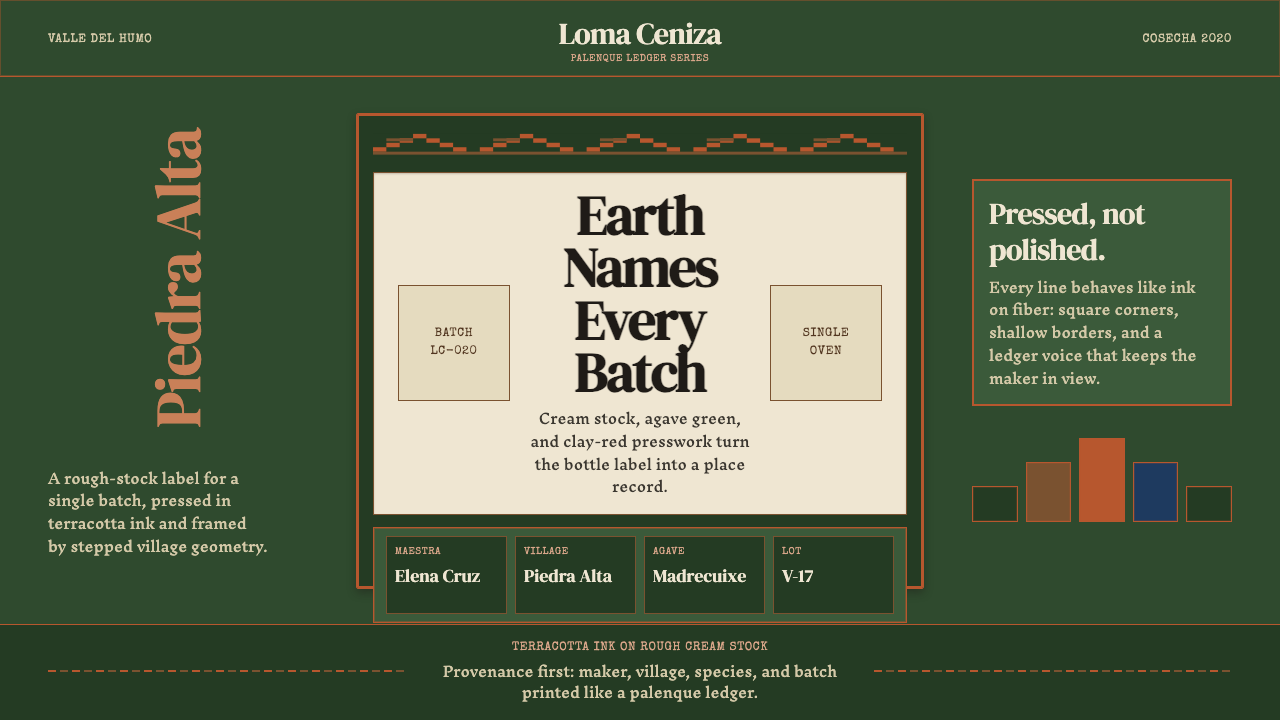 Mexican Mezcal CraftRooted and exact. Agave green, terracotta borders, and DM Serif labels tell t…
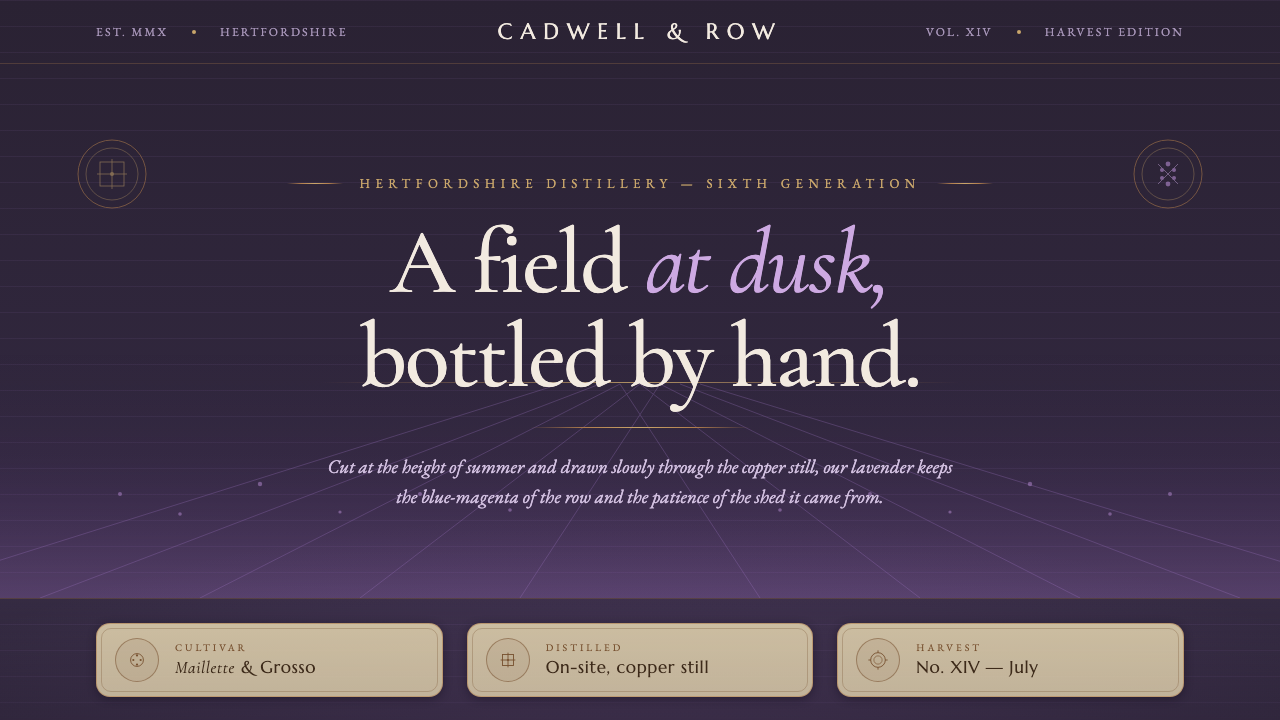 Lavender DistilleryA field at dusk, bottled by hand. Twilight purple rows, copper hairlines, Mar…
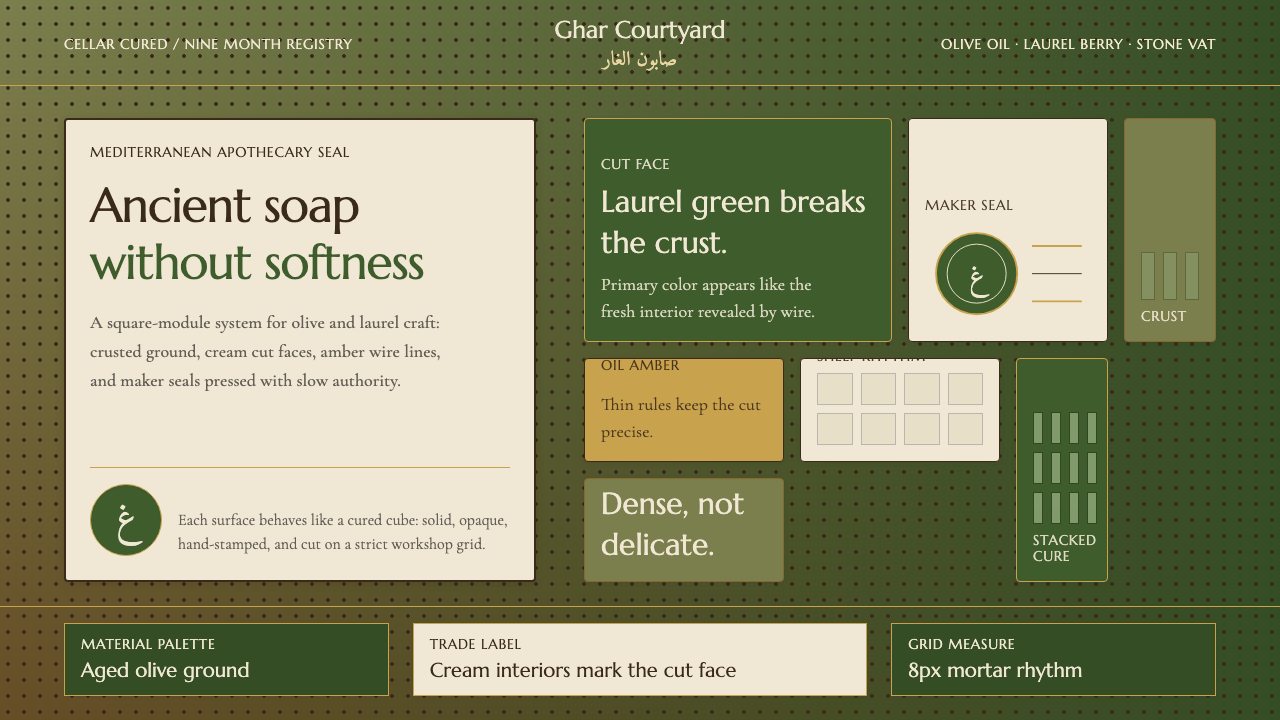 Syrian Aleppo Laurel SoapAncient without softness. Olive crust, laurel green, and stamped circles hold…
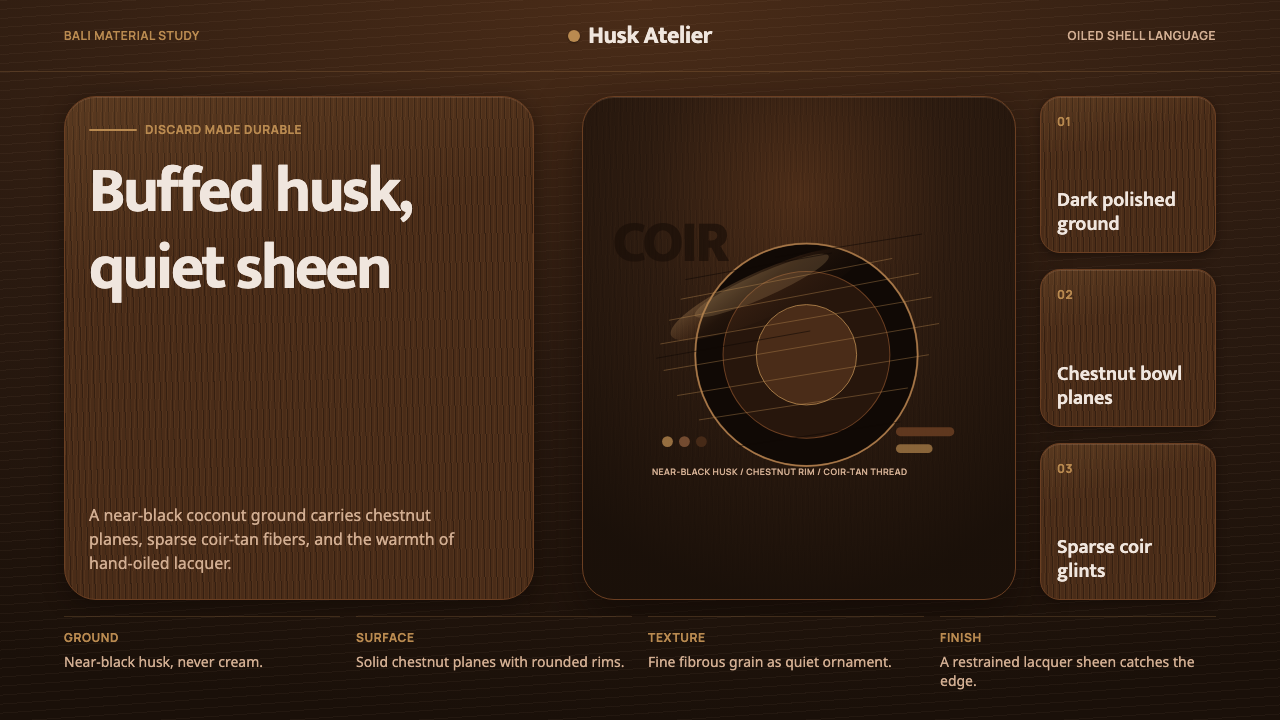 Balinese Coconut ShellQuietly hand-oiled. Near-black husk, chestnut planes, and sparse coir-tan gra…
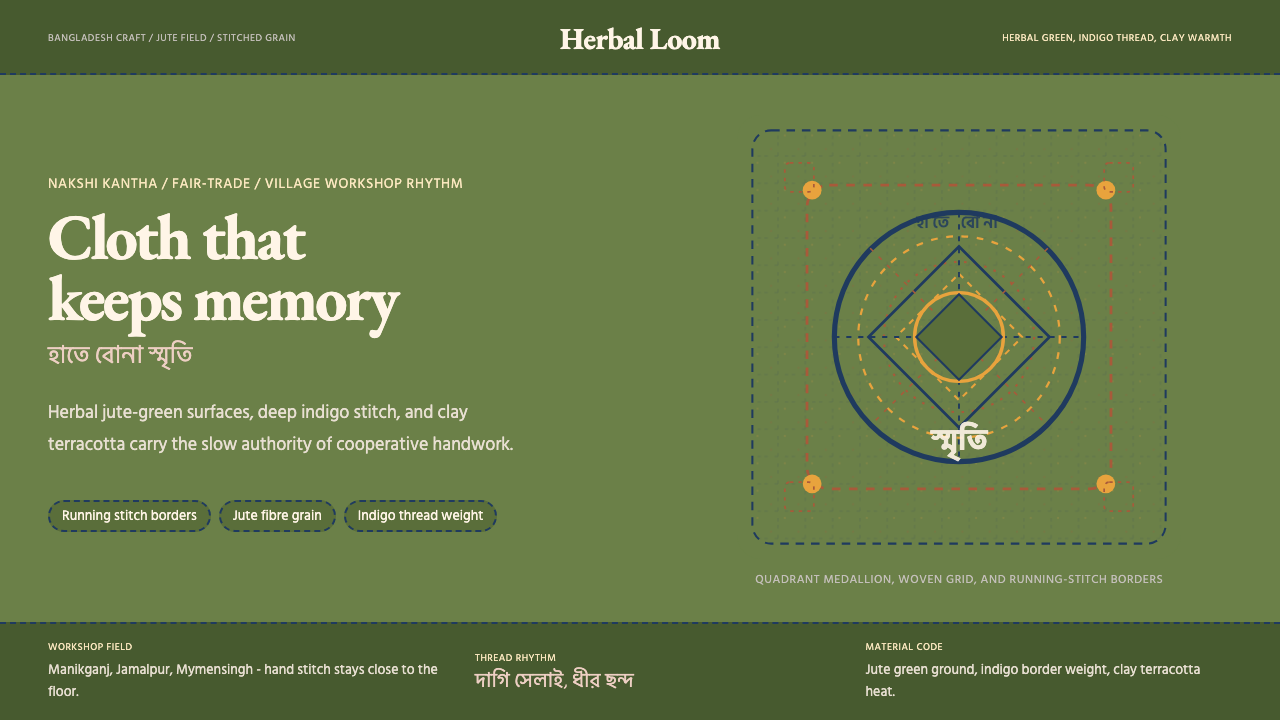 Bangladeshi Jute CraftMemory stays stitched. Jute green, indigo borders, terracotta warmth.
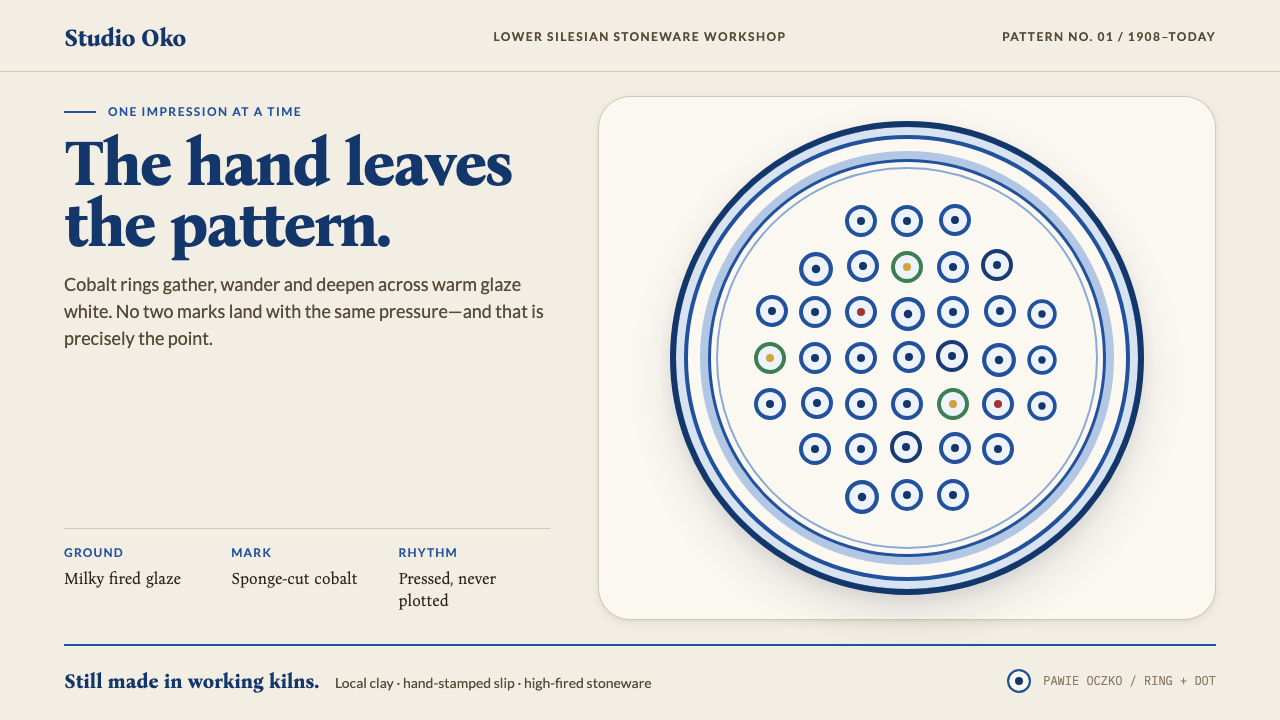 Bolesławiec PotteryThe hand stays visible. Cobalt ring-and-dot stamps drift across warm glaze wh…